




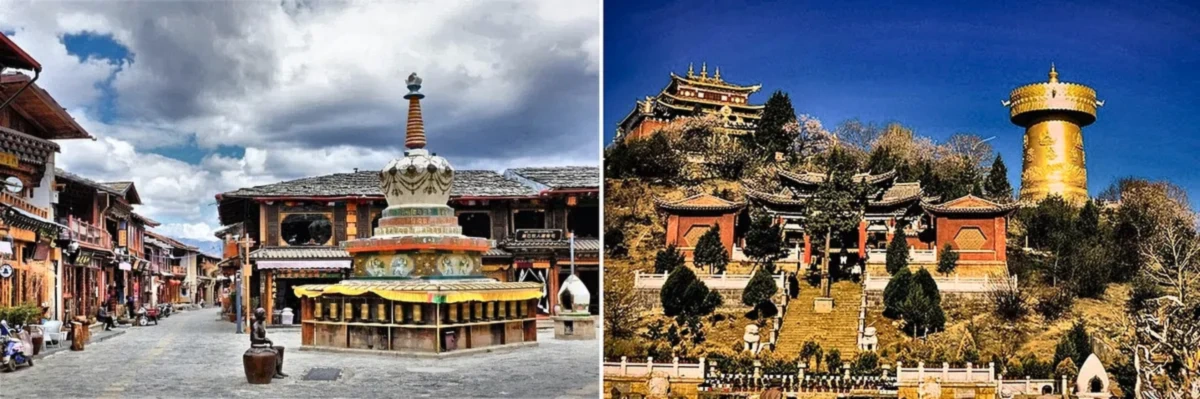


Under the Qing Dynasty, the flow of events continued to record landmark shifts in both military and economic terms. In the 39th year of Kangxi (1700), after the imperial court quelled internal rebellions by unruly lamas in the borderlands, feudal officials established the local Tusi (chieftain) system to pacify the residents and officially renamed the region Daocheng Ba. By the 33rd year of Guangxu (1907), Imperial Commissioner Zhao Erfeng, during the implementation of the “Gaitu Guiliu” (replacing native chieftains with appointed officials) national policy, conducted a bold agricultural experiment. By channeling water into fields and successfully cultivating paddy rice amidst the harsh climate of the Chitu Valley, he submitted a memorial requesting a change of the place name to Daocheng, meaning the city of paddy rice, embedding the aspiration to create a prosperous and secure granary at the frontier.
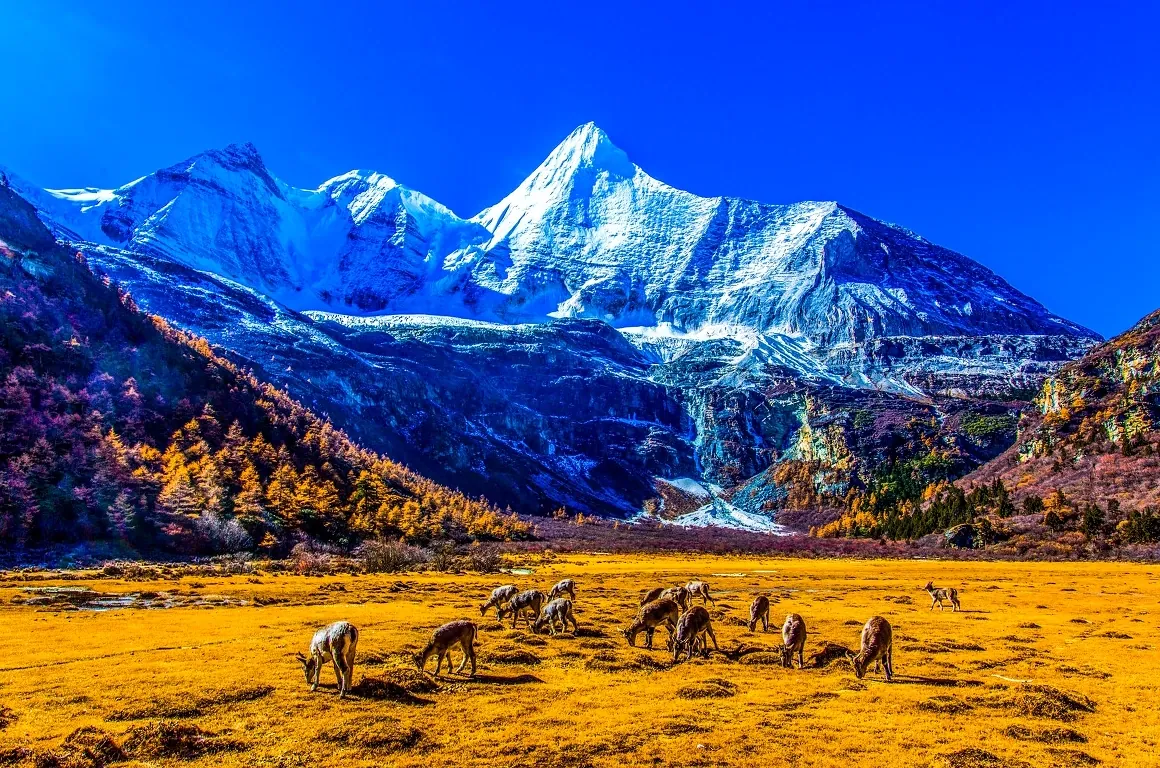
Through many volatile historical periods under feudal dynasties, the pristine nature here has preserved its tranquil and mesmerizing beauty, as if untouched by time. Rising majestically amidst the open space are sharp, perpetual snow peaks piercing the deep blue sky, reflecting the brilliant light of millennia-old glaciers. Stretching gently along the slopes are primeval forests changing colors with the seasons, weaving a magnificent brocade of countless shades of golden yellow, deep red, and subdued purple. At the foot of the snow-capped range, the foreground opens to a vast meadow suffused with warm golden-orange hues, where herds of deer graze leisurely in an atmosphere of absolute purity, perfectly capturing the surreal serenity of an earthly paradise.
The veil of mystery shrouding Daocheng Yading was only truly lifted for the Western world in the summer of 1928, when the brilliant Austro-American botanist and explorer Joseph F. Rock set foot here during two elaborate expeditions in June and August under the sponsorship of the National Geographic Society. In July 1931, his massive 45-page research treatise entitled “Konka Risumgongba, Holy Mountain of the Outlaws,” accompanied by 65 authentic documentary photographs, was published in National Geographic magazine, causing a tremendous sensation in global academic and exploration circles. His extraordinary notes on this sacred snow-covered realm served as the direct inspiration for novelist James Hilton to conceive the immortal novel “Lost Horizon” in 1933, immortalizing the concept of Shangri-La as the eternal symbol of a peaceful sanctuary isolated from worldly dust.
Entering the contemporary era, Daocheng Yading has transformed powerfully from a wild frontier into an invaluable ecological heritage strictly preserved. The location was officially established as a nature reserve in 1996 before being upgraded to a National Nature Reserve in 2001. Its unique biodiversity value brought this complex into UNESCO’s World Network of Biosphere Reserves under the Man and the Biosphere Programme in 2003, and it was subsequently recognized as a National AAAAA Tourist Attraction in 2020, affirming its pinnacle status on the map of human natural heritage.
Located on the eastern slope of the Qinghai-Tibet Plateau, resting against the undulating Hengduan Mountains between the coordinates 27°58′ to 28°28′ North latitude and 99°55′ to 100°33′ East longitude, Daocheng Yading is the majestic crystallization of a violent geological collision between the Indian tectonic plate and the Eurasian continent some fifty million years ago during the Cenozoic era. That immense upward force thrust the plateau dome high into the sky, and throughout the Quaternary Ice Age lasting millions of years, giant blades of ice and snow ceaselessly carved and sculpted the solid granite blocks into sharp horn-like spires and deep U-shaped valleys. In the worldview of Tibetan Tantric Buddhism, the isolated terrain structure here is the most perfect natural mandala altar in the earthly realm, where three towering snow peaks steadfastly guard three auspicious directions, protecting this pure land from all worldly turbulences.
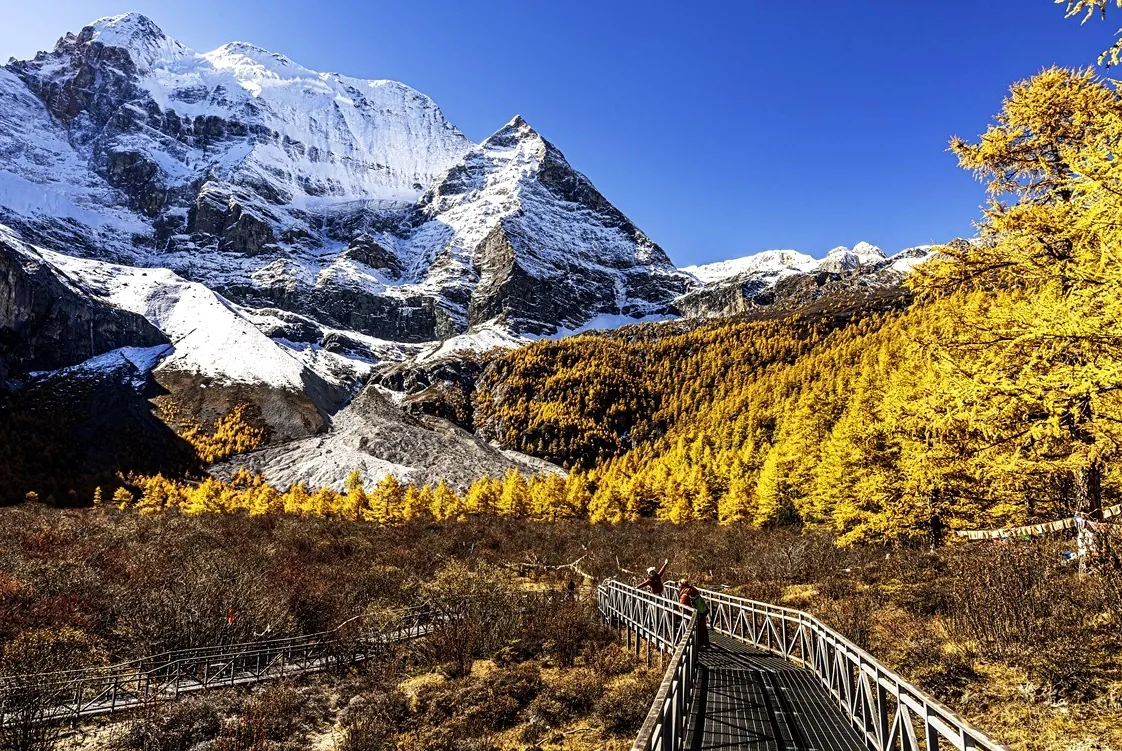
The epicenter of this sacred structure is the cluster of three perpetual snow mountains named Rigsum Gompo (Nyenchen Konka Rinjong), the manifestations of three Bodhisattvas protecting all living beings. Peak Chenrezig proudly rises to 6,032 meters, embodying the image of Avalokiteshvara, the Bodhisattva of infinite compassion, with a majestic, dignified mountain posture resembling an enlightened being meditating on a jade lotus throne. Standing alongside is Peak Jambeyang at 5,958 meters, an ethereal ice tower shaped almost entirely like a pyramid, symbolizing the boundless wisdom of Manjushri Bodhisattva. Concluding the legendary mountain triangle is Peak Chanadorje at 5,958 meters, its rugged, sheer granite cliffs resembling a divine hammer blow, manifesting the peerless, fierce valor of Vajrapani Bodhisattva. The mutual support among these three massive mountain ranges has formed an unprecedented feng shui formation that gathers wind and accumulates energy, turning this land into a realm of ultimate, pure ice and snow.
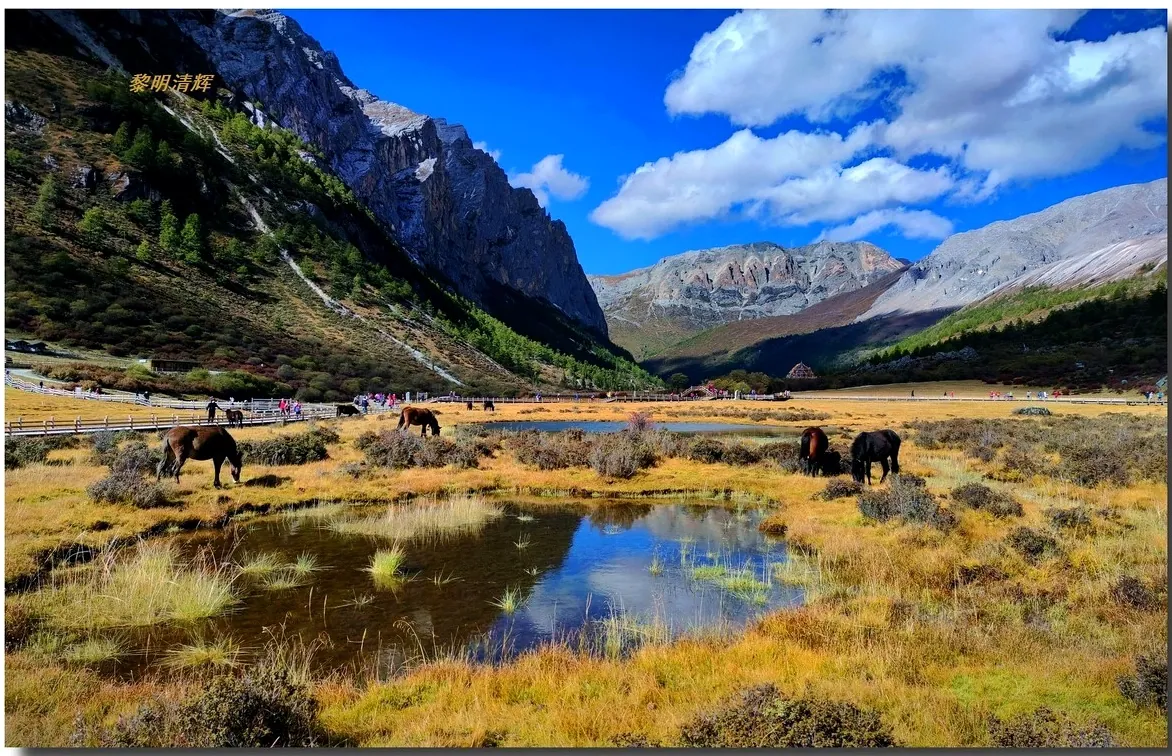
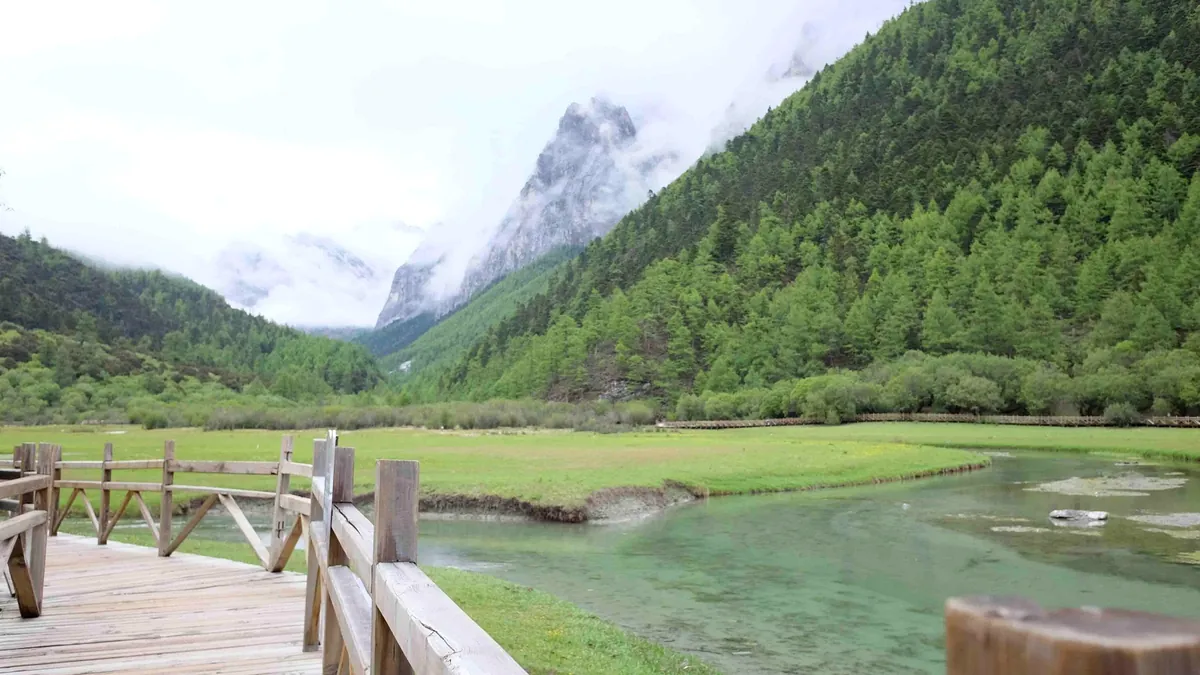
Interwoven between sheer granite cliffs are glacial hydrological systems and high-altitude alpine lakes of surreal beauty. Rising impressively at an altitude of 4,180 meters, the Luorong Pasture unfolds as a soft glacial wetland plain where meandering streams curve like silk ribbons, serving as the prime vantage point to take in the majestic silhouettes of all three sacred peaks. Following the moraine ridges upward, travelers will encounter Drolma La Lake at an elevation of 4,080 meters, where the serene jade water mirrors the millennia-old snow-clad cliffs of Jambey Yang. Ascending to 4,600 meters lies the tranquil Milk Lake, an ancient glacial basin rimmed by a surreal milky-white mineral band. Particularly, nestled between Jambey Yang and Chanadorje at an altitude of 4,700 meters is the Five-Color Lake, a body of water that shifts in hues with every refraction of sunlight, once praised in esoteric scriptures as rivaling the sacred Yamdrok Tso Lake for its mystical ability to peer into past lives and foretell the future.
Blending into this magnificent landscape are the profound spiritual imprints built by the Tibetan people over generations to connect with the realm of Buddha. Standing prominently across the vast grassland is a massive, snow-white Tibetan Buddhist stupa complex, reaching high with a magnificent, dignified gold-plated spire, harmoniously surrounded by countless smaller, neatly aligned chortens. As night falls, the entire structure glows brilliantly beneath the dazzling Milky Way and the deep starry night sky, standing out against the dark golden-brown grasslands and the faint silhouettes of distant snow-capped mountains, creating an aura of mystical, sacred, and absolute tranquility.
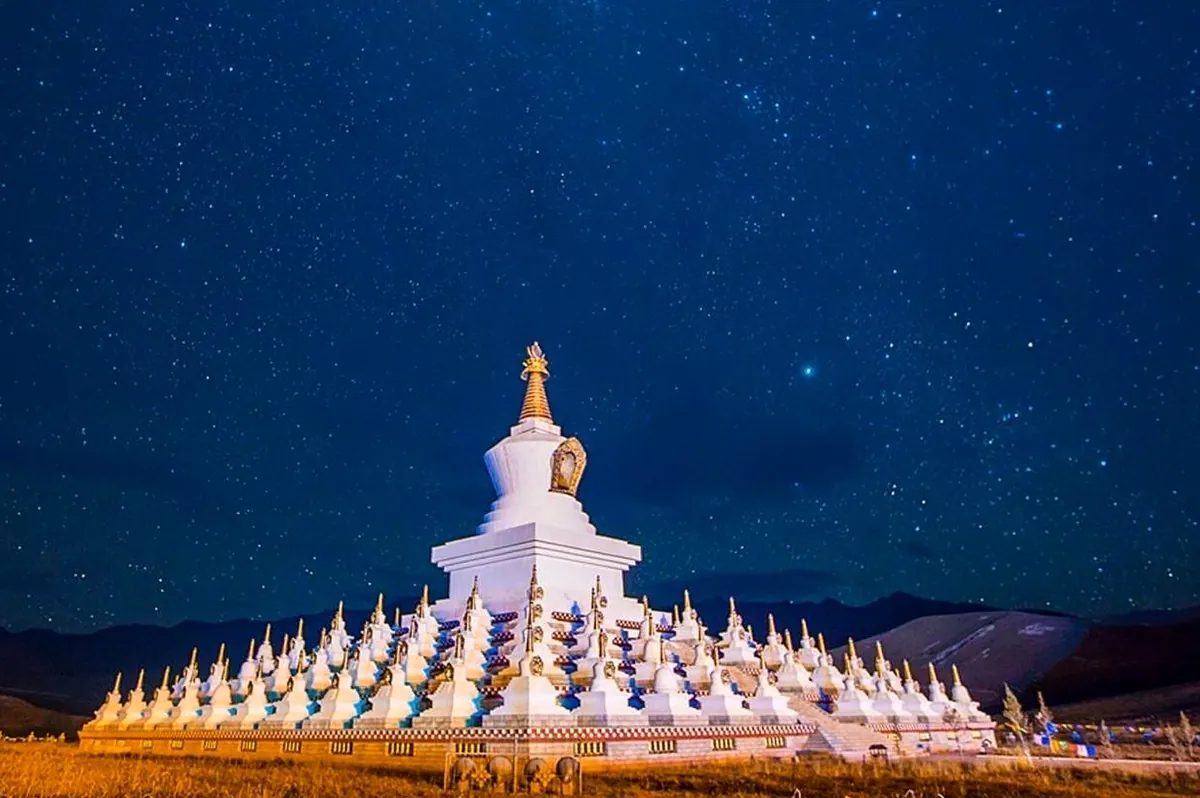
The wondrous interaction between pristine tectonic movements and deep indigenous belief systems has endowed Yading with a rare geographical landscape on Earth. From dense coniferous forest slopes and alpine cushion vegetation to ancient glaciers suspended over towering cliffs, each geological slice here not only holds inestimable geomorphological research value but also preserves the true soul of an authentic Shangri-La in the mortal world.
Perched precariously among the tectonic valleys of Tibet’s vast grasslands, the residential architecture of the Kham people reaches its pinnacle through the white-stone watchtowers known as Diaofang. These are not merely survival spaces, but masterworks of extreme-altitude climate-adaptive engineering. The foundations and walls are crafted entirely from rough-hewn granite blocks, tightly bound with manually tamped clay mortar, with thicknesses ranging from 60 to 100 centimeters. The walls are engineered with an inward slope that narrows upward, lowering the architectural center of gravity to create an exceptionally sturdy defense against natural seismic shocks caused by crustal fault shifts. The white ash-lime coating on the stone surfaces acts both as a shield reflecting harsh ultraviolet radiation and as a flawless insulation mechanism, maintaining a stable indoor temperature of 15 to 18 degrees Celsius even when the outdoor thermometer plunges to minus 15 degrees Celsius.
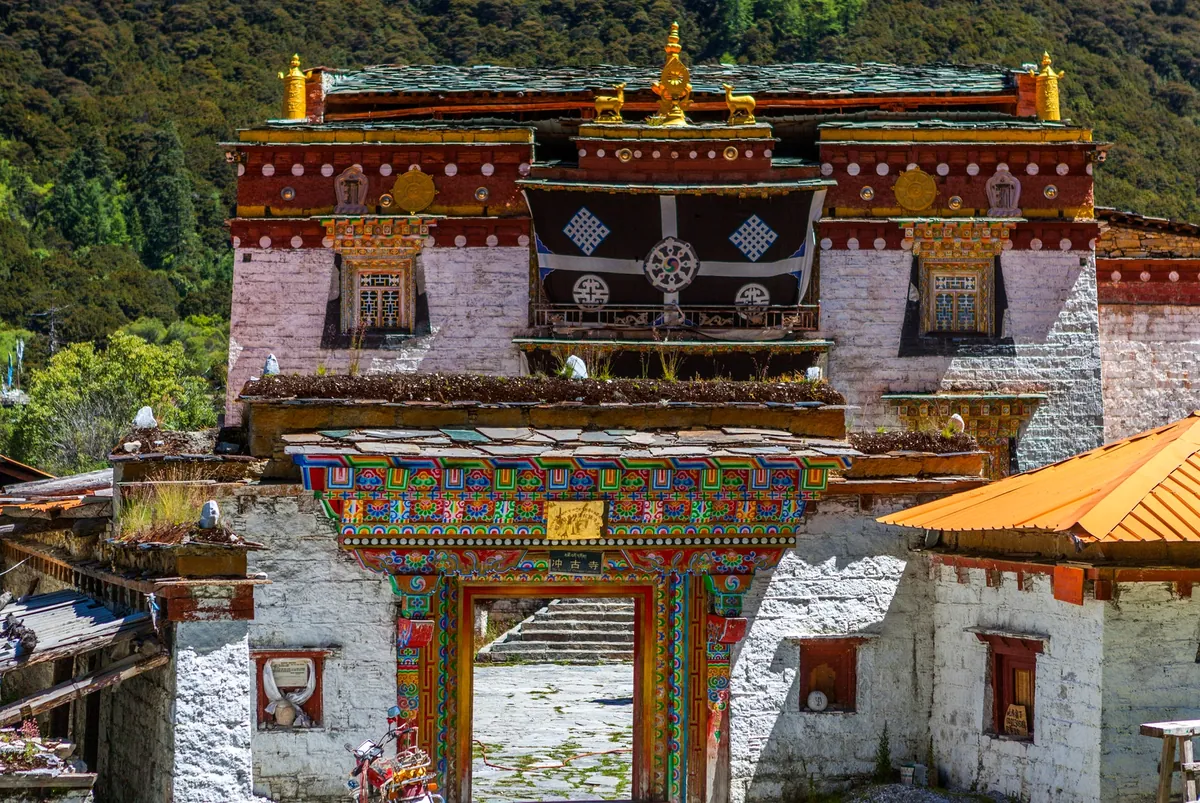
The windows, known as “Tra” on the Diaofang walls, are a unique feature of indigenous optics and spirituality. Featuring a delicately chamfered trapezoidal shape framed in pitch-black wood, this structure serves both a spiritual purpose in warding off evil spirits according to folklore, and acts as a lens focusing scarce light deep into dim rooms. The interior spatial layout is planned according to a strict functional stratification philosophy. The ground floor serves as a livestock stable where large yaks shelter alongside farming tools, maximizing the biological heat radiated to warm the wooden living floor on the second level above. Stepping up to the second floor is the center of family life, with a hearth fire burning brightly across all four seasons, symbolizing the endless source of vitality. The third floor, closest to the sky, is dedicated to the serene Chodkang Buddha worship room, opening out onto a rooftop terrace filled with the vibrant colors of Lungta prayer flags fluttering in the highland snow wind.
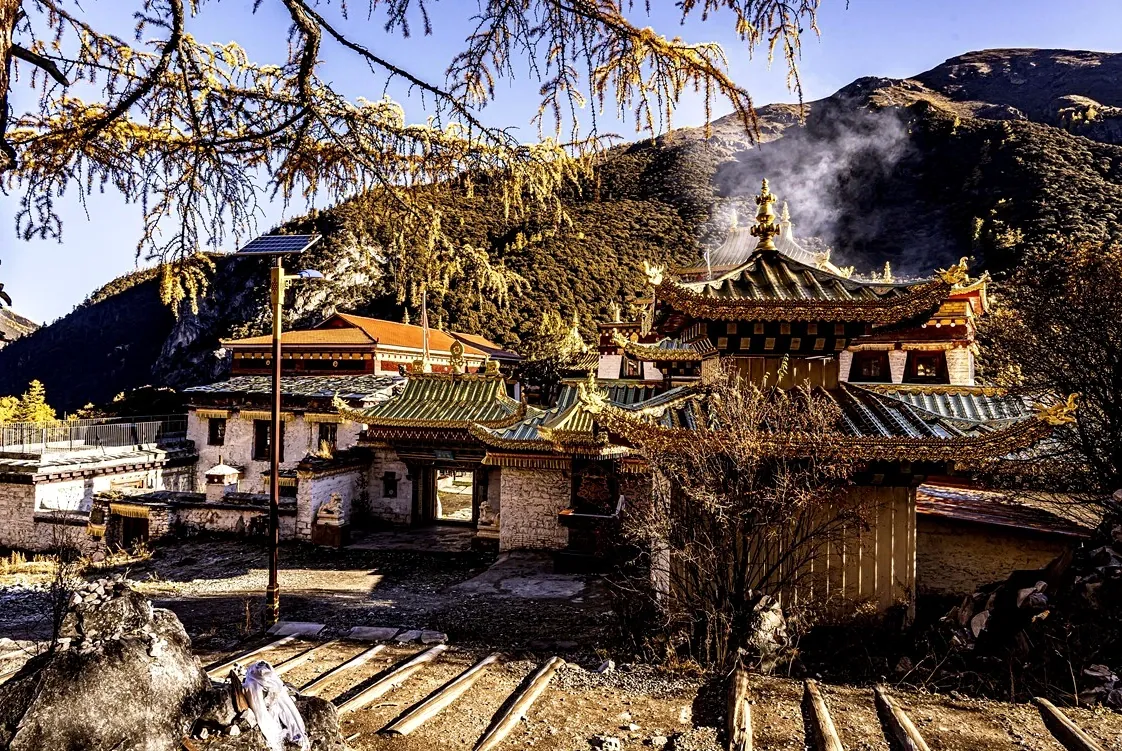
Continuing the flow of indigenous architecture is the profound spiritual imprint of Trung Co Monastery, nestled peacefully at an altitude of 3,880 meters above sea level. Belonging to the Gelug sect, this ancient temple is perched against towering granite cliffs, offering panoramic views of the pristine glacial valley. Dark stone walls combined with gleaming gold-plated tile roofs create a breathtaking visual contrast between the cold gray of massive boulders and the pure white of eternal snow and ice. The monastery’s space is structured in a closed mandala order, where natural light is filtered through narrow skylights, illuminating ancient murals and thousand-year-old Buddha statues, creating a surreal sensation completely detached from worldly mortal affairs.
Contrasting yet harmonizing with these ancient imprints is a modern engineering marvel: Daocheng Yading Airport. Reigning at an elevation of 4,411 meters, the structure holds its position as the highest civilian airport on the planet. To solve the challenge where atmospheric oxygen density is only 50% compared to the plains, causing a severe reduction in aircraft lift, the airport is equipped with a single runway up to 4,200 meters long and 45 meters wide, ensuring an absolute safe takeoff roll distance. The visual highlight is the 8,796-square-meter passenger terminal shaped like a futuristic UFO landing in a stone desert. Inside, the terminal integrates a high-capacity, large-scale diffused oxygen generation system, creating ideal pressure and oxygen levels for passengers before transit. It is also the arrival point for specialized aircraft capable of overcoming the barrier of thin barometric pressure, such as the Airbus A319-115(WV) and Boeing B737-700 High-Plateau, connecting this untouched land with modern major metropolises.
The intervention of modern construction techniques in the core conservation zone of Daocheng Yading always adheres to the principle of ecological balance. The smart Canopy boardwalk system winds through primitive forest carpets and glacial moss wetlands, installed with advanced load-sensor technology to mechanically monitor pressure, completely preventing erosion risks and protecting the delicate lichen moss systems that have taken thousands of years to form. The entire visitor circulation flow within the reserve is operated by a 100% pure electric, zero-carbon emission bus fleet, running smoothly across spectacular mountain passes without disturbing the natural living environment. The symphony between the millennium-old stone fortress, the sacred golden temple roofs, and smart green infrastructure solutions has positioned Daocheng Yading as an exemplary model of the intersection between heritage and modern engineering.
While many famous tourist destinations race to install dazzling high-voltage floodlights or stage grandiose live-action music festivals to illuminate the night, Daocheng Yading chooses a completely opposing philosophy: preserving primordial darkness. In the sacred core of the reserve, the nocturnal space is strictly preserved as a priceless heritage. This place resolutely rejects artificial stages or ostentatious urban lighting, both to honor the eternal serenity of the three sacred peaks in Tibetan Buddhist consciousness and to secure a natural survival corridor for rare wildlife such as the elusive snow leopard or herds of blue sheep grazing peacefully on jagged limestone cliffs.
It is precisely the absence of light pollution that has turned Yading into a rare plateau astronomical sanctuary in the world meeting Bortle Class 1 standards – the ultimate pinnacle of a pristine night sky. At altitudes over 4,000 meters above sea level, where the thin and crystal-clear atmosphere is free of dust and smoke, visitors do not need any complex optical equipment to witness nature’s grandest performance. As dusk falls, the Milky Way appears vividly like a giant silver river rolling with starlight, stretching across the eternal snow-capped peaks of Chenrezig, Jamyang, and Chanadorje. Glowing constellations, ethereal nebulae, and sudden streaks of shooting stars slicing across the velvet black sky create a surreal visual feast, far surpassing any of humanity’s most advanced lighting special effects.
Leaving the tranquil core of the reserve as night falls, travelers typically tend to descend in altitude toward Riwa town, proudly and serenely perched at an elevation of 2,900 meters, to enjoy the distinctive restorative lifestyle of the Kham border region. Riwa at night is not noisy or bustling with throbbing bars or bustling shopping streets, but opens up a slow-paced, peaceful world deeply imbued with local breath. In traditional wooden houses or eco-resorts designed to lean against the hillsides, the evening smoke gives way to the fragrant aroma of pine wood emanating from warm fireplaces, dispelling the biting cold typical of the windy plateau.
Riwa nights are the ideal time to recharge energy after a long day of conquering steep mountain passes. Visitors can sip a cup of spicy-sweet highland barley wine, enjoy a steaming pot of butter tea by the crackling fireplace, and listen to prayer wheels spinning steadily in the mountain wind like an eternal lullaby of the snow-covered alpine ranges. To ensure a sound sleep and help the body recover from high-altitude oxygen deficiency symptoms, the resort spaces here are equipped with micro-oxygen diffusion systems with stable concentrations ranging from 24% to 26%, maintaining a perfect balance between modern convenience and a deeply contemplative experience amidst the mountains.
The cuisine of the Kham region in Daocheng Yading does not merely reflect daily living habits; it is an exceptional wellness epic summarized over thousands of years of survival amidst the rugged terrain and thin atmosphere of the Hengduan Mountains. In the freezing environment with an average altitude exceeding 3,500 meters, every traditional dish and beverage of the Tibetan people acts as a natural remedy to balance Yin and Yang, provide abundant heat, and shield the body against severe pressure shock waves. Stepping into sturdy rammed-earth stone houses, the drifting evening smoke blending with the rich aroma of butter and cedarwood instantly dispels the bone-chilling cold outside the threshold.
The starting point for every culinary ritual and encounter on the plateau is a steaming bowl of Po Cha butter tea. To create a standard traditional batch, Kham women must boil premium Pu’er black tea leaves until concentrated, then pour them into a traditional copper-plated wooden Chandong cylinder. Here, the dark tea extract is continuously churned with rich butter distilled from female yak milk, combined with a pinch of natural rock salt harvested from ancient valleys. The rhythmic pounding blends the animal fat and tannin into a smooth, light caramel-colored liquid. Every sip of warm butter tea instantly replenishes abundant electrolytes, coating the lips and throat with a natural lipid layer to prevent cracking under sub-zero dry winds while miraculously warming the Dantian.
Accompanying butter tea in nomadic life for millennia is Tsampa, the soul of Qinghai-Tibet plateau cuisine. The main ingredient for Tsampa is high-altitude highland barley grains roasted to a crisp on hot sand before being ground into a fragrant, golden-yellow fine flour. Diners skillfully pour an appropriate amount of flour into the palm of a wooden bowl, add a bit of melted butter, a few drops of butter tea, and crispy dried Chhurpi cheese pieces, then use their fingers to skillfully knead them into small, bite-sized morsels. Boasting a uniquely rich slow-release carbohydrate chain and abundant fiber, these rustic Tsampa morsels provide sustained energy throughout the day, empowering resilient feet to cross treacherous snow-covered mountain passes.
The primary and proudest protein source of the Yading grassland is plateau yak meat, also known as Tibetan Maoniu. Yaks are grazed completely free-range on towering mountain slopes, year-round chewing on precious medicinal herbs and drinking water melted from pure glaciers. Consequently, their meat fibers possess a characteristic dark red hue, rich in protein, iron, and natural provitamin A while accumulating virtually no excess fat. During winter months when temperatures plummet, locals traditionally hang strips of fresh meat under ventilated eaves to dry naturally in the biting cold wind and dry air, creating a savory dried beef jerky rich in its original flavor. Additionally, thinly sliced fresh meat dipped in a broth simmered from bone marrow combined with cardamom, goji berries, and angelica roots provides an unforgettable warm experience amidst a cold misty night.
The Daocheng culinary map would miss a regal touch without mentioning the Chitu Valley Matsutake mushroom chicken hot pot. Known as the capital of Tricholoma Matsutake mushrooms—among the most expensive in the world—Daocheng features moist primary oak forests, the perfect natural environment for these wild mushrooms to grow without artificial cultivation. Freshly harvested mushrooms, carrying a rich, earthy, and pine-resin aroma, are thickly sliced and dropped into an earthen pot to simmer with free-range local chicken. The clear yet deeply sweet broth, rich in polysaccharides and minerals, not only nourishes blood and Qi and fights inflammation but also enhances cellular oxygen absorption, acting as a precious remedy to help travelers adapt to altitude sickness.
The plateau feast reaches full flavor when a bowl of fragrant highland barley wine is poured to the brim of a ceramic bowl. This craft-brewed wine maintains a gentle alcohol content of about twelve to fifteen degrees, exhaling the sweet, mellow barley yeast reminiscent of wild forest honey along with a smooth, spicy aftertaste in the throat. Containing various amino acids and active compounds that promote blood circulation, a cup of warm wine not only dilutes capillaries to warm the body in the frost but also conveys the sincere, rustic hospitality of the vast grasslanders to distant travelers.
The journey back to the pure realm of Daocheng Yading requires meticulous preparation regarding both legal procedures and travel mindset. Nestled within the Garzê Tibetan Autonomous Prefecture in the southwestern part of Sichuan Province, this sanctuary complex does not fall under the administrative scope of the Tibet Autonomous Region (TAR). Thanks to this special local regulatory framework, international and Vietnamese travelers do not need to go through the complex Tibet Entry Permit (TTB Permit) application process; they only need a valid Chinese visa, ranging from individual L-category sticker visas to electronic group visas. However, to maintain the fragile ecological carrying capacity on the snowy plateau, the scenic area management strictly enforces a maximum quota of 15,000 visitors per day, while requiring mandatory ticket booking and electronic identity declaration 10 to 30 days prior to departure. Notably, due to its proximity to key domestic border security locations, the entire area surrounding Haizishan Pass and the G227 national highway corridor is subject to a strict ban on unmanned aerial vehicles (drones/flycams), which visitors must strictly abide by to avoid unnecessary administrative trouble.
The harshest physiological challenge upon setting foot in the holy land is Acute Mountain Sickness (AMS). To overcome this barrier, travelers must strictly follow the “Sleep Low, Climb High” acclimatization strategy proven through generations of expeditions. On the first night approaching the plateau, one must absolutely avoid staying overnight in Daocheng town at 3,750m or Yading village at 3,900m; the ideal solution is to camp at Shangri-La town (formerly known as Riwa) located at an altitude of 2,900m. This terrain difference provides nearly 30% higher oxygen density in the air, creating a perfect stepping stone for the respiratory system to get accustomed to the thin pressure. Pharmacologically, travelers can use Acetazolamide (Diamox) at a dosage of 125 to 250mg every 12 hours before crossing the altitude threshold, combined with a steady intake of 3 to 4 liters of warm water per day, completely abstaining from alcoholic beverages and avoiding hot baths for too long during the first 48 hours to prevent peripheral vasodilation causing cerebral ischemia.
The sanctuary exploration plan is most scientifically structured within the framework of a two-day separate field journey. The first day is entirely dedicated to the Short Route aimed at initiation and testing the body’s adaptability: from the internal transfer bus station, travelers move to the Chonggu Temple station, visit the serene Chonggu ancient temple delicately built at an altitude of 3,880m, then follow the winding wooden staircases to admire the turquoise blue waters of Chonggu Lake (also known as Pearl Lake) at an elevation of 4,080m, reflecting the majestic north face of Mount Xiannairi, before proactively retreating early to rest and recover. The second day is a test of willpower with the Long Route requiring enduring physical strength: the group must depart from 07:00 AM, take the internal shuttle bus across the valley to catch the sunrise at Luorong Pasture at the 4,180m threshold, then embark on a cross-country hiking leg of over 5km overcoming rocky slopes and slippery mud to witness the surreal beauty of Milk Lake at an altitude of 4,600m, and finally muster strength to conquer the saddle slope leading up to Five-Color Lake, touching the 4,700m milestone. A non-negotiable survival rule is that all visitors must begin their descent before 15:00, avoiding the moment when twilight completely fades, bringing bone-chilling cold winds and sudden temperature drops in the deep canyon.
Besides the terrain factor, identifying and avoiding commercialization traps is a hard-earned lesson for independent travelers. Not a few budget itineraries on the market covertly embed stops under the guise of health check-ups, where local “noted physicians” intentionally exaggerate the risk of lung damage to coerce guests into buying wild caterpillar fungus or Rhodiola rosea extract at prices inflated by dozens of times. Other tricks include visiting disguised Yak farming camps to sell adulterated silver amulets or sophisticated artificial jade stalls. The safe, civilized, and emotion-preserving solution for worshipping is to choose No-Shopping Pure Sightseeing Tour programs with transparent costs, always equipped with large-capacity oxygen tanks on standby in dedicated vehicles and prioritizing accommodation systems equipped with closed-circuit oxygen-supplying machines in each guest room. To realize the dream of conquering the immortal valley without worrying about operations or medical risks, travelers can consider registering for the premium standard Lijiang – Shangrila – Daocheng Yading 6D5N tour, where every step through the heritage land is cherished by meticulous service and deep understanding of local culture.
