Stretching along the banks of the Pearl River, whose currents have deposited silt through countless historical vicissitudes, the land of Guangzhou has since its earliest establishment maintained its position as the political, economic, and cultural exchange center of the entire Lingnan realm. Tracing history back to the Qin and Han dynasties when administrative units were first established across the southern lands, this metropolis early on shaped its role as one of the busiest trading seaports along China’s borders. Entering the brilliant Tang Dynasty, the legendary seafaring route known as the “Maritime Foreign Trade Route” (通海夷道) originated from Guangzhou Bay, stretching across oceans all the way to the Persian Gulf and the East African coast, turning the capital into a vital transit link of the Maritime Silk Road. Notably, amid the turbulent vicissitudes of the Five Dynasties and Ten Kingdoms period, this land marked the rise of the Southern Han Dynasty. Founding monarch Gaozu Liu Yan chose Guangzhou as his dynastic capital, initially establishing the state title as Dai Viet before changing it to Southern Han, while selecting the Qianheng (乾亨) era name with the aspiration of inaugurating a prosperous, peaceful era. The millennial sediment of a “millennial commercial capital” continuously accumulated across dynasties, forging a solemn and enduring cultural springboard for the rise of today’s world-class mega-city.
Entering the modern era, as Guangzhou transformed powerfully from its traditional seaport status into a global technology, financial, and service center, the aspiration to forge a contemporary icon matching its millennial heritage was officially laid down. The Guangzhou Tower (广州塔 – Canton Tower) project was born not merely for the pure mission of a digital television broadcasting station, but shouldered the responsibility of reshaping the urban skyline. This grand project was created through a strategic joint venture between the Guangzhou Urban Construction Investment Group (holding a controlling 90% stake) alongside Guangzhou Television, establishing the New Guangzhou Television Tower Construction Co., Ltd. to directly manage all investment and construction operations. Overcoming unprecedented peak technical challenges, the entire monumental work was officially completed in September 2009. Following rigorous inspections, the tower opened its doors to welcome visitors on September 30, 2010, before officially launching public ticket sales for travelers worldwide on October 1, 2010, promptly becoming the focal stage welcoming the vibrantly colorful 16th Asian Games.
Alongside its official global designation, the tower integrates naturally into popular daily life through a series of witty appellations and nicknames bestowed by local citizens. The public affectionately calls the structure “Little Manyao” (小蛮腰), a poetic imagery inspired by classical poetry describing a maiden’s charming slim waist. Meanwhile, locals speaking Cantonese delightfully call the tower “Niuwenchai” (扭纹柴 – twisted firewood) due to its uniquely crossing, twisted steel framework, or jokingly liken it to “Zhentong” (针筒 – syringe) owing to its slender, sharply tapered structure piercing straight into pristine blue skies. The harmonious blending between dynastic ups and downs, ancient imperial era names, and cutting-edge asymmetrical architectural thinking has transformed the Guangzhou Tower into an epic chronicle of steel and glass. Standing solemnly beside the Pearl River, the structure is not merely a peak engineering achievement, but a living witness to the spectacular transformation of a historical port stop from the Qin, Han, Tang, and Southern Han dynasties rising to become a lighthouse of the new century.
Proudly situated beside the wetland alluvial plains on the southern bank of the Pearl River within Haizhu District, the Guangzhou Tower commands a prime position right at the geographical and energy transfer focal point of the millennial metropolis. This terrain is particularly adjacent to Chigang Pagoda—an antique red-brick geomantic pagoda built during the Ming Dynasty under the Wanli reign, originally erected by ancestors beside waters to suppress water monsters, foster literary style, and preserve dragon veins across the entire Lingnan region. The historically arranged proximity between a centuries-old contemplative ancient pagoda and a futuristic skyscraper masterpiece forged a wondrous synthesis between deep traditional heritage and the aspirations of the modern era.
From the perspective of modern urban landscape spatial planning, the project’s impressively situated presence represents the exact golden convergence between two arterial axes: Guangzhou city’s new north-south central axis and the natural landscape axis winding along the Pearl River. Standing from the breezy southern bank, the tower opens a direct perspective perfectly mirrored across expansive waters to the northern bank, gathering elite architectural complexes including the Zhujiang New Town financial center, the vast Huacheng Square, and Haixinsha Island park—the sacred site that witnessed the vibrant Asian Games. The expansive water buffer acts as a giant mirror reflecting the flourishing heartbeat of both banks, perfecting the renowned “one river, two banks, new axis glowing” landscape master plan, defining the most spectacular visual backbone of the bay area metropolis.
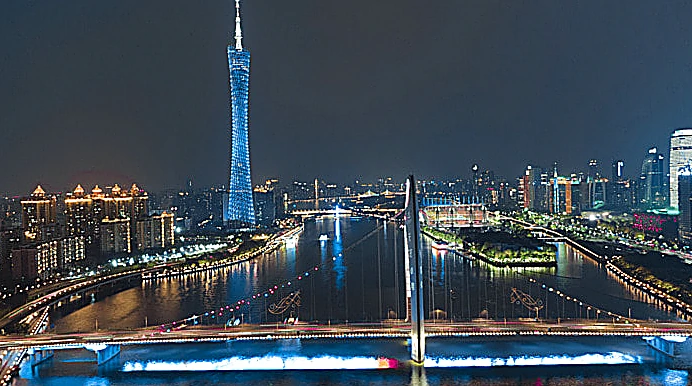
Under traditional Eastern geomantic perspectives, the terrain where the tower resides is evaluated as a rare wealth-gathering and blessing-accumulating land owing to vital energy flows from the bountiful hydrological system. The Pearl River meanders from west to east; as it winds past Haizhu District, current speeds slow, forming the “jade belt embracing waist” formation like a soft jade girdle encircling the southern bank district. Water symbolizes abundant wealth, and expansive water expanses free from high-rise obstructions to the north engineered an extraordinary open bright hall, helping attract and concentrate heavenly and earthly auspicious energy. The tower soars straight into the skies like a giant scholarly brush touching blue skies, while acting as a divine sea-calming needle standing tall to maintain prosperity and harmonious Yin-Yang energy across the entire southern economic basin.
Natural landscapes surrounding the tower’s base benefit directly from microclimate-modulating mechanisms characteristic of subtropical riverine regions. Natural breezes from the Pearl River combined with opposing sea breezes blowing from gulf estuaries continuously deliver pristine nourishing air, banishing stifling sensations typically found in concrete-dense financial centers. With every tidal rise and fall following lunar cycles, Pearl River waters transform magically from jade-blue to brilliant orange-yellow during sunset, embracing the soaring tower’s slender twisting curves. The resonance between sky, water, and riverside park vegetation turns this space into a living entity where pristine natural breath blends harmoniously with human planning brilliance.
Viewed from across the breezy Pearl River, the Guangzhou Tower proudly anchors the southern metropolis skyline with a record height hitting 600 meters, cementing its status as one of the planet’s tallest television and observation towers. This colossal grand project possesses a total constructed floor area reaching 114,054 square meters, featuring a 454-meter tower body extended by a magnificent 146-meter communication antenna spire pointing straight into the skies. Far from a mere bulky metal block or coarse concrete display, this wonder reflects peak contemporary mathematical and structural engineering thinking, shattering rigid templates of traditional skyscrapers through a graceful, poetic, and rhythmically curved form.
The tower’s breakthrough architectural concept originates from a complex three-dimensional double-hyperboloid surface space truss system, created by rotating two elliptical cross-sections at the tower base and apex in opposing directions. Primary load-bearing structures rely on combined tube-in-tube principles, comprising a sturdy reinforced concrete core serving as a central spine, enclosed externally by a giant network of slanting crisscrossing steel columns winding along spiral trajectories. The most spectacular feat within this geometric form rests within the graceful constriction segment at two-thirds of the tower body, where elliptical diameters narrow to a mere 22 meters before blooming outward toward observation decks above. This unique waist-pinching shape earned the tower the moniker “Little Manyao,” evoking the imagery of a beauty tightening a soft silk ribbon with classical Chinese poetry elegance, woven from tens of thousands of tons of super-strong steel.
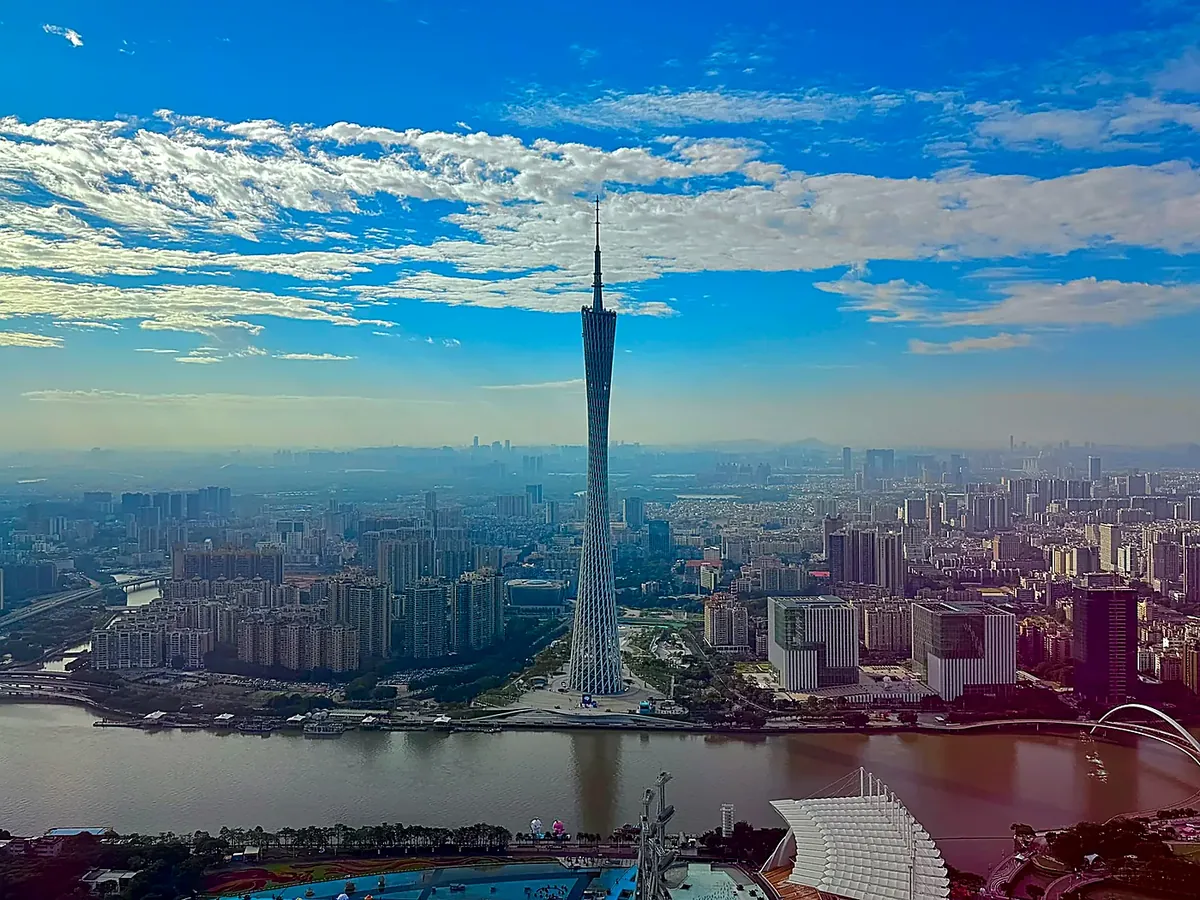
Behind soft beauty resembling a millennial silk ribbon lies a challenging engineering problem addressing fierce natural destruction across the Pearl River’s lower delta. Southern China’s coastal region frequently absorbs violent tropical typhoons and sits upon geological strata demanding stringent safety standards. To neutralize colossal wind pressures at hundreds of meters elevation, open aerodynamic forms of exterior steel trusses allow winds to flow continuously, significantly suppressing surface air turbulence. Additionally, passive tuned mass damper systems utilizing counterweight water tanks across top floors help the tower maintain maximum stability against unusual lateral vibrations.
Thanks to pioneering epoch-making technological solutions, the work achieves supreme seismic resistance capable of standing firm against magnitude 8 earthquakes and directly withstanding fierce gales up to level 12. Designed for a basic operational lifespan exceeding 100 years, the Guangzhou Tower’s internal spatial structure represents exemplary mechanical stratification, smartly distributing functions from exhibition centers, transparent glass observation decks, and multi-directional revolving restaurants to national telecommunication engineering spaces. The absolute fusion between modern metallurgy, parametric algorithms, and graceful aesthetic character honors the tower as a milestone masterpiece in humanity’s high-rise steel structure history.
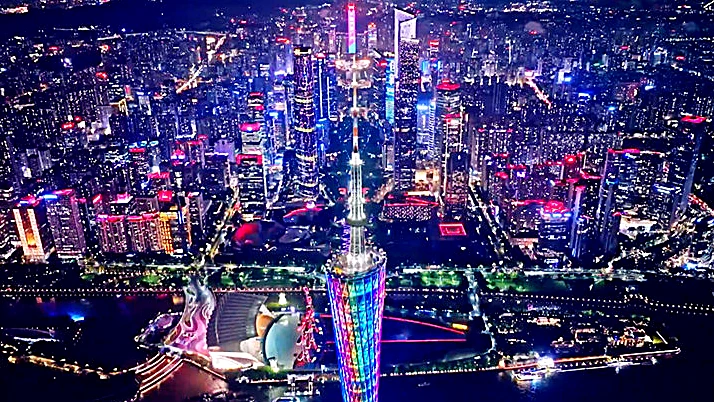
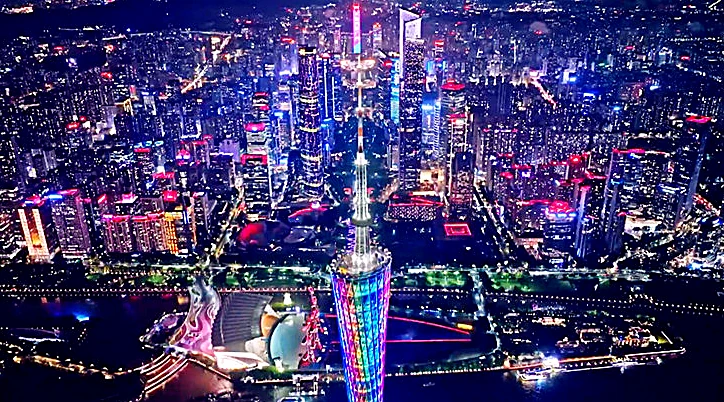
As dusk descends and darkens both Pearl River banks, the Guangzhou Tower sheds daytime quietude of curving steel blocks to transform into a colossal light sculpture masterpiece at the city center. Intelligent digital lighting systems blanketing the double-hyperboloid facade activate a mesmerizing optical dance. Multi-colored LED strips shift rhythmically across melodies, turning slender waistlines into a luminescent silk ribbon piercing through night skies. Vibrant light beams do not exist in isolation, reflecting instead upon rippling Pearl River waters, interlacing with glowing lights from dozens of luxury cruise ships plying back and forth, forging the Lingnan region’s most magnificent nocturnal vista where contemporary visual technology meets a millennial river’s historical flow.
For those seeking ultimate thrills mid-air, nighttime experiences at this iconic work extend beyond distant viewing. Spanning from 168 meters up to 334 meters along the tower body, the open-air skywalk named “Spider-Man Walkway” opens thrilling spaces. This represents the world’s longest and highest outdoor spiral staircase, winding along magnificent hollow steel framework structures. Every step placed upon load-bearing metal surfaces while roaring mountain breezes whistle through open gaps delivers sensations of standing mid-air; below lies a dizzying abyss, surrounded by crisscrossing steel girder networks reflecting magical colored lights.
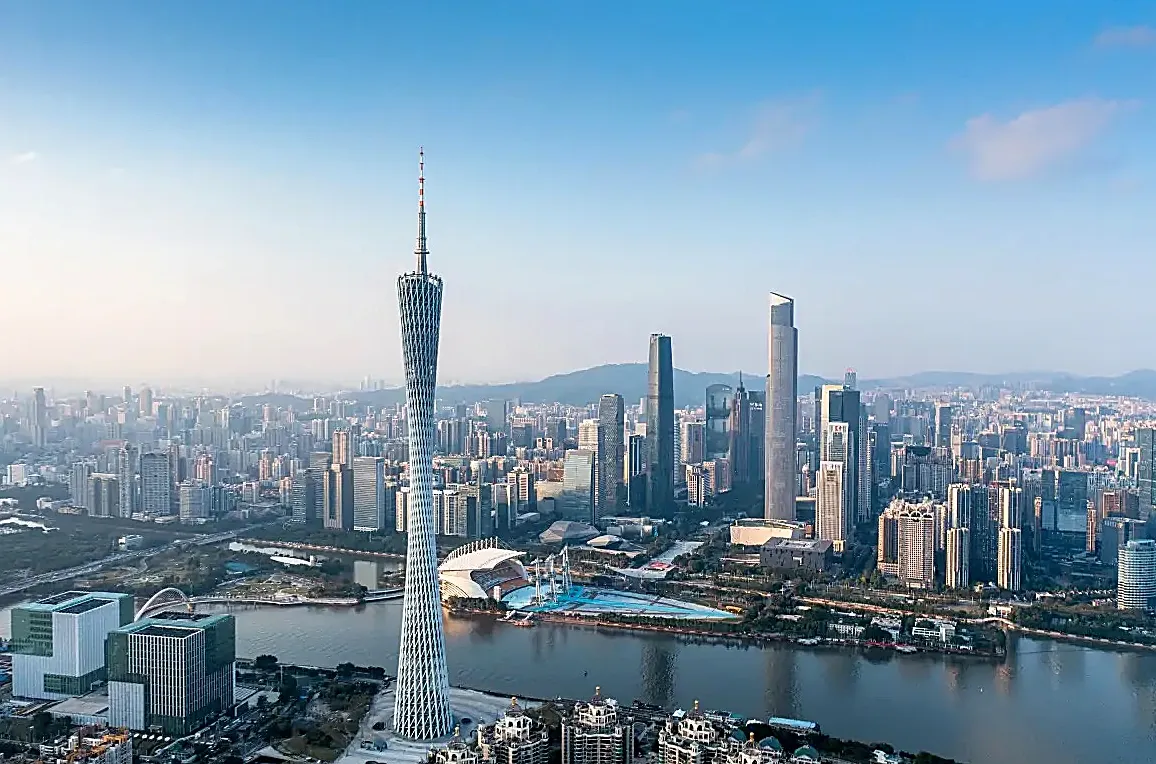
Venture deeper to the 107th and 108th floors, and travelers step into two enclosed observation halls designed along contrasting yet harmonizing aesthetic themes. The 107th floor carries the “Baiyun” (White Cloud) concept with expansive, soothing spaces simulating floating cloud layers blanketing the Pearl River delta, while the 108th floor unveils mystical “Xingkong” (Starry Sky) worlds resembling deep galaxies. The most sensational highlight across these floors is the glass corridor system jutting outward into open space. Standing upon fully transparent tempered glass panels boasting aviation engineering standards, visitors feel as though ground has vanished entirely, leaving only glittering urban light spots sprawling infinitely beneath soles like carpets woven from stars.
The pinnacle of visual and adrenaline experiences concentrates fully across tower summit structures. At coordinates 450 meters, the open-air observation deck opens panoramic 360-degree vistas where travelers touch cool lower-stratosphere night breezes. Directly above, at 460 meters, a giant Ferris wheel operating on the world’s highest inclined rail comprising 16 spherical glass cabins moves slowly around the tower summit rim, delivering peerless romantic perspectives overlooking Tianhe District and office skyscraper chains gleaming like crystal blocks. The peak of excitement rests within the antenna tower cluster from 455 to 485 meters, housing the Guinness World Records-recognized “Sky Drop” free-fall machine. Offering standing or sitting drop choices, participants undergo vertical plunges from mid-air to magnetic braking stops in fractions of seconds, forging supreme visual and emotional shocks amid Guangzhou’s brilliant nightscapes.
Since ancient times, Lingnan culinary culture has fully encapsulated refined indulgent spirits through the celebrated proverbial maxim “Eating in Guangzhou, flavors in Xiguan,” implying that experiencing China’s culinary cradle requires visiting Guangzhou, and the repository preserving finest flavor characters of Guangfu land rests within antique Xiguan districts. Standing solemnly beside surging Pearl River waters, the century-old tower acts not only as a futuristic architectural wonder but serves as a coordinate perfectly bridging traditional imperial cuisine and global exchange waves. Originating from leisurely lifestyles of “one pot, two pieces”—meaning quality tea accompanied by two delicate dim sum dishes—”shangzaocha” morning tea cultures and dim sum dining traditions rooted deeply into citizen bloodlines since the golden era of Thirteen Factories merchants during the Qing Dynasty. Through historical ups and downs, this cultural lifestyle endures intact across legendary teahouses located near the tower.
Journeys penetrating supreme dim sum worlds around the tower introduce travelers to centennial legacy brands, notably Tao Tao Ju established in the sixth Guangxu year of the Qing Dynasty alongside Dian Dou De featuring master craft. Amid hundreds of elaborate steamed and boiled pastries in steaming bamboo baskets, morning tea centerpieces always belong to the celebrated “Four Heavenly Kings.” Leading is crystal shrimp dumplings featuring translucent jade-like wrappers folded with exact precision across 10 to 12 even ripples, cradling sweet fresh prawns and crunchy diced bamboo shoots. Right beside are steamed pork siu mai wrapped in yellow wonton wrappers topped with shimmering orange-red crab roe; renowned char siu buns bursting naturally like blossoming flower petals concealing savory sweet char siu pork; and egg tarts featuring crispy thousand-layer crusts enclosing silky egg custard melting instantly on the tongue.
Leaving magnificent tea halls behind, lands surrounding the tower base double as living museums of rustic old-street delicacies. Food connoisseurs cannot miss cloth-stretched rice noodle rolls (bu la chang fen) from Yinji, where fresh stone-milled rice batter is spread across linen sheets steamed via high-pressure steam, forging translucent, chewy, and smooth wrappers sliding effortlessly across palates alongside superior soy sauce. Accompanying this are fresh shrimp wonton noodles featuring springy egg noodles kneaded with bamboo poles per traditional methods, floating in broths distilled from dried marine worms, pork bones, and roasted river prawns. Street food feasts expand further through amber-hued Ma La Gao sponges fermented naturally with honeycomb structures, crispy radish cakes fragrant with minced shrimp and lap cheong, alongside pure white Shunde fish congee where silky rice porridges preserve original sweet flavors of sliced fish and crispy carp.
At the pinnacle of Guangfu banquet arts, Sham Tseng roasted goose stands as southern lands’ most prestigious culinary treasure. Plump pasture geese are inflated, coated with maltose and red vinegar, and roasted over lychee-wood charcoal fires, emerging with paper-thin crispy amber skin and juicy meat drenched in sweet-and-sour plum sauce. Counterbalancing roast goose reds are refined white sliced chicken or scallion-oil chicken, selected from golden-foot Tam Huang free-range chickens, poached in simmering water to preserve crisp skin and sweet meat, paired exquisitely with minced ginger in peanut oil. Concluding miraculous culinary journeys, double-skin milk desserts and warm ginger milk at Nantian leave unforgettable aftertastes. Notably, inside the Guangzhou Tower at hundreds of meters elevation, rotating sky restaurants and upscale landscape dining halls offer visitors chances to savor contemporary Lingnan culinary quintessence mid-air, where gourmet flavors blend seamlessly with the southern capital’s brilliant Milky Way.
To approach the architectural masterpiece standing tall along the Pearl River’s southern bank, Guangzhou’s advanced public transit network offers travelers exceptionally convenient and seamless transit methods. The optimal and most popular choice is urban rail transit via Guangzhou Tower Station (广州塔站). Passengers board Metro Line 3 running across the city’s north-south axis, or experience the Zhujiang New Town APM Line featuring driverless underground trains gliding smoothly beneath river beds. Upon exiting at subterranean gates, bilingual signage guides travelers straight to expansive reception lobbies beneath the tower, unaffected by outdoor weather. Additionally, riding scenic double-decker buses or experiencing Haizhu Tram streetcars running along green riverbanks offers poetic approaches, opening panoramic views of twisting tower bodies from ideal distances.
Guangzhou Tower operations are managed under strict security standards comparable to international airports, enforcing mandatory real-name registration (实名制) and distinct visiting timeslots. International travelers must bring original valid passports to scan identity barcodes at electronic ticket gates and security checkpoints prior to boarding elevators. Rather than waiting in queues during peak tourism seasons, proactively booking tickets in advance via official portals is vital. Regarding experience tiers, basic tickets include the Baiyun Xingkong Observation Deck (白云星空观光层) nestled quietly across the 107th and 108th floors, combined with open-air viewing platforms at 450 meters, typically priced around 228 RMB. For thrill-seekers tackling the Bubble Tram or Sky Drop free-fall rides, booking bundled packages upfront optimizes costs compared to separate on-site add-ons.
The most precious moment to admire surreal beauty across Lingnan core regions from heights spans the “golden hour” from 5:30 PM to 7:30 PM. Begin journeys via high-speed optical elevators; within moments, you reach hundreds of meters elevation while suns still dye golden-orange hues across the Pearl River and distant Baiyun Mountain ranges. As dusk falls, fading sunsets coincide with high-tech lighting symphonies. Standing across revolving observation decks, travelers witness magical transitions between nature and human craftsmanship: cities below light up simultaneously, Zhujiang New Town landscapes shine like artificial galaxies, and steel tower shells launch vibrant multi-colored light dances through nights.
Beyond timing, subtropical coastal weather in Guangzhou remains a vital consideration. All outdoor facilities above 450 meters—including open-air viewing decks and summit adventure rides—suspend operations immediately without warning during thunderstorms, high gale winds, or local rainstorms to guarantee absolute visitor safety. Proactively checking weather forecasts and operational announcements from management offices on mornings before departure is an indispensable field tip. Such thorough preparation prevents unexpected disruptions, ensuring seamless, safe, and emotional southern metropolitan panoramic experiences.
To experience this journey alongside native guides, explore the pre-arranged itinerary within the Guangzhou – Shenzhen 4D3N Tour.