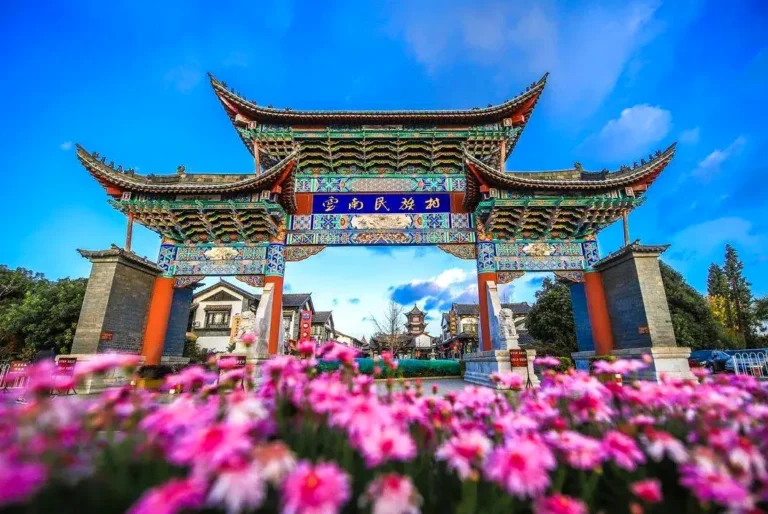
Nestled quietly beneath the eastern slopes of the majestic Jade Dragon Snow Mountain, Blue Moon Valley (Chinese: 蓝月谷) is not a designation that appeared from the very beginning in ancient local historical records. Tracing history back, before bearing its mystical beauty that enchants travelers from everywhere, this basin valley was tied to a rustic, truthful name passed down through generations of Naxi people: Baishui River (meaning White Water River). Originating from millennial glaciers melting atop snow-capped white peaks, pure underground streams wind through granite crevices, rushing down into the narrow valley. The riverbed and sedimentary terraces here are largely composed of ivory-white limestone powder. Whenever the rainy flood season arrives, as churning torrents stir up the valley’s geological strata, the entire current transforms into milky-white milk resembling mother nature’s milk, serving as the root for the name Baishui River steeped in pristine memories among Yunnan’s borderland compatriots.
In the spiritual life and worldview of Naxi people following ancient Dongba beliefs, the Jade Dragon snow range is not merely a geographical wonder, but the immortal incarnation of Sanduo God—the supreme protective deity of the entire Lijiang realm, symbolizing solemnity, shelter, and purity. According to folk tales passed down across generations of Dongbas, every stream of freezing water pouring from Baishui River downstream is heaven and earth’s pristine life force bestowed to nourish crops and shield Naxi descendants from pestilence and malevolent spirits. That sacred water once witnessed silent earth-and-heaven sacrifice rituals, where great Dongba priests beat divine gongs and chanted sacred hymns using pictographic scripts on native mulberry paper, entrusting aspirations for eternal harmony between humanity and the mystical natural world.
Passing through historical epochs from the Yuan Dynasty, flourishing under the Ming, and extending into the Qing, the Baishui River mountain valley lay entirely within the administrative jurisdiction of the Mu clan—hereditary Tusi chieftains of Lijiang. This was a golden era when Lijiang became a vital transit hub along the legendary Tea Horse Road. Pack-horse caravans chiming bronze bells transported brick tea packed from Puer northward up to snow-covered Tibetan plateaus, carrying spices, herbs, and rock salt, frequently selecting the Baishui River basin as a resting point to restore vitality beside cool waters before crossing treacherous mountain passes. Profound cultural exchange between the Naxi, Han, Tibetan, and Bai peoples under the skillful rule of Mu Tusi forged a rare historical depth for this valley, where every stone bank and water terrace absorbed imprints of long-distance merchants and hermits seeking serene sanctuaries.
The spectacular transformation from the rustic name Baishui River to the poetic moniker Blue Moon Valley stemmed from the blending of world literature and wondrous natural phenomena. Originating from British author James Hilton’s classic novel “Lost Horizon,” imagery of a pure blue-moon valley along Shangri-La’s borders sparked intense inspiration for posterity. By strange coincidence, on clear sunny days, owing to copper ions and dissolved minerals reflecting sunlight, lake waters abandoned milky white to transform into brilliant jade-blue hues, plunging profoundly to melt hearts. Simultaneously, gazing down from Jade Dragon mountain slopes, the entire curving gorge wound softly resembling a crescent moon embedded amidst ancient pine forest greens. The moniker Blue Moon Valley was thus officially born, completing its transformation journey from a sacred white-water river of indigenous locals into a celebrated scenic spot steeped in Eastern poetry and myth.
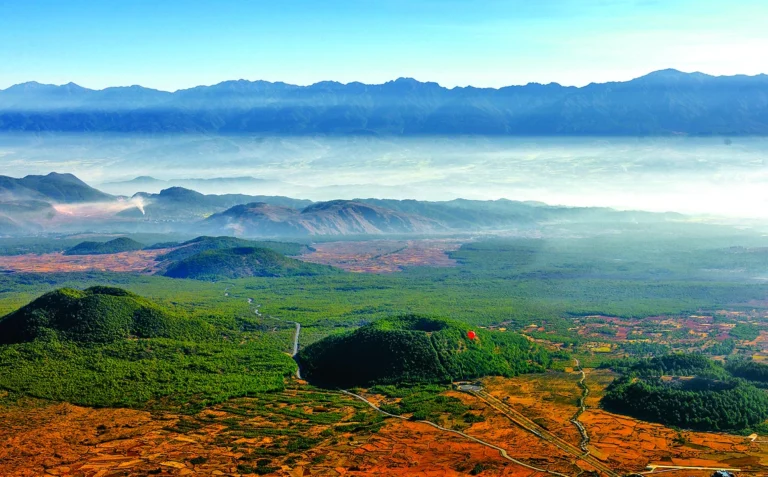
Examining geomorphological topography and traditional classical geomancy, Blue Moon Valley presides over one of the most unrivaled vantage points along the eastern slopes of the majestic Jade Dragon Snow Mountain. The valley closes itself quietly within a deep tectonic basin, bordered to the north by vast Ganhaizi meadow, while sitting southward beside the dense plateau of Yunshanping. Deep terrain surrounded on all four sides by towering vertical limestone walls creates a flawless “sheltering wind and gathering vital energy” structure, where vital energy circulating among great forests is fully retained at the bottom of the gorge. This treacherous yet harmonious posture not only blocks piercingly cold gales blowing from high glacial peaks, but accumulates moderate energy of the plateau microclimate, turning the gorge into an isolated oasis full of mystery amidst towering snow mountains.
Regarding geomorphological evolution, Blue Moon Valley represents a quintessential result of intense glacial weathering and erosion combined with Quaternary glacial deposits across millions of geological years. The lifeline nourishing the entire landscape system here is underground flow and melting water from the permanent glacier reigning across thirteen jagged peaks of the Jade Dragon Thirteen Peaks. When glaciers melt under solar rays, pure water seeps through fractured strata, soaking through dense primeval forest root systems and deep limestone crevices within mountains. That multi-layered natural filtration process dissolves large quantities of carbonate minerals alongside smooth glacial rock flour, transforming flows emerging at river sources into crystal liquids bearing wondrously shifting jade-blue colors.
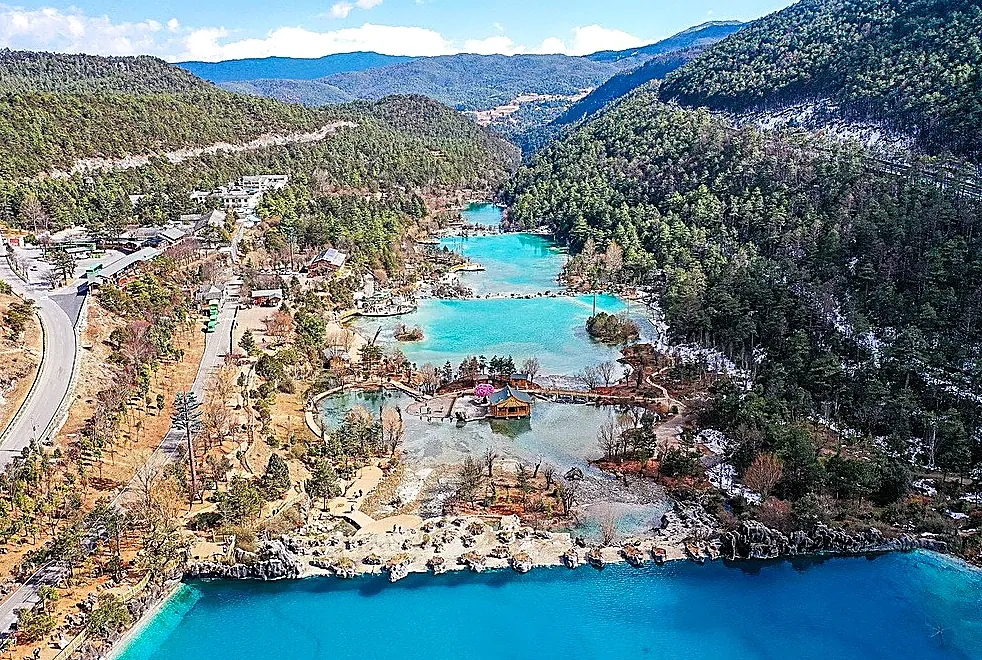
The valley’s hydrological infrastructure is elaborately arranged according to exceptionally distinctive natural stepped laws. When glacial streams pour into deep basins, tectonic fault terrain combined with travertine sedimentary bars and karst limestone terraces naturally dams flows, partitioning the valley into interconnected tiered lakes, locally termed “haizi” (little seas). Waters from upper lakes overflow natural dams, plunging into lower lakes via roaring white waterfalls before calming into mirror-like blue surfaces. Successive water terraces descend from elevations exceeding 3,000 meters gently along slopes, forging tightly structured tiered landscape compositions. Lakebeds accumulate ivory-white mineral mud reflecting sunlight refractions, causing water colors to shift unpredictably depending on depth, ranging from turquoise blue under clear skies to milky white whenever sudden mountain rains churn sediments.
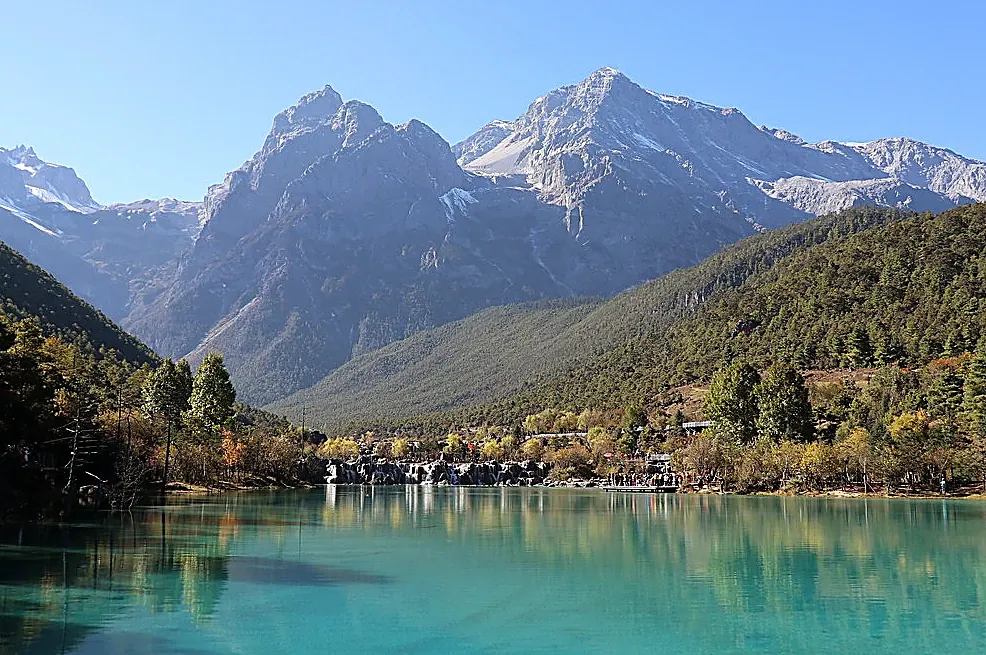
Natural landscapes at Blue Moon Valley achieve aesthetic peaks thanks to vertically distributed vegetation structures. From cold snowy boundaries atop rocky desert heights, scenery transitions smoothly across upper subalpine fir forests, dark green spruce forests, and winding dwarf bamboo thickets hugging gorge edges. On clear cloudless days, the entire magnificent silhouette of the Jade Dragon Thirteen Peaks with sharp jagged summits capped in millennial snow reflects upon crystal-clear, mirror-flat waters. That represents exquisite harmony between static and dynamic forces, between rugged cold white snow mountains and soft jade-blue waters, weaving picturesque mountain-and-water paintings steeped in Yin-Yang complementary philosophy across Yunnan’s wilderness.
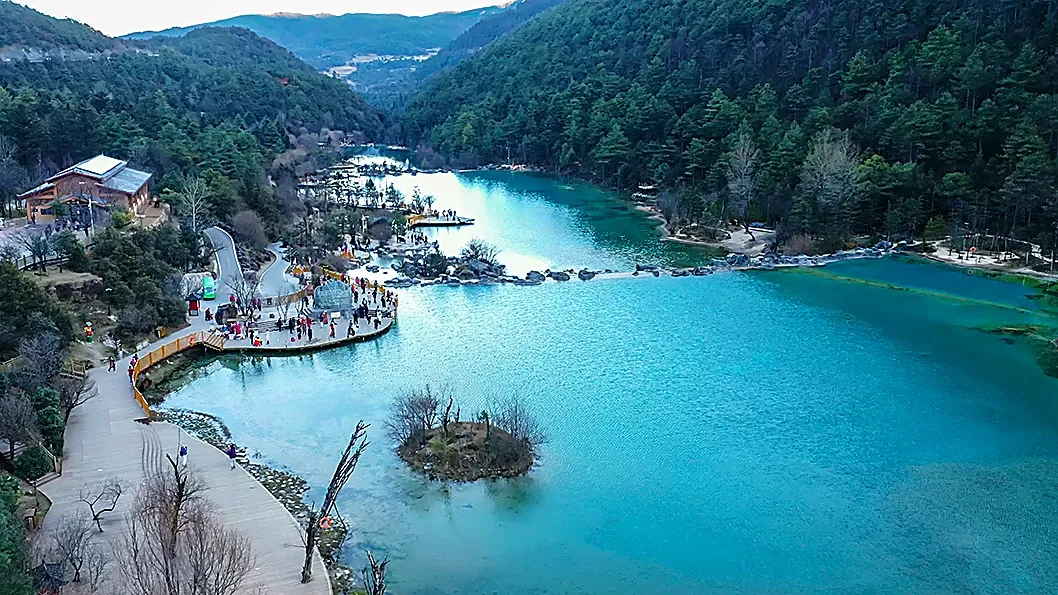
Viewed from overall geomorphology, Blue Moon Valley possesses a grandiose hydrological spatial structure shaped from Quaternary travertine and dolomite (white cloud stone) sedimentary foundations. The landscape architectural backbone of the entire valley relies on tiered structural frameworks simulating renowned Baishui Terrace morphologies, where melting glacial water from Jade Dragon Snow Mountain’s permanent ice strips cascades down slopes, forging exceptionally spectacular natural spillway chains. Winding trough topography combined with limestone-terraced steps divides flows into four interconnected water sub-districts, tiered from high to low comprising Yuye Lake, Jingtan Lake, Lanyue Lake, and Tingtao Lake. This transitional structure not only regulates hydrological rhythms but forms countless delicate curtain waterfalls, earning the poetic moniker “Little Jiuzhaigou of Western Dian.”
Reigning at upstream positions across the interconnected water network is Yuye Lake, where calm waters achieve near-absolute purity with profound turquoise hues. Sedimentation of dissolved carbonate minerals in melted glacial water combined with gentle slopes transforms this lake into a gigantic mirror reflecting jagged snow-capped peaks of the Jade Dragon Thirteen Peaks. Right beneath tiered white stone rapids lies Jingtan Lake, featuring optical transparency allowing visitors to admire sedimentary rock slabs, fossilized ancient tree roots, and underwater algae deep below. Unlike Yuye Lake’s contemplation, Jingtan Lake opens expansive clear spaces where highland sunlight glistens on surfaces, acting as a lens refracting Lijiang’s deep blue skies into valley hearts.
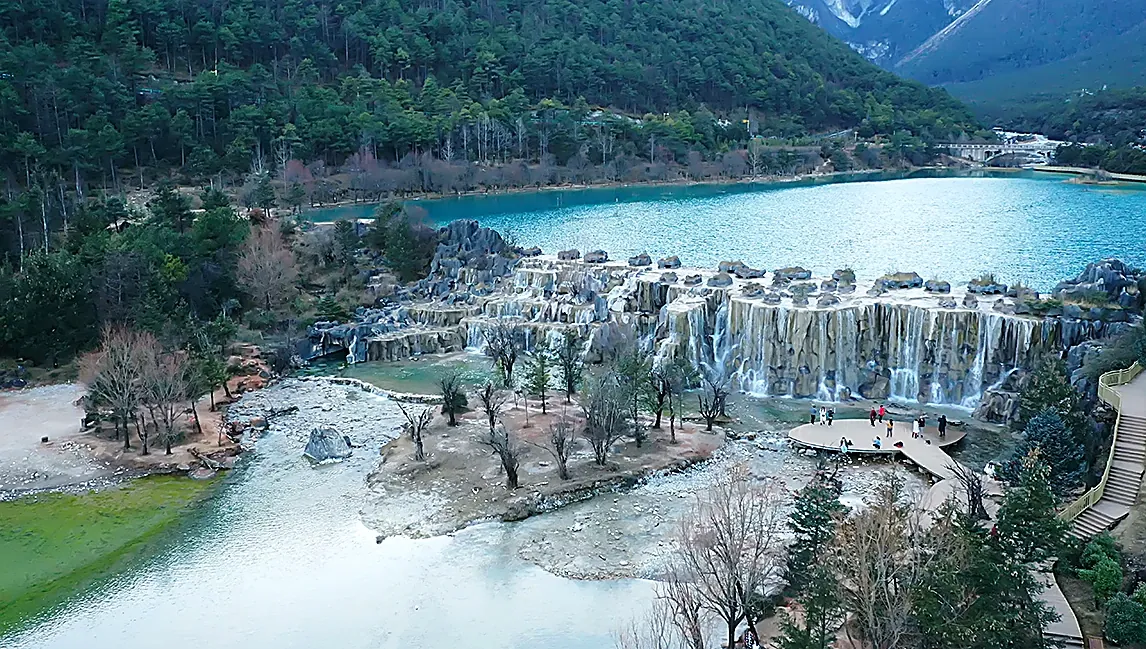
Following cascading steps descending downstream, spaces expand maximally at Lanyue Lake, the iconic central sub-district and origin for the entire valley’s name. The lake surface here widens into a perfect semi-circle, absorbing abundant copper ions and micro-minerals from limestone slopes, transforming water colors miraculously into brilliant jade-blue mixed with emerald green, contrasting sharply against silver-white rapids and primeval pine forests bordering water edges. Concluding the circulation journey is Tingtao Lake, where narrowing terrain creates steeper gradients, shifting flows from static states to powerful dynamics. Rushing waters crash repeatedly against granite boulders and millennia-old conifer roots along shores, echoing roaring sounds across gorges, turning pure visual spaces into lively multi-layered auditory experience fields.
To harmonize visitor sightseeing needs while preserving million-year fragile geomorphological structures, infrastructure planning at Blue Moon Valley establishes exquisite wooden walkway systems running alongside water slopes. This elevated walking route is built using point-anchored foundation structures driven deep into hard hill slope bedrock, completely avoiding interference with natural water-saturated travertine terraces. Pathways wind rhythmically with pristine topography, hugging water edges closely so travelers feel cool glacier moisture, before soaring across snowy pine canopies blocking views to suddenly reveal panoramic views of four tiers of blue lakes below. The spatial staging art employing “walking changes scenery” techniques optimizes visual experiences while standing as an exemplary model for sustainable international ecological landscape design.
Situated beneath towering Jade Dragon snow ranges, Blue Moon Valley captivates travelers through glacial geomorphology while acting as a visual sanctuary where natural light and breathing creation shift ceaselessly. From early dawn to midday, direct solar rays piercing valleys trigger intense Rayleigh scattering across calcium carbonate mineral particles and fine glacial flour suspended in melted ice water. Lanyue Lake surfaces act as gigantic lenses shifting gently from soothing turquoise peacock greens to profound deep blue ocean depths. Such scenery resembles optical fusion written via highland light, where every surface angle crafts magical illusions, turning valleys into mystical fairylands.
As dusk descends, moments when twilight slants across thin clouds blanketing permanent snowy summits of the Thirteen Peaks unveil the most brilliant “Golden Summit at Sunrise” (日照金山) spectacle. Sunset rays sweep across frozen slopes, gilding Naxi sacred snow peaks in golden hues before reflecting completely upon mirror-flat Blue Moon Valley waters. Blue waters appear dusted with sparkling gold, interweaving peerless splendor with serene contemplation. As final daytime rays fade, valleys close brilliant color symphonies to welcome pristine darkness, where highland night skies unveil millions of brilliant stars amidst silent heavens, detached entirely from mundane artificial lighting.
Accompanying natural serenity is the elevation of real-scene theatrical performances across Ganhaizi meadow adjacent to the valley. At elevations exceeding 3,000 meters above sea level, crimson horseshoe-shaped open-air amphitheaters become performance sanctuaries for the masterpiece “Impression Lijiang” (印象·丽江), a peak work painstakingly staged by director Zhang Yimou alongside collaborators Wang Chaoge and Fan Yue. Utilizing no curtains or artificial backdrops, stages take millennial vertical cliffs and eternal snows of Jade Dragon Snow Mountain as grand backdrops. Lighting staging art blends perfectly with natural northwestern Yunnan sky light, forging breathtaking open visual spaces.
Over five hundred participating actors are not professional artists, but indigenous farmers and woodcutters originating from sixteen ethnic minorities including Naxi, Yi, Tibetan, and Bai. Beneath expansive skies, powerful stamping dances shake earth and heaven, pristine yells echo against cliffs, and majestic echoes of ancient Dongba sky-worship songs vividly recreate heroic footsteps of pack-horse caravans along the windswept Tea Horse Road. The show’s striking impact stems from sacred resonances between humanity and nature, where rustic highland voices touch universal transcendence, leaving lingering indelible aftertastes in travelers’ souls.
Bound to Blue Moon Valley and majestic Jade Dragon Snow Mountain, native culinary cultures of borderland Naxi mountaineers contain unique traditional values. Beneath perennial snow peaks, local food culture reflects harmonious survival philosophies, where red fires crackling in wooden homes warm freezing winter days via rich highland-seasoned stews. Flavors and smoke rising from ancient copper pots carry memories of horse caravans wandering windswept Tea Horse Roads, turning valley meals into profound cultural touchpoints.
Reigning supreme atop Naxi flavor hierarchies is Lijiang salted pork rib hot pot, also termed Lap Pa Gu. This dish originates from traditional food preservation techniques among tribes inhabiting Three Parallel Rivers basins. Selected pork ribs are marinated with coarse salt, dried chili, wild pepper, and native corn liquor, then hung beneath wooden eaves to dry naturally via cold plateau winds across months until flesh turns translucent ruby red. Slow-simmered over glowing charcoal with white radishes and ginger, melting fat enriches broths, highlighting natural bone marrow saltiness and smoky campfire aromas, banishing snowy mountain chills.
Alongside salted pork crafts, highland yak beef hot pots represent powerful energies of boundless grasslands. Wild-grazing Tibetan cattle across steep rocky slopes above 3,000 meters yield firm, sweet, nutrient-dense deep red meat. Yak hot pots are meticulously stewed by Naxi people with Hongyuan cardamom, star anise, and secret herbs, generating warm aromatic layers aiding blood nourishment and high-altitude adaptation. During rainy seasons when Jade Dragon primeval forests awaken, gourmets seek wild mushroom hot pots. This convergence gathers prized products like noble Matsutake mushrooms, delicate Morels, and rich Boletus mushrooms, dissolving into sweet black chicken bone broths resembling morning dewdrops on leaves.
Feasts beneath Blue Moon Valley lack refined elegance without aquatic plants named Thuy Tinh Duong Hoa (Ottelia cordata), floating aquatic flowers hiding beneath crystal melted snow waters. Verdant, tender stems swaying with jade-blue currents when dipped briefly into boiling hot pot broth retain crisp sweetness, evoking pristine stream breaths. Accompanied by grilled stuffed tofu melting like hot cream, culinary pictures conclude with Lijiang Baba, celebrated traveling biscuits sustaining caravans across treacherous snow passes. High-altitude wheat flour is skillfully kneaded across thin layers, pan-fried golden with pork fat in sweet and savory variants, exuding alluring aromas.
Approaching Blue Moon Valley beneath Jade Dragon Snow Mountain demands strict transport regulations to preserve fragile valley landscapes. Private vehicles, rental cars, and taxis are strictly prohibited from entering heritage cores. The mandatory route departs from Lijiang Ancient Town via dedicated tourist shuttle buses running straight to the Snow Mountain Visitor Center. Here, all visitor streams transfer to internal ecological conservation shuttle buses accessing valley transit stations. Strict emission controls preserve pristine air, limiting micro-dust and sound vibrations affecting Naxi geological structures and ecosystems.
Passing transit checkpoints, ideal durations of two to three hours suit soaking in scenery without physical fatigue. Classic sightseeing routes follow elevated wooden walkways hugging gorge edges, starting from tranquil Yuye Lake upstream, passing transparent Jingtan Lake, multicolored Lanyue Lake, to cascading Tingtao Lake. Stroll downstream to feel mineral optical shifts or take eco-electric carts between stations to conserve energy for hiking.
Situated at roughly 3,000 meters elevation, Blue Moon Valley features alpine microclimates with temperatures lower than Lijiang Ancient Town. Glacial winds require layered thermal clothing, windproof jackets, and warm scarves. Thin air lowers oxygen concentrations; altitude-sensitive travelers should prepare portable medical oxygen canisters, regulate breathing, and avoid strenuous exercise or running on slippery wooden boardwalks.
Optically, winter marks golden timing as snow lines drop to lowest elevations, contrasting brilliant white with jade-blue glacial waters. Mirror-flat lakes reflect thirteen snow peaks. However, high UV radiation and strong glare from mineral surfaces and ice require polarized sunglasses to protect vision and eliminate glare. Keep passports and travel documents handy for automated barcode scans at scenic checkpoints.
Thorough preparation in geography, physical fitness, and ecological rules turns blue moon valley tours into unforgettable memories. For seamless journeys bridging mountain wonders and millennial cultures across Yunnan, explore structured itineraries within the Dali – Lijiang – Shangri-La – Kunming Tour (5N5D & 6N6D).