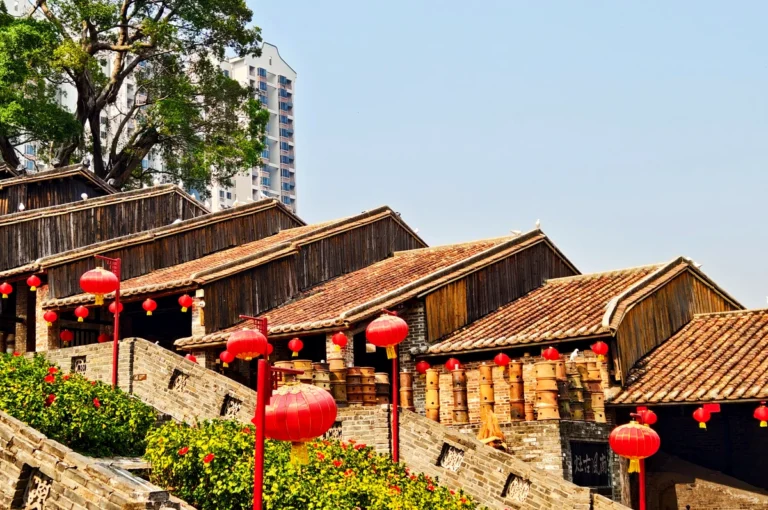
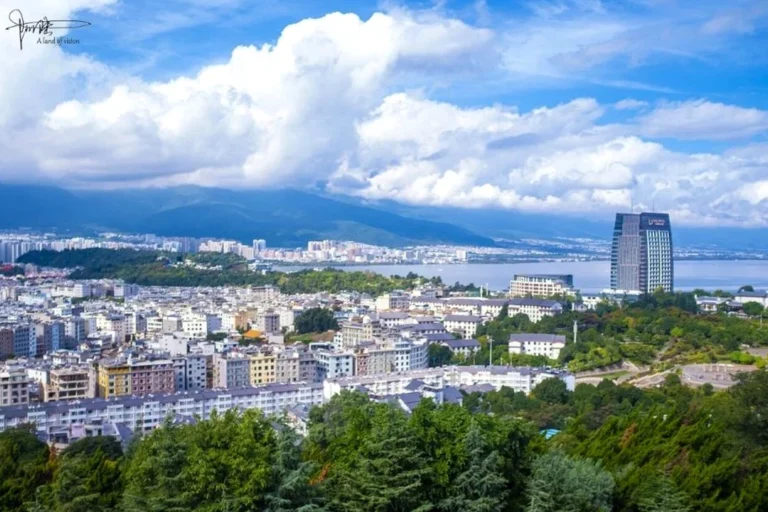
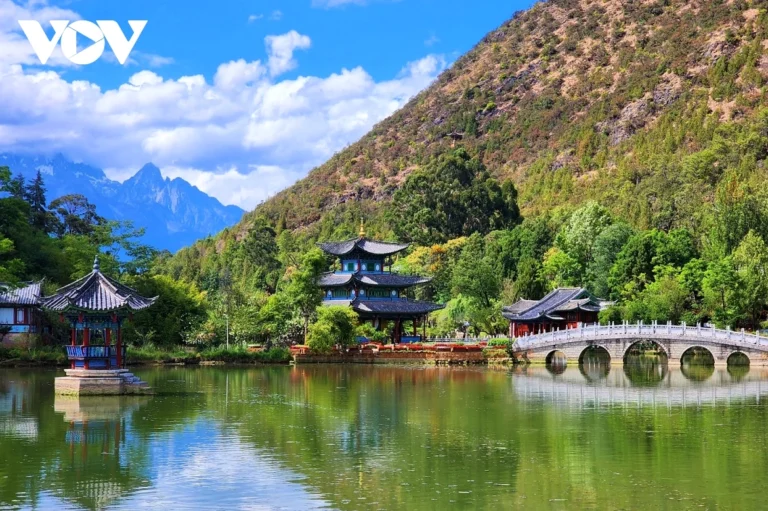
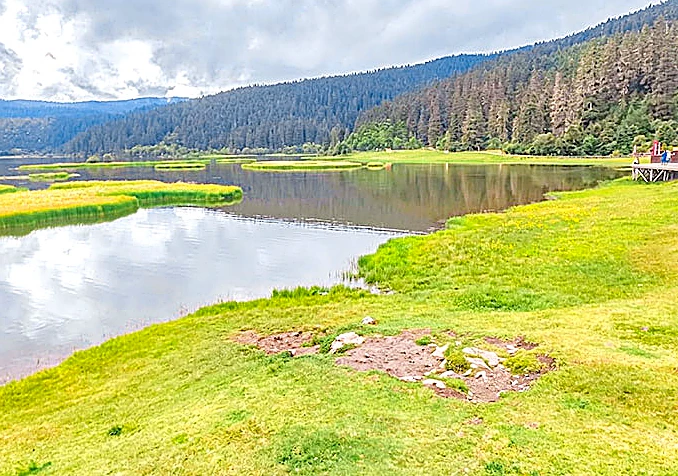
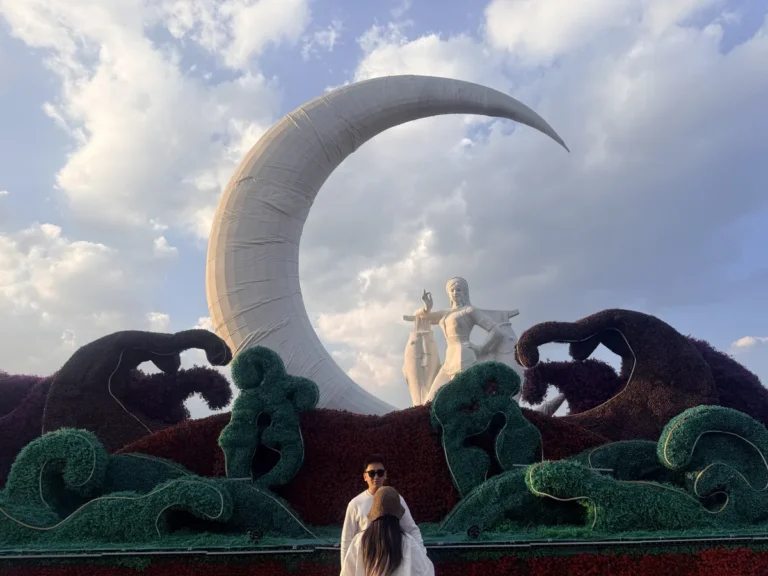
Standing quietly at the foot of the Jade Dragon Snow Mountain range, which is covered in white clouds and snow year-round, Lijiang Ancient Town—also known by its ancient name Dayan Old Town—preserves in every bluestone flagstone a glorious chronicle spanning over eight hundred years. Going back in time to the turbulent late 13th century, when the Southern Song Dynasty waned and the Dali Kingdom reached its final days before Mongol cavalry established the Yuan Dynasty, early Naxi residents stopped in this fertile plateau basin. From simple thatched huts built beside streams of melting snow from the mountain, Naxi ancestors began the endeavor of clearing fields, forging the primitive foundation of a unique mountain city along the legendary Ancient Tea Horse Road.
The formation and prosperity of the ancient town are intimately tied to the Mu chieftain clan—a hereditary leader family that governed and devotedly built this land across centuries. Under the ingenious planning and the military-cultural vision of successive Mu chieftains, Lijiang did not build sturdy defensive walls like the customary layout of Chinese ancient cities, but instead expanded naturally, flowing along groundwater channels and mountain topography. The ups and downs of feudal dynasties are also deeply recorded through the evolution of the region’s names. In the early Yuan Dynasty, this commercial hub was called Dayecang; transitioning to the early Ming Dynasty, it was renamed Dayianshuang; during the Qing Dynasty, it shifted to Dayianli. By the 18th year of the Republic (1929), the official name was fixed as Dayan Town—a name derived from valley contours resembling a giant inkstone gifted by nature.
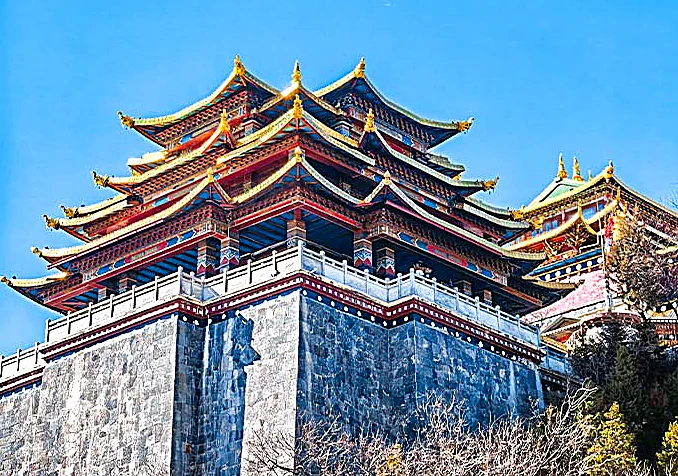
Entering the modern era, the ancient value and cultural depth of this urban space were swiftly and accurately recognized. On December 8, 1986, the State Council of the People’s Republic of China issued a decision officially inscribing Lijiang into the second batch of National Historical and Cultural Cities. This strategic policy established a solid legal foundation for zoning and conserving traditional wooden residences, ancient water channels, and pristine five-flower flagstone alleys against the wave of rapid urbanization.
Yet, the harshest trial in the modern history of the ancient town came from the fury of nature on February 3, 1996. A terrifying earthquake measuring up to 7.0 on the Richter scale shook the entire northwestern Yunnan region, leveling countless modern reinforced concrete structures in neighboring areas. Miraculously, the flexible traditional “xuidou” and “lianglang” mortise-and-tenon wooden frame structures of the Naxi people helped the core of the ancient town stand firm against violent tremors. Through a large-scale restoration project adhering strictly to restoration principles and preserving original structures, Lijiang revived strongly from the ashes, demonstrating resilient vitality and the pinnacle of vernacular building techniques.
The pinnacle of international recognition occurred on December 4, 1997, when the United Nations Educational, Scientific and Cultural Organization (UNESCO) officially approved the inclusion of Lijiang Ancient Town in the World Cultural Heritage List. The heritage council evaluated Lijiang as an outstanding model of the harmonious fusion between Naxi ethnic architectural identity, Han-Tibetan blended styles, and the spectacular natural mountain and river environment. Over more than eight centuries of dynastic ups and downs, the ancient town has not turned into a static museum; rather, it always pulses with simple local life, connecting historical roots into the endless flow of the present.
Situated on the northwestern ridge of the vast Yunnan-Guizhou Plateau, Lijiang Ancient Town is nestled within the fertile Lijiang Basin at an average altitude exceeding 2,400 meters above sea level. In traditional geomantic and landscape geography thinking, this position is likened to a jade dew-kissed flower amidst a basin valley, welcoming warm vital energy from the south while the entire northern flank is sheltered by the majestic, cloud-capped Jade Dragon Snow Mountain. This snow-covered mountain range acts as a sturdy natural rampart, blocking freezing winds sweeping down from the Qinghai-Tibet Plateau while serving as the source of accumulated heaven-and-earth spiritual energy, creating an extremely auspicious “backed by mountains, facing water” terrain. The name Lijiang itself originated from that geographical source, as the majestic bend of the Jinsha River when enclosing the ancient basin boundary was once called Lijiang River, depositing silt and reflecting jade-blue waters across millennia.
The spectacular contrast between perpetual snow peaks above and lush green vegetation at the valley floor has endowed Lijiang with a mild microclimate rarely found on cold, arid plateaus. Unlike traditional imperial capital planning preferences in the Central Plains for strict symmetrical axes and defensive moats, Naxi ancestors chose a softer approach toward nature. They did not build barrier walls, but instead followed naturally undulating topography sloping gently from northwest to southeast, fully respecting natural ecological flows. This multidirectional open urban spatial structure not only allowed the city to receive maximum warm sunlight from the high plateau equatorial region, but also created absolute harmony between artificial structures and the majestic backdrop of reflected snow peaks.
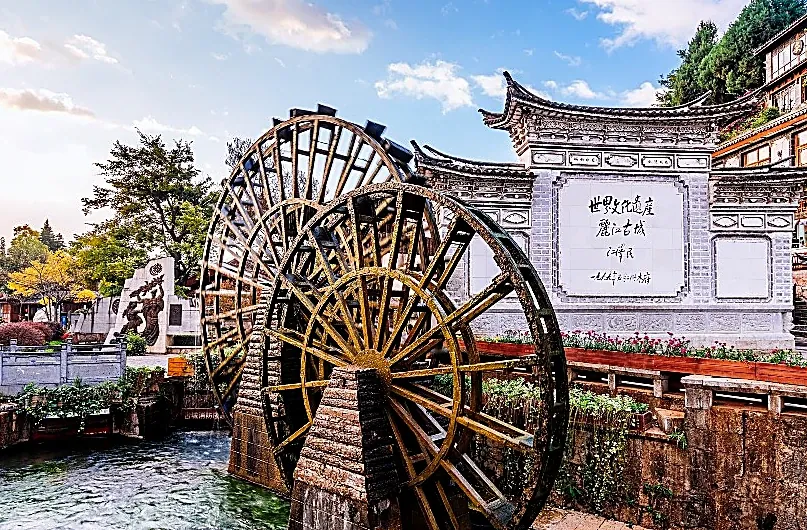
The soul creating Lijiang’s immortal vitality and distinctive appearance lies in its intertwined water network, likened to a circulatory system nourishing every urban cell. Originating from pure groundwater fed by melting snow at Black Dragon Pool on the northern edge, the crystal-clear Yuhe River flows turbulently southward, entering ancient town alleys right at the gateway area featuring the Grand Waterwheel cluster. At this giant wooden waterwheel symbol, the main Yuhe stream splits into three major distributaries: East River, Middle River, and West River. Without relying on any forced pumping systems, ancient hydraulic engineering art cleverly utilized the natural slope of limestone step topography to automatically split and branch water, circulating evenly across all streets without stagnation or flooding.
From three open main rivers, the flow network subdivides into countless winding creeks, following five-flower flagstone-paved streets, weaving past wooden walls, running beneath house foundations, and flowing directly into the courtyards of individual families before gathering in low-lying southern agricultural areas. This ingenious diversion plan birthed a vivid natural masterpiece in reality, summed up in the classic proverb: “Jia jia men qian rao liu shui, hu hu wu hou chui qing liu” – before every home, cool running streams meander; behind every eaves whenever winds blow, green weeping willows droop in shade. Water serves not merely as a resource for daily living or fire prevention for a purely wooden architectural ensemble, but also acts as a natural biological temperature regulator, keeping the plateau living space cool, fresh, and connecting humans with the universe in a perfect symbiotic entity.
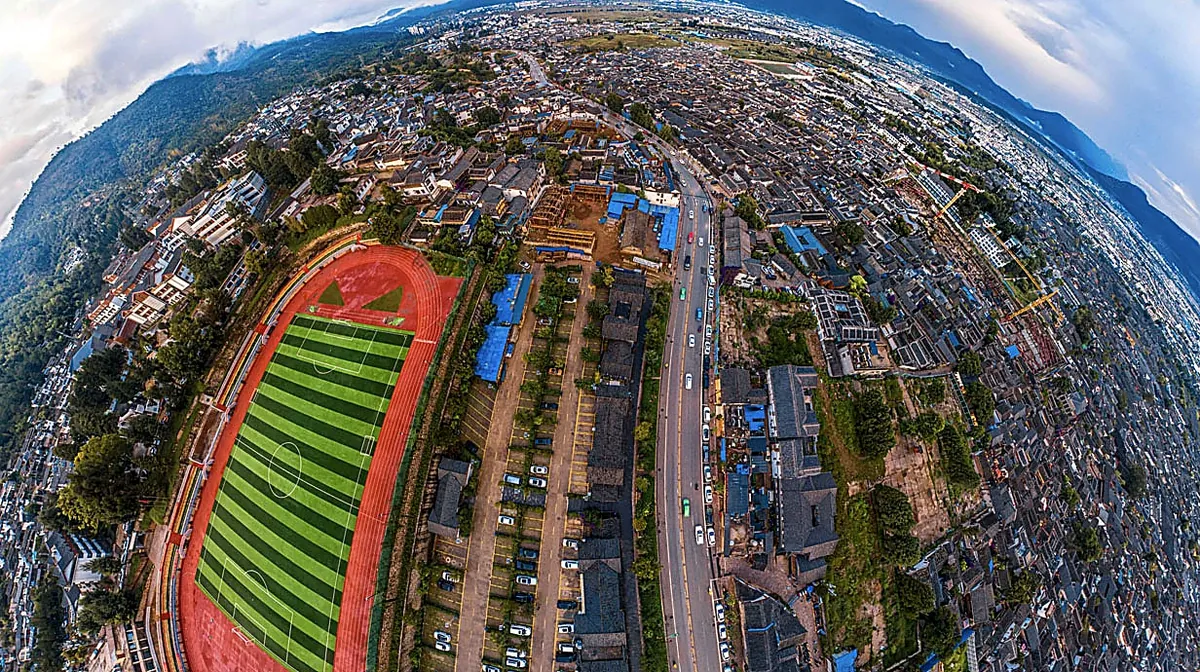
Spanning a core conservation and coordinated buffer zone totaling 7.279 km², the Lijiang Ancient Town World Cultural Heritage site establishes a unique asymmetrical spatial planning blueprint on the Yunnan-Guizhou Plateau. Rather than being enclosed within a single boundary, the overall structure of this scenic spot is an organic connection among three historic settlement zones: the Dayan ancient town urban center, and two traditional residential clusters, Shuhe and Baisha. The most classic difference in Naxi urban design thinking at Lijiang is the complete absence of defensive city walls. Disregarding the square, rigid city models of feudal Central Plain capitals, ancestors thoroughly followed natural mountain and river topography, allowing roads to wind freely along slopes and branches of water sources.
Lijiang’s inner transport arterial network represents the perfect synthesis of traditional hydraulic engineering and landscape creation art. Road surfaces along main streets and alleys are paved uniformly with five-flower flagstone quarried from neighboring mountain strata. This natural flagstone material possesses extraordinary durability: during torrential rains, natural groove patterns provide rapid drainage without muddy puddles; during dry winters, the stone surface remains solid and prevents dust dispersion. Through centuries of friction and wear from horse hooves of Tea Horse Road pack mules and traveler footsteps, the five-flower stone surface has weathered to a matte brownish-black sheen, reflecting ancient trees and rows of bright red lanterns at dusk.
The soul of settlement painting at Lijiang lies in ancient houses carrying Naxi philosophy, built with joined wood frame structures combined with mud-brick walls and sturdy stacked stone foundations. This flexible wood mortise-and-tenon connection structure creates exceptional shock absorption against earthquakes in mountain fault zones. The two most representative layout models preserved almost intact are “San fang yi zhao bi” (Three rooms and one screen wall) and “Si he wu tian jing, zou ma zhuan jiao lou” (Four compounds with five skywells and communicating corner verandas). In the first model, three main and auxiliary residential wings enclose an open courtyard, while the remaining side features a large screen wall built of white lime or fired bricks to block harsh winds and catch reflecting sunlight into the inner courtyard. Meanwhile, the complex courtyard model elevates living experiences with four wings enclosing a large central courtyard alongside four smaller skywells at corner gaps, connected continuously by covered veranda corridors running around roof corners.
Decorative arts on architectural components offer brilliant evidence of cultural exchange between indigenous Naxi people and Han, Tibetan, and Bai populations. Six-panel carved doors intricately detailed with botanical and animal motifs symbolizing good fortune reflect Central Plain scholarly aesthetics combined with exquisite open-work carving techniques of Dali carpenters. The water network branching from the Yuhe River is interspersed with hundreds of ancient arched stone bridges such as Dashi Bridge and Wanzi Bridge alongside rustic wooden plank bridges. The synergy between stone banks, weeping willows, waterwheels, and mossy yin-yang tiled roofs curving gracefully completes the unique “small bridge, flowing water, households” aesthetic in the breezy plateau.
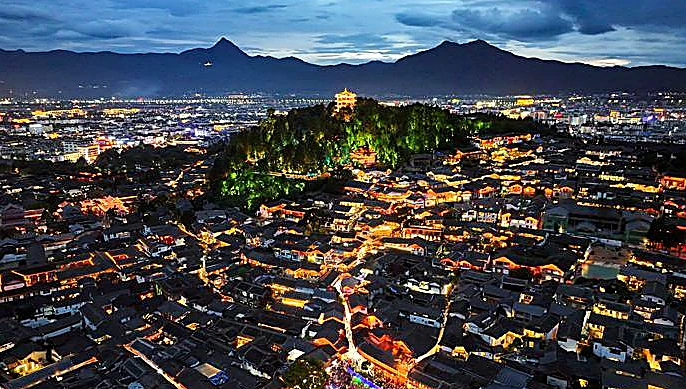
As the final sunset rays vanish behind the majestic Jade Dragon Snow Mountain, the invisible boundary between reality and myth in Lijiang seems to vanish completely under transforming lighting artistry. Dayan Old Town transitions from a solemn brick-and-tile fortress of millennial Tea Horse Road into a brilliant, mesmerizing water town. Thousands of bright red paper lanterns light up simultaneously along pine-wood eaves, blending with warm yellow spotlights winding along upturned eaves of famous San fang yi zhao bi architecture. That warm, mystical light pours onto the crystal-clear water of the Yuhe River branching across 300,000 square meters of alleys, creating shimmering, perpetually shifting reflective silk ribbons. Five-flower bluestone flagstones polished by millions of merchant footsteps and pack horse hooves since Ming and Qing times catch lantern light, glowing with a misty jade-like wet sheen, guiding travelers into an otherworldly, transcendent space.
The most vivid and bustling heartbeat of Lijiang’s night converges at Sifang Street square, which has served as a bustling commodity exchange center since the era of Mu chieftain rule. When darkness thickens, a bonfire blazes in the rough stone square, initiating the traditional *da tiao* ritual of indigenous Naxi people. Amid crisp bamboo flute melodies and urgent drumming rhythms, elderly people wearing Qixing sheepskin cloaks and young men and women join hands in endless concentric circles, singing ancient folk songs while stepping rhythmically around the fire. Adjacent to that ancient folk space, along the water axes of Xinhua Street and Huama Road, a modern nocturnal world opens with distinct personality. Rustic tea houses and traditional rice wine pubs stand side by side with wooden acoustic bars of independent traveling artists. Gentle guitar melodies strum haunting folk ballads, Djembe drums beat urging rhythms blending with running water flowing through Tamning springs, creating a diverse symphony between Tibetan plateau vibes and the romantic freedom of wandering travelers.
Alongside bustling town life, the pinnacle of performance art in Lijiang lies in outdoor live-action theater spectacles honoring the soul of mysterious Dongba culture. Ancient epics such as the Genesis heroic epic, tragic love legends at Luoshui Lake, or heroic Naxi migrations across snowstorms are vividly recreated through the resonance of hundreds of local performers, advanced visual mapping technology, and the vast natural backdrop of the valley beneath the snow mountain. Sounds of yak-horn wind instruments and bronze bells worn by pack horse necks tear through plateau night skies, awakening deep historical memories buried beneath millennial sediment.
In contrast to the bustling Dayan core, heading north toward Shuhe Ancient Town or Baisha ancient town returns travelers to startling, profound serenity. Free of dazzling lights and loud noises, centenarian rammed-earth houses nestle quietly beneath Northwestern Yunnan’s lofty skies. Sitting by a small water creek beneath drooping willows, sipping a cup of Pu’er tea warmed with pristine headwater springmelt from snow mountains, travelers can gaze across mossy tile roofs to admire the brilliant Milky Way arching across the Shizidou Peak of the Jade Dragon range. The exquisite fusion of grand performance art, vibrant contemporary breath, and millennial silence depicts a Lijiang at night that is both proudly magnificent and profoundly ancient.
The culinary culture of Lijiang Ancient Town reflects Northwestern Yunnan plateau geography, converging agricultural-pastoral habits of Naxi people with abundant produce from pristine primeval forests. In the shade of Jade Dragon Snow Mountain, indigenous culinary philosophy brims with wild herbal purity, combined expertly with heirloom pickling and curing techniques to withstand harsh valley cold. Every meal of ancient town residents is not merely nutrient intake, but a symphony of kitchen smoke, burning pine wood aromas, and tight community bonding around family hearths.
Regarding the supreme delicacy of this land, connoisseurs always look toward Naxi wind-cured pork rib hot pot, also known as *lapianguo huoguo*. Finest fresh pork ribs are carefully selected, marinated with sea salt, spicy chilis, star anise, and secret wild herbs, then hung over kitchen stoves or pine wood verandas for months so plateau winds and frost cure the product. When served, ribs are chopped into square pieces and simmered slowly for hours in clay pots with snow-white wild chives and wild mushrooms foraged from mountain slopes. Boiling broth releases rich aromatic notes, milky white and deeply flavorful, blending with the clean sweetness of forest mushrooms to provide warming comfort throughout the body on winter nights in the ancient town.
Leaving ancient houses to seek local food markets, Zhongyi Market opens a famous culinary world featuring heirloom black goat hot pot. Free-range goats grazing on limestone slopes yield firm meat and thick, crunchy skin without gamey odors. Goat meat is stewed whole with wolfberries, angelica, and red dates, then sliced thin (both meat and skin) and dropped into aromatic bone marrow broth. The soul of black goat hot pot is the Yunnan chili dipping sauce, meticulously mixed with crushed Sichuan peppercorns, minced garlic, fresh coriander, and a splash of mild rice vinegar, awakening diners’ olfactory and gustatory senses from the first bite.
Famous taverns like Yunxuelei and long-standing wine houses offer a more refined perspective on Lijiang gastronomy. Here, diners are treated to Snow Mountain fish growing in pristine melting glacier water—fish flesh milky white and silk-smooth when steamed with mushroom paste or stewed with wild wood ear mushrooms. Traditional banquets remain incomplete without Naxi claypot rice cooked with high-mountain sticky rice, simmered beside charcoal hearths with diced cured sausage and golden potatoes, exuding the light, crispy aroma of scorched rice at the bottom. Additionally, Jianchui pottery claypot chicken uses steam-pot stewing techniques to preserve pure, sweet chicken essence, reflecting ancient sophisticated cooking techniques.
Besides banquet specialties, Lijiang’s vibrant soul hides in street food stalls scattered around Zhongyi Market and stone-paved alleys. Naxi chickpea jelly—*jidou liangfen*, made from greyish-ash chickpea flour—can be served cold mixed with sweet-and-sour chili-vinegar to beat summer heat, or sliced thick and pan-seared on iron griddles with pork fat until both sides turn crispy golden while interiors remain soft and tender. Following Yuhe stream paths, travelers encounter vibrant green aquatic water celery stir-fried with garlic, dark Naxi blood sausage stuffed with sticky rice and aromatic herbs, and sweet-savory multi-layered Lijiang Baba flatbreads scented with walnut fat. Before concluding this culinary journey, the fragrant aroma of freshly baked rose pastries, with flaky pastry shells embracing sweet sugar-cured Dianhong rose petal fillings, lingers as an unforgettable olfactory memory of this millennial heritage land.
Unlike heritage sites locked behind strict office hours, Lijiang Ancient Town opens its gates to visitors twenty-four hours a day without setting time barriers. Ancient town rhythms blend magically between bright lantern lights of evening tea houses and mystical early morning mists blanketing mossy tile roofs. While visitors can stroll freely day or night, local authorities maintain conservation maintenance fee collections at key gateways such as the Grand Waterwheel, Sifang Street, and Wuyi Road areas. This fee policy may flexibly adjust random inspection intervals depending on peak seasons and current heritage management regulations, requiring travelers to keep ticket stubs or electronic QR codes handy for verification during their stay.
Because historic urban planning from Ming and Qing dynasties is preserved intact, inner heritage alley networks strictly prohibit motorized vehicles and bicycles. Pavements are paved entirely with local five-flower stone—natural patterned stone polished smooth by centuries of Tea Horse Road pack horse hooves, making surfaces uneven and extremely slippery during morning mist or rainstorms. Dedicated walking shoes with flat soles, high friction, and soft cushioning are essential to prevent fatigue after hours of wandering. Visitors carrying bulky luggage when changing hotels should contact hosts in advance to arrange small wheel carts from perimeter gates to avoid dragging suitcases over ancient stones and damaging wheel structures.
From peripheral transport networks of the ancient town, connecting to iconic scenic spots is extremely convenient when knowing key boarding points. Right at South Gate or bus stations near Zhongyi Market, visitors can easily catch official scheduled buses departing directly to Jade Dragon Snow Mountain, Blue Moon Valley, or Tingtao Lake. To maintain flexibility, hiring shared taxis or private chartered cars under legal transport contracts is preferable to heaving calls from unlicensed drivers. When entering and moving through domestic transfer stages in Yunnan Province, valid passports and visas must be kept dry and ready for inspection at expressway security checkpoints and Lijiang High-Speed Railway Station.
Rising impressively above plateaus over 2,400 meters high, Lijiang presents clear biological adaptation challenges that many travelers underestimate. Thin air and low pressure require bodies to acclimate; running, strenuous exercise, or hot baths should be avoided on the first day to minimize altitude sickness risks. Plateau UV radiation is harsh even on overcast days, combined with low dry-season humidity, making high-SPF sunscreen, sunglasses, moisturizing lip balm, and multi-layered windproof thermal jackets essential gear against temperature swings up to 15 degrees Celsius.
Alongside tranquil beauty are increasingly sophisticated commercial traps testing traveler vigilance. Visitors must remain cautious against overly enthusiastic invitations from corrupted guesthouse owners or freelance guides pushing overpriced top-grade Pu’er tea, wild panax notoginseng, or rare wild yam products that are actually low quality. Fake Naxi handmade silver items made from plated alloy or cheap horse-riding canyon tours disguising forced spending must be resolutely refused. Instead of dining at flashy main-road restaurants, blending into daily life at Zhongyi Market or Xiangshan Market offers authentic culinary experiences with salted-rib hot pot, crossing-the-bridge noodles, and snow mountain grilled fish at publicly listed prices.
To fully enjoy the magnificent fusion of natural scenery and cultural depth in Southwestern China without organizational worries, you can explore professional itineraries in the Dali – Lijiang – Shangri-La – Kunming Tour (5D5N & 6D6N) to secure a flawless, leisurely expedition.