







Beyond its mythological veil, the Siguniang region was once a fierce political and military arena that bore deep marks of shifting Chinese feudal dynasties. Throughout the Ming Dynasty (1368–1644) and the early Qing Dynasty (1644–1912), this entire rugged mountainous region fell under the semi-independent rule of the Gyalrong Tusi in the Ganzhou and Xiaojinchuan areas. Its strategic position in controlling the arterial routes of Western China made it the epicenter of power struggles between the central imperial court and local chieftains. Culminating in the periods of 1747–1749 and 1771–1776, Emperor Qianlong twice devoted his full strength to launching the "Pacification of the Two Jinchuans" military campaigns. This expedition to subjugate local leaders became one of Qianlong’s most illustrious yet resource-draining Ten Great Campaigns, as the imperial court had to deploy over 60,000 elite Eight Banners troops, fighting persistently for years and exhausting the imperial treasury beyond 70 million silver taels.
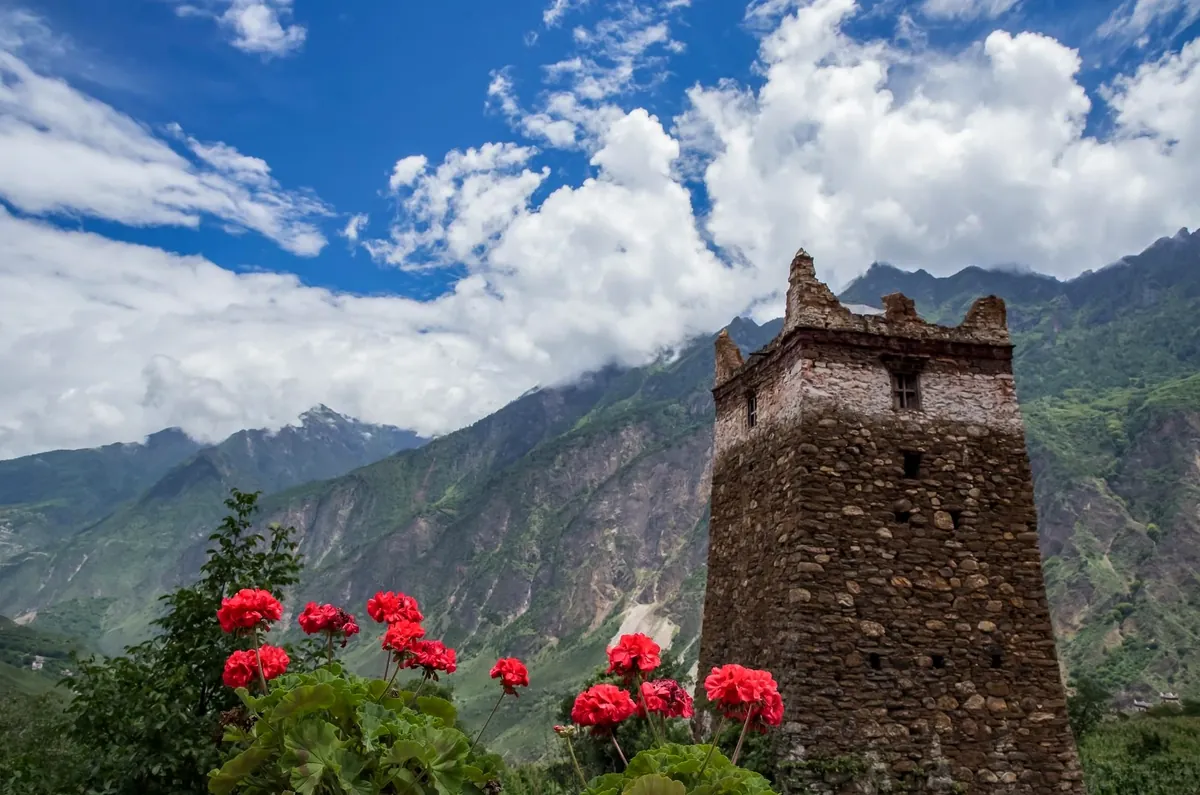
The heroic and tragic physical vestiges of that turbulent era are still clearly visible today through the system of thousand-year-old stone watchtowers known as Diaolou (碉楼), standing proudly and scattered across the Rilong Valley and steep slopes. Built entirely from natural slate combined with mud using the Gyalrong people’s unique dry-stone masonry technique, these multi-story fortresses once served dual functions as long-range military observation posts, smoke-and-fire signal stations, and sturdy defensive combat fortifications against the Eight Banners army. Today, these silent Diaolou towers standing amidst the mountain mists not only testify to masterful indigenous architectural skills but also serve as living embodiments of an indomitable spirit through feudal political upheavals.
Entering the modern era, Siguniang’s status has shifted spectacularly from a treacherous combat outpost into a focal point for international ecological and heritage conservation. In 1982, the provincial-level nature reserve was officially established, quickly placing this mountain on the list of China’s top ten adventure mountaineering destinations. In 1994, the State Council approved it as a National Scenic Area, before it was comprehensively upgraded to a National Nature Reserve in 1996. The most brilliant historical milestone took place on July 12, 2006, when UNESCO officially recognized Siguniang as a World Natural Heritage site within the Sichuan Giant Panda Sanctuaries. The destination’s reputation continued to soar as it achieved the National 5A Tourist Attraction standard in 2024 and was inscribed as a Global Geopark, affirming its position as an invaluable natural and historical treasure on the global map.
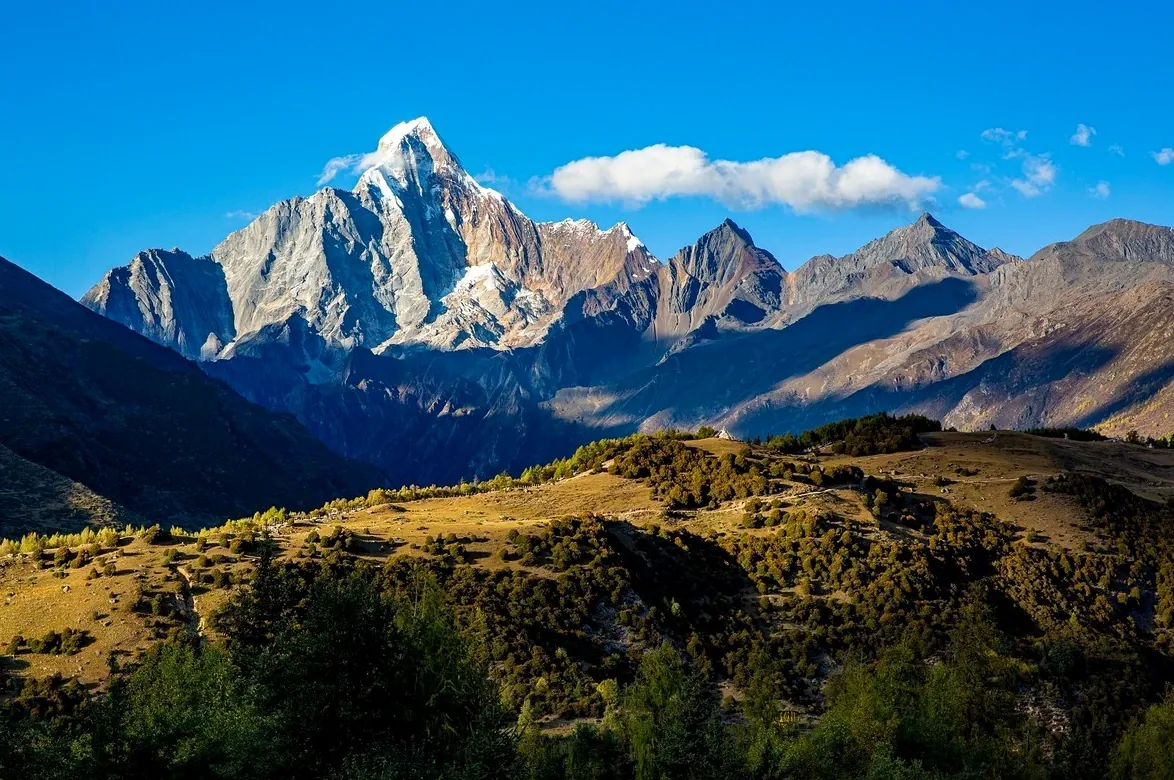
Viewed from the perspective of geomorphology and geomantic mountain ranges, Mount Siguniang guards the eastern edge of the vast Qinghai-Tibet Plateau, belonging to the undulating Hengduan mountain system and stretching along the spine of the majestic Qionglai Mountains, located entirely within the volatile Longmenshan tectonic fault zone. The local stratigraphic history records the violent movements of the lithosphere originating from the collisional mountain-building between the Indian and Eurasian plates during the Tertiary Period about 65 million years ago, before being intensely uplifted during the Quaternary Period two to three million years ago. The foundational structure of this entire complex primarily consists of massive intrusive granite blocks, interspersed with paleozoic metamorphic rocks and sedimentary rock layers subjected to extreme compressive stress. Through millions of cycles of glacial erosion and harsh periglacial weathering processes, nature has sculpted razor-sharp, vertical cliffs resembling countless giant swords piercing straight into the azure sky.
This magnificent terrain branches into a stunning harmonious Four Peaks system, arranged from lowest to highest running generally from south to north. Starting with Da Feng (First Peak) at an altitude of 5,025 meters with relatively gentle slopes, it has become an ideal trekking route for those wishing to conquer the challenging five-thousand-meter threshold. Next is Er Feng (Second Peak) at an altitude of 5,276 meters, where sharp scree slopes alternate with patches of permanent ice and snow, requiring semi-professional climbing skills. Surpassing the others in ruggedness is San Feng (Third Peak) at 5,355 meters, featuring breathtaking vertical rock walls that challenge all high-technical mountaineering standards. Located at the proudest position of the main ridge is Yaomei Feng – the "Youngest Sister" peak standing at 6,250 meters, with detailed survey measurements reaching 6,247.8 meters. This flawless, vertical ice-and-snow pyramid combined with granite is dubbed the "Queen of Sichuan Mountains," the highest peak of the Qionglai range and the second-highest mountain in all of Sichuan, second only to the towering Mount Gongga at 7,556 meters.
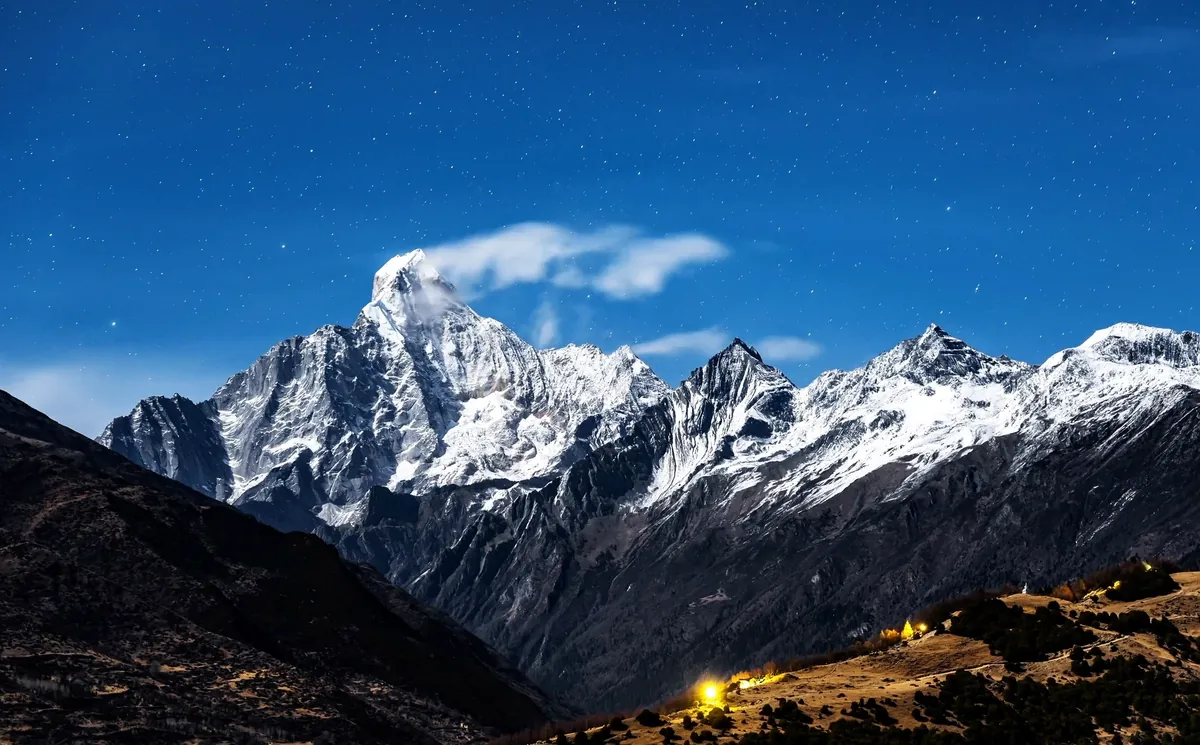
As night falls over the mountainous region, the entire overlapping mountain range appears deeply solitary and majestic beneath a profound night sky dotted with countless twinkling stars. The towering snow-capped peak at the center proudly stands amidst the serene expanse, embraced by wispy white clouds drifting lazily across the cold granite slopes. In contrast to the eternal majesty of nature, the lower hillsides on the right shimmer with warm yellow lights glowing from small structures and expedition tents, creating a quiet and magical note amidst the snow-covered wilderness.
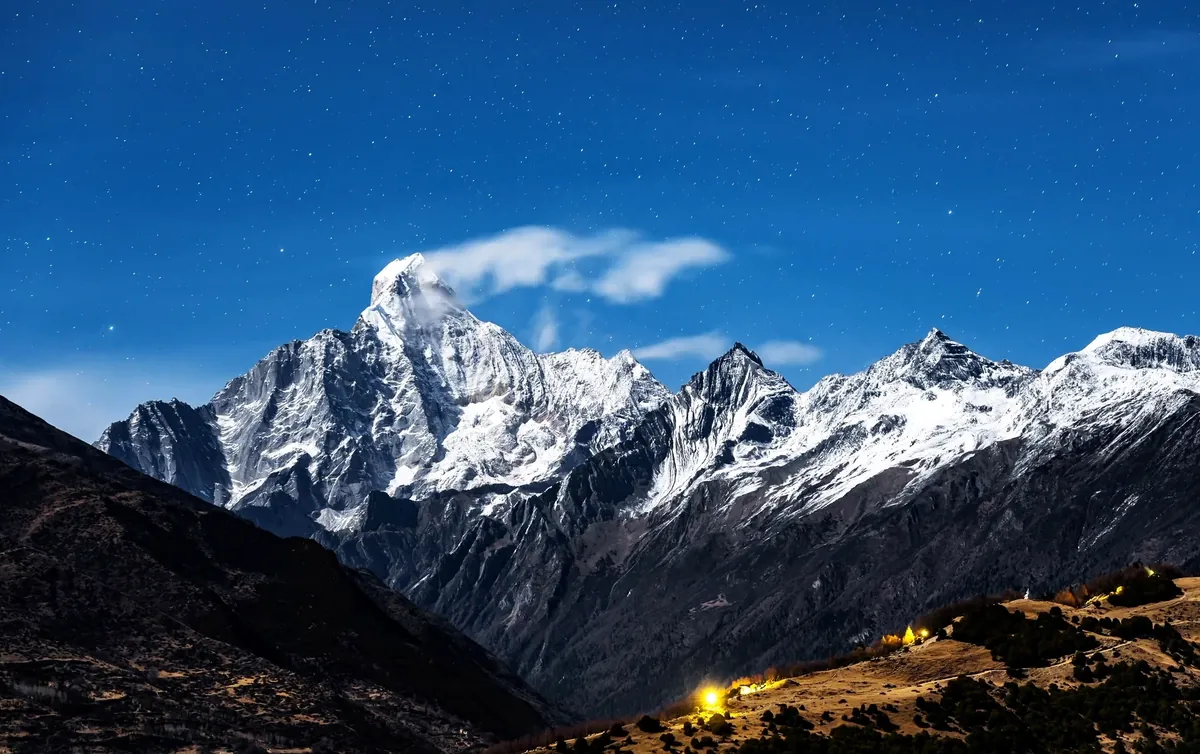
The enduring vitality of Mount Siguniang also stems from its abundant hydrological system and vast paleoglacier network. It currently preserves more than 82 modern glaciers covering a total area of about 40 square kilometers, serving as gigantic freshwater reservoirs nurturing an entire pristine ecosystem. Under the millennia-long erosion of slowly moving glaciers, the terrain has shaped unique U-shaped flat-bottomed valleys. Along the valley floors are dense temperate coniferous forests and ancient red spruce forests that remain evergreen year-round, before smoothly transitioning into soft alpine meadows in the sub-high mountain zone. Adorning this otherworldly scenery is a system of crystal-clear high-altitude glacial lakes, such as Dagaihai Lake at an altitude of 3,800 meters and Huahai Lake brimming with jade-blue waters, perfectly mirroring the four snowy peaks to create a breathtaking landscape painting of the southwestern mountains.
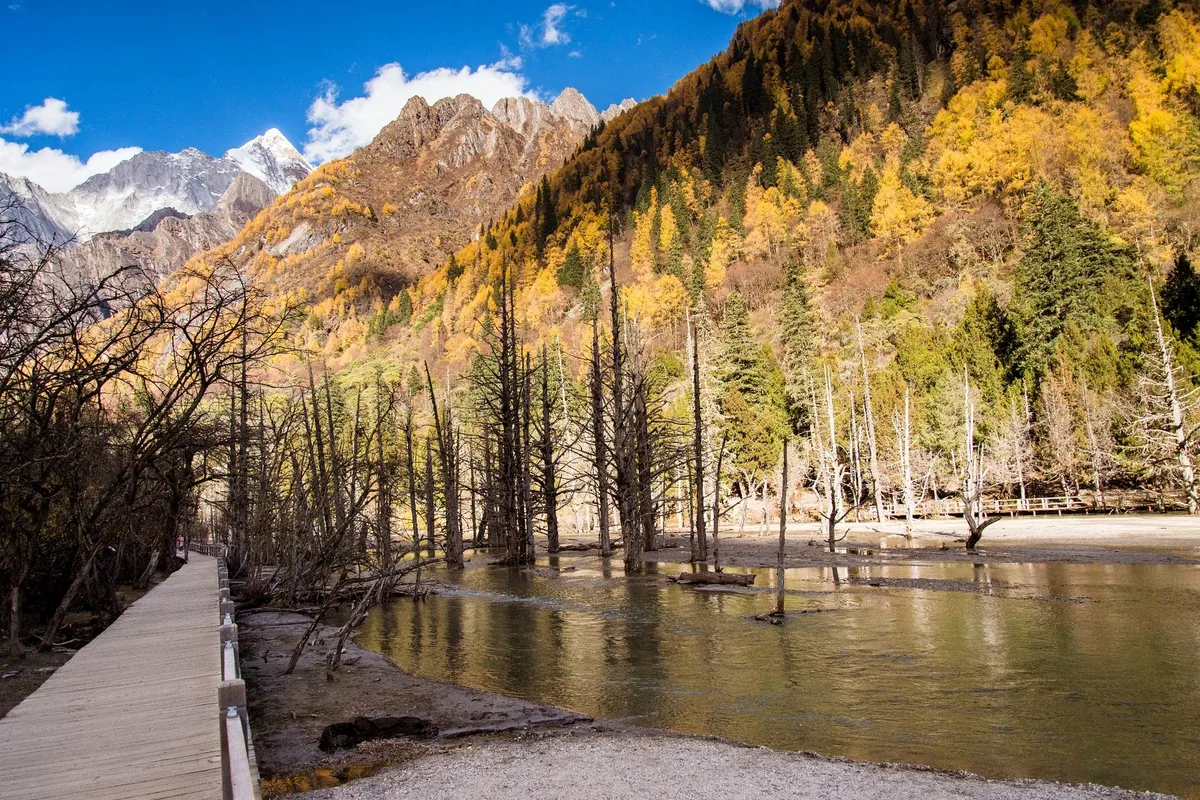
The spatial planning of Siguniang is structured around the “Three Valleys, One Peak” core concept, allocating conservation and accessibility functions across three valleys with entirely distinct topographical features. In terms of convenience, Shuangqiao Valley, stretching 34.8 km, is the most fully developed scenic route operated entirely by specialized eco-buses. This route guides visitors through tiered landscapes, from the Red Spruce Forest (Hongshanlin) at an elevation of 3,840 m and the sheer cliffs of Potala Peak, to the Siguniang Livestock Meadow and the tranquil Old Tree Lake reflecting ancient trees. Conversely, Haizi Valley, spanning 19.2 km, is preserved in an absolutely pristine state with neither wooden boardwalks nor motorized infrastructure, maintaining only rugged trails that serve as base camp access routes for professional mountaineering teams conquering Dafeng and Erfeng Peaks.
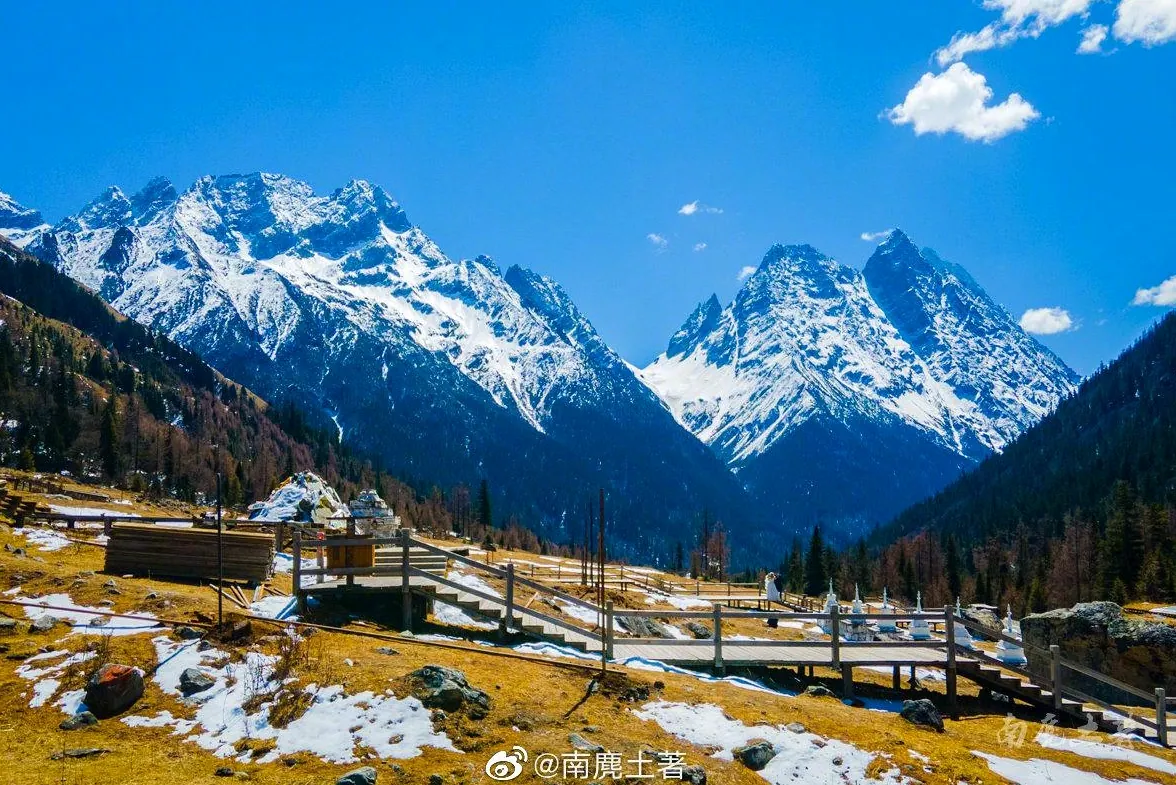
Located in the transitional zone between the two extremes above is Changping Valley, with a length of 29 km, beginning with a 7 km bus ride that takes visitors to the serene Lama Temple before continuing onto a network of elevated wooden boardwalks winding through cascading waterfalls and the dry boulder flats of Dead Tree Beach (Kushutan). As one ventures deeper into the heart of the valley toward the Mule Camp (Mulvzi) station at the foot of the magnificent Siguniang Mountain’s Western Peak cliff, all motorized vehicles completely yield to the primitive mode of travel on foot or traditional packhorse rides offered by the highlanders.
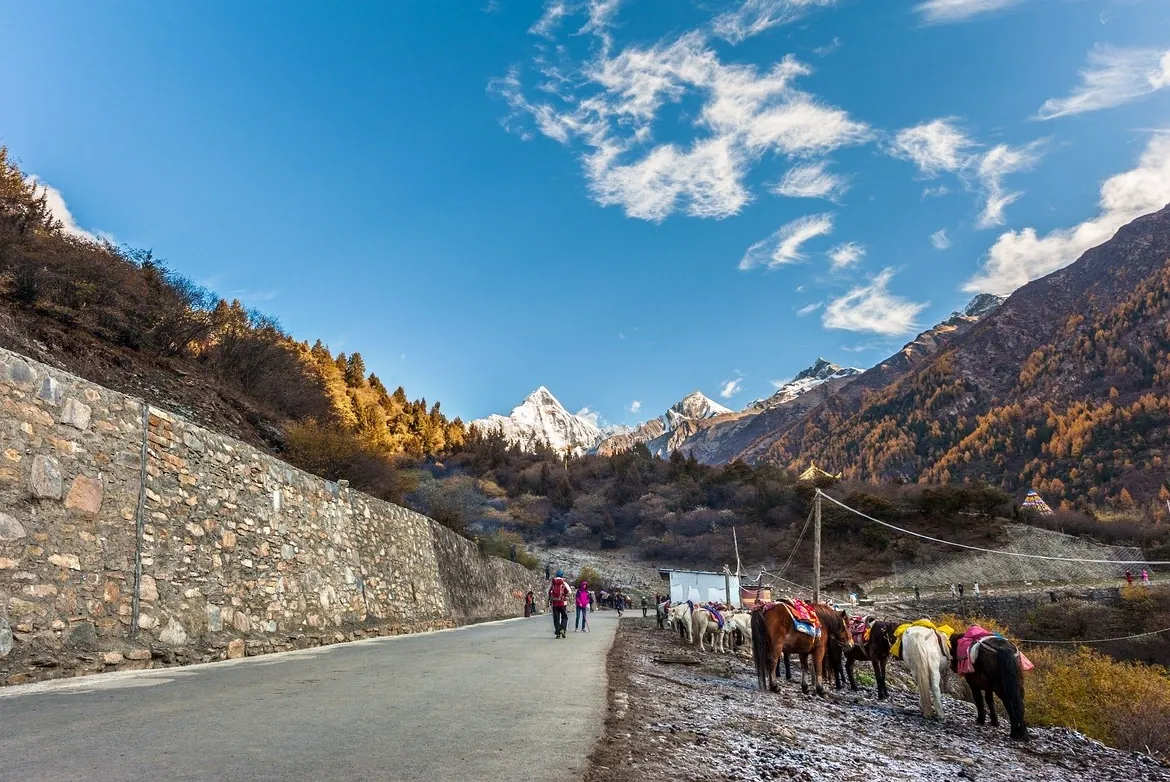
Following the winding trail amidst the valley slopes, the scenery comes alive with a rustic gravel dirt path nestled against a sturdy stacked stone wall on the left. In the distance, permanently snow-covered mountain ranges rise majestically beneath a crystal-clear blue dome of sky dotted with drifting wisps of white clouds. Along the right side of the path, groups of travelers leisurely stroll beside mountain horses outfitted with vibrant, brightly colored ethnic saddles, patiently waiting. The surrounding mountain vegetation gradually turns into rich autumn-hued golden-orange tones, perfectly capturing the peaceful rhythm of high-altitude expedition travel.
Running parallel to the magnificent nature is the architectural heritage of the indigenous Jiarong Tibetan people, highlighted by the unique Dry Stone Masonry technique passed down through generations. Without using modern mortar, but instead utilizing mineral clay combined with hand-chipped stone slabs erected on load-bearing wooden frames, the house walls are crafted with a foundation thickness of up to 60–80 cm, tapering toward the top. This clever structure not only enhances seismic dissipation but also stores solar radiation heat during the day to warm the living space when nighttime temperatures plummet to minus 15 degrees Celsius. Interspersed among the villages are polygonal Diaolou watchtowers standing 20 to 30 meters tall made of slate, solid military defensive relics dating back to the Jinchuan pacification campaigns during the Qianlong reign of the Qing Dynasty. The artistic mastery is further revealed subtly in window frames made of cedar wood carved with the Eight Auspicious Symbols of Vajrayana Buddhism, vibrant with strongly contrasting colors like vermillion red, turmeric yellow, pristine white, and deep indigo blue.
The millennium-long isolation of the Siguniang mountain region has been completely shattered thanks to century-scale infrastructure projects. The Balang Mountain Tunnel, 7,954 meters long and situated at an elevation of 3,850 meters along the G350 National Highway, has officially eliminated 30 km of dangerous mountain pass roads across the 4,487-meter Balang peak which were prone to frequent landslides and icing, shortening the 220 km overland journey from Chengdu to just about 3.5 to 4 hours of driving. More remarkably, the Dujiangyan – Siguniang Mountain tourist railway has a total length of 123.18 km, overcoming a spectacular elevation difference from 600 m to 3,200 m using advanced Swiss Abt and Strub rack-and-pinion technologies. This engineering system allows the train to operate smoothly at a speed of 120 km/h on flat terrain and climb steep gradients of over 80‰ at speeds of 30–40 km/h, opening a modern ecological connectivity era that brings travelers from the Sichuan plains to the foot of the snow mountains in less than two hours.
As the setting sun begins to slant across the treacherous gorges of the Kadar Gang range, the nature of Siguniang showcases one of the most magnificent light symphonies in Eastern Tibet: the optical phenomenon known as "Sunlit Golden Mountain" (日照金山). At the twilight moment of transition between day and night, roughly between 5:30 PM and 6:30 PM depending on the season, the last rays of the day cast an oblique angle through the thin atmosphere, brilliantly dyeing the peak of Yaomei Feng and the majestic Four Peaks range. The pristine silver-white snow rapidly transforms into a brilliant golden hue resembling pure gold leaf, before gradually fading into a gorgeous pinkish-orange and mysterious deep purple against the quiet sky. For the indigenous Jiarong Tibetan people, the moment the mountain gods don robes gleaming with golden light is not merely a breathtaking spectacle, but also a sacred auspicious sign—a time when humans bow in reverence to pray for the Mountain Mother’s blessing of peace and harmony for the villages.
When the golden light fades to give way to the deep black night, the plateau space at an altitude of over 3,200 meters instantly transforms into a pristine astronomical sanctuary. Unlike urban areas suffocated by artificial light, the core region of Siguniang boasts a dry, clear, and exceptionally pure atmosphere, meeting all the stringent conditions of an international dark sky reserve. Standing by the pristine meadows along the lakes in Haizigou or amidst the quiet Rilong Valley, travelers only need to raise their eyes to take in the entire Milky Way, rolling like a silver river across the vault of the sky. Millions of stars twinkle like dense diamond dust, embracing the ancient jagged ice peaks, creating a surreal composition between the eternity of the universe and the silent solitude of the eternal snow mountains.
In contrast to the bone-chilling cold of the snow and frost and the solitude of the starry sky, the nightlife at the central square of Siguniangshan Town bursts with the warm glow of community spirit and ancient cultural identity. As darkness envelops the sturdy stone houses, a giant bonfire is lit and crackles to life, signaling the start of the Guozhuang Dance (锅庄舞). Jiarong Tibetan people in traditional attire trimmed with brilliant five-color threads and travelers from afar hold hands tightly, forming open concentric circles around the bonfire. Footsteps stamp rhythmically to the rapid tempo, blending with the resonant Tibetan stringed instruments and the echoing call-and-response folk songs that resound across the foot of the mountain. The dance movements slow down and then quicken with enthusiastic cheers, completely dispelling the chill of the freezing plateau and erasing any language barriers between distant travelers and local residents.
The plateau night concludes fully in the ambiance of upscale boutique resorts hidden along the slopes, typically represented by Starlight Gyalrong or Siguniangshan Jinkun. To bring absolute relaxation and relieve anxieties about altitude sickness, the guest rooms here are equipped with a closed-loop micro-oxygen enrichment diffusion technology along with warm underfloor heating. Travelers can recline by the floor-to-ceiling panoramic glass windows of the mezzanine bar, sipping a warm cup of butter tea or smooth barley wine, quietly gazing at the ethereal ice and snow fortress under the freezing blue moonlight, and feeling the ultimate harmony between the profound wildness of the great forest and the ultimate serene comfort.
At an extreme altitude of over 3,000 meters above sea level, where freezing gales howl year-round through the gorges of the Four Girls Mountain range, the culinary culture of the Rgyalrong and Tibetan communities is not merely an art of tasting, but above all, a supreme instinct for survival. Unlike the elaborate, fiery complexity characteristic of Sichuan basin cuisine with its layers of chili oil, meals in the high-altitude Xiaojin region are a concentration of dense energy, rich in plant and animal lipids and proteins to generate heat against the bone-chilling cold. Every dish and heirloom drink here carries the very breath of the snow-mountain grasslands, virgin primeval forests, and the harsh soils of the boundless Hengduan range.
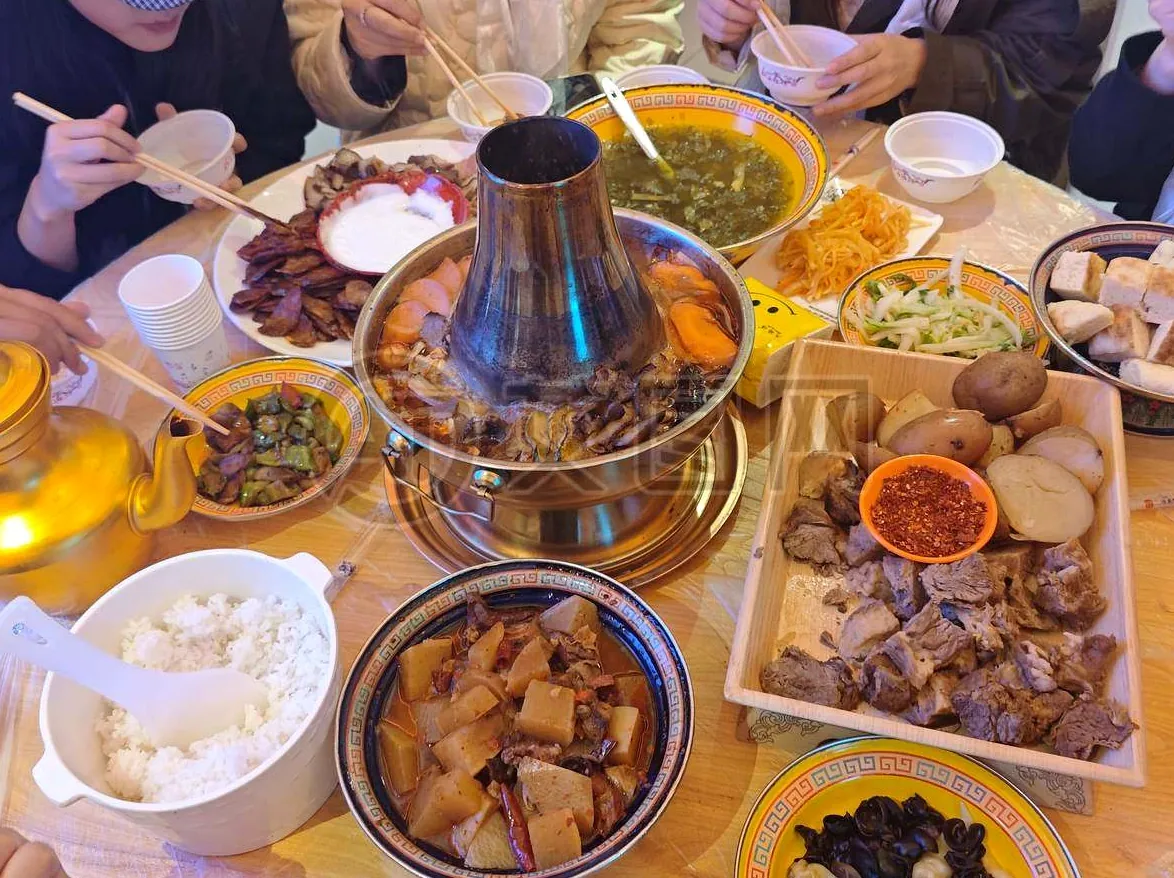
Reigning in the place of honor at grand feasts welcoming esteemed guests on deep winter nights in the highlands is the highland yak meat hotpot. These long-haired Tibetan cattle grow wild on snow-kissed slopes, drinking water melted from permanent glaciers, creating dark red, firm meat fibers packed with minerals and virtually free of excess fat. The hotpot broth does not overuse satay or sharp Sichuan peppercorns, but is patiently simmered for many hours from massive beef shin bones, skillfully paired with precious medicinal herbs such as Codonopsis pilosula, Astragalus, goji berries, and red dates. When the copper hotpot bubbles over glowing charcoal, each thinly sliced piece of beef dipped just until cooked retains its succulent tenderness, melting harmoniously with the pure sweetness of wild mushrooms, instantly warming the capillaries of the faraway traveler.
Alongside precious animal protein, the soul of a thousand-year nomadic lifestyle is also encapsulated in the traditional bronze-banded wooden churning tube known as a Dongmo. This is where shimmering butter tea is born, boiled and frothed from strong Tibetan black tea leaves, then churned intensely with rich butter skimmed from fresh yak milk and highland mineral salt crystals. The golden butter layer covering the surface of the tea bowl not only rapidly replenishes calories and balances electrolytes for those experiencing altitude sickness, but also creates a natural moisturizing film to protect lips from cracking in the dry cold. From the hot bowl of butter tea, locals take finely roasted highland barley flour, mix it with dry yak cheese and a touch of rock sugar, and swiftly knead it by hand into pliable balls of Zanba pastry. This compact ration is an indispensable source of pocket vitality in the gear of guides traversing treacherous snow passes.

When summer rains drench the slopes of Four Girls Mountain from July to September, the vegetation beneath ancient oak and pine forests awakens one of the most prized delicacies: royal matsutake mushrooms. Fresh mushrooms still smelling of damp earth are carefully harvested by hand, sliced, and stir-fried with cured pork. Slabs of salt-cured pork hung over the kitchen hearth all winter long, imbued with the aromatic smoke of decayed pine wood, release a deeply savory, delightfully crunchy yet ethereal flavor when combined with matsutake mushrooms. The mountain meal becomes even more poetic when punctuated by a plate of wild Shige Cai greens growing naturally on cliff faces, quickly stir-fried with garlic to cool the body, concluding with crisp, juicy, sweet Xiaojin red apples—a renowned sweet fruit forged from extreme day-night temperature swings.
The highland feast would not be complete without earthen jars of traditionally brewed highland barley wine. Unlike the burning spice of lowland baijiu, highland barley wine possesses a mild alcohol content of fifteen to twenty degrees, crystal-clear water, and an aftertaste as sweet as morning dew lingering on a barley grain. The wine is lovingly poured into silver cups engraved with intricate Tibetan floral patterns, accompanied by the ritual of dipping a finger to flick three drops of wine to the heavens, the earth, and the empty air to thank the mountain gods for protecting the village. Behind every bowl of steaming hotpot or cup of fragrant wine lies not merely a warming meal, but an entire cultural system of hospitality, resilience, and complete harmony with the majestic nature of the people dwelling for ages under the shadow of the four snow maidens.
The journey to the Four Girls Mountain snow range begins from the fertile Sichuan basin, following the G4217 expressway through the ancient city of Dujiangyan and entering the G350 national highway winding through the boundless bamboo forests of the Wolong Nature Reserve. The breathtaking highlight of the 220-kilometer route is the 7,954-meter Balang Mountain tunnel, piercing straight through towering rock formations to cut travel time from Chengdu to Siguniangshan town down to just 3.5 to 4 hours of driving. In the near future, the Dujiangyan – Siguniangshan mountain railway corridor (Du-Si Railway) will, upon commercial operation, compress cross-mountain travel time from the capital to under 2 hours, opening a new era for travelers passionate about alpine terrain.
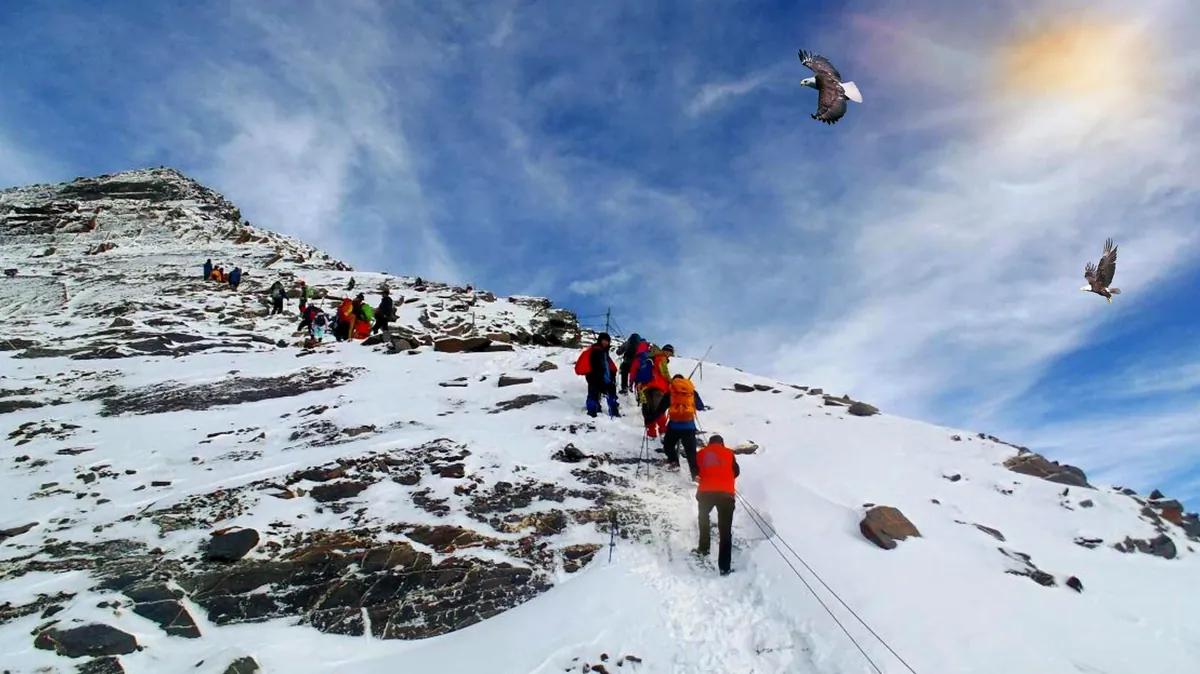
To protect the fragile ecosystem of the Qinghai-Tibet Plateau, the scenic area management strictly enforces capacity limits via real-name electronic ticketing systems using passports. Each day, Shuangqiao Valley only opens to welcome a maximum of 20,000 visitors, while the Changping Valley ecological route is capped at 4,000 visitors, and the pristine Haizi Valley accepts no more than 2,000 adventurous guests. For those yearning to cross the 3,500-meter threshold to conquer Da Feng or Er Feng, the Sichuan Mountaineering Association (SMA) sets an unyielding legal boundary: climbing permit applications must be submitted 15 days in advance, alongside the mandatory hiring of local guides or porters at a strict ratio of one guide per maximum of two guests. Unauthorized climbing without a permit will incur administrative fines ranging from 5,000 to 20,000 RMB, accompanied by deportation and a permanent entry ban to key biosphere reserves.
The greatest physiological challenge for lowlander travelers is the drop in atmospheric pressure. Siguniang Town itself stands impressively at an altitude of 3,200 meters, while the scenic valleys frequently range from 3,600 to over 4,000 meters, where oxygen density is only about 60% to 65% compared to sea level. To prevent acute mountain sickness (AMS), medical protocols recommend taking Acetazolamide (Diamox) at a dosage of 125 to 250 mg 24 hours before ascending, or regularly using Rhodiola rosea herbal extract one week prior to departure. During the first night staying at this altitude, visitors should absolutely avoid taking long hot showers, completely abstain from strong alcohol, and limit sudden strenuous physical activity. If severe symptoms such as pulmonary or cerebral edema develop, the central medical station in Siguniang Town always has a hyperbaric oxygen chamber on standby 24/7 for emergency treatment.
Each passing season in this mountainous region weaves a completely distinct visual identity. From May to June, the granite slopes awaken under blooming alpine azalea flowers along melting snow patches, with cool weather ranging from 8°C to 18°C. Entering the period from September to November, Siguniang enters its most classic and stunning golden season of the year, when fiery red maple forests and alpine fir trees turn amber, reflecting shimmeringly on the tranquil glacial lakes under temperatures of 2°C to 14°C. The period from December to March of the following year is the holy land of technical ice climbing in China, when temperatures drop deeply to minus 15°C, requiring travelers to equip specialized down jackets with a Fill Power rating of 800+ or higher, along with waterproof technical gloves and full-body thermal patch warmers.
Besides geographical factors, identifying commercial traps is also vital to preserve the complete emotions of the trip. Many suspiciously cheap tour networks often distract travelers by taking groups into "Tibetan Culture Research Institutes" or makeshift traditional Chinese medicine pharmacies in the Wenchuan and Mao County areas. Here, fake doctors diagnose pulses to scare visitors about their health and then offer fake caterpillar fungus, velvet antler, or adulterated silver jewelry at prices inflated by 800% to 1,200%, kicking back hidden commissions of 40% to 65% to the tour bus operators. The civilized and absolutely secure choice is to join standard "Pure-play" (纯玩) itineraries with written commitments of no shopping stops, dedicating a full 6 to 8 hours of daily field exploration amidst the snow-covered forests. If you discover signs of forced illicit transactions, you can call the Chinese tourist rights protection hotline directly at 12345 or 12301 for immediate intervention. To fully experience the mystical Tibetan cultural panorama combined with the icy masterpiece of the East, travelers can consider choosing the sample itinerary via Chengdu – Jiuzhaigou – Mt. Siguniang – Dujiangyan 6D5N Tour to ensure the highest medical safety standards and meticulousness throughout the journey.
