





In the early fifteenth century, the great philosopher Tsongkhapa (1357 – 1419) initiated monastic disciplinary reforms, establishing the Gelug lineage (Yellow Hat sect) along with the three great monasteries of Ganden, Drepung, and Sera. The title Dalai Lama (symbolizing “Ocean of Wisdom”) was officially established in 1578 when Altan Khan bestowed it upon Sonam Gyatso (the 3rd Dalai Lama). Religious and secular power reached absolute centralization in 1642 under the 5th Dalai Lama – Ngawang Lobsang Gyatso (1617 – 1682), when he allied with Gushi Khan to unify Tibet, establish the Ganden Phodrang government, and extensively reconstruct the Potala Palace. The intervention of the Qing court deepened when Emperor Yongzheng instituted the office of the Amban (Imperial Resident) in 1727, and by 1793, the Qianlong Emperor issued the “Twenty-Nine-Article Imperial Ordinance for More Effective Governance of Tibet”, establishing the “Golden Urn” ritual overseen by the Amban to authenticate the reincarnate souls of the Dalai Lama and Panchen Lama.
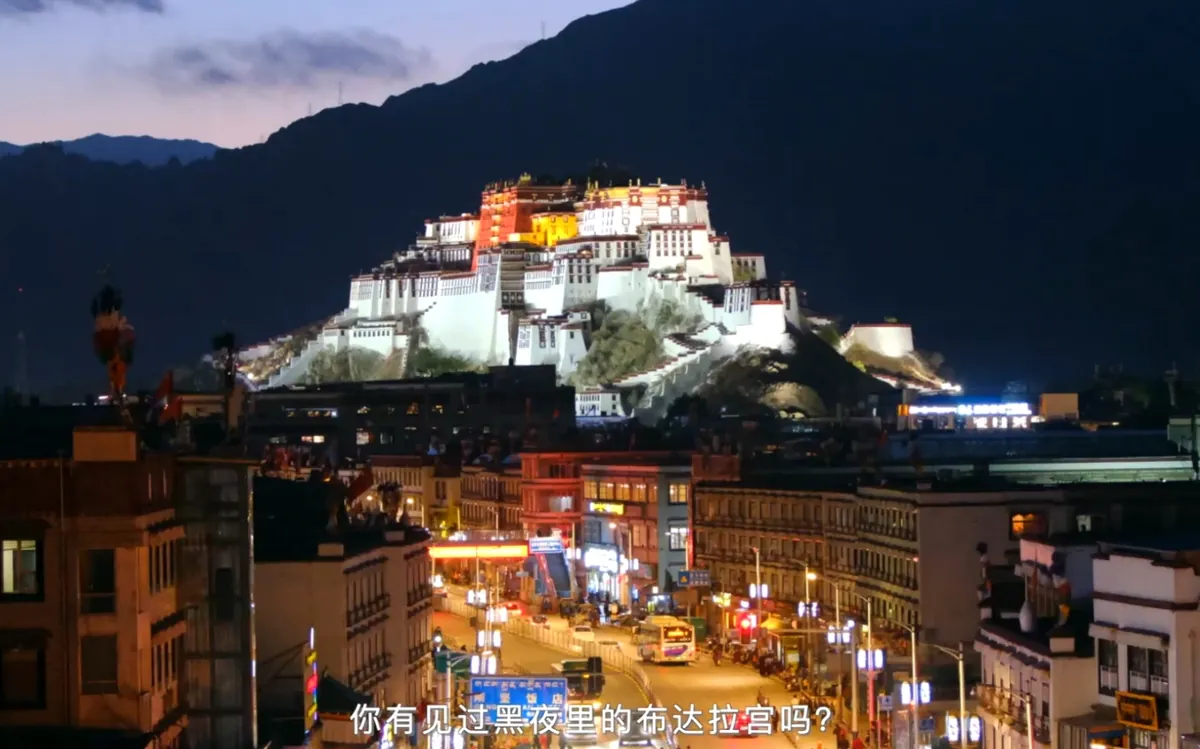
Gazing at the panoramic view of Lhasa unfolding sharply, observers are immediately captivated by the magnificent dialogue between millennial historical heritage and contemporary rhythms. Standing proudly on the Marpori hill spur in the background, the Potala Palace with its twin White and Red Palace blocks rises majestically like a sacred fortress spanning the sapphire sky. Right at the foot of this legendary structure, a modern metropolis spreads out with wide asphalted roads, bustling traffic flowing alongside solid high-rise buildings. Embracing this entire sacred and worldly space are rolling, arid, and majestic snow-capped mountain ranges in the background, forming a natural rampart that isolates yet shields the cultural heart of the snow land.
The wheel of history entering the twentieth century brought epoch-making transformations to the plateau’s regime. On May 23, 1951, the Agreement on Measures for the Peaceful Liberation of Tibet was signed, officially integrating the snow land into the state structure of the People’s Republic of China. Following profound upheavals in 1959, the 14th Dalai Lama relocated to Dharamshala in northern India, while the administration carried out the Democratic Reform movement to completely eradicate the feudal serfdom system. A pivotal administrative milestone was established on September 1, 1965, with the founding of the Tibet Autonomous Region (TAR), closing the era of theocratic isolation to enter a journey of modern integration, where layers of Vajrayana cultural sediments continue to coexist alongside the heartbeat of the new century.
Reigning at an average altitude exceeding 4,000 meters above sea level, the Qinghai-Tibet Plateau stands proudly in space like an isolated natural fortress, hailed by ancient Easterners as the “Roof of the World” and honored by modern geography as the “Third Pole of the Earth”. The terrain here was sculpted by the fierce collision of tectonic plates ten million years ago, forging a colossal barrier consisting of the rugged Hengduan mountain axis, the snow-clad Nyenchen Tanglha range, and the solid Greater Himalayas arc that completely blocks moist monsoon winds from the Indian subcontinent. From the perspective of Tantric geomancy and traditional geography, the Lhasa valley along the Lhasa River basin—the lifeline tributary of the Yarlung Tsangpo—possesses an exceptional feng shui configuration. Marpori Hill (Red Hill) and Chakpori Hill (Medicine Buddha Mountain) rise high to the left and right, guarding the heart of the plateau, creating a sacred dragon-coiling and tiger-crouching formation that thoroughly protects the spiritual and cultural heart of all of Tibet.
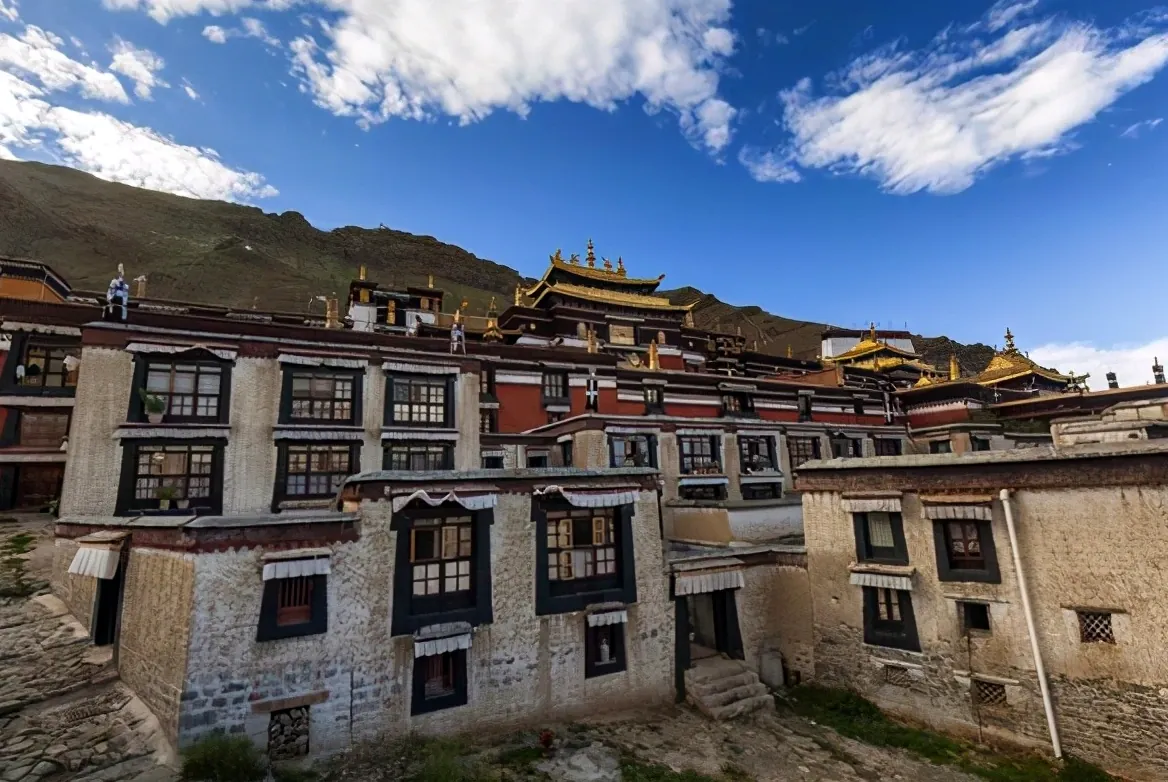
Adhering to the wind-gathering and energy-consecrating feng shui planning characteristic of the snow land, the Buddhist monasteries here are always established, firmly leaning against sheer granite rock faces. The massive monastery complex emerges majestically with solid, multi-layered architectural blocks draped in traditional white and red colors symbolizing boundless compassion and wisdom. Dark wooden windows with somber black borders highlight each steep wall, while the brightly gilded roof ridges sparklingly reflect rays of light under the azure highland sky and wispy white clouds hovering around the peaks of the sacred mountains.
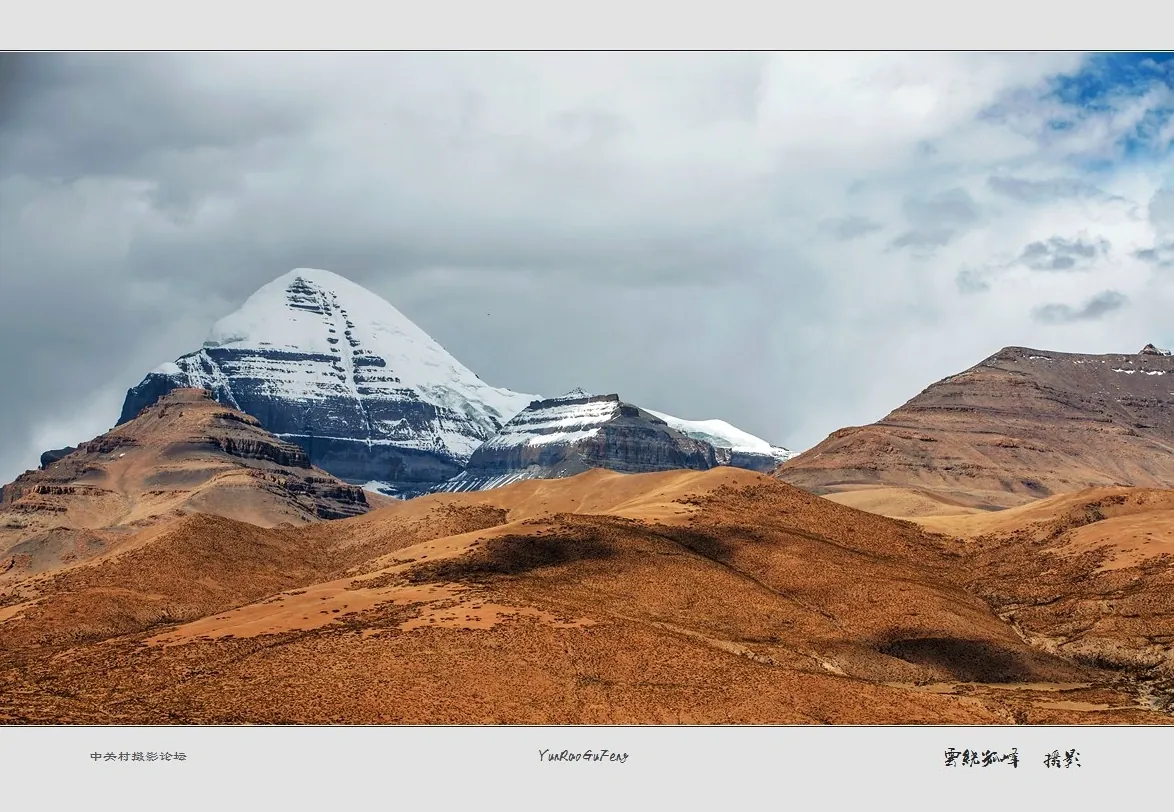
The grandeur of the plateau terrain is vividly crystallized through a system of mystical sacred mountains, culminating in the majestic Mount Kailash at an altitude of 6,638 meters in the rugged Ngari (Ali) wilderness. Far more than just a geological wonder with its perfectly symmetrical, four-sided snow-white pyramid, Kailash is revered as the inviolable Axis Mundi at the core of four major religions: Tibetan Esoteric Buddhism, Hinduism, Jainism, and the indigenous Bön tradition. Flowing toward the natural border between China and Nepal, Mount Everest (Qomolangma) soars to an elevation of 8,848.86 meters, offering panoramic vistas from the Everest Base Camp at an altitude of 5,200 meters, where pristine glacial landscapes display nature’s ultimate power.
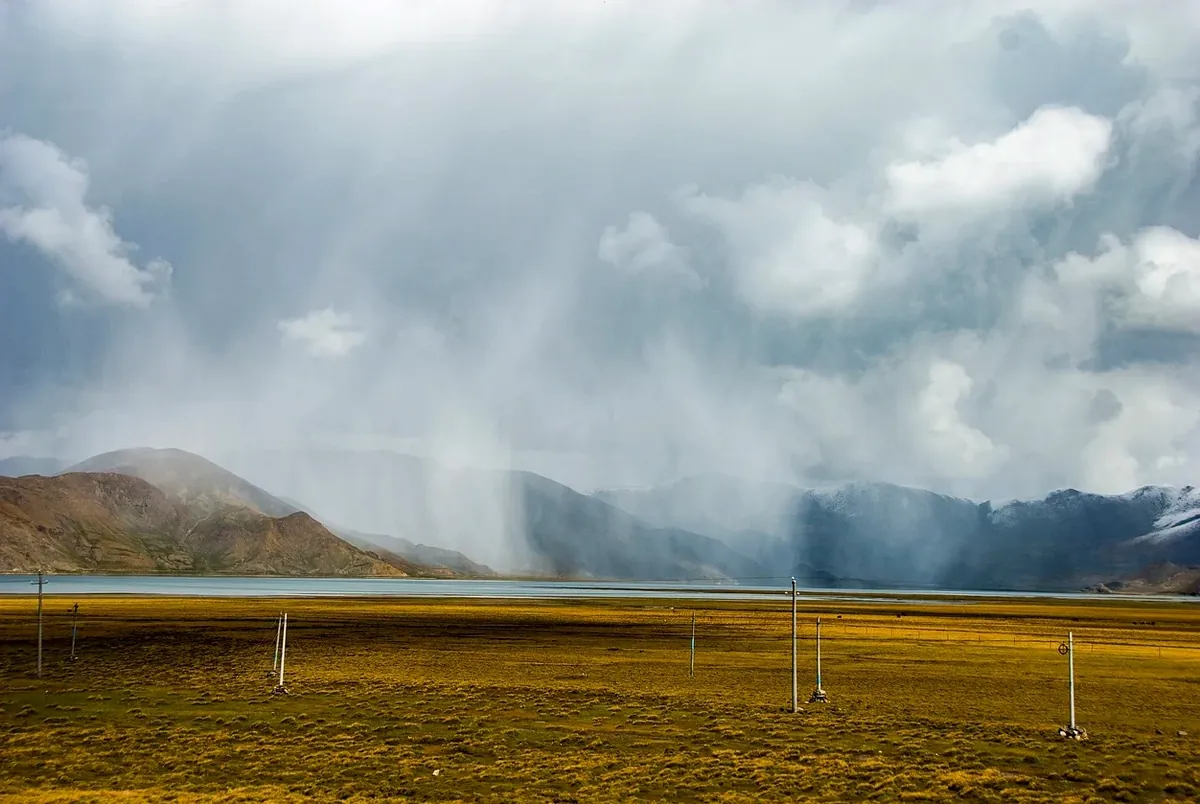
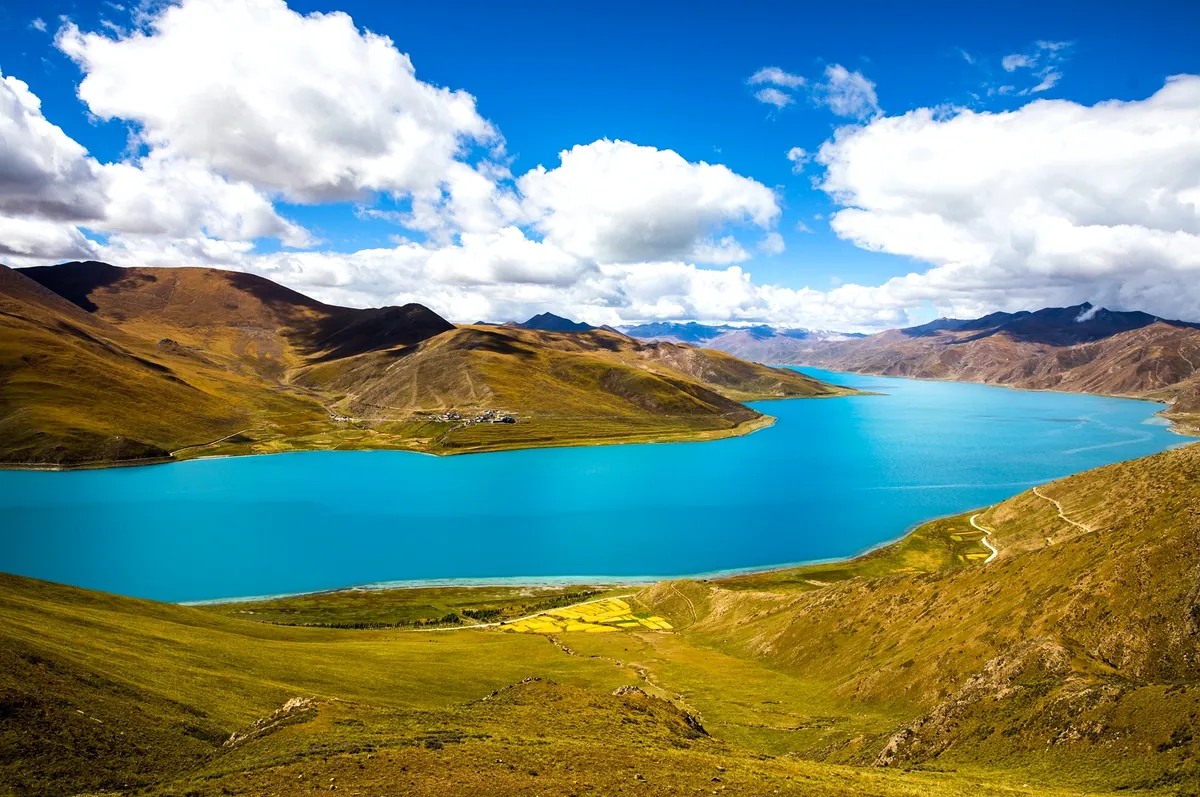
Accompanying these snow-capped peaks is a surreal network of three great sacred lakes. Lake Yamdrok rests impressively at an altitude of 4,441 meters, winding softly like a turquoise coral branch amidst rolling barren rocky mountains. To the north, Lake Namtso at 4,718 meters holds the title of the highest saltwater lake on the planet, lying tranquilly to mirror the majestic Nyenchen Tanglha range against waters so clear they pierce the floating clouds. Completing this sacred water triangle is the freshwater Lake Manasarovar at 4,590 meters, adjacent to Mount Kailash, preserving pristine water flowing from millennia-old glaciers as a symbol of absolute purification for the mortal realm.
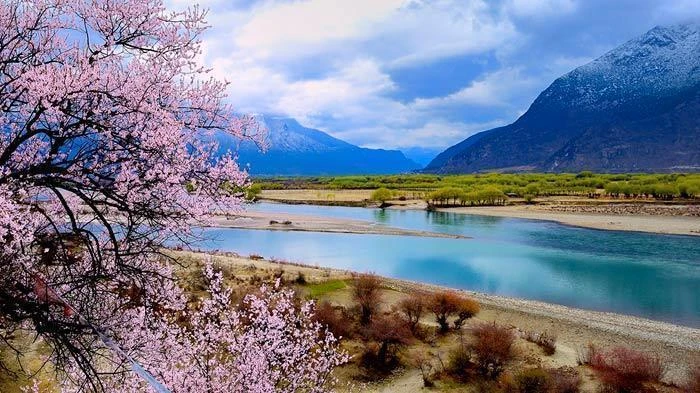
Tibet’s geomorphological transformation is further vividly portrayed through breathtaking gorges and high mountain passes. The Yarlung Tsangpo Grand Canyon tears through mountain ranges with the world’s greatest depth, near the Three Parallel Rivers region where the Jinsha, Lancang, and Nujiang rivers surge side by side through 72 legendary hairpin turns. Mountain passes exceeding 5,000 meters—such as Tanggula Pass (5,072 meters), Gyawu La Pass (5,210 meters, capturing five 8,000-meter peaks of the Himalayas in a single view), Lakenla Pass (5,190 meters), or Dolma La Pass (5,630 meters)—are rigorous challenges dividing distinct climatic sub-regions. This stark contrast is clearly visible when placing the icy Ngari wilderness side by side with the downstream Nyingchi Valley at a mere 2,900 meters elevation, which captures moisture-laden currents from the Indian Ocean to create sprawling primeval forests and a paradoxically lush subtropical microclimate.
The ultimate symbol of the Tibetan plateau’s architectural philosophy—combining a defensive Dzong with a monastery—reigns supreme at the Potala Palace, standing magnificently on the slopes of Red Hill at an elevation towering far above the Lhasa Valley. This monumental structure stands 110 to 117 meters high, spanning 13 stories with over 1,000 large and small rooms, covering a footprint of 36,000 square meters and a total floor area of up to 138,025 square meters. The overall layout adheres to a deeply symbolic dual-zone structure: the White Palace wraps around the exterior with pristine white stone walls representing compassion and tranquility, serving as the administrative power center of the Ganden Phodrang government and the living quarters of successive Dalai Lamas; in striking contrast, the brilliant Red Palace towers at the center, symbolizing supreme authority and boundless prajna wisdom. This inner sanctum houses gilded stupas containing the sacred remains of revered masters, among which the stupa of the Fifth Dalai Lama is plated with up to 3.7 tons of pure gold and studded with over 20,000 rare diamonds, rubies, and emeralds.
The centuries-long endurance of the Potala fortress against fierce geological shocks stems from sophisticated indigenous engineering solutions. The entire foundation is anchored directly into the bedrock of Marpori Hill, supporting granite stone walls ranging from 2 to 5 meters thick at the base and tapering gradually toward the peak, creating a sturdy sloping posture that lowers the architectural center of gravity. At critical load-bearing junctions, ancient builders poured molten iron directly into the gaps between stone blocks to tightly lock the masonry, enhancing earthquake shock-wave dissipation. Furthermore, floors and ceilings were crafted using Arga—a local lime-mud mortar seasoned with arborvitae leaf decoction and rich yak butter, then manually tamped for months to produce an elastic, marble-smooth surface with exceptional waterproofing. The cornice trim along the roofline is made from bundled desert red willow branches cut flat and painted in deep red, significantly reducing the downward weight on the stone walls while acting as a cushion to dampen the howling storm winds across the plains.
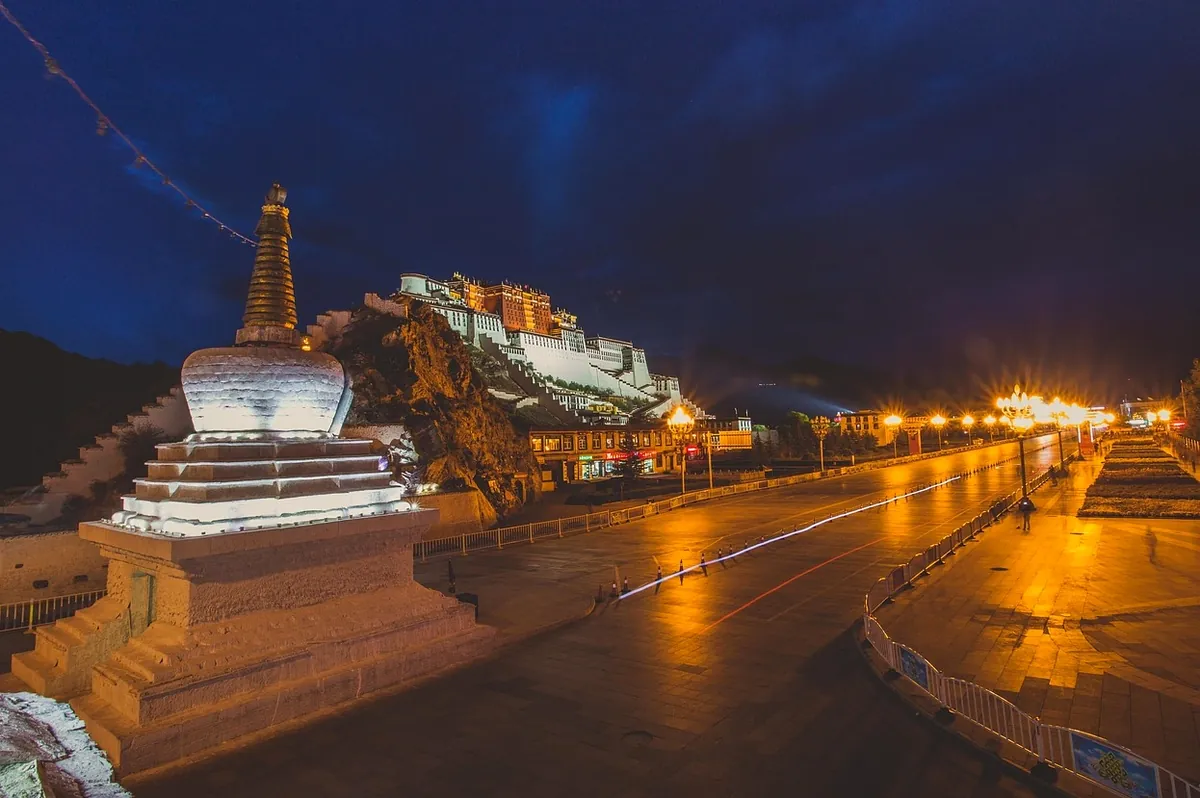
As night falls over the Lhasa Valley, the snow-white holy city dons a magnificent, mystical guise through a visual dialogue between millennia of history and contemporary life. In the lower left foreground, a serene white stupa glows brilliantly under bright floodlights, majestically guiding the gaze toward the backdrop where the Potala Palace atop Red Hill is illuminated as magnificently as a castle suspended in mid-air. At the foot of this wonder, a wide boulevard opens up an expansive perspective with neat street lamps and continuous streams of light from traffic, running alongside warm urban architecture to weave a magical tapestry blending spiritual solemnity with modern vitality.
If the Potala Palace reigns supreme in terms of temporal power and defensive scale, the Jokhang Temple is truly the most sacred spiritual heart of Tibet, nestled peacefully in the center of the ancient city across a sprawling 25,100-square-meter complex. Commissioned by Tibetan King Songtsen Gampo in 647 AD, the four-story main hall is designed according to the esoteric Buddhist Mandala. The structure is a perfect crystallization of various Asian civilizations: the load-bearing frame and intricately carved wooden rafters echo the artistic style of the Licchavi dynasty in Nepal, while the pillars evoke ancient Indian temple architecture, all harmoniously blended with the gracefully curved, gold-plated copper roof tiles characteristic of the Tang Dynasty. Inside the tranquil inner sanctum, thick with the scent of yak butter, sits the 12-year-old statue of Sakyamuni Buddha brought from Chang’an by Princess Wencheng—a supreme pillar of faith that has drawn millions of devotees to perform the prostration pilgrimage for generations.
Alongside these ancient legacies, modern infrastructure investment on the “Roof of the World” continues to set extraordinary records in construction technology. The 1,956 km Qinghai-Tibet Railway successfully conquered 550 km of permafrost using a network of self-regulating ammonia-filled heat pipes, keeping the geological foundation stable despite extreme temperature fluctuations. The trains operating on this line are designed like terrestrial spacecraft, featuring hermetically sealed bodies to prevent pressure drops, specialized UV-filtering glass, and a dual oxygen supply system that maintains levels between 24% and 25%, ensuring passengers safely traverse the Tanggula Railway Station at a record-breaking altitude of 5,072 meters. This feat continues with the 1,629 km Sichuan-Tibet Railway connecting Chengdu and Lhasa, where bridges and tunnels account for over 90% of the route, paving the way for the dual-mode electric-diesel Fuxing CR200JS-G high-speed trains to slice through the clouds on the treacherous Lhasa-Nyingchi section.
As the deep purple twilight descends upon the Lhasa valley, Tibet dons a mystical appearance, completely distinct from its daytime solemnity. Under a sophisticated artistic lighting system, the Potala Palace complex perched on Marpo Ri hill glows brilliantly against the deep blue plateau sky, highlighting the steep, majestic walls of the White and Red Palaces. The artificial lake in front of the Potala square remains still, acting as a giant mirror that perfectly reflects the thousand-year-old fortress in a mesmerizing water-reflection effect. From the nearby foot of Yaowang (Medicine King) Mountain, visitors and the people of the snow land stand silently for hours to admire the masterpiece of Tubo architecture shining luminously in the cold plateau wind, where modern light honors ancient sanctity.
The rhythm of urban life in Tibet retains its ancient breath through every house and stone-paved path winding around the central streets. Along the bustling traditional thoroughfares, sturdy multi-story stone houses in the distinctive Tibetan style stand out with intricately carved wooden window frames, flowing five-colored curtains, and balconies vibrant with fresh flowers. Under the drifting clouds of the plateau sky, locals in traditional Chuba robes stroll leisurely, blending naturally with travelers from afar, while in the distant horizon, towering snow-capped mountain ranges proudly embrace the peace of this thousand-year-old city.
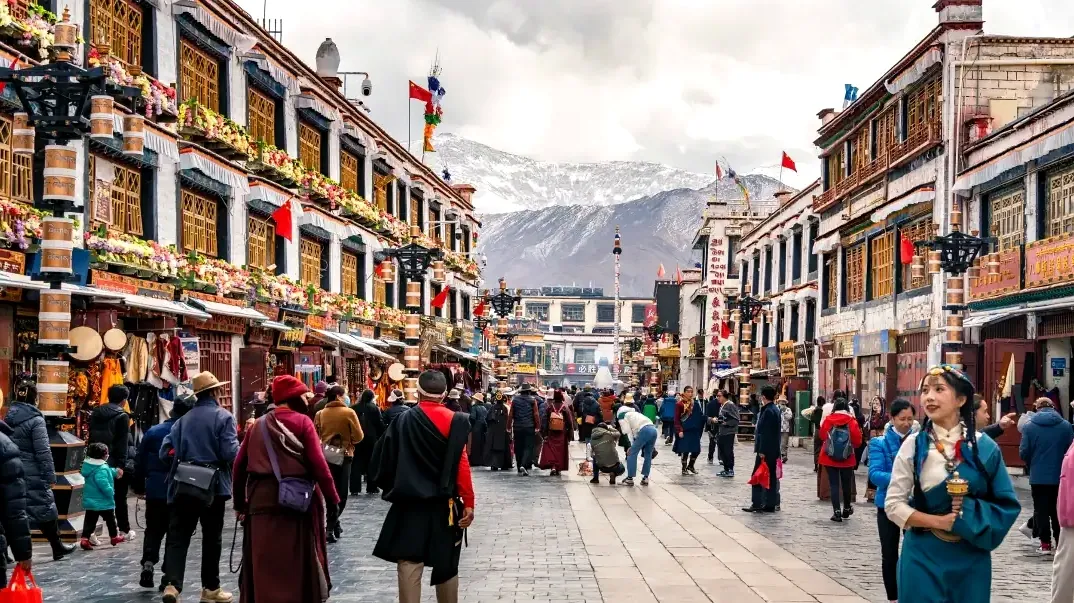
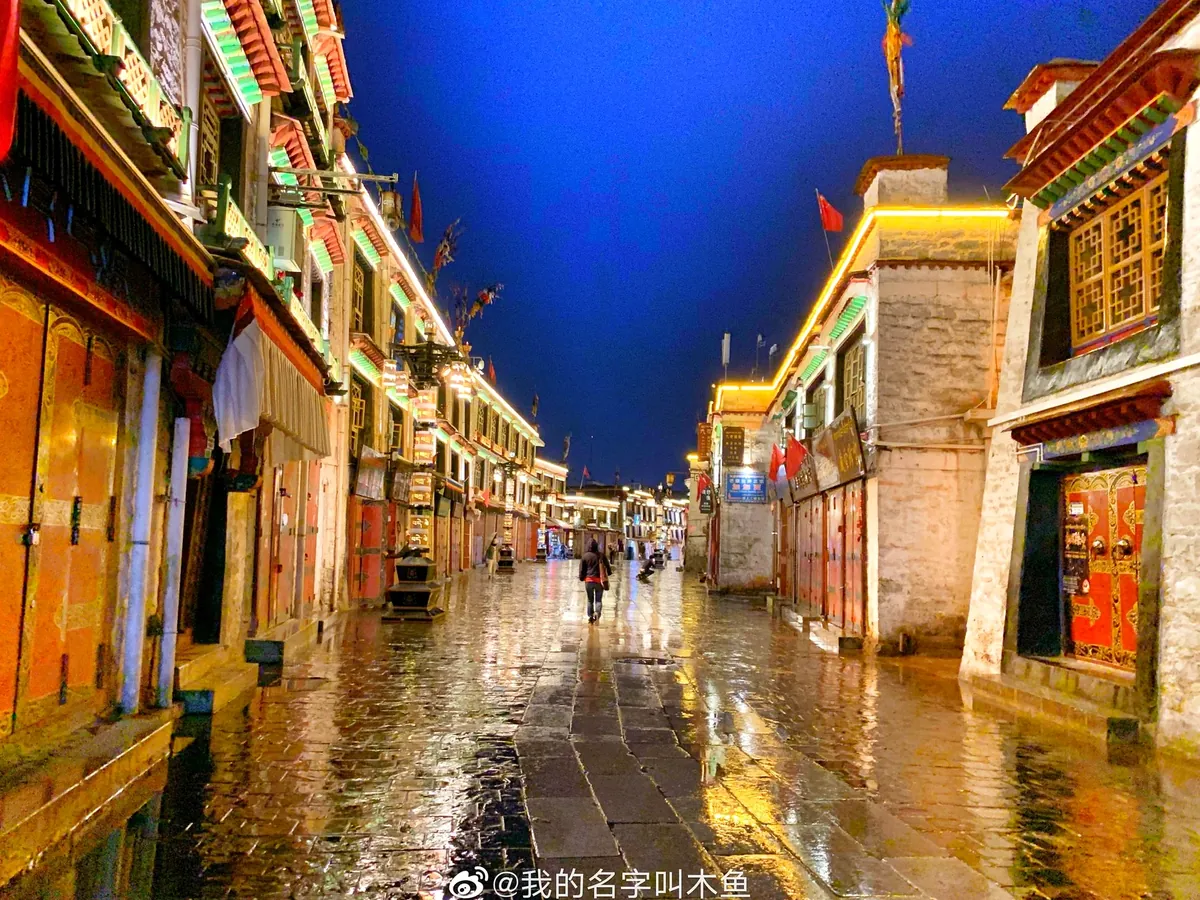
As night deepens, the Barkhor Kora circumambulation path surrounding Jokhang Monastery becomes even more filled with miraculous spiritual energy. Tens of thousands of butter lamps flicker, illuminating the monastery’s front hall and releasing a fragrant blend of yak butter and juniper incense into the serene space. In the freezing night, devout pilgrims persistently perform the prostration ritual, the rhythmic sound of their bodies hitting the smooth marble echoing steadily alongside the ethereal chime of bronze bells and the murmuring of prayer wheels. Beyond the endless spiritual flow, the alleys of Barkhor and the Canggu nunnery keep the doors of warm sweet tea houses open. Amidst the steam rising from old aluminum kettles, locals gather over cups of rich sweet tea, sharing everyday stories in an intimate and simple atmosphere.
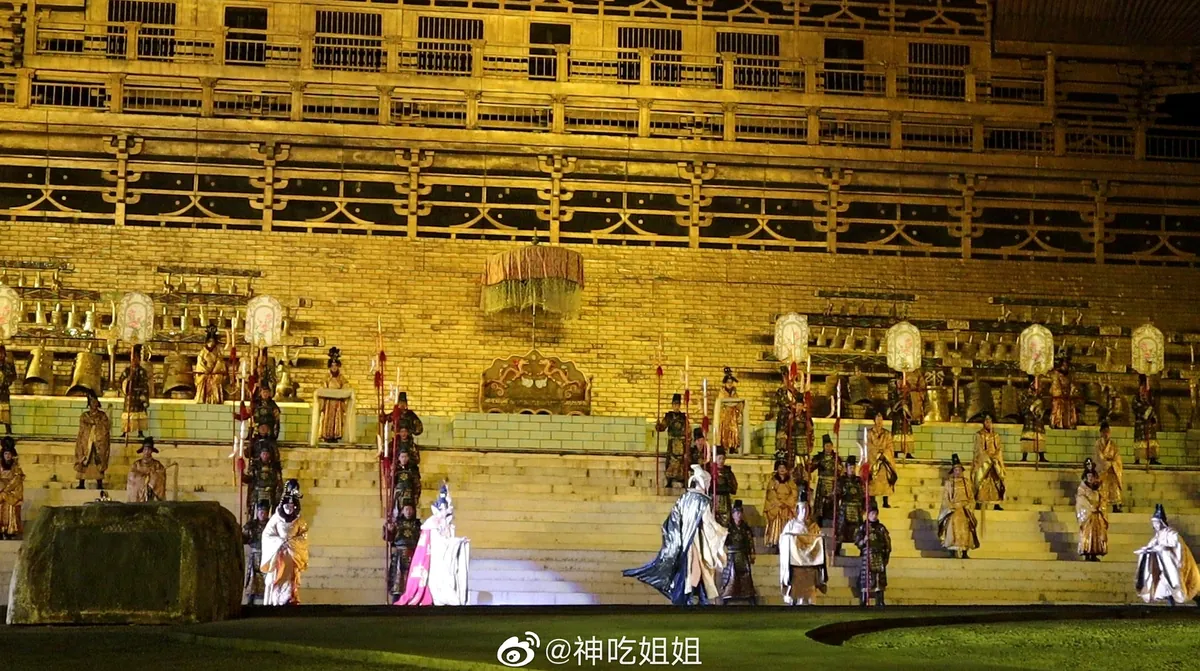
One of the visual highlights of Lhasa by night is the large-scale live-action show titled “Princess Wencheng,” held on the windy southern bank of the Lhasa River. Using the entire range of natural, rugged mountain peaks as a backdrop, the production features over 800 actors and dancers, along with hundreds of native livestock, including yaks, sheep, and highland steeds. This 90-minute theatrical epic vividly recreates the historic journey of Princess Wencheng, who traveled over 3,000 miles from the Tang Dynasty capital of Chang’an to the Tibetan plateau to marry the Tibetan King Songtsen Gampo. Advanced laser lighting technology, combined with massive artificial snowstorm effects cascading down the mountainside, spectacularly recreates the moment the royal entourage crossed the Sun and Moon Mountain, delivering a poignant and emotionally stirring experience.
Far from the city lights, the Tibetan night hides magnificent astronomical experiences in high-altitude regions such as Namtso Lake or the Everest Base Camp near Rongbuk Monastery, at an altitude of over 5,000 meters. The extremely thin, dry, and cold air, combined with the total absence of light pollution, turns the plateau’s night sky into an infinite cosmic museum. The Milky Way stretches across the deep sky like a river of shimmering diamonds, casting a magical silver glow over the eternal snow-capped peak of Everest, offering a moment of overwhelming silence before the infinite grandeur of nature.
At an average altitude exceeding four thousand meters on the “Roof of the World,” Tibetan culinary philosophy was not born to showcase elaborate elegance, but rather crystallized into an art of absolute survival against the harshness of nature. At the forefront of the local diet, revered as the lifeblood of the Tibetan people, is Tsampa. This essential staple is crafted from highland barley (known as “Nê”), which is roasted to perfection in a pan of hot sand before being ground into a fine powder in a stone mill. When dining, locals pour the flour into intricately carved wooden bowls, add a piece of golden yak butter and a splash of hot black tea, then use their skilled fingers to knead it into a round ball called a “Kula” to enjoy. With its high concentration of beta-glucan fiber and a mechanism for slow, sustained energy release, Tsampa serves as an invisible shield, helping pilgrims and nomadic tribes maintain body temperature and endurance in the thin, high-altitude atmosphere.
Alongside highland barley in every breath of daily life is Po Cha (Butter Tea), a drink of profound cultural significance in the land of snow. To make a standard pot of butter tea, premium pressed black tea is boiled until the liquid turns a deep amber, then poured into a traditional wooden churn (Chandong) along with rich yak butter and natural mineral salt. The rhythmic, manual churning creates a smooth, pale yellow emulsion with a rich, fragrant aroma. More than just a thirst quencher, Po Cha acts as a perfect physiological remedy: the natural animal fat protects the lips of the Tibetan people from cracking under the dry, biting winds, while the mineral salts and caffeine help stabilize blood pressure, support lipid metabolism, and prevent altitude sickness. Beyond the salty butter tea of the tents, the ancient streets of Lhasa entice travelers with steaming Tibetan sweet tea houses, where black tea is brewed with fresh yak milk and pure rock sugar.
The core protein source that nourishes the robust physique of the highland people comes from the long-haired yak, grazed entirely in the wild on high-altitude grasslands. Yak meat boasts superior protein content, is rich in iron, and has an extremely low fat ratio, prepared in two contrasting styles that both reach culinary heights. The most unique is “wind-dried beef.” Around December, when the biting cold covers the plateau, fresh lean shoulder meat is sliced into long strips and hung in the shade under windy eaves. Over three to four months, the freezing, dry winds draw out every drop of moisture, condensing all the nutrients into dark, firm strips of meat. When torn into small pieces and chewed slowly, it releases an original, rustic, and lingering sweetness. In contrast to this wind-dried delicacy, steaming fresh yak hotpot is the centerpiece of gatherings, where thinly sliced lean meat is dipped into a broth simmered from bone marrow and precious herbs like codonopsis, angelica, goji berries, and snow lotus flowers picked from steep cliffs, creating a tonic that boosts blood circulation and helps the body quickly adapt to low-oxygen conditions.
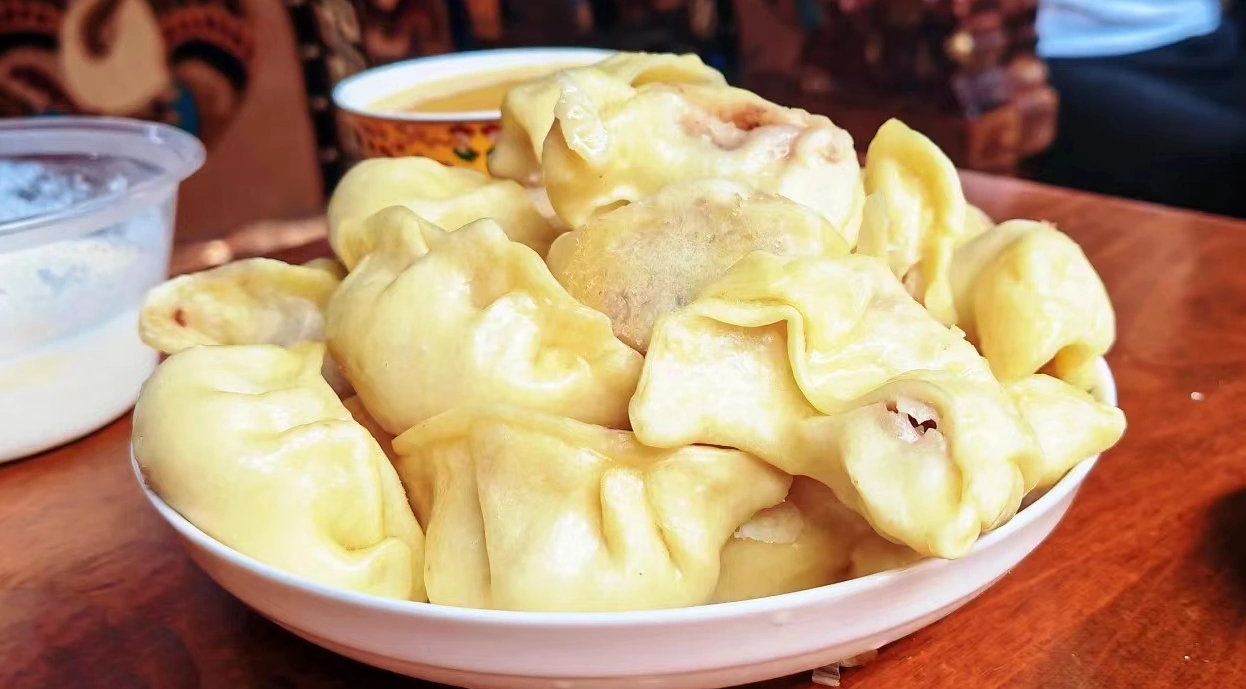
The cultural intersection along the Himalayan belt is also vividly reflected in everyday comfort foods that warm the hearts of travelers. There is the steaming bowl of Thukpa noodle soup, with chewy wheat noodles swimming in a rich yak bone broth, accented with cold-hardy vegetables and savory minced meat. There are also the round Momo dumplings, echoing Tibetan and Nepalese culinary influences, with thick barley flour skins wrapping a filling of minced yak meat seasoned with onions, mountain ginger, and aromatic cardamom. Momo is typically dipped in a fiery Tibetan Ezay chili sauce, a masterful blend of spices designed to awaken and stimulate the palate, which is often significantly dulled in the thin air of the high altitudes.
The culinary map of the snow-capped mountains would remain incomplete without the uplifting taste of Chang beer (青稞酒 – Highland Barley Wine). This hand-brewed fermented millet wine has an alcohol content of just five to eight percent, featuring a soft cloudy hue, a refined sweet-and-sour taste, and a hint of gentle bubbles dancing on the tip of the tongue. Chang is always present with great solemnity in welcoming rituals for esteemed guests accompanied by pristine white Khata silk scarves, or flowing abundantly during the song and dance celebrations of the sacred Losar New Year. Finally, to balance the fiery, rich energy of the meat and butter feast, the Tibetan people always enjoy naturally fermented Yak yogurt. With a dense, smooth texture resembling fresh cheese and the pure, sharp tartness of high-altitude probiotics, this dessert—when drizzled with a little wild forest honey or shimmering maltose—brings an enchanting culinary journey to a close, perfectly reflecting the sacred harmony between humanity and majestic nature.
The journey into the land of snow requires international travelers to navigate one of the planet’s strictest administrative barrier systems, where independent backpacking or self-guided travel is completely outlawed. Every step taken by foreign visitors must be under the sponsorship of an officially licensed tour operator, traveling in specialized vehicles equipped with GPS satellite tracking throughout the entire journey, and accompanied constantly by a local guide holding a national professional license. The legal dossier is structured in a strict three-tier framework: the Tibet Entry Permit issued by the Tibet Tourism Bureau requires submitting a copy of the passport and Chinese visa twenty to thirty days before departure, and mandates presenting the physical paper original at the security checkpoint before boarding a flight or high-speed train to Lhasa; the Aliens’ Travel Permit (PSB Permit) issued by the Public Security Bureau is required when the itinerary extends toward Shigatse, Gyantse, or Everest Base Camp; and the Military Permit is exclusively reserved for the most sensitive border regions like Nyingchi or the sacred land of Ngari surrounding the legendary Mount Kailash.
The next major challenge on the Qinghai-Tibet Plateau lies in acute mountain sickness, caused by a sudden drop in atmospheric pressure and thinning oxygen levels with every meter gained in altitude. As soon as you step foot at the 3,650-meter altitude of Lhasa, a life-saving rule that every traveler must strictly follow is to completely refrain from bathing or washing hair for the first full twenty-four hours, limit all strenuous movement, and dedicate time to absolute rest so that the cerebral capillaries and respiratory system can promptly adjust their oxygen absorption mechanisms. Personal medical kits should be equipped with a fingertip pulse oximeter to ensure SpO2 levels remain stable above the threshold of 75 to 80 percent, accompanied by a mini compressed oxygen spray and the habit of supplementing with Rhodiola rosea herbal extract starting one week before departure. At the advanced protection level, long-distance transport vehicles must be equipped with large-capacity oxygen cylinders, and the exploration program must be covered by a specialized international travel insurance policy featuring coverage for emergency medical evacuation helicopter services in the event of pulmonary or cerebral edema complications.
Alongside natural barriers, the Tibetan plateau also harbors sophisticated commercial traps targeting the devout mindset and health anxieties of distant travelers. A typical scam often takes place in counterfeit Tibetan medicine clinics, where individuals posing as master physicians conduct free pulse diagnoses, intentionally exaggerating heart and lung failure due to oxygen deficiency to scare patients into buying mysterious secret remedies or Cordyceps from Nagqu priced between 18 million and 110 million VND, which are actually mostly defective products treated with chemical additives or glued together to piece caterpillar larvae back together. Similarly, the dazzling gemstone market around Barkhor Street is crowded with Dzi beads and Tibetan agates woven with tales of mystical protective magnetic fields, yet over ninety-nine percent of them are merely industrial pressed stone powder treated with acid and baked with devil-eye patterns produced in workshops in Henan or Zhejiang with a base cost of less than a hundred thousand dong, or Tibetan silver jewelry which is actually just nickel-copper alloy with plating or toxic lead contamination. To protect their own rights, travelers should only join pure itineraries with no designated shopping stops, while keeping in mind the power of Article 35 of the China Tourism Law, which allows travelers to request returns and receive a 100% refund within thirty days if signs of fraud or forced shopping are discovered at scheduled stops.
Entering the spiritual space of Buddhist monasteries, every behavioral action reflects an understanding of local cultural standards. At the Potala Palace, authorities enforce a strict digital quota limiting visitors to 5,000 per day, while setting a maximum time limit of sixty minutes inside the Red Palace to provide maximum protection for invaluable murals against humidity and body heat. Visitors are required to dress modestly and respectfully, remove hats and sunglasses, and strictly refrain from filming or taking photos inside the sacred shrine halls; when standing before statues of the Buddha, never point directly with a finger but instead keep the palm open and facing upward toward the deity; when walking along Kora pilgrimage paths or spinning prayer wheels, one must always move clockwise and avoid stepping on monastery door sills. The Tibetan climate features distinct variations, with the vibrant peak season from May to October offering warm temperatures and higher oxygen levels, while the winter season from November to mid-March opens up opportunities for tranquil worship with free admission to all A-grade scenic spots and halved hotel room costs. To fully grasp the cultural depth and witness the surreal beauty of the roof of the world in a safe and thoroughly well-organized manner, choosing a standard itinerary such as the all-inclusive Tibet tour will be the perfect guarantee for a once-in-a-lifetime spiritual pilgrimage.
