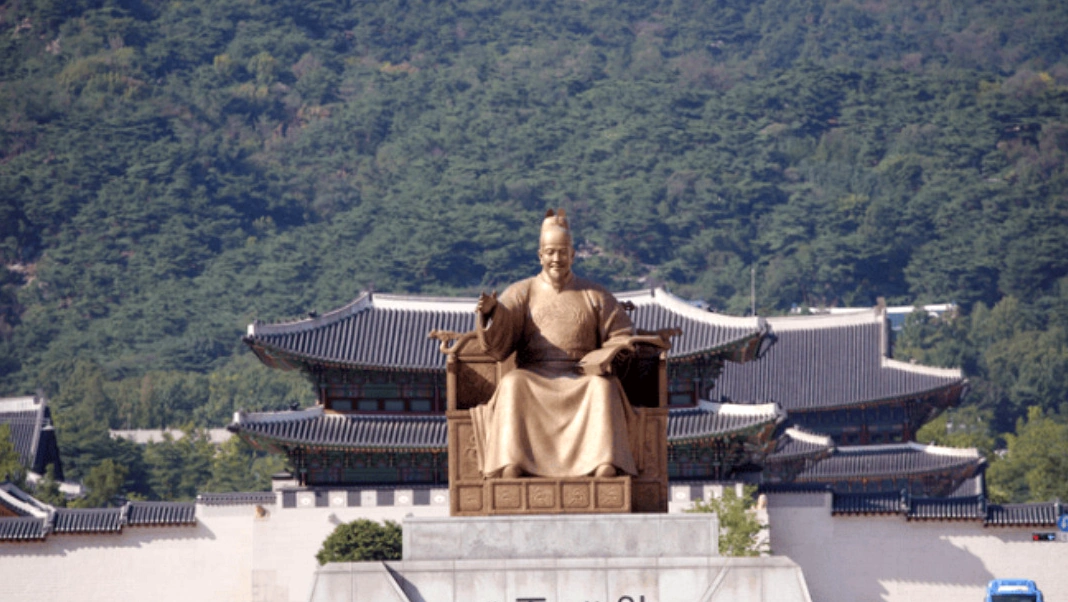
Tracing back through time to the primordial years of the Joseon Dynasty, when the founding monarch Taejo Lee Seong-gye decided to relocate the capital to Hanyang in 1394, the embryonic form of today’s Gwanghwamun Square began to take shape. Just a year later, in 1395, Gyeongbokgung—the principal palace and supreme legal court of the royal court—was officially completed, marking the birth of Gwanghwamun, the majestic main gate facing southward. Extending outward from this grand portal was a straight avenue named Yukjo-gil, or the Avenue of the Six Ministries, which once gathered the six supreme administrative organs of the feudal court. This was not merely a simple transportation artery but a powerful spiritual and authoritative axis, witnessing countless transformations of the dynasty. It is closely associated with exceptional figures who shaped the cultural and historical identity of Korea, from the great thinker Jeong Do-jeon to the wise monarch King Sejong the Great—who created the Hangul alphabet alongside groundbreaking inventions such as the Chugugi rain gauge, whose solemn bronze statue now stands proudly at the center of the square. Accompanying this is the monument of Chungmugong Lee Sun-sin, the renowned national hero with illustrious feats in the war against the Imjin Waeran invaders, respectfully positioned at the southern extremity of this historical space.
Through numerous modern historical upheavals, this sacred land suffered deep wounds under Japanese colonial rule from 1910 to 1945. The occupiers ruthlessly destroyed the traditional spatial structure, even erecting the Japanese Government-General Building directly in front of Gwanghwamun Gate to suppress the indigenous spirit and autonomy. It was not until the post-war era, as the nation entered reconstruction, that this spatial axis gradually recovered its form through restorations under President Park Chung-hee in 1968. The next historical turning point occurred in the 1990s under President Kim Young-sam, when the administration decided to dismantle the haunting Japanese Government-General Building, initiating the process of restoring Gwanghwamun and the ancient grand avenue to their historical state. The ethos of returning space to the citizens was further elevated in 2009, when the Seoul Metropolitan Government first converted smog-filled asphalt lanes into a sprawling pedestrian square, connecting citizens with millennia-old heritage.
The pinnacle of this metamorphosis occurred in 2022 with a large-scale geomantic expansion and restructuring project, transforming the area from a bustling traffic artery into a peaceful green oasis amidst the modern metropolis while serving as a symbol of popular sovereignty. Today, stepping onto Gwanghwamun Square, visitors not only touch the sediment of Joseon Dynasty history but also feel the contemporary pulse of a dynamic Seoul. The flawless fusion of past and present values has forged an iconic spatial axis where history does not remain confined to fading golden pages but lives vibrantly every day.
Tracing back to the urban planning origins of the Joseon Dynasty, the site selection and spatial planning of Hanyang (the ancient name of today’s Seoul) is considered a quintessential marvel combining architectural art with traditional East Asian feng shui philosophy. According to principles of geomancy (kan-eo-hak), the capital was positioned on a terrain of “flourishing mountain and flourishing water,” gathering the vital energy of heaven and earth to deserve its status as a millennium-old imperial city. Surveying the overall topographical structure, Mount Bukaksan (also known as Baekaksan) towers to the north, serving as the principal ancestral mountain (main guardian peak), with majestic winding mountain ranges resembling a soaring dragon and crouching tiger, channeling vital energy directly into the inner city. The Azure Dragon is protected by the gentle Mount Naksan to the right, while the White Tiger is formed by the towering Mount Inwangsan to the left, creating a secure armchair formation that cradles the seat of power. Looking southward, Mount Namsan serves as the majestic court mountain paying homage, while in front winds the Han River like a jade belt, simultaneously retaining vital breath and attracting prosperity according to traditional planning concepts.
Standing amidst this flawless geographical system, the Gyeongbokgung Palace complex along with the sacred spatial axis of Gwanghwamun Square was designed to face south (complying with the principle of sitting north and facing south, specifically aligned toward the Rat mountain facing the Horse direction combined with Kuei and Ding). This arrangement was not accidental; it represented an exceptionally sophisticated ecological and climatic engineering solution. This orientation allowed the capital to completely neutralize biting northern winds blowing down from the Siberian plateau in the northwest during harsh winters while opening up to welcome refreshing breezes blowing from the southeast during scorching summer months. The vast square stretching before the main Gwanghwamun Gate is the embodiment of the “Mingtang” concept (the open area before a palace to gather and converge primordial breath) in Confucian geomantic philosophy. This is not merely an empty transit space but an integral component of the power structure, serving as a solemn transitional buffer zone between the profound seclusion of the royal palace and the bustling world of citizens outside.
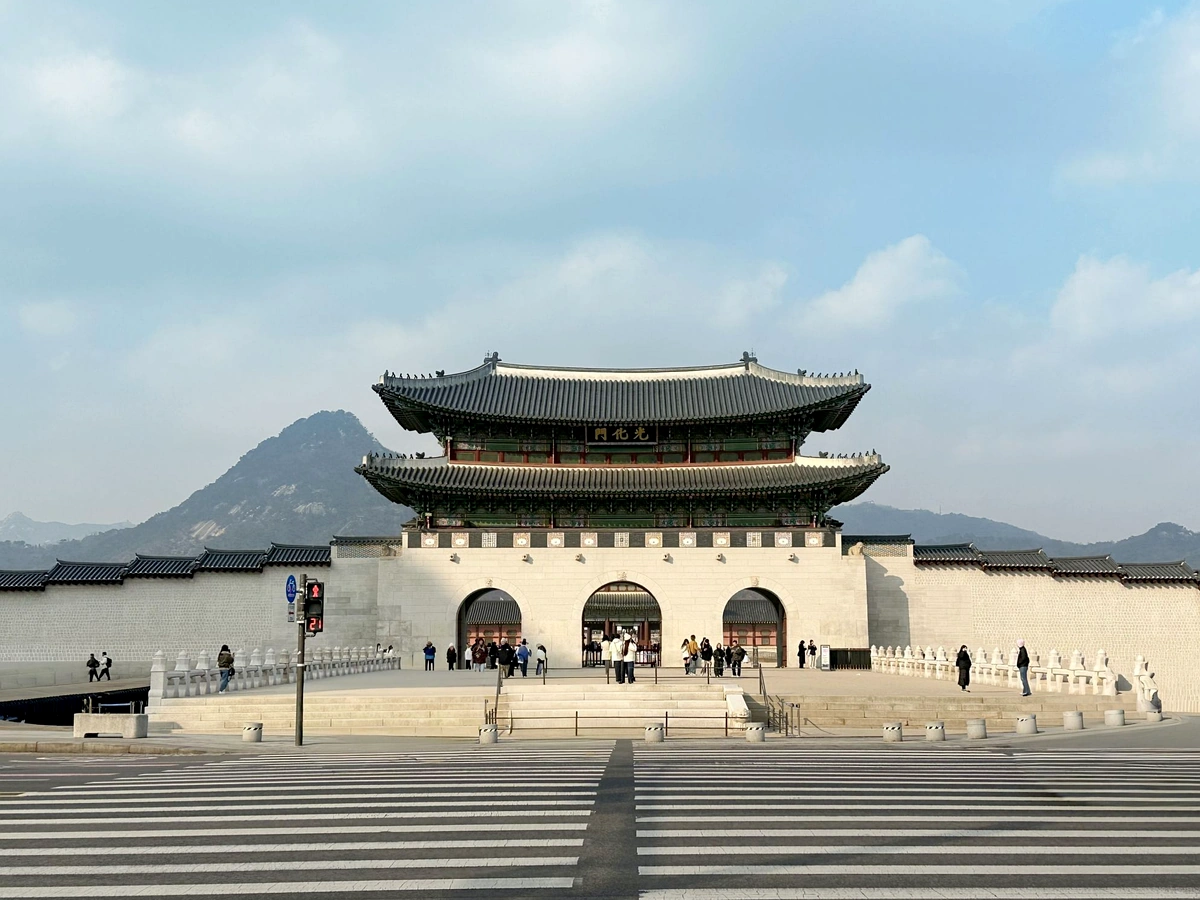
From a historical urban planning perspective, the space before Gwanghwamun Gate was historically planned according to the “Yukhjo-geori” (Avenue of the Six Ministries) system, concentrating supreme core organs of the Joseon court, mirroring the central six-ministry model. Today’s modern square, despite undergoing numerous restorations and structural transformations through modern historical periods, still preserves the majestic spirit of the ancient outer courtyard space. This was once the venue for outdoor court rituals where civil and military officials gathered to bow before the Son of Heaven, as well as where the court promulgated important decrees to the populace, symbolizing the supreme authority of royal power and the unshakable truth of the “Mandate of Heaven.” The restoration and reshaped grandeur of the square in the 21st century have once again revived the historical spirit axis connecting Gwanghwamun Gate, through the monuments of King Sejong the Great and General Yi Sun-sin, extending all the way to the central intersection, creating a special cultural energy field where a golden past and contemporary present intertwine powerfully in every heartbeat of Seoul.
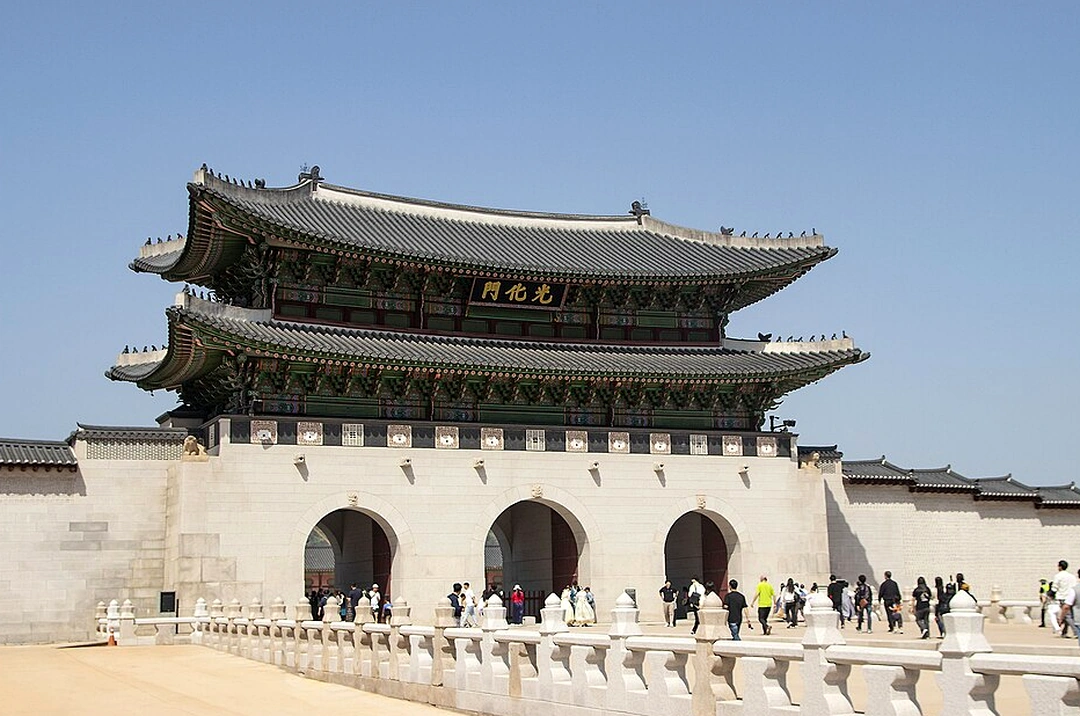
The historical cultural space in South Korea’s capital city of Seoul features Gwanghwamun Square, converging supreme craft artistic values and immense physical scale. Stepping into this spatial axis, right from the main Gwanghwamun Gate of Gyeongbokgung Palace—a structure planned and built by the Joseon Dynasty under supreme hierarchical standards reserved for a royal palace gate—observers cannot fail to marvel at the technical foundation and traditional architectural artistry of the Land of the Morning Calm. The gate’s foundation utilizes exquisitely cut granite and white jade slabs fitted tightly together, forming a sturdy Woldae stone terrace, featuring the clear Imperial Way path reserved for the emperor along with stairs carved with undulating dragon-cloud reliefs, testifying to the supreme power and mandate of the ancient feudal court.
Delving deeper into the superstructure, the thick brick and stone fortress walls feature three arched doorways curved like swallow wings, of which the central arch of the largest scale was reserved exclusively for the sovereign’s royal procession, while the two side arches served as passages for civil and military officials. Rising above those sturdy fortress walls is a pavilion structure featuring dual-eaved roofs designed in the Xieluoshan style, supported by precious wooden pillar-and-beam frameworks adorned with vibrant and durable traditional Dancheong decorative art. Ancient artisans skillfully employed the five basic colors of Eastern philosophy—including bluish-green, vermillion, yellow ochre, pure white, and pitch black—to paint flowing geometric, floral, and cloud motifs on each piece of timber, carrying spiritual significance to ward off evil spirits while protecting wooden materials against harsh seasonal weather.
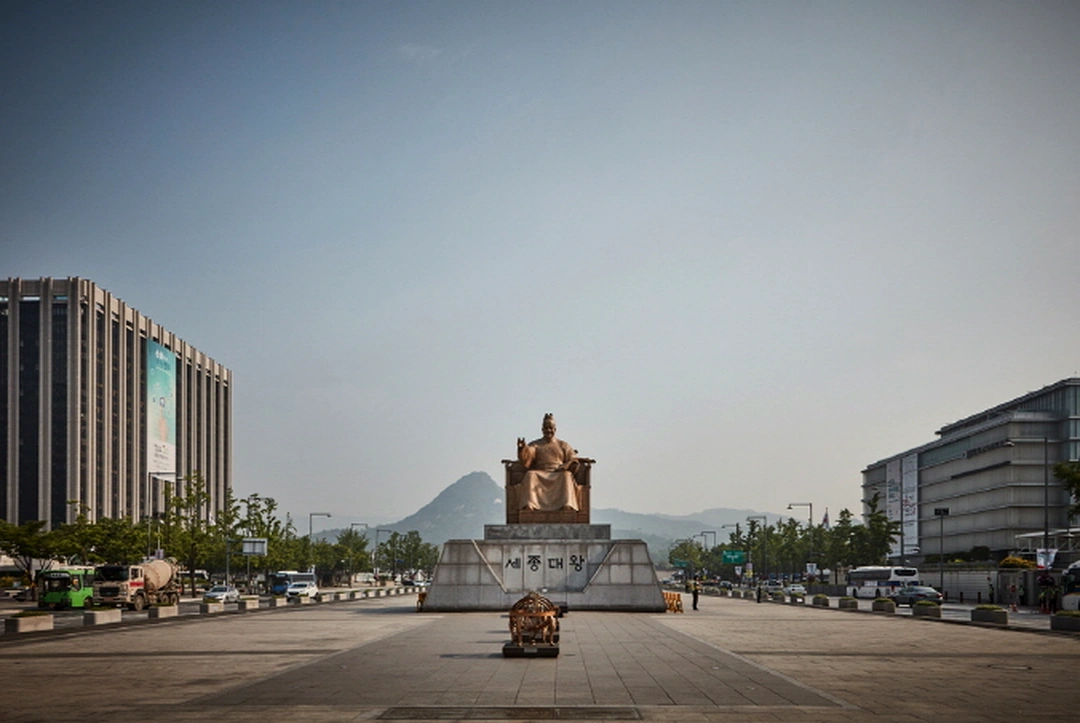
Inheriting and succeeding that ancient architectural essence is the modern open space of the square, highlighted by monument sculptures representing the pinnacle of metal casting art and contemporary monumental fabrication techniques in Korea. Standing out at the center of the square is the monumental statue of King Sejong the Great cast entirely from pure bronze, standing at an impressive height of 6.2 meters, a width of 4.3 meters, and weighing up to 20 tons, depicting the benevolent wise ruler seated calmly upon his throne, holding a scroll containing the Hunminjeongeum alphabet (the Korean national script) that enlightened reading and writing culture for the nation. Surrounding the pedestal of this benevolent king, designers delicately arranged miniature replicas of astronomical scientific achievements during his reign, such as the sundial (Angbu Ilgu), rain gauge (Chugugi), and celestial observation armillary sphere (Honcheoni), vividly recreating a golden age of science, technology, and human knowledge on the Korean Peninsula.
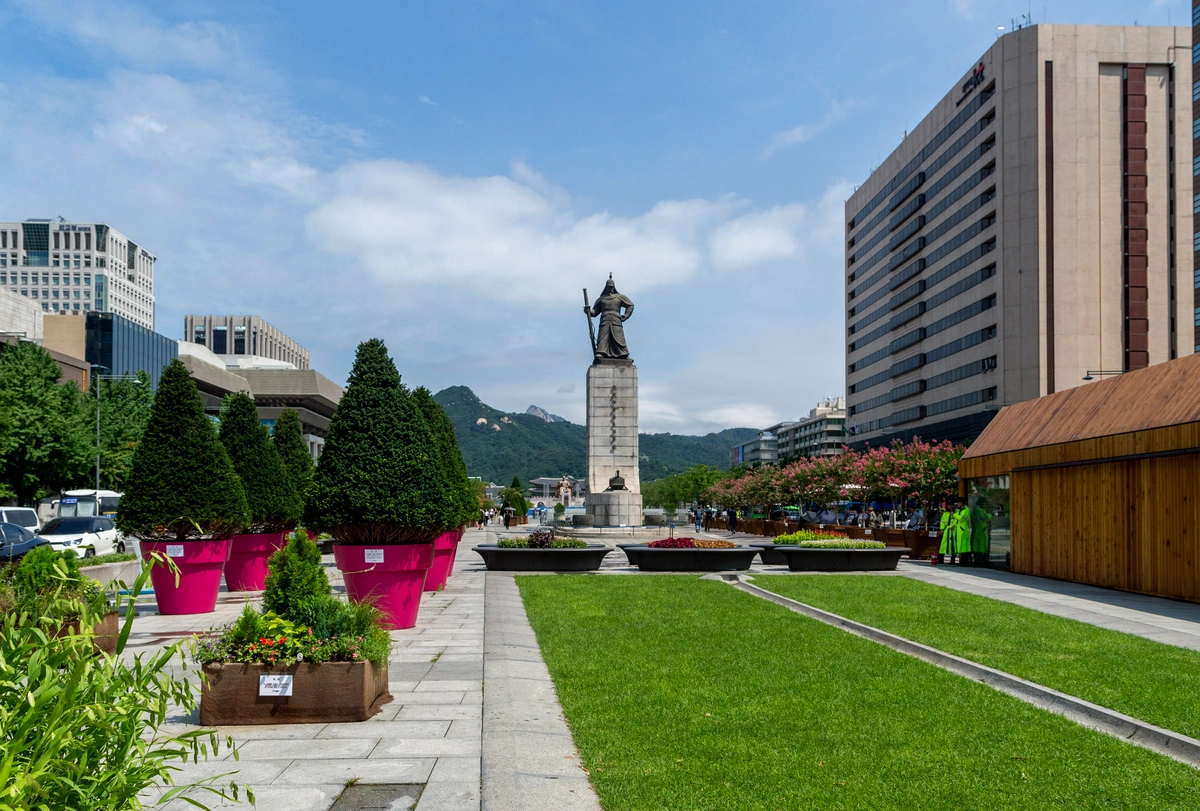
Not far to the south, majestic and valiant amidst the breezy space of Sejong Avenue stands the monument of Chungmugong (Loyal and Valiant Duke) Admiral Yi Sun-sin, soaring 17 meters high including its grand pedestal. The national hero appears in weathered armor, firmly grasping his long sword while gazing out toward the open sea, backed by an artistic fountain system simulating a fleet of twelve elite warships along with exquisite sculptural highlights recreating the ruins of legendary turtle ships (Geobukseon) that once terrified foreign navies. The harmonious combination of open urban landscape planning, interactive fountain systems, dynastic archaeological imprints, and heavy metal sculptural masterpieces has transformed Gwanghwamun Square into a living outdoor architectural museum where Seoul’s heroic past and prosperous present intertwine and blend seamlessly, profoundly, and convincingly.
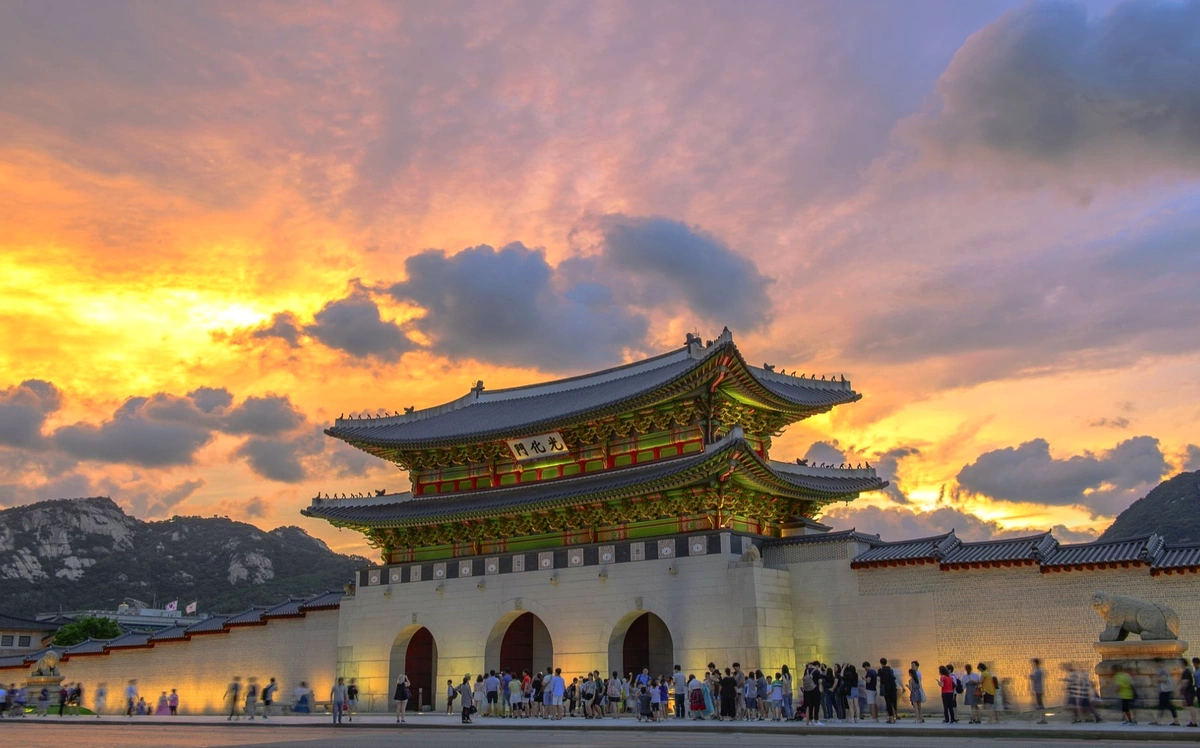
When night falls, shedding the rustic and solemn guise of daylight, Gwanghwamun Seoul Square enters an entirely different dimension—a magical spatial intersection between millennia-old heritage and futuristic technology. Nighttime lighting systems here are not merely public utilities for security purposes but true visual art crafted by top-tier names in Korea’s lighting design sphere. This team of experts skillfully deployed layers of illumination to honor the pulse and breath of historical architecture while evoking the flow of modern light. Viewing from the Sejong-daero avenue axis toward the north, the entire Gwanghwamun gate structure emerges like a grand landscape ink painting. Every rustic piece of timber, every curving line of yin-yang tile roofs, as well as the intricate interlocking details of the Dougong structural brackets, are accented by warm-toned LED spotlight systems. The gentle golden light does not dazzle the eyes but embraces the vermillion lacquer, gold leaf, and traditional Dancheong motifs, highlighting the enduring majesty of a structure that witnessed countless Joseon Dynasty ups and downs before rising to become a symbol of modern-era Seoul.
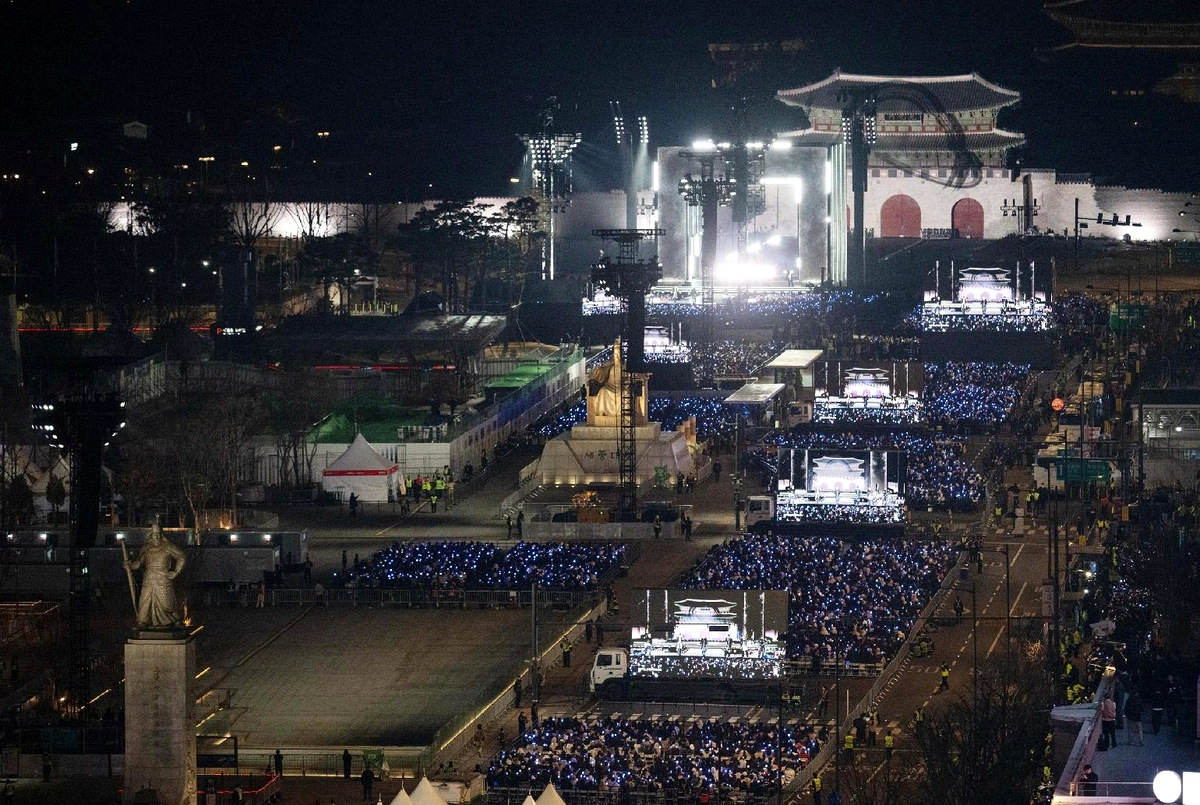
Stepping into the interior space of the square at night, visitors are immediately captivated by a mesmerizing visual feast orchestrated by architectural planes and artistic water systems. The square’s ground and fountain clusters are integrated with advanced dynamic projection mapping technology, frequently hosting digital art exhibition series titled “Gwanghwamun Era.” Here, the boundary between reality and illusion seems to dissolve as colorful light spectra undulate beneath pedestrians’ feet, reflecting onto water jets erupting to musical rhythms. Immersive artistic performances and premier cultural festivals reach perfection each winter when the “Gwanghwamun Festival of Lights” officially commences. Backed by ultra-high lumen projection technology, the entire facade of Gyeongbokgung Palace alongside Gwanghwamun Gate is suddenly transformed into a gigantic outdoor screen. Tens of thousands of spectators present at the square witness breathtaking digital films where ancient Korean mythology blends harmoniously with modern Hallyu wave culture and vivid AR/VR interactive technology.
Located along the spine of the square, the Hangul fountain and the open-air subterranean water vein system (Địa tuyền) are the most bustling interactive coordinates for locals and international tourists alike at nightfall. Controlled by a central computer system, water jets erupt into the air in perfect synchronization with musical variations and changing color light strips, creating a symphony of water, light, and music in the heart of the city that never sleeps. Amidst the breezy open air of a Seoul night, visitors can leisurely stroll across lush green lawns, gazing at statues of King Sejong the Great and General Yi Sun-sin standing proudly under ground-level spotlights, clearly sensing the seamless continuity between a heroic past and a prosperous present. Nightlife in Gwanghwamun lacks the noisy, chaotic bustle of sleazy nightlife quarters, possessing instead an elegant, tranquil yet vibrant charm of a cultural capital where every street corner and every wall knows how to tell its own story through the language of light and supreme contemporary visual art.
Gwanghwamun Square and the cultural space surrounding Seoul’s historical avenue possess an exquisite indigenous culinary map, gathering renowned gastronomic heritages preserved from antiquity. Radiating from adjacent ancient quarters such as Seochon, Bukchon, or the famous Cheongjin-dong area, the culinary landscape here represents the perfect continuation of Joseon royal court culture blended with the profound folk flavor of townspeople across centuries. Tasting dishes here is not merely dining to satisfy hunger but experiencing a cross-temporal dialogue with culinary artisans—descendants preserving the culinary essence of ancient royal kitchens.
Reigning at the pinnacle of the royal culinary heritage system is the art of preparing renowned royal court dishes, exemplified by premium Hanjeongsik banquets at traditional cultural spaces like Seokparang. Directly tracing back to the sophisticated craftsmanship of the Dae-ryeong-sug-su, elite chefs who served in the Joseon royal court, this art consistently elevates the philosophy of five colors and five flavors alongside absolute balance according to Yin-Yang and Five Elements principles. Every set meal served is a miniature universe where classic dishes such as Sinseollo—a royal hot pot cooked in a central brass chimney pot with sweet bone broth and dozens of fresh ingredients—or Gujeolpan—an octagonal wooden tray dish featuring vegetables and finely shredded meats wrapped in delicate small pancakes—demand utmost strictness in ingredient selection and exquisite carving techniques by chefs. This elaborate artistry lies not only in refined, gentle flavors but also conveys Koreans’ profound dietary health philosophy, viewing food as medicine to maintain harmony between humanity and the universe.
In fascinating contrast to the opulent, authoritative grandeur of royal court cuisine is the robust, rustic yet vibrant flavor of Cheongjin-dong Haejangguk hangover soup, a culinary heritage deeply marked by the citizenry since the Joseon era. Originating from Cheongjin-dong, which once concentrated the supreme administrative organs of the court, this dish emerged as an effective folk remedy helping officials and citizens recover from drinking bouts after nightly banquets. The Haejangguk broth here is meticulously simmered for over twenty-four continuous hours from premium beef bones, combined with smooth fresh beef blood, nutrient-rich dried ugeo-ji cabbage, and long-fermented traditional daejang soybean paste. The rich, viscous broth carrying a natural deep sweetness from bone marrow intertwined with the salty, pungent aroma of fermented soybeans has been recognized as an intangible cultural culinary symbol of Seoul, warming the souls of generations through freezing winters.
Furthermore, the culinary canvas around the Gwanghwamun Square axis is embellished by health-restoring legends such as Samgyetang ginseng chicken soup at the famous Tosokchon restaurant nestled west of Gyeongbokgung Palace. This dish is the perfect combination of young pullets around forty days old with naturally firm meat and sweet tenderness, stuffed tightly with herbs and premium nutrients including top-grade ginseng, chewy glutinous rice, sweet jujubes, savory chestnuts, and milk vetch roots. All are simmered until tender in milky white broth emitting rich aromas of ginseng and herbs. Savoring a hot bowl of Samgyetang in modern Seoul, as warmth spreads from tongue tip to bones, diners fully experience Koreans’ “food and medicine are of the same origin” philosophy, an invaluable family culinary heritage encapsulating centuries of history.
Concluding this contemplation of the most monumental historical and cultural space in the Land of the Morning Calm, to make your journey to the heart of Seoul truly complete, equipping yourself with a meticulous field guide featuring precise guidance from cultural researchers and travel experts is indispensable. Shifting between bustling contemporary life and layers of dynastic sediment, Gwanghwamun Square opens an open public space where architectural substance and urban landscape merge to welcome exploratory footsteps regardless of the season. According to field research documents and heritage management practices, this central square operates year-round, open 24/7 and completely free, allowing the public and international tourists to freely stroll and admire monuments of King Sejong the Great and General Yi Sun-sin at any hour. However, if your itinerary includes passing through the majestic gates of adjacent Gyeongbokgung Palace to inspect Joseon royal architecture, opening hours are specifically regulated from 09:00 AM to 17:00 or 18:00 PM depending on seasonal daylight adjustments by management, noting that this site typically closes on Tuesdays to preserve artifacts.
Regarding financial preparation and ticket acquisition, adult admission fees for the Gyeongbokgung Palace interior are listed at 3,000 won, a very modest investment for priceless visual and intellectual experiences regarding Korean feudal architecture history. Travel experts advise booking tickets in advance via official web portals or purchasing directly at on-site ticket counters before visiting to optimize personal schedules. Regarding public transit, Seoul’s urban infrastructure provides maximum convenience for anyone accessing this landmark via subway or city bus. You can take Subway Line 3 and alight at Gwanghwamun Station, exiting via Exit 6 or 7, or take Line 5 and use Exits 1, 2, 8, 9 to step straight into the basement level connecting directly to the Sejong Story Exhibition Hall. Additionally, surface transit networks with dozens of city bus routes stopping near the square offer excellent options for observing street life through window frames.
To optimize practical experiences and capture every valuable angle, a scientific sightseeing itinerary compiled by researchers from fieldwork will guide you through emotional highs. Early morning is ideal for starting with underground exhibits at Sejong Story museum preserving Hangul and Joseon history before ascending to admire the central axis monuments in dawn light. At noon, move to nearby Seochon old town for Samgyetang or Hanjeongsik. Afternoon brings palace interiors and the National Palace Museum of Korea. Nightfall returns visitors to artistic architectural lighting. Prepare neat attire and specialized sneakers; mind security instructions during national celebrations. Finally, for exquisite crafts or premium ginseng, visit official duty-free centers. To make your Korean cultural journey smooth and worry-free, explore our all-inclusive tour packages.