






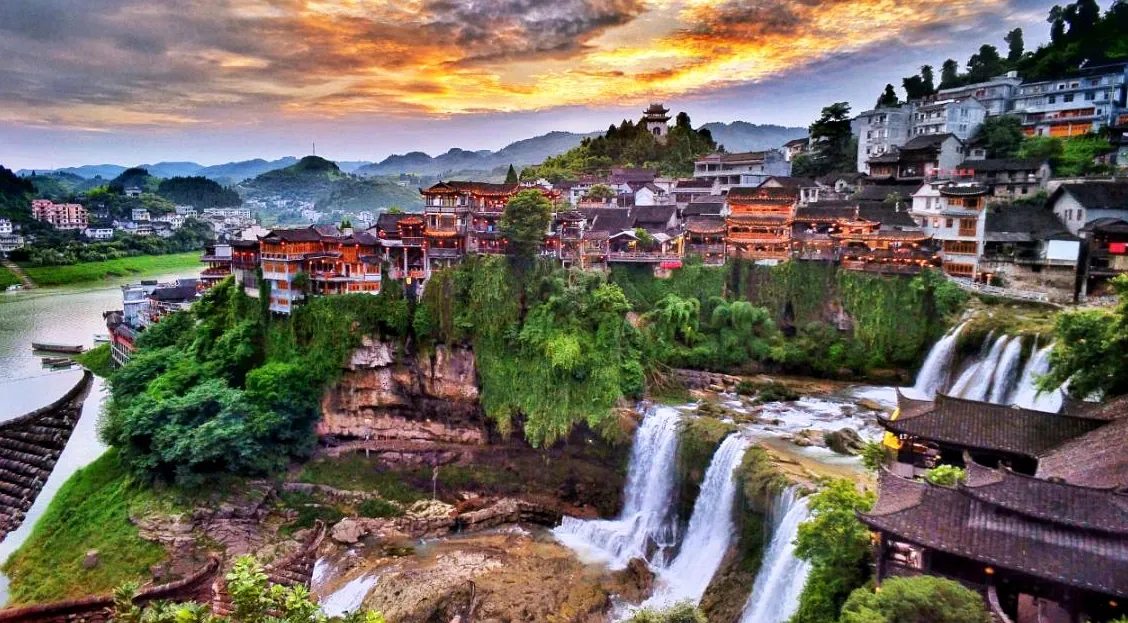
The ancient historical flow of Wangcun opened a poetic new chapter in 1986, when renowned director Xie Jin chose its slate-paved alleys and stilt houses as the main backdrop for the classic cinematic masterpiece named *Hibiscus Town*, adapted from the novel of the same name by writer Gu Hua. Deeply portraying the ups and downs of worldly affairs, the touching performances of Liu Xiaoqing as the tofu vendor Hu Yuzhi and Jiang Wen as the intellectual Qin Shutian led the film to a sweeping victory at China’s two most prestigious film awards, the Golden Rooster and the Hundred Flowers. The resounding fame of the work permanently blended the soul of the ancient town with its silver-screen moniker, leading to the historic decision in 2007 when Yongshun County officially renamed the thousand-year-old Wangcun to Furong Town.
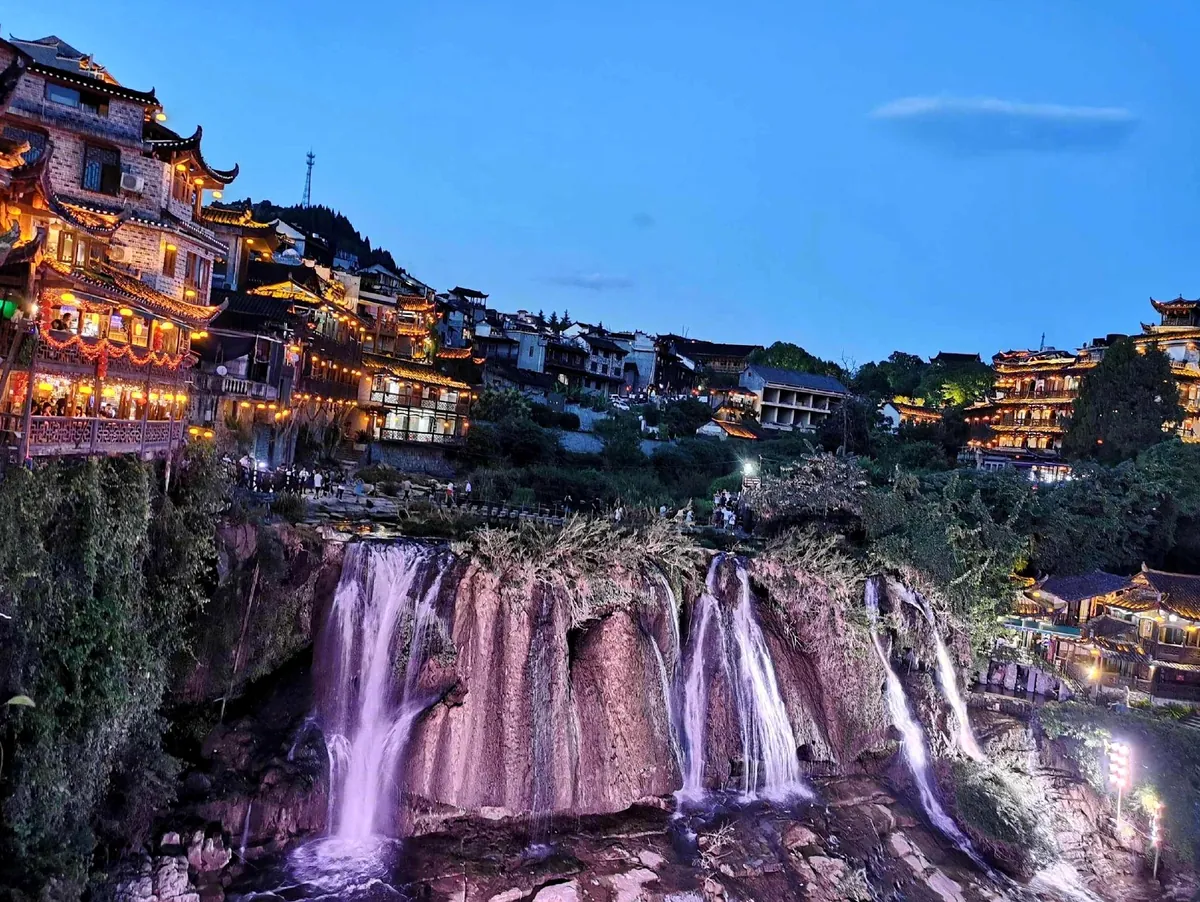
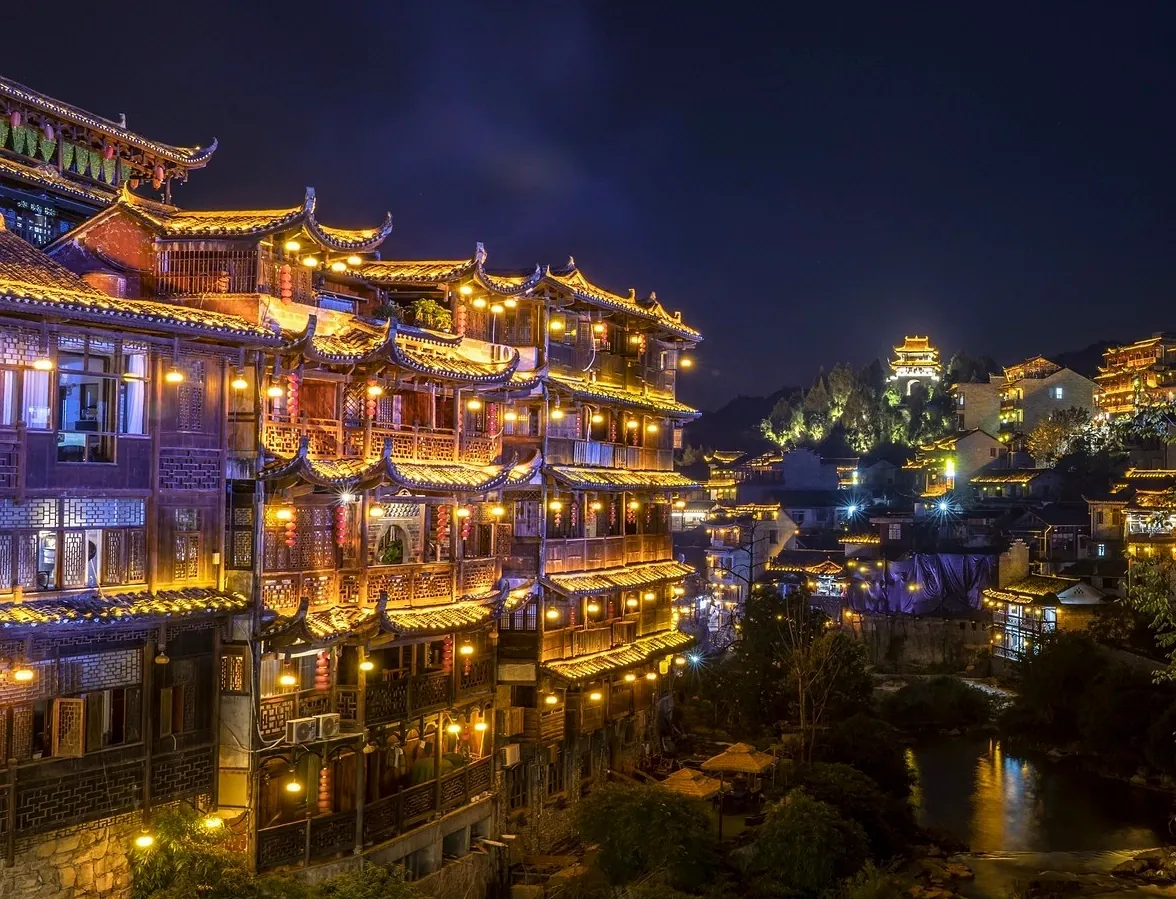
When night falls, the thousand-year-old ancient town showcases a rare, magical otherworldly scene, where traditional wooden buildings perched precariously on limestone hillsides are brightly illuminated by countless warm lanterns. Right at the foot of the solemn diaojiaolou stilt houses, a huge natural waterfall splits into multiple tiers cascading down with roaring white foam, bursting into a mystical purple hue under a delicately interwoven artistic lighting system. Along the winding stone-paved walkways and balconies clinging to the cliffside, travelers leisurely stroll to admire the churning water, feeling the exquisite harmony between human life and the endless majesty of nature.
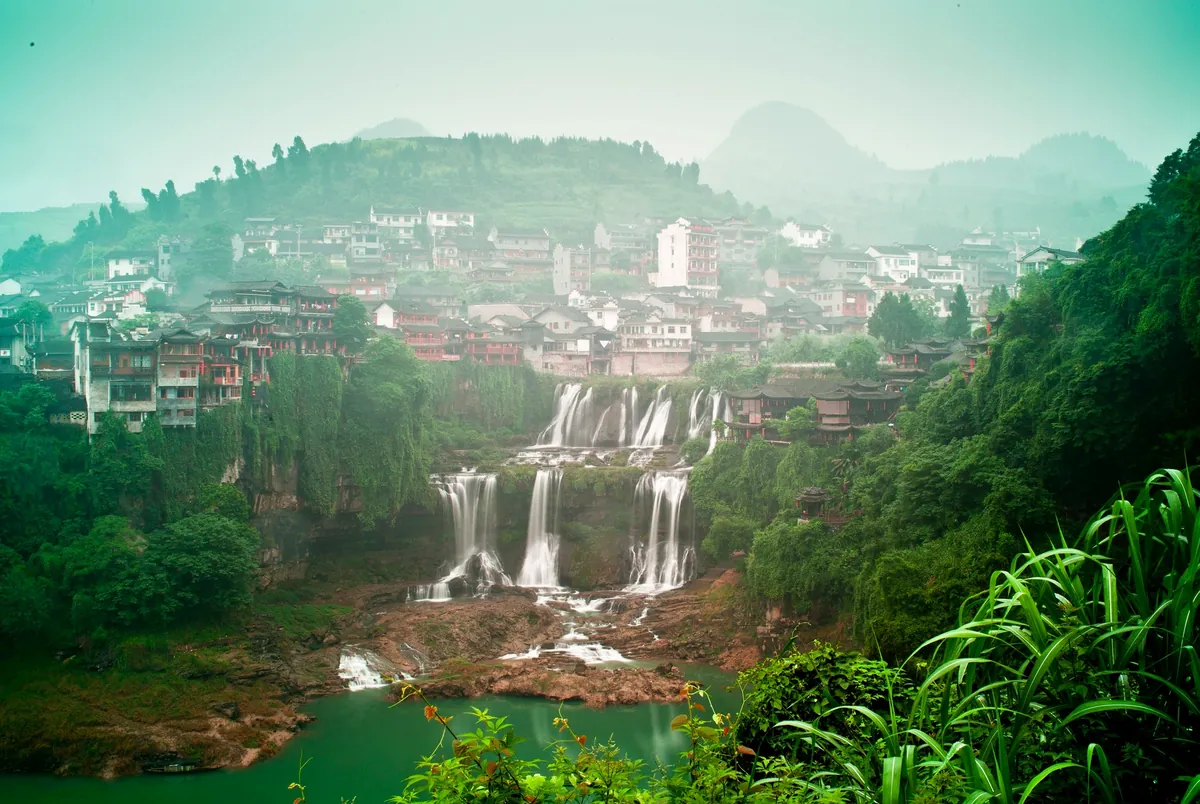
Through various tumultuous historical stages—from an administrative outpost in the Han dynasty, through the era of dominant Tusi chieftains, to entering the pages of contemporary art—Furong Town has retained the profound soul of the West Hunan region. The Youshui River still diligently carries heavy fragments of time, where each bluestone slab polished by human footsteps and each ebony wooden pillar conceals tragic stories of fame, power, and human affection within the rugged canyon.
Impressionistically present in the core of the rugged Karst limestone gorge within the majestic Wuling mountain arc, Furong Town belongs to Yongshun County, Xiangxi Tujia and Miao Autonomous Prefecture, Hunan Province. Since the primordial days of settlement, the Tujia ancestors chose to lay the foundations of the town on a unique limestone plateau following the classic feng shui principle of “backing mountains on three sides and facing water on one side.” The overlapping mountains on three sides act as a sturdy throne shielding the valley basin from toxic mountain vapors, while the sole facade opens wide to welcome the boundless vital energy from the water source of the Youshui River. The combination of steep gray limestone cliffs eroded over millions of years and the fierce currents has forged an isolated yet exceptionally primeval habitat, both defensively fortified against foreign invaders and fully embracing the lifeblood of waterway commerce.
The magnificent hydrological highlight and also the geographical soul of this land is the Grand Furong Waterfall, a natural two-tiered silver silk cascading spectacularly right through the center of the ancient town. With a drop height of up to 60 meters and a width stretching over 40 meters across layered Karst stone terraces, the roaring waterfall pours water day and night into the Youshui River, emitting a majestic, resonant sound echoing through every corner of the village. This rare geological structure has bestowed upon Furong Town a unique title in the world: “The thousand-year-old ancient town hanging on a waterfall.” The ancient Tujia people cleverly relied on each precarious stone step to build their Diaojiaolou wooden stilt houses, allowing the cool mist and fine spray of the waterfall to envelop them, turning the harshness of the fractured terrain into a masterpiece of harmonious coexistence between humans and nature.
As night falls, the scenery transforms into a magical, ethereal natural wonderland. Traditional wooden houses, tiered along the cliffs, glow brilliantly in warm golden lights intertwined with rows of vibrant red lanterns. The calm waters below act as a giant mirror, perfectly reflecting the ancient architectural lines blended with the tranquil silhouettes of trees. Far away against the dark sky, the rolling, undulating hills embracing the town are also elaborately illuminated, highlighting the majestic silhouette of a tower reigning atop the high hill, creating a poetic multi-layered spatial depth.
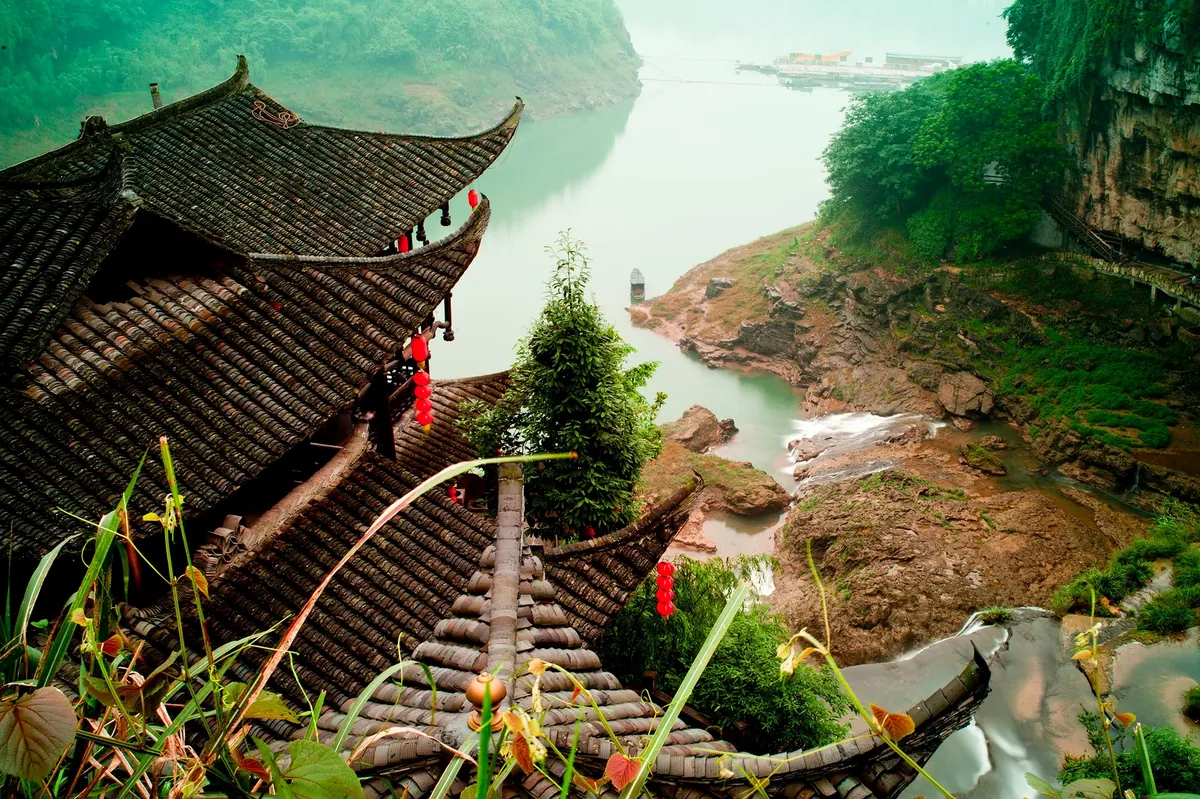
Considering the overall geography of the Xiangxi region, Furong Town also plays a vital ecological and archaeological role. Situated on the lifeline waterway axis of the Youshui River basin, the ancient town serves as a natural bridge connecting the Red Stone Forest National Geopark—with its mysterious Cambrian red rock formations—and the Laositai World Heritage Archaeological Site, the powerhouse of the Tujia chieftain regime for over eight centuries. The Youshui River is not merely a natural boundary separating territories, but also a biological corridor preserving the diversity of humid subtropical flora, making Furong Town a radiant green heart that crystallizes the ancient geological and feng shui essence of the southern landscapes.
Perched resiliently against the rugged fault lines of the millions-of-years-old karst terrain, the Diaojiaolou architectural complex in Furong Town is an extraordinary testament to the Tujia people’s talent for environmental adaptation. Instead of leveling or subduing nature, the ancestors drove ancient fir and pine tree trunks deep directly into the sheer limestone crevices right at the edge of the waterfall’s abyss and the lower Youshui River. All the stilt houses hanging precariously in mid-air were constructed using exquisite traditional mortise-and-tenon joinery without using a single iron nail. Their graceful, sweeping yin-yang tile roofs, layered like dragon scales extending out from the cliffs, not only create a perfect slope to drain tropical rainwater but also help the structures stand firmly against tremors and year-round moisture erosion from the surging waterfall base.
In terms of interior spatial structure, each traditional Diaojiaolou house is a closed microcosm clearly divided into three distinct functional living levels. The ground floor, or lower level, consists of a load-bearing pillar system made of the hardest corewood trunks, serving as a storage space for farming tools and fishing gear, with direct access to boat landings along the water’s edge. Step up to the second floor—the beating heart of the entire house—which features the solemn reception hall and the hearth area, where a glowing wood-burning fire is kept alive year-round as the soul protecting the family’s prosperity. Also on this floor, the wraparound veranda (Tzoumalou) extends with intricately carved balustrades, becoming an open viewpoint to catch the breezy winds blowing from the Youshui River. Moving up to the third floor, you will find an airy mezzanine where the Tujia people dry and store dried agricultural produce, as well as a tranquil space for women to meticulously weave vibrant Xilan Kapu brocade pieces imbued with indigenous culture.
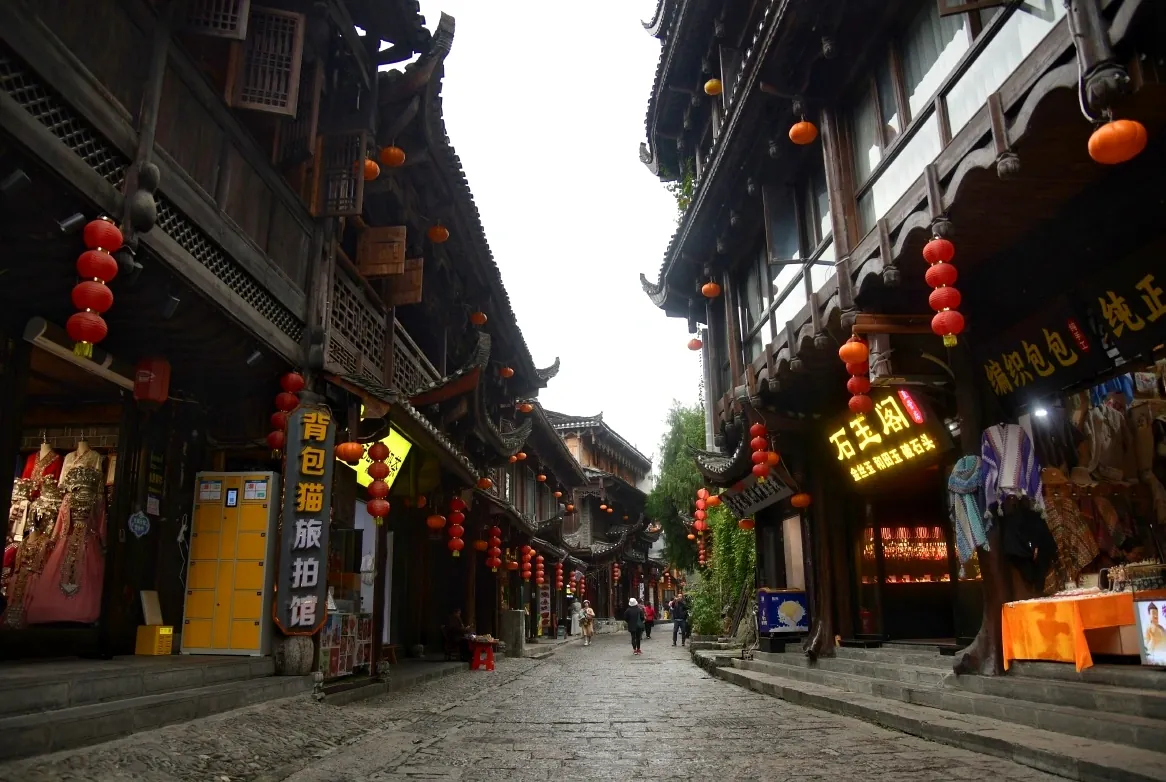
Along the spine of the ancient town, the old stone-paved street opens up to a profound scene featuring two rows of dark wooden Diaojiaolou nestled closely together, perfectly preserving the soul of a bustling former trading port. The smooth flagstone pathway reflects hazy light, guiding visitors past houses with curved balconies and mossy ancient tiled roofs. Standing out against the rustic wood are rows of bright red lanterns interspersed with warm yellow-orange pumpkin lanterns hanging gracefully in front of porches, creating a poetic splash of color amidst the ancient townscape. Small shops display local specialties beneath solemn gold-trimmed Chinese character signboards, while a few travelers leisurely stroll in the distance, turning the space into a peaceful daily life painting entirely detached from the hustle and bustle of the outside world.
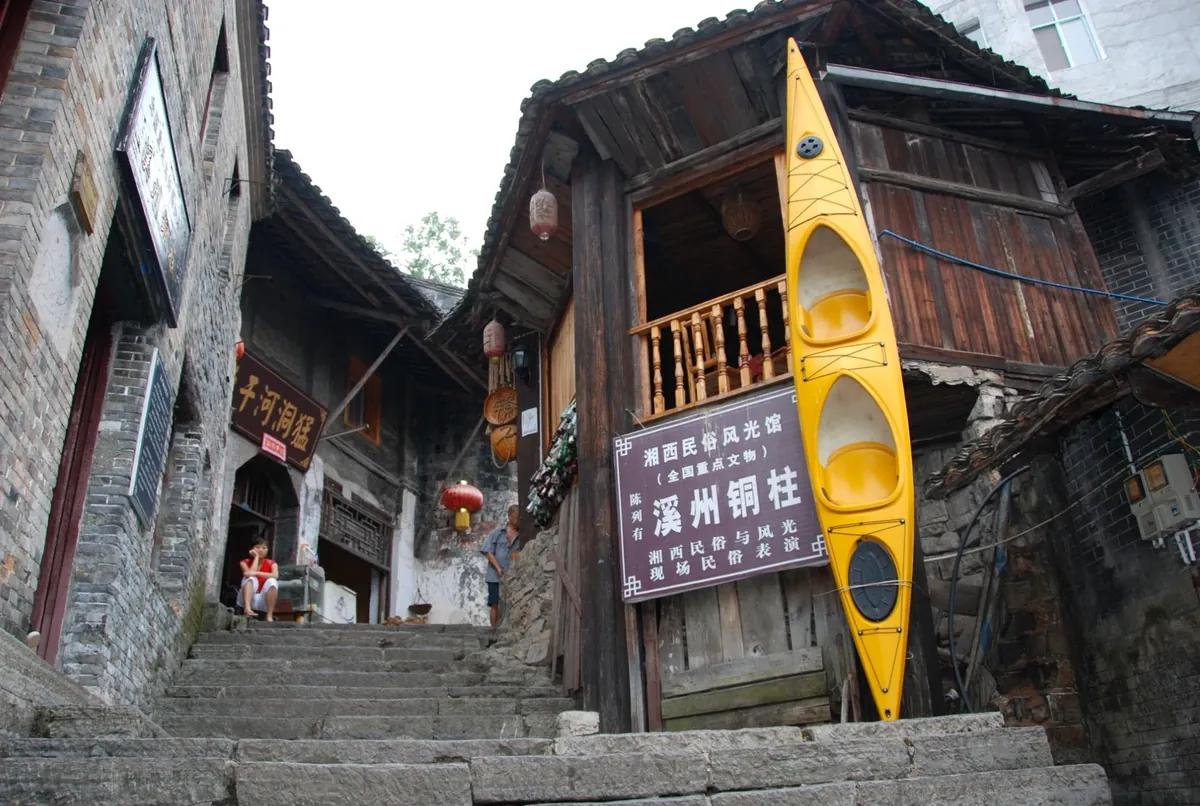
The spatial planning flow of Furong Town follows an organic current philosophy, seamlessly connecting key heritage sites along a dramatic experiential route. Starting from the mossy Ancient City Gate, visitors step into the miles-long Wuli Bluestone Ancient Street before opening up to the imposing Tusi Imperial Palace complex perched on the highest rock cliff—once the powerful headquarters of the Tusi chieftains who governed this borderland. The most breathtaking highlight in the spatial structure is the pedestrian tunnel carved through the Karst cliff, leading travelers right behind the giant water curtain of the waterfall before gently descending to the ancient Wangcun Ferry Pier, which was once bustling with boats trading silk and rock salt connecting Western Hunan with the downstream provinces.
To preserve the integrity of a living architectural museum in the heart of nature, local authorities have established strict conservation regulations with an absolute ban on concrete within a 1.5-kilometer radius of the waterfall’s center. All construction or renovation projects are required to maintain 100% of the traditional Tujia wooden architectural facades. This consistency is backed by massive funding from the 12-billion-yuan Greater Western Hunan tourism revitalization project, which focuses on both restoring ancient rafters and purlins, and burying modern fiber optic and drainage systems beneath the ancient bluestone slabs, ensuring that Furong Town retains its pristine beauty despite the ceaseless movement of time.
As the dusk gradually falls over the limestone valley, Furong Town undergoes its most spectacular transformation of the day. During the golden hour from 19:15 to 21:30, thousands of artistic lights simultaneously illuminate, casting a brilliant golden glow over every upturned yin-yang tile roof and the rustic wooden structures of the Diaojiaolou stilt house complex perched precariously on the cliffs. The two-tier natural waterfall—the heart of the ancient town—is illuminated by a multi-layered optical system, vividly recreating the image of a sparkling Milky Way pouring straight down into the deep abyss. The warm golden light reflects shimmering on the surface of the tranquil Youshui River, turning the thousand-year-old tranquil landscape into a magnificent night scenery painting, both mysterious and endlessly enchanting.
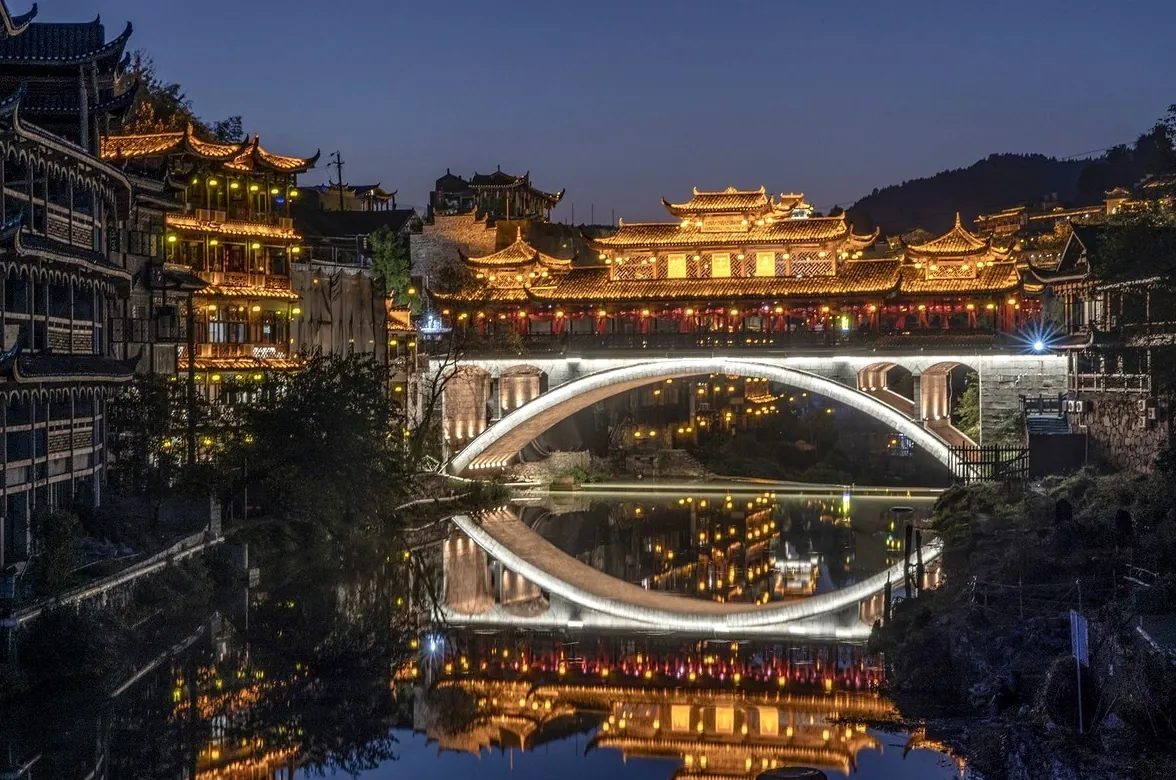
The climax of the nocturnal rhythm is the live immersive spectacular "Hua Kai Fu Rong" (Blossoming Furong). Without the need for dry artificial backdrops, the performance stage is set up right on the ancient flagstone square, using the roaring sound of the waterfall and the majestic towering cliffs as a magnificent natural backdrop. State-of-the-art 3D Mapping projection technology transforms the millennium-old rock arch into magical moving paintings, sketching every trace of the ups and downs of this borderland. Beams of light sweeping through the misty water spray create a mesmerizing visual effect, where the boundary between illusion and reality, between pristine nature and contemporary stagecraft, completely dissolves.
The soul of the night performance lies in the depth of authentic Tujia culture vividly recreated through each epic chapter. Audiences are taken back in time as the deep, resonant sound of brass horns echoes through the canyon, guiding them into the Maogusi Dance—an intangible cultural heritage containing primitive philosophies about origins and farming dances praying for a bountiful harvest. Artisans in rustic woven-grass costumes recreate ancient hunting and land-clearing movements, interspersed with a tragic love epic and the political shifts of the Peng family Tusi clan who brilliantly ruled for eight hundred years along the banks of the Youshui River, weaving a heroic yet deeply touching epic poem.
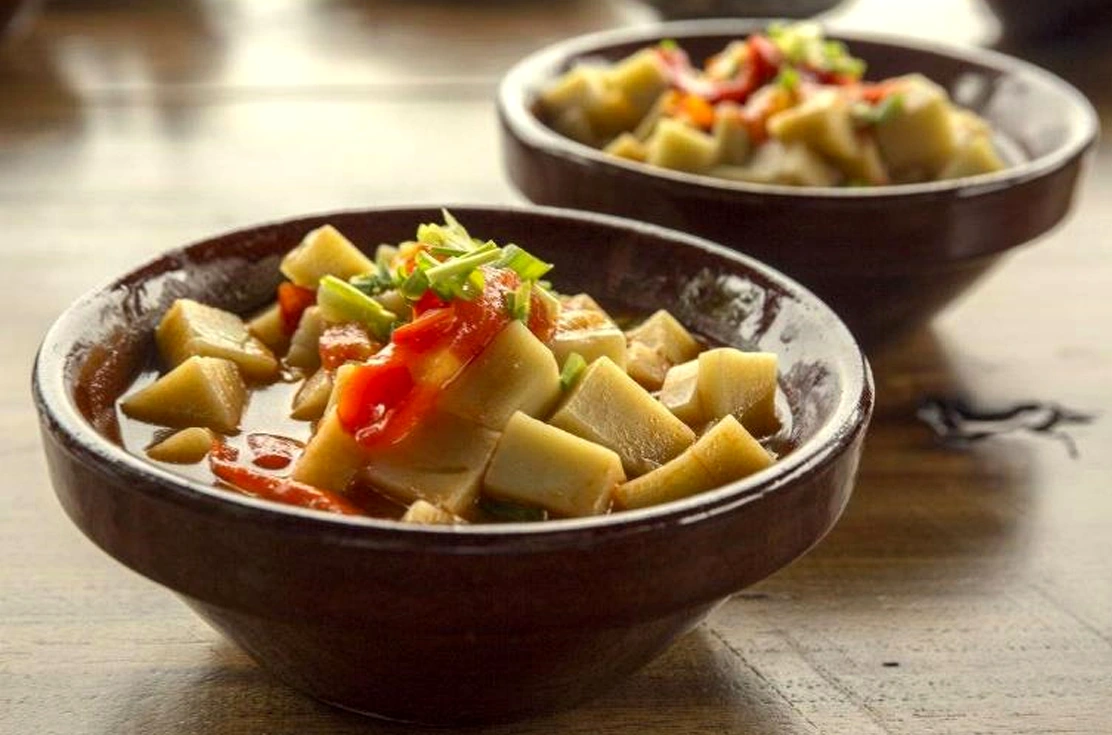
After being dazzled by the fiery performances, stopping by a wooden pavilion by the quiet stream to enjoy the flavor of night cuisine is an unforgettable heart-warming experience. On the time-darkened rustic wooden table, two bowls of steaming rich stewed soup capture every gaze with their dark brown sauce blending smoothly with light yellow chunks of ingredients infused with the flavors of tender bamboo shoots and soft potatoes. Dotted on the surface of the bowls is the bright red of diced tomatoes mixed with the vibrant green of chopped scallions, emitting a gentle herbal aroma that helps dispel the chill of the highland night mist.
Therefore, the night in Furong Town is neither noisy nor bustling in the urban rhythm, but deeply sinks into the traveler’s soul with an ancient breathing blended with contemporary visual art. When the velvety night curtain blankets the entire valley, the babbling sound of the Youshui Waterfall harmonizes with the lively chatter from the taverns along the rocky slopes, creating a peaceful symphony in the heart of the heritage. Leaning against the railing of the Diaojiaolou to watch the last glittering streaks of light on the blue water, one can truly feel the endless soul of a thousand-year-old ancient land.
Tucked away along the misty cliffs of the Youshui Gorge, the culinary life of Furong Town has long been an absolute harmony between pristine natural products and the unique Tujia ethnic culinary philosophy. Under the profound impact of the valley’s climate shrouded in fog year-round, the local palate leans toward cooling and warming properties to dispel dampness with four main flavor axes: tongue-numbing spiciness from chili peppers stir-fried in rapeseed oil, gentle sourness from local pickled bamboo shoots, rich wood-smoke from kitchen rafters, and herbs that cleanse the meridians. The ancient town’s cuisine is not ostentatiously elaborate in the imperial style; rather, it distills simplicity, packing the wild flavors of the mountains and forests into unforgettable treats that leave a lasting impression on travelers at first taste.
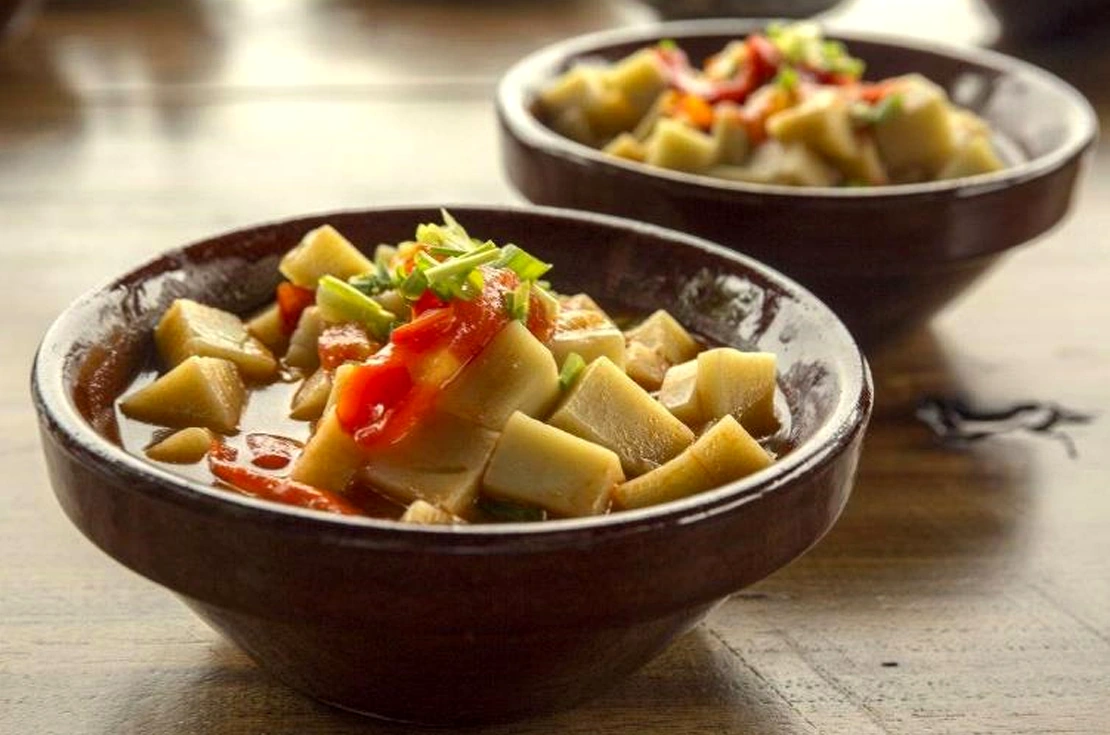
The soul culinary symbol, associated with the name and destiny of the ancient town through the classic 1986 film, is Rice Tofu, also known as Mi Doufu. This rustic delicacy requires an extremely meticulous manual preparation process: upland rice grains are soaked in natural wood ash water overnight to absorb organic alkali, then ground in a stone mill into a smooth, rich rice milk, poured into an iron wok and stirred constantly over a simmering flame until thickened, and then poured into molds to cool into soft, jade-green, refreshing jelly blocks. The most authentic spot to savor this flavor is Liu Xiaoqing Rice Tofu Shop No. 113, modestly situated on the bluestone-paved Wuli Street polished by countless footsteps. Each piece of rice tofu is diced into neat cubes, generously drizzled with secret chili soy sauce stir-fried with spicy rapeseed oil, and sprinkled with vibrant green scallions, crushed roasted peanuts, and crunchy pickled soybeans, delivering a magical melting sensation that is rich, nutty, sour, and spicy all at once.
Leaving the street food stalls along the slope, the locals’ banquet unfolds lavishly with the flavors of the Youshui River, most famously featuring the art of “live water cooking live fish,” which means using the fresh water of streams and rivers to cook freshly netted fish. Fresh stream carp and catfish, caught from the silt-laden Youshui River, are simmered with sour bamboo shoots and mountain ginger in thick earthenware pots, or clamped in bamboo strips and grilled directly over glowing charcoal after being marinated in a spicy Xiangxi chili paste and fragrant wild Chinese prickly ash. The fish meat is sweet, firm, and blends with the appetizing sourness that stimulates the spleen and stomach, completely driving away the damp cold characteristic of the mountainous region.
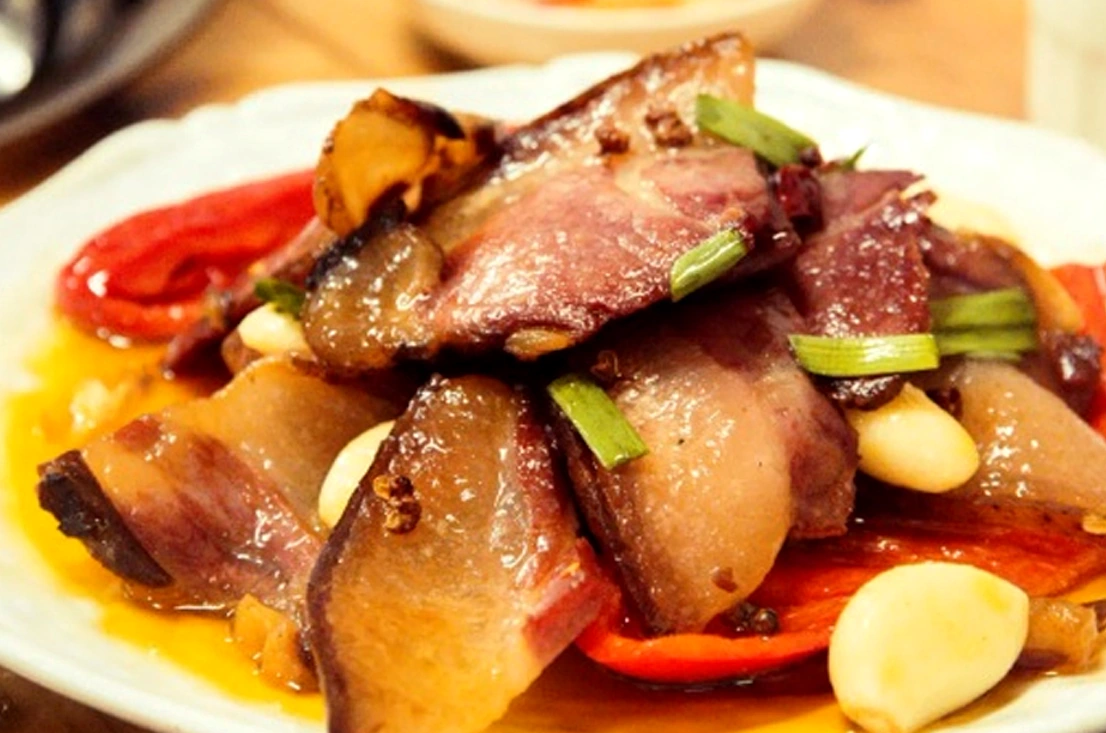
Alongside the river’s seafood is Xiangxi Bacon (Lap Rou), the winter culinary treasure of the Tujia people. Slabs of free-range black pork belly are thoroughly marinated with coarse salt, glutinous rice wine, and prickly ash in earthen jars for many days, then hung upside down from kitchen rafters, continuously smoked with pine wood smoke and rice husks for two to three months. When taken down, the pork fat turns crystal clear like amber and the lean meat is bright red like jade; the outer layer of soot is scraped off, sliced paper-thin, and stir-fried with bamboo shoots or pungent leeks, creating a rich yet non-greasy flavor deeply imprinted with time and cozy smoke.
By the edge of the silvery water gorge, a sweet aroma spreads from the traditional handmade ginger candy stalls located along the ancient slopes. Pure sugarcane molasses is boiled down bubbling hot with mashed old ginger and golden roasted sesame seeds, then the artisan briskly tosses and stretches the chewy candy mass on an ebony wooden stake to create air bubbles, pulls it into threads, and cuts it into small, crispy pieces. Every bite warms the chest, driving away the cold evil absorbed from the deep river. Blending with this rustic culinary feature is the ethereal flavor of Maonan Vine Tea, also known as Baoxing Vine Tea. This wild vine tea grows naturally on steep, sheer limestone cliffs and, through skillful wok-roasting, crystallizes into a natural white powder rich in precious flavonoids; the first sip brings a slight bitterness to the tip of the tongue, but a split second later, a deep, sweet, and refreshing aftertaste blossoms in the throat, helping to regulate circulation and soothe physical fatigue.
Today, Xiangxi’s transportation infrastructure has entered a breakthrough era, completely liberating it from the ruggedness of the steep cliff paths of a thousand years ago. The backbone connecting Furong Town with neighboring wonders is the Zhangjiajie-Jishou-Huaiyuan (张吉怀高铁) high-speed railway, with a designed speed of up to 350 km/h, acclaimed as one of the most spectacular railway lines in China. Departing from Zhangjiajie West Station, passengers take a mere 25 minutes to reach Furong Town Station, and from there, a further 20-minute glide brings them to Fenghuang Ancient Town Station. The Furong Town high-speed railway station is just 2.5 km from the ancient town gate, smoothly connected by a dedicated shuttle bus service running every 10 minutes. For travelers choosing to travel by road from Zhangjiajie Hehua International Airport (DYG), the G5515 expressway stretches for about 80 km, offering a smooth journey through rolling limestone valleys, taking only around 70 minutes of driving to set foot in this Tujia homeland.
Regarding immigration and entry regulations, international tourists can access the ancient town through two flexible and convenient methods. The most popular and optimal solution is the electronic group visa (团签) sponsored by legitimate travel agencies, with a fast processing time of 3 to 5 working days, completely eliminating complex financial proof procedures. Additionally, for charter flights flying directly to Hehua International Airport, the port visa policy for organized tour groups also provides significant convenience, making the border crossing into Hunan’s mountainous region easier than ever before.
To fully grasp the essence of an ancient Tujia kingdom, choosing the exact moment for your field exploration is of absolute decisive importance. The time frame from 05:30 to 07:00 in the morning is dubbed the invaluable golden hour, when the waterfall continues to roar amidst the ethereal blue mist rising from the surface of the Youshui River. At this time, loud tour groups have not yet awakened, returning the ancient town to its pristine, profound serenity from the days of its founding, with every green stone slab drenched in morning dew and everything immersed in the purest tranquility.
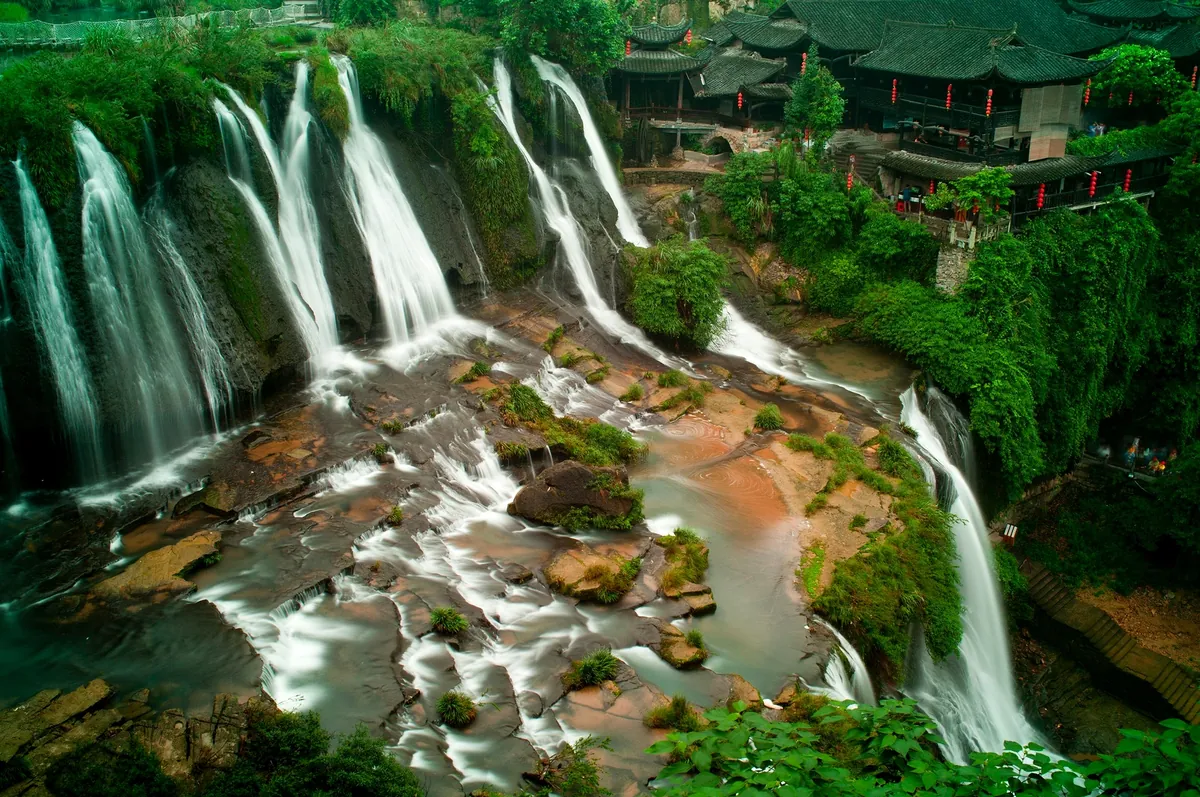
To avoid the pressure of mid-day crowds, your exploration should follow a closed-loop and smart walking route. Starting from the airy West Gate, travelers leisurely stroll along the Wuli Ancient Street, paved with flagstones polished by the footprints of history, and visit the Tusi Mansion with its multi-layered stilt house (Diaojiaolou) architecture. Continuing into the mysterious walking path winding right behind the roaring curtain of water, the cool mist against your skin will lead you down to the ancient pier on the banks of the Youshui River. From the pier, follow the slope leading to the imposing Diaojiaolou houses on the East Bank; this is the ultimate direct vantage point to capture the full panoramic view of the two-tier waterfall plunging straight into the deep rocky abyss.
A painful blind spot that discerning travelers need to recognize is the trap of underpriced tours, also known as “Zero-Dollar Tours.” With an outwardly attractive price tag of just 5 to 7 million VND, tour operators are forced to recoup their losses by trapping visitors for 90 to 120 minutes at at least 4 designated shopping stops: Xiangxi silver workshops with prices marked up by 300% to 500%, black tea shops, latex mattress factories, and traditional medicine pulse-diagnosis rooms prescribing expensive herbal remedies. As a consequence, the time spent in Furong Town is pitifully squandered, with tourists rushed past the waterfall in just 1 to 2 hours at dusk amidst suffocating crowds.
The authentic value of this thousand-year-old scenic spot truly unfolds only when you spend a full 18 to 20 hours overnight right in the heart of the ancient town, listening to the sound of the waterfall blending with the rhythmic beating of laundry mallets at midnight and gazing at the billowing morning mist at dawn. To preserve an authentic experience free from commercialization, travelers can consider meticulously designed signature itineraries such as the Nanning – Liuzhou – Zhangjiajie – Fenghuang Ancient Town – Furong Town 6D5N Tour, where time belongs entirely to genuine cultural emotions.
