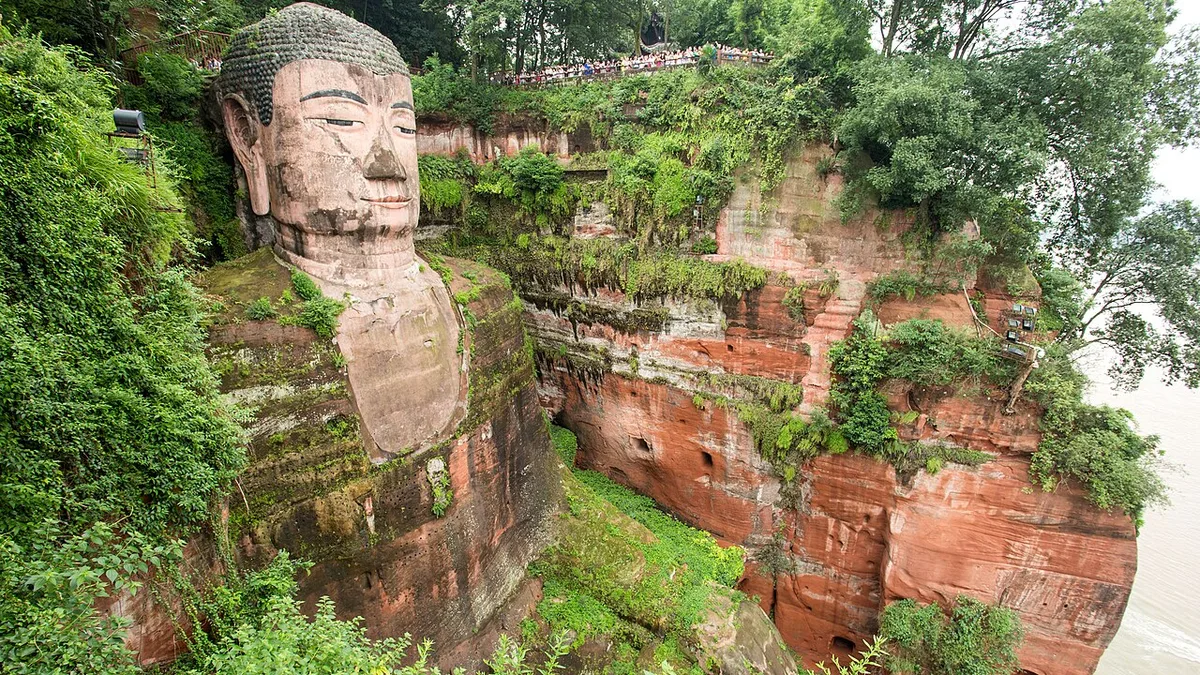
Situated at the vital hydrological intersection where three major rivers of Sichuan Province—the Min River, Qingyi River, and Dadu River—converge, the Leshan Giant Buddha occupies a position of profound natural strategic and spiritual significance. In terms of spatial coordinates, this colossal stone Buddha is carved directly into the Xiling cliff face of Lingyun Mountain, facing directly across the rushing river currents toward the city of Leshan. The terrain of this area is renowned for its Cretaceous red sandstone geological structure, a material of moderate softness that facilitates large-scale carving while remaining extremely vulnerable to erosion by floodwaters and natural weathering phenomena over centuries. With an overall height reaching 71 meters, this monumental work holds the record as the largest carved stone cliff Maitreya Buddha statue in the world, representing a magnificent achievement of ancient human architecture and religious sculpture.
The endeavor to create this monumental masterwork began in the first year of the Kaiyuan era of the Tang Dynasty, namely 713 CE, under the leadership of Zen Master Haitong of the Lingyun Temple sect. The primary motivation driving the carving of the Buddha statue was not a pure political ambition, but rather arose from profound compassion for the sufferings of the populace downstream. Where the three rivers intertwined, dangerous whirlpools frequently occurred, capsizing commercial boats and claiming the lives of countless innocent people whenever the flood season arrived. Zen Master Haitong vowed to carve a colossal Buddha statue to subdue the water deities, pacify the ferocious currents, and bring peace to the common folk. The construction process dragged on for a full ninety years across multiple generations, enduring numerous dynastic upheavals, and was only truly completed in 803 CE during the tenure of military inspector Zhang Qin, long after Haitong had passed away, with the work continued by his disciples and financial patronage from the Tang imperial court.
Under the lens of history, the endurance of the Leshan Giant Buddha is bound to countless vicissitudes of China’s feudal dynasties as well as the violent shifts of time. During its early construction period, the Buddha was protected by a magnificent wooden architectural structure called the 13-story Dafalingyun Pavilion, shielding the statue’s body from rain, sun, and wind. However, through wars and devastating fires across the Ming and Qing dynasties, this wooden pavilion was completely burned down, exposing the entire body of the Buddha to the harshness of the natural environment. The degradation of the gold-leaf plastering and the original drainage systems caused the sandstone surface to be rapidly covered by moss, cracking and suffering severe erosion. Minor and major restoration efforts were continuously undertaken by the Chinese state and local communities across historical periods, most notably comprehensive preservation projects in 1962, 1984, and the early 21st century, aimed at saving the statue from structural damage caused by environmental pollution and acid rain.
The national symbolic value of the Leshan Giant Buddha extends far beyond the boundaries of an ordinary religious art monument, standing as a historical testament to the indomitable spirit and supreme intellect of medieval Chinese laborers. Choosing the imagery of Maitreya Buddha, the future Buddha representing compassion, tolerance, and prosperity, reflects the aspiration of the Min River basin community to live in harmony with nature. The intricately concealed drainage system inside the statue’s body—comprising subterranean channels, ventilation tunnels, and open-air gutters—is an ancient hydraulic engineering masterpiece that minimizes water pressure and moisture seepage into the rock core. This demonstrates the highly scientific macro-planning mindset of Tang Dynasty engineers, who not only deeply understood molding art but also mastered applied physics, mechanics, and hydrology.
The cultural influence of the Leshan Giant Buddha also radiates powerfully through traditional literature and art, becoming an endless source of inspiration for poets, painters, and scholars over centuries. Countless poems, rhapsodies, and stele inscriptions record the overwhelming emotion felt when confronting the colossal scale and compassionate demeanor of the statue amid the majestic natural scenery of the Sichuan mountains. Prominent literary figures such as Su Dongpo and many other historical luminaries, when stopping here, left behind literary works praising the harmonious combination of human craftsmanship and the grandeur of creation. These values received official international recognition when UNESCO inscribed the Leshan Giant Buddha on the World Heritage List in 1996, linked with the Mount Emei scenic area.
Today, the Leshan Giant Buddha continues to serve as one of Asia’s premier centers for archaeological research, Buddhist art history, and heritage conservation. Modern geological research employing 3D laser scanning, ground-penetrating radar, and specialized biological materials is being applied to monitor every minor crack on the statue’s body, ensuring the integrity of the heritage against the challenges of global climate change. The proud survival of the statue across more than a millennium and a half not only reflects the triumph of human resilience over natural floods but also strongly reinforces its status as an eternal symbol of human culture, where history, art, and spirituality blend into a cohesive entity enduring alongside the passing years.
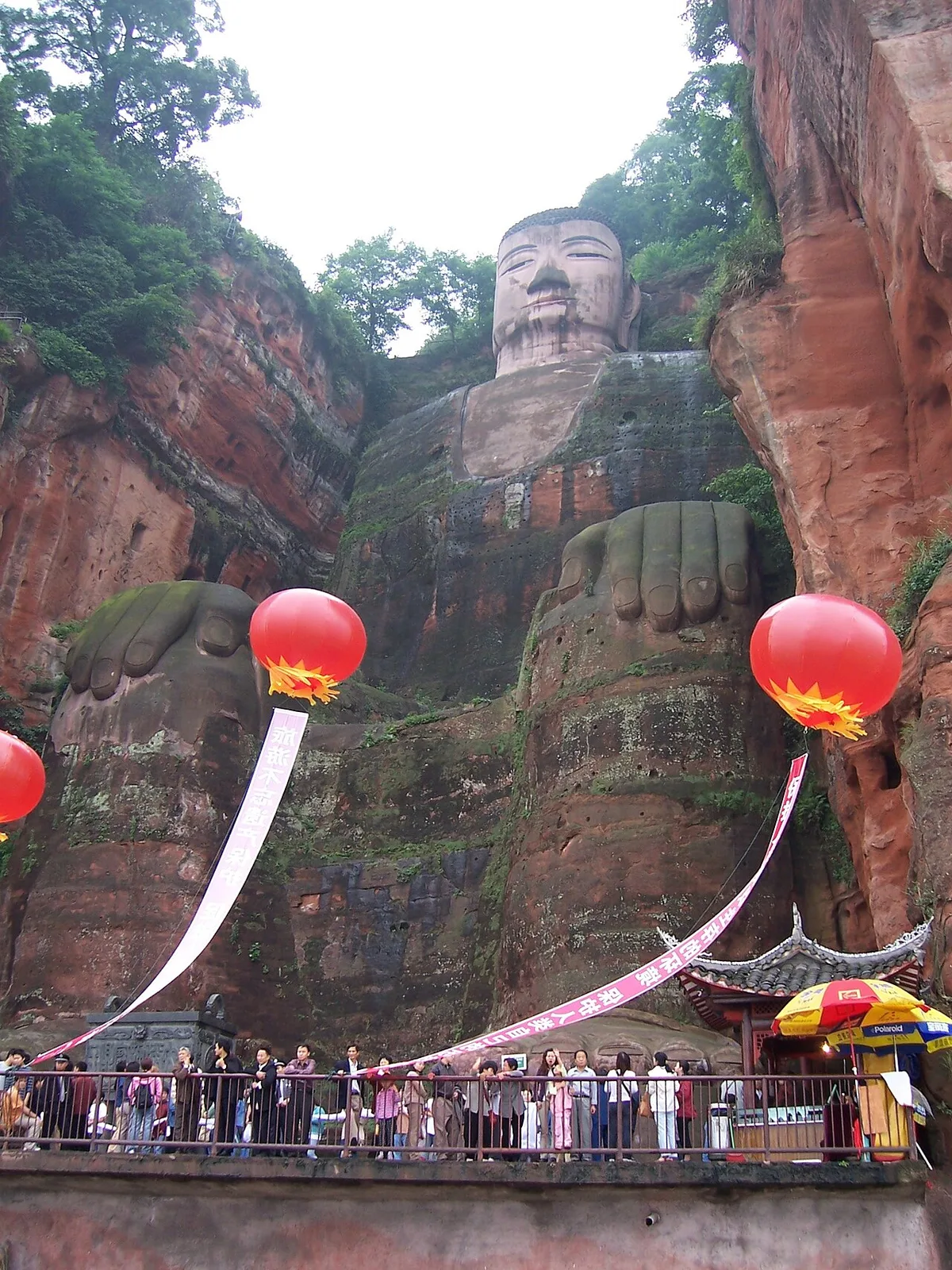
The grand religious architectural and sculptural complex of the Leshan Giant Buddha, initiated by the Tang imperial court in 713 under the leadership of Zen Master Haitong, is located at the southernmost tip of Sichuan Province, where three major streams—the Min River, Qingyi River, and Dadu River—converge right at the foot of Lingyun Mountain. From the perspective of geology and spatial tectonics, this area is a red sandstone cliff belonging to the Cretaceous system, possessing a soft sedimentary strata structure that is susceptible to weathering yet offers ideal thickness and height for executing a colossal work through direct carving into the mountain heart. Zen Master Haitong and generations of Tang Dynasty craftsmen ingeniously utilized the mechanical properties of this red sandstone to construct a spiritual work of cosmic proportions, where architectural forms blend completely into the natural geological structure of the river valley.
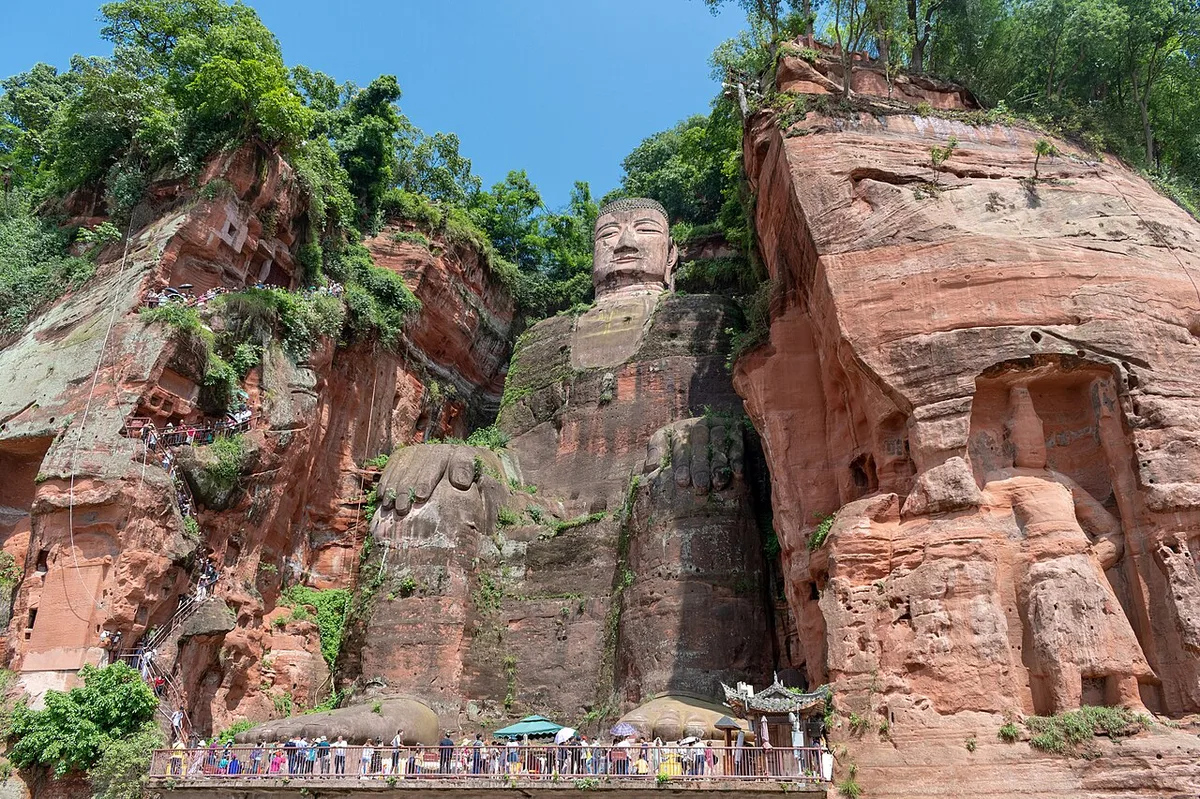
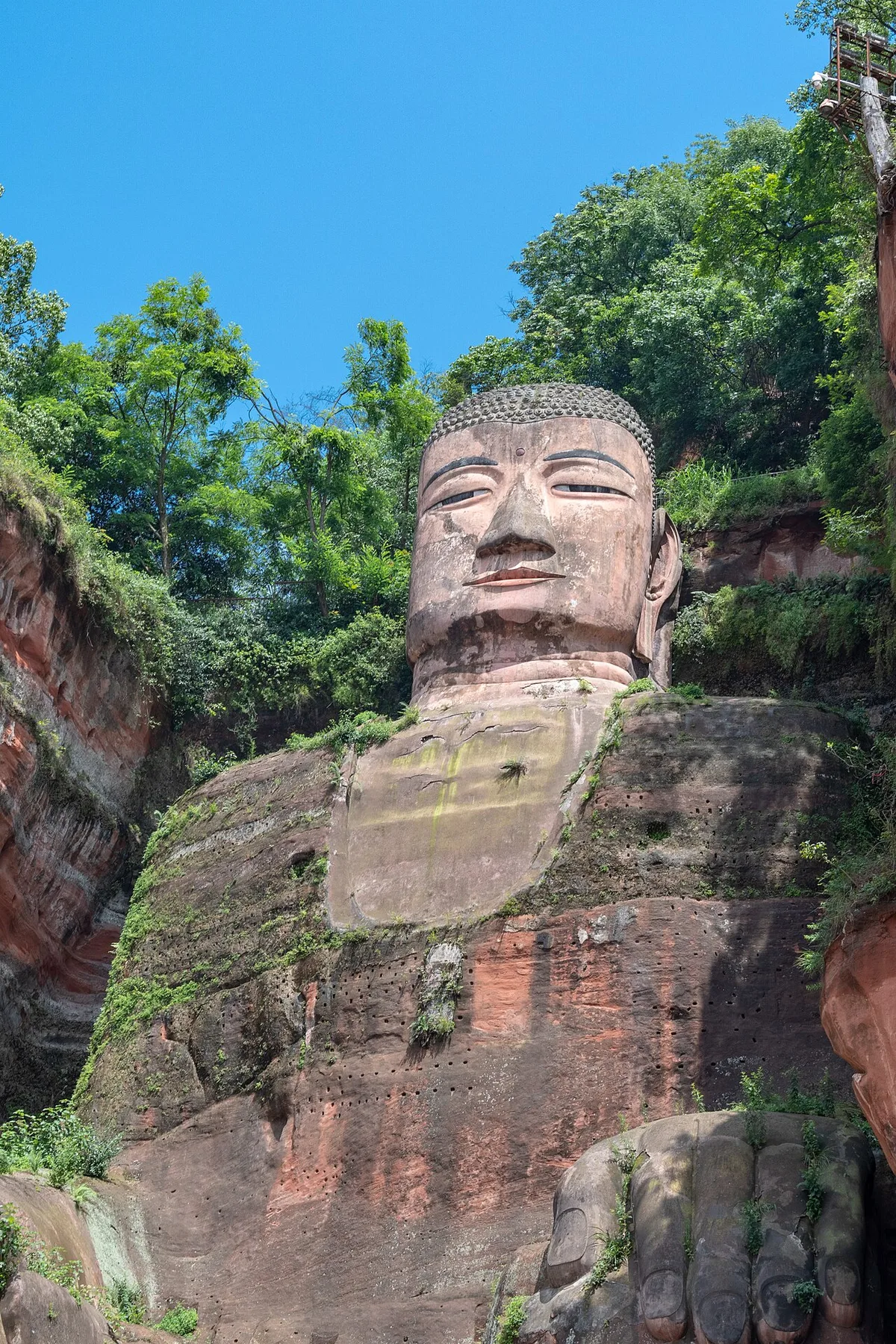
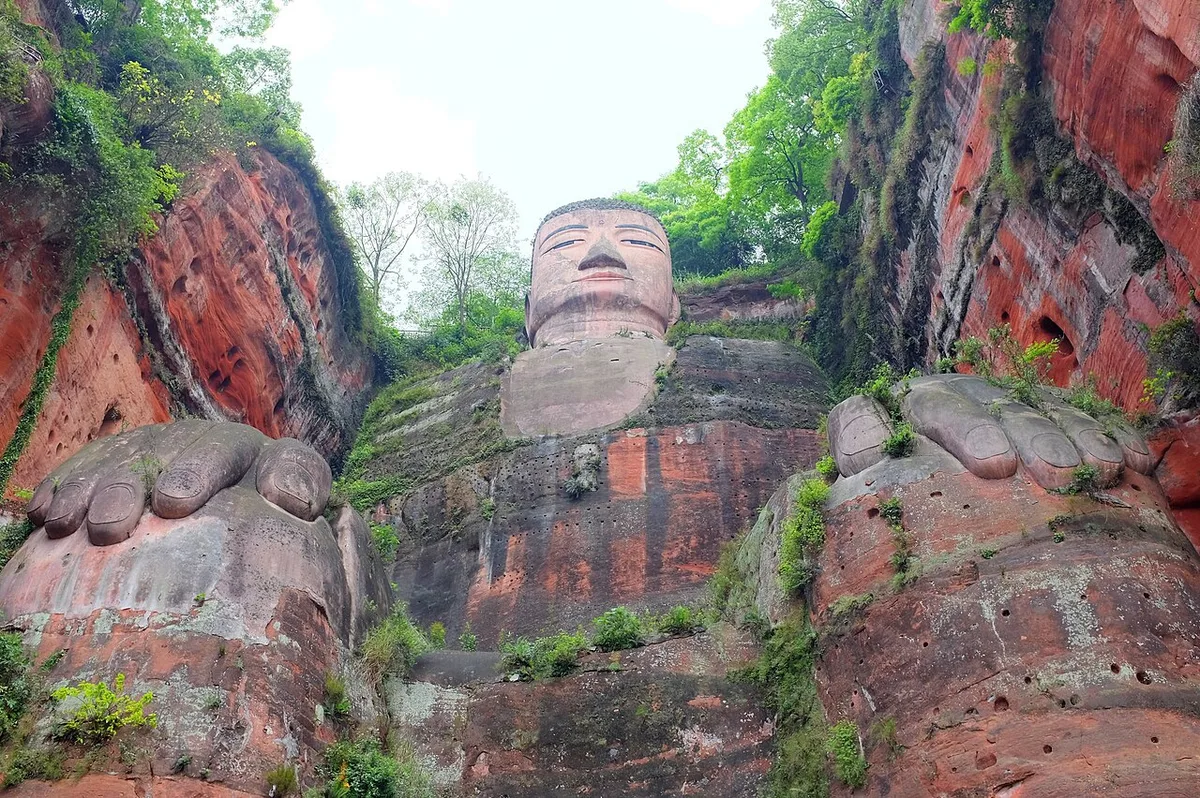
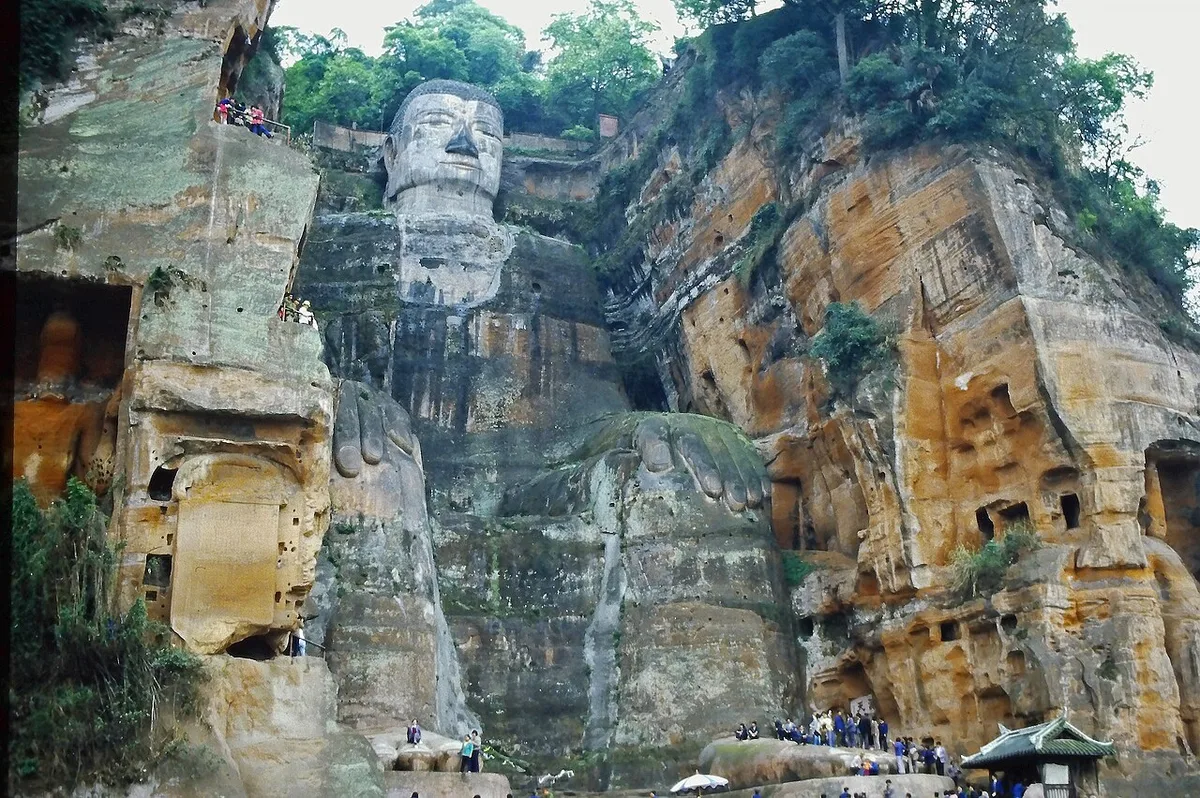
The overall scale of this seated Maitreya Buddha statue yields technical specifications that astonish both contemporary engineering and posterity. The overall height of the statue from the crown of the head to the heels reaches a full 71 meters, with the head alone standing 14.7 meters high and 10 meters wide, composed of thousands of intricately carved spiral hair buns. The Buddha’s eyebrows alone span 5.6 meters, with open eyes gazing toward the rushing water possessing a compassionate yet majestic expression; the nose is 5.6 meters long, the mouth 3.3 meters wide, and the ears 7 meters long, functioning as structural supports combining natural stone and supplementary artificial masonry. The statue’s feet measure 8.5 meters in width, spacious enough to accommodate dozens of people standing simultaneously, forming a miniature plaza directly upon the natural rock base above the abyss.
To execute a colossal sculpture on a sheer cliff overlooking a river without collapsing the foundation structure, Tang Dynasty engineers and artisans applied unique construction techniques combining subtractive carving and highly advanced subterranean drainage systems. Because red sandstone is easily eroded by rainwater and moisture rising from the three major rivers, the entire body of the statue from the neck downward was designed with an intricate network of drainage grooves, ventilation tunnels, and underground troughs carved within the stone core. This system includes hidden pipes running along the folds of the kasaya robe, ears, chest, and arms, functioning to channel rainwater from the mountain peak downward and outward through various directions, completely preventing water seepage into the sandstone core that would otherwise crack and shatter the structure. This technique attests to the highly scientific spatial planning mindset of the ancients, who did not merely create a pure religious effigy but also successfully resolved complex hydrological and geotechnical engineering challenges.
Alongside the main statue carved directly into the Lingyun cliff face, the overall spatial layout of the heritage site historically included protective wooden architectural systems, most notably the Dafalingyun Pavilion built during the Song Dynasty. According to archaeological documents and historical records, the original structure of the Leshan Giant Buddha was protected by a 13-story wooden pavilion named Dafalingyun Pavilion, acting as a giant suit of armor shielding the statue’s body from the direct impact of extreme sun and rain in the Sichuan basin. Through historical upheavals and wars in the late Yuan and early Ming periods, the original wooden pavilion was completely burned down, leaving traces of mortise holes drilled deep into the cliff face surrounding the statue body, which researchers can still observe clearly today. Whether or not to rebuild this wooden pavilion across periods has created an open appearance for the architectural space, allowing the statue to merge entirely into the sky and natural environment of the gorge.
The zoning scheme of the Leshan Giant Buddha scenic area is organized into a multi-tiered spatial axis, tightly integrating the rugged mountainous terrain with supplementary Buddhist architectural works. The main axis of the heritage site begins from the triple gate at the foot of the mountain, guiding visitors through a network of winding stone stair trails hugging the slopes of Lingyun Mountain, which concentrates numerous ancient temples, relic pagodas, and stone-carved steles from various feudal Chinese dynasties. The highlight of internal transportation planning is the Nine-Bend Plank Road (Cửu Khúc Cát Đạo), a rugged winding walkway comprising 333 stone steps carved along the cliff beside the statue’s body. This path does not merely serve a vertical transportation function connecting the summit to the base of the statue, but is also carefully calculated in terms of visual angles, enabling observers to approach the statue from diverse distances and elevations, ranging from panoramic overhead vistas to close-up eye-level perspectives of the colossal effigy.
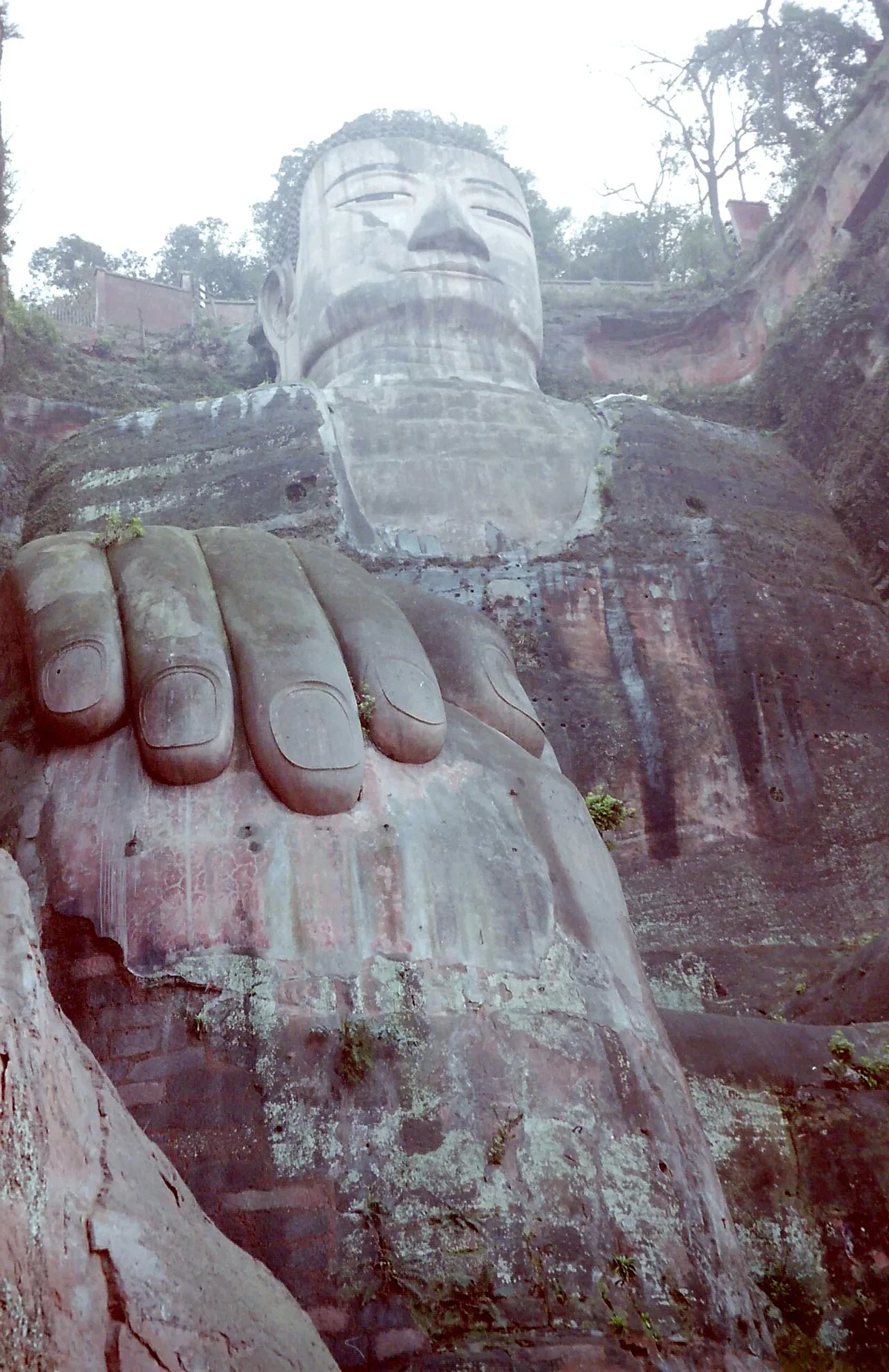
The primary construction and restoration material of the Leshan Giant Buddha is a combination of in-situ red sandstone and traditional mortar composed of lime, sand, clay, and reinforced hemp fibers utilized across historical restoration phases. When the statue suffered damage or peeling over time, craftsmen typically utilized red sandstone slabs of matching color and composition for joining, subsequently plastering a specialized mortar layer across the surface to protect the inner stone layer from oxidation and moss growth. Modern conservation efforts in recent decades continue to employ advanced technical methods, such as spraying penetrating chemical solutions to stabilize hollow internal structures within the cliff face, alongside installing automated seismic measurement and humidity monitoring devices to continuously control the shifting of sandstone blocks under the pressure of weather and water currents.
Visitor capacity and tourist space management at the Leshan Giant Buddha demand an extremely complex traffic distribution system to balance heritage preservation against the demands of millions of annual tourists. This scenic area welcomes massive volumes of domestic and international tourists, particularly during major festive holidays, making crowd control on narrow pathways like the Nine-Bend Plank Road a challenging urban and heritage planning problem. The heritage management board has established real-time capacity monitoring systems paired with dual tour routes comprising pedestrian cliff trails and specialized riverboat docks along the Min River. Employing water transport to carry visitors mid-stream to admire the statue’s full frontal appearance from a water-level perspective does not merely deliver a breathtaking visual experience, but also helps relieve weight loads and friction on ancient stone stairs along the cliff face, guaranteeing the eternal preservation of one of humanity’s greatest sculptural masterpieces.
Cutting deep into the Xiling cliff face of Lingyun Mountain, at the confluence of the Min, Dadu, and Qingyi rivers in Sichuan Province, the Leshan Giant Buddha emerges as a towering pinnacle of world Buddhist sculptural art dating from the Tang Dynasty. Initiated in 713 CE under the leadership of Zen Master Haitong and completed in 803 CE during the reign of Emperor Dezong of Tang, this giant Buddha statue is the embodiment of Mahayana Buddhist philosophy harmoniously combined with traditional Chinese architectural engineering and molding aesthetics. The work is not simply a colossal religious sculpture but an open-air architectural museum, reflecting clear upward aspirations, compassionate salvation, and the fierce ambition of the ancients to subdue raging floods in the southwestern frontier.
Regarding overall structural composition, the seated Maitreya Bodhisattva statue reaches a height of 71 meters, an overwhelming dimension making it the largest stone Buddha statue in the world carved directly into a mountain core. Tang Dynasty artisans skillfully utilized the geological structure of the red sandstone strata—a material of moderate softness yet strong load-bearing capacity—to carve meticulous details from the crown of the head down to the lotus pedestal. The Buddha’s head stands approximately 15 meters high, elaborately sculpted with 102 spiral hair buns carved following strict geometric symmetry, generating an optical illusion of depth and solemnity when viewed from the river base upward. The square face, half-closed eyes gazing down upon rushing waters with a compassionate yet majestic expression, high straight nose, and slightly parted lips compose a transcendent expression that bridges the gap between divine greatness and mortal sentient beings.
The drainage network concealed within the statue’s body constitutes a masterwork of ancient architectural engineering reflecting the highly progressive scientific thinking of Tang Dynasty engineers. Artisans intricately designed a web of tunnels, drainage grooves, and ventilation pipes arranged along the ears, chest, robes, and flanks of the statue. This system collects rainwater, minimizes erosion caused by high humidity, and prevents vapor accumulation that triggers moss growth, thereby preserving the sandstone structure through more than ten millennia facing the harsh climate of the Sichuan basin. Thanks to this intelligent ventilation and drainage network, the stone core of the statue maintains relative stability, attesting to the visionary outlook and profound mastery of building materials and natural laws possessed by ancient architectural masters.
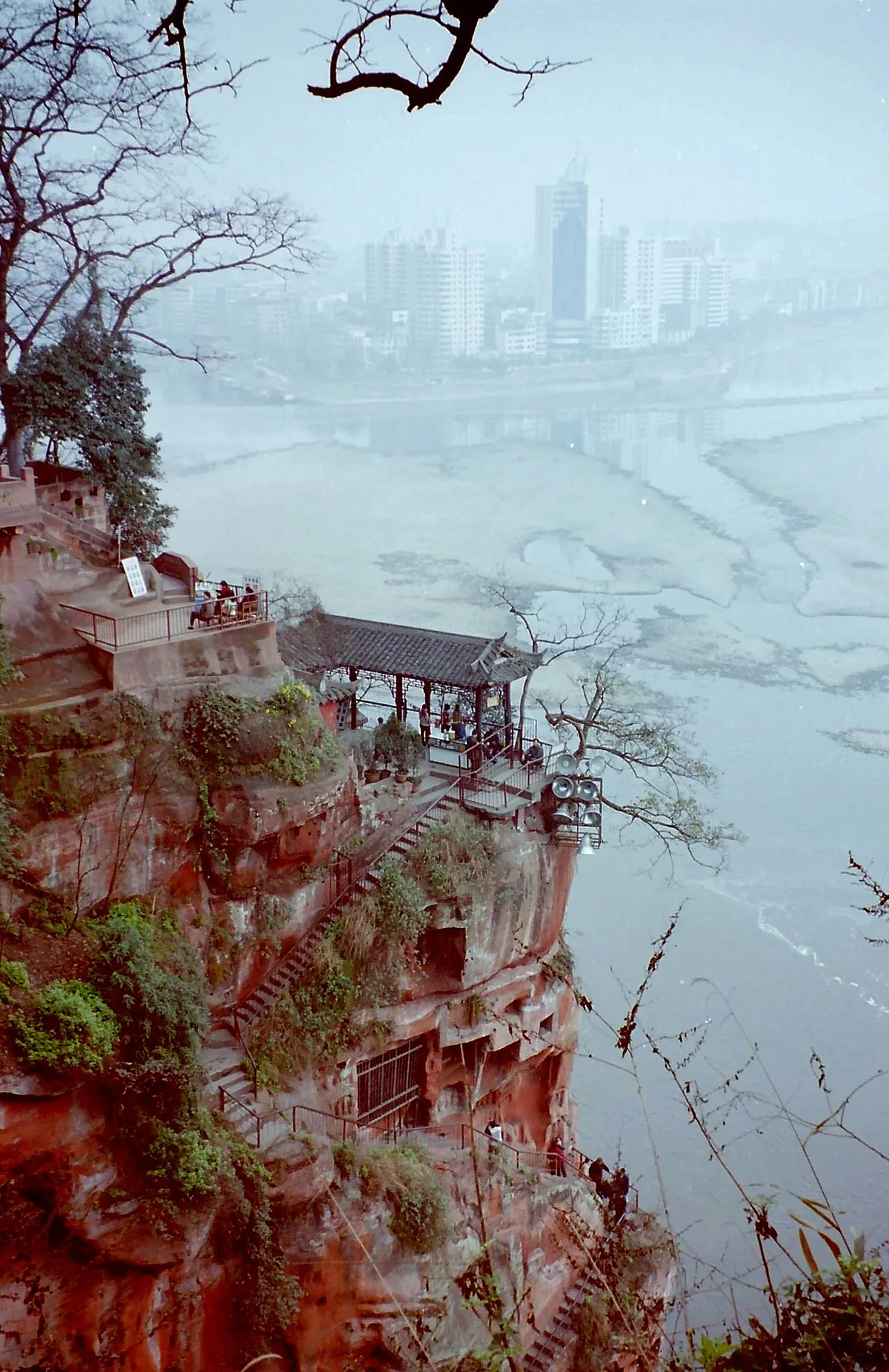
Surrounding the main colossus is a system of supplementary Buddhist architectural works arranged symmetrically on the slopes of Lingyun Mountain, including Lingbao Pagoda, the Mahavira Hall, along with corridors and bell towers bearing distinct styles of the Ming and Qing dynasties. Lingbao Pagoda atop Lingyun Mountain is a 13-story dense-eave brick pagoda characteristic of esoteric Buddhism, establishing a balanced vertical accent relative to the massive mass of the Buddha statue below. Surrounding shrines house hundreds of murals, guardian statues, terracotta arhats, and precious wood sculptures reflecting the synthesis of Chan and Esoteric Buddhist thought in the spiritual life of local residents across various feudal dynasties.
Decorative motifs and motifs carved on wood, stone, and architectural components throughout the Leshan Giant Buddha manifest the peak of traditional Chinese carving art. Motifs of lotus blossoms, rolling clouds, waves, and auspicious symbols are carved with fluid, gentle yet decisive lines, reflecting the prosperity and refinement of Tang Dynasty aesthetics. Notably, the Buddha’s kasaya robe features natural falling folds that realistically simulate soft silk fabric despite being carved on rigid stone surfaces, demonstrating supreme sculptural craftsmanship and a profound understanding of anatomical form by anonymous craftsmen of that era.
The core philosophical and religious significance of the Leshan Giant Buddha is bound to the imagery of Maitreya Bodhisattva, the future Buddha in the Mahayana Buddhist tradition. Choosing Maitreya as the primary object of veneration conveys messages of salvation, hope, and the transformation of suffering into peaceful bliss. Within the historical context when converging river currents frequently triggered devastating floods, sweeping away thousands of lives and boats, constructing a giant Buddha statue facing the waters carried immense psychological reassurance. It embodied spiritual faith that the Buddha’s compassionate power would tame turbulent waters, bringing safety to passing merchants and prosperity to all of Sichuan.
Enduring through millennia of vicissitudes, weathering historical turbulence, wars, and the erosion of time, the Leshan Giant Buddha stands majestic as a living testament to the harmonious combination of human creative labor and nature’s grandeur. Every architectural detail, every carved line, and every hidden drainage engineering system tells the story of a brilliant civilization that respected and honored humanistic values. Researching and preserving this heritage does not merely retain material artifacts of high historical value, but also sustains the flowing currents of philosophy, art, and spirituality for future generations to explore and contemplate.
The geographical space surrounding the Leshan Giant Buddha in Sichuan Province, China, operates according to a local lifestyle rhythm deeply imbued with the cultural identity of the southwestern plateau, where millennia of history intertwine with the daily existence of the local community. From the earliest moments of a new day, as thick mist rises from the river junction where three large waterways—the Min, Qingyi, and Dadu rivers—converge, the space around the colossal Buddha carved into the Xiling cliff face begins to stir. Local fishermen on traditional wooden boats slowly cast their nets, continuing a livelihood passed down from generation to generation upon the very waters that witnessed legendary floods. Morning temple bells from the ancient Lingyun Temple ring low and deep, blending into the sound of waves lapping against the base of the giant Buddha, creating a natural acoustic score imbued with monastic breath and the practical life of riverbank residents. Locals in simple attire begin their new day by walking along moss-covered red stone steps, practicing Tai Chi beneath century-old trees, transforming the heritage zone into an intimate community space rather than a mere silent scenic spot.
As morning sunlight gradually dispels the early mist, casting brilliant golden rays onto the crown and solemn face of the 71-meter-tall seated Buddha, pilgrims and culture researchers begin pouring into the scenic area along winding paths. The most valuable panoramic viewpoints do not lie at the immediate base of the statue, where angles are constrained by the sheer height of the work, but rather along the rugged cliff system opposite across the river or atop Wuyou Hill. From the perspective of tourist boats bobbing between the river junction, the entire astonishingly balanced proportion of the statue carved since the 8th century gradually emerges clearly, revealing the supreme talent of Zen Master Haitong and Tang Dynasty stone artisans. They cleverly integrated an intricate drainage system hidden within the garments and hair of the Buddha to protect the work from rain erosion and moisture in the Sichuan basin—an ancient engineering marvel that continues to operate effectively today, prompting modern engineers to tip their hats in admiration.
Entering midday, the living rhythm around the Leshan Giant Buddha shifts to the bustling hue of local cultural exchange and commerce in the ancient streets at the foot of the mountain. Traditional eateries offer characteristic specialties of Sichuan cuisine featuring iconic pungent and spicy flavors derived from Hanyuan peppercorns and red chilies, attracting numerous visitors stopping to dine after hours of climbing through the challenging Zhuwei Cogu stone steps. Local residents here are exceptionally open, frequently sharing folk legends with travelers regarding the Buddha’s creation, historic floods touching the Buddha’s toes, and how the local community united to overcome adversity across generations. Folk artists perform traditional water puppet shows and Sichuan Opera face-changing in small roadside theaters, recreating local myths through body language and music imbued with southwestern Chinese colors, establishing a vibrant cultural layer enveloping the stone heritage.
As dusk descends, the sky shifts from bright orange to deep dark blue, and the living rhythm at the Leshan Giant Buddha enters an entirely different, serene, and profoundly philosophical religious dimension. Last-day sunlight casts long rays across the half-closed eyes of the giant Buddha, generating a powerful visual effect as if the effigy is looking down upon sentient beings with boundless compassion. Monks inside the monastery commence evening chanting sessions, with sutra melodies echoing from the main hall, blending with winds rustling through bamboo forests on Lingyun Mountain. During major lunar festive holidays, the space becomes glowing and ethereal under the light of tens of thousands of candles and lanterns offered by pilgrims, praying for national peace, favorable weather, and inner peace.
At night, modern artistic architectural illumination activates, tracing every architectural and sculptural contour upon the red sandstone cliff, highlighting the monumental scale of the statue against the pitch-black void of mountains and rushing river. The immersive night exploration grants observers an overwhelming sensation of human smallness before the universe and ancestral masterpieces created over millennia. Tourist boats continue plying the calm water reflecting golden lights from the cliff, while across the river bank, Leshan’s local life unfolds peacefully with bustling night food stalls serving steaming Sichuan hotpots. The flawless fusion of a UNESCO World Heritage cultural site and the contemporary lifestyle of local residents builds a multidimensional experiential space where past and present coexist in parallel, offering travelers deep and comprehensive insights into Sichuan’s culture.
The geographical territory of Leshan in Sichuan Province, China, operates according to an independent culinary ecosystem imbued with the identity of the legendary Sichuan basin. Distinct from the opulence of Beijing court cuisine or the delicate lightness of Huaiyang cooking, Leshan gastronomy possesses a wild, rustic yet exceptionally refined vitality, polished over centuries under the influence of the humid basin climate and bustling river trade traditions. The majestic presence of the giant Buddha carved into Lingyun Mountain does not merely anchor the spirituality of this land; it also generates a cultural space where millions of believers, merchants, and travelers across eras have shared unique sensory experiences. The local culinary system results from a blend of supreme native spice craftsmanship—especially Sichuan peppercorns, known locally as huajiao—combined with red chilies, fermented bean curd, animal fats, and rich ingredients from the river ecosystem, forming a flavor map of irresistible appeal to any cultural researcher.
Mentioning the pinnacle of food preparation technique in Leshan requires analyzing smoked tea duck, a product of blending medicinal marination methods with old-forest tea-leaf and pine-needle smoking. Preparation demands meticulous care from selecting medium-weight ducks, rubbing evenly with salt and pepper, curing overnight with Shaoxing wine and aged ginger, before steaming and directly smoking over low heat. The duck skin turns deep amber-brown, releasing the rich fragrance of tea tannins combined with the signature tingling spice of huajiao, generating complex flavor layers upon tasting. This technique served not only to preserve food in the humid monsoon climate of southwestern China, but also expressed the traditional culinary philosophy of balancing yin and yang, neutralizing poultry’s cooling nature with warming, pungent spices and ancient tea aromas.
Alongside poultry dishes, Leshan street food achieves high refinement with Bazhen tofu and beef offal preparations, demonstrating thorough and creative utilization within folk culinary culture. Leshan spicy braised beef utilizes prime short ribs and beef tendon simmered for hours in concentrated bone broth mixed with Pixian bean paste and dozens of herbs including star anise, fennel, cinnamon, and black cardamom. Diners immediately encounter a piercing yet non-abrasive spice, with a tingling sensation spreading across the palate from Hanyuan huajiao, leaving a naturally sweet aftertaste from bone broth. The art of balancing spice in Leshan never obscures ingredient flavors; instead, it acts as a powerful catalyst awakening all senses, turning even the humblest dish into a masterwork of culinary labor.
The dining customs of Leshan residents connect intimately with the ancient tea culture of the Wumeng mountains and surrounding areas, where robust green tea is placed on dining tables to cool down and offset spicy chili oils. Riverside teahouses or spots shaded by century-old trees around the Leshan Giant Buddha scenic area have long functioned as vital community spaces where locals gather early to enjoy hot tea brewed from pure spring water. Tea brewing rituals adhere to strict rules concerning water temperature, leaf ratios, and delicate ceramic utensils to extract pure fragrance and astringent sweetness. Combining spicy dishes with warm tea embodies the slow lifestyle of Sichuan generations.
Strolling through famous Leshan food streets like Shangzhong Street or alleys around the Great Buddha Bridge, diners immerse in aromas of sesame oil, crushed peanuts, and fried scallions. Traditional street stalls and multi-generational family eateries offer black sesame rice cakes, stuffed fried dough sticks, or spicy skewers simmering in pots of boiling broth laden with red chilies and huajiao. Every alley narrates migration histories and culinary preservation. The bustling atmosphere and fragrant steam forge a vivid picture of local life along the Min River.
The depth of Leshan’s culinary heritage transcends nutritional satisfaction, embodying deep humanistic philosophy toward nature. Through refined cooking techniques, locals turn food into universal art reflecting the bold, generous yet sophisticated spirit of Sichuan. Understanding and appreciating this gastronomy unlocks deeper comprehension of spiritual life, architectural history, and cultural identity in southwestern China.
Approaching the colossal stone Buddha of Leshan in Sichuan Province, China, requires thorough preparation regarding logistics, weather patterns, and local cultural etiquette. Carved into the Xiling cliff face at the confluence of the Min, Qingyi, and Dadu rivers, this monumental work is governed by Sichuan’s subtropical humid monsoon climate, featuring four distinct seasons with weather profiles. Spring (March to May) brings mild temperatures from 15°C to 25°C and blossoming landscapes, though increasing rain requires light rain gear. Summer (June to August) brings heat exceeding 35°C, high humidity, and sudden thunderstorms typical of the Sichuan basin’s bowl terrain. Autumn (September to November) is rated by travel researchers as the ideal season due to dry weather, clear skies, and colorful foliage. Winter (December to February) brings biting cold near freezing and heavy river mists.
Transportation infrastructure from Chengdu to Leshan is highly developed. High-speed rail from Chengdu East or Chengdu South stations reaches Leshan in 45 to 60 minutes. Local buses, taxis, and ride-hailing apps connect easily to the scenic area. Visitors should note traffic congestion during morning and evening rush hours near Fengqiao.
Early morning from 7:00 AM to 9:00 AM offers optimal lighting and tranquility. Dress modestly, wear non-slip shoes, book tickets online in advance with valid passports, and respect religious heritage rules (no flash photography inside shrines, no touching stone surfaces).
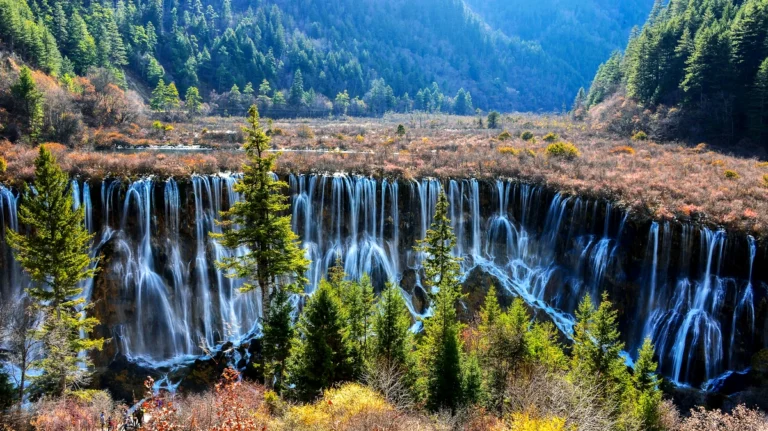
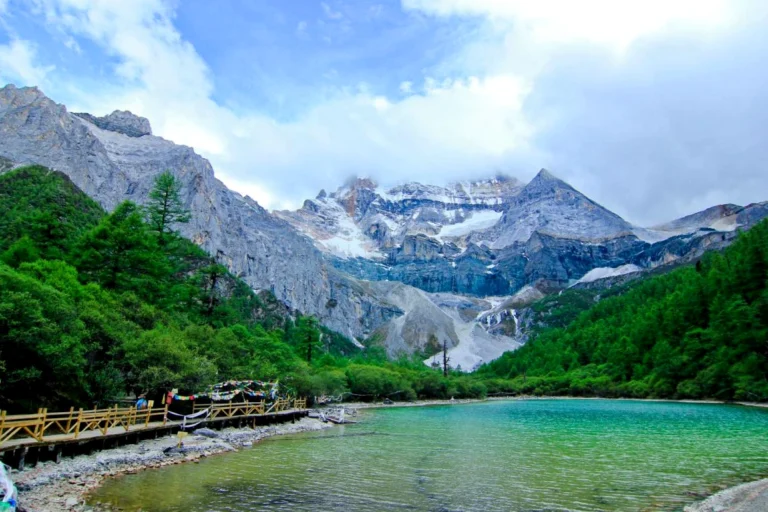
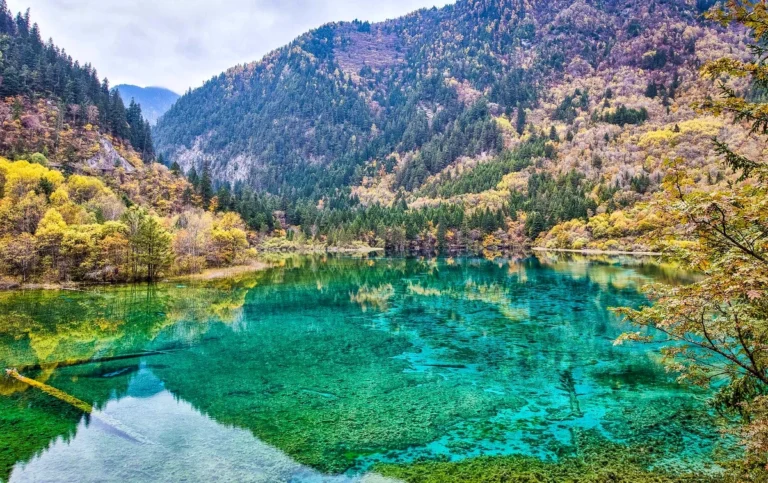
To experience this journey seamlessly along with a local guide, you can check out the Chengdu – Jiuzhaigou – Leshan Giant Buddha 6D5N Tour featuring a pre-arranged itinerary.