Tracing history back to the Joseon Dynasty (1392–1910), Mount Namsan—standing proudly at the heart of historic Hanyang (old Seoul)—was revered under the classical name Mokmyeoksan. Far more than a geomantic dragon vein anchoring the southern flank of the royal capital, the peak occupied a position of supreme military importance in safeguarding the realm. Atop this summit, the royal court established the Bongsu beacon system—an emergency smoke-and-fire signaling network stretching from distant frontier outposts straight to the royal palace. Five beacon towers operated as the kingdom’s top-secret national defense lifeline: sending columns of smoke by day and blazing signal fires by night. Whenever border unrest broke out or foreign invaders approached the frontier, alerts were relayed across hundreds of miles of rugged mountain terrain to ignite atop Namsan within mere hours. That historical legacy endowed the mountain with a sacred calling from its earliest days: serving as the supreme communications beacon of the entire Korean Peninsula.
Entering the modern era, as waves of industrialization and economic revival surged forward from the ashes of war, the mountain’s role as a communications hub was reaffirmed through a landmark architectural triumph. On December 15, 1969, during the Third Republic led by President Park Chung-hee, construction officially began on South Korea’s first integrated broadcast tower. The historical moment posed an urgent challenge: rapid expansion in national radio and television broadcasting demanded a unified central transmitter powerful enough to end chaotic signal interference among independent broadcasters. A strategic joint venture uniting the government with the nation’s flagship media networks—Korean Broadcasting System (KBS), Munhwa Broadcasting Corporation (MBC), and Dong-A Broadcasting System (DBS)—gave birth to a monumental spire rising straight into the capital’s sky.
Following relentless engineering efforts amid steep, challenging mountain terrain, the structural shell of the tower stood firmly completed in 1971. Yet only after intricate installation of cutting-edge telecommunications electronics did the landmark officially open for broadcast on December 3, 1975. Rising high above the mountain ridge, the tower not only transmitted radio and television signals to more than 80 percent of households nationwide at the time, but became a proud emblem of the “Miracle on the Han River”—symbolizing a nation rising from wartime devastation to claim its place on the global technological stage.
Changing times and rapid urban evolution opened yet another chapter for this architectural icon at the turn of the millennium. In 2000, CJ Corporation assumed management of the landmark and embarked on a historic, comprehensive renovation. Completed in 2005 with a total investment of 15 billion KRW, the transformation elevated a pure broadcast tower into a premier cultural and tourism complex under a new name: N Seoul Tower. Clad in sleek glass panels paired with high-tech artistic LED lighting programmed to change color according to urban air quality, the structure shed its utilitarian industrial shell for a captivating contemporary identity. From the signal smoke of Joseon’s Bongsu beacons to today’s radiant multi-colored light displays, the spire atop Namsan remains an enduring witness to every heartbeat of a rising global metropolis.
Viewed through traditional East Asian geomancy, when King Taejo (Yi Seong-gye) founded the Joseon Dynasty and established his capital at Hanyang, the city was cradled by the protective ring of the Four Inner Mountains (Naesasan). Within that royal geomantic mandala, Bugaksan stood guard to the north as the Black Tortoise, Naksan flanked the east as the Azure Dragon, Inwangsan watched over the west as the White Tiger, and Mokmyeoksan—the ancient name of Namsan—served as the Vermilion Bird guarding the southern front gate. Rising majestically at the center of the capital to 262 meters above sea level, Namsan acted as a natural screen deflecting negative energy while anchoring enduring prosperity through the classic “mountain-backed, water-facing” configuration—backed by high peaks and gazing straight across the winding ribbon of the Han River. Far more than a granite outcrop rising above a plain, this energy-gathering nexus represented the sacred geomantic pulse of the Korean Peninsula, where Joseon monarchs maintained the Guksadang shrine to the mountain deity Mokmyeok to conduct state rites for favorable weather across the centuries.
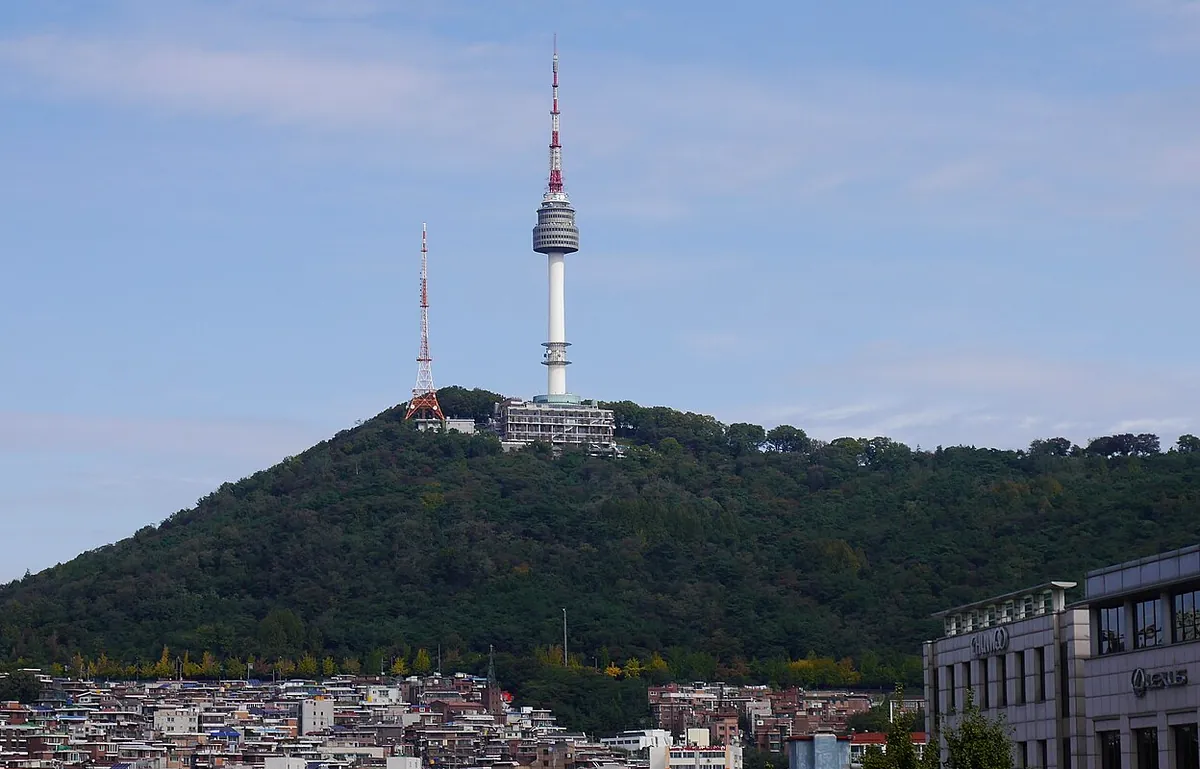
Beyond classical geomantic symbolism, this 262-meter peak fulfills an irreplaceable ecological mission today as the green lung purifying the atmosphere of a metropolis of millions. Recognizing the fragile value of its native woodland, municipal authorities enacted strict conservation zoning prohibiting private motor vehicles from ascending the summit, drastically curbing emissions and noise pollution. This forward-looking ecological policy has preserved resilient groves of Korean red pine—the iconic tree celebrated in South Korea’s national anthem—alongside hundreds of bird species and temperate flora shielded from urban smog. As a result, the buffer forest surrounding the tower maintains a cool, refreshing microclimate, thriving as an unspoiled ecological sanctuary right in the heart of one of Asia’s most dynamic megacities.
To welcome millions of visitors each year without disturbing its natural habitat, Namsan’s access infrastructure was designed as a benchmark in sustainable landscape engineering. Foremost is the 605-meter Namsan Cable Car, operating continuously since 1962 to glide smoothly overhead above dense forest canopies straight to the summit without cutting trees or disturbing soil strata. Complementing this historic aerial tramway is a fleet of zero-emission electric circular shuttle buses—Routes 01, 02, and 04. Operating quietly along closed loops, these electric buses connect travelers seamlessly from major transit hubs ringing the base of the mountain, including bustling Myeongdong Station, historic Chungmuro Station, and Seoul Station, delivering visitors cleanly into serene mountain woodland.
For travelers who love exploring on foot and experiencing every contour of the terrain, the Namsan Perimeter Road paired with 7.5 kilometers of scenic hiking trails offers an unforgettable visual journey. Winding gently along forested slopes ablaze with golden ginkgo leaves in autumn and soft pink cherry blossoms in spring, these paths create a poetic transition from bustling downtown boulevards into woodland stillness. Stone stairways and shaded bends beneath ancient oaks open continually onto sweeping panoramas of the city spread out below. The harmony between the proud spire rising at 262 meters and the embracing primeval forest transforms Namsan into an exemplary model of modern urban geomancy, where human-centered infrastructure honors and elevates natural tranquility.
Crowning the granite summit of Mokmyeoksan (the classical Sino-Korean name for Namsan) at 262 meters above sea level, N Seoul Tower rises to a precise architectural height of 236.7 meters from its base to the tip of its broadcast antenna. Combined with the natural elevation of the sacred mountain guarding the southern approach to old Hanyang, the tower’s observation decks sit at roughly 480 meters—nearly half a kilometer—above central Seoul. This commanding geodetic vantage point turns the tower into an urban celestial observatory where visitors gaze across the entire Han River basin, looking past the jagged peaks of Bukhansan to the north all the way toward the distant horizon of the West Sea.
Structurally, the tower stands as a pinnacle of late-20th-century engineering. Its core is cast from ultra-high-strength prestressed reinforced concrete with a hollow circular cross-section, forming a resilient spine engineered to absorb severe seismic tremors and withstand violent typhoon gales sweeping across the Korean Peninsula. Framing and supporting the upper observation decks is a precision-engineered high-tensile alloy steel space-truss system joined with high-strength bolts and pressure welds. Its tapering aerodynamic profile not only disperses wind loads efficiently, but creates a graceful silhouette reminiscent of a stylized lotus bud rising above a granite valley.
The landmark’s contemporary identity took shape during its comprehensive 15-billion-KRW renovation in 2005. That milestone project transformed the tower’s architectural language by wrapping the shaft in ultra-clear, multi-layered reflective tempered glass—enhancing thermal insulation while opening crystal-clear panoramic sightlines from every interior angle. The centerpiece of the overhaul was an integrated digital artistic lighting system comprising thousands of high-efficiency LEDs enveloping the tower. Beyond illuminating Seoul’s sleepless skyline, this light display functions as an intelligent urban barometer: cool blue signals crisp, clean air with ultra-low fine-dust levels; emerald green indicates moderate air quality; while glowing yellow and vibrant red alert residents to elevated air pollution or photochemical haze across the basin.
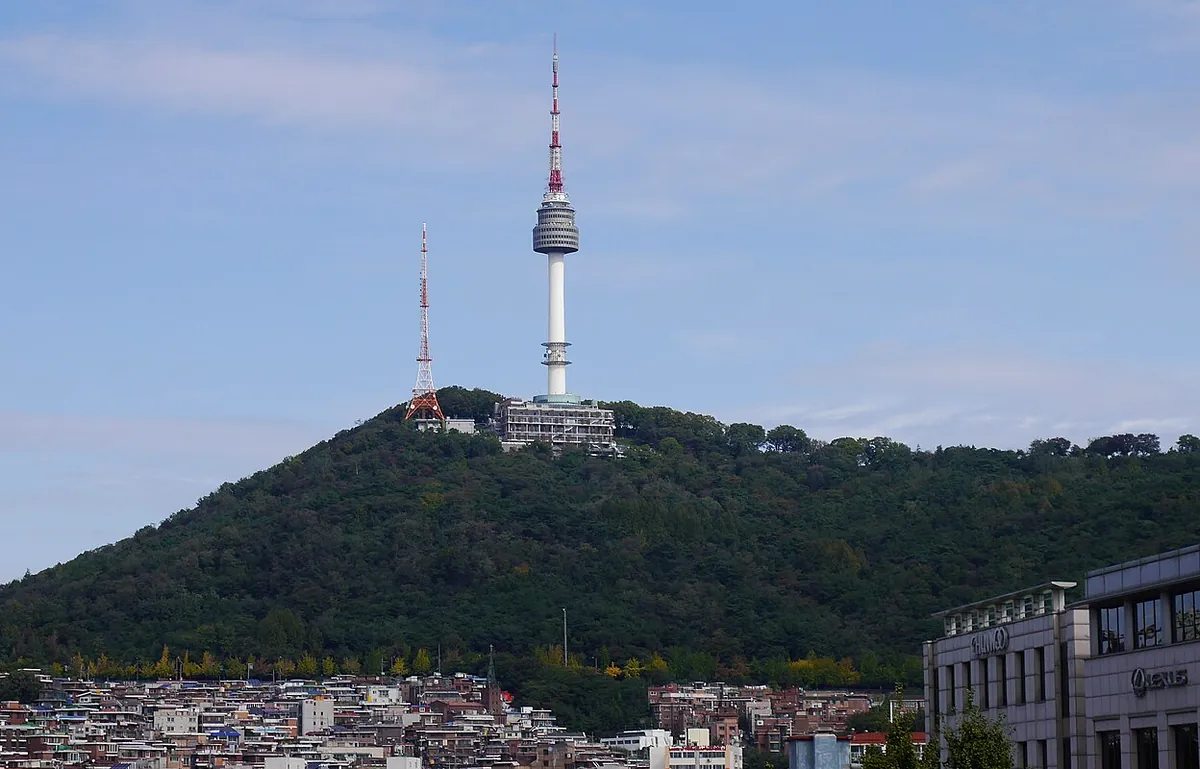
Interior levels and surrounding plaza terraces are organized as a thoughtfully integrated multi-tier complex. On the windswept base terrace lies the world-famous outdoor cultural installation “Locks of Love,” where millions of colorful padlocks clipped onto sturdy steel railings form an open-air museum of devotion preserving romantic vows from couples around the globe. Inside the shaft, high-speed elevators whisk visitors up to digitized 360-degree observation decks equipped with interactive LCD displays and high-powered optical telescopes revealing fine details from historic Bukchon Hanok Village to Gangnam’s glittering skyscrapers. Crowning the highest circular pod is the revolving fine-dining restaurant n.GRILL, whose whisper-quiet mechanical drive completes one full 360-degree rotation every 48 minutes—allowing diners to savor gourmet cuisine among the clouds as all of Seoul turns slowly beneath their seats.
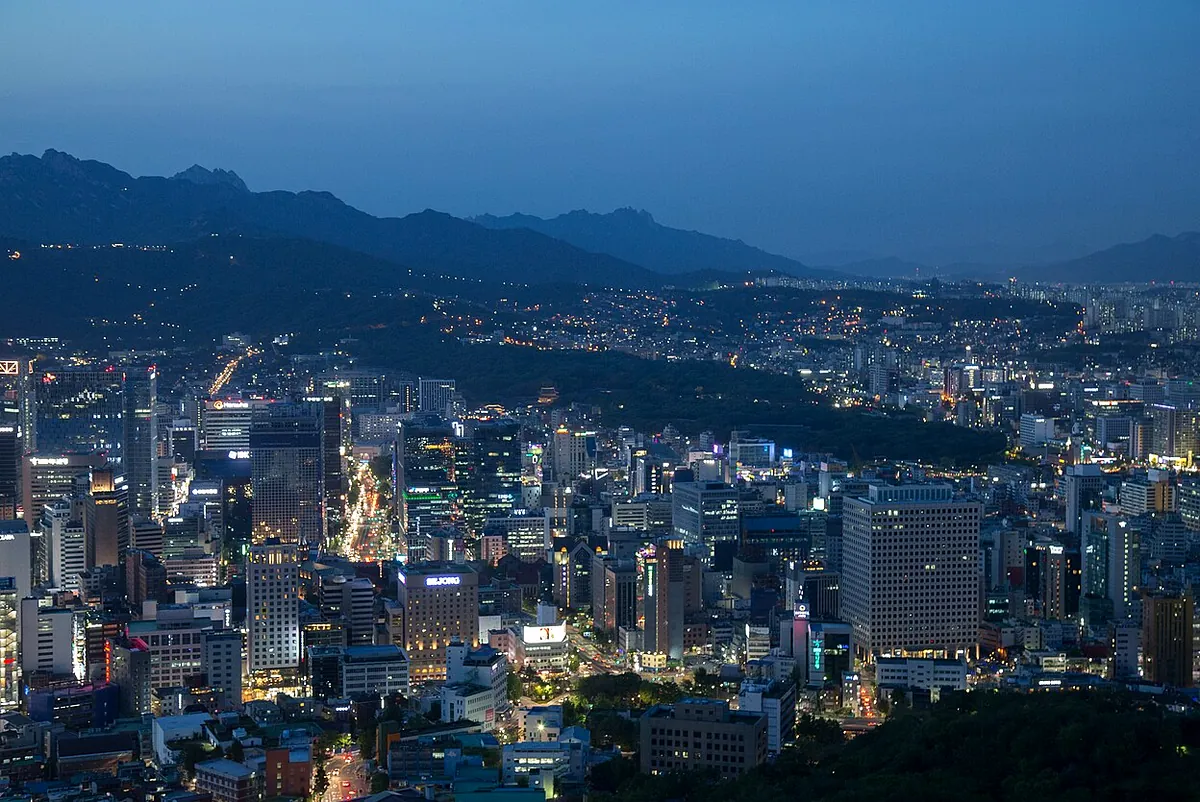
As the setting sun dips behind the proud ridge of Inwangsan, Namsan enters its most enchanting daily transition, celebrated by visual artists and photographers as the “Golden Hour.” Depending on the rhythm of the four seasons, this twilight window shifts subtly: in bright summer months, sunset lingers between 5:00 PM and 7:00 PM, whereas in crisp winter, dusk arrives early between 4:00 PM and 6:00 PM. Standing nearly 480 meters above sea level, visitors witness a grand visual symphony as the boundary between indigo twilight sky and urban valley dissolves—giving way to millions of glittering lights awakening across high-rise towers like galaxies descending into the ancient basin of Hanyang.
Defining the tower’s nocturnal presence is its state-of-the-art digital architectural lighting system, turning the soaring structure into a monumental sculpture of light piercing the night sky. Far more than aesthetic spectacle, N Seoul Tower’s shifting colors act as a modern visual signaling beacon for the capital—a poetic echo of the Joseon-era Bongsu fire beacons once lit atop this very peak. Color schemes adjust dynamically according to real-time meteorological telemetry and PM2.5 fine-dust readings: pure blue signifies clean, fresh air; emerald green reflects moderate conditions; amber-yellow warns of declining air quality; and vivid red cautions residents to limit outdoor activity. This fusion of environmental sensors and public light art creates a living landmark intimately attuned to the city’s daily breath.
As night deepens, the plaza around the tower base and open-air observation terraces transform into an evocative open-air stage blending multimedia art with romantic urban life. Vibrant 3D projection mapping washes across the tower’s facade with poetic motifs celebrating Korean nature, four-season blossoms, and folklore, contrasting vividly against ribbons of headlights flowing endlessly along Olympic-daero and the Han River expressways. In the crisp night air scented with warm Omija (five-flavor berry) tea and roasted chestnut pastries sold along forest walkways, melodies from street violinists mingle with the soft chatter of couples fastening keepsake padlocks. Together, they compose a magnificent nocturnal tableau where natural heritage, timeless history, and modern optical artistry shine brilliantly above Seoul.
Dining around historic Mokmyeoksan—modern-day Namsan—has long been far more than satisfying hunger; it stages a thoughtful dialogue between stately Joseon royal court gastronomy and the cosmopolitan pulse of a global capital. Poised serene and high above Seoul, N Seoul Tower serves not only as a geographic observatory, but as a miniature culinary sanctuary spanning cloud-level fine dining to comforting street-food aromas drifting along gentle woodland slopes.
Crowning the fifth floor at the apex of the tower, upscale French restaurant N Grill offers an unforgettable fine-dining experience powered by a precision 360-degree revolving floor completing one full panoramic turn every forty-eight minutes. By candlelight accompanied by soft piano melodies, prime dry-aged beef steaks seared to perfection lock in succulent juices paired with fragrant black truffle reductions. Long celebrated as a quintessential romantic destination, N Grill has witnessed countless anniversary toasts and marriage proposals set against Seoul’s night skyline sparkling like a fallen Milky Way. Just below, The Place Dining transports guests to the Mediterranean with artisanal pastas and wood-fired pizzas crafted in a contemporary fusion style uniting European herbs with peak-fresh local Korean produce.
Balancing Western refinement is authentic Korean culinary heritage preserved at Hancook, a traditional Korean buffet spanning the first and second floors of N Seoul Tower Plaza. Hancook pays homage to Surasang—the elaborate royal court banquets once served to Joseon monarchs—strictly honoring Yin-Yang and Five Elements philosophy through the harmony of five colors and five flavors. Its menu showcases over thirty meticulously prepared royal and folk specialties. Guests can savor heirloom Bulgogi—thinly sliced beef marinated in earthenware-aged soy sauce, sweet Asian pear, and toasted sesame oil before grilling over glowing charcoal—alongside glossy Japchae glass noodles tossed with black wood-ear mushrooms, golden egg strips, and vibrant spinach. Dozens of traditional banchan side dishes, from tangy aged napa cabbage kimchi to crisp soy-pickled radish, complete a royal feast reflecting centuries of reverence for nature and culinary patience.
Descending the wooden steps back toward the mountain foothills, Namsan’s culinary personality shifts to the heartwarming simplicity of everyday Korean street food. Along winding lanes shaded by ancient pines, steaming snack carts draw passersby with irresistible aromas. Freshly griddled golden Hotteok sweet pancakes emerge crisp from sizzling cast-iron pans, bursting at first bite with molten brown sugar, fragrant cinnamon, and crunchy sunflower seeds; nearby, chewy Tteokbokki rice cakes simmer in glossy crimson Gochujang chili sauce—fiery at first taste yet lingering with deep sweetness that warms away chilly evening breezes atop Namsan.
The ideal time to begin your ascent up Mount Namsan and N Seoul Tower is late afternoon, roughly one hour before sunset. As amber sunlight sinks behind the mountain ridges framing the historic Hanyang basin, the sprawling metropolis along both banks of the Han River lights up, weaving an unforgettable transition from twilight glow to a sea of city lights. From the observation deck nearly 480 meters above sea level, visitors take in sweeping views across thirty-one bridges spanning the Han River while witnessing the tower’s own evening light show. High-tech LED arrays along the shaft shift color in real time according to urban air quality—from cool blue signaling clean air to red alerting residents to fine dust—offering a living visual pulse of South Korea’s capital.
Because the tower sits exposed atop a mountain peak catching breezes from all four directions, N Seoul Tower’s microclimate is noticeably cooler than the city streets below. In spring and autumn, brisk hillside winds call for a light windbreaker or fine knit sweater when strolling along open-air decks. In winter, temperatures around the Octagonal Pavilion plaza can drop well below freezing with sharp windchill, making thermal layers, a scarf, gloves, and heat packs indispensable. Furthermore, because the surrounding park features steep stone staircases and sloping wooden boardwalks leading to the Love Padlock terraces, supportive cushioned sneakers with reliable traction will keep you comfortable throughout your exploration.
Public transit serving the tower is thoughtfully designed around strict environmental protection, banning all private passenger cars from driving up the summit. All-electric Namsan Sunhwan Shuttle Bus Route 01 provides the most economical and convenient option, departing every seven to ten minutes from Exit 3 of Myeongdong Subway Station (Line 4) and Chungmuro Station (Lines 3 and 4). Buses glide quietly along forested roads lined with ginkgo and maple trees before stopping just a short walk from the tower plaza. For travelers wishing to admire granite cliffs and forest canopies from above, the historic Namsan Cable Car—operating since 1962—delivers a nostalgic three-minute aerial ride spanning over six hundred meters directly to the summit.
Alongside preparing valid electronic travel authorization or entry visas and a reloadable transit card, travelers should remain mindful of heavily discounted tour traps. Many unusually cheap packages slash valuable sightseeing time at Namsan to herd visitors through high-pressure shopping stops selling overpriced ginseng or unverified herbal oils. Choosing reputable, no-forced-shopping itineraries ensures generous, unhurried time to appreciate authentic local culture. To turn your journey to South Korea into a relaxed, deeply enriching holiday, explore curated itineraries through high-quality all-inclusive South Korea tour packages.