Reclining quietly amidst the endless basin valley of ancient Zhongdian—now transformed into the fairyland of Shangri-La on the northwestern Yunnan plateau—Songzanlin Monastery (Chinese name: 松赞林寺 – Songzanlin Temple) stands soaring like an indestructible spiritual fortress across countless historical vicissitudes. To comprehend the roots of this grand sanctuary, the timeline must reach back to the foundational epoch of the frontier history of Tubo (Tibetan Empire). As early as the eighth year of Zhenguan (634 CE) during the Tang Dynasty, the illustrious Tubo Tsenpo, Songtsen Gampo, dispatched a massive army southward, establishing Jiedu Zong to assert administrative and military control over this strategic trading bottleneck. Subsequently, in 680 CE, the Shenchuan Military Governor’s Office was officially established, turning this vibrantly colorful plateau into a vital cultural, political, and commercial intersection between the Tibetan world on the roof of the snow mountains and the fertile inland territories of China. That auspicious geomantic terrain sowed initial spiritual seeds, paving the way for the emergence of a premier Vajrayana Buddhism holy site centuries later.
The greatest historical turning point shaping the monastery’s appearance unfolded during the peak of the Manchu Qing Dynasty. Under the strategic patronage of the Kangxi Emperor and the propagation aspirations of the Fifth Dalai Lama, a monastery project of unprecedented scale was initiated. In the eighteenth year of Kangxi (1679 CE), the Fifth Dalai Lama personally performed divination, selecting a dragon-coiling and tiger-crouching terrain at the foot of Futou Mountain to locate foundations and bestow the sacred title: Gedan Songzanlin Temple. Construction proceeded swiftly and meticulously under the strict supervision of Tibetan architectural masters alongside financial backing from the imperial treasury, so that just two years later, in the twentieth year of Kangxi (1681 CE), the entire massive architectural complex was basically completed to perfection. The Qing court subsequently bestowed the Chinese name Guihua Temple (归化寺), implying submission to imperial grace and the salvation of all beings, turning Songzanlin into the supreme symbol of harmonious, unbreakable bonds between Manchu-Han royal power and Tibetan-tradition theocracy.
Ever since completion, Songzanlin swiftly became the Gelug (Yellow Hat) sect’s sanctuary boasting the grandest scale and most profound influence across all of Yunnan. It was not merely a closed religious center, but genuinely evolved into a magnificent Buddhist academy nurturing high virtuous monks renowned across snow mountain realms. Across centuries of transmission, the monastery witnessed the emergence of numerous eminent masters, notably the lineage of the Bengzhu Living Buddha, who left deep imprints in propagating the true Dharma, upholding monastic discipline, and harmonizing multi-ethnic cultures. Prajna scriptural canons, priceless golden-thread thangkas, and countless exquisite gold-plated bronze statues accumulated across dynasties transformed magnificent grand halls such as the Tsongkhapa Grand Hall or Sakyamuni Grand Hall into living art and spiritual museums of Himalayan civilization.
Nevertheless, historical currents have never been tranquil. Entering the turbulent twentieth century, the whirlwind of times and particularly the fierce Cultural Revolution inflicted heavy devastation upon ancient architectures, treasures, and precious scriptural woodblocks of the monastery. It seemed Gedan Songzanlin Temple’s aura had permanently faded beneath historical markers, yet owing to irreplaceable cultural and historical values, during the 1980s, a national emergency restoration master plan was systematically deployed. Tens of thousands of indigenous artisans and restoration scholars poured hearts into rebuilding red walls, brilliantly gilded roof borders, and fully reviving former solemn appearances. Today, with over seven hundred resident monks chanting day and night, practicing exoteric-esoteric dual cultivation and rigorous philosophical debate, Songzanlin preserves unbroken Buddhist transmission lineages spanning hundreds of years while standing firm as an immortal stone-and-gold chronicle on the Zhongdian plateau.
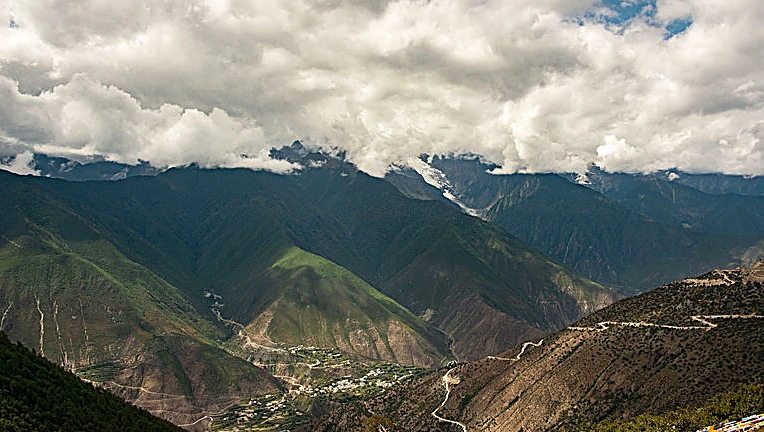
Situated within the mysterious transitional zone of three cultural sources—Dian, Chuan, and Tibet—the great sanctuary of Songzanlin is located at precise geographical coordinates 27°51′49″ North latitude and 99°42′16″ East longitude. This territory belongs to Jiantang Town, northern Shangri-La City—an antique land whose Tibetan nomenclature embodies the sacred concept of “sun and moon reigning in the depths of hearts.” Stepping into the secluded core of the Hengduan mountain range along the southeastern fringe of the Qinghai-Tibet Plateau, any traveler or spiritual seeker easily recognizes creation’s breathtaking arrangement, where rugged mountain topographies and earthly meteorological forces converge to forge the perfect natural plateau supporting supreme religious sanctuaries.
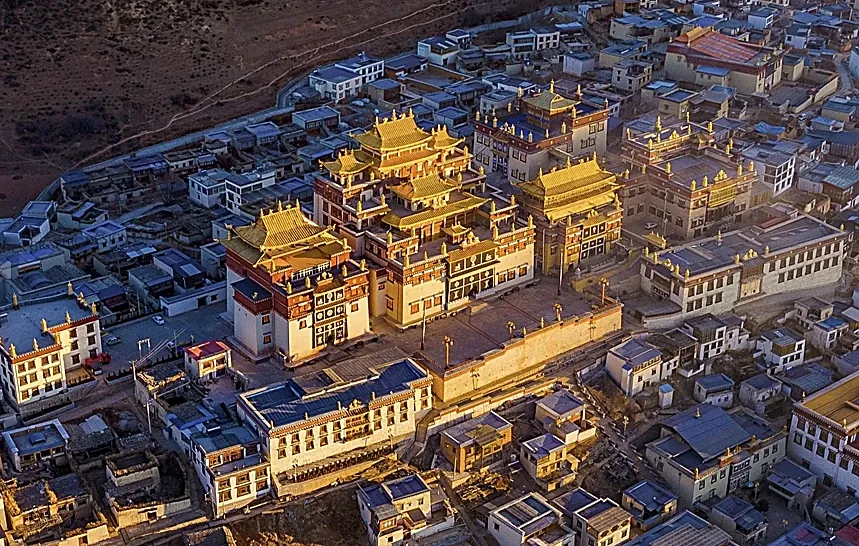
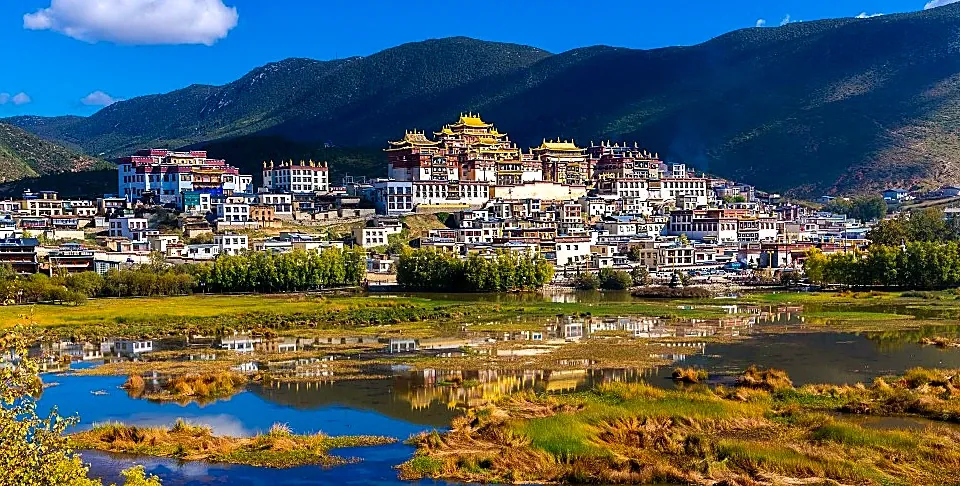
Examining traditional Eastern geomantic standards combined with Tibetan Esoteric Buddhism geomancy, Songzanlin Monastery possesses a rare classical terrain aligned with the axis “backing mountains and facing water, sheltering yin and embracing yang.” The monastery complex backs firmly against the slopes of Fuping Mountain—a winding mountain range shaped like a protective screen shielding against harsh northern cold winds. All assembly halls, red palaces, and monks’ quarters do not flatten topography but conform absolutely to natural mountain slopes. Architecture distributes along tiered cascading steps ascending upward, generating sensations that this colossal work is emerging directly from mountain stone, proudly displaying inviolable solemnity amidst barren wilderness.
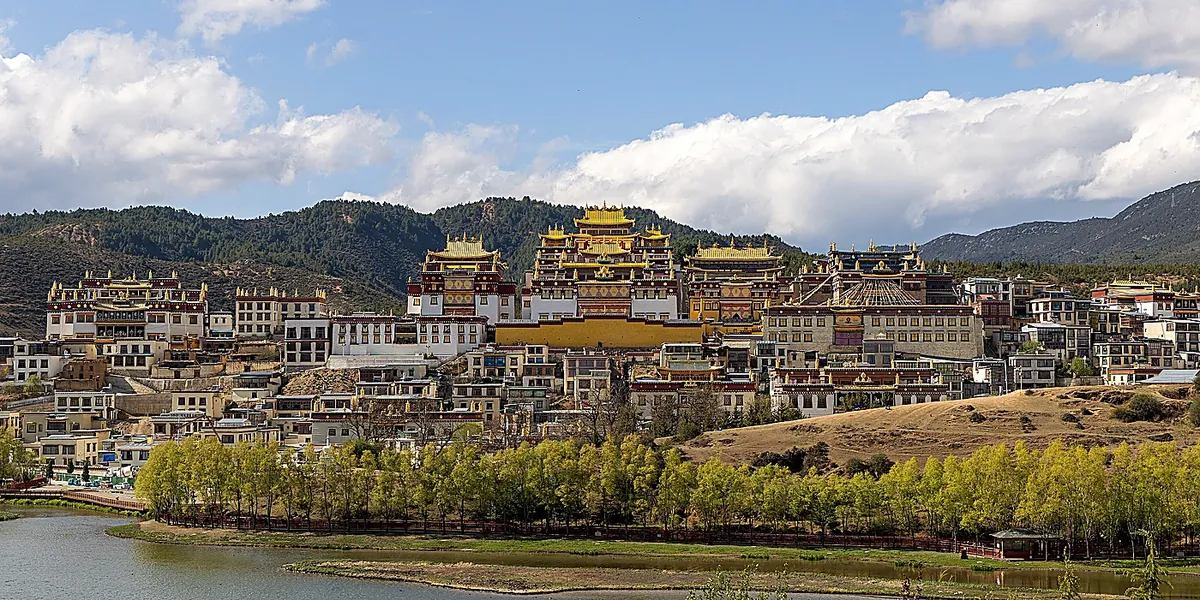
Right before the sanctuary’s grand hall lies the mirror-flat surface of sacred Lamu Yangcuo Lake, a holy water body in native culture revered as the soul and eyes of the protecting goddess. The appearance of the lake not only neutralizes dry highland cold of snow-covered regions but completes vital energy-gathering structures for the sanctuary. Crystal-clear waters reflect magnificent gold-plated tiled roofs alongside crimson-red and ivory-white plastered walls of the grand monastery. When dusk falls or early dawn breaks, sloping tower shadows mirroring in water create surreal visual shifts, making boundaries between tangible mortal realms and Western Pure Lands vanish entirely.
Blending into that regal terrain is a plateau grassland and wetland ecosystem spreading endlessly around Fuping Mountain’s foot. Following four-season revolutions, native vegetation transforms magically from emerald green summer grasses to autumnal brown-brown sedges, plunging into pristine white snow mists when winter reigns. Far along horizons, snow-capped ranges crowned in permanent ice erect magnificent barriers, enveloping Songzanlin within a serene, secluded spiritual oasis. This scenery never detaches from human architecture; conversely, interactions between the monastery’s massive scale and highland wilderness raw beauty elevate local landscapes into a priceless natural geomorphological museum, exuding transcendent airs and enduring solemnity.
Strikingly present in majestic splendor along gentle hillsides overlooking tranquil Lamu Yangcuo Lake, Songzanlin Monastery’s spatial structure is planned under classical defensive and spiritual motifs, faithfully recreating legendary Potala Palace tiered-axis structures at Lhasa holy sites. This backing-water facing-mountain terrain endows the sanctuary with the appearance of an ancient highland military fortress atop snow-covered regions, where the entire architectural complex is enclosed by a sturdy oval fortification ring built from slate and rammed earth meters thick. Viewed from mountain bases, chestnut, white-plastered, and deep-red building blocks interweave sequentially along steep slopes, resembling a thousand-petaled lotus blooming to welcome radiant dawn across Shangri-La.
The pinnacle of craftsmanship and hierarchical order is concentrated fully across two central halls reigning at highest points: Zhacang Hall (Zhacang Grand Hall) and Tsongkhapa Hall (Grand Hall enshrining Founder Tsongkhapa). Surpassing pure Tibetan architectural norms, these two grand halls represent brilliant evidence of supreme aesthetic fusion between Tibetan culture and internal Chinese mainland architectural quintessence. Sloping roof tiers are covered by tens of thousands of pure gold-plated bronze tiles sparkling beneath thin atmospheric layers, punctuated by gilded dharma wheels, kneeling deer pairs, and upturned eaves carved with pearl-gargling dragon motifs bearing strong Ming-Qing imperial styles. Massive monolithic ancient hardwood pillars inside boast unspannable circumferences, supporting multi-layered heavy purlin structural frameworks against harsh plateau blizzards.
Stepping across stone steps into Zhacang Grand Hall’s interior, pilgrims are instantly overwhelmed by secluded spatial depth, thick with yak butter smoke and millennia-old concentrated sandalwood. Hall walls towering tens of meters are covered with massive mural paintings executed entirely by hand using natural mineral stone powders like lapis lazuli, cinnabar, malachite blended with pure gold leaf, keeping blue, green, and crimson tones unfaded despite historical markers. Meticulous murals portray Six Realms Wheel of Life cycles, tutelary deities, wrathful protectors, and mystical Shambhala pure land legends. Alongside these are hundreds of precious brocade thangkas hanging from hall ceilings, surrounding thousands of gold-plated bronze Buddha statues meditating in deep contemplation.
Serving monastic lifestyles and administrative governance for thousands of Yellow Hat (Gelug) monks, core nuclear halls are surrounded by the clustering of Eight Kangcun (eight branch divisions representing directions and origins of monastic communities) alongside hundreds of intersecting monks’ quarters. Organizing floor plans under “stars surrounding the moon” motifs—myriad stars bowing before bright moons—turns each flat-roofed rammed-earth room of monks into a sturdy protective link for central sacred shrines. Every stone-paved triple step connecting steep alleys is hand-dressed, forging an architectural matrix that is simultaneously orderly and disciplined while exuding absolute solitude and tranquility of Zen gates amidst snow-capped wilderness.
As the sun dips behind undulating snow ranges across Diqing plateau, Songzanlin Monastery enters the most magical transition moment of day, where nature and ancient architecture co-create a supreme sacred lighting symphony. Late afternoon sun slants across Fuping Mountain slopes, gilding cascading monastery complexes in contemplative amber before converging brilliantly upon gilded roof peaks of Zhacang Grand Hall and Khangtsang Grand Hall. Standing along stone-paved lakeside pathways of sacred Lamu Yangcuo stretching beneath mountain bases, travelers admire the breathtaking optical phenomenon named “Golden Palace on Water” (Golden Temple)—where illusory gilded shrines mirror immaculately upon mirror-flat waters. Emerald ripples sway gently with highland breezes, blurring solemn crimson wall silhouettes and white tower shapes, creating a surreal color dance making boundaries between mundane mortal realms and Western Pure Lands merge as one.
Completely distinct from tourist spots showcasing modern lighting tech or commercialized live-action stages, nighttime at Songzanlin is an art space originating from pristine spiritual heartbeats preserved across hundreds of years. When twilight fades, plateau silence at 3,300+ meters elevation blankets spaces, yielding to enchanting acoustic blending. From high towers, deep, resonant sounds of bronze Dungchen long horns echo against vertical cliffs, harmonizing with unhurried ritual drums announcing evening prayer hours. Amidst Diqing’s biting cold, deep-toned Tibetan chanting blends with copper bell notes whispering beneath wood-carved Tạng-motif eaves, forging healing energy dispelling mortal distractions.
Deep plateau nights deliver breathtaking celestial masterpieces as skies shift into deep, pure indigo unblemished by urban dust. Millions of stars alongside the Milky Way sparkle spanning curved eaves and Dharma wheel symbols atop sanctuaries. Inside shrines and quarters, thousands of warm yak butter lamps ignite, casting gentle golden light through intricate cypress wood window lattices, sparkling across rich herbal incense smoke. Viewed from afar in cold nights, the entire Songzanlin complex resembles a solitary yet magnificent glowing fortress resting peacefully across boundless skies, lulling all creation into deep meditative sleep, leaving visiting minds with absolute peace atop heaven’s nearest sanctuary.
Leaving Songzanlin’s solemn stone steps behind, touring snow-capped Shangri-La only reaches true completion when senses awaken via kitchen warmth from Tibetan homes. Dwelling at 3,300+ meters elevation where cold winds sweep snow ranges year-round, native culinary cultures around the monastery transcend simple energy intake to crystallize into unique wellness philosophies, employing pure terroir to offset harsh climates. Every fire lit in pine kitchens, every fragrant wisping smoke blending with rich yak butter opens rustic yet refined traditional flavor worlds, where gifts offered to travelers pack boundless plateau affection.
The brightest, proudest star within this highland culinary painting is pan-seared matsutake mushrooms with yak butter, a celebrated specialty honored in the famous food documentary *A Bite of China*. Foraged by hand from dense primeval forests beneath snow mountains during brief rainy seasons, fresh, tender, sturdy matsutake mushrooms carry pure aromas of moss and early mists. When chefs slice them thick and drop them into bubbling cast-iron woks of rich yak butter, gentle flames quickly lock in inner sweetness. Seared mushroom edges turn golden, revealing crunchy textures where butter richness blends with deep sweetness, leaving enchanting woodsy aftertastes.
Alongside forest flora, Tibetan family table souls rely on renowned yak beef. Wild-grazing yaks forge firm, sweet, nutrient-dense meats. Amid freezing nights, red-copper yak beef hotpots carved with Esoteric motifs exhale steaming vapors as the coziest stops; long-simmered herbal broths taste sweet, intertwining with tender tendon slices and highland wild greens. Banquets grow richer with hand-shredded steamed yak beef ribs tenderly fragrant with rock salt, round yak beef steamed buns bursting with hot soup, or crispy yak beef fried rice mixed with savory onions.
Completing sensory symphonies are fragrant Qingke barley cakes featuring crispy crusts encasing chewy interiors, paired with grilled Tibetan cured pork featuring crispy skin and aromatic non-greasy fat. Whenever travelers tire from climbing monastery slopes, yak butter tea churned rhythmically in wooden tubes, or sips of Qingke liquor banish alpine chills instantly. Pausing at renowned legacy eateries near mountain bases like Shuntian or antique inns like Akhustonpa, listening to soothing Tibetan melodies and accepting wine bowls from weathered native hands, travelers realize Shangri-La cuisine is not merely food, but a hospitality love song passed down across centuries.
Witnessing Songzanlin Monastery demands meticulous preparation in mindset and physicality, as the sanctuary reigns over basin valleys 3,300+ meters above sea level across Diqing Prefecture. Reduced atmospheric pressure and thin plateau air induce altitude sickness easily; hence, primary survival rules demand controlled breathing, avoiding running or strenuous exertion upon arrival. Unpredictable plateau climates feature wide day-night temperature swings alongside intense UV radiation from clear skies. Travelers should pack Acetazolamide, oxygen canisters, anti-glare sunglasses, high-index sunscreen, and multi-layered windbreakers to adapt against sudden cold winds from snow ranges.
Transport networking connecting to Songzanlin is convenient and orderly. From Dukezong Ancient Town center, travelers board public bus route 3 running directly to scenic gates, or take taxis within 20 minutes. Monastery gates open from early dawn until dusk. At outer reception centers, travelers board eco-friendly shuttle buses across grassy plains and yak herds to reach monastery bases where massive architectural complexes reside.
Entering spiritual boundaries requires respecting Tibetan Buddhism hierarchical rules. All visiting routes—walking around compounds, stepping inside Zhacang and Khangtsang halls, or spinning bronze prayer wheels—must follow clockwise directions (kora) expressing harmonious alignment with reincarnation and universes. Never step upon wooden sills of grand halls, regarded as guardian deity thresholds; never point index fingers at sacred Buddha statues or Thangkas, pointing open palms upward instead. Inside solemn shrines redolent of butter tea and herbs, remove hats, sunglasses, maintain absolute silence, and store recording devices since photography is forbidden inside sanctums.
For photography and visual art lovers, prime viewpoints reside across sacred Lamu Yangcuo Lake. Walking wooden boardwalks framing mirror-flat waters captures miniature Potala Palace models mirroring green mountains. Early mornings feature mists rising from lake surfaces blending with juniper incense smoke, while late afternoons bathe gilded roof tiles in golden light reflecting deep blue waters like pure land paintings.
Despite pure fairyland beauty, surrounding tourist zones harbor commercial traps requiring alert minds. Beware unlicensed guides outside gates or street stalls selling precious herbs like Cordyceps, snow lotus, and Dzi beads at low prices due to counterfeits. Exercise caution regarding “head-touching blessing” ceremonies coercing large donations; monetary offerings should remain voluntary inside main hall donation boxes. To fully appreciate this wonder within a smooth, culturally saturated itinerary, explore practical insights via the Dali – Lijiang – Shangri-La – Kunming Tour (5N5D & 6N6D).