The birth of the Gardens by the Bay complex is closely tied to the transformation of the Lion City, rooted in a century-spanning urban planning philosophy. Looking back to the turbulent late 1960s, right after Singapore separated from the Federation of Malaysia to become a young independent nation facing immense geopolitical challenges and scarce natural resources, founding Prime Minister Lee Kuan Yew championed the “Garden City” vision. At the time, greening concrete streets was far more than a way to clean the air or beautify the city—it was a strategic policy to create a healthy living environment, project vitality, and attract international investment to the tropical island.
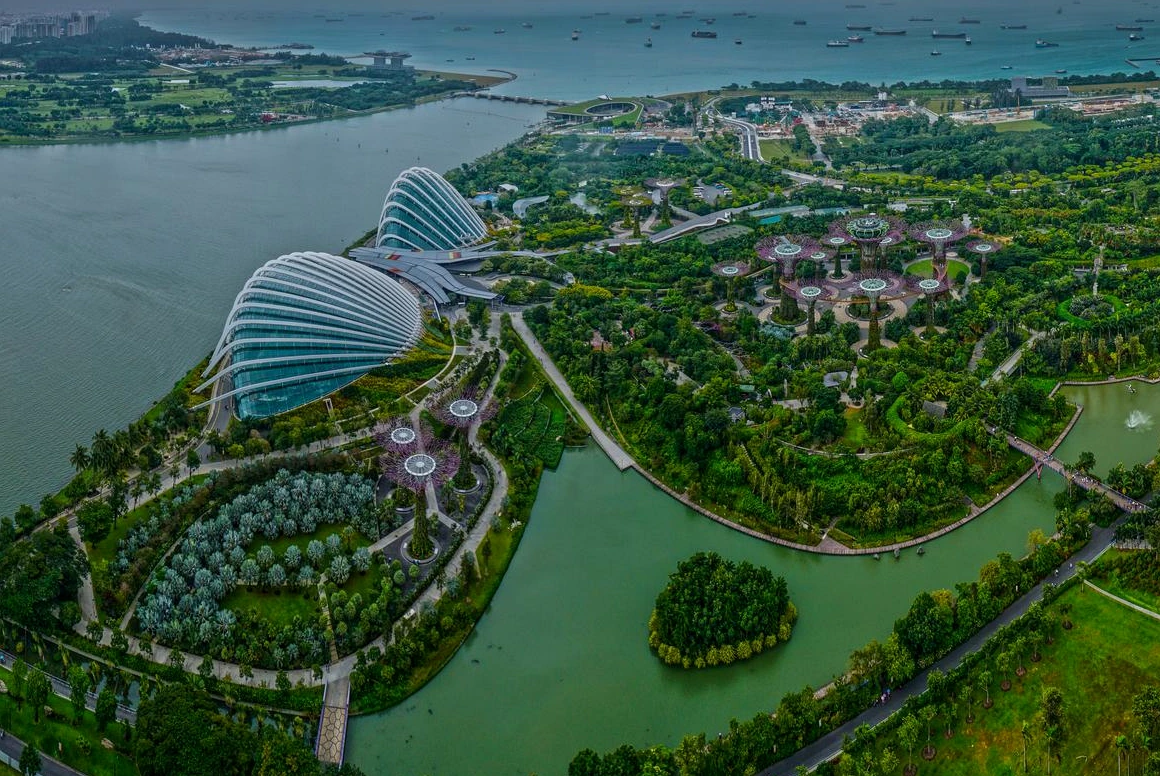
Entering the twenty-first century, after Singapore had risen to become one of the most prosperous financial and commercial hubs in the Malay Peninsula, the nation’s ecological ambition reached a new level. During his 2005 National Day Rally speech, Prime Minister Lee Hsien Loong officially announced a revolutionary shift: transforming Singapore from a “Garden City” into a “City in a Garden.” At the heart of this master plan was the comprehensive rejuvenation and expansion of the Marina Bay area, turning reclaimed land facing the Singapore Strait into a lush public realm where primeval nature harmonizes with futuristic architecture.
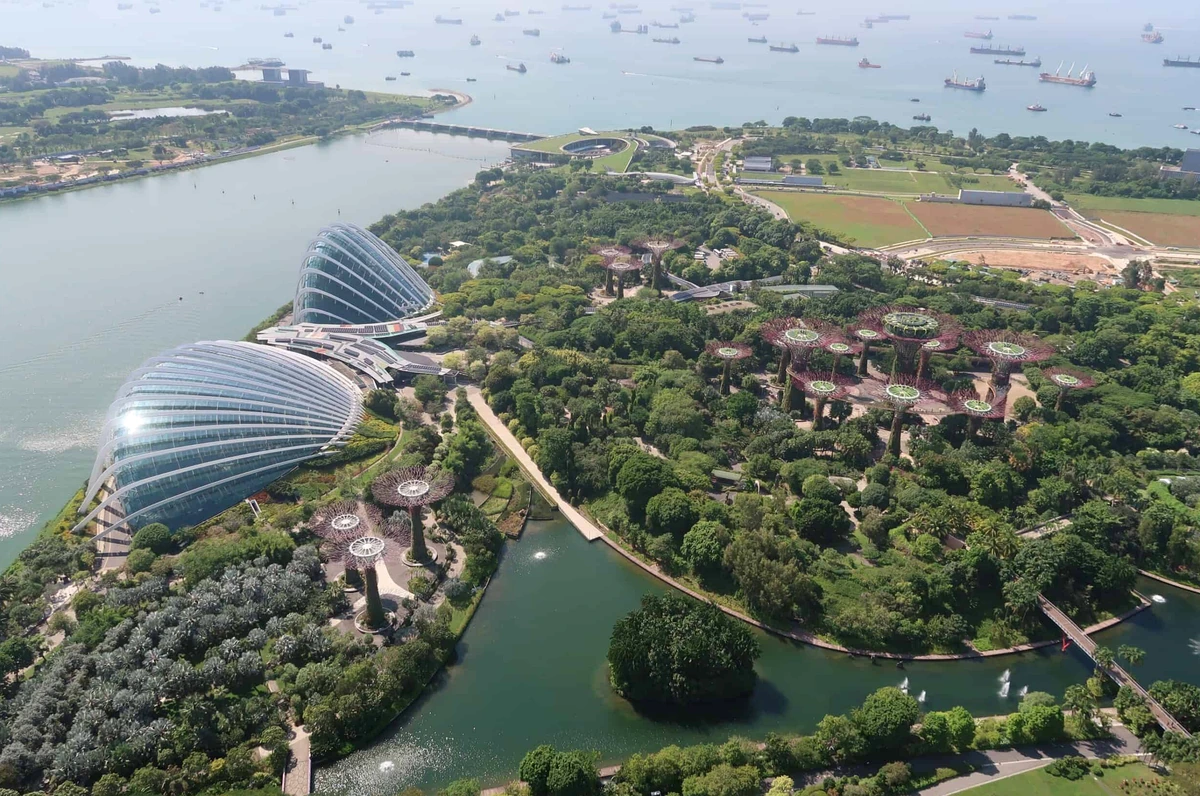
To source the world’s most groundbreaking ideas for a landmark of the century, Singapore’s Ministry of National Development and the National Parks Board launched an unprecedented international master plan design competition in January 2006. The contest drew more than 170 entries from 70 landscape firms across 35 countries on five continents. Outshining a roster of globally renowned rivals, the poetic concept by UK landscape architecture firm Grant Associates won the commission for the sprawling Bay South Garden—anchored by the fantastical Supertrees—alongside Gustafson Porter + Bowman, which was tasked with master-planning Bay East Garden overlooking the Marina Bay skyline.
In November 2007, construction officially began on reclaimed land with a massive investment totaling S$1.035 billion, marking one of the costliest and most ambitious ecological projects in the island nation’s modern history. Despite complex geotechnical challenges on newly reclaimed marine clay, thousands of engineers and top landscape specialists worked tirelessly to recreate a grand tropical ecosystem alongside a one-of-a-kind renewable energy infrastructure. On June 29, 2012, Prime Minister Lee Hsien Loong officially opened Gardens by the Bay, inviting the global public to experience the pinnacle where nature and human ingenuity converge. The attraction quickly surpassed 50 million visitors by late 2018, becoming an enduring ecological icon that placed Singapore firmly on the global architectural map.
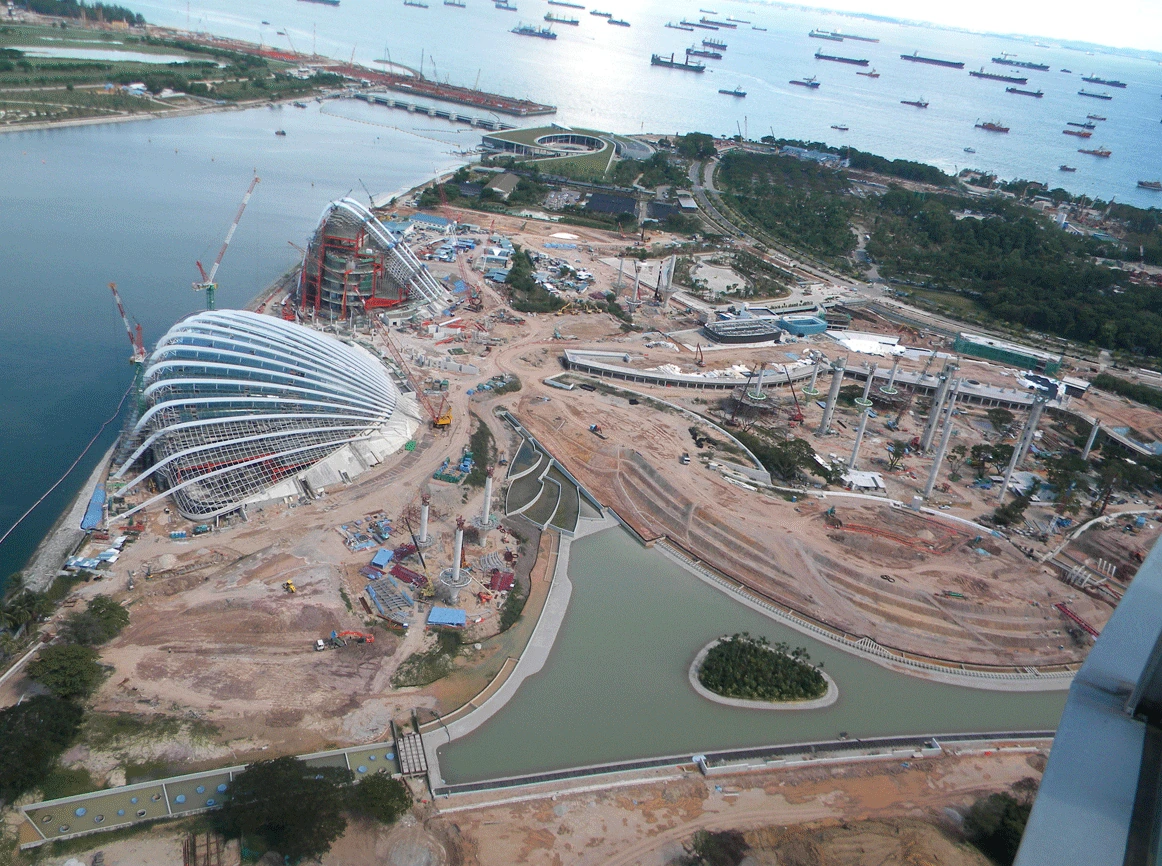
From a geographical and urban history standpoint, the entire 101-hectare footprint of Gardens by the Bay is an extraordinary feat of geological engineering, formed entirely through large-scale land reclamation in the Marina Bay basin during the 1970s and 1980s. Beneath today’s lush greenery lies a complex subsurface profile where soft marine clay once submerged beneath the ocean was consolidated and reinforced with millions of cubic meters of engineered landfill sand. Viewed through the lens of contemporary landscape feng shui in the Lion City, this stretch of land sits in an auspicious water-gathering position, acting as a living ecological screen right at the mouth of Marina Bay. Where ocean currents meet the freshwater Marina Reservoir, the complex tempers raw sea energy into gentle, life-giving vitality that shelters and nourishes the bustling financial core next door.
Bay South, the heart of the grand park, is not confined to the flat, monotonous plane of typical reclaimed land; instead, landscape architects sculpted it into a rolling, poetic topography. Gentle artificial hills alternate with sunken valleys calibrated to equatorial monsoon winds, catching cool sea breezes off the Singapore Strait to dissipate trapped urban heat. These man-made elevation shifts create varied microclimates for distinct plant communities while framing dramatic sightlines. From the sloping hills, visitors’ eyes follow continuous sweeps of vibrant blooms straight toward the soaring towers of the central financial district and Marina Bay’s iconic skyline silhouettes.
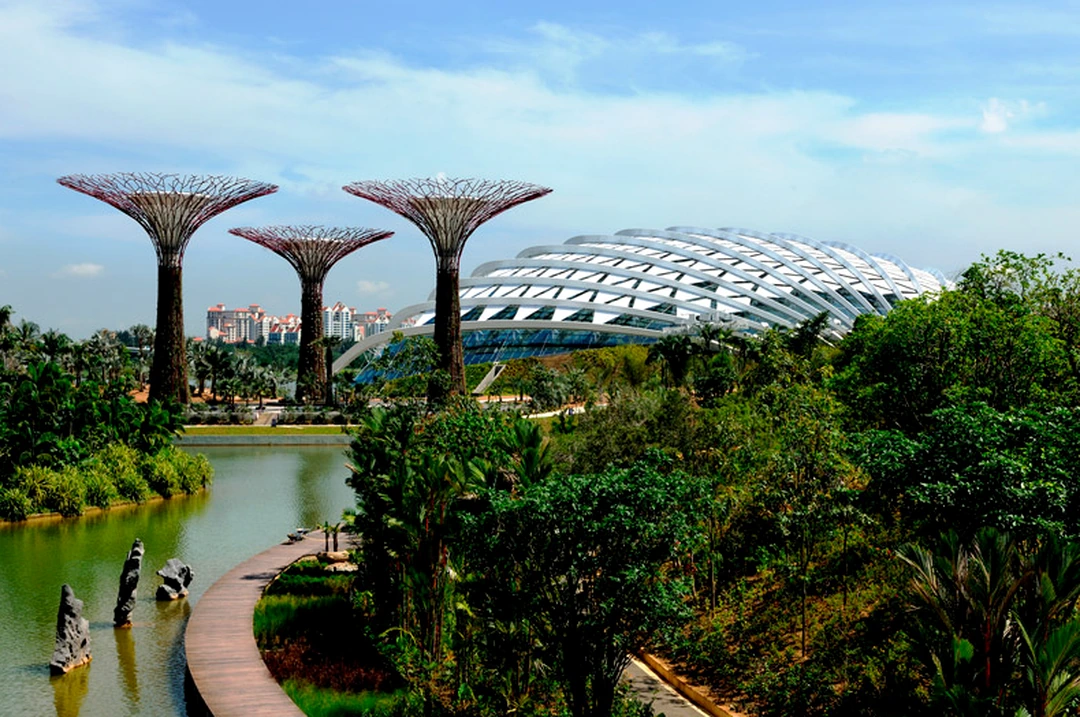
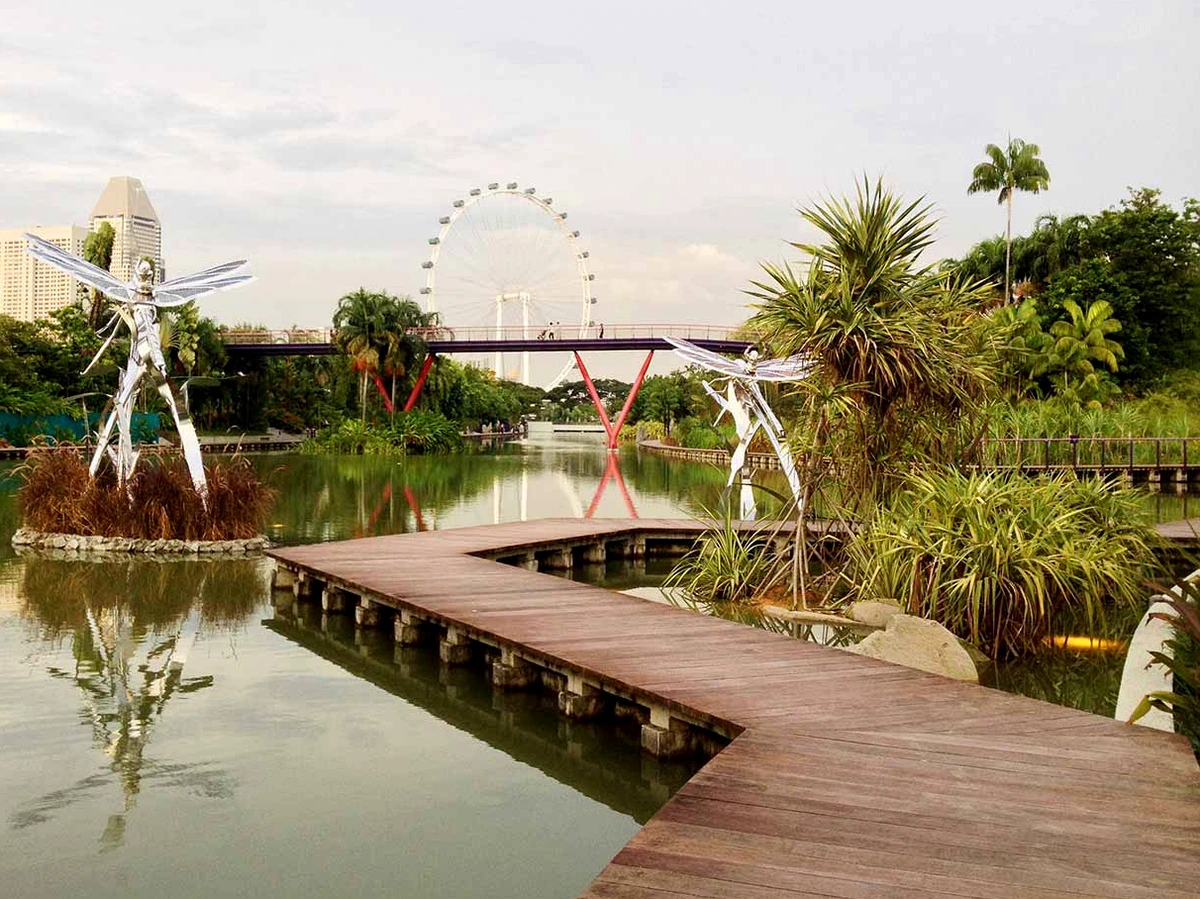
The hidden lifeblood keeping this wonder verdant is a closed-loop freshwater ecological system anchored by two major water bodies: Dragonfly Lake and Kingfisher Lake. Designed as constructed wetlands that provide biological filtration, both lakes collect stormwater runoff across the park. Rather than relying on industrial chemical treatment, the system harnesses natural symbiosis among dense shoreline aquatic plants, particularly stands of cattail (Typha) and common reed (Phragmites). Their intricate root networks act as high-efficiency biofilters—trapping suspended sediment, absorbing excess nutrients, and curbing harmful bacteria—producing crystal-clear water before surplus flow enters Marina Reservoir.
This self-sustaining hydrological loop supplies clean irrigation water for more than 1.5 million plants across 200 rare tropical species thriving on reclaimed soil. The seamless blend of landscape feng shui, complex marine-clay engineering, and sustainable aquatic systems has transformed a windswept coastal reclamation site into a vibrant ecological sanctuary where human craft and natural laws appear as one.
At the center of Bay South, futuristic architecture meets sustainable tropical engineering in a conservatory complex of world-leading scale. Crafted by celebrated British architectural practice WilkinsonEyre alongside master structural engineers, the two Cooled Conservatories rise along the waterfront like a pair of giant, reclining glass seashells. Their revolutionary design uses a free-spanning curved steel diagrid grid that eliminates heavy interior support columns, maximizing sightlines and opening tens of thousands of square meters of exhibition space bathed in natural daylight.
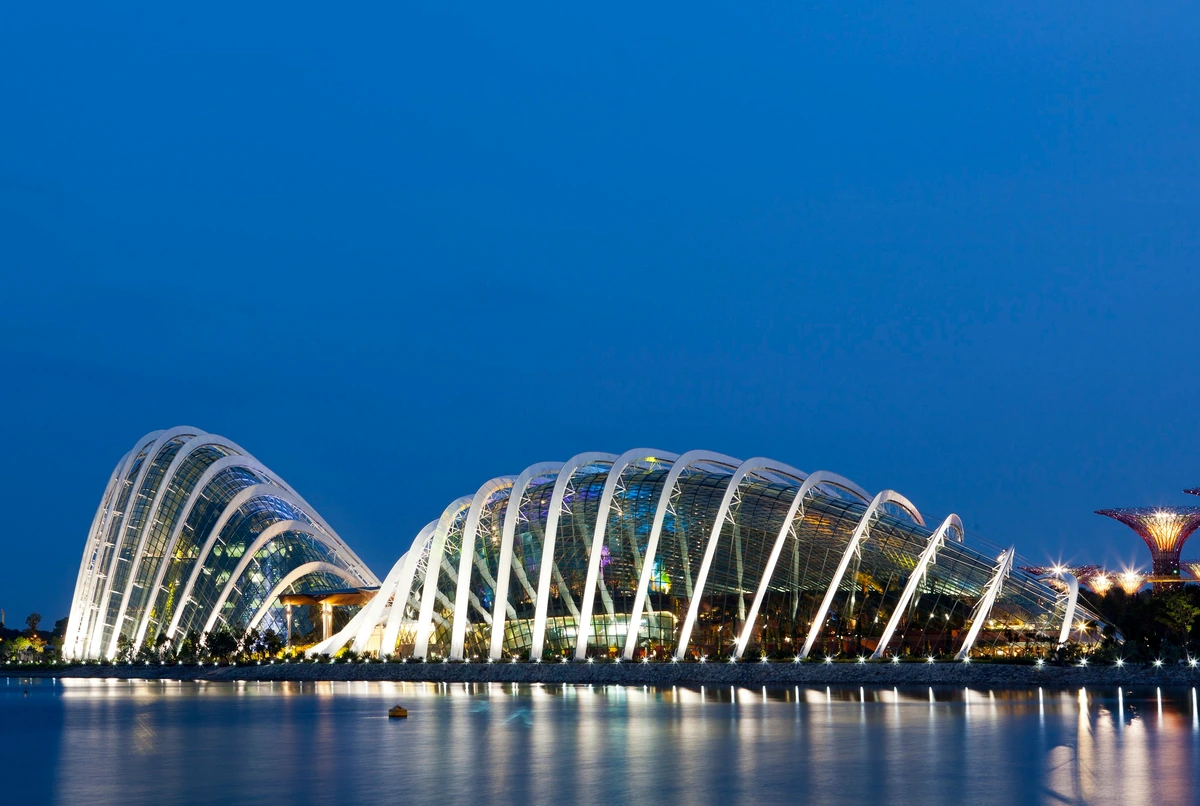
Anchoring the southern side is the 1.2-hectare Flower Dome, which earned the Guinness World Record in 2015 as the world’s largest glass greenhouse. This vast space is far more than a plant display—it is an artificial microclimate marvel where underground cooling pipes and specialized reflective glazing maintain a cool, dry range of 23°C to 25°C with relative humidity between 60% and 80%. Protected by this sophisticated climate envelope, tens of thousands of rare plants from arid Mediterranean regions, semi-arid Southwest Australia, coastal Chile, and the South African highlands sprout and bloom year-round in the middle of Singapore’s hot, humid equatorial monsoon climate.
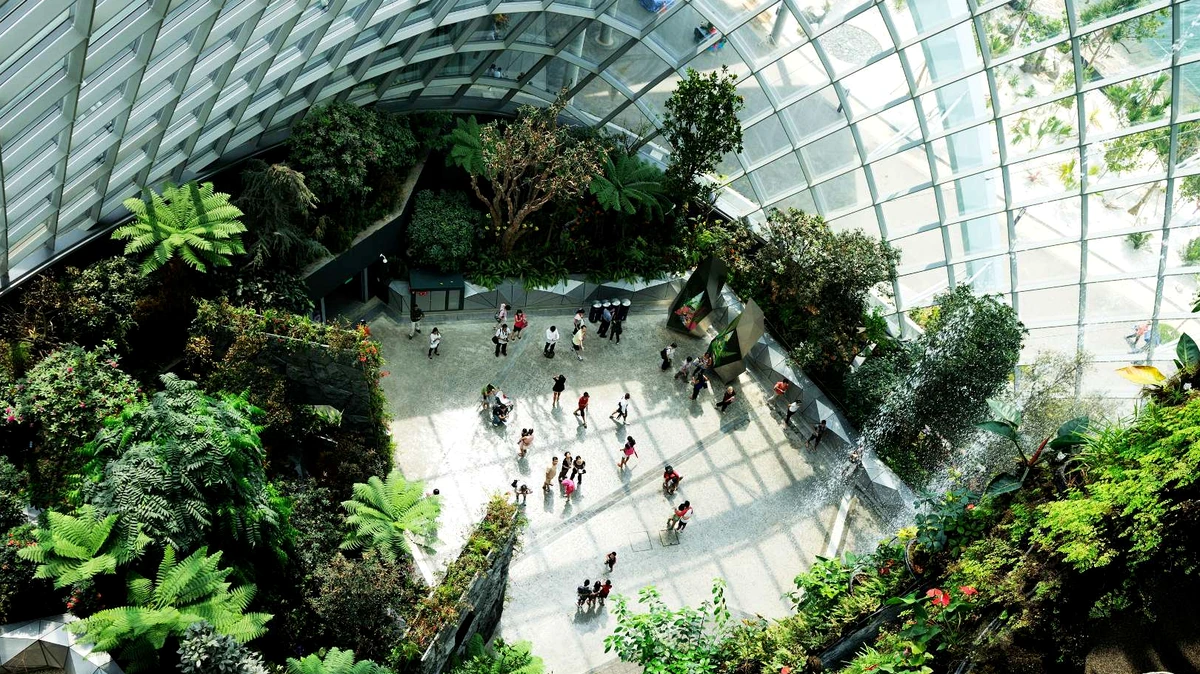
Right beside it, the 0.8-hectare Cloud Forest—reaching a peak height of 58 meters—transports visitors into a starkly different world: a humid tropical cloud forest environment modeled on elevations from 1,000 to 3,000 meters above sea level. The soul of this sanctuary is the 35-meter Cloud Mountain, where a dramatic waterfall cascades down from the summit as one of the tallest indoor waterfalls in the world, sending ethereal mist drifting through the air. Inside the artificial mountain, an elevator takes visitors to the top so they can stroll along two dramatic aerial walkways, Cloud Walk and Crest Walk. Suspended in mid-air and hugging cliffs blanketed in orchids, epiphytic ferns, and carnivorous pitcher plants, these sleek steel walkways let visitors observe forest stratification from the upper canopy down to the rainforest floor.
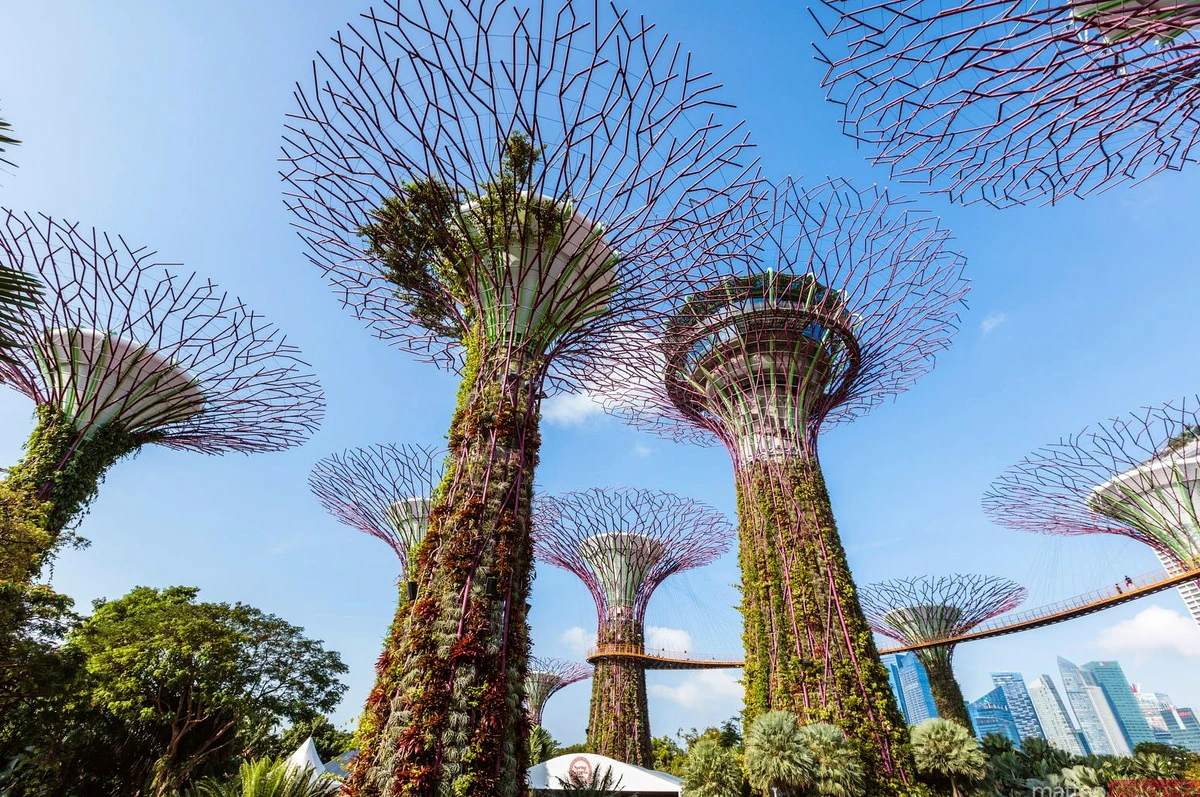
Stepping outside the enclosed glass domes, the outdoor landscape immediately captivates with Supertree Grove, home to 12 of the garden’s 18 “Supertrees,” ranging from 25 meters (about a 9-story building) to 50 meters (roughly a 16-story tower). Structurally, each Supertree is built around a heavy-duty reinforced concrete core wrapped in a steel-framed trunk and flaring canopy with specialized planting panels. More than 160,000 epiphytic plants across over 200 species—including tropical orchids, cascading Spanish moss, and bird’s-nest ferns—turn raw steel towers into towering vertical living gardens.
Even more remarkably, these green towers do more than dazzle the eye—they act as artificial lungs powering the park’s energy loop. The crowns of the tallest Supertrees integrate solar photovoltaic panels to harvest energy for nighttime illumination, while their trunks collect rainwater to feed the closed-loop irrigation system. Some Supertrees also serve as seamlessly disguised exhaust flues linked to underground biomass waste-to-energy operations, venting heat rejected by the conservatories’ cooling systems skyward. Spanning the dramatic gap between two towering Supertrees is the 128-meter-long OCBC Skyway at a height of 22 meters, where visitors can feel cool breezes through the planted canopies and take in sweeping views of the futuristic city.
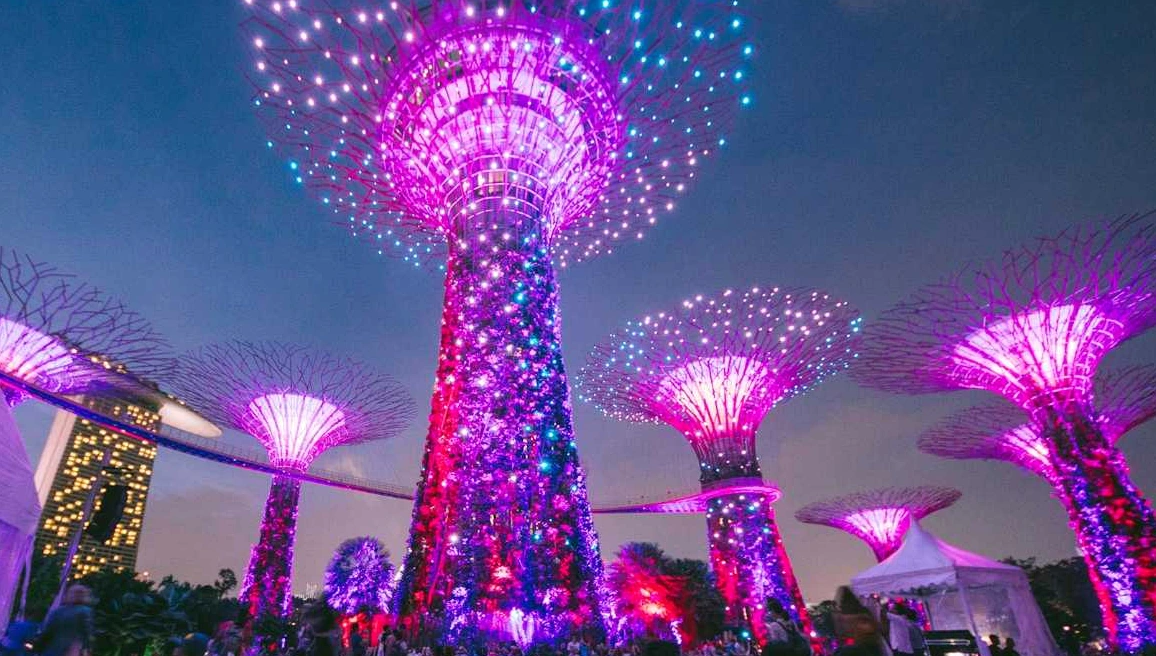
As dusk settles over Marina Bay and paints the coastal skyline in shades of amber and violet, Supertree Grove undergoes a breathtaking visual and emotional transformation. Orchestrated by lighting design masters Speirs + Major, nightfall brings no quiet darkness—instead, it becomes a mysterious velvet canvas that activates a multi-dimensional universe of light. Tens of thousands of advanced LED fixtures woven along the steel frames and nestled through the epiphytic layers of the twelve giant Supertrees begin to glow. No longer static steel columns by day, the 25- to 50-meter structures transform into luminous towers dancing with the breeze, creating one of the Lion City’s most dazzling nightscapes.
The undisputed highlight of the evening is the signature light-and-sound spectacle Garden Rhapsody, performed twice nightly at 19:45 and 20:45 local time. More than mere city lighting, this live show is a millisecond-choreographed fusion of digital programming and orchestral or thematic music. Sound is delivered through high-grade directional speakers discreetly concealed behind ferns, orchids, and climbing epiphytes, enveloping the plaza in an immersive soundscape without exposing bulky machinery. From timeless Hollywood film scores and dramatic Broadway showtunes to global folk arrangements, every musical cue aligns with color shifts across the Supertrees—turning rainforest emerald into mystical violet, then erupting into molten lava orange-red and regal gold to turn the night sky into a captivating 360-degree kinetic canvas.
Experiencing Garden Rhapsody has a rare, free-spirited charm that leaves conventional theater seating behind. Thousands of visitors from around the world gather naturally, settling onto curved stone benches or reclining directly on the lawn and granite paving of the central plaza. Lying back looking up at the night sky gives a full panorama of the umbrella-like canopies as beams of light weave, chase, and dance like stars falling to earth. In the cool breeze off the bay, the crowd’s rhythm seems to sync with the pulse of the lights, creating a deep sense of connection between people and a futuristic ecological creation.
Within the wider urban layout, the light show at Supertree Grove also creates a striking visual dialogue with the three-tower silhouette and sky-deck of Marina Bay Sands rising behind it. While the iconic resort radiates the sleek silver-white glow of a thriving financial hub, the Supertrees below burst with warm, surreal, organic color. Together, contemporary lighting art and lush tropical flora underscore Singapore’s design ethos: a city that never sleeps yet never runs out of nature, where vibrant nightlife is powered by green technology and every hour of darkness becomes an enchanting work of art.
Amid the grandeur of glass domes and lush flora, Gardens by the Bay is more than a showcase of green engineering—it also opens a refined culinary sanctuary celebrating the Lion City’s multicultural heritage. Beneath the towering structures, visitors follow a trail of flavors woven from Chinese culinary craft, Malay vibrancy, Indian richness, and storied Peranakan traditions. Every dining spot here links past and present, honoring decades-old family recipes alongside the energetic pulse of Marina Bay.
Strolling along the breezy eastern waterfront path, Satay by the Bay feels like a laid-back open-air flavor oasis, bringing back memories of the famed mid-century waterfront Satay Club. Here, the sizzle of hot charcoal mingles with wisps of smoke carrying the rich aroma of golden grilled skewers. Chicken, beef, or mutton is sliced neatly, marinated generously in golden turmeric, fresh lemongrass, cumin, and coriander, and grilled directly over glowing embers. The crowning touch is a velvety peanut sauce simmered with tangy tamarind, red chili, and coarsely crushed roasted peanuts, served with neat palm-leaf-wrapped rice cakes (ketupat) and crisp cucumber slices—balancing rich, nutty, sweet, and spicy notes characteristic of tropical coastal waters.
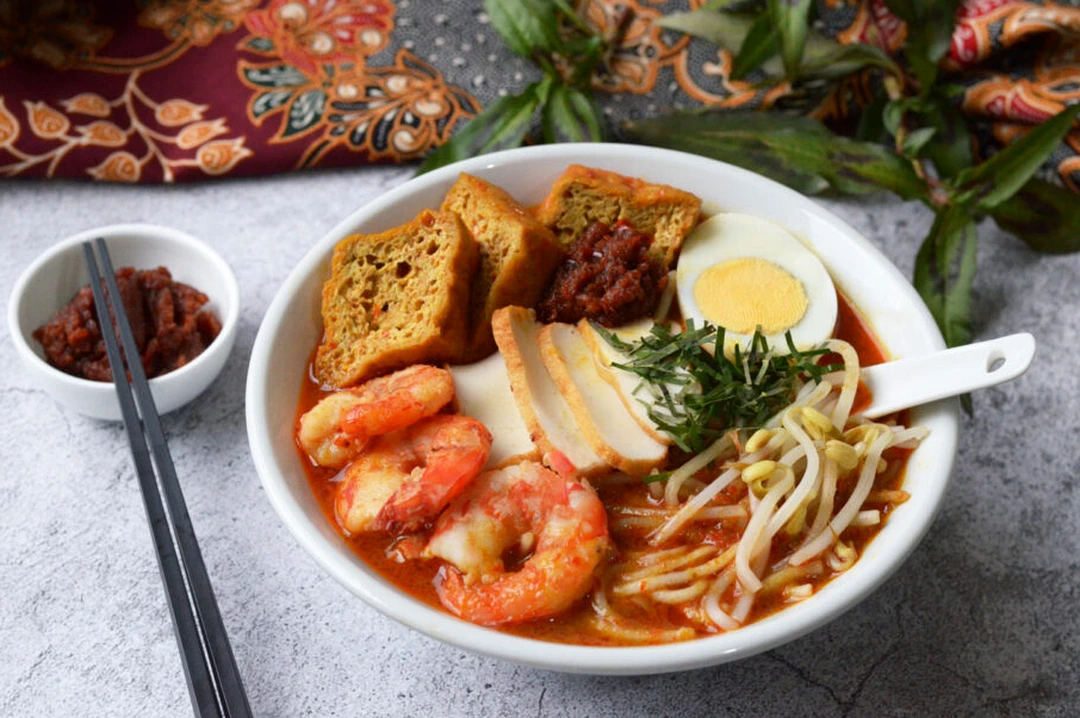
Alongside iconic satay skewers, the dining map features bowls of classic Peranakan Laksa with golden coconut broth rich with dried shrimp and fishcake, accented by fragrant Vietnamese coriander (daun kesom), as well as authentic Hainanese Chicken Rice pairing tender poached chicken with fragrant rice cooked in chicken broth and bruised ginger. Moving closer to Supertree Grove, diners encounter Jurassic Nest Food Hall—a distinctive dining venue combining animated dinosaur displays with well-known street-food names recognized with Michelin Bib Gourmand honors. Savoring time-honored dishes amid majestic roars and towering man-made canopies creates a dining experience that is at once whimsical and culturally grounded.
What gives the local cuisine at this ecological complex its lasting depth comes from mastering core regional ingredients refined across generations. First is rempah—the pounded spice paste foundational to Straits braises and curries—where galangal, fresh turmeric, shallots, garlic, dried chilies, and candlenuts are ground carefully in a stone mortar and slow-fried in hot oil until fragrant and aromatic oils separate cleanly. Alongside it, vibrant pandan leaves act like an eastern aromatic jewel, infusing sticky rice, steamed rice, and sweet jellies with natural vanilla-like fragrance that pairs smoothly with the deep, caramel-smoky sweetness of gula melaka palm sugar. These layered aromas awaken the senses while preserving memories carried by generations of migrants inside one of Asia’s most futuristic landmarks.
To make the most of this futuristic ecological complex by Marina Bay, visitors should keep each zone’s operating hours and layout in mind. Outdoor core areas—including Supertree Grove and the Dragonfly and Kingfisher lake ecosystems—are open free of charge daily from 05:00 to 02:00 the following morning, making them ideal for peaceful early-morning walks or nighttime light shows. By contrast, the two climate-controlled conservatories, Flower Dome and Cloud Forest, welcome visitors from 09:00 to 21:00, with last admission at 20:00. For those wanting to walk the 22-meter-high OCBC Skyway or head up to the Supertree Observatory at the top of the tallest Supertree, operating hours also run daily from 09:00 to 21:00, with ticket sales and entry closing at 20:30 for safety procedures.
On the ground, combined adult admission for both conservatories—Flower Dome and Cloud Forest—typically sits around 53 Singapore dollars. Elevated experiences such as OCBC Skyway or Supertree Observatory are priced separately at roughly 14 Singapore dollars each. To avoid long queues during peak hours and help management regulate visitor flow inside enclosed biospheres, booking tickets online in advance through official channels is the smartest choice. Locking in tickets early also keeps your visit smooth and reduces the risk of sold-out slots during major holidays and festivals.
Singapore’s renowned public transit network makes reaching the gardens fast and effortless. The MRT subway is the top choice, with Bayfront station serving as a key interchange on both the Circle Line (CE1) and Downtown Line (DT16). From Bayfront station, passengers simply follow the underground linkway directly through Exit B into the gardens, staying sheltered from sun and rain. In addition, Gardens by the Bay station on the Thomson-East Coast Line (TE22) provides a convenient, open arrival point right near the waterfront and the complex’s southern entrance.
Thoughtful packing and awareness of local public etiquette will make your visit even smoother. Tropical equatorial weather outdoors calls for light, breathable clothing and comfortable walking shoes for covering kilometers of garden paths. Inside the climate-controlled conservatories, however, temperatures stay around 23°C with high humidity to protect temperate and montane cloud-forest flora—so a light windbreaker or shawl is a smart carry-along to prevent sudden temperature chill.
Strict respect for Singapore’s environmental laws is essential—including zero tolerance for littering, no picking plants or breaking branches, and smoking only in designated marked zones. When strolling through the Heritage Gardens celebrating the four major influences—Chinese, Malay, Indian, and Colonial—visitors should also show respectful decorum around sculptures and flora that hold cultural and spiritual significance. To experience this ecological masterpiece alongside legendary sights across Southeast Asia’s maritime crossroads with attentive service, travelers can book the 6D5N Luxury Singapore – Malaysia Tour.
In terms of spatial organization, a standard Dzong is strictly divided into three main sections that reflect a parallel spiritual order and political structure. At the center of the fortress is always the Utse – a soaring stone tower symbolizing Mount Meru, the central axis of Buddhist cosmology, nestled peacefully among the most sacred shrine halls housing scriptures and sacred images. Surrounding this central axis are two separate, enclosed courtyards: the quiet monastic quarters of the Dhey-khor reserved for monks practicing meditation and studying doctrine, and the livelier administrative wing of the Du-khor, which houses the offices of the Dzongda (district governors/judges) overseeing secular affairs. This dual yet interwoven division within a single fortified whole accurately reflects the doctrine of Chhoe-sid-nyi – the harmonious unity of religious law and royal authority in Bhutanese life.
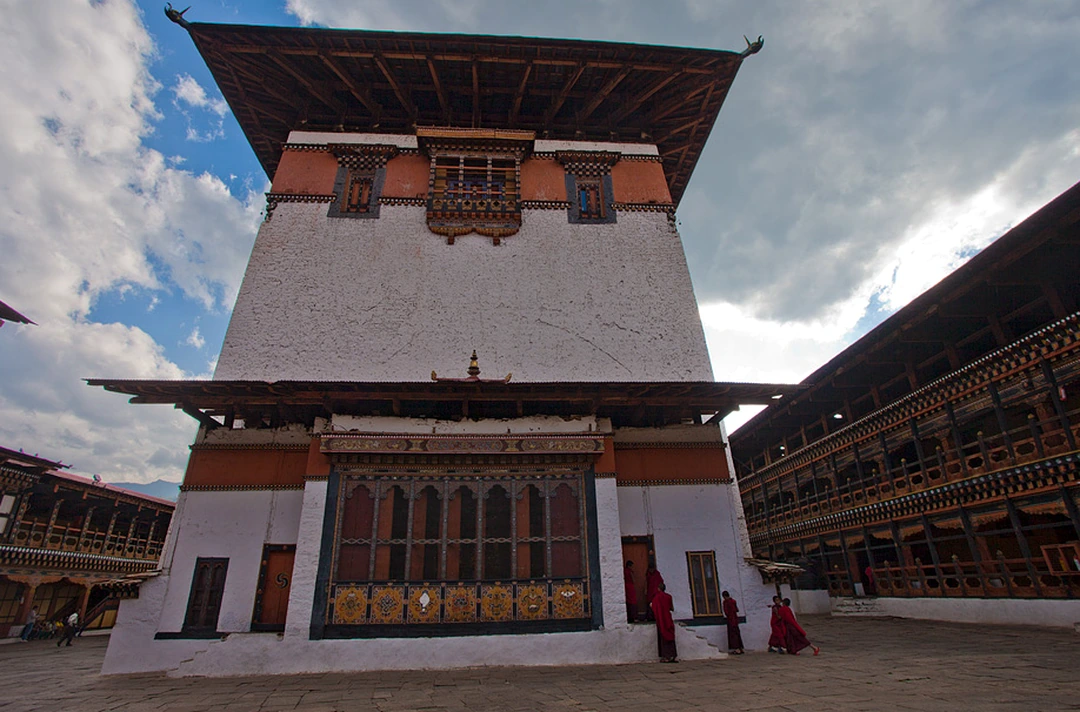
The supreme embodiment of this scale and aesthetic is Punakha Dzong, a masterpiece founded by Zhabdrung Ngawang Namgyal in 1637 under the name Pungtang Dechen Photrang Dzong (Palace of Great Bliss). Rising proudly at a prime confluence where the rushing male river (Pho Chhu) meets the gentle female river (Mo Chhu), the fortress stretches more than 180 meters in length, with the stately Bazam wooden arched bridge spanning the water to lead into its gate. Climbing the steep steps, the Kuenrey assembly hall of Punakha Dzong opens into a breathtaking space with solid gold-leafed timber pillars, ceilings painted with hundreds of mandalas, and murals depicting the entire life of Shakyamuni Buddha rendered in natural mineral pigments.
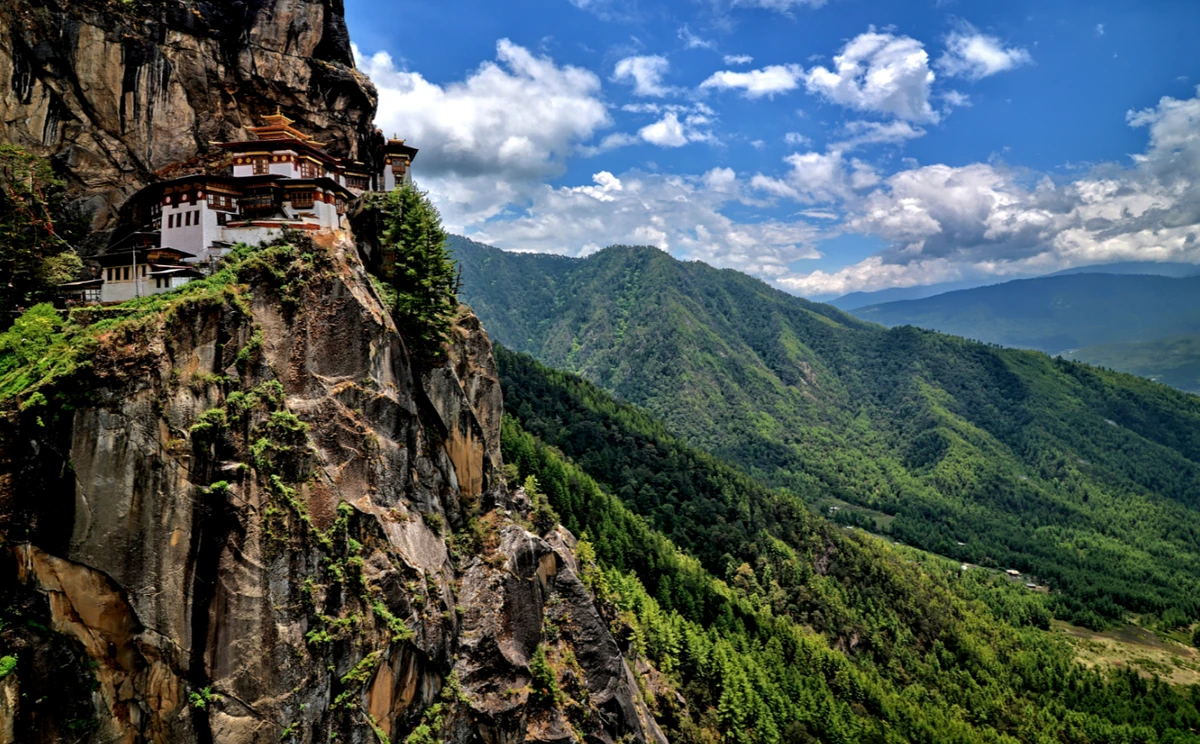
If Punakha Dzong is the symbol of valley majesty, Taktshang Monastery (Tiger’s Nest) represents the ultimate fortitude of Buddhist architecture at dizzying heights. Clinging precariously at an elevation of 3,120 meters on a sheer granite cliff overlooking the deep Paro valley floor, its cluster of four main temples and eight meditation caves connects via narrow passages carved straight into the rock face. Legend has it that Guru Rinpoche flew here on the back of a tigress to subdue local demons in the eighth century. Hauling thousands of tons of rough stone, pine timber, and mortar up a vertical cliff using only human labor and pack mules to create an ensemble that seems to grow out of the living rock is an architectural feat that makes this site one of the most sacred pilgrimage destinations in the entire Himalayas.
When dusk draws a dark curtain across the snow peaks of the Himalayas, the Land of the Thunder Dragon, Druk Yul, undergoes a magical spatial transformation. Viewed through the lens of the Gross National Happiness philosophy, quietness and pristine darkness are protected as priceless natural heritage, leaving Bhutan’s valleys completely free of bright, chaotic urban light pollution. When night falls, the vast sky becomes a pure black velvet dome where millions of stars and the Milky Way stand out vividly to the naked eye, suspended right above tall pine forests. In sharp contrast to modern cities racing to outshine one another with artificial glare, nightlife in this Vajrayana land is shaped by a still, restrained lighting craft rich in spiritual reverence.
The grandest visual focal points across the Himalayan nightscape are the monumental monastic fortresses known as Dzongs. In the capital Thimphu, Tashichho Dzong stands stately beside the Wang Chhu river, while in the winter capital, Punakha Dzong rises at the sacred confluence of the Pho Chhu and Mo Chhu rivers, with lighting calculated down to every angle. Lighting engineers use next-generation LEDs paired with warm-toned metal-halide fixtures, washing upward from the base across massive stone walls whitewashed in crisp lime. Amber light wraps around the signature gently sloping walls, highlighting intricate mahogany window carvings and glinting off the lofty gold-plated Gajur roof finials. Seen from afar, the Dzongs look like sacred palaces of light drifting amid valley mist, casting shimmering reflections across sediment-flecked waters.
Stepping away from the grandeur of the fortresses, the evening rhythm of local people settles into a warm, deeply traditional family atmosphere. Inside sturdy two-story rammed-earth houses, the center of evening life is always a glowing cast-iron Bukhari stove. Smoke from dry pine wood releases a resinous fragrance mingled with warmth spreading through the room, driving away the bone-chilling highland cold. Right beside the stove, in the solemn family altar room, the evening ritual of lighting Karme butter lamps takes place regularly every night. Dozens of small yak-butter lamps flicker with a gentle golden-orange flame, giving off a pure, rich buttery scent blended with wisps of juniper incense smoke known as Sang. Bhutanese people believe the Karme flame not only illuminates physical space but also acts as a torch dispelling the darkness of ignorance, guiding the mind toward peaceful enlightenment.
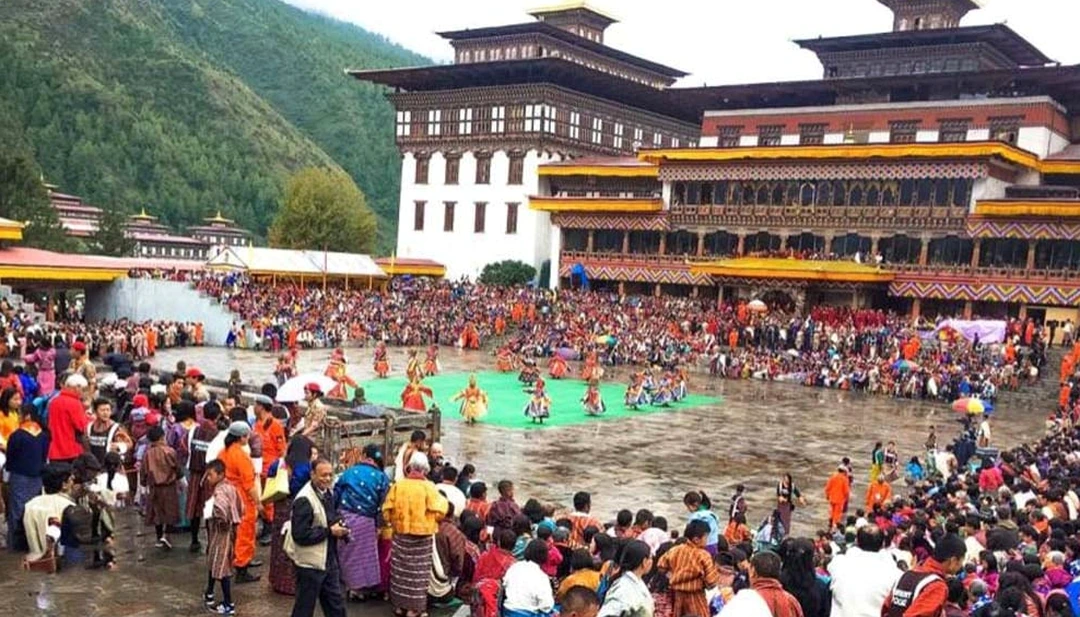
Yet the soul of the Vajrayana night truly reaches its height in live spiritual performances held inside monasteries and Dzong courtyards. That is the evening Chodpa chanting ritual – a practice of cutting through the ego performed just as twilight fades. In the dim half-light of the shrine hall, the deep, resonant sound of a Kangling trumpet made from a human thigh bone rings out plaintively, mingling with rapid beats of the Damaru hand drum, the rumbling drone of the long Dungchen horn, and ringing metal cymbals that reach deep into the subconscious. During major sacred festivals, the fortress courtyard also becomes a living stage for expressive Cham masked dances. Under sharp beams of light cutting through dense darkness, lamas wearing brocade robes embroidered with sparkling metallic thread and masks of fierce Mahakala protector deities execute turns that are graceful yet full of power. Light art and spiritual sound weave tightly together into an unmatched mystical spectacle, carrying onlookers across a surreal threshold between the human realm and the realm of Buddhas.
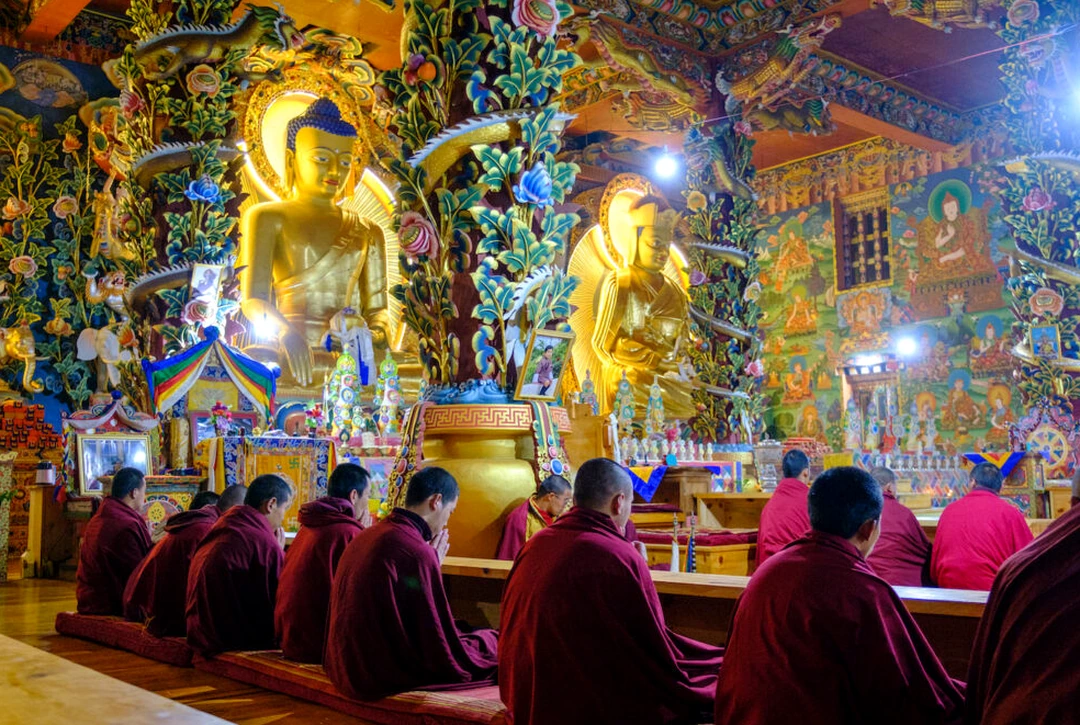
Amid drifting clouds enveloping the majestic Himalayas, Bhutan’s Gross National Happiness philosophy is visible not only in monastery architecture or turning prayer wheels, but also distilled in the warmth of the family hearth. Cuisine in the Land of the Thunder Dragon carries a distinctly cold-climate highland character, where every meal is carefully balanced to supply lasting thermal energy against the biting chill of snow peaks. Unlike the common view elsewhere that treats chili merely as a supporting seasoning, people here revere chilies as a staple vegetable in everyday life. At the heart of every family meal, from Punakha’s royal court to remote villages in the east, are steaming bowls of jowo red rice. This ancient red rice variety, nourished by meltwater from millennium-old glaciers in the Paro valley, gives off a nutty chestnut-like aroma when steamed and has a sticky, mineral-rich grain that forms the ideal base for Bhutan’s famous fiery cooking.
Topping the list of Bhutan’s signature national flavors is Ema Datshi, a simple yet remarkably elevated harmony between blazing heat and deep richness. The dish brings together split dried green or red chilies simmered with creamy datshi cheese crafted by hand from yak or local cow’s milk. Melted cheese strands cling closely to every chili strip, creating a thick, savory sauce that awakens every sense in freezing weather when spooned generously over jowo red rice. Building on this classic structure, locals have created well-known variations such as Kewa Datshi with thinly sliced potatoes simmered soft in creamy cheese, offering a gentler sweetness for cold evenings. On formal festive occasions, a traditional spread always includes Shakam Paa, made from strips of yak beef air-dried naturally under eaves through the dry cold winter, then stir-fried with thick slices of white radish and bright red dried chilies for a chewy, savory bite infused with hearth and herbal smoke.
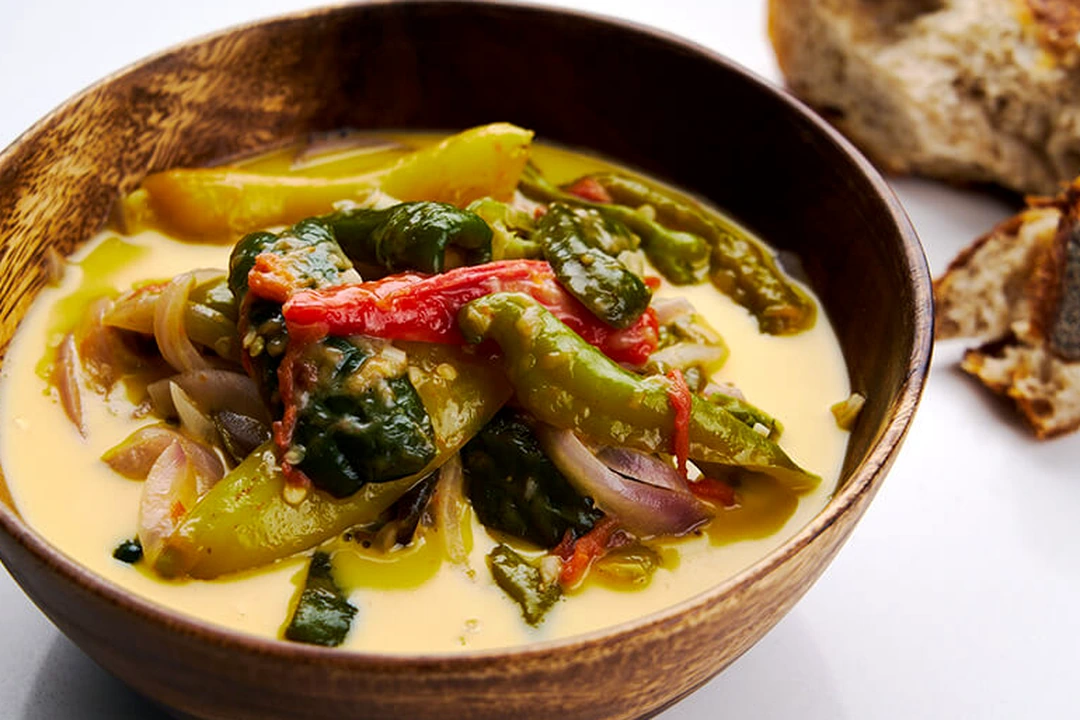
Exploring the map of local flavors takes travelers across rugged high passes into the secluded Haa valley, home to the traditional culinary treasure Hoentay. Appearing during traditional Lophey New Year celebrations, Hoentay is a one-of-a-kind buckwheat dumpling whose dark, slightly bitter buckwheat wrapper – grown on steep slopes – encases a savory filling of finely chopped turnip greens, toasted hemp seeds, fresh ginger, and aged datshi cheese. Whether delicately steamed or pan-seared crisp with fragrant yak butter, the dumpling evokes the resilient self-reliance of herders in the borderlands. To balance the cooling nature of highland greens, Bhutanese people often raise a glass of aromatic Ara, distilled from naturally fermented rice, corn, or millet. When welcoming honored guests, warm Ara is finished with the Mar-tshoe ritual – whisking in a pat of fresh butter and a raw local egg with a runny yolk right in a cast-iron pan to create a warm, rich drink that sends vitality coursing through the body.
Bhutanese food culture reaches its highest refinement when joined with the spirit of Vajrayana Buddhism through mindful dining customs. Seated cross-legged on handwoven wool carpets beside wooden Choktse tables carved with auspicious symbols, diners observe quiet etiquette. Before touching any food, the eldest member of the household performs the Phud ritual by flicking three tiny pinches of rice and a few drops of drink into the air with their fingers. This solemn gesture is a reverent offering to the Three Jewels and local protector deities, dedicating merit to sentient beings in unseen realms. A meal is not merely taking in physical nourishment, but a miniature space of meditation where people express deep gratitude to earth, sky, and all living things while maintaining harmony between body, mind, and the wider universe.
Setting foot in Druk Yul is not simply a sightseeing trip, but an encounter with a one-of-a-kind cultural system in the world. To stay firm in its “High Value, Low Volume” philosophy and safeguard its unspoiled environment along with pure spiritual heritage, the Kingdom of Bhutan enforces strict visa management. All international visitors must book their trip through licensed tour operators and pay the Sustainable Development Fee (SDF) at a rate of 100 USD per guest per night. Rather than being a mere administrative charge, this revenue is reinvested directly by the government into free nationwide healthcare and education, the restoration of historic monasteries, and maintaining Bhutan’s status as the only carbon-negative country on Earth. Every night spent in the Land of the Thunder Dragon therefore serves as a direct contribution to community well-being and lasting cultural vitality.
To set foot in the peaceful Paro Valley, travelers experience one of the most dramatic and breathtaking aviation journeys on Earth. Paro International Airport is nestled at an elevation of over 2,200 meters above sea level, surrounded by towering snow-capped peaks exceeding 5,500 meters in the Himalayas. The extreme complexity of wind currents and bowl-like terrain requires aircraft to take off and land strictly under visual flight rules (VFR), and only a select handful of seasoned pilots worldwide hold the specialized certification to weave through narrow mountain passes onto the runway. After leaving the airport, the domestic road network consists largely of winding mountain passes hugging steep abysses. Navigating challenging bottlenecks like Dochula Pass at 3,100 meters—home to the 108 Druk Wangyal chortens soaring into the clouds—always calls for sturdy four-wheel-drive vehicles and experienced local drivers, turning every transfer into a slow journey immersed in majestic nature.
When passing through the imposing wooden gates of fortress monasteries (Dzongs) and revered temples, visitors should keep in mind the typical opening hours from 09:00 AM to 05:00 PM, with a midday closure from 12:00 PM to 01:00 PM for chanting sessions and monastic routines. Anyone entering these sacred spaces must follow strict dress standards: hats are strictly prohibited, and attire must be modest with buttoned long-sleeved shirts, long pants, or knee-length-plus skirts, leaving no shoulders or chest exposed. While locals gracefully wear traditional national attire—the Gho cinched neatly at the waist with a Kera belt for men, or the intricately woven silk Kira skirt paired with a Toego jacket for women—visitors must also show comparable reverence with dignified poise and remove their shoes before crossing the threshold of sacred shrine rooms.
The depth of Vajrayana life also shines through every standard gesture when interacting with sacred monuments. An unbreakable rule that every devotee and visitor must take to heart is always walking clockwise around Chortens, prayer wheel rows, and main prayer halls—a meditative circumambulation known as Kora to accumulate merit and align with cosmic order. In particular, inside central towers (Utse) and Buddhist temples (Lhakhang), authorities and the monastic community strictly prohibit all filming and photography. This steadfast rule not only preserves the supreme sanctity of the monastery but also protects centuries-old Tantric murals painted with natural mineral pigments from degradation caused by artificial light.
Listening to resonant chanting mingle with the fragrant drift of juniper incense across rocky slopes, travelers realize that these disciplined norms are not barriers at all, but bridges guiding awareness toward the source of inner stillness. To prepare thoroughly for a pilgrimage discovering the otherworldly beauty and enduring philosophy of happiness in this kingdom tucked away among snow peaks, reviewing a detailed itinerary through a professional Bhutan tour will help travelers enjoy every serene moment in this wondrous land with peace of mind.