Situated right in the heart of Futian District in Shenzhen, Guangdong Province, Huaqiangbei Avenue stands like an observatory bearing witness to the earth-shaking transformations of the modern era. Long celebrated as “China’s Number One Electronics Street,” this district carries the identity of a grand turning point when winds of reform and opening-up first swept across Lingding Bay. Tracing time back to the early 1980s, just as the Shenzhen Special Economic Zone was laying its foundational stones, the Shenzhen Urban Planning and Construction Committee designated this area as the Shangbu Industrial Zone. Back then, ambitions to revitalize manufacturing turned a rough, low-lying tract into a premier electronics and raw-material processing base—opening a stirring chapter in the history of a miracle metropolis.
The rise of Huaqiangbei is closely tied to strategic national decisions, as key ministries established outposts here to lay the groundwork for a nascent technology sector. Contingents of technical cadres, engineers, and skilled workers answered the call of the times and headed south, gathering under the banners of the former Ministry of Electronics Industry, Ministry of Ordnance, Aviation Administration, and the Electronics Bureau of Guangdong Province. From these core institutions, flagship factories and enterprises—such as Aihua, Jinghua, Huafa, and parent firm Huaqiang—rose one after another along both sides of the avenue. Gray concrete factory blocks, the round-the-clock hum of component stamping presses, and the brisk footsteps of a pioneering generation transformed an internal industrial road into one of the busiest commercial arteries anywhere.
As economic reform gathered intense momentum, the line between pure manufacturing and commercial distribution blurred under the pressures of a free market. Ground floors of factories rapidly gave way to stalls displaying microchips, diodes, resistors, and semiconductor circuit boards, sparking the most dramatic structural shift in East Asian tech retail history. Right here, an immortal marketplace legend was born and echoed across continents: “rising from a one-meter counter to a fortune of hundreds of millions.” With nothing more than a one-square-meter glass display case, a landline telephone, and a handheld calculator, thousands of everyday entrepreneurs seized the moment—moving millions of components daily to every continent, amassing vast fortunes, and becoming self-made millionaires and billionaires seemingly overnight.
Even so, the tides of history have never been calm or effortless for this technology sanctuary. Huaqiangbei has navigated turbulent periods—from crackdowns on counterfeit “shanzhai” phones to sharp shake-ups brought on by booming e-commerce and multi-year underground transit construction. Yet inner resilience and a bold spirit of enterprise have driven the district to reinvent itself across every economic cycle. From simple component stalls, Huaqiangbei has evolved into a cradle for hardware incubators, smart-device design centers, artificial intelligence robotics, and a global tech innovation ecosystem. Every inch of this ground holds memories of pioneering enterprise while serving as a living declaration of a modern city’s drive to move forward.
Viewed on a broad geographic map of the lower Pearl River Delta, Huaqiangbei sits right at the prosperous core of Futian District, acting as an anchor shaping Shenzhen’s entire commercial and economic layout. The district is framed by a quadrilateral remarkable in both traditional geomancy and contemporary urban planning: bounded on the east by Shangbu Middle Road, extending west to Huafu Road, touching Hongli Road to the north, and bordering Shennan Middle Avenue directly to the south. These four broad thoroughfares enclose a level, evenly graded urban plain—forming a steady, square grid that smooths out topographical friction and welcomes a continuous flow of commercial vitality from every direction.
In modern urban geomancy, “roads as water” plays a vital role in gathering fortune, and Huaqiangbei is fortunate to command a prime dragon-vein position right beside Shennan Avenue to the south. Often likened to a golden dragon winding east–west across Shenzhen, this vital corridor carries millions of vehicles and surging capital flows day and night. Positioned prominently along the central stretch of the Shennan dragon vein, Huaqiangbei’s marketplace draws vibrant commercial momentum from the east—inheriting long-standing trading energy from historic Luohu—while connecting with tech innovation and financial energy emerging from software parks and business hubs in the west.
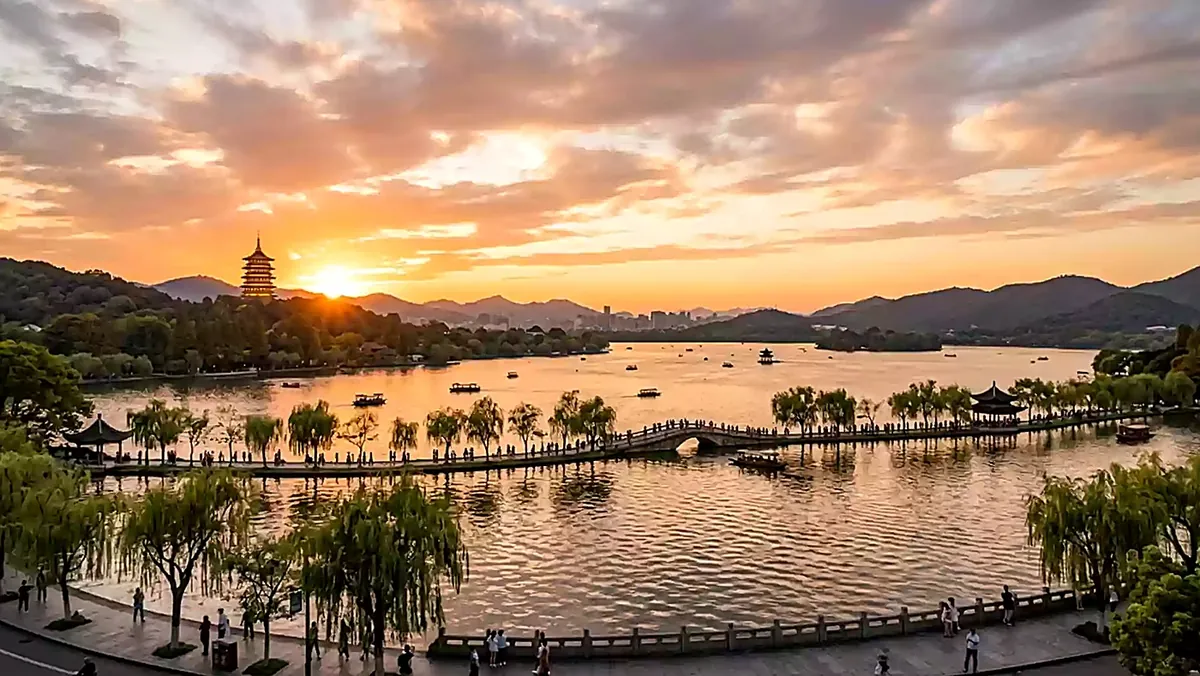
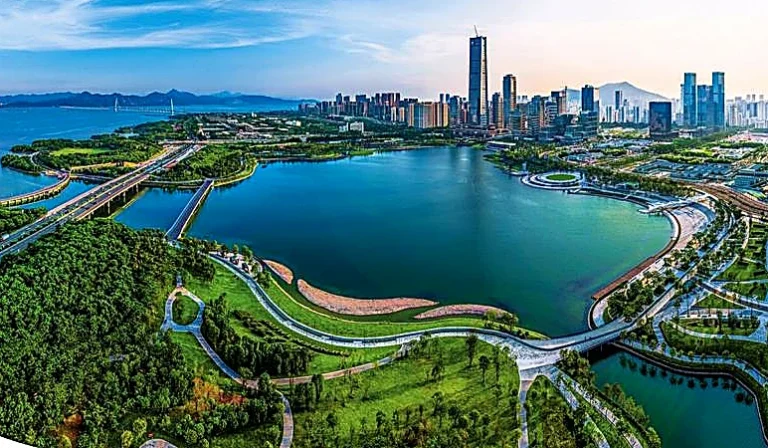
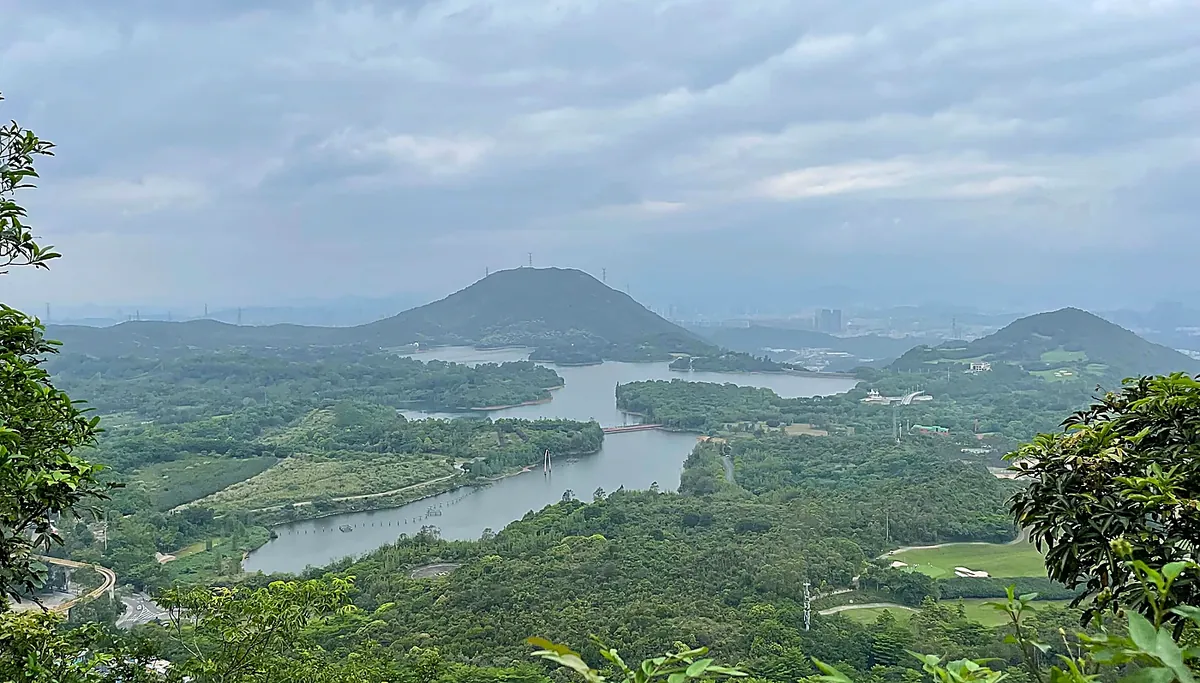
Alongside dense reinforced-concrete infrastructure, surrounding natural landscapes grant Huaqiangbei a rare Yin–Yang balance within a major industrial metropolis. Flanking its western edge is Shenzhen Central Park, a sweeping green ecological belt stretching like a jade screen that buffers strong winds, purifies the microclimate, and refreshes the air around compact commercial blocks. Calm waters and native greenery within the central park form a natural water-gathering feature—softening the high-pressure pace of microchip commerce while supplying tranquil energy and a smooth transition between peaceful nature and one of Lingnan’s liveliest business hubs.
Heading north, seamless connection with the cultural corridor along Hongli Road gives the district a deep intellectual and spiritual foundation. The northern zone brings together cultural institutions such as libraries, children’s palaces, and arts exchange centers, while facing geomantically toward graceful Lianhuashan Hill—crowned by a monument looking out toward the open bay. This refined cultural backdrop helps balance a predominantly mechanical, hardware-driven district, nurturing creativity and higher intellectual value across electronics products. The blend of lush greenery, cultural spaces, and bustling commerce makes Huaqiangbei a cohesive whole—supporting generations of merchants building component distribution networks that reach continents worldwide.
Covering a compact area of roughly 1.45 square kilometers in central Futian District, the Huaqiangbei fashion, technology, and culture district represents a rare feat of spatial organization in global economic history. Rather than spreading out as a flat commercial strip, it rises as a complex three-dimensional structure—a vertical supply-chain powerhouse of extraordinary density. Its architectural face is the result of decades of transformation, turning early Special Economic Zone industrial workshops into standardized commercial towers interwoven with multi-level pedestrian walkways.
From the moment you step into its central core, visual impact comes from the interplay between macro planning and unique micro-structures. At the heart of the district is a network of 35 large-scale, specialized electronics and digital markets, anchored by iconic buildings such as the soaring SEG Plaza tower and Huaqiang Electronic World. Modern planning divides urban space into clear functional tiers: underground tunnels connect directly to major subway lines and linked subterranean malls, ground level provides spacious pedestrian avenues, and upper towers rise into brightly lit tiers of specialized trade.

The most distinctive feature of Huaqiangbei’s layout lies in the micro-stalls packed inside its commercial buildings. Thousands of booths measuring just one to two square meters sit side by side like living cells, making use of every centimeter of height and depth to display millions of varieties of microchips, resistors, diodes, sensors, and display screens. Far from creating chaos, this fine-grained subdivision follows a strict floor-by-floor specialization: floors dedicated to passive components, floors for semiconductor chips, floors for testing tools, and floors for finished peripherals. Each tiny booth acts as a direct node linked to massive manufacturing plants in nearby Dongguan and Huizhou.
The sheer scale of this sub-1.5-square-kilometer footprint astonishes urban researchers, housing more than 115,000 active commercial entities in daily operation. Continuous flows of people, data, and goods create an unrelenting mechanical rhythm, with narrow aisles bustling with handcarts loaded with printed circuit boards and rapidly packed parcels. Huaqiangbei’s architecture is therefore defined not merely by concrete and tempered glass, but by extreme material turnover—shaping a hardware ecosystem fast enough that a morning technical drawing can find full components and be assembled into a working prototype before nightfall.
As sunset settles along the Shenzhen coast, Huaqiangbei sheds the hurried daytime bustle of a component trading floor to put on the dazzling mantle of a technology light capital. The crisp snap of packing tape and rush of pushcarts along sidewalks gradually yield to an enchanting visual blend woven from millions of LEDs and giant digital screens. Stretching over 900 meters, the central pedestrian avenue turns into a surreal corridor of light where towering buildings serve not just as shopping centers, but as massive canvases for contemporary visual art inside the Special Economic Zone.
Anchoring this nightscape is SEG Plaza, rising over 350 meters as a proud technological beacon for Shenzhen, reflecting vivid spectrums where cool cobalt blue meets warm neon red. Right beside it, commercial complexes like Century Place and surrounding electronics towers light up the night sky with giant naked-eye 3D displays, projecting lively three-dimensional effects that seem to pierce the darkness. Sweeping laser beams and interactive floor lights beneath walkers’ feet turn the entire precinct into a giant sci-fi stage where every visitor feels like a character stepping into a classic science-fiction film.
Huaqiangbei’s night pulse is further energized by a singular meeting point between the international maker community and easygoing city life. In open squares and along pedestrian corners, hardware founders, programmers, and electronics engineers from around the world gather at late-night outdoor cafes to debate microchips, algorithms, and artificial intelligence. Weaving through the tech crowd are fashion-minded young people drawn to neon-lit corners for cyberpunk-inspired photos, alongside street performers captivated by interactive light installations.
Stepping just a few paces off the main avenue into neighboring lanes like Zhenhua Road or Zhenxing Road, sleek modern energy gives way to the warm, down-to-earth rhythm of a sleepless Shenzhen. Late-night eateries stay open until morning, steaming with pots of Chaozhou beef hotpot in clear, naturally sweet broth, sizzling Cantonese clay-pot rice fragrant with cured sausage, and charcoal skewers dusted with spicy chili powder. This interplay between futuristic light and comforting street food makes nights in Huaqiangbei a multisensory experience capturing the boundless drive of the district.
Beneath Huaqiangbei’s high-rises and dense electronics labyrinths lies a vibrant culinary world where Shenzhen–Hong Kong commerce blends closely with authentic Cantonese roots. After intense business negotiations, the pace unwinds beside fragrant steam rising from well-known food streets. Dining around Huaqiang Avenue and nearby lanes is more than fuel for visiting merchants—it acts as a flavor museum reflecting migration culture and Lingnan culinary identity.
Top of mind among local food lovers are the traditional pork-tripe and chicken hotpot spots along Zhenhua Road. This signature dish embodies Hakka and Cantonese health-focused cooking, featuring a broth simmered for hours from pork bones infused with the warming spice of white pepper alongside traditional herbs such as goji berries, astragalus (huangqi), and codonopsis (dangshen). Crisp, chewy pork tripe wrapped around tender, sweet chicken—paired with a sizzling clay pot of rice and crispy cured-sausage crust—creates an irresistible burst of flavor. Right beside it, traditional Chaoshan Longjiang braised pork-knuckle rice represents hearty, everyday energy: trotters and pork knuckles stewed slowly in seasoned soy sauce fragrant with star anise, black cardamom, and cinnamon until the skin turns glossy amber and fat melts effortlessly over long-grain rice and tangy pickled mustard greens.
Snack lanes cutting across Huaqiangbei form a colorful multi-regional tapestry shaped by migrant families. Visitors can easily find clean, comforting flavors at Hanshuiyuan, or crispy northern-style Tianjin Jianbing crepe stalls with thin mung-bean batter, rich egg, and golden fried dough crisps. Deeper in side streets are bowls of clear rice noodles in broth simmered from dried shrimp and lean pork, along with nostalgic coastal snacks at Haifeng Zeng’s dim-sum shop—preserving memories of eastern Guangdong through savory glutinous rice balls, mugwort cakes, and handmade fish cakes.
As activity shifts toward modern shopping hubs like Century Place, Huaqiangbei’s dining scene takes on a sleeker edge suited to upscale business banquets. Here, diners enjoy rich butter-glazed shrimp brimming with roe, numbing-spicy green-peppercorn grilled fish, colorful revolving-style hotpots, and fresh charcoal-grilled eel prepared tableside. Especially noteworthy is Guangming-style roast squab—a Shenzhen culinary pride with more than half a century of history. Young squab is glazed in a secret marinade and basted continuously with hot oil until the thin skin turns glass-crisp while locking in juicy, flavorful meat inside—highlighting refined gastronomy right inside southern China’s busiest electronics hub.
To reach the semiconductor hub of Huaqiangbei, Shenzhen’s underground transit network offers one of the clearest, most reliable routes in the Guangdong–Hong Kong–Macao Greater Bay Area. Nestled in central Futian District, the electronics district connects directly to modern metro lines: take Metro Line 2, Line 8, or Line 7 to Huaqiangbei Station for direct access to bustling commercial towers. The subterranean network also links seamlessly with Huaxin Station to the north and Huaqiangnan Station to the south, forming an extensive underground walkway system. For travelers arriving on intercity high-speed trains, Futian Railway Station is just two metro stops away, making it easy to roll luggage right up to renowned electronics complexes like SEG Plaza or Huaqiang Electronic World regardless of scorching sun or rain.
Daily life in Huaqiangbei follows a highly specialized rhythm divided between industrial trading hours and evening leisure. Stalls selling microchips, semiconductor sensors, display panels, and motherboards inside multi-story markets typically open around 10:00 AM and pull down shutters around 6:30 PM. After that hour, vendors shift focus to packing orders, checking manifests, and handing off large volumes of components to couriers bound worldwide. In contrast to technical trading winding down at dusk, the nearly one-kilometer pedestrian avenue and adjacent food lanes light up with neon signs, serving everything from traditional Cantonese dim sum and Chaoshan beef noodles to modern milk tea late into the night.
Navigating tens of thousands of digital stalls calls for practical negotiation and product-checking habits to find what you want. A core rule is comparing prices and component quality across at least three vendors before paying. Component inventory ranges widely—from factory-new originals and harvested pulls to refurbished stock. Stay alert to prices that seem unusually below market rates, and ask sellers for itemized receipts and clear warranty terms on processors or higher-value electronics. Also watch your step and keep personal gear and cameras secure during peak hours when handcarts hauling tall stacks of boxes move briskly through aisles.
For border and payment logistics, international visitors traveling from Hong Kong to Shenzhen typically clear immigration smoothly via the Luohu or Futian land crossings, where automated gates and border officers handle steady flows efficiently. Across mainland China, cashless payment is standard practice, so linking an international card to local QR apps such as WeChat Pay or Alipay before your trip makes paying for everything from small hardware parts to street meals effortless. To make the most of your time and experience the commercial culture of this remarkable district, consider joining our 4-day, 3-night Guangzhou – Shenzhen tour package to explore hardware innovation in southern China while enjoying the flavors of Lingnan.