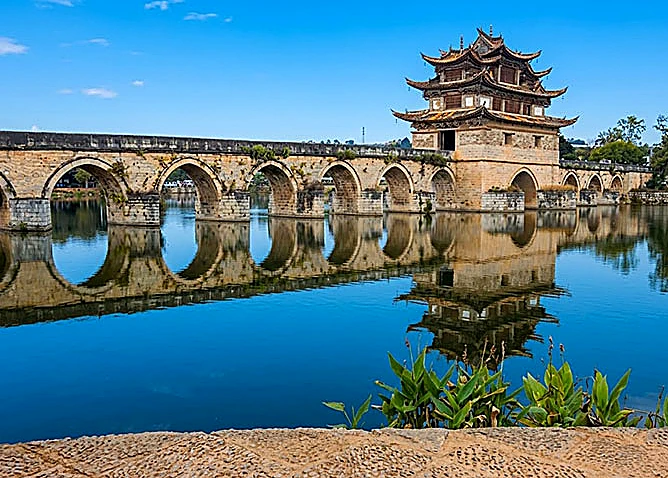
Resting quietly within the ancient valley of Jianshui County, situated in the Honghe Hani and Yi Autonomous Prefecture of Yunnan Province, Shuanglong Bridge (建水双龙桥) stands like a stone epic spanning the endless flow of time. Local folklore has long referred to the structure by a rustic yet evocative descriptive name: the Seventeen-Arch Bridge (Shishi Kongqiao). Boasting monumental architectural stature and a profound reservoir of historical memory preserved across centuries, the bridge has been officially inscribed in the sixth batch of National Key Cultural Relics Protection Units in China, cementing its supreme standing within the treasury of southern ancient bridge heritage.
Tracing chronicles back to their origins, this magnificent work was by no means constructed in a single day. Amid the peaceful, prosperous years of the Qianlong reign during the Qing Dynasty (1736–1795), responding to the need to connect southern Yunnan’s vital trading arteries, local residents initiated construction on a curved stone bridge featuring three arched spans crossing the gentle Lujiang River. At that time, the compact three-arch stone bridge resembled a soft silk ribbon draped across turquoise waters, perfectly fulfilling the unhurried daily rhythms of carrying porters, salt merchants, and travelers crossing the frontier.
Yet the auspicious terrain of Jianshui was a place where nature constantly transformed. This land witnessed a fierce hydrological encounter between the Lujiang River and the Taxung River (preserved in ancient texts as Taxung River). Each rainy season bringing downpours from undulating mountain ranges, the two churning streams converged to create terrifying flash floods, relentlessly battering riverbanks and widening the riverbed manyfold. Faced with such intense deformation of hydrological topography, the three sturdy stone arches built during the Qianlong era suddenly stood desolate, isolated amidst vast waves like an isolated oasis. The bridge was severed, both banks cut off, turning a once-bustling crossroads into an impassable hazard.
Refusing to yield to the ferocious water monster, in the nineteenth year of Daoguang (1839), local officials alongside literati and the common folk of Jianshui initiated an unprecedented public fundraising movement. All local financial and material resources were funneled into a monumental engineering project: hewing tens of thousands of green stone blocks to extend fourteen new arch spans from the old bridge body. Utilizing masterful stone mortise-and-tenon locking and arch-joining techniques, the fourteen new arches were linked with the three original Qianlong-era spans using the “wild-goose teeth and cicada wings” technique—interlocking seamlessly like successive flights of wild geese and overlapping cicada wings without a single gap. Human willpower crystallized to resurrect the bridge into a majestic seventeen-arch giant stone bridge, permanently neutralizing the fury of the flood and reconnecting arterial riverbanks.
The poetic name “Shuanglong” (Double Dragons) was deeply etched into posterity’s consciousness from that moment, symbolizing a coiling dragon safeguarding both the Lujiang and Taxung rivers as they converge. Surviving stormy historical epochs from Daoguang, Xianfeng, Tongzhi, Guangxu, down to the eventful Republican era, Jianshui Shuanglong Bridge stands enduringly resilient. Beneath each mossy stone arch are places that once carried footsteps of Tea Horse Road pack-horse caravans jingling bronze bells, serving as silent witnesses to the rise and fall of dynasties and historical transformations across legendary Yunnan.
Located about five kilometers west of Jianshui ancient town, within the territory of Shuidaying Village, Xizhuang Town, Shuanglong Bridge rises majestically across the expansive, fertile basin of southern Dian. From the very inception of urban planning, ancient ancestors selected its location not through mechanical coincidence, but by surveying natural topography thoroughly to find coordinates converging earthly spiritual energy. The massive bridge spans precisely across the convergence point linking two vital waterways of the entire basin: the Lujiang River carrying surging silt and the peaceful Taxung River winding softly from distant ravines.
Gazing down from above at a panoramic view, the ancient Lujiang and Taxung rivers—formerly recorded as Taxtun River—resembled twin delicate jade ribbons winding through fertile fields, branching and meandering to embrace peaceful villages. Reaching Shuidaying, those two streams swirled, intertwined, and hugged before merging, crafting a majestic winding posture akin to two divine dragons courting and playing tails in the mortal realm. Sensing creation’s mystical grandeur before the phenomenon of “two rivers winding and turning like intertwined double dragons,” ancients conformed to this picturesque terrain to construct this masterpiece, respectfully bestowing upon the bridge the name Shuanglong Bridge (Double Dragons Bridge) to endure for millennia.
Judged by traditional East Asian geomantic standards, Shuanglong Bridge serves as an unrivaled geomantic talisman guarding a critical node known as “shuikou suo shuo” (water-gate locking bolt). In ancient geomantic belief, water governs wealth and vitality, yet if currents flow straight and violently, auspicious energy dissipates, inviting drought or devastating floods. The towering presence of seventeen sturdy blue stone arches spanning the twin river convergence not only functions for flood diversion and moderating violent rainy-season currents, but slows drainage to retain fertile sediment nourishing surrounding green rice paddies, accumulating enduring fortune for all Jianshui residents.
Beyond wealth-gathering geomantic elements, Shuanglong Bridge’s terrain establishes a picturesque tableau of surreal beauty. The bridge sits in a classic north-south backing-mountain facing-south posture, taking rolling green southern boundaries as a sturdy rear anchor while opening wide to receive abundant vital energy from the expansive plain ahead. Beneath the bridge, mirror-flat waters sharply reflect the curved lines of hilltop pavilions upon the bridge alongside distant green mountain shadows. During early mornings when mists rise from river branches or at dusk when evening glow dyes waters, the bridge resembles a stone rainbow connecting reality and dreams, affirming ancestral topography planning when turning transport infrastructure into a unified nature-humanity landscape masterpiece.
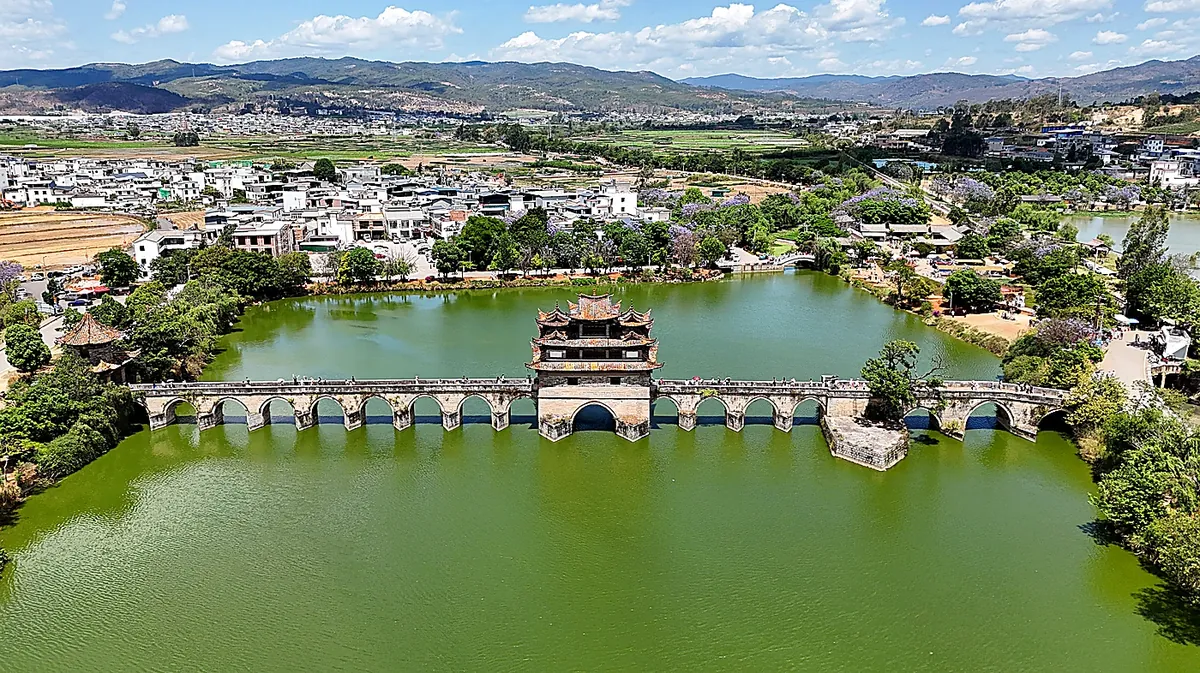
Admiring Shuanglong Bridge from afar, visitors easily succumb to its imposing silhouette spanning the Lujiang and Taxung river convergence. Acclaimed by specialists as a multi-arch stone bridge masterwork of massive scale and supreme artistic value across Yunnan, the structure rises like a stone rainbow anchored amid Jianshui’s plains. Featuring harmonious successive 17-arch curves, spanning over 140 meters with a wide deck, the structure fully displays standard spatial planning during feudal times. The space here serves beyond simple commercial transit between ancient regions, functioning as a declaration of supreme engineering, where humans tame raging floods through the flawless synthesis of hydraulic utility and classical architectural aesthetics.
The secret behind Shuanglong Bridge’s enduring survival across centuries rests in exquisite stone masonry. The entire bridge body crystallizes from tens of thousands of colossal blue stone blocks, each weighing tons and hand-dressed flat down to every corner. Master stonemasons applied tight stone-mortise interlocking techniques without abusing crude mortar, forging an internal linking system resistant to basin tectonic tremors. Piers beneath clear waters are shaped like boat prows to cut water, cleverly neutralizing the tearing force of raging floodwaters. Seventeen arches with precisely calculated diameters and spans achieved perfect load distribution onto both abutments, turning the entire structure into a milestone of multi-arch stone vault mechanics in Eastern bridge-building history.
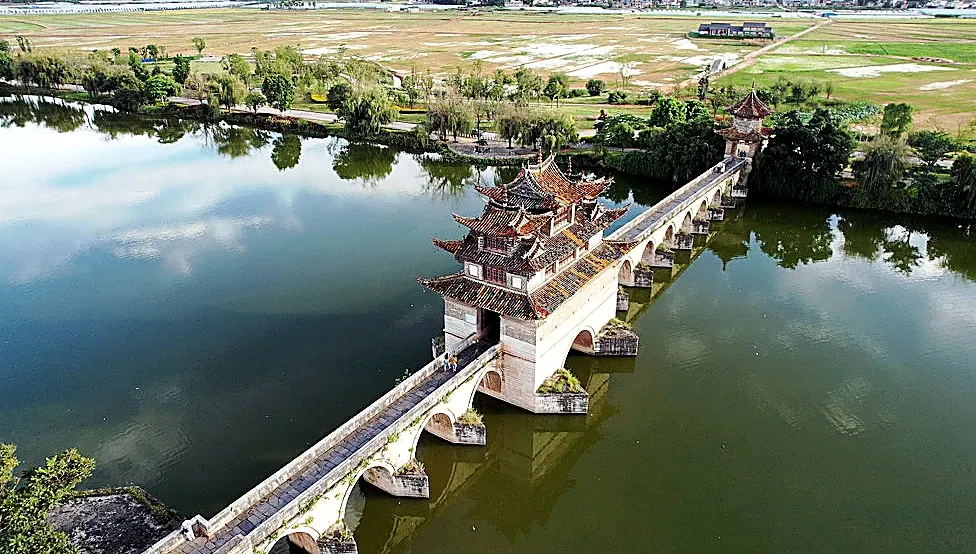
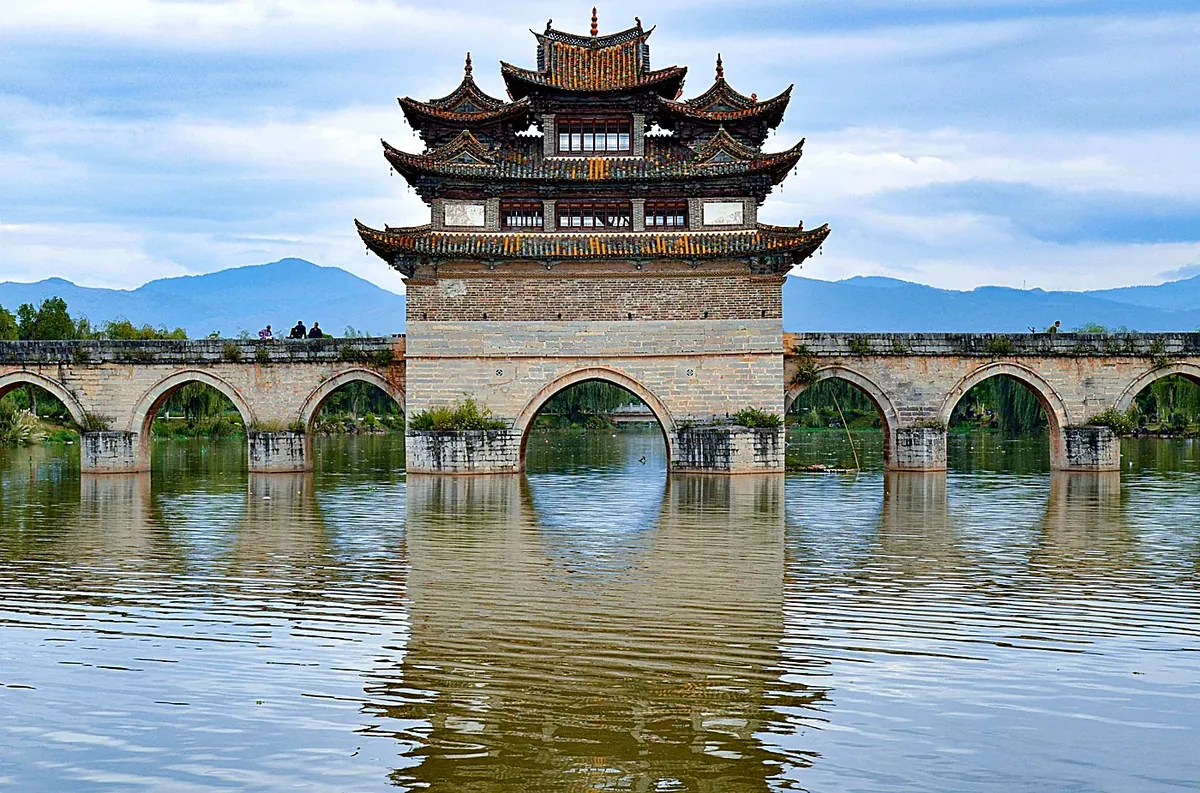
The crowning highlight elevating Shuanglong Bridge from pure engineering into a magnificent landscape masterpiece is the cluster of pavilions resting directly upon the bridge deck. Most prominent is the commanding three-tiered central watchtower rising high, harmonizing with auxiliary pavilions and carrying strong double-eaved hipped-roof styles. Purlins, crossbeams, and classic bracket clusters crafted from precious hardwoods interweave across tiers, supporting soaring upturned eaves resembling phoenix wings sweeping through space. Open-work relief carvings of swirling clouds, coiling dragons, and river flora upon rafters and stone balustrades reflect marvelous synthesis between Qing royal standards and southern native aesthetic freedom. Every ebony window frame is cleverly opened to perfectly frame green mountain views and lush fields spreading across both banks.
The harmonious pairing of rustic, eternal blue stone supporting below and the ethereal, shifting wooden pavilion architecture generates rare visual contrast in ancient architecture. From the perspective of historical construction investment, gathering abundant financial resources alongside thousands of skilled artisans to quarry, transport, and dress colossal megaliths across frontier plains was a monumental century-spanning endeavor. Shuanglong Bridge is not merely the perfect solution for ancient tea and salt trade routes, but a living testament affirming phenomenal engineering genius, earning its place among Eastern civilization’s greatest ancient stone bridge icons.
As the sun dips behind undulating mountain ridges of southern Dian, expansive spaces near the Lujiang and Taxung river junctions enter a marvelous optical transformation at dusk. Sunset descending upon Shuanglong Bridge is not simple day’s end, but the prelude to a magnificent visual performance crafted by nature and ancient architecture. Brilliant golden sunset rays slant across seventeen granite vaults, turning each bridge span into a picture frame capturing shining light ribbons upon the river. Mirror-flat waters are suddenly gilded with shimmering ripples, creating magical visual refractions as light pierces vault tiers like breathing divine dragons coiling across turquoise waves.
Silent night settling over ancient Jianshui turns the ancient bridge and its artistic illumination into a lavish real-scene spectacle between sky and water. Warm golden lighting calculated precisely embraces curved eaves, illuminating majestic three-tiered pavilions and intricate bracket systems soaring proudly in the night. Beneath the bridge, continuous stone vaults mirror onto crystal-clear water surfaces, joining actual vaults to forge seventeen perfect rings of light blending reality and illusion. Viewed from afar, the 140-meter stone bridge emits contemplative radiance, resembling a colossal dragon clad in golden scales resting across nocturnal river mists.
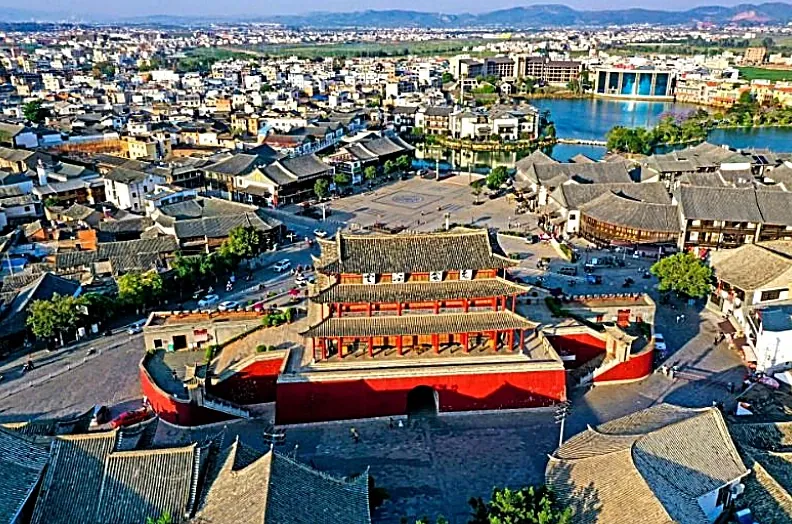
Entirely distinct from bustling modern entertainment complexes, nighttime scenery at Shuanglong Bridge captivates travelers through refined quietude carrying classical Confucian character from ancient Lin’an. Night spaces here avoid massive sound systems or dazzling laser shows, honoring pristine heritage beauty during southern nights instead. Gurgling river currents flowing past boat-shaped piers, mountain winds whispering through glazed tile eaves, and evening crickets chirping beside reed banks form a purifying symphony lifting human minds above worldly agitations.
Nighttime rhythms around the ancient bridge gain rich character when paired with indigenous daily life. At turnoffs leading toward the ancient town, warm charcoal braisers ignite, emitting appetizing aromas of renowned Jianshui grilled stinky tofu alongside wisps of Pu-erh tea smoke aged within firewood-fired purple pottery jars. Travelers can pause to savor crispy tofu pieces dipped in spicy chili powder, sip hot red tea to dispel mountain chill, and gaze at crescent moons hanging above temple roof corners. The delicate synthesis of classical lighting, riverine soundscapes, and rustic cuisine sculpts an enduring real-scene painting enchanting anyone viewing this wonder by night.
The journey to contemplate Shuanglong Bridge’s antique beauty remains incomplete without reaching heritage depths through ancient Lin’an culinary flavors. Across centuries of nourishment beside the winding Lujiang River, Jianshui culinary arts have crystallized into a celebrated system known as “Jianshui Eighteen Delicacies.” In this millennial cultural town, food philosophy transcends ordinary nourishment, representing the symbiotic fusion of fertile terroir, master craftsmanship, and pure spring water flowing from highland springs.
The pinnacle of local heirloom flavors belongs to Jianshui Zitao Steamed Chicken, a culinary masterpiece inscribed on Yunnan’s Provincial Intangible Cultural Heritage List. The soul elevating this dish is the qiqiao pottery pot crafted from renowned Jianshui Zitao clay, whose smooth clay texture fired at high temperatures and polished by hand provides perfect heat retention. The magical secret of this chicken is adding zero drops of plain water; local free-range chicken, cleaned and seasoned with fresh ginger and highland cardamom, is neatly stacked around a central steaming column. Steamed over hours, pure steam rises through the vent pipe and condenses into pristine soup drops, distilling bone marrow essence to yield tender chicken meat and clear broth steeped in natural earthly sweetness.
Leaving refined soups behind, rustic charm radiates around glowing charcoal braisers where grilled stuffed tofu and baked tofu exude irresistible appeal. Local tofu’s enduring renown stems from pristine, sweet water drawn from the Grand Spring (Da Ban Jing), also honored as the “Number One Well of Southern Dian” built during the Ming Dynasty. Well water used for curdling makes tofu rich yet remarkably smooth. Square blocks placed on wire mesh over glowing charcoal gradually puff up, outer crusts turning golden-crisp while interiors melt into gooey paste or soft fluff; dipped in spicy chili powder, Sichuan peppercorns, and sesame oil, chewing reveals deep, lingering richness.
Local culinary landscapes are further enriched by herbal shoot rice noodles (caoyaxian), a delicate noodle dish cooked with a special vegetable known as “elephant-tusk vegetable” due to its white, crispy, sweet shoots growing exclusively in Jianshui wetlands. Clean herbal shoot flavors blend with rich bone broth to evoke fresh spring mountain flavors. Accompanying traditional dining tables are cold vinegar-chili rice rolls, sweet honey-stewed lotus roots stuffed with glutinous rice, and renowned Qujiang roast duck with crispy amber skin and aromatic, spiced meat.
To fully savor traditional banquet quintessence imbued with Confucian flavor, the ideal spot for gourmets is Lin’an Restaurant, a century-old eatery nestled quietly beneath towering trees along antique Lin’an Road. Seated beneath moss-grown eaves, sipping Pu-erh tea and savoring traditional dishes after a day wandering Shuanglong Bridge, every diner steps back in time to appreciate unhurried rhythms and centuries-old culinary depth that remains timeless across picturesque Yunnan.
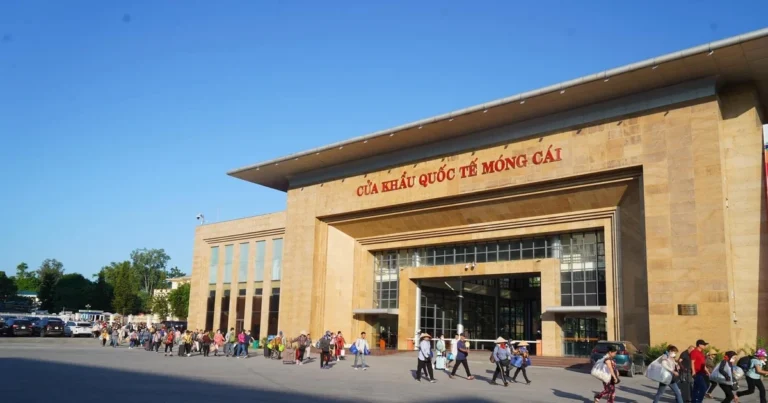
Approaching the ancient stone bridge typically begins at the Lao Cai International Border Gate to complete exit formalities into Hekou town using convenient border travel permits or standard tourist visas. From the border, travelers easily catch modern high-speed trains or intercity cars running along transport routes crossing the Red River valley to reach Jianshui ancient town. Upon arriving in this millennial cultural destination, Shuanglong Bridge in Xizhuang Town sits merely five kilometers west of the old town center. Travelers can leisurely catch local taxis, rent electric bicycles through green fields, or—most poetically—board antique sightseeing trains departing from Lin’an Station. This historical 1-meter narrow-gauge railway dating from French-Indochina trading eras carries visitors slowly through fertile countryside before stopping right at Shuanglong Bridge station.
Shuanglong Bridge welcomes visitors completely free of charge 24 hours daily without admission fees, offering optimal convenience for contemplative visits during quiet hours. The ideal dawn timing begins at sunrise, when mists rise from Lujiang and Taxung river junctions to envelop seventeen stone arches, while gentle early sunrays illuminate mossy roof tiles on three attic towers. Following that serene beauty, an unmissable golden hour runs from 9:00 AM to 9:30 AM. This is when antique nostalgia-themed yellow-and-green sightseeing trains arrive and pause at Shuanglong Bridge station, capturing classic photo angles where a century-old narrow-gauge train and a 17-arch stone bridge unite in a historic frame.
Strolling across picturesque landscapes, visitors encounter rustic culinary scenes where seniors and locals set up small stalls right beneath the bridge’s cool shade. Charcoal crackles alongside rich aromas of Jianshui grilled stuffed tofu puffing on wire mesh; breaking open crispy crusts reveals cream-like interiors dipped in spicy chili powder. Nearby bubble aromatic bowls of herbal shoot rice noodles, harvested fresh from plateau natural springs. Street food pricing is remarkably affordable, requiring pocket change to savor Red River basin agricultural heritage without tourist traps.
To ensure safe travel and preserve national heritage dating from Qianlong and completed under Daoguang, visitors must protect historic structures by avoiding climbing stone balustrades, roof tiles, or wearing down ancient dragon and turtle stone carvings. Waterside steps feature slippery moss accumulated across years, requiring caution when stepping down close to water for photography angles. For travelers seeking a seamless itinerary from clearance paperwork to transport connections across scenic spots, joining the Honghe Prefecture Tour Package guarantees peace of mind while soaking in antique historical serenity along Shuanglong Bridge.