Stepping onto the majestic Diqing Plateau, where the boundary between the mortal world and the mythical realm of Shangri-La seems to dissolve, travelers encounter the serene silhouette of Dukezong Ancient Town (Chinese: 独克宗古城 – “Ancient City of Dukezong”). Founded around 676 to 679 CE during the Tang Dynasty, this historic citadel has stood resiliently across more than a millennium of turbulent history. The genesis of Dukezong is closely intertwined with the vigorous expansion of the Tibetan Empire, when the visionary monarch Songtsen Gampo pushed his frontier southeastward to establish a network of military outposts safeguarding vital border trade routes. Recognizing the strategic significance of this crossroads linking the snowy Tibetan Plateau with the Yunnan basin, builders erected a fortified stone-and-earth stronghold, laying the earliest foundations of an ancient town that would endure across dynasties.
In classical Tibetan, the name “Dukezong” carries a sacred dual meaning at once poetic and stalwart: “City of Moonlight” and “Castle Built upon White Stone.” Its name originates from a treasured local legend recounting how early Tibetan master artisans gathered distinctive white limestone from surrounding mountain ridges to construct the town’s ramparts and foundations. When night descended over the valley, crisp highland moonlight bathed the whitewashed stone walls, causing the entire town to glow with a silvery, ethereal luminescence resembling a jade lotus floating amid a sea of clouds. Across the opposite ridge once stood Niwangzong, meaning “City of Sunlight”—forming a celestial sun-and-moon pairing believed to watch over and protect local residents through centuries of storms.
Through the rise and fall of feudal dynasties, Dukezong gradually shed its austere military armor to blossom into a vibrant commercial hub, reaching its zenith during the Qing Dynasty (1644–1911). Positioned at a critical chokepoint along the famed Ancient Tea Horse Road, the ancient town became a bustling entrepôt where mule and horse caravans converged after traversing thousands of miles of treacherous snowbound passes. Here, prized Pu-erh tea bricks and fine porcelain from Yunnan and Sichuan were traded for sturdy warhorses, warm furs, deer velvet, and priceless highland medicinal treasures such as cordyceps, musk, and snow lotus. The chiming bronze bells of pack mules mingling with lively bargaining across Tibetan, Han, Naxi, and Bai dialects transformed Dukezong’s slate-paved squares into the most prosperous multi-ethnic economic and cultural crossroads of China’s southwestern frontier.
Entering the tumultuous twentieth century, Dukezong Ancient Town etched its name into modern history when it served as a strategic staging area for the Chinese Red Army during the historic Long March in 1936. Time-worn Tibetan timber homes and spacious pine-shingled courtyards sheltered weary troops from harsh highland weather before they pressed northward. The generosity and solidarity extended by local ethnic minority communities left a lasting imprint on highland memory, turning every street corner and rammed-earth wall into a living witness to the continuity of heroic eras.
Yet Dukezong’s gravest trial came not from warfare, but from a tragic blaze in the early hours of January 11, 2014. A devastating fire broke out abruptly during the bone-dry winter season, racing swiftly through tightly packed wooden houses and reducing more than 240 centuries-old buildings—nearly one-third of the heritage core—to ashes. Confronted with this immense loss, an unprecedented restoration campaign unfolded from 2014 to 2018 backed by over 3 billion RMB in funding. Guided by the painstaking craftsmanship of local artisans, every mortise-and-tenon timber joint, mural, and traditional Tibetan shingle roof was faithfully rebuilt upon original foundations alongside state-of-the-art subterranean fire-suppression infrastructure—allowing the “City of Moonlight” to rise proudly from the ashes and shine once more amid snow-crowned peaks.
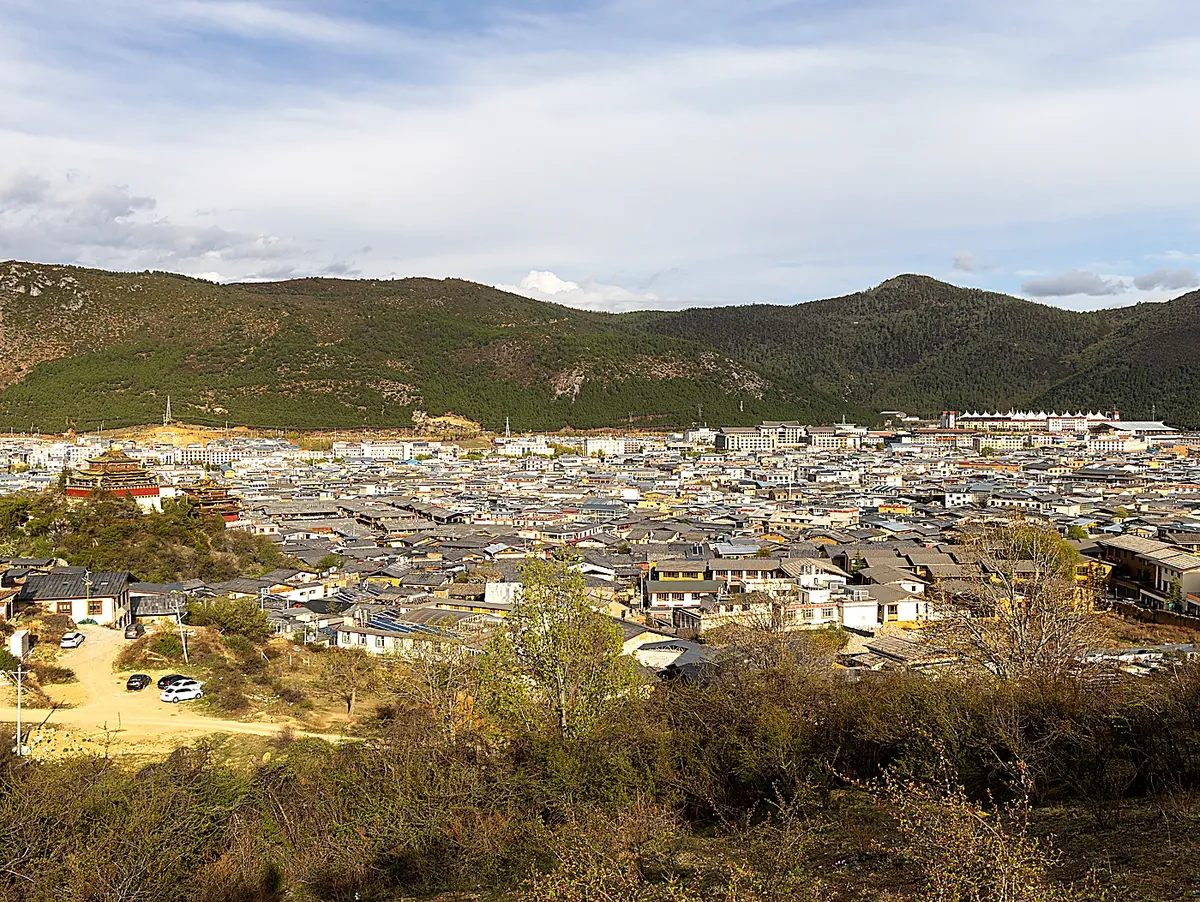
Perched impressively above 3,200 meters above sea level, Dukezong Ancient Town nestles inside a mountain basin within the Diqing Tibetan Autonomous Prefecture of Yunnan Province. In Tibetan geomantic cosmology, this valley embodies the auspicious form of an eight-petaled lotus blossoming across the rocky plateau, encircled by sacred mountain ranges that shield human habitation from frigid gales sweeping down from the Roof of the World. The anchor of the entire ancient settlement is Guishan (“Turtle Hill”), rising rounded like a sacred tortoise shell at the town center as a cosmic axis stabilizing the terrain. From this sacred hilltop, slate-paved lanes radiate downward in a spiral mimicking a mystical mandala—harmonizing gracefully with gentle natural slopes while optimizing drainage and winter wind protection.
Viewed across the macro-canvas of East Asian trade history, Dukezong occupies a decisive strategic threshold uniting three vast cultural realms: mysterious snow-clad Tibet, fertile Sichuan, and vibrant, multi-ethnic Yunnan. Situated along the primary artery of the Ancient Tea Horse Road—where caravans hauling tea from Pu’er and Dali braved blizzards over high mountain passes to trade for steeds and rare herbs from the Kham grasslands—the ancient town functioned as an indispensable rest and resupply garrison before merchants ventured into perilous Himalayan gorges.
Today, remoteness deep in the mountains has given way to seamless modern infrastructure, connecting Shangri-La to global travelers while preserving its timeless serenity. The engineering marvel of the Lijiang–Shangri-La High-Speed Railway, threading through dramatic mountain tunnels and soaring gorge viaducts, has shortened travel time from Naxi-heritage Lijiang to Dukezong to just 1 hour and 18 minutes while linking directly to provincial capital Kunming in roughly 4.5 comfortable hours. Complemented by National Highway G214 winding like a silver ribbon past snowy ridges and Diqing Shangri-La Airport located just five kilometers from the old town, Dukezong stands as an effortless, inspiring gateway for in-depth highland exploration.
Beyond its distinctive indigenous town planning, Dukezong sits at the heart of one of southwestern China’s most breathtaking natural corridors, fostering deep ecological and spiritual resonance. Just north of the ancient town, Songzanlin Monastery—the grand Gelugpa Tibetan Buddhist complex hailed as the “Little Potala Palace”—rests serenely along a gentle hillside mirrored in Lamuyangcuo Lake, forming a majestic spiritual counterpoint. Immediately adjacent lies Napahai Wetland, an ever-changing seasonal masterpiece that swells into a vast highland mirror reflecting clouds in summer before receding in autumn and winter into sweeping grasslands welcoming rare migrating black-necked cranes.
Looking further afield, Dukezong’s surrounding panorama continues into Pudacuo National Park with its primeval coniferous forests, peat bogs, and crystal-clear glacial lakes reflecting emerald skies. To the southeast, the surging Jinsha River carves through towering ranges to form Tiger Leaping Gorge, one of the deepest and most dramatic canyons on Earth, while on the far northwestern horizon rise the thirteen perpetual snow peaks of Meili Snow Mountain floating amid seas of clouds. Cradled between deep gorges and guardian snow peaks, Dukezong enjoys crisp, invigorating highland air and preserves a self-contained cultural world steeped in enduring antiquity.
From an urban heritage perspective, Dukezong’s contemporary streetscape stands as an extraordinary achievement in cultural revival following historical adversity. To restore an authentic living environment along the flanks of the Hengduan Mountains after the devastating fire, authorities invested over three billion RMB—upgrading subterranean utilities and highland fire-protection grids while decoding and reviving classical timber craftsmanship to return the old town to its centuries-old spatial harmony.
Defining Dukezong’s visual soul is its traditional fortress-like residential architecture known locally as Diaolou (碉楼). Each house unites aged highland pine timber with time-honored rammed-earth walls measuring an impressive 50 to 70 centimeters thick. These massive earthen walls serve as natural thermal insulators, blocking icy winter winds off snowbound peaks while keeping interiors refreshingly cool during bright summer afternoons. Remarkably, early Tibetan master builders engineered intrinsic seismic resilience by tapering walls gently inward toward the top—a truncated pyramid geometry that disperses tectonic tremors effectively across centuries on the active Tibetan Plateau.
Rising proudly at the central convergence of slate-paved lanes is Moonlight Square (Sifang Street / Yueguang Square), the vibrant heart of community life and spiritual ritual. Commanding the skyline above the square is the magnificent gilded Great Prayer Wheel perched atop Guishan Hill. Soaring 21 meters high and weighing over 60 tons, this colossal sacred instrument is embossed with intricate Buddhist deities and houses millions of printed Six-Syllable Mantras inside its cylinder. Too massive for any single person to turn alone, the wheel requires six to ten people gripping braided ropes together and walking clockwise in unison to set the Dharma wheel in motion—culminating in the deep, resonant chime of its rooftop bronze bell echoing across the valley with each full revolution.
Directly beside the square rises Guishan (Turtle Hill) like a natural citadel crowned by solemn Guishan Temple. Climbing winding stone steps draped in five-colored prayer flags brings visitors to the highest vantage point in the old town. From the temple terrace, Dukezong unfolds below like a giant mandala shaped like an open eight-petaled lotus, where undulating dark timber-shingled roofs, warm ochre rammed-earth walls, and gleaming stone alleys compose a striking dialogue between human craft and majestic nature.
Beneath this weathered, historic patina thrives a refined hospitality ecosystem attesting to the enduring vitality of a classic Tea Horse Road crossroads. Travelers can choose cozy youth hostels tucked down quiet lanes where solo wanderers share warm butter tea, alongside world-class boutique retreats such as Songtsam Lodge and Voya—which transform historic Diaolou residences into intimate sanctuaries blending modern comfort with handwoven yak-wool textiles, artisanal metalwork, and elevated Tibetan gastronomy.
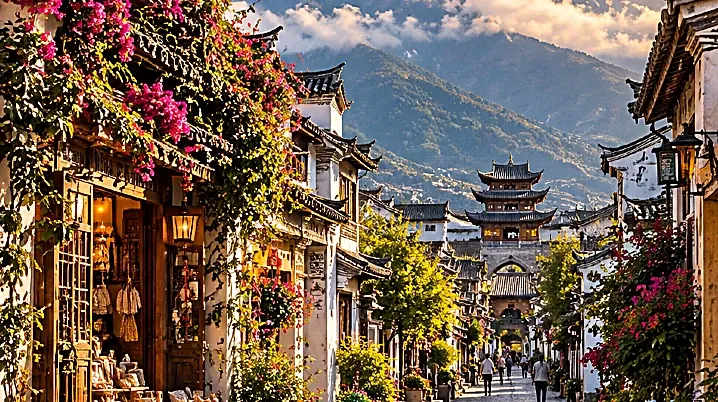
As sunset fades behind the snow-clad peaks of Diqing Plateau, nightfall invites Dukezong Ancient Town to shed its quiet daytime composure for an enchanting mantle of architectural illumination. Carefully calibrated warm-amber spotlights trace sturdy whitewashed rammed-earth walls and cast soft shadows across uneven granite flagstones worn smooth over a millennium by pack-horse hooves along the Ancient Tea Horse Road. Bathed in honey-gold light beneath the luminous highland moon, ancient Tibetan facades radiate serene splendor—bringing to life the sacred name bestowed by ancestors: Moonlight City.
The brightest nocturnal focal point shines atop Guishan Hill beside Moonlight Square, where Dafo Temple glows like a golden lotus against the deep indigo sky. Right beside the temple, the world’s largest gilded bronze prayer wheel—soaring twenty-one meters high and weighing over sixty tons—gleams brilliantly under focused uplighting. After dusk, devotees and travelers gather around its base, pulling heavy ropes in collective rhythm to turn the massive cylinder clockwise; each rotation sends a resonant bell tolling across the night air amid soft murmurs of the Six-Syllable Mantra, creating both a solemn spiritual ritual and a captivating visual spectacle.
Directly below the hill, Moonlight Square transforms into a joyful hub of communal life. Free of artificial commercial staging, evening energy here pulses with genuine local spirit. As lively melodies of Guozhuang—the traditional Tibetan circle dance—ring out across the stones, bonfires illuminate enduring nomadic warmth. Broad-shouldered Khampa men in fur-trimmed chuba robes and Tibetan women adorned with turquoise-braided hair join hands in concentric circles, welcoming travelers from near and far into rhythmic footsteps and spirited applause that dissolve every language barrier under starry highland skies.
Stepping away from the lively square into lotus-petal alleys reveals the contemplative depth of Tibetan Buddhist culture woven with contemporary poetic charm. Inside restored century-old pinewood lofts, cozy butter-tea houses and intimate acoustic lounges offer welcoming warmth against the crisp chill at over 3,200 meters elevation. Beside crackling woodstoves and steaming pots of rich yak-butter tea, plucked tungna lutes accompany soulful contemporary Tibetan folk songs—while sips of heirloom barley wine and tales of ancient caravan trails bring time to a gentle standstill.
When silvery moonlight blankets Dukezong’s moss-kissed roofs after dark, daily life gathers warmly around glowing kitchen hearths inside traditional timber homes. Cuisine in Shangri-La at over 3,200 meters above sea level is far more than simple nourishment; it embodies centuries of survival wisdom forged by caravan traders along the Ancient Tea Horse Road. Thin highland air and brisk mountain weather inspired hearty, energy-rich dishes designed to warm the body and restore vitality using pure harvests from untamed alpine pastures.
Standing proudly at the heart of every Dukezong family feast is traditional Yak Beef Hotpot (牦牛肉火锅). Free-ranging Tibetan yaks grazing across pristine alpine meadows above 3,500 meters yield lean, richly flavored, deep-crimson meat exceptionally high in protein. A steaming red-copper hotpot simmered for hours from yak marrow bones and mountain herbs releases an irresistible aroma. Into the bubbling broth go thick-cut slices of tender yak beef alongside prized wild forest mushrooms foraged from Shangri-La’s old-growth woods—notably matsutake, porcini, and snow-pine mushrooms—uniting earthy woodland sweetness, rich meatiness, and warming Tibetan chili heat to banish highland chill instantly.
An indispensable daily ritual in Moonlight City is savoring authentic Tibetan Butter Tea (酥油茶). Strong black tea brewed from compressed Tea Horse Road bricks is boiled in copper kettles and churned vigorously inside a wooden cylinder with rich yak butter and a pinch of pink Himalayan mineral salt. Hundreds of rhythmic plunges emulsify butter and tea into a velvety, golden-ivory elixir; a single hot sip warms the throat and helps stabilize circulation at high altitude. Steaming bowls of butter tea are traditionally paired with freshly baked Qingke barley cakes (青稞饼)—rustic flatbreads crafted from the hardy highland barley capable of thriving in frost, delicious dipped in pure wild mountain honey.
Along stone-paved lanes circling the old square, street food stalls tempt walkers with bamboo steamers billowing fragrant steam around handmade buns and Momo dumplings—springy dough wrappers enclosing juicy minced yak meat sautéed with wild leeks. Discerning food lovers also seek out Chura, naturally fermented yak or goat milk cheese air-dried on wooden attic racks under crisp plateau sunshine for a distinctively chewy texture and clean, tangy richness. Completing an evening banquet in Dukezong, local dinners are often toasted with fine Shangri-La red wine—crafted from nineteenth-century missionary grape vines thriving in limestone Mekong valley soils and dramatic day-night temperature swings, pairing seamlessly with charcoal-grilled local meats.
Located at the heart of Diqing Tibetan Autonomous Prefecture, Dukezong Ancient Town welcomes visitors day and night with free admission throughout its public stone lanes, while key spiritual monuments such as Guishan Temple and the hilltop Great Prayer Wheel operate during daylight hours until dusk. Reaching this historic Tea Horse Road hub is straightforward via Diqing Shangri-La Airport just five kilometers away, or aboard modern high-speed trains linking directly from Kunming and Lijiang. International arrivals crossing border checkpoints should prepare valid Chinese tourist visas, customs declarations, and confirmed bookings at traditional Tibetan timber inns inside the old town.
Positioned above 3,200 meters on the eastern edge of the Qinghai–Tibet Plateau, the primary physical challenge for visitors is acute altitude sickness caused by thin air and lower barometric pressure. Both traditional herbal wisdom and field experience recommend taking Rhodiola Rosea (Hongjingtian) supplements starting at least three days prior to departure. During your first twenty-four hours in town, avoid long hot showers or alcohol, as sudden vasodilation can trigger altitude discomfort. Carrying compact portable oxygen canisters—widely sold at old-town pharmacies for a fixed 20 to 30 RMB—provides instant relief when climbing steep temple steps.
Regarding attire, high-mountain valley geography produces dramatic day-to-night temperature swings, particularly in autumn and winter when temperatures frequently drop below minus 5 degrees Celsius amid biting winds. Dress in adaptable layers topped with a wind- and snow-resistant down jacket, thermal gloves, and a warm wool scarf. Notably, the old town’s main granite flagstones have been polished glassy-smooth by centuries of pack-horse hooves and become slick with early morning frost—making athletic or hiking shoes with deep-lugged high-traction rubber soles essential for safe footing.
Thanks to comprehensive telecommunications infrastructure, international travelers can participate effortlessly in China’s cashless digital economy even in this remote highland town. Nearly every establishment—from humble butter-tea stalls to fine thangka painting studios—accepts Alipay and WeChat Pay linked directly to international Visa and Mastercard credit cards. Even so, keeping a modest supply of small-denomination RMB cash remains useful for butter-lamp offerings inside temple halls or purchasing herbs from elderly local street vendors.
Souvenir shopping in the old town also calls for informed discernment. Steer clear of bargain-priced group tours built around forced shopping stops, which often funnel visitors into closed retail centers selling alloyed “Tibetan silver” or overpriced cordyceps and snow lotus at inflated markups. Prioritizing pure sightseeing itineraries preserves unhurried exploration free of commercial pressure. To experience this legendary Shangri-La sanctuary safely and seamlessly, joining a professionally curated all-inclusive China tour package guarantees peace of mind across visas, highland logistics, and authentic cultural immersion.