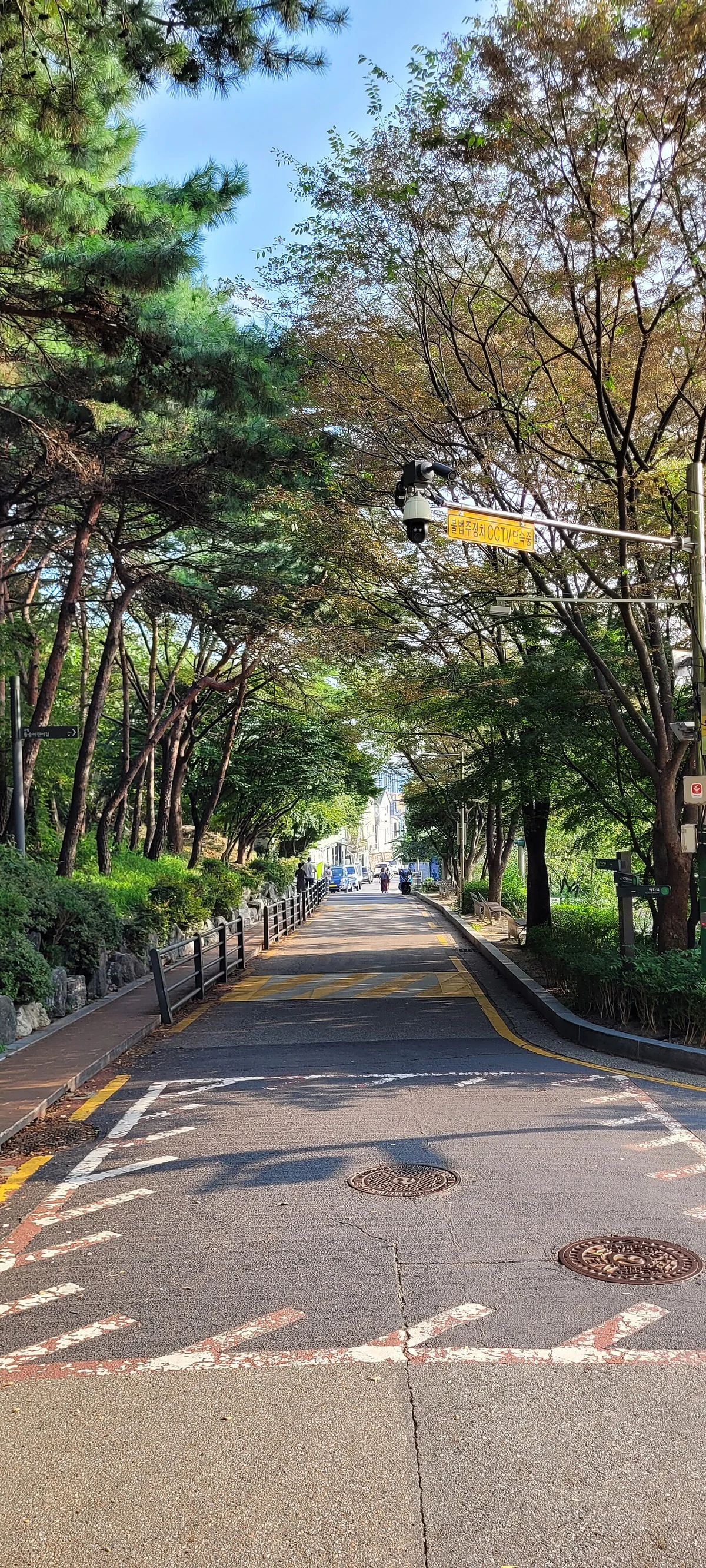
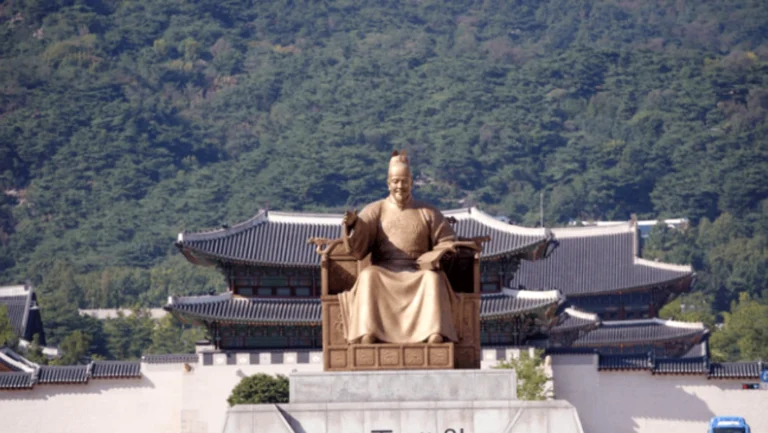
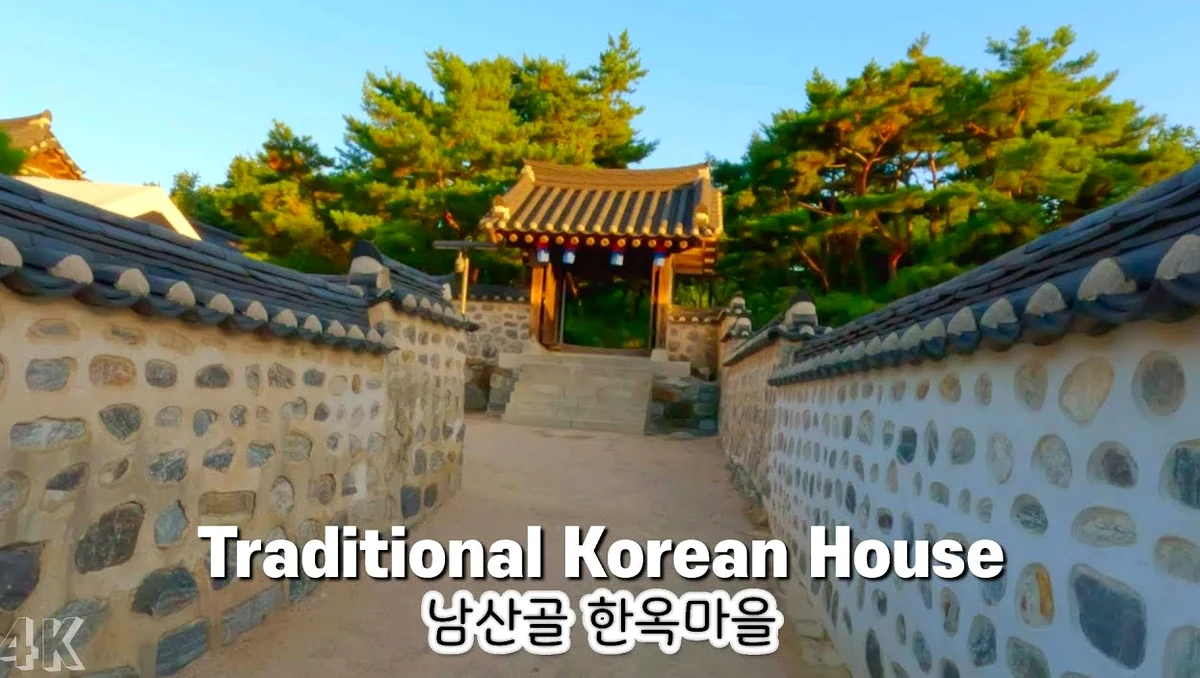
Beneath the shadow of Hanyang, the capital of the Joseon Dynasty that rose in the late fourteenth century, the gentle slopes along Mount Namsan once held a quiet, pristine beauty. At that time, the area was administratively designated as Myeongnyebang, or Mingli Ward, a residential district on the southern side of the capital. Back then, the neighborhood was completely free of urban clamor, home only to traditional wooden Hanok houses with sweeping ash-gray tiled roofs tucked behind moss-covered stone walls. It was a longstanding residence for the noble Yangban aristocracy and Confucian scholars devoted to propriety and ritual. Amid old pine groves and mountain breezes sweeping down from Mount Mokmyeoksan, daily life in Myeongnyebang unfolded at a unhurried pace for centuries, intertwined with royal ceremonies and the refined, leisurely customs of the Korean peninsula’s feudal elite.
The shifting tides of the early twentieth century swept this aristocratic quarter into a turbulent wave of modernization. Entering the colonial period, Japanese colonial authorities overhauled urban planning across the district and renamed Myeongnyebang to Meijimachi, or Meiji-machi. This geographic and economic shift quickly transformed the once-tranquil residential area into one of the most pivotal commercial and financial hubs in the city. Banks, insurance companies, and Western Neoclassical-style department stores sprang up side by side along stone-paved avenues. From a quiet retreat for scholars, the district abruptly reinvented itself as a bustling commercial heart where international capital flowed swiftly and shaped the early commercial structure of the entire area.
Following the devastating bombardment of the Korean War from 1950 to 1953, Seoul faced widespread ruin—yet from those ashes, the name Myeongdong rose with extraordinary cultural vitality. Throughout the 1950s and 1960s, it became a seedbed for the cultural awakening of Korean intellectuals and artists. Smoke-filled, rustic traditional dabang tea houses, echoing with classical chamber music, served as unofficial gathering spots for contemporary poets, painters, writers, and philosophers. Steeped in rebellious romanticism, Myeongdong witnessed the emergence of avant-garde art movements while acting as a forum for free thought that nurtured a generation of capital residents seeking to reclaim their national identity.
Moving into the 1970s and peaking in the 1980s, the rise of the Miracle on the Han River propelled Myeongdong dramatically from an arts hub into a trendsetting fashion capital. High-end tailoring salons, spontaneous street fashion runways, and artisanal leather shoe shops filled the alleys, defining the lifestyle of Seoul’s urban youth. By the turn of the millennium, as the Hallyu pop-culture wave spread globally, Myeongdong restructured itself once again to step onto the international stage. Domestic K-Beauty cosmetics stores and retail fashion chains multiplied across the district, turning every inch of land into prime real estate drawing hundreds of thousands of visitors each day.
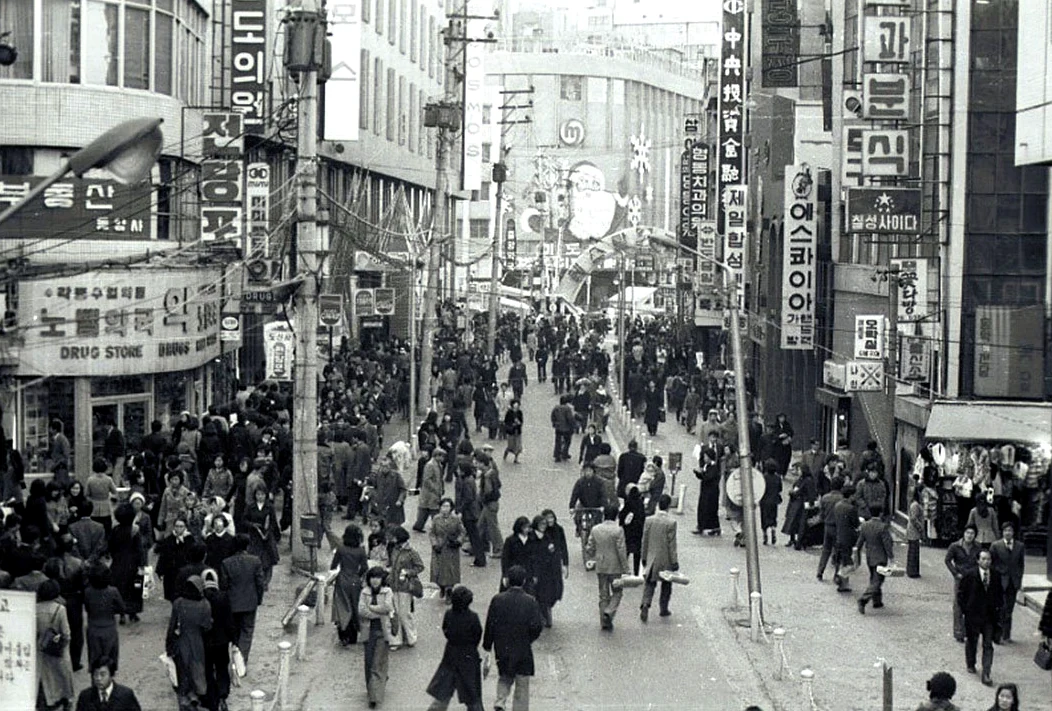
Looking across more than six centuries of history, Myeongdong is far more than one of East Asia’s liveliest shopping districts—it is a living testament to the adaptability and resilience of the people of the Land of the Morning Calm. Beneath bright LED signs and the brisk pace of modern pedestrians, the cultural undercurrent that began in refined Myeongnyebang still flows quietly, creating a singular depth of memory woven between thousand-year heritage and contemporary prosperity.
In terms of traditional Eastern geomancy and geography, Myeongdong occupies a rare, prime position right in the heart of Seoul’s Jung-gu district. It fulfills the classic “water in front, mountain behind” (baesanimsu) topography that Joseon royal geomancers carefully selected when establishing Hanyang as the capital. To the south, the neighborhood leans firmly against the gentle slopes of Mount Namsan—Mount Mokmyeoksan, which protected the dynasty for more than five centuries—while to the north it gradually steps down toward the gently gathering waters of Cheonggyecheon stream. During the feudal era, this area was known as Myeongrye-bang, a peaceful outer ward receiving pure vital energy flowing down from Namsan’s ridge into the valley. The name Myeongdong—combining “Myeong” (bright, radiant light) and “Dong” (a thriving settlement)—seems almost foreordained by the ancients as a wellspring of lasting abundance, evolving from a quiet noble quarter into one of the Korean peninsula’s busiest commercial centers.
Through the shifts of modern urban history, Myeongdong’s layout was restructured into a finely woven grid spanning less than one square kilometer, yet boasting commercial density and floor-area ratios among the highest in the world. Its natural terrain slopes gently from the southern foothills down toward flatter avenues in the north, offering ideal conditions for underground drainage and multi-tiered traffic separation. Below ground, Myeongdong connects directly to two vital subway transfer arteries of the capital: Myeongdong Station on Line 4 acts as the southern gateway for travelers coming from the hills and satellite cities, while Euljiro 1-ga Station on Line 2—the circular line framing the financial core—serves as the northern anchor. Together with the branching corridors of the Myeongdong Underground Shopping Center, these two stations form a self-contained subterranean ecosystem that lets visitors move effortlessly between financial towers and department store complexes without being slowed by harsh weather.
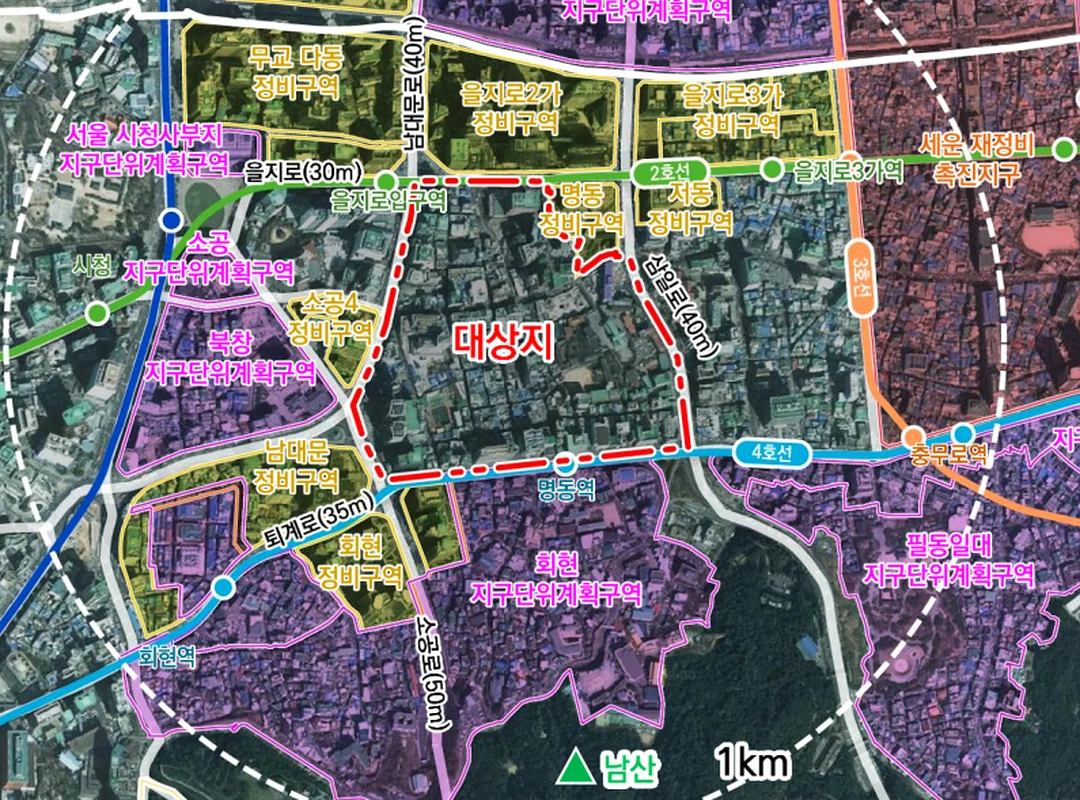
Beyond its high-capacity underground rail network, external transport connections to Myeongdong are further streamlined by a dedicated fleet of upscale airport buses. Premium routes 6015 and 6001 run dedicated schedules day and night, carrying travelers straight from Incheon International Airport and Gimpo International Airport to key stops along the roads encircling Myeongdong. Traffic management here relies on thorough street clearing: during peak hours from late afternoon until late at night, core streets such as Myeongdong-gil and Myeongdong 8-gil are closed off with automated bollards, prohibiting motorized vehicles so pedestrians can stroll freely.
Myeongdong’s signature streetscape is a striking visual harmony between modern energy and historical-spiritual depth. Set against gently rolling topography, hundreds of multi-story flagship stores for local cosmetics brands and international fashion labels—crowned with glowing LED signs—layer together like an endless labyrinth of light. Yet following the gentle slope up toward the eastern rise opens onto a solemn, quiet expanse anchored by Myeongdong Cathedral. Built of red and gray brick in Neo-Gothic style, its soaring bell tower rises into the sky atop the knoll like a spiritual landmark grounding the lively district. The interplay of bustling visitors from around the world, fragrant steam rising from pojangmacha street stalls serving gyeran-bbang (egg bread) and piping-hot eomuk (fish cake skewers), and the quiet gravitas of the historic cathedral gives this shopping haven a character all its own.
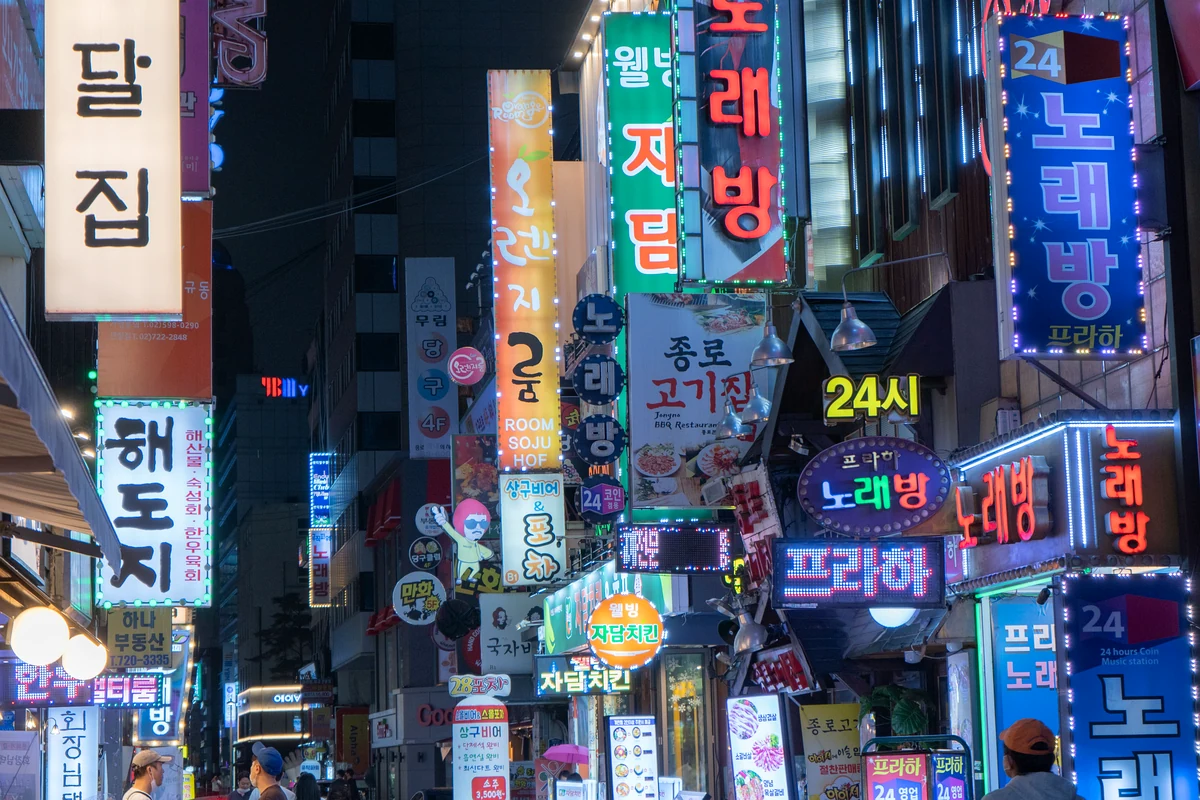
From the perspectives of urban planning and spatial anthropology, Myeongdong displays one of the most concentrated commercial footprints on earth, packing over a hundred fashion labels and hundreds of cosmetic brands into less than a square kilometer. Its main spine, Myeongdong-gil, winds in a classic L-shape from the busy Euljiro intersection to the gentle rise leading up to historic Myeongdong Cathedral. Rather than following a monotonous Western linear grid, the space operates as a multi-layered living organism where surface streets and subterranean passages, soaring prestressed concrete structures, and flagstone alleys interlock with intricate precision.
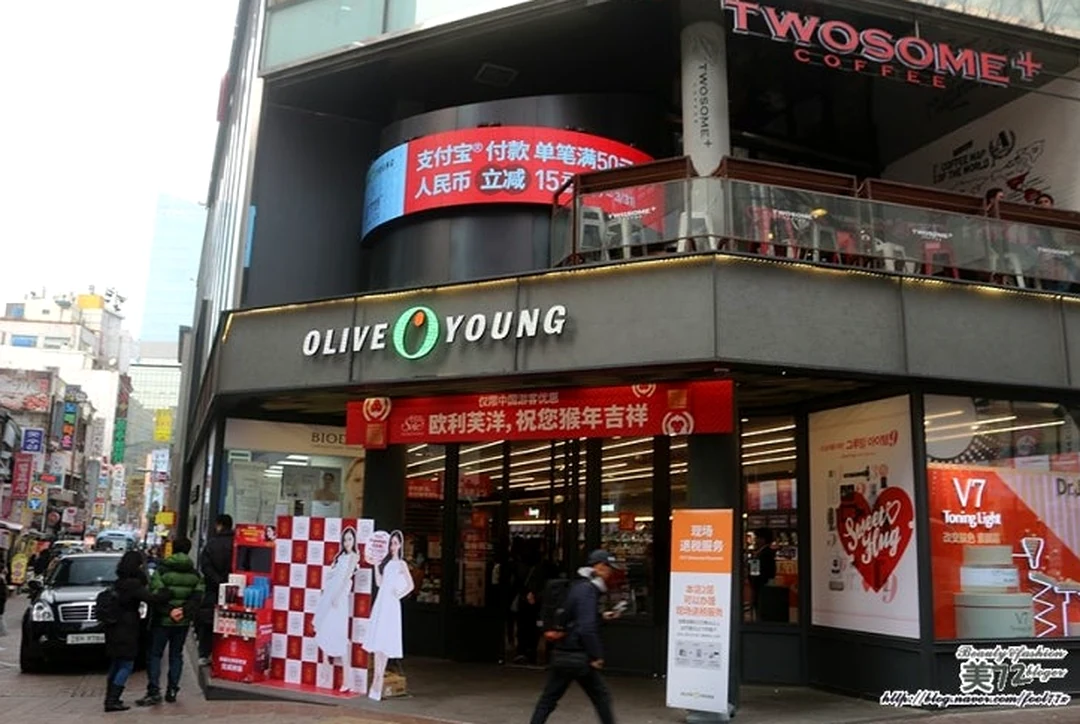
The architectural language across Myeongdong is a dramatic contrast between large-scale modernism and intimate traditional urban rhythm. At the district’s gateways, visitors are greeted by landmark structures like Lotte Department Store—with expansive glass facades reflecting the Seoul sky—and the raw industrial aesthetic of lifestyle retailer A-Land. Especially noteworthy are specialized retail “cathedrals” such as the multi-story Olive Young Town experience flagship, designed like a futuristic beauty lab with museum-grade lighting and pedestrian flow modules calibrated with ergonomic precision.
Still, the true soul that gives Myeongdong its spatial depth lies behind those gleaming glass walls, within a dense web of cobblestone alleys. Preserving parcel divisions dating back to the Joseon era, these lanes act like capillaries nourishing the entire district. Here, architectural scale tightens into narrow frontages just a few meters wide that stretch surprisingly deep. Facade design in these alleys is applied visual art at its sharpest, with neon signs, embossed aluminum composite panels, and edge-to-edge glass windows carefully proportioned to engage walkers at close range.
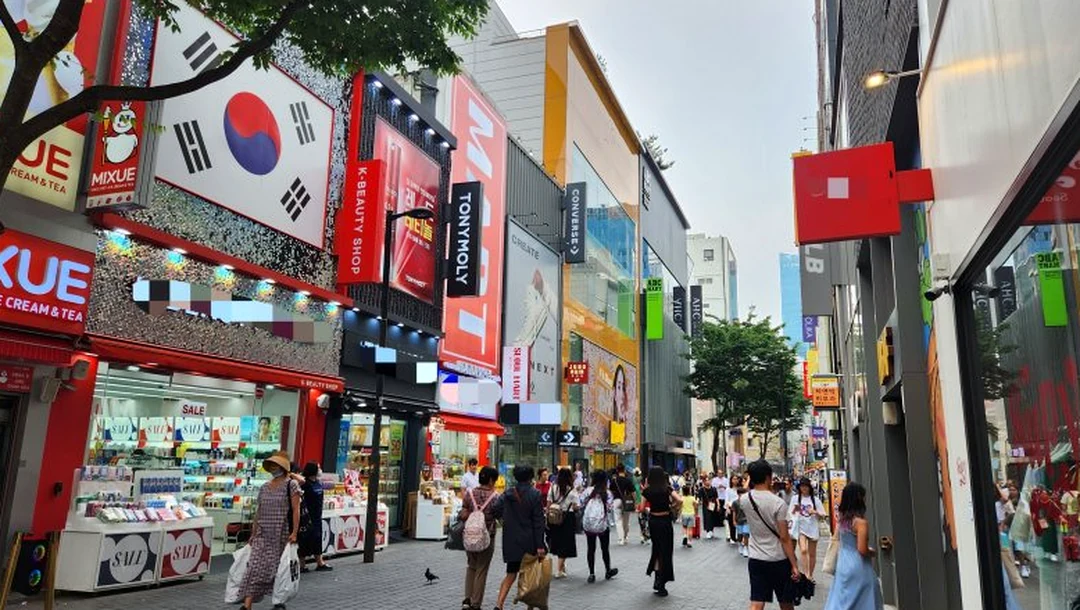
This shopping district extends further underground via the Myeongdong Underground Shopping Center, linking directly with major transfer hubs on Subway Lines 2 and 4. Beneath the surface, it spreads like a modern subterranean labyrinth where artificial lighting erases any sense of day or night. The smooth transition from breezy cobblestone sidewalks above to polished granite concourses below creates a multi-sensory sequence, turning Myeongdong into a complete retail complex where spatial craft serves the desire to explore and shop.
As dusk settles over the urban valley of Jung-gu, Myeongdong sheds its daytime commercial rush and dons a shimmering cloak woven from electronic light. Lighting here goes beyond simple illumination to become an enchanting form of contemporary visual art. Facades of grand beauty and fashion flagships—such as Nature Republic’s towering store pairing a lush living green wall with a massive LED screen, or the brightly lit Olive Young Myeongdong Town flagship—project shifting streams of digital color. Interlocking three-dimensional forms create a vivid visual spectacle, turning Myeongdong into a luminous beacon in central Seoul where day and night nearly blur in the sleepless pulse of a global city.
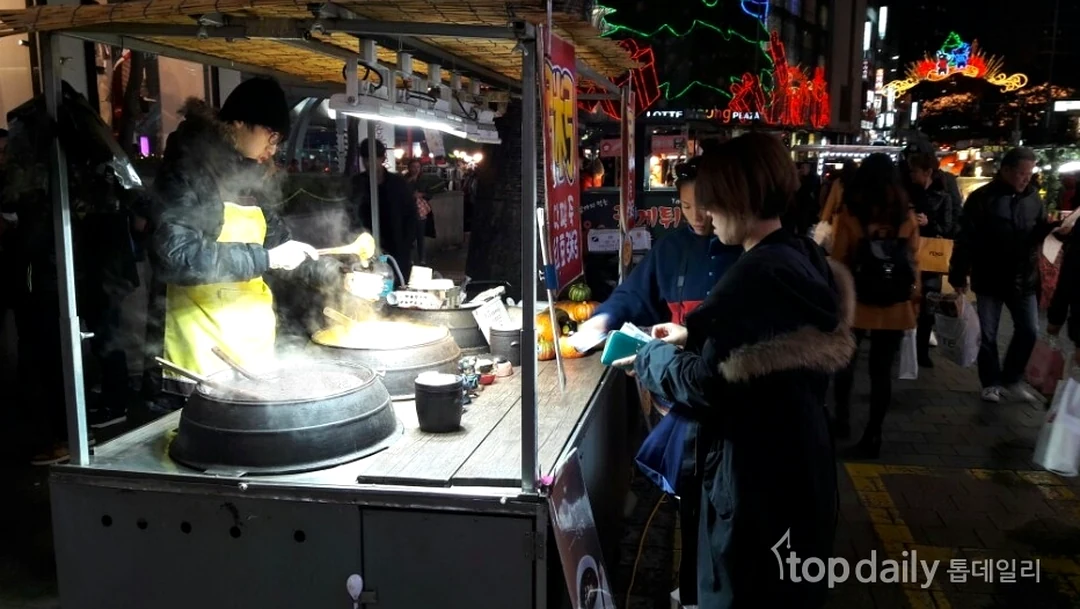
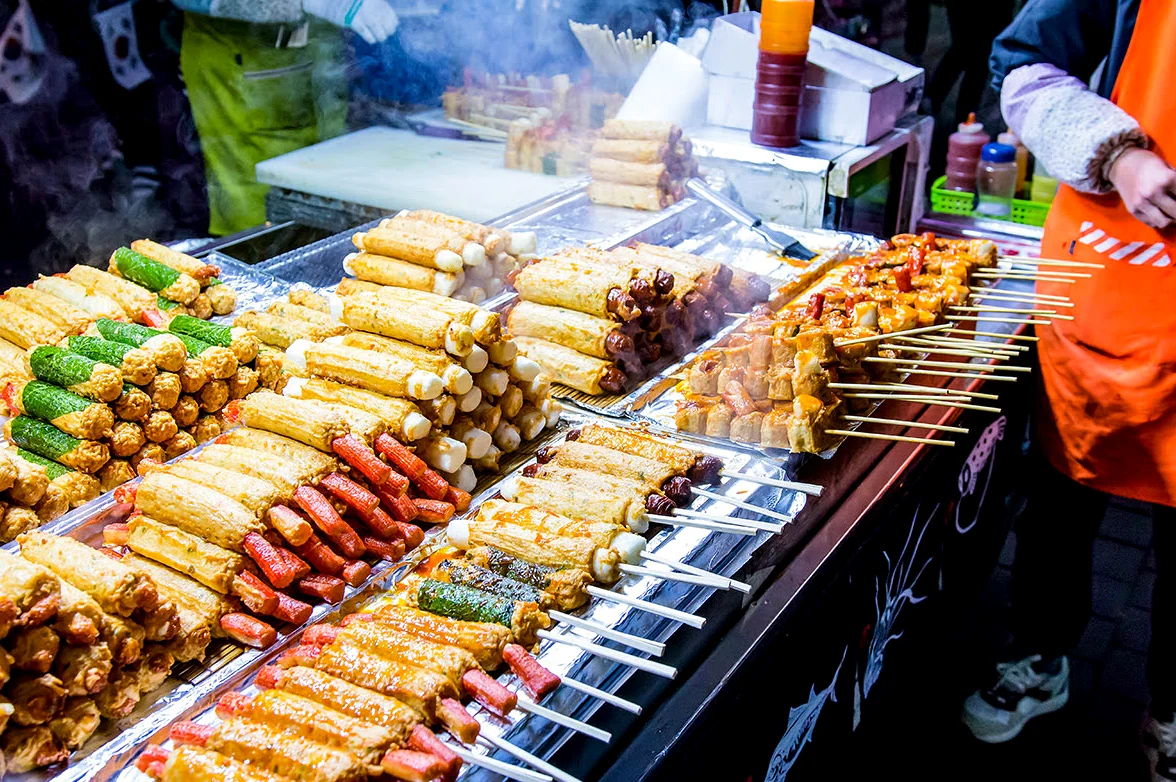
Nightlife surges hardest at 16:00, when hundreds of street-food carts roll out in a quiet, orderly procession and stay lit until 23:00 every night. The main thoroughfare stretching from Myeongdong Station on Line 4 across branching grid alleys turns into an open-air food avenue filled with savory steam. Under warm bulbs strung along traditional pojangmacha canopies, visitors step into a lively maze of flavors: bubbling pans of spicy tteokbokki (rice cakes) bright red with gochujang chili paste, steaming skewers of eomuk (fish cake) in clear radish and kelp broth, and inventive modern bites like blowtorch-seared cheese lobster or sweet-savory butter-and-milk gyeran-bbang (egg bread). The sizzle of hot oil mingling with steam in Korea’s crisp night air creates a sensory blend of sound and taste that captivates any traveler.
The dining and entertainment atmosphere in Myeongdong is further elevated by live performance arts where theater meets folk tradition. Right among the busy shopping streets sits Myeongdong Nanta Theatre, home to Korea’s best-known non-verbal percussion show. Drawing on the spirit of traditional Joseon Samulnori percussion, performers turn kitchen knives, wooden cutting boards, pots, pans, and cabbages into driving rhythmic instruments, paired with acrobatics and slapstick comedy. Resonant stage rhythms connect with the energy of street buskers at nearby intersections, creating a vibrant artistic pulse few commercial districts anywhere can match.
Night in Myeongdong winds down amid lingering lights and unhurried footsteps across polished granite paving. Once the refined ward of Myeongrye-bang where Joseon scholars recited poetry and debated classics, the area today presents a striking contrast: the solemn historic lines of Gothic-style Myeongdong Cathedral mirrored against cascades of modern neon light. Strolling quieter side alleys near midnight, as stalls pack up and LEDs dim, reveals the full cultural depth of one of the Korean peninsula’s most prosperous districts, where contemporary glamor embraces everyday street warmth.
Behind gleaming glass towers and bold fashion signage, Myeongdong’s labyrinth of alleys preserves decades of culinary heritage. Food here is more than a quick recharge between shopping sprees—it is a sensory journey into Seoul’s collective memory. Across one of the peninsula’s most bustling urban hubs, family-run eateries keep their stoves lit every day, guarding recipes passed down through changing times to chart a flavor map that feels at once historic, grounded, and vibrantly modern.
The oldest landmark on this culinary map is Hadongkwan, a renowned eatery dating back to 1939 when Seoul was called Gyeongseong under colonial rule. Through the Korean War and rapid modernization, Hadongkwan has remained faithful to a single signature dish: gomtang (beef soup). Prepared from choice cuts of domestic Hanwoo beef simmered for hours with beef offal, the broth emerges amber-clear yet deeply savory and remarkably clean. Served in traditional bangjja yugi brass bowls to hold heat evenly, it arrives with rice steeped in broth and a plate of crisp, tangy-spicy kkakdugi (radish kimchi), recalling the refined table customs of old Seoul.
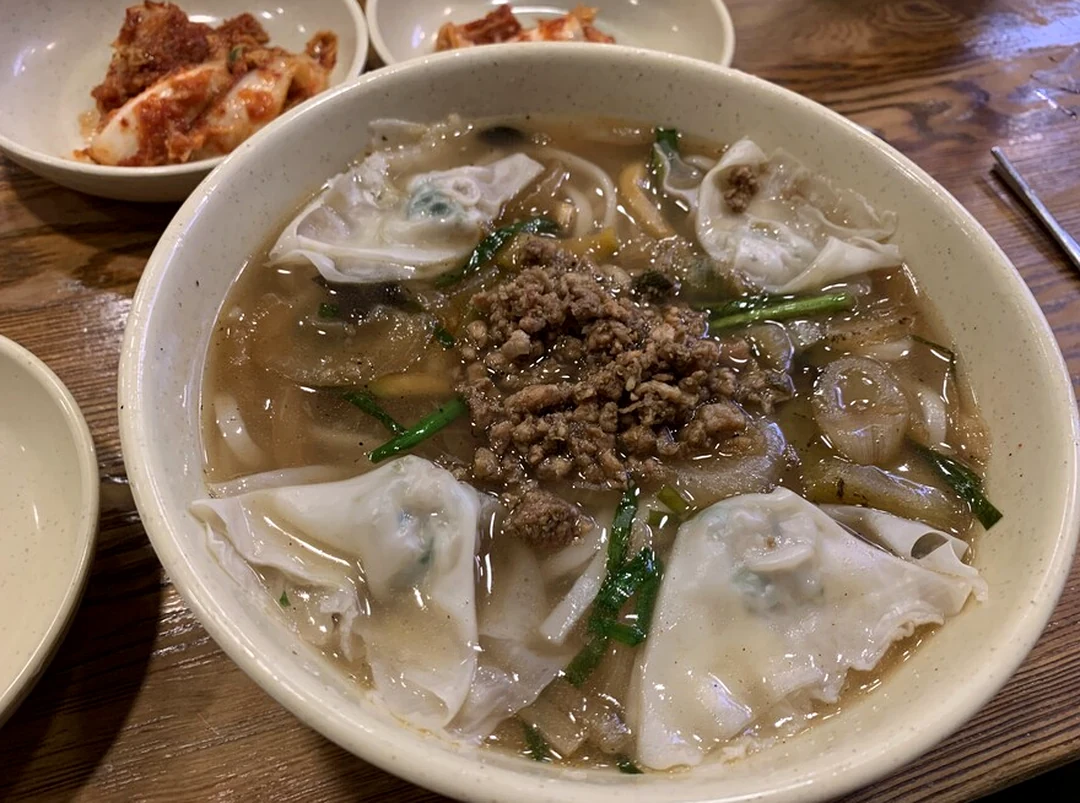
Not far away, Myeongdong Gyoza—founded in 1966—represents the boom of everyday comfort food during the post-war rebuild and has earned repeated recognition in the Michelin Bib Gourmand guide. Its signature dish is kalguksu (hand-cut noodle soup), made from fresh wheat dough kneaded and hand-sliced with a knife, then simmered in a rich, velvety chicken broth topped with seasoned minced meat and delicate, butterfly-thin wontons. Alongside the noodles come mandu (dumplings) filled with finely minced pork, fresh chives, and sesame oil in a paper-thin steamed wrapper that releases savory juices at the first bite. A meal at Myeongdong Gyoza is defined by its fiery, garlic-heavy kimchi—fermented with a bold punch of garlic and chili that creates a lively contrast against the clean, rich hand-cut noodles.
Local food culture here also celebrates communal dining through dakhanmari (whole-chicken hot pot), where diners enjoy a whole young chicken simmered in a large brass pot right at the table. Tender young chicken cooks in a light herbal broth with crushed garlic, leeks, and tender potatoes. Diners mix their own dipping sauce from gochugaru chili flakes, yellow mustard, rice vinegar, and fermented soy sauce, dipping cut pieces of juicy chicken into the spicy, tangy glaze to warm up against chilly seasonal winds blowing through the Han River valley.
As dusk gives way to glowing neon, Myeongdong’s side streets transform into a sprawling street-food paradise lined with misty pojangmacha carts. Walkers are drawn in by the comforting aroma of eomuk (fish cake skewers) bobbing in sweet radish-and-kelp broth, where you can sip a warm cup right beside the sidewalk. Next door, wide iron pans toss fiery red tteokbokki coated in thick, addictive gochujang sauce. Modern street creations—like rich cheese-topped lobster grilled with a torch right before your eyes—add a bold contemporary twist. Together, centuries-old recipes and lively street fare capture the rhythm of modern Seoul.
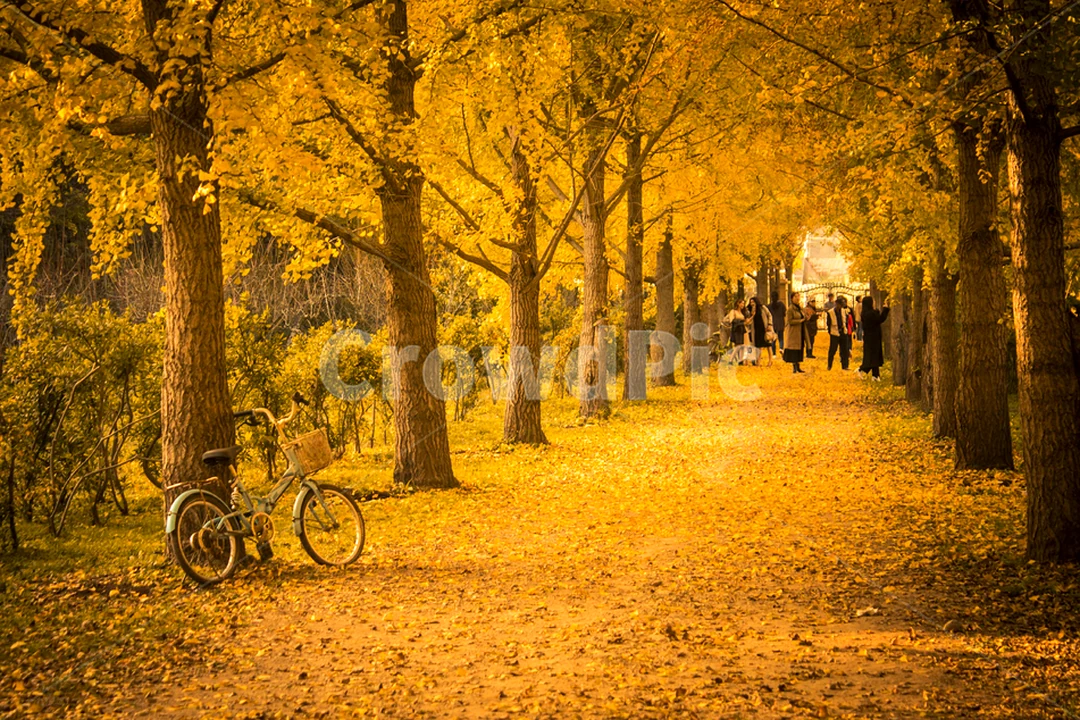
Daily life in Myeongdong shifts with the seasons, taking on a distinct character throughout the year. The best time for unhurried walks through its bustling lanes is autumn, from September to November, when ginkgo trees along Euljiro Avenue turn a vivid gold in crisp, cool air with comfortable temperatures between 12 and 20 degrees Celsius. Spring in April is equally inviting as temperatures warm after winter freeze and cherry blossoms bloom along nearby Namsan. Mild weather makes it effortless to explore on foot and take in city life without summer heat or harsh winter winds.
This vibrant commercial hub runs on overlapping schedules that keep it humming from morning until late at night. Major department stores such as Lotte Department Store Main Branch and Shinsegae Department Store typically open at 10:30 and close at 20:00, extending to 20:30 on weekends. Meanwhile, fashion and cosmetics shops along Myeongdong-gil generally light up at 10:00 and stay open until 22:30. A highlight of the pedestrian zone is the street-food market, where hundreds of pojangmacha carts set up around 16:00 on weekdays or 14:00 on weekends, filling the air with steaming odeng (fish cake), spicy stir-fried tteokbokki, and garlic-butter grilled scallops until past midnight.
The modern Seoul Metro network is the fastest, most economical, and most reliable way to reach the shopping district. Subway Line 4 to Myeongdong Station offers the most direct access; stepping out of Exits 5, 6, 7, or 8 puts you right in the heart of the lit-up shopping streets. Taking Line 2 to Euljiro 1-ga Station and using Exit 6 is another convenient route, leading straight toward upscale department store complexes. Using a reloadable T-Money transit card or a Climate Card makes bus-to-subway transfers seamless while keeping transit costs low across the city.
Smart budgeting and shopping in Myeongdong go hand in hand with taking advantage of South Korea’s Instant Tax Refund program. At most established cosmetics chains like Olive Young and participating local tax-free shops, visitors spending between 15,000 KRW and under 500,000 KRW per transaction (up to a total instant refund limit of 2,500,000 KRW during their stay) can present their original passport at checkout to have roughly 7% to 10% in tax deducted on the spot—saving time in customs refund lines at Incheon International Airport. For dining costs, expect around 4,000 to 12,000 KRW per street snack, or 11,000 to 16,000 KRW for a hearty meal at long-standing local spots like Myeongdong Kyoja’s hand-cut noodles or seolleongtang (ox bone soup).
For a smooth, worry-free visit, follow “No Shopping Trap” principles: check clearly posted prices rather than buying from unverified stalls without electronic receipts. Keep small-denomination South Korean won cash handy for street-food carts, and complete your K-ETA electronic travel authorization ahead of departure if required. To minimize language hurdles and take the stress out of transfers, traveling on a guided package tour can make exploring Myeongdong an easy, memorable highlight of your trip.