Nestled amidst the majestic highland folds of fertile southern Yunnan, Jianshui Ancient Town holds within it deep layers of time spanning more than 1,200 years of continuous urban development. Long before rammed-earth or kiln-fired brick walls rose skyward, early human footprints were already etched into this ancient valley during the Paleolithic era, setting in motion a vibrant life force along sweeping hills. In the distant memory of the indigenous Yi people, this land was once called Huili. In ancient Yi semantics, “Huili” evoked both a “vast sea”—a sweeping lake-like expanse—and a “high-mountain plain”—a fertile basin stretching across sacred peaks. That simple primordial name reflected rugged terrain while pointing to a rare, fertile plain where the vital essence of southern lands converged.
Written chronicles officially opened this urban epic during the Yuanhe reign of the Tang Dynasty, spanning 806 to 820 AD. At that time, the powerful Nanzhao Kingdom—recognizing the strategic bottleneck guarding southern approaches—had soldiers and locals raise the first rammed-earth fortification while keeping the name Huili Earth City. Driving the first spade into rich red soil turned a wild valley into a sturdy military stronghold, laying a lasting foundation for an ancient town. Weathered by wind and rain, that early earthwork became the original seed witnessing cultural exchange between indigenous ethnic groups and Central Plains civilization gradually reaching the southern frontier.
The most dramatic historical upheaval struck this land in the mid-13th century, when Mongol cavalry swept across Eurasia. In 1253—the first year of Bao’you under the Southern Song and the third year of Emperor Xianzong (Möngke Khan)—Mongol expeditions pacified Yunnan. To establish tight military administration, the new regime set up the Jianshui Battalion (Qianhusuo) under Commander Abo. Then in 1276—the thirteenth year of Zhiyuan under Kublai Khan, Emperor Shizu of Yuan—the territory was elevated to Jianshui Subprefecture (Zhou) under Lin’an Route, whose seat was then in Tonghai. From that point on, the name “Jianshui” took shape, carrying hopes of peaceful urban construction and thriving waterways.
The turning point that carried the town to a radiant golden age arrived under the Ming Dynasty, when the court relocated and upgraded it into the seat of Lin’an Prefecture. Jianshui Ancient Town became the administrative brain governing a broad southern Yunnan domain, ushering in waves of Han migrants bringing Confucian scholarship, building crafts, pottery making, and advanced farming techniques that blended with local Yi and Dai cultures. During the Qing Dynasty, even after prefecture status was abolished and Jianshui was re-established as a county, its regional importance never wavered. For more than half a millennium across the Yuan, Ming, and late Qing periods, Jianshui stood firm as a political heart, military fortress, bustling trade hub, and premier scholarly center of southern Yunnan—worthy of its place among China’s national historical and cultural cities.
Rising majestically along the northern bank of the middle Red River, Jianshui opens onto a landscape at once grand and serene in southern Yunnan. Through traditional East Asian feng shui, the site gathers the golden traits of a miniature imperial basin with a rock-solid “backing onto mountains beside water” formation. Behind the old town rise layered ranges stretching from central Yunnan, while ahead spreads a fertile plain of terraced fields and rich alluvial soil built up over tens of thousands of years. Mountain energy flowing south into the Jianshui basin is met by the red-silt current of the Red River running west to east, forming an auspicious feng shui pocket that made the town a vital trade gateway between the Central Plains and southern borderlands.
The area’s natural setting feels secluded yet remarkably fertile thanks to distinctive karst geology beneath a rich valley floor. Surrounding the town is not the barren harshness often seen in rugged highlands, but a broad, productive plain of red basalt hills and ancient alluvium. This plain acts as a natural ecological belt—supplying abundant food across centuries while providing a sturdy natural buffer against historical upheavals. When ancient Yi settlers chose this site for their Huili tribal center, they recognized nature’s shelter early on, turning a wind-sheltered basin into a place where vital energy gathered for ages.
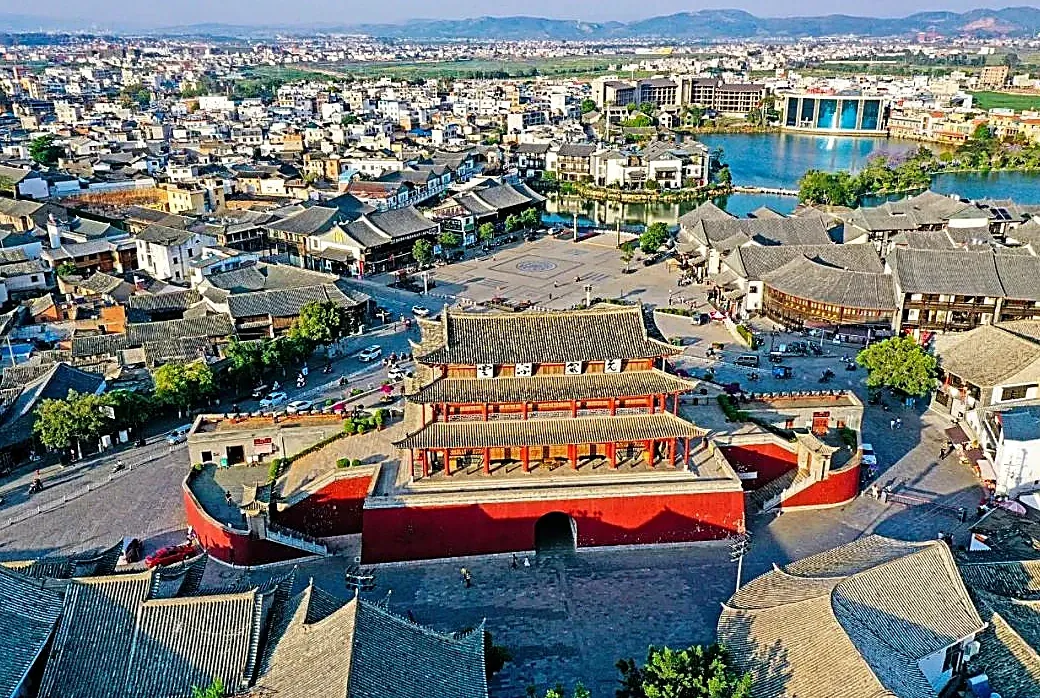
The crowning jewel of Jianshui’s hydrology is its network of pure underground springs threading beneath ancient limestone strata. Beyond surface streams drawing water from the Red River basin to irrigate fields, the town sits atop a generous subterranean water pocket rich in clean minerals. Cool, gently sweet, crystal-clear water filters through limestone layers and bubbles up across town corners, creating a celebrated cluster of “twelve ancient wells.” This auspicious water vein not only met daily needs for tens of thousands of residents through history, but also became the lifeblood behind famous local specialties like Jianshui grilled tofu and ideal water for bringing out the finest aroma of southern Yunnan Pu-erh tea.
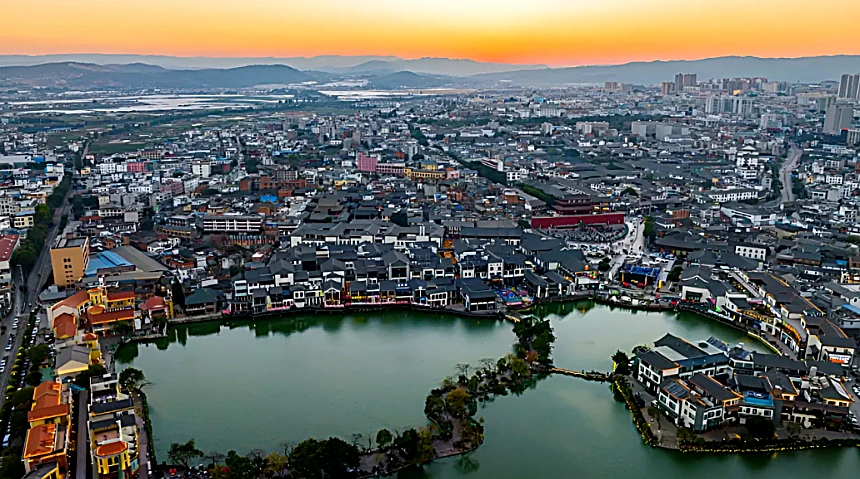
The union of a level basin with underground springs produces a landscape both open and deeply peaceful. As sunset light reflects off the Western Hills onto curving field ridges, the ancient town gleams like a jade jewel cradled by green hills and clear water. All four seasons remain lush and cool here, set apart from the scorching heat of drier Red River valley stretches thanks to balanced vegetation and natural groundwater. That is why across the Tang, Song, Yuan, Ming, and Qing eras, ancestors chose this fertile basin as a vital administrative and military seat—a serene sanctuary where people lived in harmony with mountain and river spirits.
Strolling through Jianshui’s bluestone-paved lanes, the first impression comes not just from grandeur, but from layers of spatial order preserved largely intact from the Ming and Qing eras. Once the administrative and military center of Lin’an Prefecture, its urban layout mirrors traditional capital planning while curving gently to fit the southern Yunnan–Guizhou Plateau basin. Woven throughout the old town are quiet temple roofs, ancestral clan halls, and dozens of moss-trimmed ancient wells still yielding sweet water after centuries. Rather than isolated museum pieces, these spaces operate as a living organism where the legacy of southern Yunnan’s great families shows in every courtyard, rammed-earth wall, and time-burnished timber veranda.
Exemplifying the pinnacle of aristocratic courtyard planning here is Tuanshan Ancient Village, sitting quietly about 13 kilometers west of the ancient town’s West Gate. Spanning 18,384.5 square meters of land with 16,158 square meters of built area, the village is like an open-air encyclopedia of local domestic architecture. Its layout reflects deep cultural fusion between Central Plains Han migrants and indigenous Yi communities, crystallizing classic forms such as “Three Courtyards and One Screen Wall” (Sanfang Yizhaobi) and “Four-Sided Courtyard with Five Skywells.” Here, the screen wall serves both feng shui screening and auspicious relief decoration, while five small skywells bring in daylight, drain rainwater, and temper southern heat.
Woodwork inside Tuanshan’s residences reaches refinement through the hands of Yunnan master carpenters. Roof trusses, purlins, brackets, and interior partitions feature multi-layered openwork carvings of historical stories, flowers, birds, and mythical beasts with striking depth. Skillfully shaped local fir timber paired with cut bluestone pillar bases helps buildings withstand seismic tremors and frontier winds. Every detail—from door latches and bracket sets to roof ridges—reflects the refined taste of merchants and scholars who once prospered along cross-border salt and tin routes.
Beyond carpentry and masonry, Jianshui’s spatial soul is enriched by its famed purple pottery, Jianshui Zitao—one of China’s four celebrated pottery traditions. Five-colored clay artistry goes far beyond scholar’s desk pieces and tea ware, weaving directly into architecture and daily life. From rainwater channel tiles on pavilion eaves and subtle ceramic wall reliefs to well-water jars placed in skywells, dark purplish-black surfaces and “carving and clay-filling” decoration turn corners of every estate into understated works of art. Together, handcraft skill and town planning give the heritage core a distinct identity.
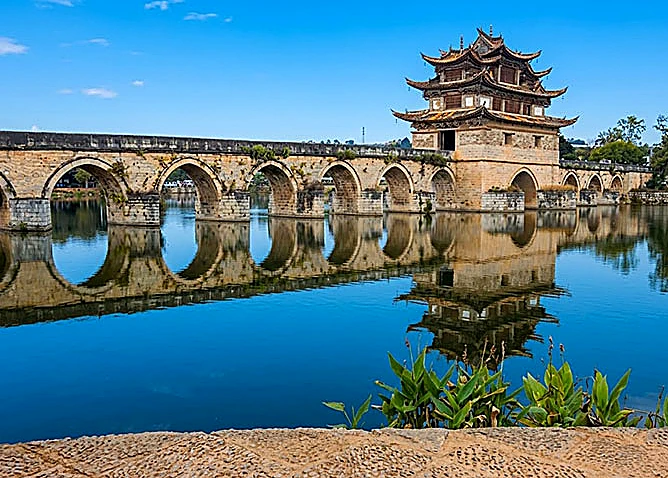
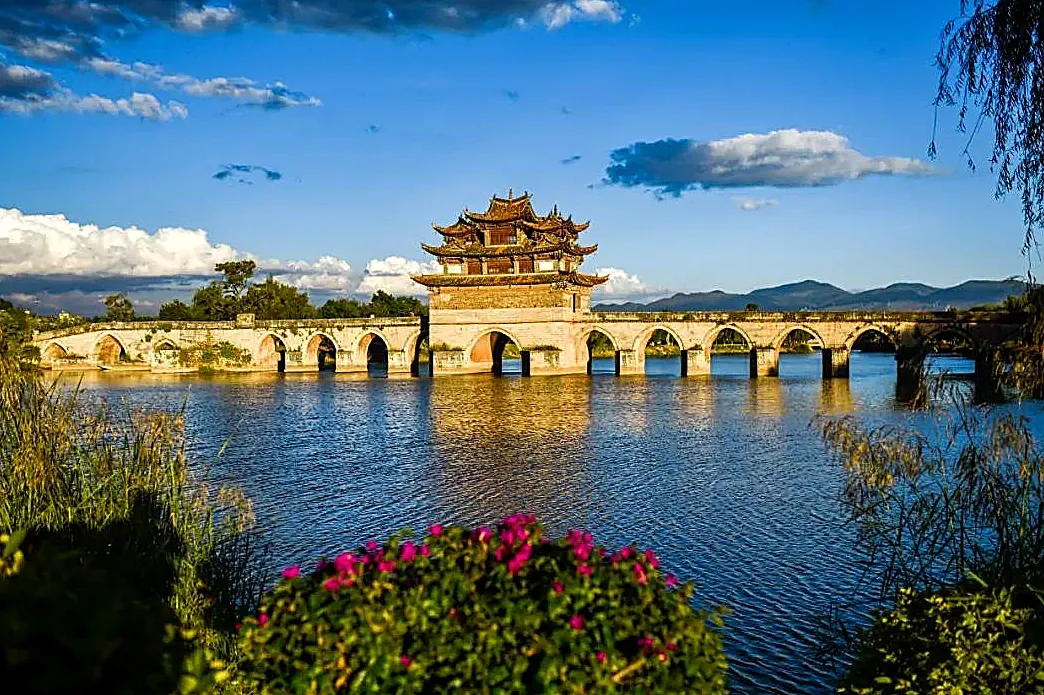
From a macro-planning perspective, Jianshui Ancient Town today models how to balance historic-city preservation with community and ecological safety. Heritage landmarks such as the grand Confucian Temple, multi-arch stone bridges across rivers like Shuanglong (Twin Dragon) Bridge, and crescent, square, and octagonal community wells are protected within strict zoning corridors. Continuity from the inner town out to satellite villages like Tuanshan preserves both tangible heritage and the calm, dignified bearing of a southern frontier town across centuries of change.
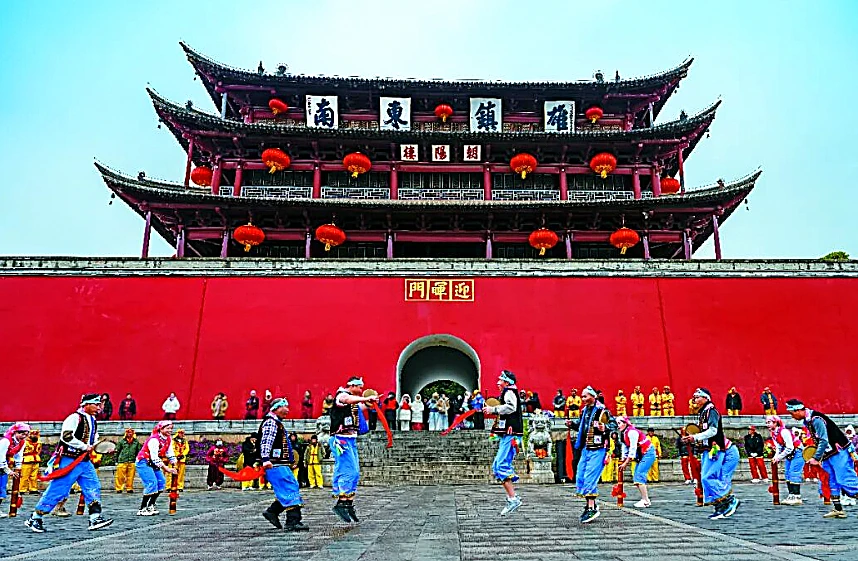
As a deep red sunset fades behind layered mountains of the southern Yunnan plateau, Jianshui Ancient Town enters another enchanting dimension where a thousand years of history and present-day life seem to dissolve. Traditional red lanterns hung along main streets such as Lin’an Ancient Street glow together, casting warm halos across smooth bluestone slabs worn down over Ming and Qing eras. Guided by thoughtful historic lighting, the grand lines of Ying’en Gate—the Chaoyang Tower standing over six hundred years—appear solemn and luminous. Soft golden light wraps its triple-tiered bracket sets and sweeping eaves, turning the monument into an open-air stage where night deepens rather than dims the royal air of a place once famed as Nanzhao’s “Supreme Camp.”
Nightlife in Jianshui feels unhurried and neighborly rather than flashy or commercialized, anchored in a simple local ethos: “A thousand-year ancient town, Jianshui as one big family.” The liveliest highlight of evening streets is “gathering around the brazier for night talk” in bustling night food lanes. From West Gate to East Lake, low square charcoal braziers glow side by side. Locals and travelers from afar sit on small stools around them, sipping rich southern Yunnan Pu-erh tea and enjoying famous Jianshui grilled tofu.
Made with sweet water from the millennia-old Daben Well, West Gate tofu is turned deftly on the grill until puffed, with a crisp golden crust around a soft, creamy center. Each time a diner finishes a piece, the vendor drops a dried corn kernel into a small bowl to tally the bill at the end—a charming folk custom kept alive across generations. Mingling with mouthwatering grill aromas is the clear sound of the three-stringed sanxian lute from Yi folk gathering spots, giving the town night a warm, lyrical frontier charm.
Beyond food, Jianshui nights also celebrate traditional handcrafts as Zitao pottery workshops stay brightly lit by lamps and lanterns. Renowned as one of China’s four great pottery traditions, Jianshui Zitao draws its deep purplish-red hue from multi-colored clays of the upper Red River region, fired in dragon kilns at over a thousand degrees Celsius. Strolling along Lin’an Pottery Street or Wanbalu Village, visitors can stop by workshops open into the night to watch artisans practice “carving and clay-filling”—incising patterns or calligraphy into raw clay and inlaying contrasting colored slip before firing. The whir of the wheel, warm lamplight on potters’ hands, and the chance to shape a keepsake piece turn Jianshui nights into a living heritage song.
Southerners have long praised Jianshui cuisine as the finest in southern Yunnan. Its appeal shines in the folk tradition of Jianshui’s “eighteen delicacies,” whose roots trace back to an ancient underground water source. Tucked beside the ancient town’s West Gate, Daben Well—dating back over six hundred years to the Ming Dynasty—flows without cease. Its clear, naturally sweet, slightly alkaline water is the enduring soul behind the town’s celebrated grilled tofu. Jianshui sour-fermented tofu is crafted from fine soybeans and family starter culture, shaped by hand into neat white squares smooth as jade. Set on an iron grate over glowing charcoal, each square puffs round and golden with a crisp shell around a rich, warm, soy-milk-like interior. Gathering around a steaming brazier, diners pick up piping-hot squares with chopsticks and dip them into a secret sauce of chili powder, Sichuan peppercorn, and fermented soy sauce—savoring the crisp-yet-creamy contrast and lingering nutty aroma with every bite.
If grilled tofu is a beloved street favorite, Jianshui steamed pot chicken (Qi Guo Ji) represents refined culinary craft—honored on Yunnan’s provincial intangible cultural heritage list. Its signature is a steamer pot made of Jianshui Zitao clay with a hollow funnel tube rising in the center. Firm free-range chicken is lightly seasoned with fresh ginger and local herbs and placed neatly inside without adding a single drop of water. Over hours of gentle steaming, rising steam passes up the central funnel and condenses back down into a clear, amber-gold broth. Every strand of chicken turns tender while holding its shape, blending with pure, nourishing essence from bone and marrow. The old town’s flavor map also features century-old names like Lin’an Restaurant at No. 2 Lin’an Road, preserving recipes passed down by veteran chefs. There, diners shouldn’t miss a refreshing bowl of Caoya rice noodles made with tender aquatic shoots grown in fertile marshes around town—crisp, sweet, and cool alongside springy rice noodles—alongside quick-seared beef slices and steaming Crossing-the-Bridge noodles. Both humble and elaborate dishes unite fertile soil, ceramic craft, and a thousand years of history into a deeply nostalgic cultural experience.
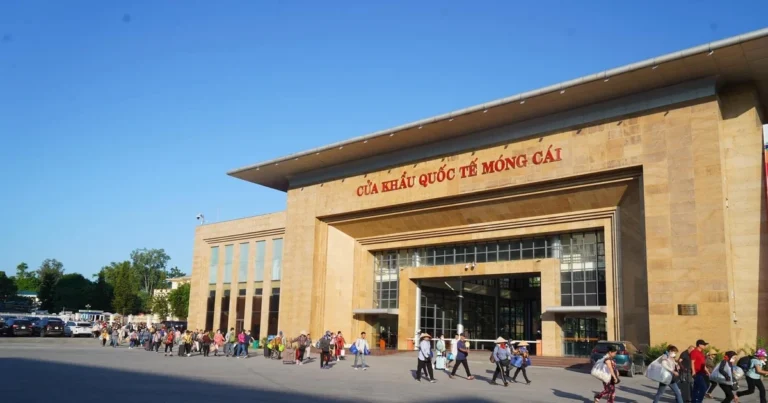
Reaching Jianshui often begins with border crossing at the Lao Cai international border gate into Hekou. Vietnamese citizens can travel with a border permit within designated areas or use a passport with a Chinese visa when heading further inland. From Hekou North Station, high-speed trains run through the Red River valley and reach Jianshui Station in under two hours. Right outside the station plaza, public buses such as Line 12 or Line 919 connect conveniently to the heritage center. Alipay linked to an international payment card can be used to scan QR codes for bus fares as well as meals and attraction tickets with minimal cash.
Unlike walled historic towns closed off behind admission gates, Jianshui’s heritage core charges no general entry fee; its old streets welcome visitors day and night. Key sites such as the Confucian Temple or Zhu Family Garden are typically open from morning until around 6:30 PM daily. The best way to explore is on foot along polished bluestone lanes in the shade of moss-kissed homes. Dawn is an especially rewarding time to feel the town’s rhythm as morning mist lingers around ancient Daben Well beside West Gate—where Ming-era daily life still echoes as locals carry wooden buckets of sweet spring water to grind fresh soy milk for famous tofu.
Jianshui’s food culture carries a distinct Lin’an character, highlighted by steamed pot chicken (Qi Guo Ji) and charcoal-grilled tofu. Lunch or dinner feels complete at a century-old spot like Lin’an Restaurant on Lin’an Ancient Street, sampling Qi Guo Ji slow-steamed for hours in a signature purple clay pot to lock in pure chicken sweetness and nourishment. After dark, street-side grills glow with hot charcoal and inviting aromas. Enjoying grilled tofu here comes with a charming local custom: as the vendor flips puffing squares over the coals, each finished piece is marked by dropping a dried corn kernel or bean into a small bowl in front of you; at the end of the meal, counting the kernels settles the bill—reflecting honest, straightforward mountain hospitality.
To extend your journey back in time, set aside a half-day for Tuanshan Ancient Village, about 13 kilometers from the town center. A scenic way to go is riding a vintage narrow-gauge tourist train through green cornfields and pausing to admire the seventeen-arch Shuanglong Bridge spanning the river confluence. At Tuanshan, visitors can see traditional Zhang family mansions with Qing-era carved woodwork and stone screen walls preserved through the ages. For smooth border paperwork, transfers, and knowledgeable local guidance, joining an organized Honghe Prefecture tour package offers an easy way to take in the timeless charm of this historic town.