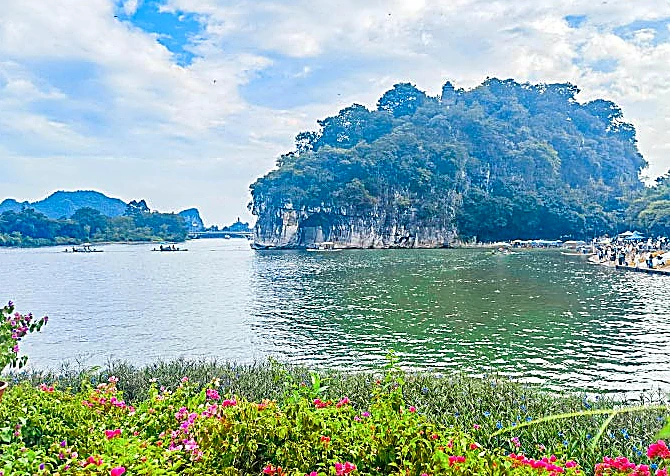
Standing proudly at the river confluence where Peach Blossom River meets the tranquil Li River in Xiangshan District, Guilin, Guangxi Zhuang Autonomous Region, the remarkable karst peak known as Xiangbishan (象鼻山)—or Elephant Trunk Hill—has long entered poetry as an iconic wonder of southern waters and mountains. In ancient times, scholars called it Li Mountain (Lishan), later shortened in everyday speech to Elephant Hill (Xiangshan). The name Elephant Trunk Hill comes directly from its one-of-a-kind natural silhouette: a towering limestone massif shaped like a giant thousand-year-old elephant extending a long trunk down into emerald water to draw in the vital essence of heaven and earth. Form and spirit merge as one, composing a scenic landscape rich in auspicious geomancy.
Elephant Trunk Hill’s timeline is closely tied to northern imperial dynasties, with its brightest golden era unfolding during the Tang and Song periods. From the seventh through the thirteenth centuries, as Guilin grew into a vital commercial and military hub linking the Central Plains with Lingnan, the hill drew the gaze of princes, poets, and imperial officials dispatched on inspection tours. Beyond admiring the scenery, Tang and Song scholars inscribed reflections on history, cosmology, and humanism across limestone faces. Hundreds of cliff inscriptions (moya shike) along the walls of Water-Moon Cave (Shuiyuedong) have turned the site into a priceless open-air museum of calligraphy. Standard, cursive, seal, and clerical scripts carved into rock are more than souvenirs; they record shifting ideas, frontier inspections, and hopes for peace and prosperity across thriving dynasties.
Alongside official history, layers of folk legend cast a magical glow over Elephant Trunk Hill, reflecting centuries of local worldview. Ancient lore tells that the hill began as a celestial elephant serving beside the Jade Emperor in heaven. On an inspection journey over the mortal world passing Guilin, moved by the beauty of the Li River yet pained to see common folk suffering from floods and failed harvests, the elephant felt deep compassion. Defying heavenly punishment, the divine elephant stayed on earth, using its immense strength to help villagers reclaim land, build flood-blocking dikes, and level fields to revive life along both riverbanks. Angered by disobedience on behalf of mortals, heaven struck down with a punishment, driving a divine sword through the elephant’s back as it bowed its head to drink by the river. The elephant sank and turned into a monumental stone statue guarding the land, while the sacred sword hilt was later transformed into the quiet Puxian Pagoda atop the back—an enduring symbol of altruism, sacrifice, and all-embracing protection.
In modern times, Elephant Trunk Hill moved beyond poetic sightseeing and spiritual folklore to be officially named the city emblem (logo) of Guilin City in 1995. That legal and cultural designation marked a major step, carrying the image of the stone elephant drinking from the river beyond the region to become one of Lingnan’s foremost cultural ambassadors on the international stage. Today, viewing this heritage through morning mist or violet sunset hues along the Li River lets visitors feel the bond between millions of years of natural sculpting and a millennium of cultural history in every stone and blade of grass.
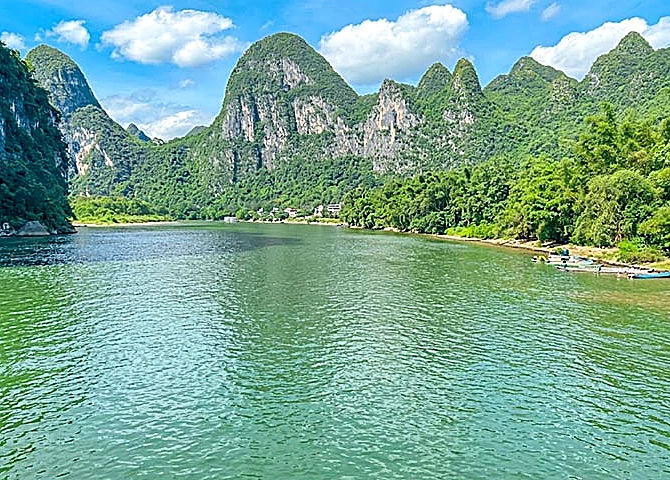
In classical Chinese geomancy, gathering water brings wealth and enclosing hills gather vital energy. Sitting right at the confluence where Peach Blossom River and the Li River meet, Elephant Trunk Hill enjoys a prime “two-river confluence, mountain-ringed and water-embraced” setting. Peach Blossom River winds gently from the west with nurturing waters, merging smoothly into the clear, deep Li River. Where the two waterways meet just before the stone headland acts like a natural screen holding auspicious energy across the area, creating a balanced yin–yang field. The monumental rock formation looks like a primeval divine elephant striding calmly to the water’s edge and bowing to drink jade-green water—forming a spacious, majestic yet serene scene.
Through modern geology, this natural wonder is no mere flight of fancy, but the result of hundreds of millions of years of Earth’s crustal evolution. Elephant Trunk Hill is composed mainly of pure limestone deposited on warm, shallow tropical seabeds during the Paleozoic Era, roughly 360 million years ago. Across episodes of continental uplift and complex tectonic faulting, ancient limestone blocks rose to the surface. Over tens of millions of years of wind and rain, eroding currents and slightly acidic rainwater dissolved limestone fissures through thorough karstification. That enduring erosion carved vertical cliffs and hollowed softer rock to sculpt the moss-draped elephant form standing tall in southern skies.
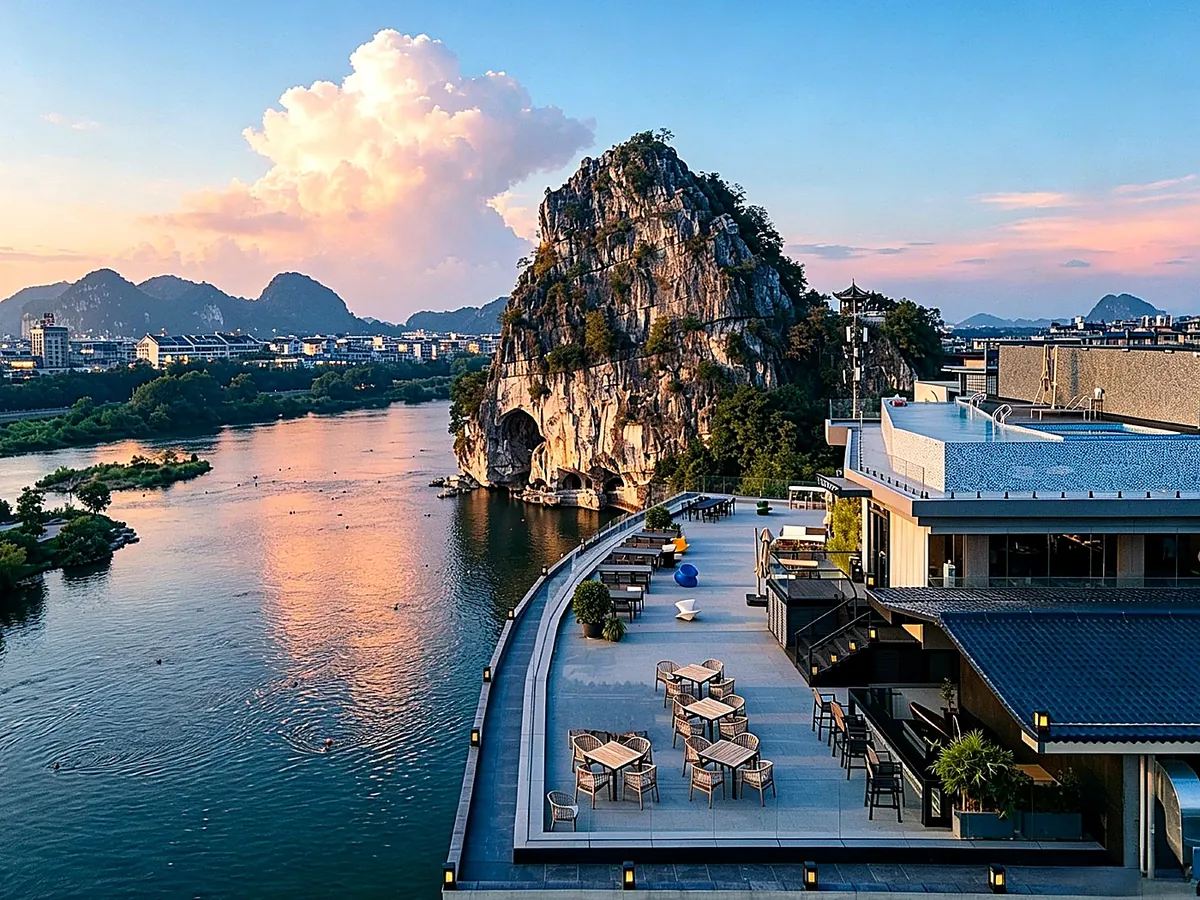
The signature geological feature of this karst formation is Water-Moon Cave, a singular natural arch nestled between the extended “trunk” and the “front leg” of the rock. In fact, it is a water-penetrated cavern carved by centuries of waves from the ancient Li River, forming a crescent opening piercing through the rock roughly seventeen meters long with an airy ceiling. Calm river water glides through the cave, catching cool breezes and scattering light across pale gray limestone marked by time. Together, the cave arch opening and its reflection on still water form a complete circle—like a full moon set right into the base of the cliff.
Each night, the enchanting optical scene known as “Xiangshan Water-Moon” captivates poets and travelers across eras. Moonlight shining through the cave arch reflects onto clear water below, evoking classic verses: a bright moon rests at the water’s depth while a bright moon floats upon the water; flowing water does not take the moon away, and when the moon sets the water still flows on. This harmony between stillness and motion, between multi-million-year limestone and the ceaseless Li River, gives onlookers a living landscape where calm is drawn from centuries of gathered natural harmony.
Elephant Trunk Hill’s timeless appeal comes not only from nature’s arrangement but also from thoughtful spatial planning where historic architecture blends organically with karst terrain. Standing at the confluence of Peach Blossom River and the jade-green Li River, the scenic area features a distinctive three-tier spatial structure: an open water surface reflecting cliffs, a hollow cave arch creating ecological balance, and a dramatic summit acting as a steady geomantic anchor for historic Guilin. Pairing grand natural forms with subtle human touches turns this isolated peak into an open-air architectural museum guiding visitors through layered cultural history.
Crowning the elephant’s back stands Puxian Pagoda, an ancient architectural gem begun during the Ming Dynasty. Unlike typical hollow pagodas, it is a sturdy solid-brick structure measuring an exact 13.6 meters tall. Its octagonal body tapers upward into a distinctive inverted-trumpet profile. Seen from boats drifting on the Li River, the old pagoda looks like the hilt of a sharp sword planted firmly into the giant elephant’s back—which is why locals have long called it “Sword-Hilt Pagoda.” In traditional East Asian geomancy, building a solid brick sword-hilt pagoda carries the philosophy of “anchoring the mountain and calming turbulent forces”—suppressing fierce energy, easing flood risks at the two-river confluence, and protecting livelihoods and peace in Guilin.
Right beneath the stone arch, the space stretching down like an elephant’s trunk into the current forms Water-Moon Cave, a luminous karst tunnel. On clear moonlit nights, a full moon reflected in calm water aligns with the round arch, bringing the famed poetic line about the moon above and below the water to life. Water-Moon Cave’s artistic value grows even richer as gray limestone walls serve as a living archive holding dozens of Tang, Song, Yuan, Ming, and Qing stone inscriptions and poems. Carefully carved characters show both scholarly prestige and deep reverence for every vein and grain of this natural wonder.
In the modern era, the scenic area has continued evolving through comprehensive urban renewal and tourism digitalization. Local authorities removed artificial boundary fences to create an open “scenery-and-city integrated” space, turning the park into a seamless ecological belt bringing Li River breezes into town streets. Supporting facilities—from bluestone waterside paths and modern boat piers to nighttime artistic lighting—are finely tuned to highlight the mountain’s silhouette without disturbing karst geology. Harmonious architecture alongside open views shows an invisible thread connecting a thousand-year past with lively modern energy along the Li River.
As night falls over Guilin’s waters and mountains, Elephant Trunk Hill sheds its quiet daytime look to don a radiant mantle of contemporary lighting. Resting peacefully where the Li River and winding Peach Blossom River meet, this limestone landmark serves as the visual heart of the celebrated Two Rivers and Four Lakes waterway system—linking two major river branches with four historic lakes: Rong Lake, Shan Lake, Gui Lake, and Mulong Lake. High-tech lighting washes karst slopes in subtle contrasting hues, blending warm amber with clear jade-green. Moss-touched limestone veins are delicately accented, bringing to life the thousand-year-old divine elephant reaching a long trunk into rushing river waters to draw in heaven-and-earth vitality.
The focal point of this glowing interplay is Water-Moon Cave hollowed between the trunk and mountain body. Skilled heritage lighting designers illuminate the round arch so it shines like a man-made full moon framed naturally inside rock. The refined Tang–Song motif of “Xiangshan Water-Moon” is reborn through modern optics: still Li River waters act like a vast mirror doubling the glowing moon and shifting subtly with every ripple from passing boats. When night mist drifts across the river, light diffusing through moisture creates a dreamlike effect, making viewers feel as if they have stepped into a living ink-wash painting from classical Eastern art.
To soak in the lively yet serene night rhythm of this region, taking a boat along the Two Rivers and Four Lakes is a poetic highlight. From central piers, gilded flower boats and rustic bamboo rafts glide smoothly past scenic bridges before pausing quietly before illuminated Elephant Hill. Gentle erhu strings, clear bamboo flutes from riverside stages, and Lingnan folk duets ring out and echo softly against ancient cliffs—guiding listeners into a deeper aesthetic layer where modern light frames untouched natural character.
Nightlife along Elephant Trunk Hill also stretches along granite walkways skirting the base of the hill. The air carries the rich fragrance of osmanthus blossoms characteristic of the old town, mingling with warm osmanthus tea or fiery Sanhua liquor served in rustic riverside teahouses. High above the elephant’s head, Puxian Pagoda—shaped like a Ming-era wine vessel—rises against a velvet-black sky, catching calm silver light like a sword hilt guarding the realm. Blending real and reflected scenes, modern pulse and ancient soul, the foot of Elephant Trunk Hill stands among southern waters and mountains’ premier nighttime destinations.
Stepping off breezy Elephant Hill into historic lanes around the scenic area opens another sensory journey, where evening mist mingles with herbal aromas from family-run eateries. Guilin’s food culture has never chased flashy excess; instead, it distills produce from the Li River basin, blending southern country flavors with Lingnan culinary depth. Among countless old-street tastes, the undisputed soul of local food is Guilin rice noodles (mifen)—a humble street staple crafted to strict family standards.
An authentic bowl of Guilin rice noodles near Elephant Trunk Hill is never drowned in broth at the start, but opens with the poise of traditional dry-tossed style. Fresh, white, silky rice noodles made from early-harvest rice are blanched just right and set neatly in an earthenware bowl. The essence lies in a ladle of glossy, dark-amber braised sauce (lushui) slow-simmered for hours from marrow bones and dozens of traditional herbs such as black cardamom, tsao-ko, cloves, cassia bark, and aged tangerine peel. Topping the seasoned noodles are slices of traditional roast pork belly—parboiled, pricked carefully along the skin, and deep-fried until the rind puffs into crisp, golden-amber crunch. Diners add tangy-spicy pickled bamboo shoots, crisp pickled beans, crunchy roasted peanuts, and fresh cilantro, tossing until every glossy strand absorbs herbal richness—before adding a spoonful of clear, hot pork-bone broth at the end to savor the lingering sweet finish.
Alongside rice noodles in everyday local food life is Gongcheng oil tea, a distinctive culinary heritage of Yao communities living along mountain slopes. Unlike delicate urban teas, oil tea is prepared right over glowing charcoal: old-growth green tea leaves are pounded with aged ginger and garlic cloves, stir-fried evenly with local lard, and then simmered briskly with clear spring water. Served steaming hot in a deep jade-green hue, it tastes rich and lightly astringent up front before blooming with warming ginger-garlic spice and a savory edge. Tossing in crisp puffed rice kernels or fried snacks makes it a beloved folk tonic that chases away chill and dampness from the Li River.
Along historic houses reflecting in the calm Li River, river breezes also carry the inviting aroma of Li River beer fish. Fresh carp caught from Guilin’s mother river are cooked with scales intact to lock in natural richness, pan-seared golden, and slow-braised in heavy cast-iron woks with pure local beer, ripe tomatoes, and fresh red chilies. Bubbling beer vapor softens any fishiness and infuses white flesh, yielding tender, flaky meat rich with natural freshwater sweetness and warm chili spice. A riverside meal feels even more complete alongside golden-fried glutinous rice cakes with sweet brown sugar and sesame inside.
Strolling around iconic Elephant Trunk Hill, nothing feels more refined than tasting a freshly baked osmanthus pastry straight from the oven. Made with fragrant osmanthus blossoms—the flower that gave Guilin its name—blended with fine glutinous rice flour and wild honey, soft osmanthus cake is tender, gently aromatic, and sweet without heaviness, capturing crisp autumn mountain air on the palate. Walking slowly through history, pausing by the river to watch the stone elephant drink, and enjoying authentic local food offer a calm, culturally rich experience.
Visiting Elephant Trunk Hill begins with convenient access from northern Vietnam’s border crossings. Travelers commonly enter via Friendship International Border Gate in Lang Son into Pingxiang, connect by expressway or rail to Nanning City, and ride high-speed trains from Nanning East to Guilin in roughly two and a half hours. For entry into China, prepare a passport valid for at least six months along with a valid tourist visa or group entry permit as required. Setting up Alipay linked to an international card and activating international mobile data roaming before departure keeps payments and digital check-ins smooth.
A major policy update at Elephant Trunk Hill Scenic Area is free admission for visitors. Even so, to manage crowd flow and protect riverside karst rock, management uses time-slotted online real-name reservations. Visitors simply scan a valid code at automated gates with zero admission fee. Outside the grounds, stay cautious of touts pushing unauthorized tickets or informal bamboo rafts promising secret views of the elephant rock from the water; such unlicensed boats lack maritime safety certification, so always buy river-cruise tickets at official piers on regulated vessels.
To capture the magic of “Elephant Trunk Drinking Water,” timing makes all the difference for memorable photos. The two finest hours of the day are early morning—when Li River water wears a gauzy mist under soft sunrise—or late afternoon when sunset paints Water-Moon Cave warm crimson. The classic panoramic angle sits at the viewing platform opposite Gate No. 1, where the trunk reaching into water stands out clearly against lush greenery. Walking along Xinjiang Promenade across the Li River also gives a broad view taking in Shenxian Peak behind. After dark, extending the evening by boat along the Two Rivers and Four Lakes lets you admire lights reflecting across the Sun and Moon Pagodas.
For first-time visitors to Guangxi who want a relaxed, worry-free trip without navigating border paperwork, time-slot bookings, or dockside bargaining on their own, joining a 4-Day 3-Night Nanning–Yangshuo–Guilin Tour is a smart option. A structured itinerary connects highlights across Nanning, Guilin, and Yangshuo while pairing local favorites like Guilin rice noodles, clay-pot beer fish, and standard hotel stays for an unhurried journey.