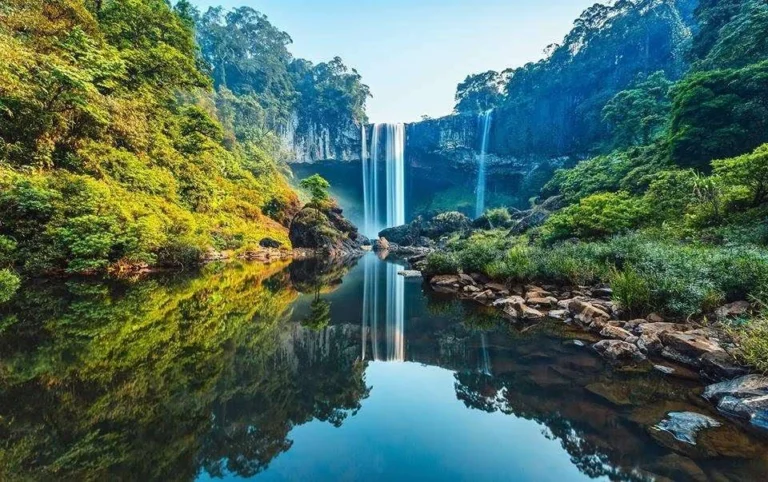
Stretching like a turquoise silk ribbon winding through the undulating karst ranges of Guangxi, the Li River has long been not only the ultimate symbol of picturesque landscapes but also a living witness to the great historical shifts of the South. Originating from the mist-shrouded Mao’er Mountain, this gentle current has deposited layers of cultural sediment, where the imprints of emperors, expeditionary armies, and scholars have intersected for over two millennia. The ethereal, otherworldly beauty of the river serves as a silent backdrop, concealing countless military upheavals and historical fluctuations, carving out a scenic region where every bend breathes the spirit of heroic epics.
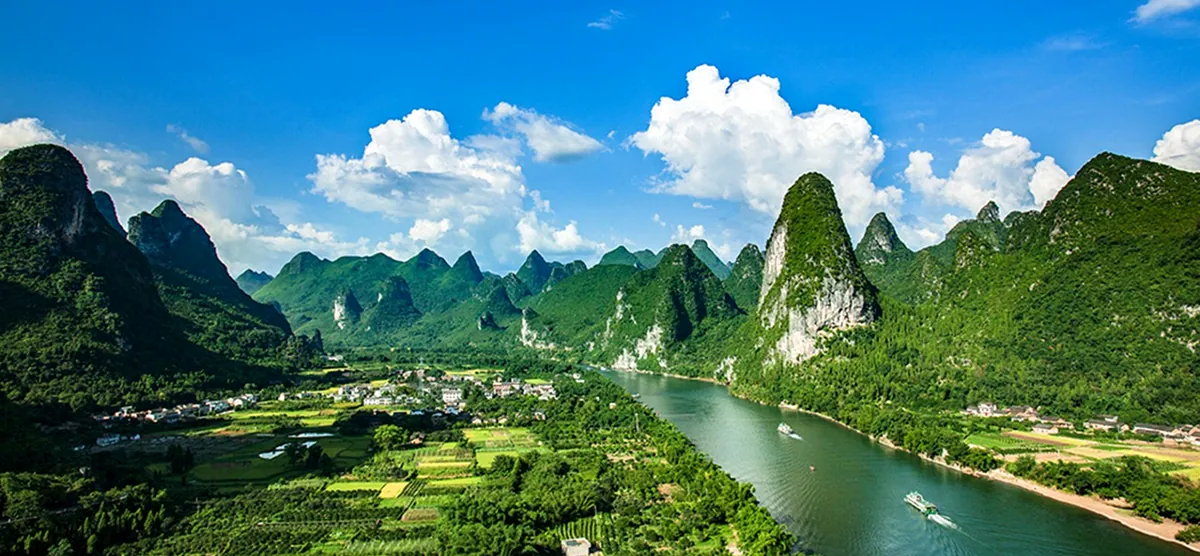
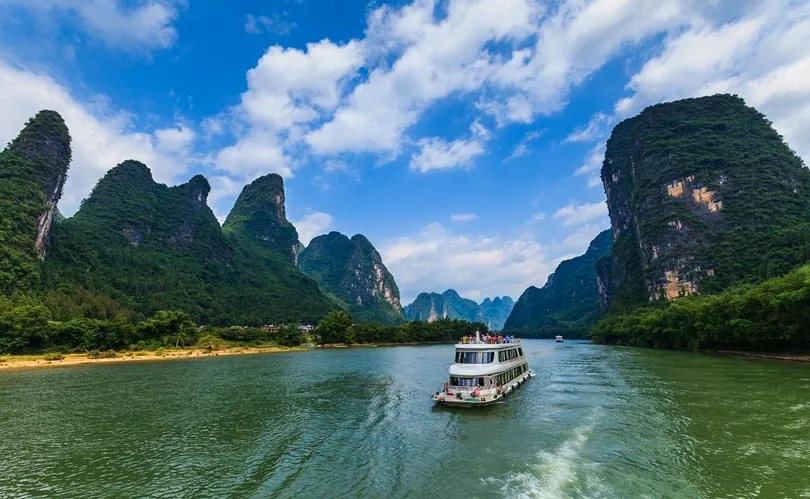
Admiring the panoramic view of the Li River at dawn, visitors are easily overwhelmed by the magnificent natural scenery stretching across the Guilin landscape. Towering limestone formations with spectacular shapes rise straight into the clear blue sky, casting majestic shadows over the mirror-like turquoise water. The river winds gracefully between fertile alluvial banks, dotted with lush green fields and gentle bamboo groves. Scattered on the water, tourist boats cut through the waves, carrying travelers to immerse themselves in the perfect harmony between raw, majestic nature and the peaceful rhythm of mountain life.
The historical turning point that opened the destiny of the Li River basin began in 214 BC during the Qin Dynasty. To serve the campaign to pacify the South and incorporate the vast Lingnan region into the empire’s map, the Qin Emperor ordered the Imperial Censor Shi Lu to lead hundreds of thousands of laborers to dig the magnificent Lingqu Canal. This pinnacle of ancient hydraulic engineering ingeniously connected the Xiang River, part of the Yangtze system, with the Li River of the Pearl River basin, erasing the natural wall separating the North and South. Thanks to the Lingqu Canal, the Li River suddenly transformed from a remote waterway in a limestone valley into a strategic arterial transport route, shouldering the mission of transporting military supplies, promoting migration, and facilitating large-scale cultural exchange.
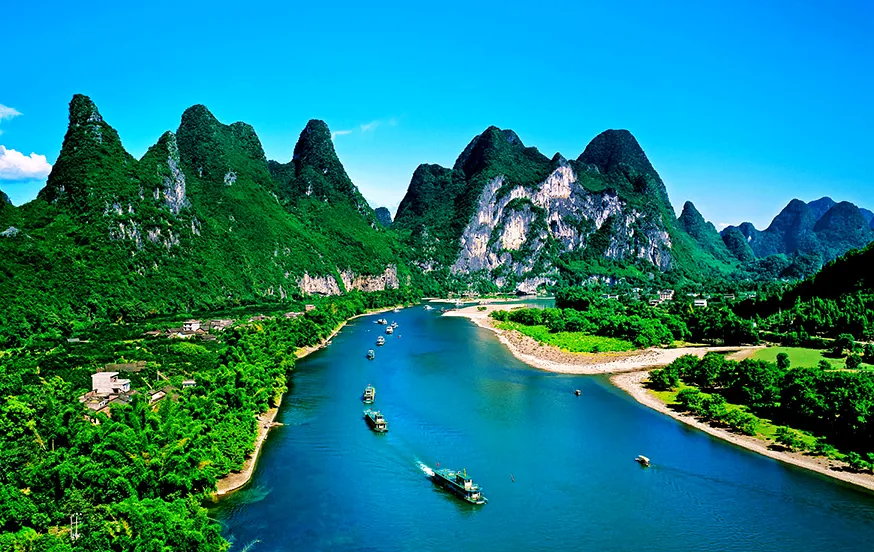
By the prosperous Tang and Song dynasties, when the smoke of war gave way to economic and poetic development, Guilin and the Li River rose to become a vibrant cultural center on the southern frontier. The enchanting allure of the green mountains and blue waters inspired countless poets and officials who were exiled or stationed at the border. The great Tang dynasty writer Han Yu once distilled the essence of this place through immortal verses, describing the river as soft as a blue silk ribbon winding around mountains as sharp as jade hairpins. Continuing this poetic tradition, during the Southern Song Dynasty, the scholar Fan Chengda, while serving as the Prefect of Jingjiang, meticulously researched the geography and customs, penning the classic work “Guihai Yuheng Zhi,” which officially cemented the beauty of this landscape as the finest under heaven in the treasury of Eastern scholarly literature.
Through a thousand years of cultural accumulation, the value of the Li River has transcended the boundaries of a regional landmark to become a precious natural heritage of humanity. In 1982, the Li River Scenic Area was honored in the first batch of National Scenic Spots, affirming its central position in landscape conservation. In 2014, a brilliant milestone was reached when the South China Karst, including the Guilin karst core area along the Li River, was officially recognized by UNESCO as a World Natural Heritage site. This global recognition completed the magnificent epic of the Li River, transforming the river that once carried heavy supply boats into a natural and cultural masterpiece that is eternal through time.
Viewed through the lens of global geological evolution, the Li River landscape is not merely an aesthetic wonder, but the result of a great transformation spanning over three hundred million years, originating from the Devonian period when the entire Guilin plain was still submerged deep under the ancient Tethys Ocean. Through tectonic movements that uplifted the Earth’s crust and the continuous erosion of rainwater containing carbonic acid dissolving thousands of meters of pure limestone, the terrain here gradually formed one of the most typical tropical karst ecosystems on the planet. Thousands of individual mountains rise straight into the blue sky like giant stone bamboo shoots, interspersed with a system of closed karst basins and a mysterious network of underground rivers, creating a magnificent geomorphological structure that is hard to match anywhere else.
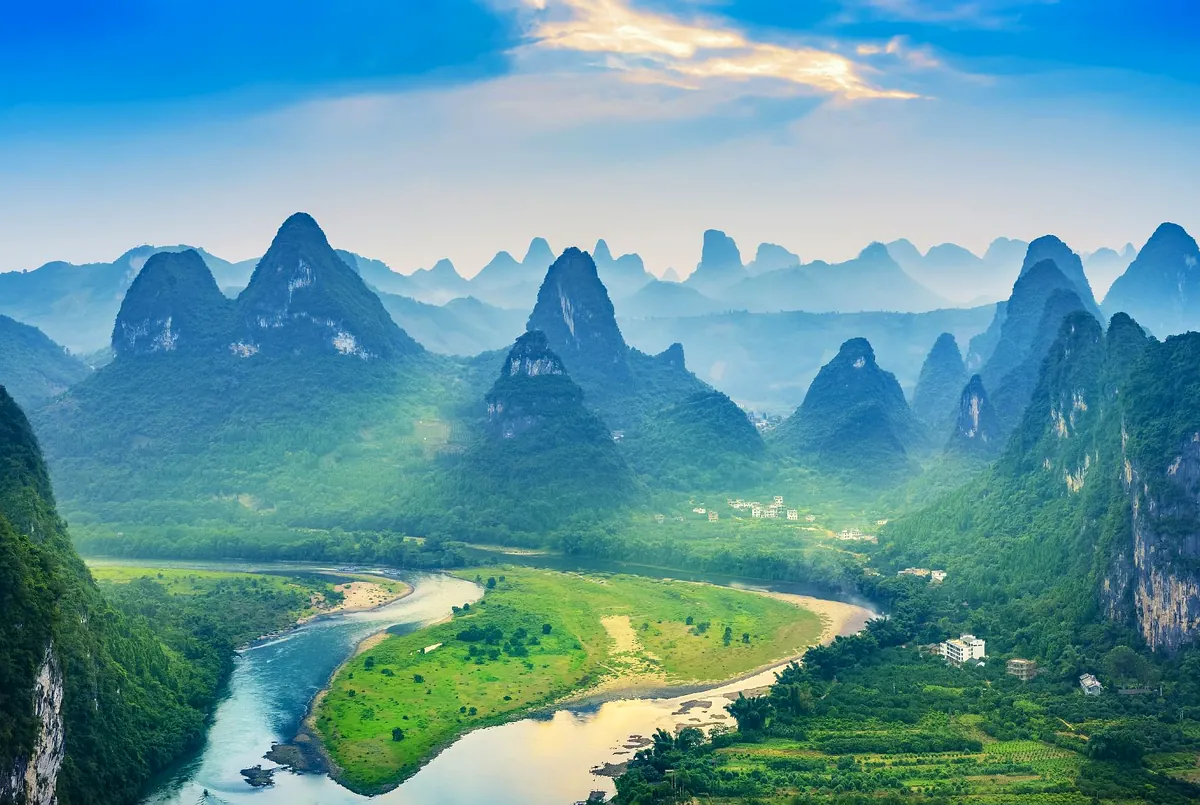
A magnificent panoramic view of Guilin unfolds before the traveler, where the emerald Li River winds as softly as a jade silk ribbon, weaving through countless ancient, solemn limestone cliffs. Tourist boats glide peacefully across the mirror-like water, adding a vibrant, harmonious touch to the vast landscape. The exquisite interplay between the jade-green water, the weathered gray of the layered karst mountains, and the expansive sky perfectly illuminates the splendor of nature in this southern frontier region.
From the perspective of traditional Eastern Feng Shui, the Li River, stretching over four hundred kilometers from the peak of Mao’er Mountain in the Yuecheng Range, is likened to a dragon vein carrying prosperous energy throughout the Guangxi region. The terrain here perfectly embodies the principle of “mountains encircling and water wrapping, concealing wind and gathering energy,” where the cluster of limestone mountains acts as a natural screen to block harmful winds, while the winding river follows the “affectionate curves” principle, ensuring that vital energy is not dispersed but gathered abundantly along the delta. The balance between the towering, masculine Yang energy of the karst cliffs and the deep, feminine Yin energy of the river weaves a state of cosmic harmony, nurturing lush evergreen vegetation and purifying the observer’s mind.
Along the unique journey toward Yangshuo town, the Nine Horse Mural Hill on the west bank appears like a giant, natural fresco. This vertical limestone cliff, over four hundred meters high and hundreds of meters wide, has been dyed by time and the weathering of iron oxide minerals and lichen into natural patches of white, gray, and brownish-yellow. From a distance, these miraculous lines depict nine steeds in various states: some rearing their heads and neighing at the clouds, some galloping across the steep cliffs, and others relaxing to drink by the riverbank. Local folklore challenges travelers with a test of keen eyesight, claiming that anyone who can spot all nine divine horses will possess wisdom equal to a brilliant scholar.
A short distance downstream, the water opens up to the famous Huangbu Shoal, where the shallow riverbed reveals a strip of pale yellow sandstone, resembling a shimmering golden silk cloth submerged in clear water. At this spot, the “Huangbu Reflection” phenomenon reaches the pinnacle of visual art, as the shadows of the seven surrounding karst peaks are clearly imprinted on the ripple-free water, creating a surreal symmetry between reality and reflection. This breathtaking natural scene was chosen to be featured on the back of the twenty-yuan banknote, a testament to the iconic beauty of the landscape. Gliding through this section, visitors will fully grasp the classic poetic sentiment: “The boat sails on green waves, the person travels within a painting” – the boat cuts through the emerald water, and one wanders leisurely through an endless masterpiece of nature.
The intersection of majestic natural scenery and human craftsmanship along the banks of the Li River has shaped a unique residential structure, where Lingnan cultural geography blends with traditional Chinese planning philosophy. Over hundreds of years of historical change from the Ming to the Qing dynasties, the architectural appearance of ancient riverside settlements, most notably the ancient town of Daxu on the left bank, has preserved its heritage intact. The ancient village space stretches over two kilometers, paved with blue flagstones polished by time, featuring deep, tube-shaped houses designed for trade by the wharf. Each horse-head-shaped fire wall, built to prevent the spread of fire, combines subtly with dark gray glazed tiles and sturdy fir wood beams, clearly depicting the spirit of traditional garden architecture and merchant shops.
In particular, the indigenous cultural layers of the Zhuang people are clearly expressed through the traditional “Ganlan” architectural philosophy—stilt houses raised on wooden platforms to adapt to the humid tropical monsoon climate and the frequent tidal fluctuations of the Li River. The ground floor is left open to allow for flood drainage and the storage of bamboo rafts, while the upper floor serves as a cozy living space, carved with patterns of water waves and animals according to animistic beliefs. The resonance between the rustic Ganlan construction technique of the Zhuang people and the strict Feng Shui rules of Ming-Qing Han patterns has created a cyclical planning picture: backs leaning against towering thousand-foot karst limestone blocks, faces turned toward the jade silk ribbon, welcoming vital energy and facilitating bustling waterborne trade for centuries.
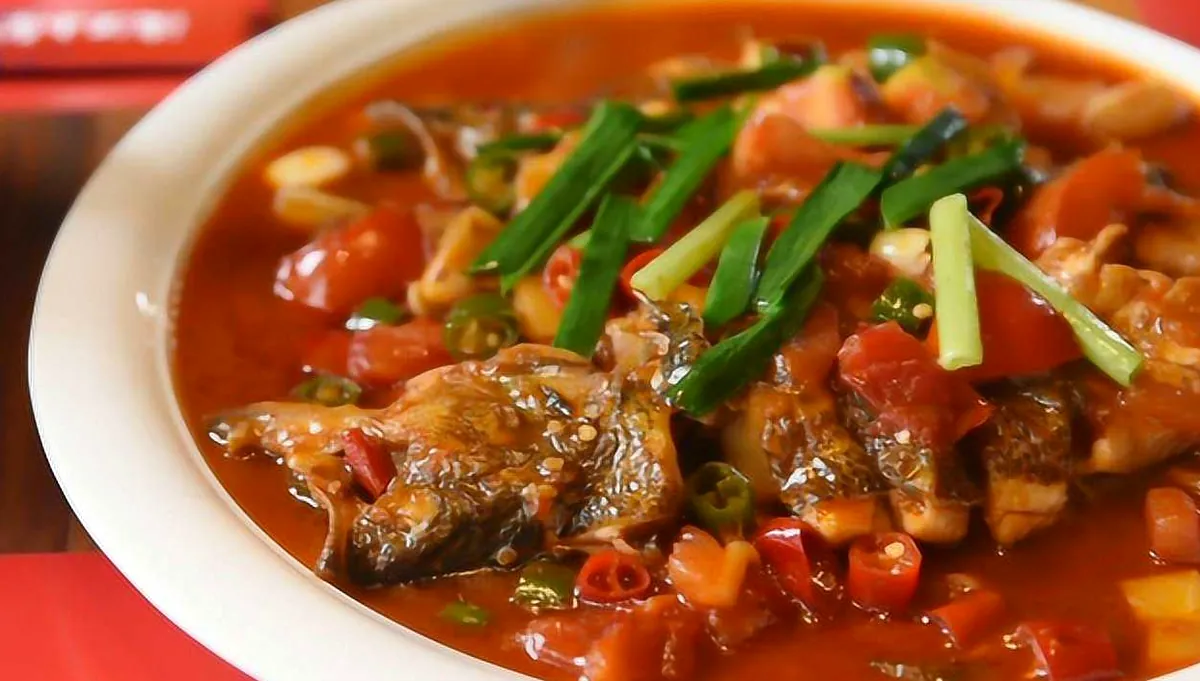
Entering the modern era, this ancient spatial structure has been reshaped through large-scale investment projects aimed at transforming the Yangshuo and Guilin basins into world-class eco-resort destinations. The strategic focus lies in revolutionizing the cruise fleet, clearly segmenting the guest experience. High-end four-star and five-star cruise ships departing from Zhujiang and Mopanshan piers are designed with vibration-dampening alloy hulls and equipped with multi-layered, anti-glare, soundproof panoramic glass, allowing travelers to fully admire the scenery without disturbing the valley’s inherent tranquility. The interiors of these luxury cabins are crafted entirely from natural ebony, serving imperial-style banquets combined with renowned local mountain delicacies such as Yangshuo beer fish cooked with bird’s eye chili and cherry tomatoes, or Lipu taro steamed with pork belly, rich in traditional flavors.
Parallel to waterway infrastructure, actual investment in Yangshuo town and the lower reaches of the Yulong River focuses on creating heritage-inspired resort complexes. A prime example is the adaptive reuse project transforming an old sugar mill into a complex eco-resort, where raw gray concrete walls and modern-era sugarcane transport rails are preserved intact, dialoguing harmoniously with an infinity pool overlooking the jade-colored mountain ranges. Resort villas nestled among thorny bamboo groves and lush paddy fields strictly adhere to building height limits to remain below the canopy of ancient trees, utilizing local slate, terracotta tiles, and handcrafted blue bricks. This master plan simultaneously realizes peak luxury for high-end travelers and preserves the absolute integrity of a geological wonder that has inspired poetry and painting for millennia.
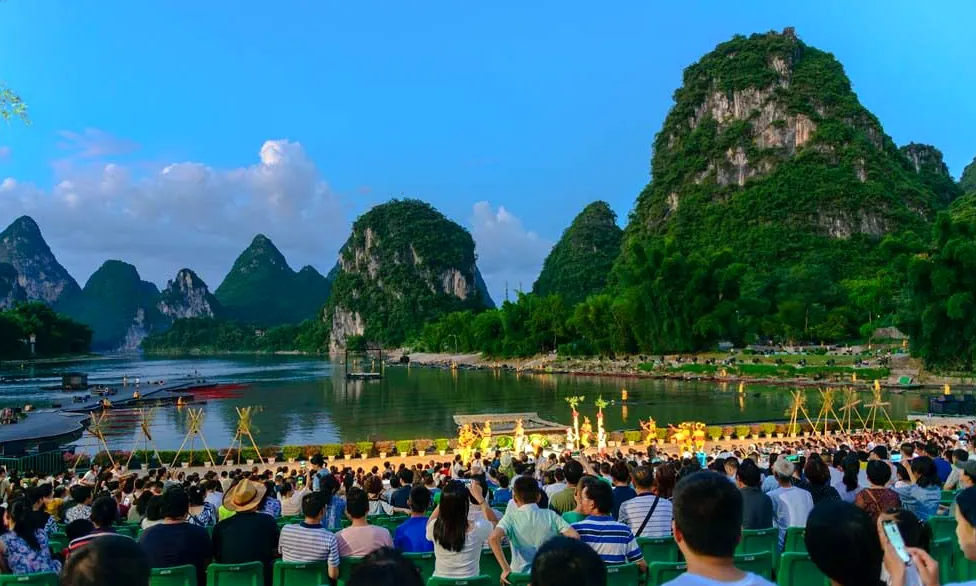
As sunset fades over the Li River, the mystical velvet curtain of night descends upon the ethereal landscape of Yangshuo, revealing a viewing space entirely distinct from the daytime silence. Amidst the secluded mountain scenery, the Li River transforms spectacularly into an unprecedented open-air stage for the real-scene musical “Impression Liu Sanjie” (印象刘三姐). Under the masterful direction of the trio Zhang Yimou, Wang Chaoge, and Fan Yue, this work ushered in a new era of peak landscape art performance. Unlike enclosed concrete theaters, the stage here spans nearly two kilometers of the natural river basin, using twelve towering karst limestone peaks in the Tianyuan village area as a permanent backdrop, perfectly blending the grandeur of nature with the essence of indigenous culture.
More than six hundred performers in the show are mostly humble fishermen who cast nets by day and transform into artists at night, telling stories through their bodies and resonant voices. The legend of the Song Fairy Liu Sanjie from the Tang Dynasty – a symbol of freedom and musical talent of the Zhuang people – is vividly recreated through folk songs echoing deeply between the ancient cliffs. The lighting art in the performance is a sophisticated mechanical feat, with high-power floodlights hidden beneath the water and rock crevices, suddenly bursting to life to pierce the mist drifting over the river. The image of a maiden dancing on a crescent moon reflecting on the water, a hundreds-of-meters-long crimson silk ribbon undulating rhythmically with the waves, and the flickering fire from dozens of traditional cormorant fishing bamboo rafts create a stunning visual sequence that captivates any aesthetic soul.

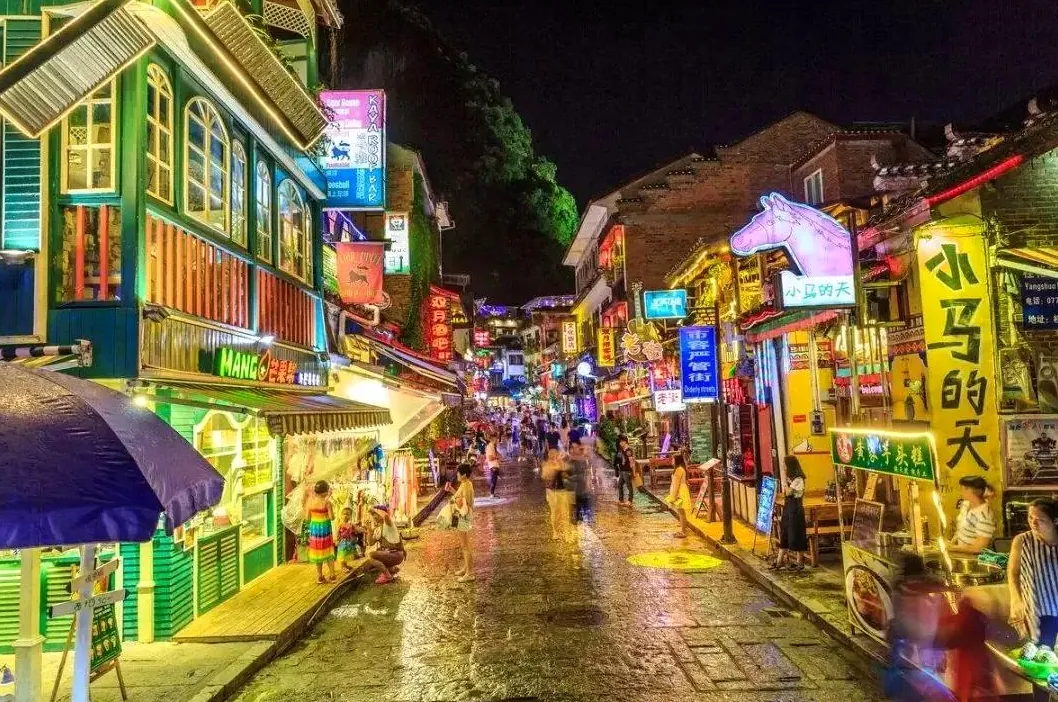
Leaving the overwhelming space of the real-scene performance, nightlife in Yangshuo branches into two fascinating extremes. On one side is the bustling, prosperous West Street (Xi Jie), with a history spanning over a millennium since the Sui Dynasty, where blue-stone paved alleys are filled with the sound of acoustic guitars and the fragrant aroma of traditional beer-braised fish. But on a deeper dimension, modern tourism trends are quietly leading travelers toward “Healing Tourism” along the banks of the Li River. Amidst the quiet night, as city lights recede behind the mountains, the humid breath of the river and the cool breeze blowing through the limestone valley become a miraculous balm for the body and mind of travelers weary from the fast-paced life.
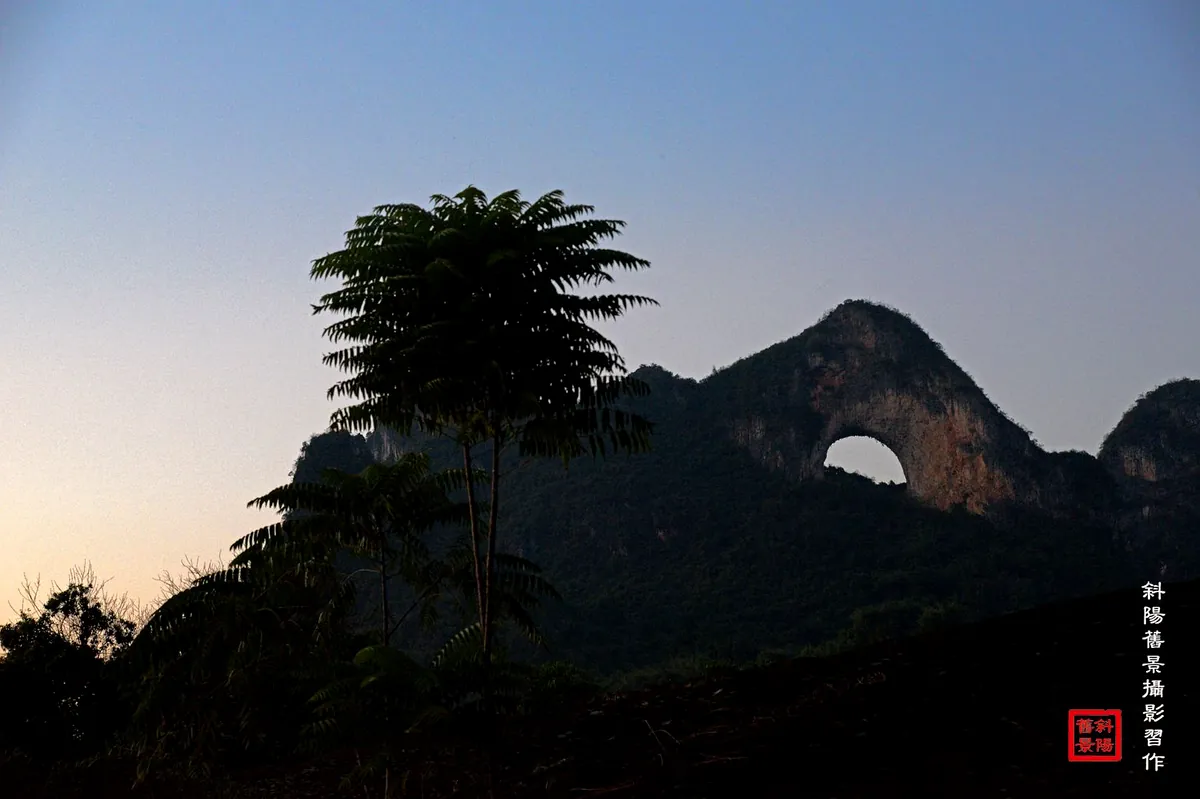
Along the bamboo-shaded sandbars and riverside accommodations, meditation sessions, moonlit meditation, and yoga classes take place in near-absolute silence. Under the bright moon illuminating the distant Moon Hill, travelers sit cross-legged on the grass, breathing in the pure essence of the wilderness. Night tea ceremonies by the Li River also offer a rare sense of serenity, where travelers sip Guangxi’s famous Liu Bao tea or fragrant osmanthus black tea by the flickering oil lamp, watching the night mist slowly condense on the calm waves. In that profound stillness, the boundary between humanity and nature seems to dissolve, leaving only a miraculous connection between the tranquil mind and the endless flow of the fairy-tale river.
The culinary culture along the banks of the Li River has long transcended mere dining pleasure, evolving into a harmonious blend of the abundant natural produce from the unique karst landscape and the rustic lifestyle passed down through generations of fishermen. The pristine waters originating from the Mao’er Mountain range flow over hundreds of millions of years of sedimentary limestone, nurturing plump freshwater aquatic life while fostering a warm, comforting cooking style. This cuisine balances spicy, rich, and delicately herbal notes, serving as a remedy for locals to brave the misty winter days shrouded across the river surface.
The legendary scenery of the river unfolds like a painting, with undulating limestone peaks appearing and disappearing in the mist. An elderly fisherman with silver hair sits quietly on a simple bamboo raft, accompanied by glossy black cormorants perched obediently on both sides of the boat. In the distance, a white-painted cruise ship glides serenely across the calm water, creating a vibrant contrast between modern life and the millennium-old art of cormorant fishing. These birds diving deep to catch the freshest fish from the limestone riverbed form the natural link that provides pristine ingredients, shaping the soul of this land’s renowned culinary map.
Topping the list of riverside delicacies is undoubtedly Yangshuo Beer Fish, a culinary masterpiece born from the rustic eateries along the Li River wharves in the late last century. Local chefs typically select fresh grass carp or bighead carp straight from the nets, leaving the scales intact to maintain a crispy texture after being deep-fried in local tea oil. The fish is then braised with local beer brewed from Guilin’s subterranean spring water, combined with juicy tomatoes, fiery fresh bird’s eye chilies, garlic cloves, and wild herbs. The alcohol evaporates, leaving behind a subtly sweet malt flavor that penetrates deep into the pristine white fish flesh, melding seamlessly with the rich, savory red sauce. This leaves diners both gasping and captivated by an unforgettable, deeply flavorful finish.
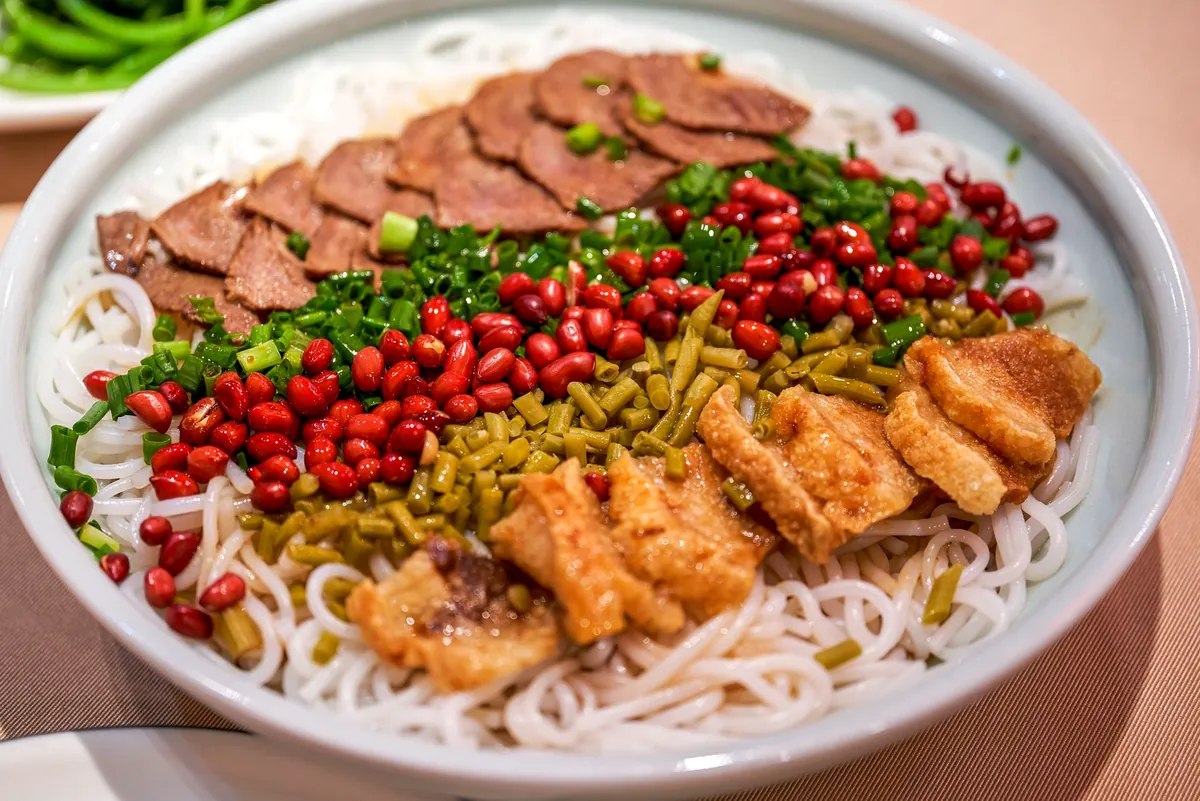
While beer fish represents the carefree spirit of the waterways, Guilin rice noodles carry historical layers dating back to the Qin Dynasty, when northern troops marched south to dig the Lingqu Canal. Unaccustomed to hard-grained rice, the soldiers ground the rice into flour, pressed it into round strands, and boiled them, laying the groundwork for this world-famous noodle dish. The essence of the bowl lies entirely in its traditional herbal broth, painstakingly simmered for dozens of hours from marrow bones and over twenty traditional medicinal herbs such as black cardamom, cinnamon, star anise, licorice, and clove. A standard bowl of dry-mix noodles must be thoroughly tossed with fragrant crispy-skinned roast pork, thinly sliced beef, savory salted roasted peanuts, and distinctively spicy-sour bamboo shoots, delivering layers of flavor that stimulate every single sense.
Guilin’s cuisine would not be complete without missing out on the famous chestnut-stewed chicken from the villages nestled in the Yangshuo karst valleys. Locals choose firm hill-raised free-range chicken, chop it into bite-sized pieces, and stir-fry it with aged ginger, scallions, and premium soy sauce before slow-simmering it in an earthen pot with plump wild chestnuts harvested from the mountain ranges. The deep sweetness and firmness of the chicken blend with the nutty, chewy, milky-sweet flavor of the chestnuts, creating a delicate, warming soup that perfectly encapsulates the harmonious intersection of the ancient jungle’s bounty and the gently winding river.
After hours of sightseeing amidst mountains and waters, local gastronomy serves as the perfect concluding note to the journey, best represented by the millennium-famed bowl of Guilin rice noodles. Against a backdrop of delicate porcelain glaze, each glossy, resilient, and perfectly chewy noodle strand hides beneath thinly sliced beef infused with spices, accented by the vibrant green of finely chopped scallions and the golden hue of crunchy roasted peanuts. Every melt-in-your-mouth piece of crispy pork crackling is skillfully balanced with tangy, crunchy pickled mustard greens, all mingling within a glossy, fragrant herbal sauce that fully awakens the traveler’s palate.
Local folklore recounts that Guilin rice noodles originate from the era of Qin Shi Huang mobilizing troops to pacify the south, closely linked to the magnificent engineering feat of the Lingqu Canal. Northern soldiers, accustomed to wheat flour, arrived in the misty and malaria-prone Lingnan region and invented the technique of grinding soaked rice into round strands, pairing them with a Luzhou master broth simmered from dozens of medicinal herbs to strengthen the spleen, nourish qi, and dispel damp cold. Enjoying a traditional bowl of mixed dry noodles early in the morning before stepping onto the cruise deck to glide across the waves has become an indispensable custom, providing travelers with abundant energy to immerse themselves in the picturesque landscape.
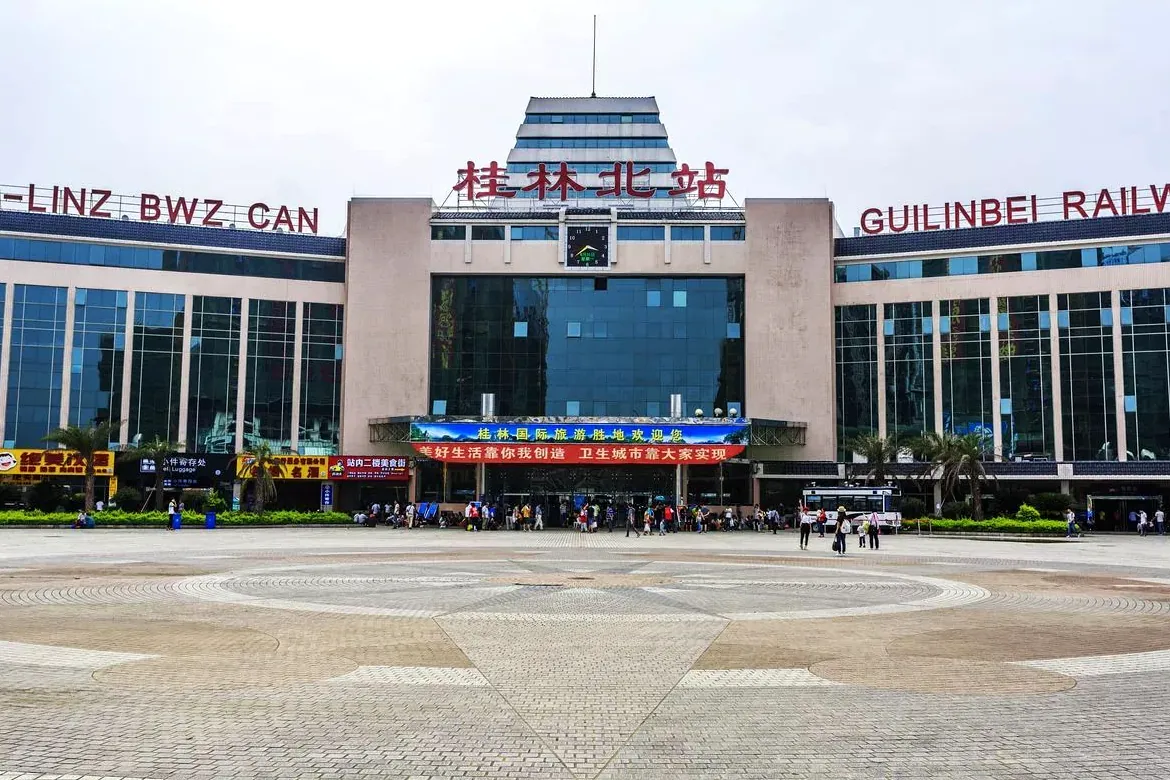
To bring your journey through the borderlands to life, modern transport infrastructure offers exceptional convenience for travelers from all over. The vital high-speed railway line connecting Guiyang and Guangzhou is the optimal choice, providing direct access to central stations like Guilin North or Guilin West after just a few hours of gliding through rolling limestone valleys. From the city center, the magnificent 83-kilometer waterway route heading south typically departs from Mopanshan Pier (磨盘山码头) or Zhujiang Pier. Travelers are advised to prioritize morning departures, when the blue mist still clings to the karst peaks, creating the most vivid ink-wash painting scenery.
Fully experiencing the aesthetic beauty and cultural depth of this region requires prioritizing authentic encounters, steering clear of the opaque commercial activities often found in mass tourism models. Instead, opting for accommodation on 4 or 5-star cruise ships with 360-degree observation decks and refined culinary services will provide tranquility and the most comprehensive perspective. Furthermore, a stay of at least 2 nights in Yangshuo County is the ideal condition for travelers to leisurely stroll through the thousand-year-old West Street, cycle along the Yulong River valley, and fully admire the legendary ‘Impression Sanjie Liu’ live-action performance by director Zhang Yimou.
Regarding procedural requirements, international citizens need to prepare a passport valid for at least six months along with a Chinese tourist visa or a group visa through licensed travel entities, while also completing an electronic arrival card at customs. Given the rapid development of the digital economy in mainland China, installing and verifying international payment cards on mobile apps like Alipay or WeChat Pay is mandatory; however, travelers should still keep a small amount of Chinese Yuan in cash for street vendors or folk souvenirs. To ensure every stage of your journey is scientifically arranged, from pier departure times to luxury hotel standards, you can refer to our all-inclusive tour packages for a complete and worry-free trip.