


Following early timber and stone structures repeatedly ravaged by fire and Danish invasions, history entered a grander chapter with the construction of “Old St. Paul’s” between 1087 and 1666. Blending Norman and Gothic styles, this medieval engineering marvel once boasted a towering spire reaching 149 meters into the sky. Beyond serving as a solemn monastic sanctuary, “Old St. Paul’s” functioned during the feudal era as a bustling multidimensional social hub, famous for “Paul’s Walk”—a lively promenade frequented by merchants, gossips, and nobility alike. Yet the fate of this monumental structure was sealed on a fateful evening in 1666, when the Great Fire of London erupted, reducing the ancient cathedral to ashes and leaving an immense void at the heart of the royal capital.
From the ruins of that historic catastrophe, during the reign of King Charles II, a new icon rose. The majestic edifice standing today is the immortal masterpiece designed by the genius architect Sir Christopher Wren, begun in 1675 and completed in 1710. The birth of this great cathedral under King Charles II not only marked the rebirth of London’s urban landscape, but also affirmed British resilience in the face of adversity. Sir Christopher Wren poured his life’s devotion into every stone, creating a sanctuary that enshrines the soul of the nation through state funerals and the tombs of figures who shaped world history.
Stepping into the solemn interior, visitors encounter the tomb of chief architect Christopher Wren himself, inscribed with the famous and proud Latin epitaph: “Lector, si monumentum requiris, circumspice” (Reader, if you seek his monument, look around you). This sacred ground also serves as the final resting place of Admiral Horatio Nelson—the illustrious naval hero honored with a grand state funeral in 1806; the Duke of Wellington, laid to rest in a historic ceremony in 1852; and, more recently, Prime Minister Winston Churchill in 1965. Every corner and stone of St. Paul’s Cathedral in London, UK thus tells not only an architectural story, but also etches the most heroic chapters of an entire empire’s cultural history.
Examined through the lens of classical Eastern feng shui combined with Western urban topography, St. Paul’s Cathedral (London 圣保罗大教堂) occupies an extraordinarily auspicious and rare site in the heart of the British capital. This grand sanctuary commands a “north-backed, south-facing” orientation, resting firmly against the summit of Ludgate Hill—a natural elevation on the north bank of the River Thames rising roughly 14 meters above sea level. In traditional geomancy and capital planning, this position establishes a solid geological and spiritual anchor. The cathedral’s southern flank faces directly toward the gracefully curving River Thames, naturally forming the classic feng shui configuration known as the “Jade Belt Embracing the Waist” (ngọc đái hoàn hủ). As a result, the cathedral’s forecourt opens wide and expansive, gathering vital energy and prosperity while sheltering wind and water, transforming the site into one of the most sacred geomantic focal points of the United Kingdom.
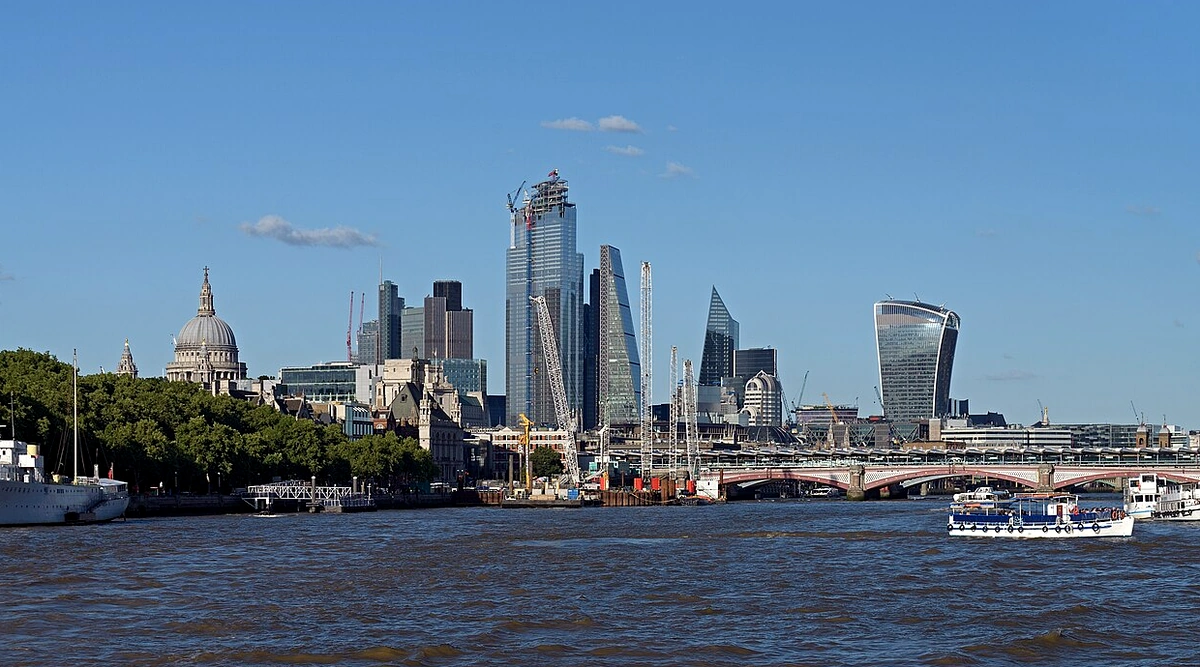
The uniqueness of the landscape surrounding St. Paul’s goes beyond natural topography; it stands as a testament to the timeless urban planning vision of architectural genius Sir Christopher Wren. Immediately after the Great Fire of 1666—which devastated much of the old City of London—Wren seized a golden opportunity to reimagine the entire spatial network. He artfully integrated the cathedral into a landmark master plan, establishing a remarkably precise system of visual corridors (sightlines). From historic Ludgate Hill, vistas sweep across the bustling financial district around Bank and extend all the way to the modern Millennium Bridge. Every angle was meticulously calculated so the cathedral rises as a proud emblem of renewal and steadfast faith.
To safeguard the majesty and sanctity of this heritage space against rapid urbanization, London authorities enacted and strictly enforced height-control regulations known as “St. Paul’s Heights.” Under these laws, no skyscraper may be constructed if it risks obstructing views of the cathedral from strategic distant vantage points. These classic viewpoints include King Henry’s Mound inside sprawling Richmond Park and the scenic span of Waterloo Bridge. Thanks to these rigorously protected viewing corridors, the silhouette of St. Paul’s grand dome continues to reign majestically over the modern London skyline, standing as an exemplary global model for preserving historic urban heritage across centuries.
Having weathered the vicissitudes of history and the ravages of time, St. Paul’s Cathedral in London, UK (伦敦圣保罗大教堂) stands tall as a crowning marvel of Western architecture. When Sir Christopher Wren took on the monumental task of rebuilding the cathedral after the Great Fire of London in 1666, he did far more than reconstruct a house of worship—he forged an eternal symbol of human resilience and creative spirit. This masterpiece represents a seamless fusion of magnificent Late Renaissance style and stately English Baroque, leaving posterity an indelible legacy.
Viewed from the exterior, the sheer scale of the building leaves every traveler awestruck by its grandeur. The cathedral spans a footprint of nearly 6,000 square meters, stretching an impressive 158 meters (518 feet) in total length. Its cross-arms, known as the transepts, extend roughly 75 meters (246 feet) wide. Most remarkably, the height from ground level to the tip of the cross reaches 111 meters—corresponding to 365 feet, a subtle architectural tribute to the 365 days of the year woven into the fabric of the monument by its master architect.
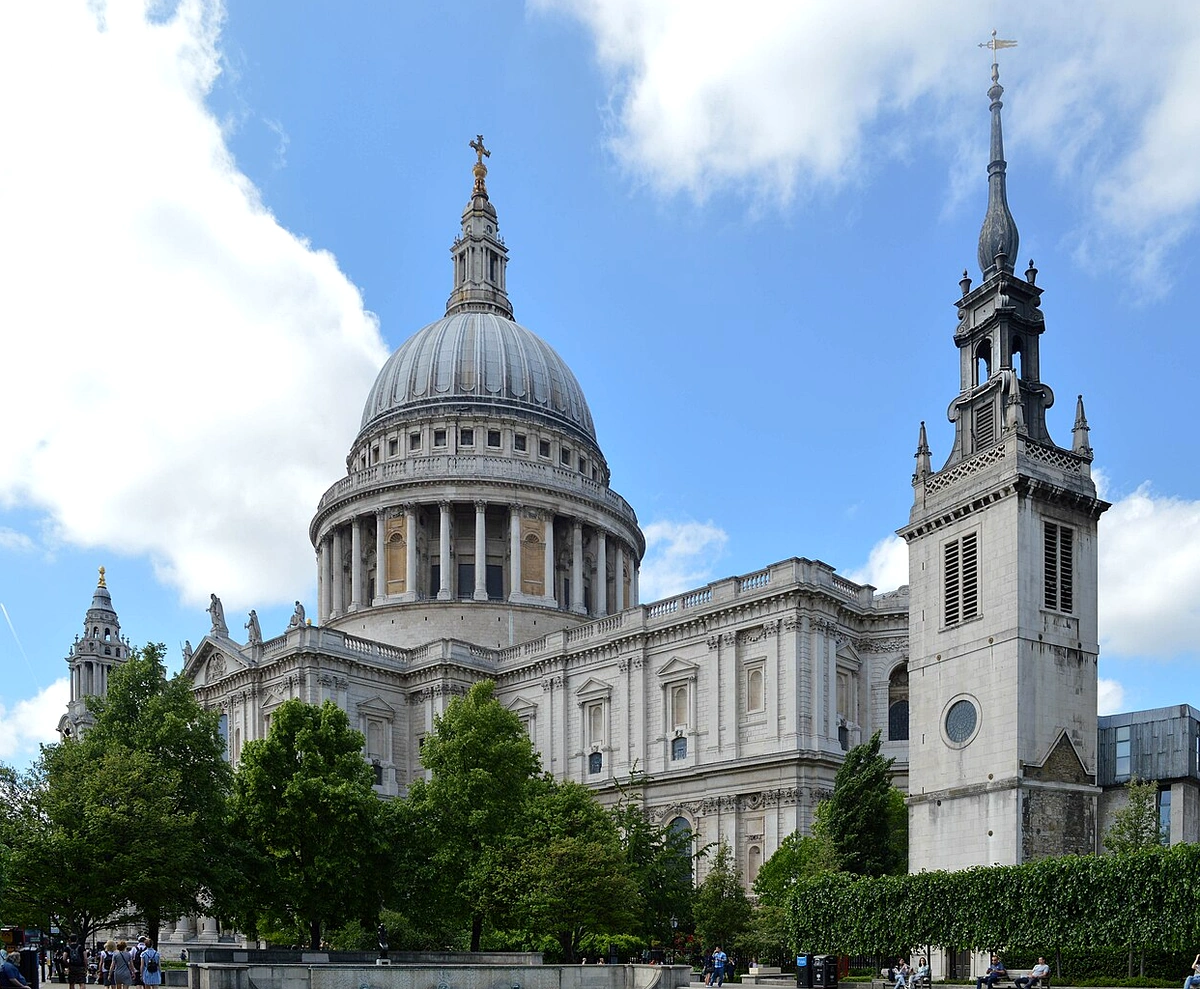
The core secret behind the cathedral’s enduring stability lies beneath its robust foundations, anchored into a stratum of London Clay reinforced with dense gravel beds that bear the immense weight above. For the primary building material, Wren carefully selected Portland limestone quarried in Dorset. Originally gleaming bright white, the stone radiates purity in the soft British sunlight before weathering over the centuries—shaped by the elements and urban soot—into a dignified, antique silvery-gray patina steeped in the breath of time.
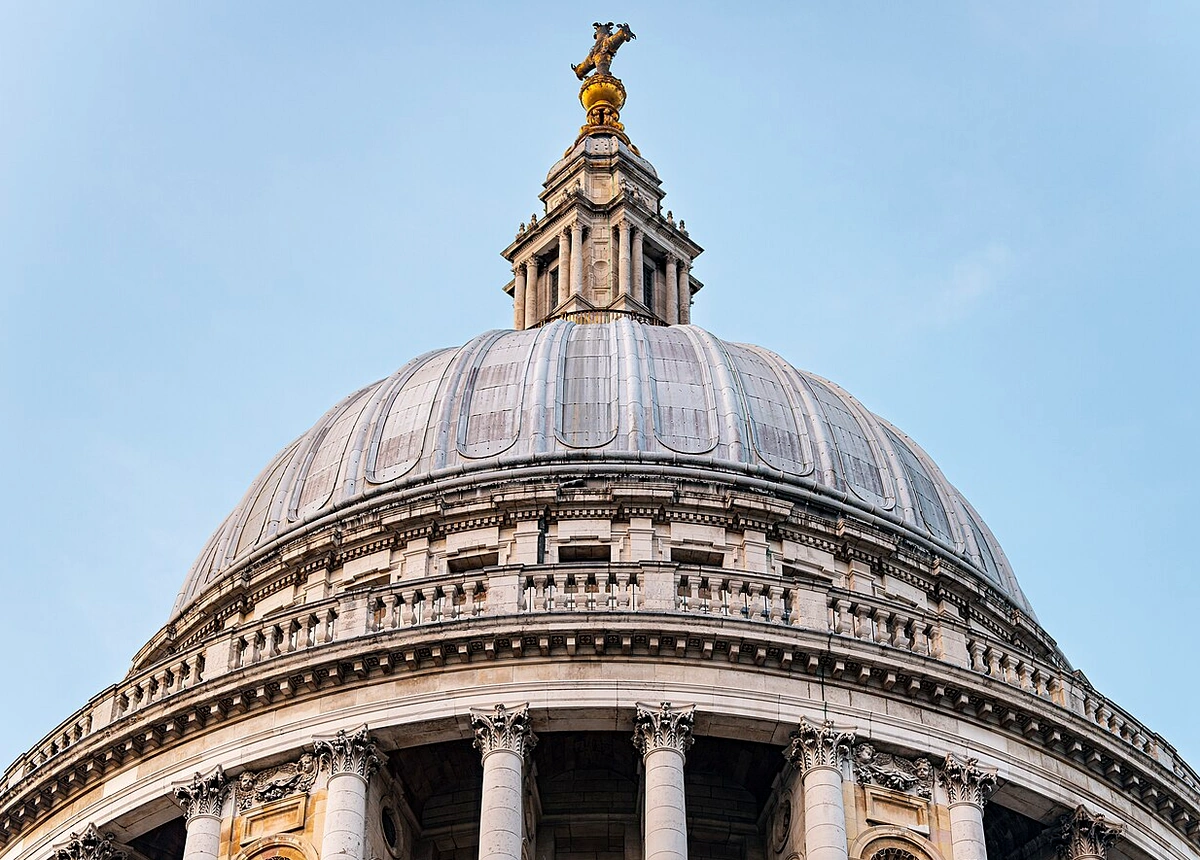
The greatest engineering triumph of St. Paul’s Cathedral is its Triple Dome system—an extraordinary structural innovation devised by Wren after studying St. Peter’s Basilica in Rome and Les Invalides in Paris. This ingenious assembly consists of three distinct yet tightly integrated layers. The innermost layer is a brick dome pierced with a delicate oculus, allowing natural daylight from the lantern above to filter down into the sanctuary floor. The middle layer is a hidden, extraordinarily strong brick cone engineered to support the massive weight of the multi-ton stone lantern perched at the apex. The outermost layer is a grand lead-clad dome sculpted in a graceful parabolic profile, defining the iconic skyline of London.
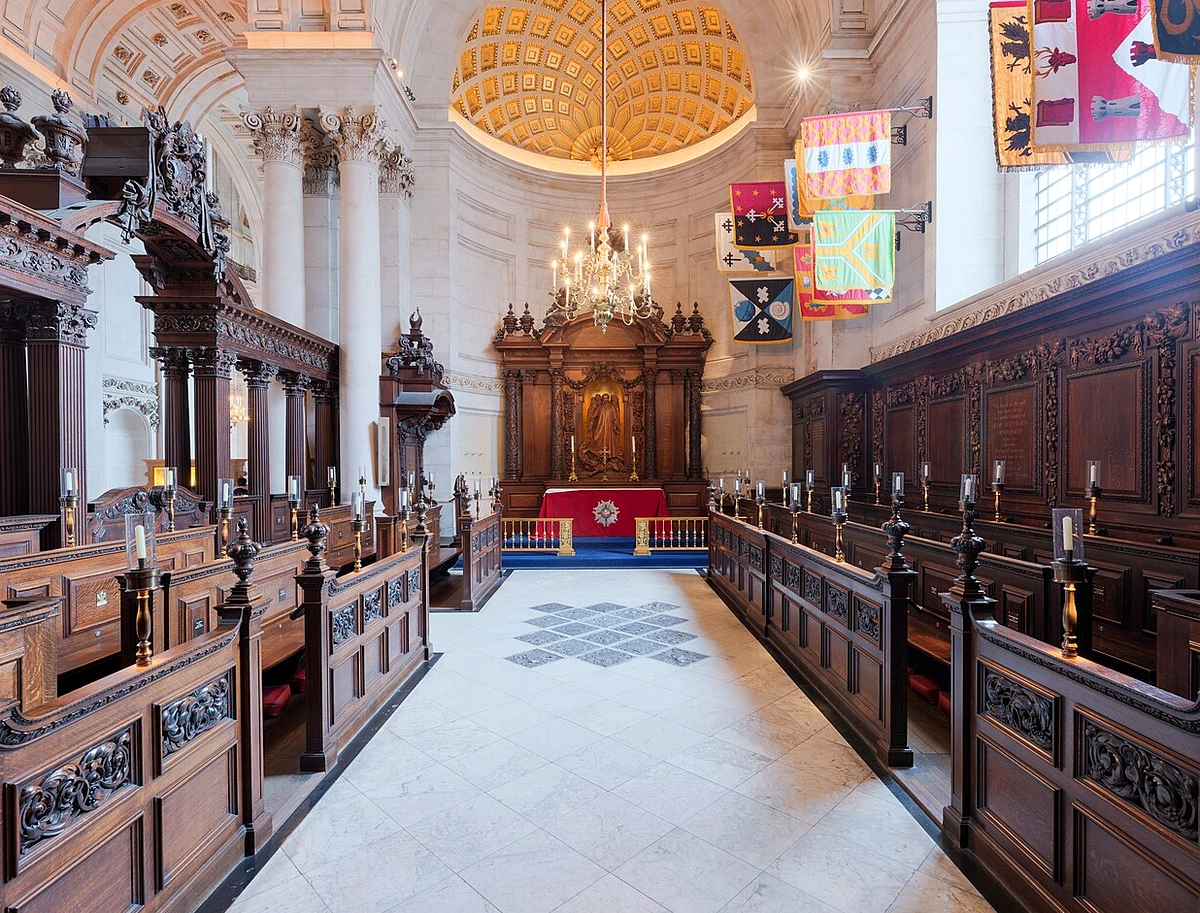
Stepping through the portals into the interior, travelers enter a living museum of sacred art, where the interplay of light and shadow accentuates every carved detail. Standing out across the hallowed space are the supreme woodcarvings of master craftsman Grinling Gibbons, adorning the stately choir stalls and the magnificent pipe organ, where solid oak appears softened into lifelike delicacy beneath the artisan’s chisel. Meanwhile, looking toward the West Portico, the eye is drawn to the intricate wrought-iron screens—a tour de force of metallurgy forged by French master ironsmith Jean Tijou. Every contour and relief inside the cathedral tells a story of extraordinary devotion by brilliant minds, crystallizing into an immortal icon of British architectural artistry.
When night falls and the neon glow of the City of London financial district comes alive, St. Paul’s Cathedral (伦敦圣保罗大教堂) undergoes a dramatic metamorphosis, shifting from a daytime architectural masterpiece into an ethereal work of art amid the modern cityscape. The cathedral’s nocturnal illumination is far more than simple floodlighting; it is a carefully engineered showcase of modern landscape philosophy built on layered lighting and contour enhancement. Leading lighting designers strategically positioned warm-gold LED uplights along the ground to graze the prized Portland stone—the signature white limestone handpicked by Sir Christopher Wren from Dorset quarries in the 17th century. That gentle golden glow caresses the stately paired colonnade around the drum, traces the delicate lead ribs of the outer dome, and ascends to the gilded cross shimmering against the night sky. Through this masterful lighting choreography, the entire monumental silhouette shines like a sacred beacon, casting shimmering reflections across the winding River Thames and carving out an uncanny oasis of serenity in the heart of one of the world’s busiest financial hubs.
Evening life at the cathedral is shaped not only by visual beauty, but also by a sublime auditory feast where architecture and music merge through wondrous acoustic and spiritual harmony. The vast space beneath the colossal dome possesses unmatched acoustic resonance, transforming the subtlest sound into waves echoing across vaulted arches and soaring columns. Every evening, as foot traffic along the Millennium Bridge begins to quiet down, the St. Paul’s Cathedral Choir upholds the centuries-old tradition of Choral Evensong. Pure, crystal-clear, majestic a cappella harmonies soar through the sanctuary, intertwining with the resonant voice of the historic thousands-pipe organ. This marriage of grand Baroque architecture and contemplative sacred music offers travelers a deeply moving spiritual experience, washing away the fatigue of fast-paced urban life.
During special illumination festivals in the British capital—such as the renowned Lumiere London festival or major national commemorative milestones—St. Paul’s Cathedral further demonstrates how seamlessly ancient heritage adapts to contemporary performance art. Its historic Portland stone facade is transformed into a colossal 3D canvas through cutting-edge Projection Mapping technology. Epic tales of the 1666 Great Fire of London, chief architect Sir Christopher Wren’s arduous journey to rebuild the cathedral, and the dramatic chapters of British royal history unfold in luminous animated layers synchronized to musical scores. This dialogue between past and present—between digital artistry and three-century-old foundations—turns every night at the cathedral into a living chapter of history, preserving the sacred spirit of Britain in the hearts of all who visit.
Exploring St. Paul’s Cathedral in London, UK (伦敦圣保罗大教堂) is not merely a journey to admire the pinnacle of Renaissance Baroque architecture or immerse oneself in the sacred aura of royal history; it is also an invitation to step into a nostalgic culinary dimension across the surrounding City of London and Fleet Street. This neighborhood has long been celebrated for the seamless intersection of traditional British pub culture and centuries-old gastronomy, where every dish carries a time-honored story steeped in authentic British character.
Most iconic and steeped in historical memory among the dining establishments neighboring the cathedral is the legendary pub Ye Olde Cheshire Cheese, tucked away down narrow cobbled alleys off Fleet Street. Rebuilt and reopened immediately after the Great Fire in 1667, this historic tavern has witnessed centuries of London’s evolution and once served as a regular haunt for both architectural genius Christopher Wren—during the years he tirelessly supervised the cathedral’s construction—and literary giant Charles Dickens, who immortalized its atmospheric rooms in several classic works. Stepping into its dimly lit interiors, scented with aged oak and warmed by open coal hearths, diners feel transported straight back to the 17th century.

At this historic landmark, signature dishes are served not merely to satisfy hunger, but as authentic expressions of maritime temperate cuisine. Foremost on the heritage menu is the traditional Steak, Kidney and Ale Pie, alongside classic Roast Beef with Yorkshire Pudding. Crafted using a time-honored flaky pastry technique, the pie’s golden crust—crisp on the outside yet tender within—encloses a rich filling of beef and kidney slow-braised for hours in dark British ale. This masterful pairing yields deep, savory, comforting flavors capable of chasing away the biting chill of a misty London afternoon beneath St. Paul’s dome.
Stepping away from the historic pubs imbued with Fleet Street’s working-class and literary heritage, the culinary journey around the cathedral expands into more refined settings to the east. Here, traditional Victorian-inspired afternoon tea rooms elevate tea drinking into a graceful social ritual. Guests can sink into plush velvet armchairs and sip fragrant bergamot-scented Earl Grey tea paired with warm butter scones topped with rich Cornish clotted cream and artisanal strawberry jam—completing a seamless cultural tapestry spanning past and present right beneath the majestic shadow of London’s architectural icon.
Concluding this encyclopedic journey through the signature architectural masterpiece of the British capital, this final section equips aspiring travelers with the most comprehensive, practical field guide available. To prepare for a seamless encounter with Sir Christopher Wren’s magnum opus, St. Paul’s Cathedral in London, UK (Chinese: 伦敦圣保罗大教堂), knowing the operating schedule is essential. This majestic sanctuary welcomes sightseers Monday through Saturday from 08:30 AM to 04:30 PM, with last admission at 04:00 PM. On Sundays, the cathedral closes to general sightseeing to focus exclusively on sacred worship services. Seasoned travelers recommend booking tickets online in advance—at an approximate cost of £25, which includes a multilingual multimedia audio guide—to bypass ticket-counter queues and explore this English Renaissance landmark at your own pace.
London’s public transportation network is renowned for its seamless connectivity, making reaching the cathedral atop Ludgate Hill remarkably effortless. The fastest and most popular option is the London Underground, affectionately known to locals as The Tube. Travelers can alight at St. Paul’s station on the Central Line and walk just two minutes to stand before the imposing Portland stone facade. Alternatively, nearby stations such as Mansion House and Blackfriars—served by the District and Circle Lines—offer convenient access within a pleasant five-to-eight-minute stroll through historic streets. For those arriving via National Rail commuter services, City Thameslink station lies just a four-minute walk away, bringing you right to the foot of the monumental cathedral that has stood resilient through centuries of British history.
Stepping through the grand doors inside reveals a captivating world of art and spatial engineering, paired with exhilarating physical challenges for those eager to scale new heights. The tranquil Crypt—final resting place of national heroes such as Admiral Nelson and the Duke of Wellington—as well as the expansive Cathedral Floor are thoughtfully equipped with step-free access, ensuring comfortable entry for visitors with reduced mobility. However, the most thrilling highlight of the visit is climbing the 528 spiral steps to the summit of the legendary dome. This ascent unfolds across three fascinating tiers: first, the Whispering Gallery encircling the interior of the dome, celebrated for its remarkable acoustic phenomenon along the curved wall; next, the Stone Gallery, opening onto an airy outdoor terrace overlooking the city from the base of the outer dome; and finally, the highest vantage point—the Golden Gallery. Perched at a dizzying height, its intimate walkway rewards sure-footed climbers unafraid of heights with breathtaking 360-degree panoramic views sweeping across the meandering River Thames and the vibrant skyline of modern London.
To ensure a smooth visit that properly respects this sacred space, travelers should observe strict dress codes and visitor etiquette. Because St. Paul’s remains an active place of worship, modest, respectful attire is mandatory for all visitors, requiring clothing that covers both shoulders and knees upon entry. Cathedral regulations also strictly prohibit flash photography and commercial filming inside the main sanctuary in order to preserve priceless artworks. Additionally, for safety along the narrow spiral staircases leading up the dome, selfie sticks are completely banned. To weave all of these unforgettable experiences into a seamless European itinerary, travelers can explore full tour details on our United Kingdom tour for thorough preparation ahead of your upcoming journey.
