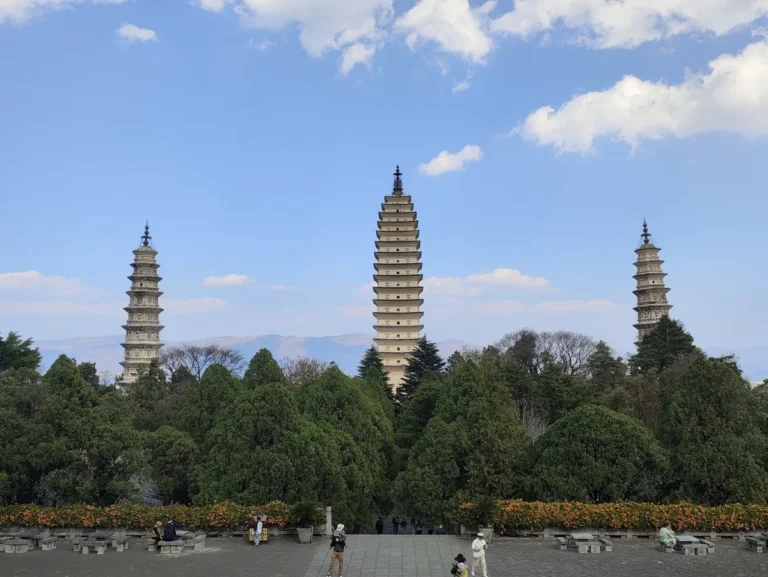
Nestled along the northern shore of the vast and shimmering Dianchi Lake, the Daguan Pavilion in Kunming has long stood as a profound cultural symbol of the Yunnan region. The origins of this illustrious landmark date back to the autumn of the 29th year of the Kangxi reign (1690) during the prosperous Qing Dynasty. At that time, after years of wandering and spreading Buddhist teachings, Zen Master Qian Yu stopped at the tranquil marshlands along the banks of Dianchi. Captivated by the breathtaking landscape of green mountains and clear waters, he vowed to build a small temple named Daguan Pavilion. With the strong support and approval of Wang Kewen, the then-Governor of Yunnan and Guizhou, the structure was gradually expanded and planned into a grand garden, transforming a desolate waterfront into the premier scenic spot of Kunming, complete with magnificent crimson pavilions and ornate towers.
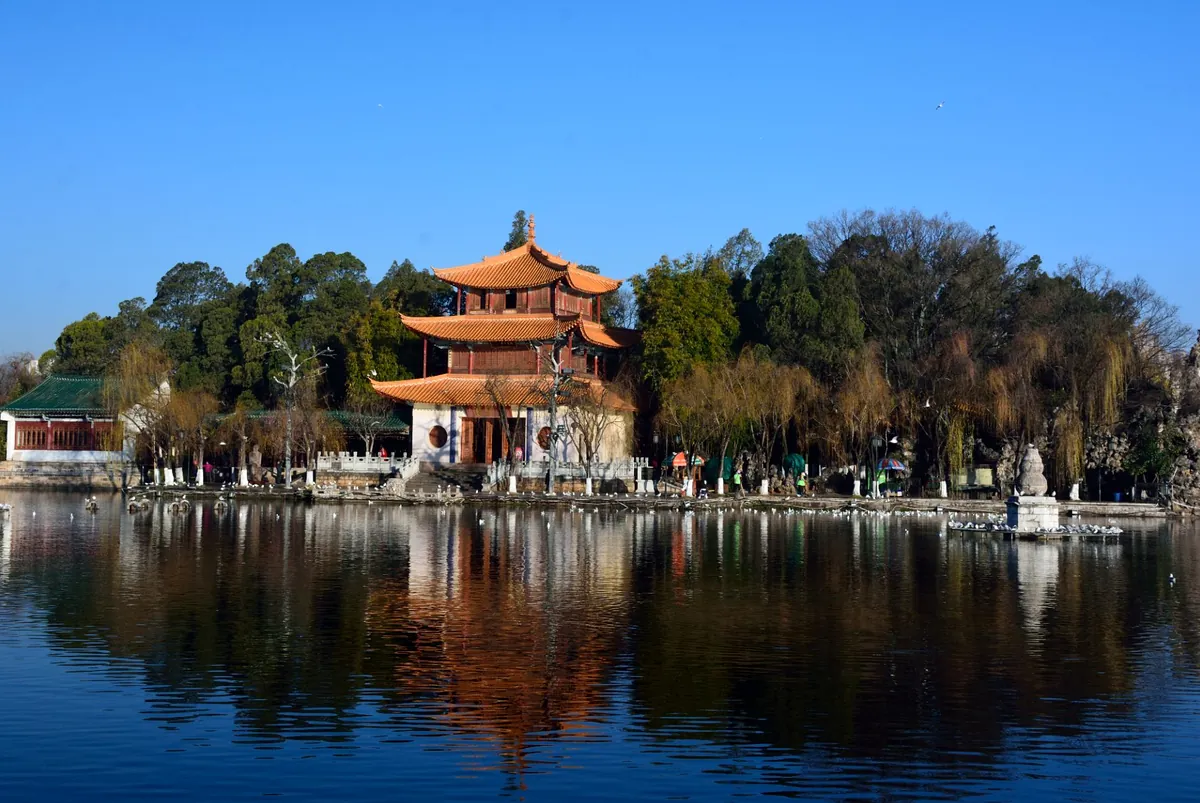
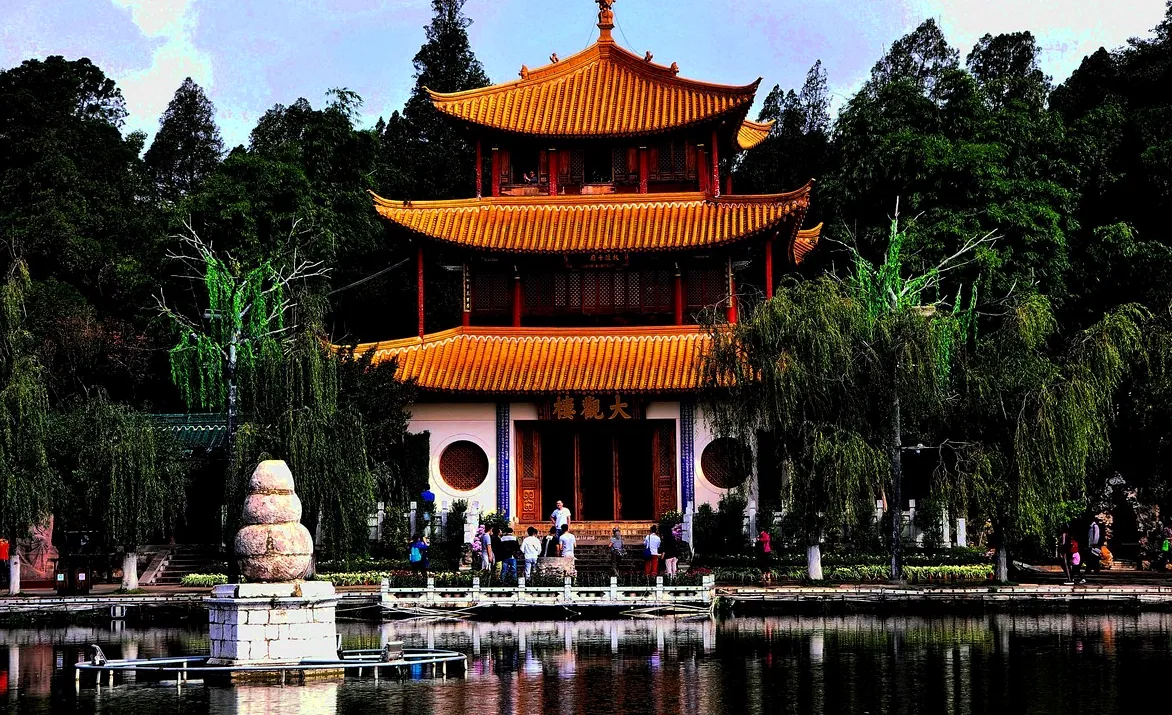
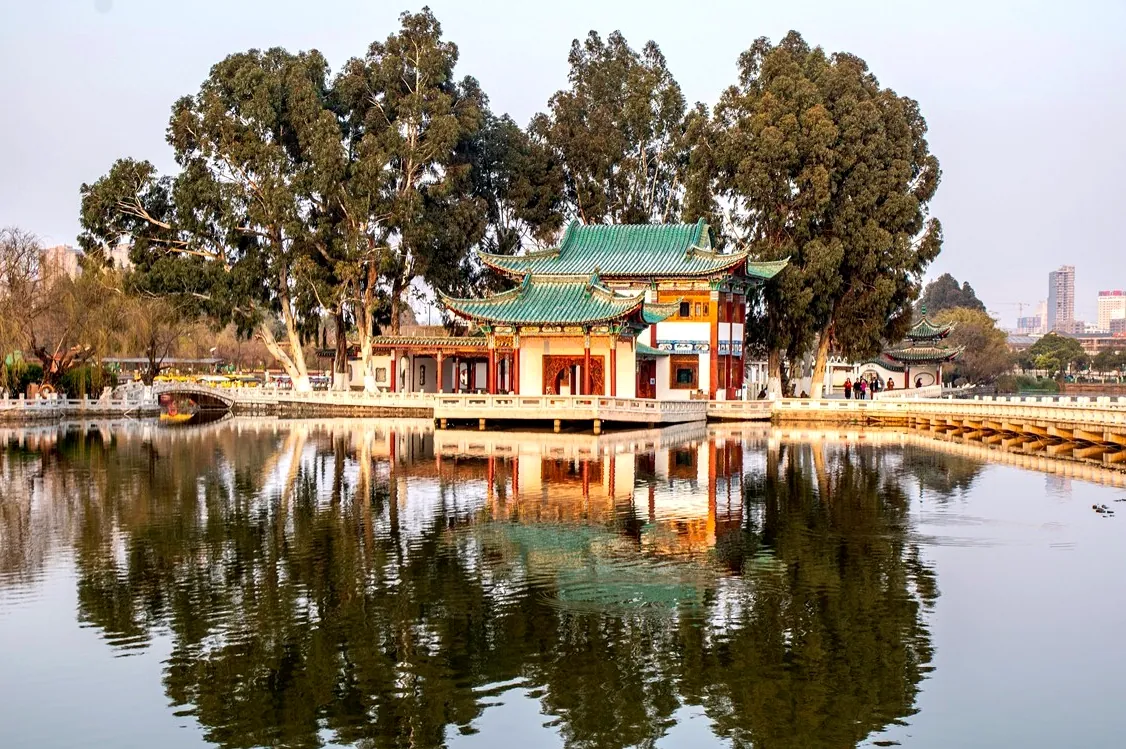
Gazing from the still water, the ancient landmark appears as a stunning highlight against the clear Kunming sky. Standing out against the expansive landscape is the ancient architectural complex with its warm orange, gracefully curved tiled roofs, exuding the solemnity and nobility of ancient construction art. The majestic structure sits right at the water’s edge, reflecting every intricate pattern and wooden pillar onto the crystal-clear surface of Dianchi Lake, which acts like a giant mirror, creating a poetic, simple, yet deeply profound reflection of reality and illusion.
However, the true soul that elevated Daguan Pavilion into the immortal temple of Eastern poetry lies not only in its feng shui location or its wooden and stone scale, but in the poetic genius of the scholar Sun Ranweng during the Qianlong era. Living in a prosperous age but facing personal setbacks in his official career, the scholar poured all his thoughts on the world, human sentiments, and his deep understanding of Yunnan’s past into his masterpiece, the “Long Couplet of Daguan Pavilion.” With a total of 180 elegant ancient Chinese characters divided equally into two sides—ninety characters each—this monumental linguistic achievement established a unique status and has been honored by posterity as the “Greatest Long Couplet Under Heaven.”
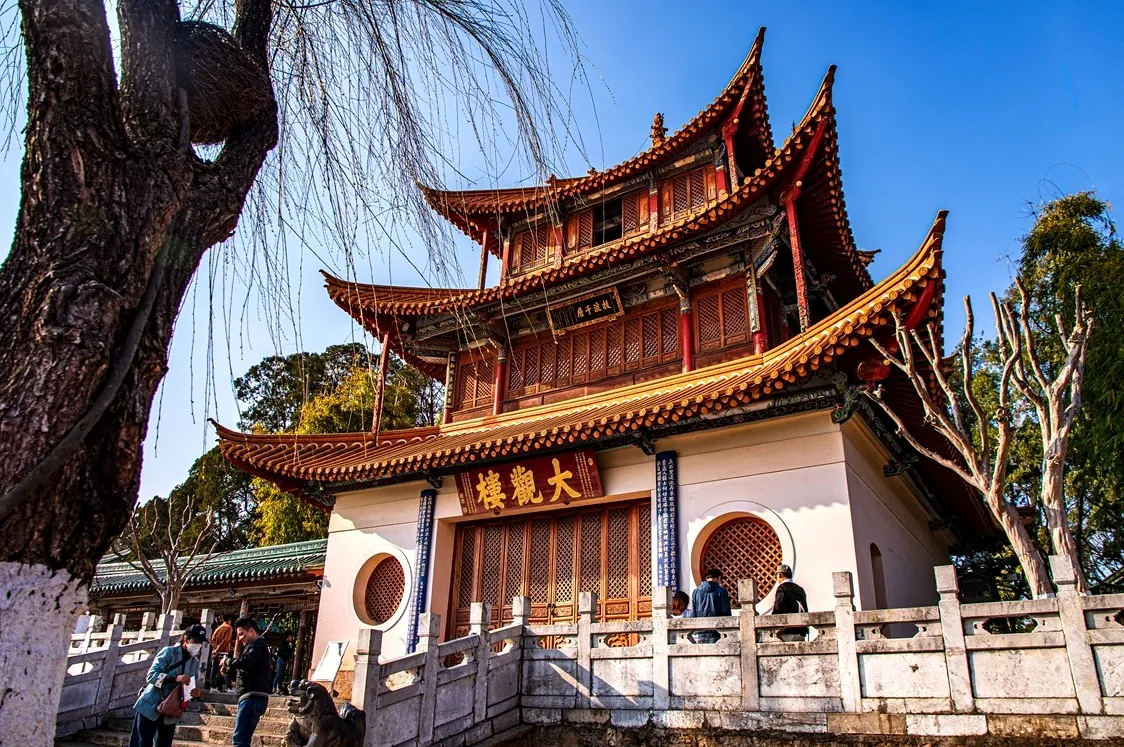
The first part of the long couplet acts as an endless epic praising the vast 500-mile landscape of Dianchi, guiding the traveler’s mind to observe the mountains and waters in all directions: from the towering Western Hills resembling dancing dragons and phoenixes, to the imposing Golden Horse Hill in the east; from the emerald hues of Bichi in the west to the drifting clouds of White Crane in the north. Meanwhile, the second part transforms into a summary of the thousand-year history filled with the changes of the Southwest region. Sun Ranweng skillfully recounted the achievements of Emperor Wu of Han in opening the Southwest, Emperor Taizong of Tang in pacifying Nanzhao, Emperor Taizu of Song in marking boundaries at Dadao Chuan, and the hooves of Kublai Khan’s Mongol forces crossing the Jinsha River to pacify Dali. All the rise and fall of dynasties and the glorious feats of emperors ultimately drift away like clouds, sinking into the echoing temple bells at sunset and the endless mist over the waves.
Over more than three centuries of turbulence, Daguan Pavilion has often suffered from the ravages of war, only to be rebuilt firmly through each historical period. During the Xianfeng era, the Du Wenxiu uprising left the pavilion in ruins for many years. It was not until the fifth year of the Tongzhi reign (1866) and continuing through the Guangxu era that local officials and Kunming scholars joined forces to donate and reconstruct the three-story wooden structure to its current appearance. Every piece of fir wood, every roof tile, and every inscribed horizontal board is imbued with the dedication of our predecessors, transforming this place from a simple Zen hermitage into a historical witness that preserves the cultural essence of one of the most ancient cities in the South.
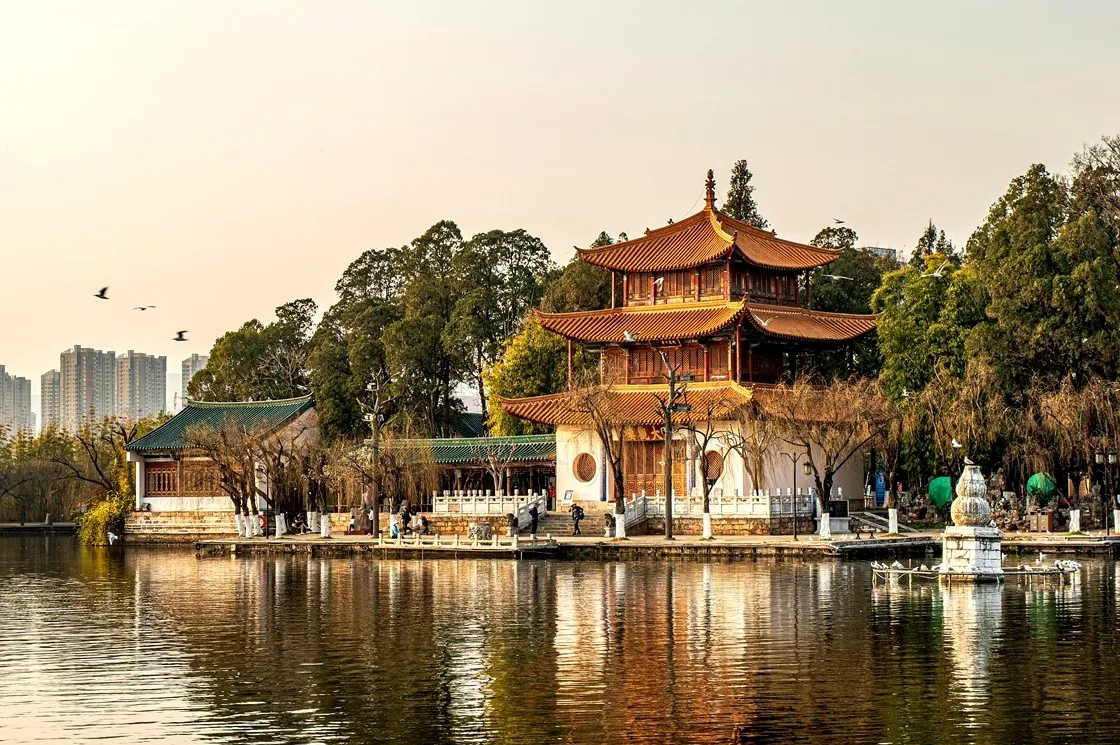
Presenting an impressive presence on the northern shore of Dianchi Lake—a giant jade mirror spanning over 300 square kilometers in the heart of the Yunnan-Guizhou Plateau, the Daguan Pavilion Kunming complex possesses a rare and favorable feng shui position, crystallizing the pinnacle of the “harmony between mountains and water” philosophy of Eastern culture. The terrain here is surrounded by layers of mountains, taking the majestic Western Hills, which resemble a sleeping fairy, as a front screen, while facing the boundless blue waves of Dianchi. The earth’s energy converges with fresh water streams before blending into the lake, creating a prosperous “gathering of energy and hiding of wind” (tụ khí tàng phong) position, turning the entire Daguan Park into an ecological oasis separated from the noise of the city, where the flow of nature and the art of imperial garden planning harmonize perfectly.
Gazing at the panoramic view of the scenic spot from the water’s edge, travelers are immediately struck by the solemn beauty of the ancient architecture, which bears the distinct mark of Chinese imperial style. Its warm, golden-orange tiled roofs are gracefully tiered, winding along the edge of the mirror-still lake. The crystal-clear water perfectly reflects every intricate carving, while on the distant horizon, the proud, towering skyscrapers of modern Kunming rise clearly, creating a striking visual contrast between the somber, profound heritage of centuries past and the vibrant, contemporary pulse of life.
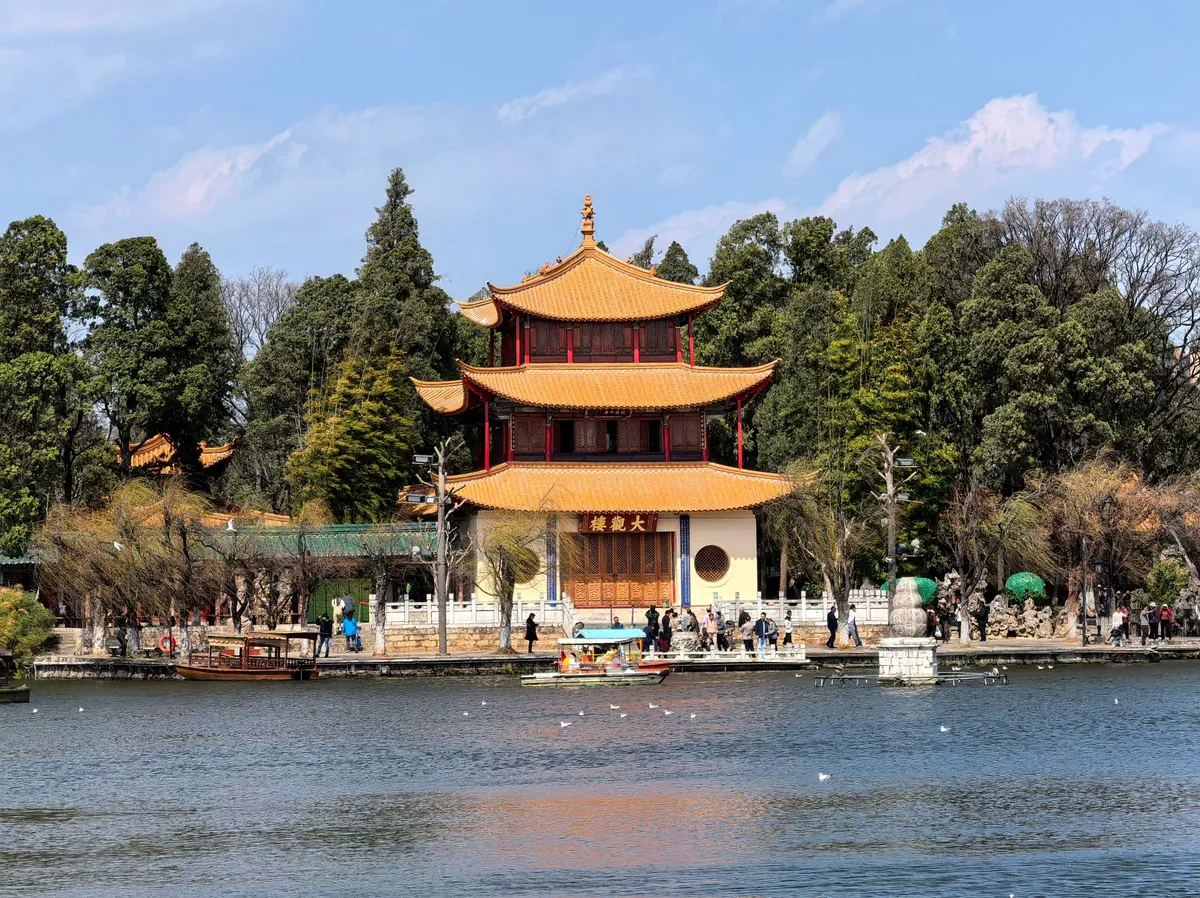
The landscape planning art at Daguan Pavilion fully inherits traditional Southern garden techniques combined with the liberal flair characteristic of Yunnan province. Ancient designers did not flatten the natural terrain; instead, they skillfully diverted water channels, excavated a series of interconnected ponds, the Hundred-Mu lotus lake, and winding streams to circulate water energy throughout the garden. The arched stone bridges, natural pebble embankments, and weeping willows along the shore were precisely calculated using the “borrowed scenery” technique—capturing the magical beauty of the distant Biji Mountain within the viewer’s sight as they pause at the entrance. The space unfolds in multiple layers, making visitors feel as if they are wandering through a picturesque ink-wash painting that is both charming and expansive.
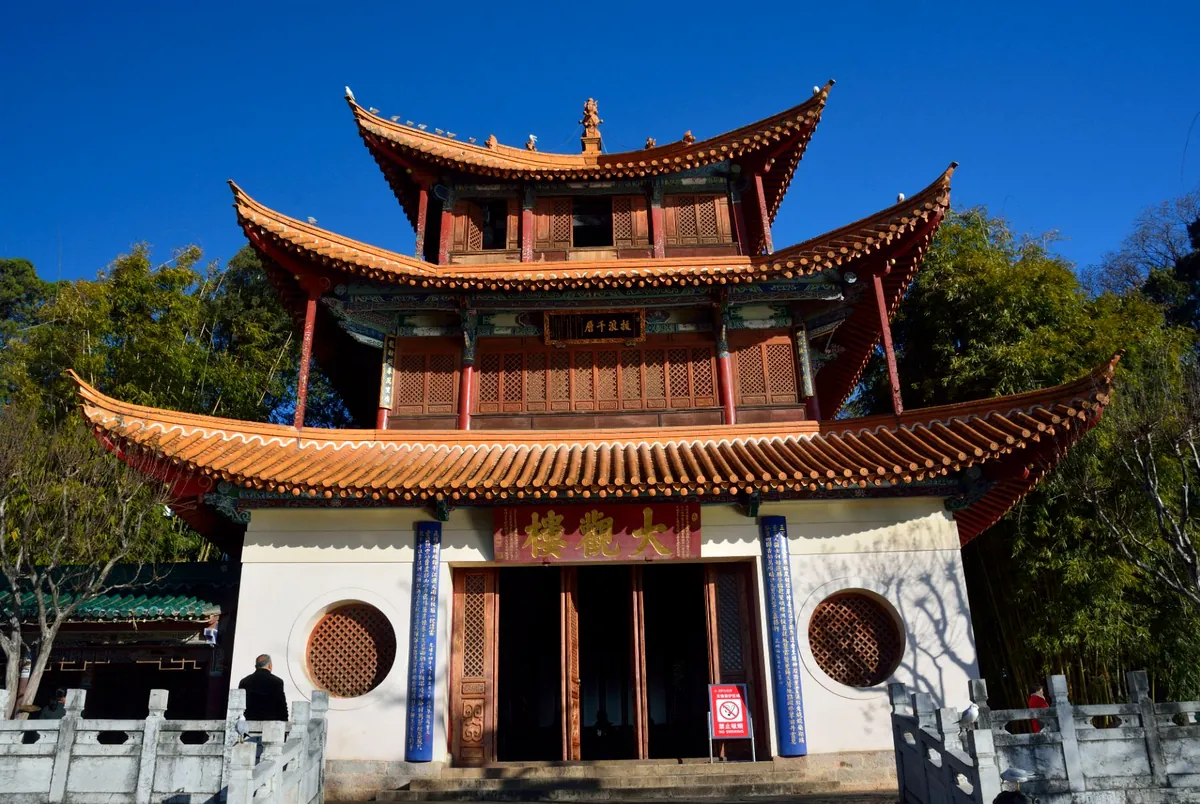
The “north-facing, south-looking” orientation of the scenic spot creates an incredibly mild microclimate, fully utilizing the gifts of Kunming—the City of Eternal Spring—with its year-round sunshine and cool breezes blowing from the lake. The native vegetation is layered meticulously, with ancient trees providing shade, patches of camellias, tea roses, and fragrant lotus ponds blooming in season, all harmonizing with the lush green lawns stretching to the water’s edge. The ingenious arrangement of the precious wooden pavilion amidst the surrounding wetland ecosystem not only honors the central status of Daguan Pavilion but also establishes a model of ecological balance between human craftsmanship and the spiritual essence of the Southern mountains and rivers.
Looking out over the panoramic view of Daguan Pavilion standing tall by the edge of Dianchi Lake, visitors are immediately drawn to the majestic three-story classical Chinese architectural style rising amidst lush greenery. Each curved, golden-tiled roof glimmers under the highland sun, interwoven with a somber red-wood structure reflected in the mirror-like lake. Along the shore, willow-shaded paths invite travelers to pause and admire the scenery, creating a magnificent landscape painting where the essence of imperial architecture blends perfectly with the natural beauty of Kunming’s West Lake.
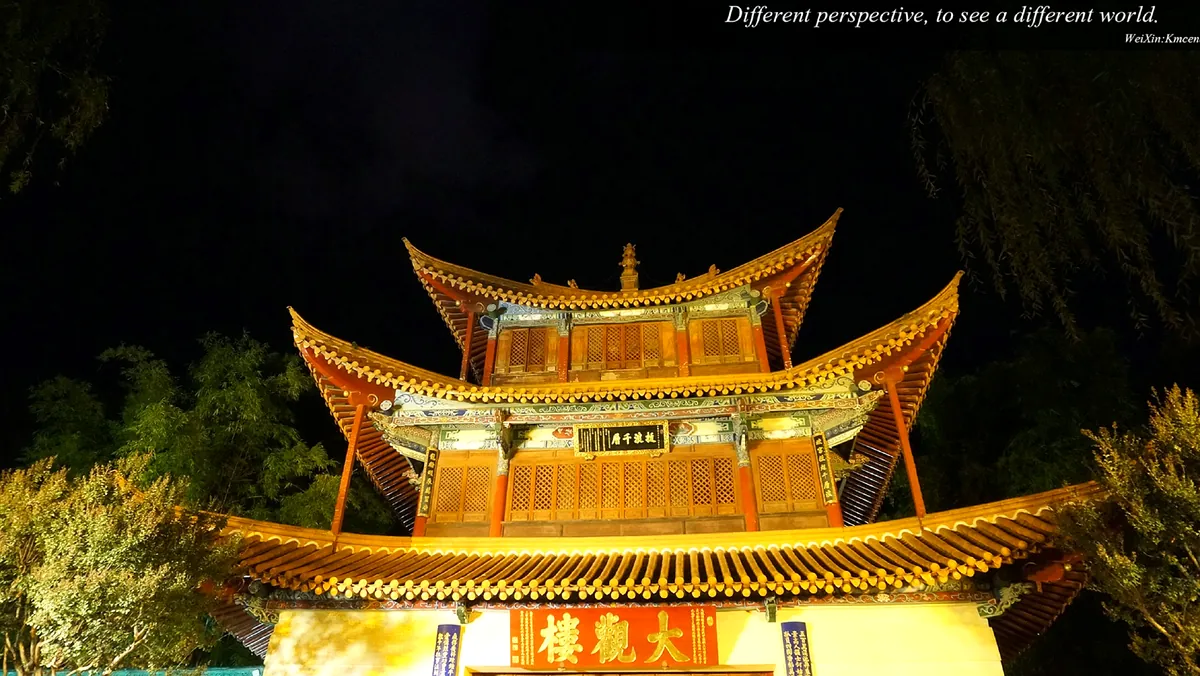
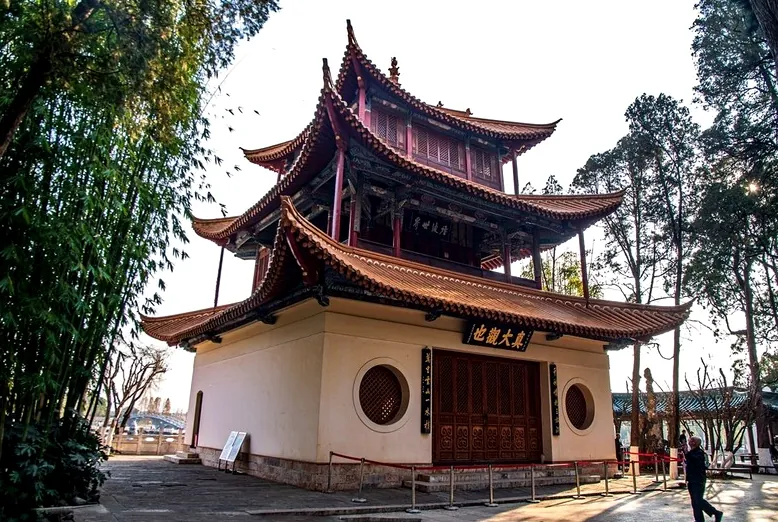
The overall architecture of Daguan Pavilion is a vivid testament to the peak of carving and carpentry skills during the Qing Dynasty. The main three-story building was constructed entirely from solid precious timber, applying the standard multi-layered dougong bracket system with intricate joinery that requires no iron nails. The roof is designed in a tiered style with four corners curving upward like elegant sword blades, evoking the luxury of the imperial court while retaining the liberal spirit of the Southwest. Every rafter, purlin, and wooden partition is coated with traditional protective lacquer, accented with exquisite cloud and wave patterns, showcasing the masterful craftsmanship of the famous carpentry guilds that once served the construction of the Yunnan-Guizhou Governor’s mansion.
More than just a single pavilion, the Daguan Garden complex is planned as a masterpiece of classic garden design, deeply imbued with the language of Southern landscaping, where the philosophy of harmony between mountains and water is perfectly applied. The vast space surrounding the main pavilion is a continuous chain of elegant landscapes, from vibrant peony and azalea gardens to water pavilions and arched stone bridges spanning clear streams. The arrangement of waterways, natural stone embankments, and dense bamboo groves reflects the profound art of Lingnan gardening combined with the tranquility of Jiangnan gardens, turning every turn of the winding corridors into a natural frame that changes with every step of the wanderer.
With its historical stature and unique artistry, the site has been designated by the government as a key national cultural heritage, becoming a symbol of tourism and scholarship for the entire Yunnan province. Having weathered numerous historical shifts and major renovations from the Guangxu era to modern expansions, the site has preserved its original creative spirit intact. Well-planned auxiliary structures, artistic lighting systems, and ancient plant conservation areas have elevated the heritage, transforming Daguan Pavilion into a living architectural museum where thousand-year-old history harmonizes with the timeless, serene beauty of the Spring City.
As the deep purple twilight fades over the vast expanse of Dianchi Lake, the Daguan Pavilion scenic area sheds its solemn, quiet daytime demeanor to don a magnificent cloak woven from contemporary lighting art. The transition between dusk and night in this historic park unveils a shimmering dreamscape, where Ming and Qing dynasty architectural lines blend with cutting-edge visual technology, turning the entire complex into a vivid ink-wash painting in the heart of Kunming.
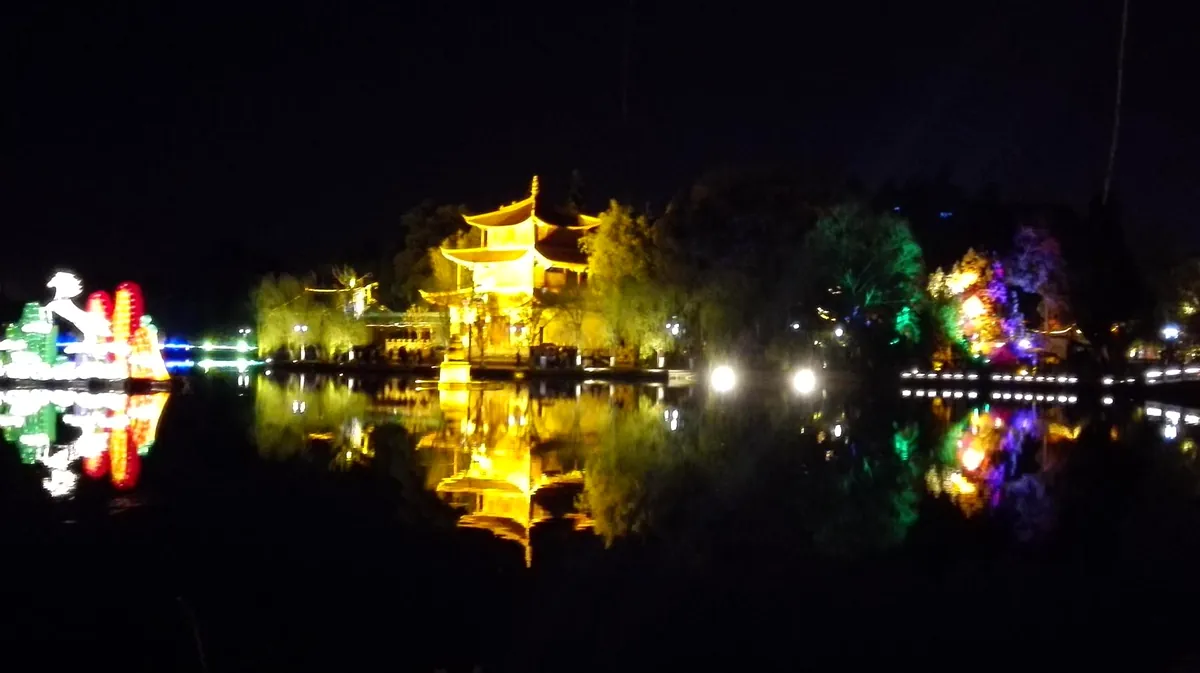
Gazing at Daguan Pavilion in the quiet of the night, visitors are immediately overwhelmed by the ethereal beauty of the traditional Chinese pavilion standing proudly in the stillness. The golden artistic lighting system embraces every curved eave, highlighting each layer of glazed tile and intricately carved railing, perfectly reflecting its magnificent silhouette onto the mirror-like lake. On the opposite shore, clusters of brightly colored lanterns are meticulously arranged, creating a warm, multi-layered spectrum that honors classical lines while bringing a mesmerizing, modern breath to the nocturnal landscape.
During cultural festivals and themed live performances, the water surface in front of the main pavilion becomes a massive interactive stage. 3D mapping techniques and misty smoke effects vividly recreate the legends associated with the Qing dynasty scholar Sun Ranweng, illustrating every verse of his famous 180-character masterpiece, the Long Couplet. Each golden-gilded calligraphic stroke seems to dance on the waves, undulating with night lotus petals and weeping willow shadows, taking viewers on a journey through three hundred years of time to fully feel the vicissitudes of the ancient Diannan land.
Completely different from the bustling, hectic pace of central Kunming, the night life at Daguan Pavilion is a perfect intersection of the increasingly popular healing tourism trend. Along the winding lakeside corridors, rustic teahouses nestle under ancient trees, where visitors can sit back and relax, enjoying rich, aged Pu’er tea or the fragrant, honey-fruity Dianhong black tea. In the cool plateau climate, nearly 1,900 meters above sea level, the warmth of a fragrant tea cup combined with the rustling lake breeze and the melodious sounds of the zither brings absolute peace to the body and mind.
A night visit to Daguan Pavilion is therefore not merely a sightseeing trip, but a journey of soul-nurturing amidst pure nature and deep local culture. Amidst the hazy lights and rippling water shadows, every step on the mossy stone path evokes the serene, carefree spirit of ancient scholars, leaving a lingering, unforgettable impression on the hearts of travelers from afar.
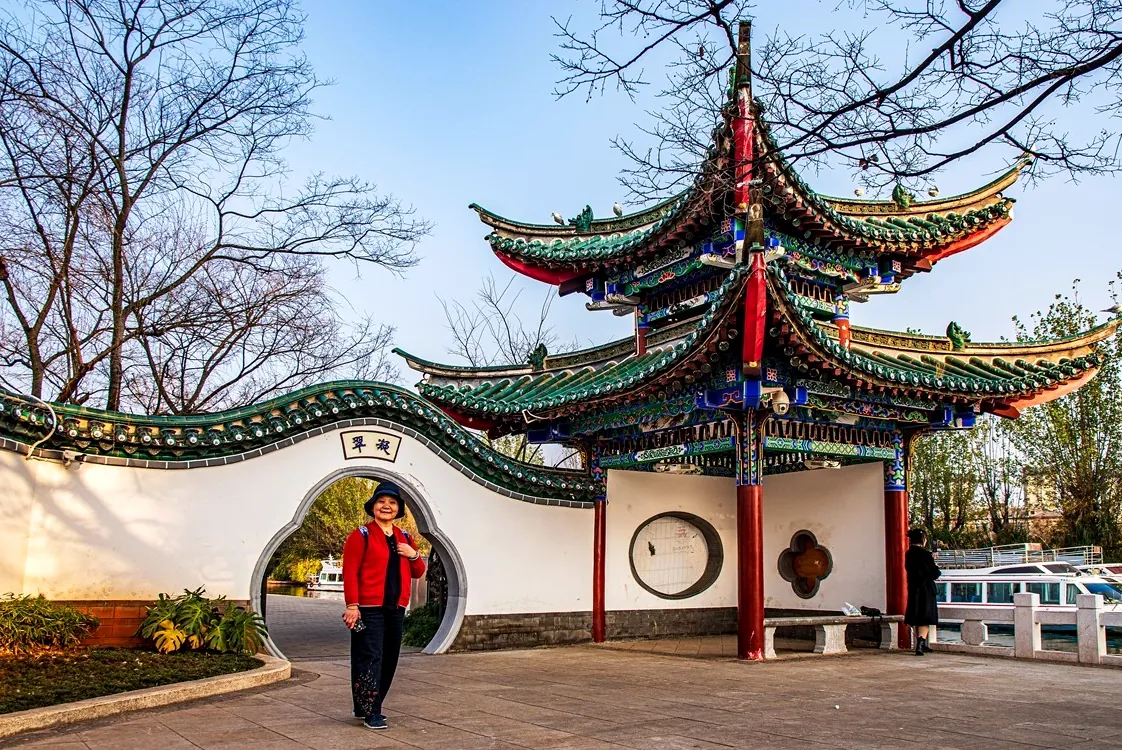
After spending time admiring the dragon-and-phoenix-like calligraphy on the main pavilion, visitors often stroll leisurely along stone-paved paths shaded by ancient trees, where auxiliary structures reflect on the calm waters of Dianchi Lake. The moment of pausing before the elegant moon gate of the traditional garden, beside a gracefully curved rest pavilion and with an ancient, mossy boat dock bobbing in the water behind, opens up a space of exquisite nostalgia. The symbolic circular gate in Southern garden architecture not only frames the magnificent natural scenery of the landscape but also serves as a gateway for wanderers to enter the culturally profound world of Dianzhong aesthetics.
The culinary culture surrounding the Daguan Pavilion complex is deeply influenced by the refined lifestyle of Qing Dynasty scholars and poets. After admiring and discussing the famous long couplet by scholar Sun Ranweng, these intellectuals would often gather around the dining table to enjoy the legendary “Cross-Bridge Rice Noodles,” a culinary masterpiece originating from the Nanhu area in Mengzi before flourishing in the metropolis of Kunming. A bowl of Cross-Bridge Rice Noodles at the ancient teahouses around the lake is presented like a culinary microcosm, featuring an oversized ceramic bowl filled with broth simmered from pork marrow bones, old hen, and young duck for six consecutive hours. A shimmering layer of chicken fat on the surface acts as a thermal seal, keeping the broth simmering at over 100 degrees Celsius while appearing as still as a mirror. Connoisseurs follow a poetic ritual: sequentially adding paper-thin slices of pork, Dianchi salmon, raw quail eggs, followed by chrysanthemum petals, young chives, and fresh, chewy rice noodles.
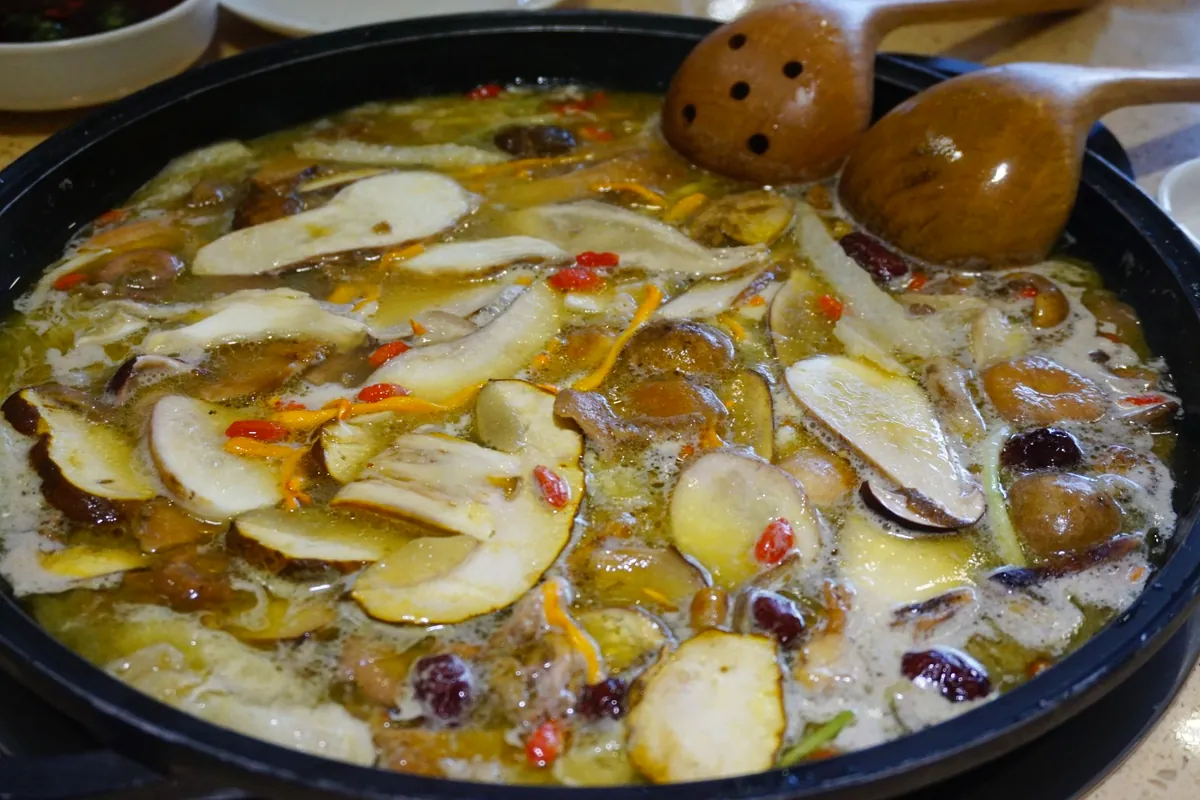
Beyond the delicate flavors of the noodle soup, the subtropical highland climate, influenced by the monsoons from the Ailao Mountains, has bestowed upon Kunming the title of “Kingdom of Wild Mushrooms,” with the irresistible, authentic wild mushroom hotpot. In the taverns along Dianchi Lake, the bubbling mushroom hotpot releases the intense aroma of natural herbs, gathering dozens of rare species from the ancient forests of Yunnan, such as porcini, matsutake, termite mushrooms, bamboo fungus, and morel. The broth is crafted entirely from pristine mountain spring water simmered with dried mushrooms as a base, avoiding industrial seasonings to honor the pure, natural sweetness of the earth. Locals strictly adhere to a twenty-minute hourglass timer before eating—a culinary custom that is both a food safety practice and a ritualistic tradition passed down through generations.

Concluding this symphony of Dian-region flavors is the lingering sweetness of rose pastry, a royal souvenir once presented to the imperial kitchen during the reign of Emperor Qianlong. Made from indigenous Dianhong rose petals hand-harvested while morning dew still clings to the branches, the filling is macerated with rock sugar and pure wild honey to preserve its natural color and fragrance. The multi-layered crust, kneaded with premium lard and flour, releases an intoxicating aroma after being baked over charcoal. A single bite reveals a crisp, flaky texture that melts on the tongue, blooming with a subtle floral bitterness and a clean, sweet aftertaste. This elegant dessert, paired with a pot of aged Pu-erh tea by the weeping willows of Daguan Pavilion, perfectly encapsulates the serene spirit and culinary depth of this land of flowers.
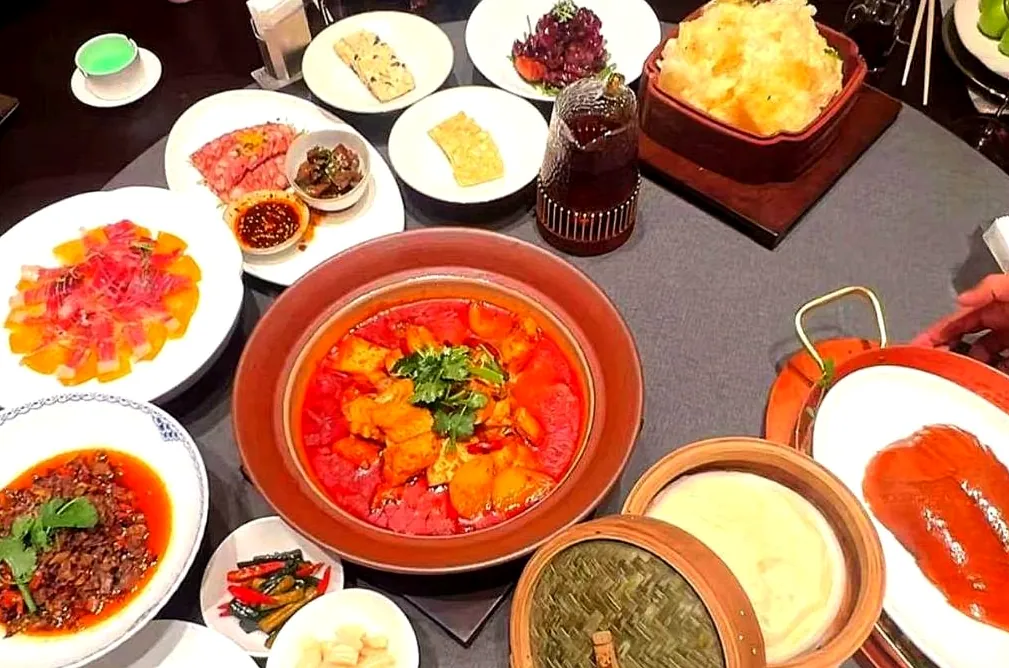
To wrap up a journey through the expansive landscapes of Daguan Pavilion, nothing is more complete than leisurely savoring the Dian-region culinary style at a lavish, traditional Chinese banquet. At the center of the traditional rotating round table, a large, spicy hotpot with a vibrant red broth bubbles with the aromatic scent of Sichuan peppercorns and dried chilies, elegantly surrounded by plates of thinly sliced fresh beef, highland wild mushrooms, baskets of crisp vegetables, golden-fried dishes, and delicate side dishes. This cozy, communal atmosphere not only awakens all senses after a long day of sightseeing but also fully embodies the generous, hospitable spirit and the simple yet sophisticated culinary culture of the bountiful Yunnan land.
To begin your expedition to the “City of Eternal Spring,” the land route combined with rail travel via the Lao Cai – Hekou international border gate is a classic itinerary favored by travelers. After completing quick immigration procedures at the Hekou border gate, travelers can board modern high-speed trains or high-quality coaches along the main transport corridor to reach Kunming station, covering the long distance in about 6 to 7 hours. Throughout the journey across the majestic karst terrain of Southwest China, the magical transition from the humid tropical climate of the border region to the cool, crisp breeze of the plateau—over 1,800 meters above sea level—will signal that you have officially set foot in this land of heritage.
When visiting Daguan Pavilion, travelers should note that the park is generally open from early morning until dusk, making it very convenient to arrange an itinerary that includes other nearby attractions around Dianchi Lake. A valuable piece of advice for those with a refined soul is to set aside at least 3 hours to experience a tea ceremony on the veranda of the ancient pavilion. Amidst the scent of incense and the gentle lapping of water against the rocks, sipping on renowned aged Pu-erh tea while listening to a master recount the poetic flow of classical scholars or reflecting on the 180 golden characters of Sun Ranweng’s famous long couplet will bring a rare sense of inner stillness that hurried trips simply cannot touch.
Kunming currently faces many challenges due to commercialization in major tourist hubs, where visitors can easily encounter forced stops at shops selling overpriced jade, medicinal herbs, or low-quality handicrafts. To preserve authentic and pure memories of this land, travelers should proactively seek independent experiences and avoid non-transparent services. Prioritizing self-guided itineraries or specialized services helps respect personal freedom, eliminating commissioned shopping stops to dedicate time fully to admiring landmarks, exploring historical depth, and immersing oneself in the local culture in the most genuine way.
Being well-prepared with visa procedures, pre-installing local mobile payment apps, and maintaining an open mindset will help make your visit to Daguan Pavilion an unforgettable mark in your travel diary. If you are looking for a well-curated itinerary that delicately combines exploring the wonders of Dianchi Lake with enjoying the original essence of the landscape, you can refer to our all-inclusive tour packages, specifically designed to elevate every moment of your journey.