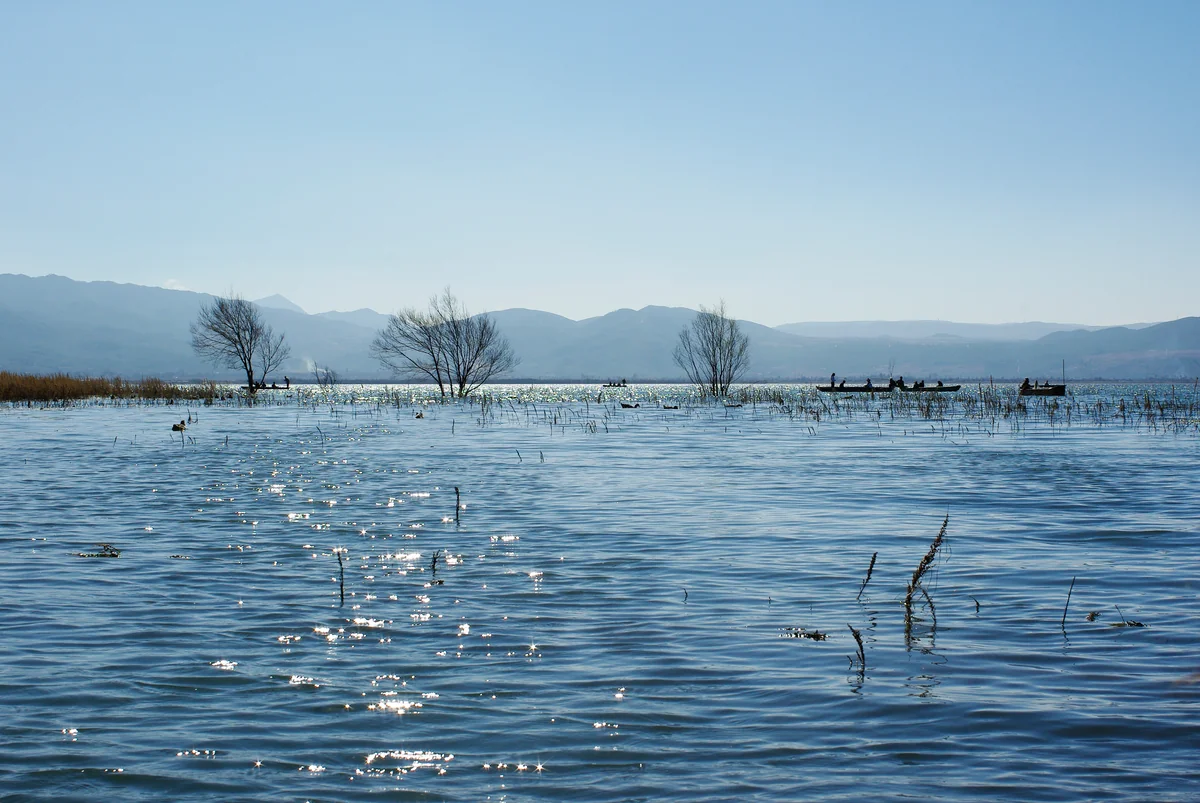
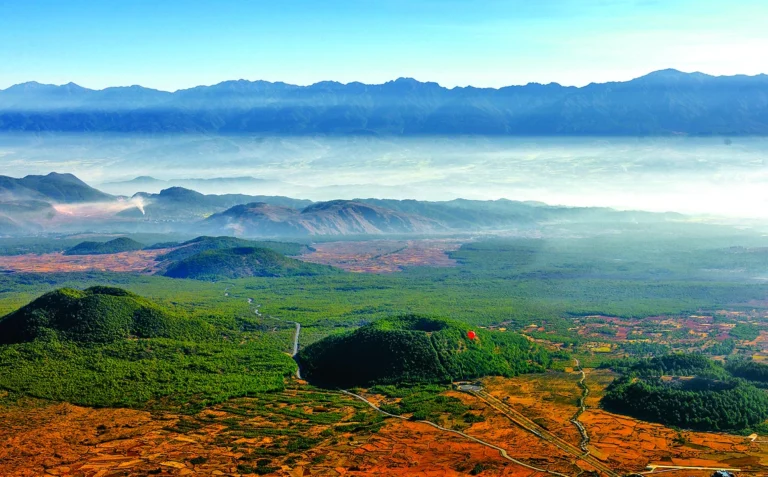
The architectural complex of the Three Pagodas at Chongsheng Temple is situated in the ancient land of Dali, Yunnan Province, People’s Republic of China—a remarkable geographical realm located at approximately 25 degrees north latitude and 100 degrees east longitude. Topographically, this monument occupies a strategic position at the foot of Ma’er Peak in the majestic Cangshan Mountain range, facing the vast waters of Erhai Lake at an elevation of roughly two thousand meters above sea level. The harmony between year-round snow-capped peaks and the tranquil lake basin creates a distinctive landscape ecosystem where geomorphological features and plateau climate shaped a sacred precinct many centuries ago. This setting offers far more than natural defensive advantages; it reflects traditional East Asian geomantic philosophy in siting monumental religious structures, closely uniting soaring mountains with sacred waters.
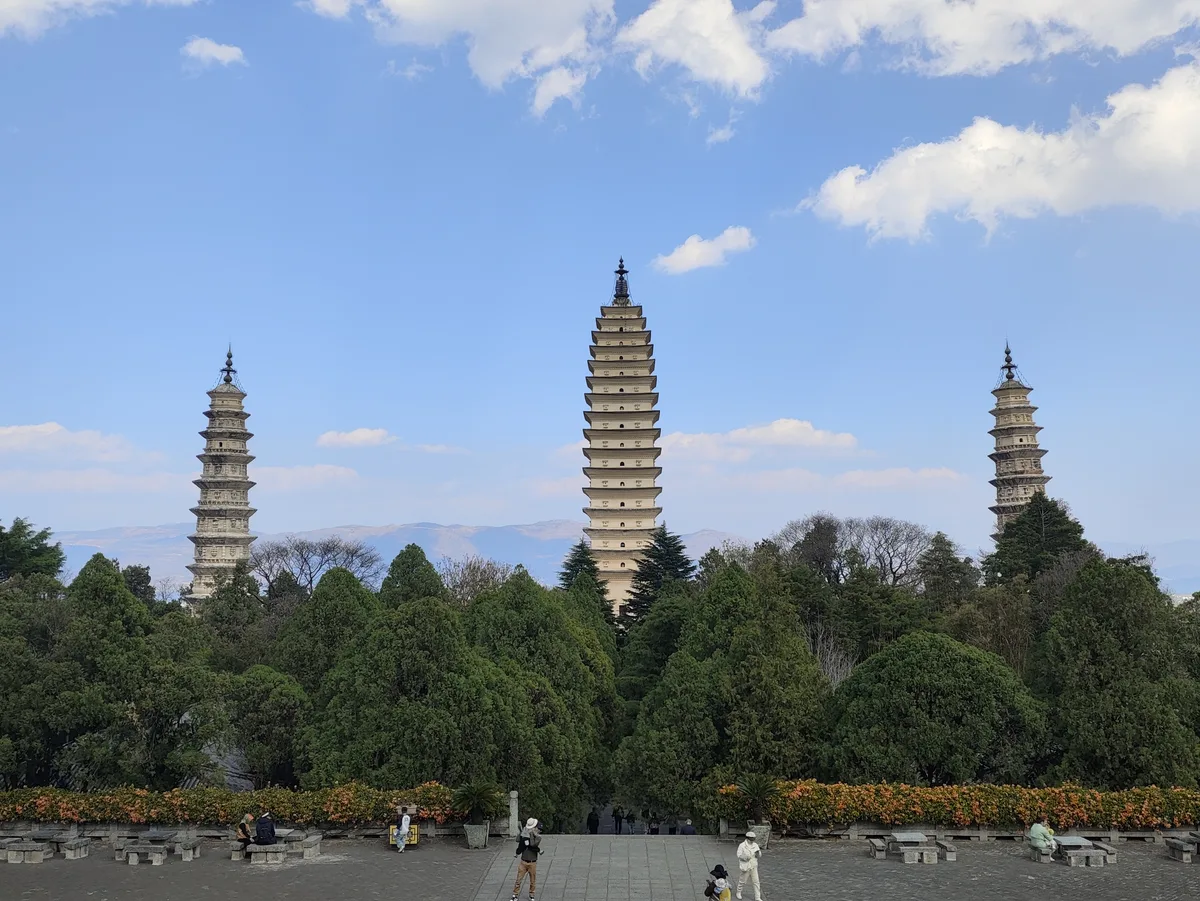
The origins and evolution of Chongsheng Temple and its trio of pagodas are closely tied to the regional dynasties that ruled the Nanzhao and Dali kingdoms from the ninth century onward. According to surviving archaeological records and historical stone inscriptions, the central tower—named Qianxun Pagoda—was begun during the reign of King Quan Fengyou (recorded in local chronicles under the Zhuli era) of the Nanzhao Kingdom, specifically between 824 and 839 CE. Constructing a brick-and-stone monument on such a grand scale at that time demanded highly advanced metallurgy, brick firing, and structural engineering, testifying to the social organization and financial strength of the independent kingdom. The two subsidiary pagodas to the north and south were added during a later phase, estimated around the tenth century during the Dali Kingdom, completing a balanced triangular composition and forming an architectural emblem enduring across space and time.
Across more than a millennium of historical change, Chongsheng Temple and the Three Pagodas have weathered countless upheavals, from dynastic wars to devastating natural disasters. Originally, Chongsheng Temple flourished as an extraordinary Buddhist center hailed as the “Buddhist Capital” of Southwest China, where as many as nine kings of the Dali Kingdom abdicated the throne to enter monastic life. Yet most of the original temple’s grand timber halls, galleries, and wooden structures were destroyed by armed conflicts and fires over the centuries—most severely during the Qing Dynasty and late nineteenth-century turmoil. Remarkably, the trio of brick pagodas stood resilient through a succession of major earthquakes that leveled surrounding settlements, including the historic 1925 earthquake that destroyed nearly all of Dali Ancient City while leaving the Three Pagodas standing as a miracle of ancient engineering.
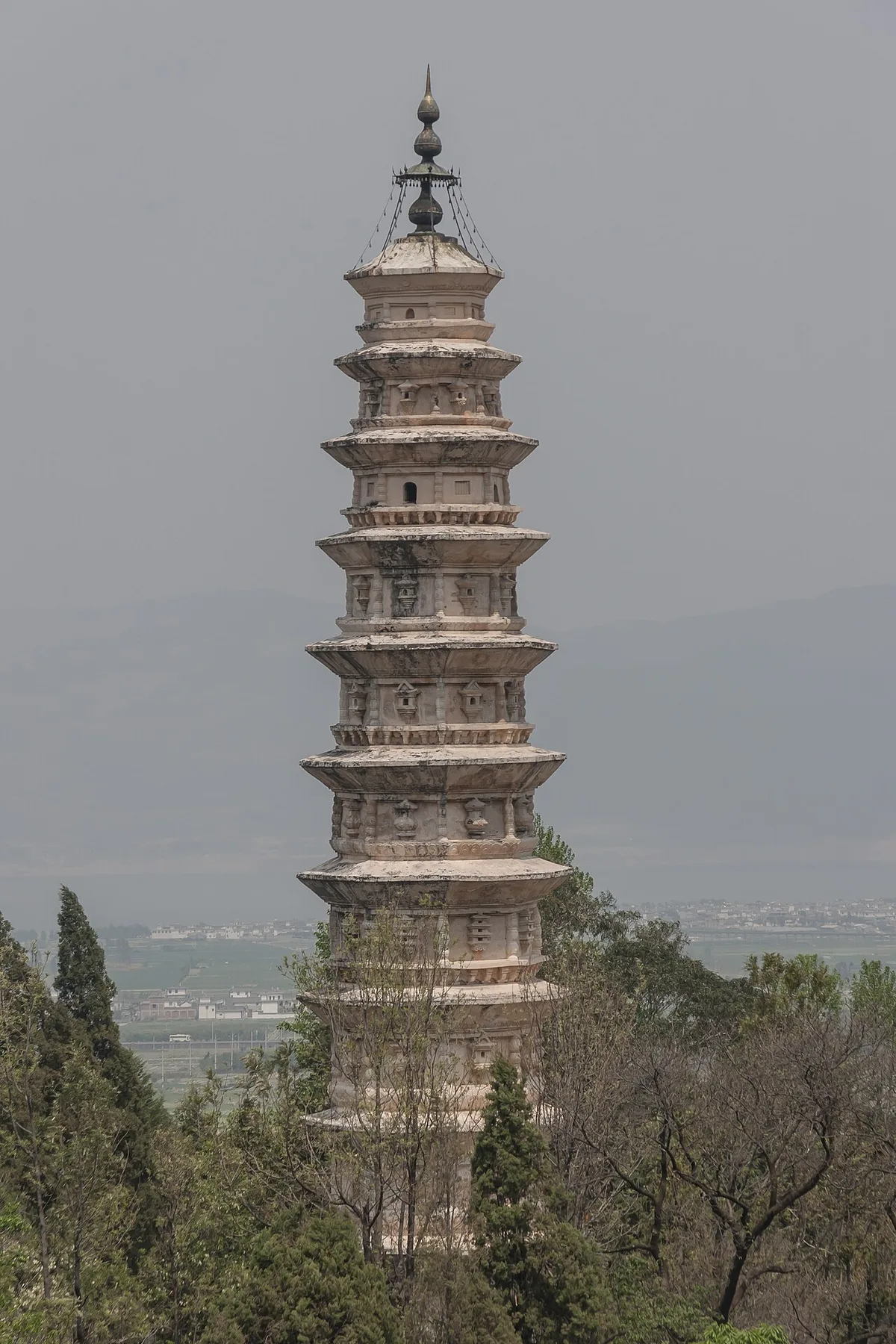
The central Qianxun Pagoda is a hollow-core brick pavilion-style tower rising nearly seventy meters across sixteen tiers, featuring upturned eaves strongly reflecting Tang and Song architectural traditions. Its exterior walls are coated in traditional lime-clay plaster and carved with blind windows and terracotta reliefs depicting Buddhas, bodhisattvas, and dharma protectors in exquisite detail—demonstrating a profound synthesis of Chinese Buddhist art with South Asian and Tibetan aesthetic elements. Flanking it symmetrically, the two smaller pagodas stand roughly forty meters tall, each built with ten tiers on an octagonal floor plan to form a dignified, balanced skyline. The intact survival of these three towers provides architectural historians with invaluable insight into medieval multi-story hollow-brick tower construction built without a central core pillar.
The national symbolic stature and cultural reach of the Three Pagodas of Chongsheng Temple extend far beyond Yunnan to rank among the foremost tangible cultural treasures of Chinese civilization. In 1961, the State Council of China officially designated the Three Pagodas of Chongsheng Temple among the very first batch of Major Historical and Cultural Sites Protected at the National Level, affirming their exceptional historical and artistic significance. Major restoration programs in the late twentieth century—most notably the landmark 1978 conservation campaign—uncovered thousands of priceless relics concealed within the pagodas, including Buddhist statues crafted from gold, silver, bronze, and jade alongside Sanskrit scriptures written on paper and palm leaves. These artifacts not only illuminate the rich spiritual life of the Dali Kingdom, but also attest to the vital role of the ancient overland trade network linking regions across Asia, widely known to scholars as the Southern Silk Road.
The cultural influence of this monument is equally evident in the deep interplay between indigenous Bai culture and Buddhist traditions transmitted from India via Tibet and the Central Plains. In centuries past, Chongsheng Temple served as a gathering center for eminent monks who composed major Buddhist treatises and acted as diplomatic envoys between the Dali court, the Song and Yuan dynasties, and neighboring kingdoms across Southeast Asia. The silhouette of the three pagodas rising against the sweeping backdrop of Cangshan Mountain and Erhai Lake has inspired poetry, painting, and scholarship for generations, shaping the distinctive cultural identity of Dali.
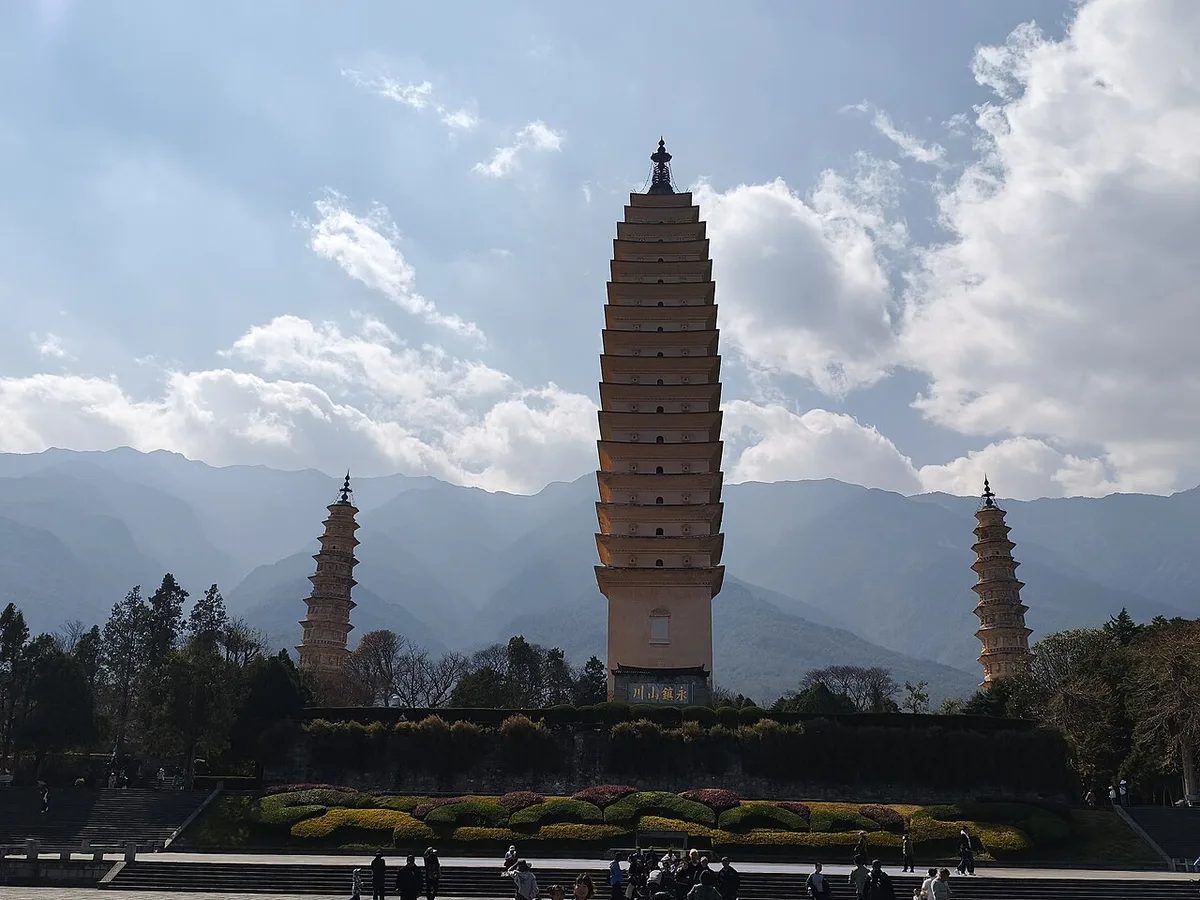
In the contemporary era, conserving and presenting the heritage value of the Three Pagodas of Chongsheng Temple demands rigorous scientific methodology from international scholars to safeguard the delicate brick structures against environmental pressures and heavy visitor foot traffic. Geotechnical surveys, seismic vibration monitoring, and ancient material analyses are conducted continuously to ensure this millennium-old landmark endures the passage of time. Defined by irreplaceable historical depth, resilience through natural disasters, and pinnacle craftsmanship from the ancient Dali Kingdom, the Three Pagodas remain one of humanity’s most radiant cultural icons—where a storied past and modern preservation unite eternally.
The architectural ensemble of Chongsheng Temple and its soaring Three Pagodas rest along the eastern foothills of Cangshan Mountain—part of the dramatic range framing the Yunnan basin—roughly one kilometer northwest of Dali Ancient City. Geologically and tectonically, the terrain was shaped millions of years ago by crustal faulting that created a gentle slope descending straight toward the broad expanse of Erhai Lake at an average elevation of around two thousand two hundred meters above sea level. The meeting of steep metamorphic-schist slopes and fertile basin alluvial deposits formed a distinctive geographical setting that required feudal-era planners and architects to execute complex grading, stone terracing, and site layouts in order to erect one of ancient East Asia’s grandest Buddhist sanctuaries.
The construction history of the complex mirrors the golden age of the Nanzhao and Dali kingdoms between the ninth and tenth centuries. The principal tower—also celebrated in local lore as Qianxun Pagoda—was initiated in the mid-ninth century, while the two smaller flanking pagodas were completed slightly later at the height of Nanzhao and Dali prosperity. The master layout of Chongsheng Temple strictly observes north–south axial symmetry paired with stepped terracing along the incline of Cangshan Mountain. Originally spanning hundreds of mu of land, the monastic complex encompassed five grand halls, three soaring pagodas, nine pavilions, seventy-six worship chambers, and countless bronze and gilded Buddha statues—forming a monumental ensemble capable of accommodating tens of thousands of monks and pilgrims during major state ceremonies.
At the focal point of the entire precinct stands the Three Pagodas cluster, whose clean geometric form and extraordinary structural stability reflect the height of pre-modern masonry engineering. The main Qianxun Pagoda is a square, hollow-core brick tower reaching 69.13 meters across sixteen stories, built in the signature Tang-style multi-eaved brick pagoda tradition while infused with indigenous Nanzhao cultural motifs. Its base flares outward and tapers gracefully toward the summit in precise geometric proportion, generating an imposing silhouette engineered to resist frequent earthquakes along this active tectonic fault zone. All four faces feature arched niches housing bas-relief Buddhas and bodhisattvas sculpted in traditional lime plaster.
Flanking the main tower symmetrically, the South and North Pagodas stand roughly 42.19 meters tall across ten tiers. Viewed from the east, the floor plan of the three pagodas forms a classic isosceles triangle, with the main tower anchoring the western apex and the two subsidiary pagodas positioned at the eastern corners—spaced with mathematical precision to balance structural weight and architectural proportion. The primary building material consists of large, high-strength fired clay bricks bound with traditional mortar formulated from slaked lime, clay, and cane-sugar syrup or glutinous rice water, creating bonds resilient enough to endure more than a thousand years of weathering.
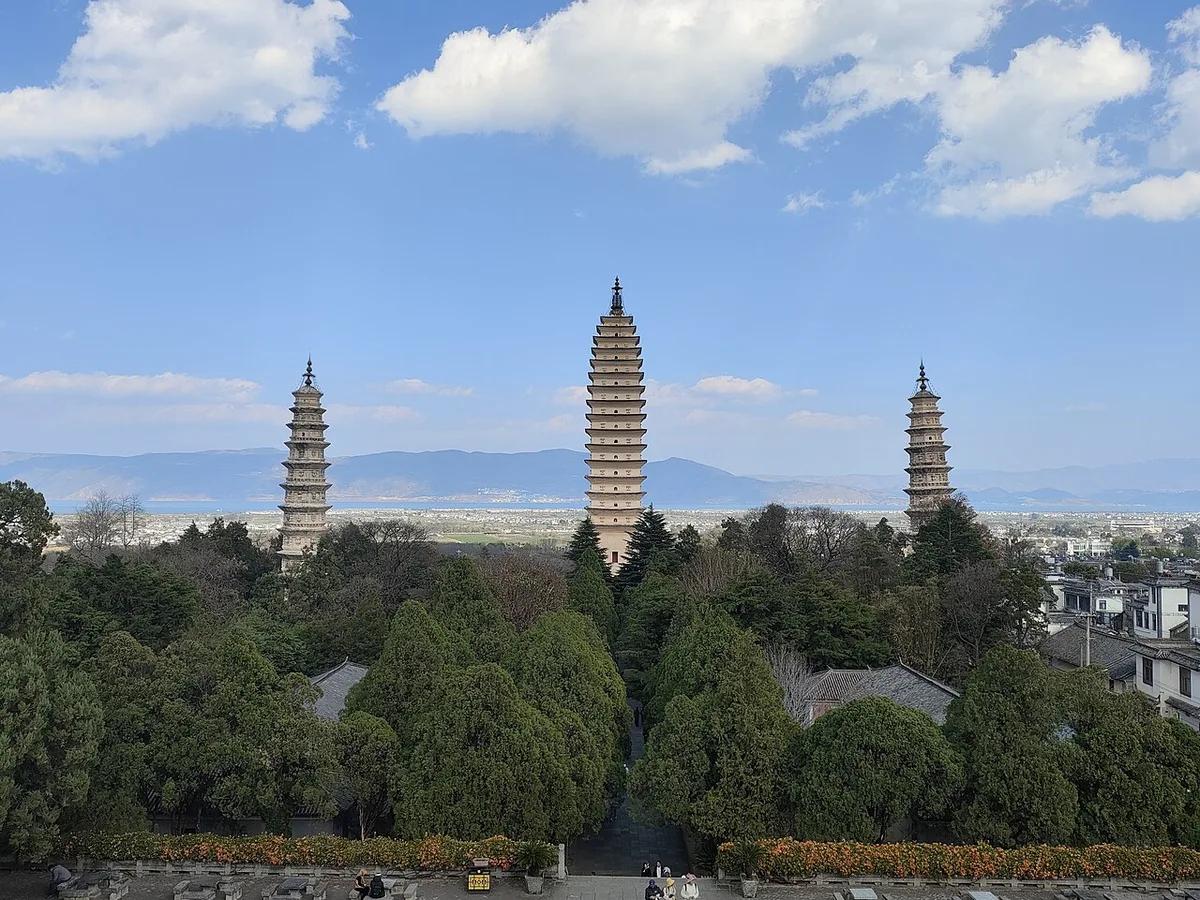
The ingenuity of ancient builders in raising sky-piercing towers on sloping ground without modern machinery testifies to remarkable mastery of mathematics and structural physics. Nanzhao builders piled compacted earth into spiral earthen ramps winding around the rising tower body to haul bricks and mortar upward, gradually excavating the ramps once construction was complete. Inside the hollow core of the main pagoda, wooden staircases and walkways provided access to upper levels for astronomical observation and maintenance. Exterior walls were finished with a smooth coat of white lime plaster serving as a crisp backdrop for molded lotus petals, drifting clouds, and Buddhist emblems—creating an aesthetic at once serene and commanding.
Beyond the Three Pagodas, Chongsheng Temple’s architectural plan includes principal worship halls—such as Chongsheng Hall, Guanyin Hall, and the Bell Tower—stepped sequentially up the mountain slope along the central axis. Chongsheng Hall houses some of the largest pure-bronze Buddha statues in ancient Southwest China alongside a monumental bronze bell weighing several tons, resting upon deep foundations of dry-stacked stone slabs interlocked without mortar. Surrounding halls employ traditional timber post-and-beam frames crowned with intricate dougong bracket sets supporting ash-gray glazed tile roofs, reflecting dynamic cultural exchange between Tang-dynasty Central Plains architecture and indigenous Bai craftsmanship in Dali.
Today, the restored and expanded heritage park spans dozens of hectares, incorporating landscaped ecological grounds and reflecting pools that mirror the stately silhouette of the Three Pagodas. Visitor reception and research facilities are thoughtfully organized near the eastern entrance, featuring spacious parking areas, a heritage visitor center, granite walkways blending naturally into the hillside, and advanced security monitoring to safeguard fragile thousand-year-old masonry. Welcoming millions of travelers and architectural scholars annually, the site enforces careful capacity management to minimize environmental stress and carbon impact on its historic structures.
Preserving the spatial integrity and architectural fabric of Chongsheng Temple and the Three Pagodas relies on close collaboration between modern archaeology, 3D laser scanning, and traditional material replication. Conservation specialists continually monitor soil moisture, measure subtle structural tilt caused by historic and modern seismic activity, and analyze original plaster chemistry to formulate fully compatible restoration mortars. By faithfully maintaining its original spatial layout, the monument preserves its historical, artistic, and engineering significance intact—standing as an invaluable open-air textbook on the evolution of Asian civilization.
Rising beside the shores of Erhai Lake in Yunnan Province, Chongsheng Temple and its iconic Three Pagodas stand as an eloquent monument to the golden age of the Nanzhao and Dali kingdoms during the ninth and tenth centuries. Initiated under Nanzhao ruler Quan Fengyou, the monastery once served as the supreme Buddhist center of China’s southwestern frontier, where Esoteric and Mahayana Buddhism merged seamlessly with indigenous Bai traditions and spiritual currents arriving from India and Tibet along the overland Silk Road. Though most wooden worship halls have undergone successive restorations over the centuries, the master layout and the trio of brick pagodas preserve nearly intact the structural mastery and artistic brilliance of ancient builders.
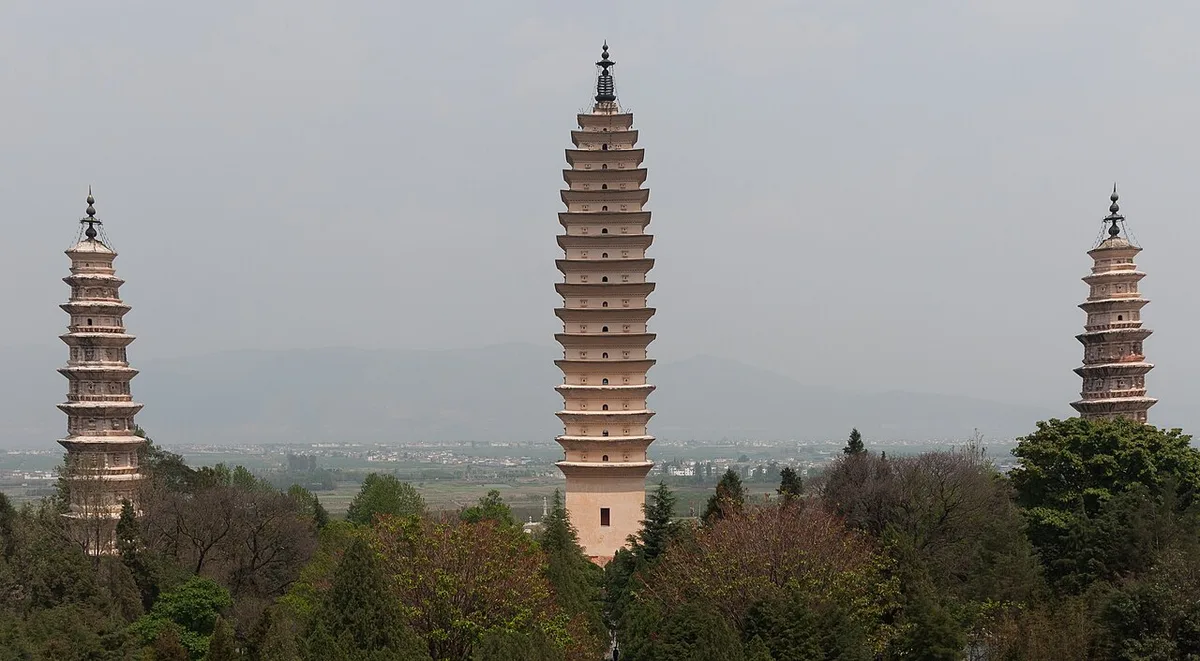
At the heart of this heritage ensemble stands Qianxun Pagoda, the central tower positioned in front, soaring nearly seventy meters across sixteen tiers in the classical Tang-dynasty multi-eaved pavilion style. Constructed entirely of fired clay brick bound with traditional lime-and-cane-sugar mortar, the tower features a square floor plan with gently upturned eaves that lend grace to its massive masonry volume. Every tier opens with arched portals facing the four cardinal directions, leading to a hollow interior once fitted with wooden stairs allowing monks to ascend and gaze out over Cangshan Mountain and the shimmering expanse of Erhai Lake. Thick exterior plaster coats are delicately sculpted with Buddhist symbols, lotus motifs, scrolling clouds, and mythical guardians, showcasing brick-firing and exterior relief artistry at the pinnacle of ancient East Asian craftsmanship.
Set symmetrically behind Qianxun Pagoda are two smaller octagonal towers erected slightly later during the Dali Kingdom, forming a harmonious triangular composition when viewed from afar. Rising roughly forty meters across ten tiers, these flanking pagodas feature solid brick cores with exterior wall niches enshrining bas-relief Buddha figures carved from white marble or molded terracotta finished in red lacquer and gold leaf. Pairing a square Tang-style central pagoda with two octagonal Song-era subsidiary towers reflects rich cultural synthesis and a deeply philosophical master plan conceived by Dali royal architects. Standing steadfast beneath the vast sky of the Yunnan Plateau, the three towers served in traditional geomancy as spiritual anchors calming seismic turbulence, while simultaneously symbolizing the Three Jewels of Buddhism—Buddha, Dharma, and Sangha—and the tripartite cosmos of classical Eastern philosophy.
Stepping beyond the Three Pagodas into the inner sanctuary of Chongsheng Temple, visitors and art historians are captivated by the grandeur of worship halls reconstructed faithfully from royal archaeological records. Principal structures—including the Mahavira Hall, Guanyin Hall, and Hall of Heavenly Kings—align along the central sacred axis, adhering strictly to imperial courtyard symmetry while incorporating distinctive Bai folk artistry. Load-bearing timber frames rely on intricate dougong bracket sets assembled without iron nails, providing vital structural elasticity during seismic tremors. Glazed yellow and jade-green roof tiles rest atop rafters carved with dragons, phoenixes, and stylized flora, gleaming brilliantly in the crisp plateau sunlight.
Inside the halls, statues and ritual treasures preserved across centuries form an extraordinary gallery of Nanzhao and Dali bronze casting and stone sculpture. Hundreds of figures of Buddhas, bodhisattvas, arhats, and dharma guardians are crafted from bronze, prized hardwoods, and gleaming white marble quarried directly from neighboring Cangshan Mountain. Serene images of Shakyamuni Buddha seated in lotus posture embody the Mahayana ideal of liberation, while local depictions of Avalokiteshvara (Guanyin) reveal a uniquely regional identity influenced by Southeast Asian and Indian Esoteric traditions—such as Acarya Guanyin and multi-armed forms adorned with royal regalia symbolizing universal compassion.
The cultural legacy of Chongsheng Temple is further enriched by ancient inscriptions, stone stelae, and monumental bronze bells—foremost among them the great Dali-era bronze bell cast during the height of the kingdom. Weighing many tons and inscribed in relief with thousands of Chinese characters chronicling the temple’s founding and prayers for peace, its deep, resonant toll once echoed across the Erhai valley, recalling an era when Buddhism flourished as the state religion. Ancient stone stelae lining the temple galleries preserve calligraphy by monarchs and eminent monks across dynasties, offering invaluable primary records on the language, governance, and social life of the ancient Dali Kingdom.
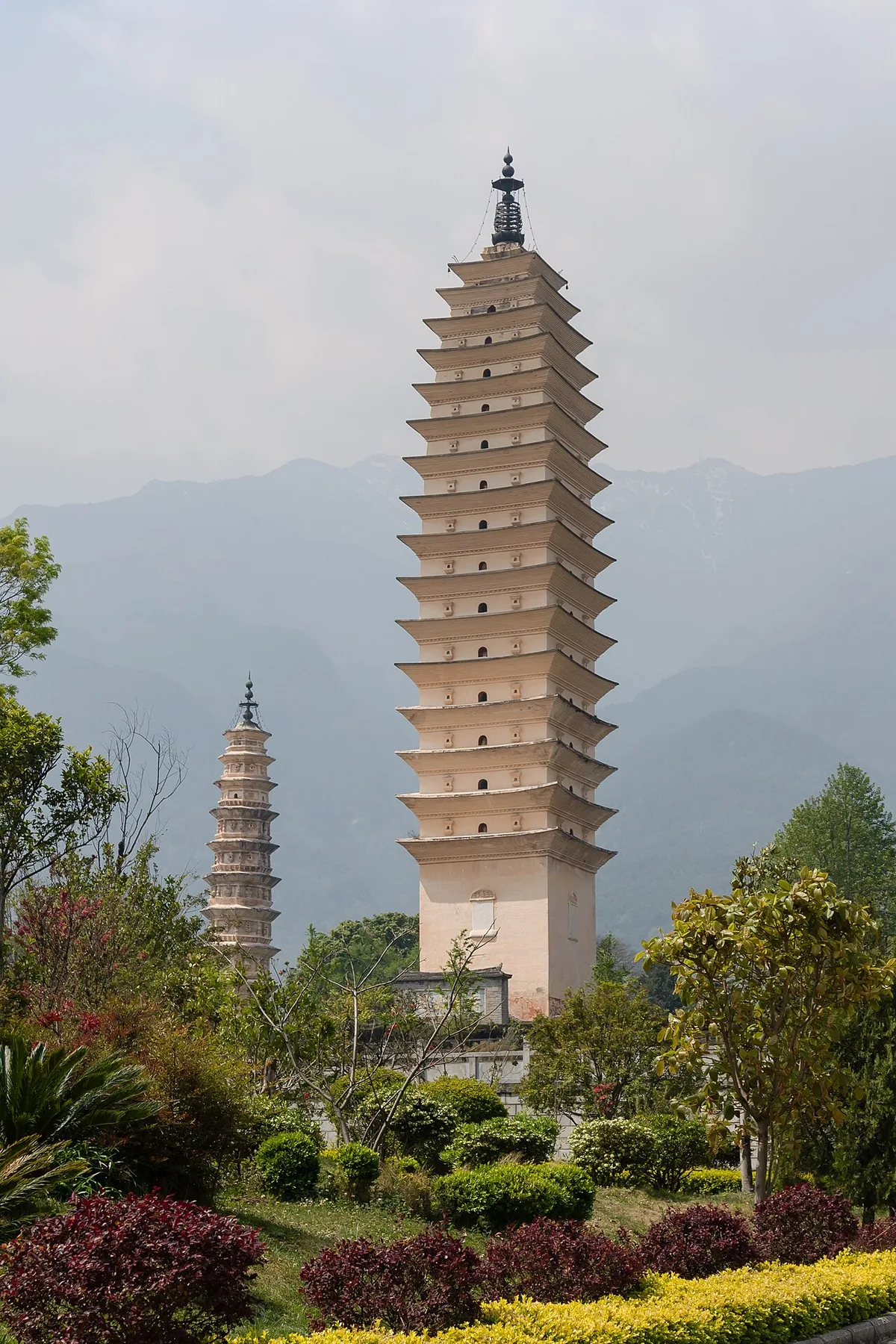
Examining decorative motifs across the complex reveals a captivating dialogue between Tang and Song artistry from the Central Plains and South Asian as well as indigenous Yunnan motifs. Dragons carved along stone stairways and timber beams forego the fierce rigidity of northern imperial styles in favor of fluid, graceful curves paired with lotus blossoms, swirling water, and birds—sacred emblems rooted in ancient Bai animist beliefs. This cultural synthesis transforms Chongsheng Temple into a living museum of cultural exchange where major Asian civilizations met, conversed, and blended within a tranquil mountain sanctuary.
Anchored by its soaring Three Pagodas between Erhai Lake and Cangshan Mountain, the Buddhist complex of Chongsheng Temple beats to a daily rhythm woven closely into Bai spiritual life and the distinctive ecology of the Yunnan–Guizhou Plateau. Here, the shifting light across the day brings more than visual beauty; it marks centuries-old traditions observed continuously by local communities. Dawn breaks as wisps of mist hovering over Erhai Lake dissolve beneath the first golden rays striking Malong Peak of Cangshan. Warm morning light gilds the ancient brick facade of Qianxun Pagoda in a serene, monumental tableau, broken only by the deep chime of the morning temple bell, wind whispering through old pines, and the quiet footsteps of monks and local pilgrims. Dressed in traditional attire accented with crisp white, Bai residents arrive early to offer incense, chant sutras, and circumambulate the pagodas in the brisk highland air.
By midday, the precinct shifts toward a livelier pace filled with cultural discovery and unhurried sightseeing. Visitors and art historians from around the world gather to admire the nearly seventy-meter central pagoda and its twin flanking towers, studying Sanskrit-inscribed bricks and finely carved bluestone reliefs dating from the Nanzhao era. Along moss-worn stone steps, local folk musicians frequently play traditional Bai melodies on the dulcimer and bamboo flute beneath temple eaves, their notes mingling with clear mountain streams cascading down from Cangshan. Nearby, local artisans warmly share regional crafts such as traditional tie-dye textiles, Dali marble paintings, and celebrated Three-Course Tea, offering travelers an authentic window into everyday life at the foot of Cangshan Mountain.
Late afternoon brings a dramatic visual transformation as sunset paints the sky over Erhai Lake in rich crimson and amber, casting warm light across the whitewashed facades of the pagodas against the deepening twilight shadow of Cangshan Mountain to the west. From the upper terraces of the complex, sweeping panoramic views unfold across the Dali valley—emerald and golden rice fields dotted with traditional white-walled, gray-tiled Bai courtyard homes, while Erhai Lake mirrors the glowing sky like a colossal looking glass. Photographers prize this golden hour for capturing the timeless harmony between ancient architecture and untamed highland scenery. Once darkness falls, subtle architectural lighting illuminates the Three Pagodas against the star-filled plateau sky, lending the sanctuary an ethereal, contemplative presence.
At night, the temple grounds settle into profound stillness punctuated only by mountain breezes rustling through ancient trees and distant evening sounds from surrounding villages. Under silvery moonlight, the silhouettes of the Three Pagodas evoke the storied history of the independent Dali Kingdom along the Southern Silk Road, while in nearby hamlets at the foot of the mountain, families gather around hearths sharing folk legends of how the pagodas were raised to calm waters and protect the valley. Exploring Chongsheng Temple and the Three Pagodas thus becomes far more than a sightseeing stop—it is an immersive journey through time into living Bai heritage and the enduring spirit of Yunnan.
Dali in Yunnan Province—where Chongsheng Temple and its three ancient pagodas have weathered more than a millennium of highland winds—is not only a treasury of Nanzhao and Dali architectural heritage, but also a living showcase of Bai culinary culture. Cradled between the towering Cangshan range and freshwater Erhai Lake, the Dali basin enjoys a unique agricultural and aquatic ecosystem that supplies remarkably fresh ingredients. Local gastronomy around Chongsheng Temple reflects a thoughtful fusion of time-honored Bai cooking methods, highland preservation techniques, and cross-cultural flavors carried along the Southern Silk Road, honoring seasonal rhythms and ecological balance.
At the pinnacle of traditional Bai food craftsmanship are artisanal goat-milk products produced along the slopes of Cangshan Mountain, where pastoral herding has thrived since medieval times. Foremost among them is Rushan (milk fan), a beloved regional specialty that has become an emblem of Dali cuisine. Crafting Rushan requires practiced skill: fresh goat milk is heated and curdled with natural acid derived from green papaya or traditional rice vinegar, then hand-stretched into thin ribbons and air-dried on bamboo poles in the crisp mountain sun. Enjoyed grilled over glowing charcoal with a drizzle of cane sugar or crushed rose jam, or flash-fried until crisp, Rushan offers a delicate crunch and rich, milky flavor infused with subtle notes of mountain herbs.
Alongside dairy specialties, fresh aquatic harvests from Erhai Lake form a cornerstone of local dining around Chongsheng Temple. Erhai carp and freshwater shrimp have been celebrated in local chronicles since the Ming and Qing dynasties. Signature dishes such as Dali sour-and-spicy fish combine freshly caught lake fish with naturally fermented bamboo shoots, pickled chilies, and local Sichuan pepper. Bai cooks skillfully incorporate wild lakeside herbs—such as sawtooth coriander, mountain mint, and aged tangerine peel—to balance richness and create a bright, aromatic broth. Simmered with tender tofu and white radish, this comforting soup warms the body during brisk winter days while embodying traditional principles of culinary harmony.
No exploration of Dali’s food and drink culture is complete without experiencing the Bai Three-Course Tea ceremony—a social and spiritual ritual cherished for over a thousand years as the ultimate expression of Bai hospitality. Served during festivals, weddings, and honored guest receptions at the foot of Cangshan Mountain, the ceremony presents three distinct cups symbolizing the stages of human life. The first cup is brisk and bitter, representing the trials and hard work of youth; the second cup is sweet and lingering, symbolizing success and fulfillment in adulthood; and the third cup blends sweetness with spicy fresh ginger, aromatic cinnamon, and Sichuan pepper, inviting quiet reflection in the wisdom of later years. Preparing each pour demands careful control of water temperature over charcoal embers and seasonal herbal proportions to awaken every sense.
Culinary discovery around Chongsheng Temple naturally extends into the cobblestone lanes of Dali Ancient City, whose grid layout dates back to feudal times. Along moss-lined streets, family bakeries and traditional eateries serve regional favorites such as rose flower cakes, flaky pastries filled with edible rose petals harvested from nearby valleys and blended with rock sugar and lard for a crisp crust and delicate floral aroma. Equally iconic is Bai air-dried cured pork, seasoned with salt, corn liquor, and heirloom spices before being hung above pine-wood hearths, where fragrant smoke slowly cures the meat to a deep mahogany hue with rich savory depth.
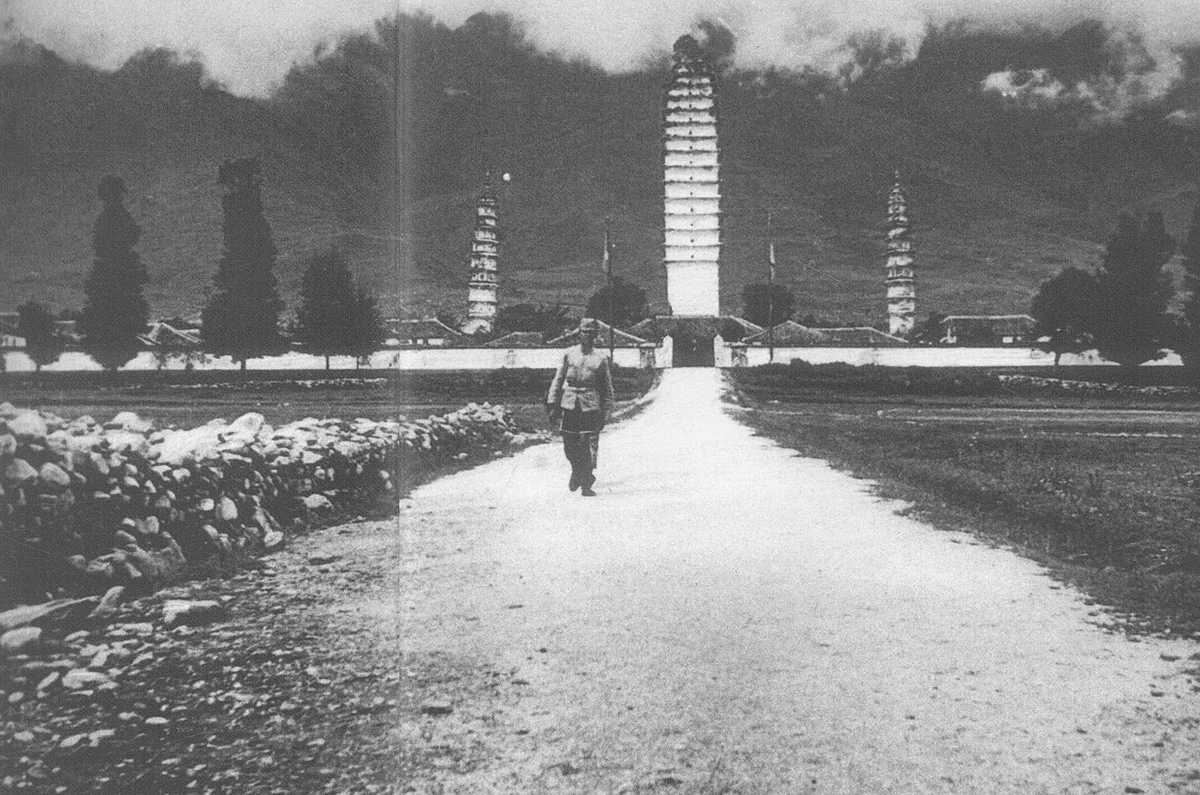
Situated on the eastern slope of Ma’er Peak in the Cangshan range roughly 1.5 kilometers north of Dali Ancient City, Chongsheng Temple and the Three Pagodas reward thoughtful planning around seasonal weather, transport logistics, visiting hours, and local cultural etiquette. Resting at nearly two thousand meters above sea level, Dali enjoys a subtropical plateau monsoon climate marked by dry winters and springs, wetter summers and autumns, and wide day-to-night temperature swings that make layered clothing essential.
In terms of the best time of year to visit, spring (March to May) is widely considered the golden season, offering mild weather, blooming highland flowers, and lingering snow caps crowning Cangshan Mountain. Summer (June to August) brings higher rainfall alongside lush greenery around Erhai Lake, making a compact umbrella or light rain jacket useful for passing mountain showers. Autumn (September to November) delivers crisp blue skies, dry air, and crystal-clear visibility ideal for photographing the Three Pagodas reflected in the temple pools. Winter (December to February) brings chilly nights, yet bright daytime sunshine and smaller crowds create a peaceful, contemplative atmosphere for studying Nanzhao and Dali Buddhist architecture.
Reaching Chongsheng Temple from Dali Ancient City is quick and convenient via several transport options. Departing from the old town, travelers can take local public buses or rent an electric scooter for a scenic ride of under fifteen minutes along tree-lined avenues. Visitors arriving from Dali Railway Station or Dali Fengyi Airport can easily connect via local shuttle buses, taxis, or ride-hailing apps—while metered fares are standard in town, confirming rates in advance for longer airport transfers is good practice. Once inside the main scenic gate, electric shuttle carts are available to carry visitors up the terraced hillside to the upper temple halls, saving energy for exploring the expansive complex.
The best time of day to visit is right when the gates open at 8:00 AM. Early morning sunlight slants cleanly across the whitewashed brick tiers of Qianxun Pagoda, highlighting intricate reliefs while letting you explore ahead of midday heat and tour groups. Late afternoon just before sunset is equally prized by photographers, as warm amber light bathes Cangshan Mountain and the ancient towers in dramatic golden hues. Because the complex spans stepped stone stairways along a hillside, sturdy, comfortable walking shoes or sneakers with good traction are essential.
As an active, revered Buddhist sanctuary, Chongsheng Temple expects respectful, modest attire covering shoulders and knees—overly short shorts, revealing tops, or provocative clothing may be turned away at main prayer halls. High-altitude ultraviolet radiation is intense in Dali even on cool days, so pack high-SPF sunscreen, sunglasses, a wide-brimmed hat, and a reusable water bottle. Admission tickets cover both the Three Pagodas precinct and the upper monastery halls, and can be purchased at the main entrance ticket office or reserved online in advance with a valid original passport.
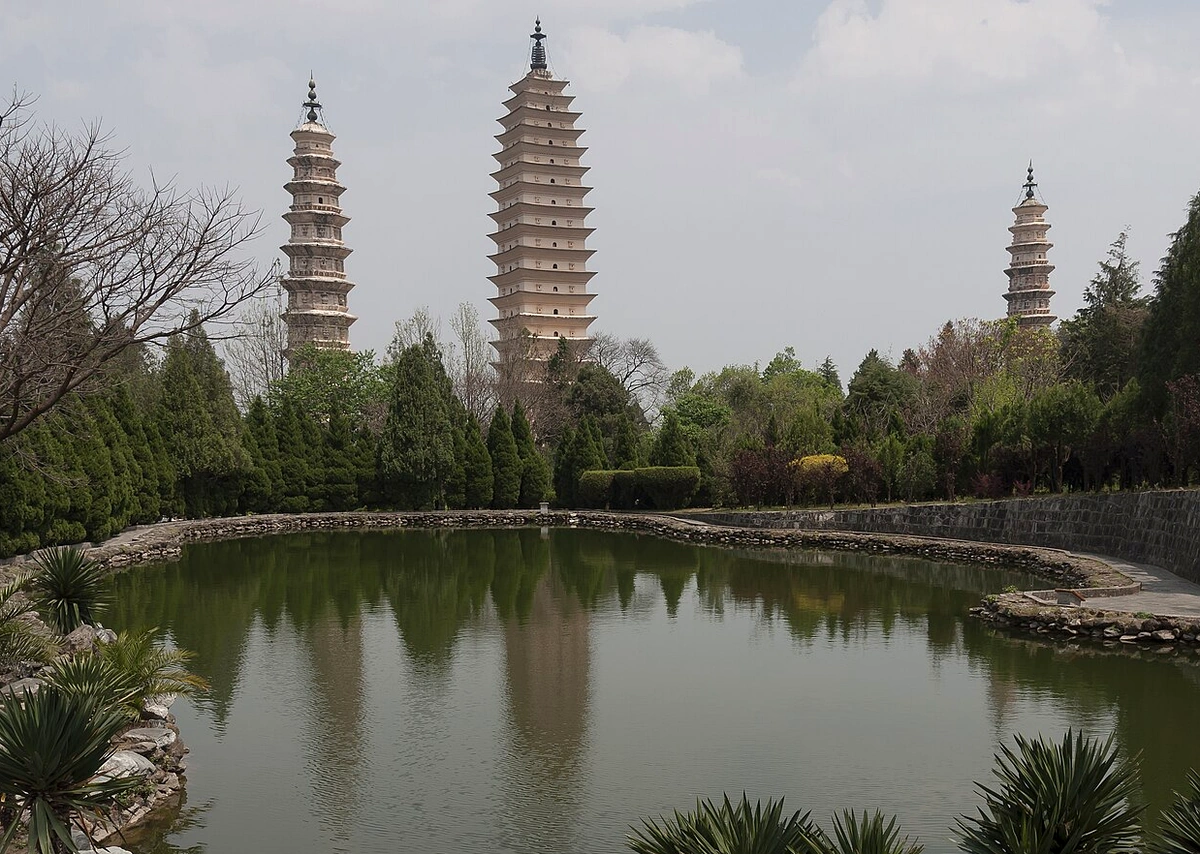
When observing religious ceremonies or touring the prayer halls, visitors should honor Bai customs and Buddhist temple etiquette. Never touch archaeological relics, ancient bronze sculptures, or gilded wooden statues inside the halls, and pay close attention to posted signs restricting photography inside main sanctuaries. When crossing temple doorways, always step over—never onto—the raised wooden threshold, which traditional belief reveres as symbolizing the shoulders of guardian deities and the dignity of the sanctuary. Keeping voices low and maintaining cleanliness throughout the grounds helps preserve the serene sanctity of one of Southwest China’s greatest Buddhist landmarks.
To experience this journey seamlessly alongside a knowledgeable local guide, explore our 6D5N Dali – Lijiang – Shangri-La – Kunming Tour featuring a thoughtfully curated itinerary.