Tracing the river of time back to the early twentieth century, when French imperialism extended its colonial influence into southern China, Mengzi in Yunnan Province witnessed one of the most profound geopolitical upheavals in modern history. Situated in Caoba Town—now part of the Honghe Hani and Yi Autonomous Prefecture—the Bisezhai Railway Station is not merely a train station; it is a historical witness bearing the scars of intense colonial rivalry. The origins of this project are tied to the Qing imperial court, which, under diplomatic and military pressure, was forced to sign the Sino-French Yunnan Railway Convention in 1903, paving the way for French capital to penetrate deep into Yunnan’s economic lifeblood. The meter-gauge railway connecting Vietnam’s Haiphong with China’s Kunming officially broke ground in 1904, mobilizing tens of thousands of laborers and costing countless lives before officially opening to traffic on April 1, 1910. This event transformed an isolated mountainous outpost into an international trade hub, where steam locomotives carrying the breath of the Western industrial age rolled across rugged borders for the first time.
In the panoramic landscape of the transportation systems of that era, Bisezhai rose to become the largest and most critical arterial link, serving as the sole transfer hub intersecting two railway systems with distinct technical standards. This was the convergence of the Yunnan-Vietnam meter-gauge railway and the Gejiu-Bisezhai narrow-gauge railway, which had been constructed to exploit and transport the renowned tin ores from the Gejiu mines. Thanks to this prime strategic location, Bisezhai rapidly transformed beyond the framework of an ordinary station into a miniature European-style city in the heart of the Yunnan Plateau. The hustle and bustle of international merchants, the presence of consulates from various powers, and crowds from everywhere bestowed upon it lavish monikers such as “Little Paris” or the “Little Marseille of the East.” Here, Western culture and Eastern identity intertwined, creating a unique living space where train whistles blended with the sounds of cultural fusion and church bells, reflecting a brilliant golden age that was nonetheless fraught with severe social stratification under colonial rule.
Yet the river of time has never been smooth, and the vicissitudes of the era quickly swept that prosperity away into the smoke of war. By 1940, as the Chinese people’s War of Resistance Against Japanese Aggression entered a fierce and critical stage, the Kuomintang government made a painful military-strategic decision ordering the destruction of the border steel bridge at Hekou to halt the Japanese military advance from French Indochina. This fatal blow completely severed the arterial transportation route, causing Bisezhai Station to lose its international through-traffic function—the very lifeblood of a once bustling town. From the standing of a bustling international trade center, Bisezhai fell into isolation, sinking gradually into oblivion beneath the dust of time, yielding to desolation and the sighs of the past.
Having spent decades submerged in silence, Bisezhai’s fate was redirected once more thanks to the miraculous power of art and popular culture. The modern era opened a nostalgic new chapter when renowned director Feng Xiaogang chose this location as the primary backdrop for his hit feature film “Youth.” These lyrical cinematic frames, recreating an emotional historical period of youth and ambition, successfully awakened the slumbering beauty of this historic station before a global audience. This spectacular rebirth not only turned Bisezhai into a leading historical-cultural tourism coordinate in Yunnan Province, but also bestowed upon it a new mission: preserving the memories of a bygone era where colonial past, warfare, and art melt into one across every weathered brick, tile, and rusted section of track.
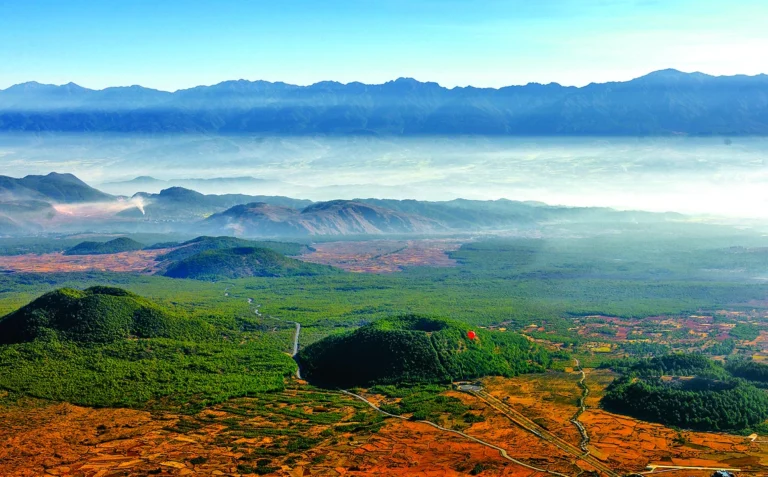
A traveler’s footsteps upon reaching southern Yunnan, winding along roads hugging the plateau, are often overwhelmed by a sudden shift in terrain where nature seems to have meticulously sculpted a space combining the majestic grandeur of a frontier mountain range with the airy openness of a miniature European sky. Bisezhai emerges amidst this space as a seamless link of geography and history, where geomantic terrain harmonizes exquisitely with the millennial philosophy of the East and the pragmatic vision of early twentieth-century Western engineering. According to geological research and cultural fieldwork documents examined on-site, Bisezhai sits right on the southern edge of the Mengzi basin, a tectonic depression with a complex geological history that nonetheless holds invaluable landscape assets for commercial development.
Viewed from traditional feng shui combined with modern urban planning, the terrain of this railway station converges rare elements for gathering prosperity. Behind the station, it relies securely against a fault-line mountain range with sedimentary cliffs weathered over time, forming a natural rampart shielding against cold northern winds sweeping down from the mainland. Conversely, the front opens toward an infinite, expansive vista of the vast Caoba plain, where the Mengzi Sea lake and wetland system moderates the climate, generating refreshing humidity year-round and expanding the view to the distant horizon. This “leaning against mountains while facing water” configuration not only carries spiritual significance regarding permanence and stability, but from a geographic-scientific standpoint, it creates an exceptional natural wind corridor, helping purify the air and mitigate the harsh thermal radiation of low-latitude plateaus.

Impressive and magnificent scenery at Mengzi Bisezhai Railway Station
Beyond landscape geomancy, under the lens of French colonial engineers and industrial strategists of the time, Bisezhai’s location was a flawless elevation buffer zone across the entire arterial Yunnan-Haiphong railway. When the narrow-gauge train began its arduous climbing journey from the low and hot border region at Hekou to conquer rugged high plateau mountains toward Mengzi and push deep into Kunming, Bisezhai appeared as a technical life-saving stopover. The local terrain provided a rare, relatively flat and spacious expanse of land amid rugged mountain topography, creating ideal conditions to plan a large-scale station system comprising train marshaling yards, locomotive repair workshops, freight warehouses, and living quarters for hundreds of French, Chinese, and multi-national technical personnel.
The distinctive climate of this region also helped shape the unique architectural style of the entire station complex. Belonging to a low-latitude plateau monsoon climate, Bisezhai enjoys temperate conditions where winters are not bitterly freezing like in Northeast Asia, nor do summers suffer the extreme sweltering heat of low tropical plains. However, the pronounced distinction between dry and rainy seasons, coupled with very high daytime solar radiation on the plateau, presented challenging puzzles for Western architects. They were forced to research and apply remarkably skillful eco-adaptive solutions combining European construction techniques with native materials.
Strolling among warehouses, offices, and residential buildings alongside the tracks, one easily notices these adaptive architectural marks stamped upon every small detail. Deep eaves were designed to extend outward to shield exterior walls from driving rain during torrential highland downpours while blocking harsh sunlight from shining directly through window frames. All structures were built with thick brick walls to enhance thermal insulation, keeping interiors cool in summer and warm when night fell. Coupled with raised subfloor venting or smart louvered openings, combined with characteristic French-blue painted wooden shutters, this created continuous air circulation, helping structures withstand high humidity and harsh weather persistently for over a century.
It was this seamless intersection between rugged yet open terrain, large-scale industrial engineering planning, and eco-adaptive architectural thinking that transformed Bisezhai far beyond a mere transport railway station. It became a complete architectural-landscape ecosystem, a living outdoor museum bearing witness to an era when modern Western industrial breath first touched and blended into the heart of the pristine Yunnan plateau.
Stepping into the Bisezhai architectural complex in Mengzi County, Yunnan, any visitor with a nostalgic soul will be astounded before a nearly pristine cultural-artistic space where early twentieth-century French architectural refinement deeply intersects with local Chinese building techniques. Viewed comprehensively, this heritage complex spans across hundreds of mu, comprising a diverse system of structures ranging from the main station, hotel, dormitories, and hospital to warehouses, all painting a unique and rare miniature French eclectic colonial townscape in the border plateau. Spatial structural surveys reveal a resourceful blend of traditional materials and Western industrial inputs, wherein load-bearing walls primarily utilized locally fired red bricks, combined with traditional rammed earth techniques and sturdy stone masonry to withstand harsh southern Yunnan climatic conditions. Wall surfaces were adorned with signature French colonial yellow paint or muted grayish tones, creating a striking visual contrast against the open sky and surrounding rolling mountain ranges.
Looking upward, the roofing system across these structures is clad in French-style red tiles, including butterfly and trough tiles with steep pitches—an optimal engineering solution shedding rainwater rapidly during tropical monsoons. Beneath that roofing lies high-grade imported timber framing tied tightly with industrial iron-steel accessories bearing heavy marks of Western technological revolutions such as gusset plates, high-strength bolts, and durable load-bearing support systems. The focal point of the entire complex is the main Bisezhai Station building, a single-story brick-wood hybrid structure featuring a spatial layout of a waiting room, telegraph room, and workspaces imbued with classical European arched motifs, having witnessed countless travelers journeying along the legendary Yunnan-Vietnam railway. Immediately in front of the station lies the historical intersection between international meter-gauge and specialized narrow-gauge tracks, alongside the invaluable artifact of a manual steel railway turntable—extremely rare proof of advanced mechanical engineering applied by the French to this rugged terrain over a century ago.
Impressive and magnificent scenery at Mengzi Bisezhai Railway Station
Beyond the central station, Bisezhai’s architectural space extends into numerous satellite structures of high artistic and historical value, notably the Galufang Hotel (哥臚芳飯店), a high-end service facility modeled after the name Cockroach that once served as a resting place for the upper class, foreign merchants, and officers during the filming of “Youth.” Every carved detail on wooden frames, every tall arched window welcoming natural daylight, and every wide hallway facing the open courtyard exudes Western architectural romanticism, yet is harmoniously reconciled by the skilled hands of local master builders. Adjacent to it stand the French railway staff dormitories, field hospital, and expansive warehouses of the Datong Company, together forming a closed, complete spatial organization operating smoothly like an independent miniature town in the heart of Mengzi. Through countless time fluctuations and historical vicissitudes, the Bisezhai architectural complex survives not only as a living museum of craftsmanship and modern railway urban planning, but also as an invaluable cross-border cultural heritage preserving indelible memories of bustling trade eras and encounters between Eastern and Western cultural streams.
When night falls and drapes dark hues over the rolling mountain ranges of southern Yunnan, the Mengzi Bisezhai Railway Station does not plunge into the tranquil slumber of the past, but steps into an entirely different chapter where contemporary space and time blend wonderfully with centennial memories. Instead of abusing bright artificial lighting commonly seen in commercialized tourist spots, the night lighting system here is elaborately invested and planned, strictly adhering to the “restore as original” philosophy combined with a subtle dark sky preservation approach. Warm yellow illumination with low intensity, fluctuating precisely across a color temperature band from 2700K to 3000K, is cleverly concealed to highlight every classic roof arch, sturdy pillar row, and weathered red tile layer across the entire historic station complex. This lighting restraint prevents the loss of inherent solemnity, instead draping the space in an illusory veil that awakens the imagination of any distant traveler setting foot here.
In the historic railway intersection area, which once witnessed countless arterial transport trains connecting Indochina and China, technology experts and lighting artists arranged a sophisticated underground strip light system combined with state-of-the-art Projection Mapping dynamic projection technology. When night achieves necessary tranquility, time-weathered peeling walls and the sprawling station yard suddenly transform into a massive screen, faithfully recreating images of historic steam locomotives rushing forward with billowing columns of white smoke, intertwined with precious archival materials from the early twentieth century. This visual effect produces a vivid spatial illusion, making viewers feel as though they are stepping directly through a narrow window of time, touching heroic and tragic vestiges of a violently turbulent era.
Alongside lighting art and digital techniques, nightlife at Bisezhai is vigorously infused with life through short interactive situational plays rich in narrative flair, notably the work “Bisezhai·1910” performed regularly each week. The performance transports audiences upstream through history to witness grievances and romance, reunions and farewells, as well as the floating fates of various character classes that once coexisted in this borderland. There is the French engineer harboring ambitions to conquer rugged terrain, the wealthy merchant trading busily under the Mengzi dynasty, and persistent horse caravan guides enduring rugged mountain passes. Each character represents a cultural fragment, a hidden corner of fate amidst a chaotic era, portrayed realistically upon the authentic stage setting of the centennial station.
The nocturnal sensory appreciation experience here is further completed by an elaborately designed hidden Soundscape system playing back purposefully on loop. Strolling across wooden railroad ties decayed over the years, visitors hear faint steam train whistles echoing long in mountain mists, jazz music playing from an antique gramophone evoking a golden decade, nostalgic short French dialogues blending with poignant folk melodies of southern Yunnan ethnic minorities. All these visual, auditory, and tactile elements interweave, turning a railway station once seemingly asleep in the past into a vibrant cultural-artistic space where history is not coldly museumized but truly breathing, singing, and whispering to future generations.
Stepping into the ancient dream realm of Bisezhai Railway Station in Mengzi, travelers touch not only somber Indochinese architectural nostalgia nor empathy through colorful cinematic frames of “Youth,” but also enter a magnificent borderland culinary journey. The local culinary map here functions as a living museum reflecting deep cultural intersections along the legendary Yunnan-Vietnam railway. There, the art of food preparation is not merely combining local ingredients, but fusing profound traditional Yunnan flavors with Western culinary heritage brought via cross-border trains over a century ago.

Impressive and magnificent scenery at Mengzi Bisezhai Railway Station
Reigning at the pinnacle of Mengzi’s culinary arts, while standing as an immortal symbol of Chinese gastronomy celebrated by UNESCO and global gourmets, is Mengzi Crossing-the-Bridge Rice Noodles. Savoring a bowl of crossing-the-bridge rice noodles at a small eatery nestled beside the platform of the historic Bisezhai station is a deeply spiritual and poetic experience. The soul of the dish lies in its elaborate broth, simmered for hours from free-range local chicken, pork bones, and crucially, renowned Xuanwei ham to extract rich, savory goodness. Across the broth’s surface, a golden layer of chicken fat coats completely like a thermal armor keeping heat intact inside. Upon serving, diners personally immerse thinly sliced ingredients into the boiling broth, including fresh fish fillets, crunchy pork kidneys, fragrant rabbit meat, crisp green chives, and brilliant yellow chrysanthemum petals. The presence of chrysanthemum petals in the noodle bowl creates not only an elegant visual highlight but also an allusion steeped in Confucian philosophy, symbolizing refinement, nobility, and the hospitality of ancient urbanites infused into every breath of Yunnan’s landscape.
Running parallel with that millennial traditional flavor, Bisezhai and Mengzi retain a culinary heritage carrying the breath of early-century colonial times, namely the unique adaptation of French baguettes blended with Yunnan-Vietnam style. Local bakers absorbed baguette-baking techniques from the French, producing golden, crispy crusts with soft, chewy interiors suited to Asian palates. Instead of standard butter and jam, this bread is elevated by salty, savory Xuanwei ham, harmoniously combined with fresh cilantro, crunchy pickles, and a secret sauce blended from local spices. Biting into a crispy piece of bread by the mossy window of the station, diners hear train whistles echoing from the past, clearly sensing the clash and fusion of Eastern and Western cultures right on the tongue.
Stepping away from the main transport axis to push deeper into neighboring Gejiu tin-mining lands, the region’s food map unveils wilder, freer flavor tiers. Here, Yunnan’s rich forest ecosystem endows residents with precious wild mushroom ingredients year-round, turning them into staples for stir-fries and soups with incomparable wilderness flavors. Gejiu cuisine also evokes fond memories with delicate sour fish soup, utilizing natural sourness from forest fruits to neutralize fishy notes while exalting original sweet flavors of river fish. Especially, grilled beef wrapped in mint leaves over glowing charcoal is a symphony of scents; spicy flavors of thoroughly marinated beef are embraced within fresh green mint leaves, emitting a rich aroma blended with refreshing herbal essential oils when grilled over wood charcoal, awakening every sense of distant travelers. All these renowned flavors, from piping hot crossing-the-bridge noodles to railway-spirited baguettes and wild forest mushrooms, constitute an invaluable heirloom experiential culture, turning every visit to Bisezhai into more than just a cinematic visual journey—it’s an emotional culinary expedition.
Concluding the heroic and nostalgic historical pages of ancient Yunnan, exploring Mengzi Bisezhai Railway Station—the legendary backdrop of “Youth”—requires thorough preparation in both knowledge and logistics to fully touch the soul of time. To secure the deepest experiences at this national historic site, the guide below provides coordinates, timeframes, costs, and highly practical pocket tips distilled from field research.
Regarding operational hours, the Bisezhai historic railway site opens daily for visitors from 8:30 AM to 6:00 PM, with night art lighting areas extending flexibly up to 9:00 PM depending on seasonal schedules and actual visitor volumes. Good news for travel lovers: the site currently offers free admission to main public areas, the station, and outdoor spaces; however, for historical thematic exhibitions inside heritage buildings or live situational shows recreating the golden age of the Yunnan-Vietnam railway, visitors should purchase combination tickets priced roughly between 30 and 50 RMB. To ensure schedules remain uninterrupted by weekend or holiday crowds, experts recommend booking admission tickets and experiential services in advance through the management board’s official WeChat mini-program.
Traveling to Bisezhai from major hubs requires smooth coordination between modern public transit and local roads. Departing from Kunming or neighboring cities, travelers can take high-speed trains to Mengzi Station or Honghe Station—two key regional transit hubs; from there, visitors catch dedicated tourist shuttle buses or hire private cars straight to Caoba Town within an estimated 30 to 40 minutes driving through sweeping barley valleys and flower hills. For self-driving enthusiasts wishing to fully enjoy majestic Yunnan plateau landscapes, the Kunmo Expressway combined with the Kaihe Expressway forms an ideal route allowing cars to drive straight from Kunming to the heritage gateway in about 3 continuous hours.
To optimize experiences during a full day exploring this classic French-imbued space, cultural researchers have synthesized a golden itinerary recommended for travelers. Early morning, when thin mists linger over European-style tracks and lamp posts, is the absolute best time to visit the main station, admire yellow-walled red-brick architecture, and freely capture artistic frames along mossy historic rail lines. Toward midday, visitors can pause at traditional eateries around the station area to taste Mengzi crossing-the-bridge noodles, combining it with cross-cultural culinary variations like crispy French baguettes—clear proof of early twentieth-century East-West cultural exchange. In the afternoon, as sunlight softens, the journey continues deeper into exploring the ancient Galufang Hotel, French officer dormitories, and the Yunnan-Vietnam Railway Museum preserving thousands of valuable records regarding the transport lifeblood that altered a border region’s destiny.
Alongside itineraries and transportation, pocket tips regarding clothing and personal items dictate comfort and safety. Because walking tours primarily encompass old railway tracks, uneven stone flooring, and mossy steps, travelers should prioritize specialized walking shoes with high traction and slip resistance. Furthermore, because Mengzi sits at a unique plateau elevation with intense solar radiation, wearing high-SPF sunscreen, sunglasses, and wide-brimmed hats is mandatory to protect skin from harsh UV rays. Particularly during visits and filming nostalgic videos, visitors must strictly obey heritage conservation rules: absolutely no climbing, stepping on, or damaging original architectural structures, nor carving on station walls—priceless historical assets strictly protected by the state. To prepare for an immaculate trip, visitors can explore all-inclusive tour packages custom-designed by leading cultural experts.