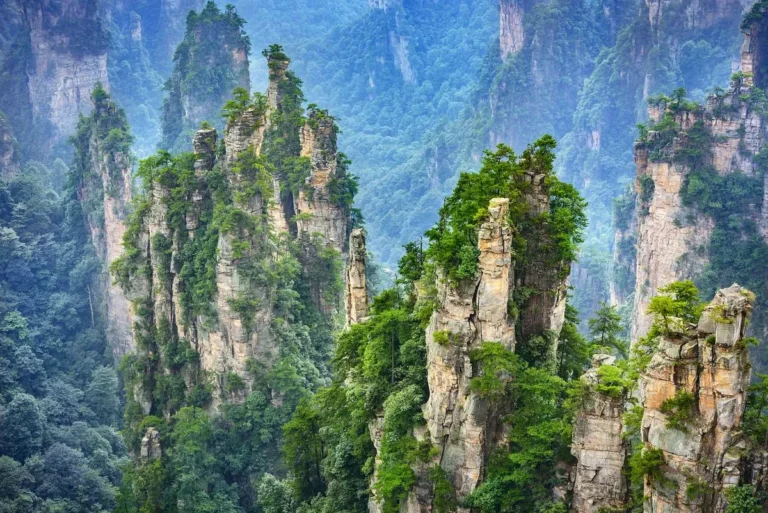
Welcome to the most comprehensive and in-depth encyclopedic guide to one of the greatest artificial marvels combined with grand natural masterpieces on the planet: the Tianmen Mountain Glass Skywalk. Nestled within the scenic enclave of Zhangjiajie in Hunan Province, China, this coordinate is not merely a conventional photo check-in spot but an emblem of courage, an engineering feat challenging human limits against the grandeur of creation. As an international travel expert and encyclopedic cultural writer for VDS Travel, I will accompany you on a journey to decode every layer of meaning—from geology, architecture, and culture to the ultimate practical tips when setting foot in this breathtaking space.
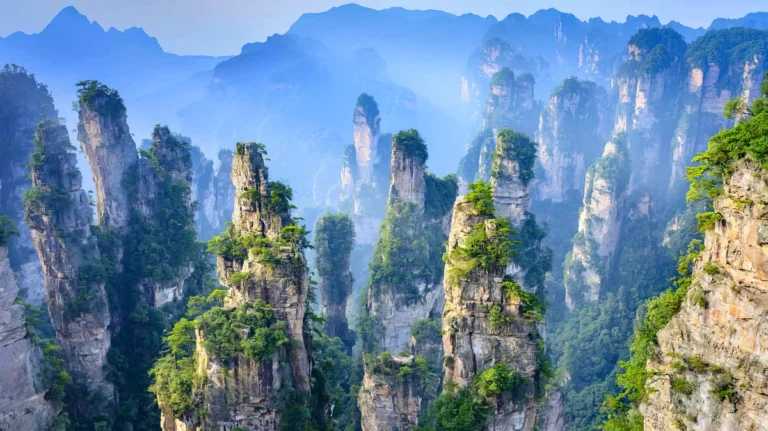
Tianmen Mountain, also known as Heaven’s Gate Mountain, is located in Tianmen Mountain National Forest Park, Zhangjiajie City, Hunan Province, China. It boasts a peak reaching up to 1,518 meters above sea level. Dubbed the “Soul of Zhangjiajie” or “The Most Magical Mountain in Western Hunan,” this peak stands out with its rugged terrain, sheer vertical cliffs, and rich primeval forest ecosystem. The Glass Skywalk is not a single standalone construction but a system of transparent tempered glass walkways anchored directly against the vertical cliffs of Tianmen Mountain, suspended at an altitude of 1,400 to 1,500 meters above the ground.
Before these breathtaking glass paths came into existence, Tianmen Mountain was already a spiritual landmark deeply tied to Chinese spiritual culture dating back to the Three Kingdoms period. Legend has it that the mountain acquired this name in 263 CE, when a portion of the cliff collapsed to form a massive cave piercing right through the mountain resembling a heavenly gate, named Tianmen by the King of Wu at the time. Across centuries, reaching the summit was reserved solely for Taoists, brave explorers, or pilgrims braving steep stone steps. In the 21st century, to serve tourism and transform the site into a world-class destination, local authorities alongside global elite engineers planned and constructed the world’s longest mountain-crossing cable car system while forging sky-high Skywalk routes, opening a new era of exploration for global travelers.
The Tianmen Mountain Glass Skywalk holds a singular status on the Asian adventure tourism map. Beyond serving as a sightseeing attraction, it carries profound symbolic meaning regarding the spirit of overcoming fear, the aspiration to conquer heights, and the flawless synthesis of state-of-the-art artificial engineering with wild, majestic nature. Each step upon the transparent glass panel is an opportunity for travelers to confront themselves, letting go of daily anxieties to merge as one with the boundless expanse of earth and sky, embraced by swirling mountain mists and winds.
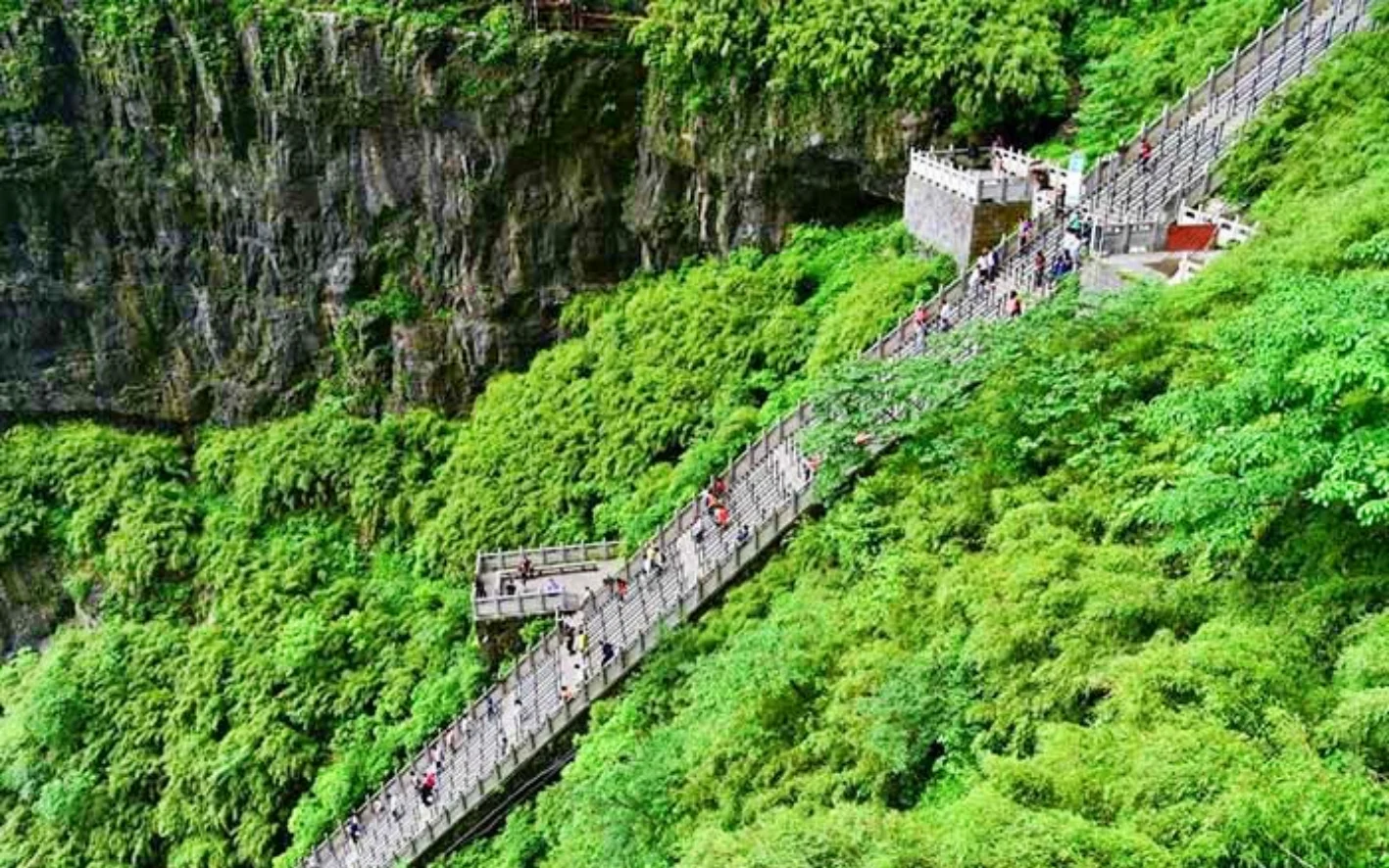
Lush green cliffside walking path at Tianmen Mountain, Zhangjiajie, China.
The Skywalk glass path system at Tianmen Mountain currently comprises three most renowned sections: the Eastern Cliff (Đông Tiêu Đạo), Western Cliff (Tây Tiêu Đạo), and the loop surrounding Coiling Dragon Cliff (Cự Long). The total length of these glass sections reaches thousands of meters, clinging closely to nearly perpendicular sheer cliffs. To construct this marvel, engineers and workers had to suspend themselves over thousand-meter-high mountain faces under harsh weather conditions. The materials utilized are ultra-durable multi-layered tempered glass, approximately 6cm to nearly 7cm thick, possessing extremely high load-bearing capacity capable of withstanding strong wind forces and the weight of thousands of visitors simultaneously. Every glass panel undergoes rigorous testing for transparency and scratch resistance, guaranteeing the most authentic perspective down into the abyss.
The hallmark defining the Skywalk’s brand is the sensation of “walking amidst mid-air.” Stepping onto the transparent glass surface reveals the entire abyssal landscape thousands of meters below completely unobstructed before the traveler’s eyes. Beneath one’s feet lies a bottomless abyss where verdant primeval forest strips shrink into grassy carpets, while far in the distance, the legendary 99-turn winding mountain pass system snakes serpentinely around the mountainside like a gigantic silver dragon. This visual experience shifts continuously with the weather: on brilliant sunny days, sunlight illuminates the entire valley; on cloudy days, rolling seas of clouds churn right beneath one’s feet, creating the sensation of walking upon celestial fairyland clouds in a Buddhist realm.
The journey to explore the Tianmen Mountain Skywalk begins in downtown Zhangjiajie, home to the world’s longest mountain-crossing cable car system spanning over 7,400 meters. Riding inside cable car cabins gliding over rooftops and valleys before surging high above majestic limestone peaks serves as an exhilarating prelude. Upon arriving at the upper station, visitors commence a mountain-hiking trek along stone pathways tethered to the mountain face. Depending on preference, you may take either the Western Cliff or Eastern Cliff route first. Both paths guide travelers through perilous hairpin turns, natural caves, and ancient temples flickering in the mist before formally stepping into the Glass Skywalk zone.
Western Cliff Skywalk Starting Point: Camera angles framing along the length of the glass path winding closely against the cliff serve as an indispensable iconic photo for anyone visiting Zhangjiajie. Coiling Dragon Cliff Section: Where the glass path embraces a sharp mountain bend, capturing the entirety of the 99-turn road (Tongtian Avenue) from an elevated panoramic perspective is breathtaking. Red Wish Ribbon Hanging Cliffs: Along the cliffside adjacent to the glass path, tens of thousands of red silk ribbons and wishing lock tablets left by travelers worldwide line iron railings, adding vibrant color splashes amidst majestic mountain backdrops. Opposite Cliff Camera Angle: Moving to wide-angle observation decks captures the tiny silhouettes of humans traversing the transparent glass ribbon spanning sheer vertical cliffs.
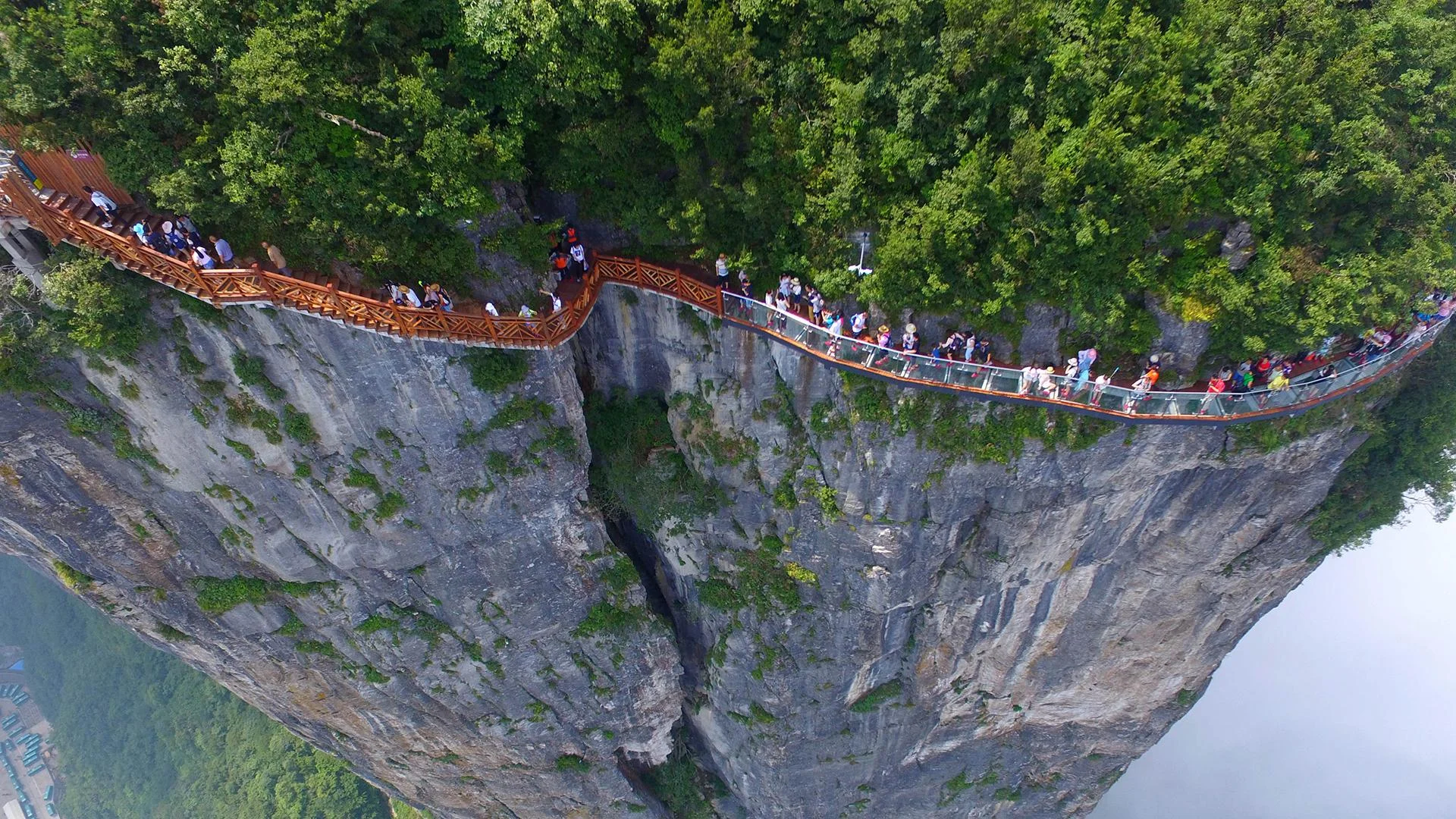
Tourists walking on the cliffside glass Skywalk at Tianmen Mountain, Zhangjiajie
Following heart-pounding moments on the glass Skywalk, recharging with signature highland Hunan specialties is an incomparable experience. Zhangjiajie cuisine is renowned for pungent, bold flavors utilizing abundant fresh chilies, dried peppers, Sichuan peppercorns, and unique mountain forest spices.
Tianmenshan Catfish Hotpot: A signature dish prepared from fresh fish originating from mountain streams, cooked with spicy broth fragrant with herbs and red chilies. Smoked Pork with Peppers: A rustic dish of the indigenous Tujia people, where pork is smoked over firewood hearths for months, yielding a rich aroma and irresistible savory flavor when stir-fried. Zhangjiajie Stinky Tofu: Unlike Beijing or Nanjing versions, the local variant is deep-fried to a crisp crunch, drizzled with specially concocted spicy chili sauce, and served with fresh herbs that profoundly stimulate the palate. Bamboo Tube Rice: Fragrant sticky rice cooked with mushrooms, meat, or peanuts inside fresh bamboo tubes roasted over glowing embers, carrying refreshing mountain forest aromas.
The foot of the mountain and pedestrian shopping streets around Zhangjiajie serve as souvenir paradises steeped in Tujia and Miao ethnic minority cultural identities:
Snow Lotus Tea and Zhangjiajie Green Tea: Premium teas cultivated on high mountain slopes blanketed year-round in mist, offering refreshing flavors and numerous health benefits. Miao Hand-embroidered Handicrafts: Scarves, handbags, and traditional costumes featuring exquisite, vibrantly colored brocade patterns. Kudzu and Rare Medicinal Products: Wild Tianmen Mountain kudzu powder and wild reishi mushroom products make deeply meaningful health gifts. Zhangjiajie Wood-carving Souvenirs and Sand Paintings: Unique sand painting art faithfully recreating Zhangjiajie stone pillars and Tianmen Mountain peaks found nowhere else.
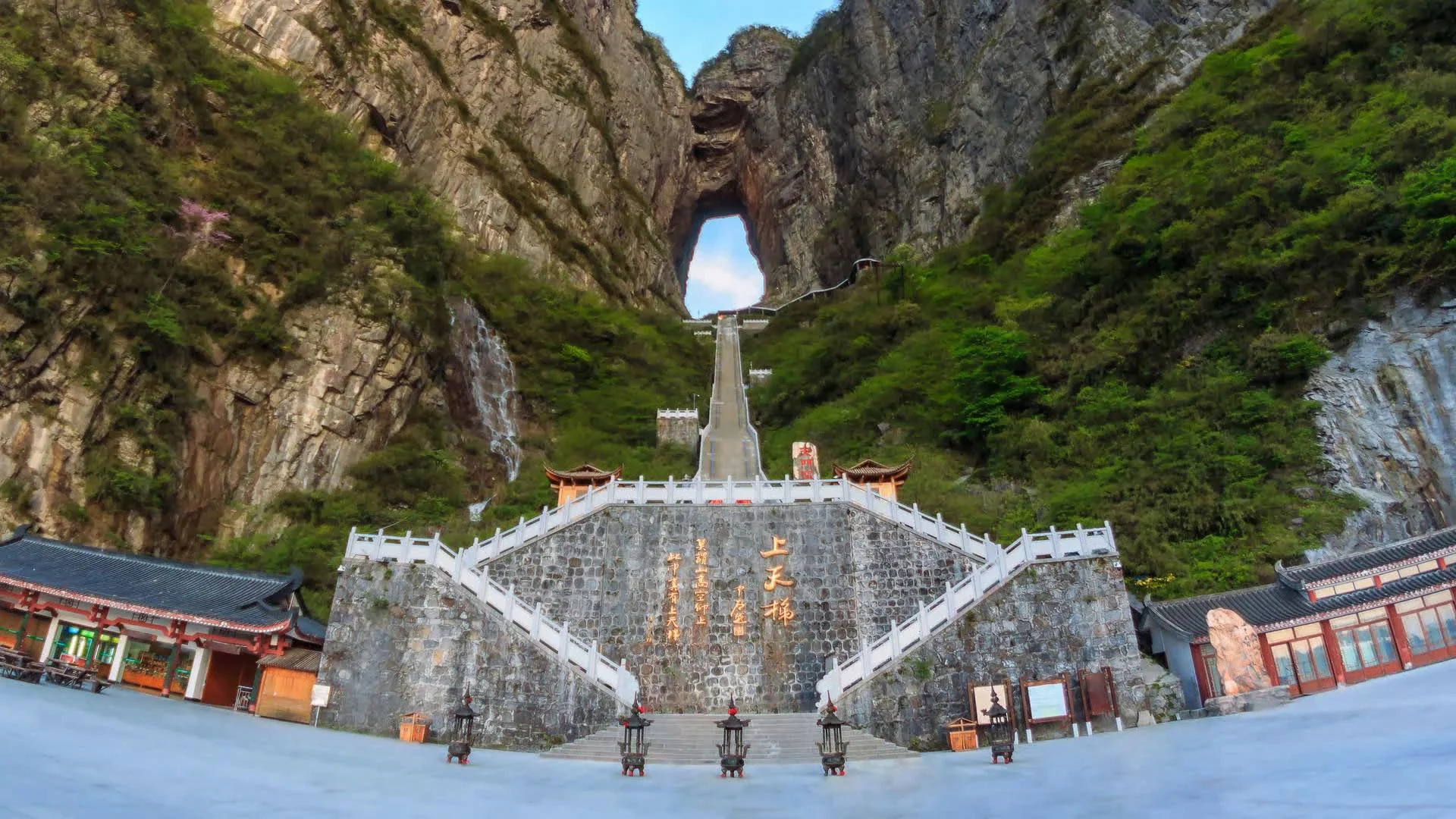
Tianmen Mountain Gate in Zhangjiajie, China with stone stairs leading up.
Tianmen Mountain is gorgeous year-round, yet each season bears distinct beauty and unique nuances:
Spring (March – May): Weather warms gradually, vegetation sprouts, and hazy mists create dreamy scenery akin to a fantastical realm. Autumn (September – November): Widely regarded as the ultimate golden window of the year. Autumn weather is dry and crisp, skies are bright blue, forest foliage turns brilliant yellow and red, and visibility from the Skywalk is furthest and sharpest. Winter (December – February): Although weather is bitterly cold with snowfall, this serves as a “sanctuary” for those enchanted by pristine white snow blanketing cliffs and glass paths, forging majestic scenery reminiscent of martial arts films. However, certain Skywalk sections may temporarily close during heavy ice to guarantee safety.
To reach Zhangjiajie, Vietnamese travelers typically choose direct or transiting flights via major Chinese cities (such as Guangzhou or Chongqing) to Zhangjiajie Hehua International Airport (DYG), or take high-speed rail from border provinces. Upon reaching the base of Tianmen Mountain, visitors experience diverse transit systems:
Mountain-crossing cable car lifting travelers from the city to the summit. Specialized shuttle buses navigating the perilous 99-turn winding road (Tongtian Avenue) to transport visitors down to Heaven’s Gate cave or vice versa. Mountain-interior escalator systems (12 consecutive escalators inside the mountain forming the world’s longest underground escalator) helping visitors navigate elevation tiers conveniently without exhausting stamina on stone steps.
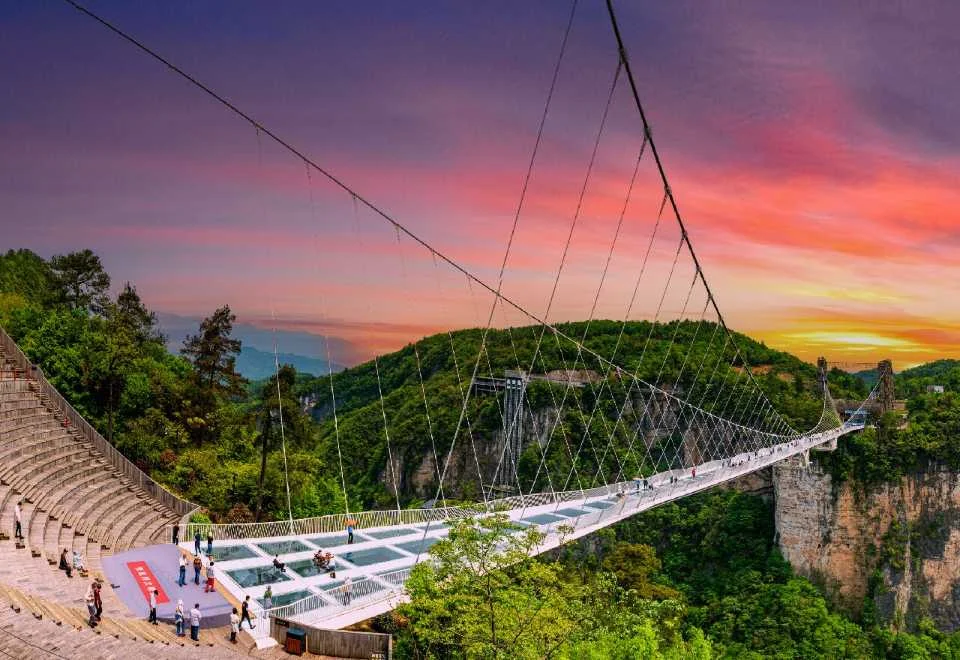
Tianmen Mountain Glass Bridge in Zhangjiajie, China viewed from above at sunset.
Expenses for trips exploring Zhangjiajie – Fenghuang Ancient Town combined with conquering Tianmen Mountain fluctuate depending on all-inclusive tour packages or independent travel. Comprehensive Tianmen Mountain admission packages (incorporating cable cars, shuttle buses, entrance tickets, and Skywalk glass path access) range from 280 to 300 RMB (roughly equivalent to 1,000,000 – 1,200,000 VND). When stepping onto Skywalk glass paths, visitors must additionally purchase a mandatory fabric shoe cover rental fee (approximately 5 RMB) to prevent scratching the tempered glass surface.
TIANMEN MOUNTAIN CABLE CAR & SIGHTSEEING TICKET PRICING TABLE (ZHANGJIAJIE)
Footwear Regulations: High heels, spiked shoes, or hard leather shoes are strictly prohibited directly on Skywalk glass surfaces. Visitors must wear fabric shoe covers provided by management. Psychological Control: Individuals with a history of high blood pressure, heart conditions, or severe fear of heights should consider carefully before entering transparent glass path zones. Avoid running, jumping, or unruly horseplay on glass paths. Respect Indigenous Culture: When visiting Tujia and Miao villages around Zhangjiajie, respect their customs, seek permission before photographing locals, and obey prohibition signs at sacred sites. Environmental Protection Etiquette: Tianmen Mountain is a strictly conserved natural heritage site. Littering, carving names onto cliffs, or damaging trees is strictly forbidden.
Answer: Completely safe. The Glass Skywalk path system was designed and constructed by leading engineers utilizing ultra-durable multi-layered tempered glass panels possessing extremely high load-bearing capacities and undergoing daily technical inspections. Management also restricts visitor numbers stepping onto glass paths simultaneously to guarantee absolute safety.
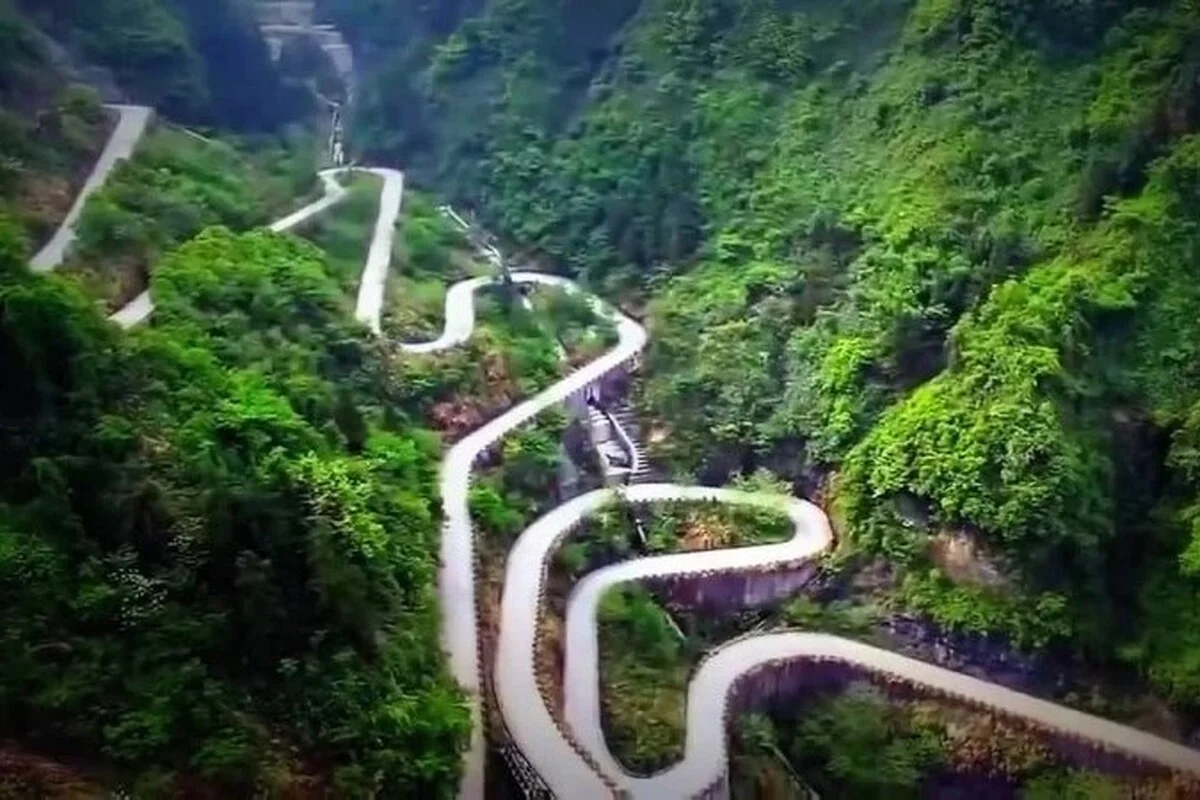
Winding serpentine road on lush green mountainside in Zhangjiajie, China.
Answer: If you experience mild fear of heights, you can safely challenge yourself by walking closely along the mountain-facing side (where sturdy stone footings run parallel to glass paths). However, if you suffer from severe acrophobia, it is best to avoid looking down into the abyss or opt for traditional cliffside walking trails instead of transparent glass paths.
Answer: General Tianmen Mountain admission tickets typically already include access rights to Skywalk paths (Western Cliff, Eastern Cliff). However, you will need to pay a nominal fee (approximately 5 RMB) to rent specialized fabric shoe covers to protect glass surfaces prior to stepping onto these transparent walkways.
Answer: Both routes deliver stellar visual experiences. Western Cliff is generally livelier, featuring longer glass path stretches and comprehensive views of valleys and the 99-turn road. Eastern Cliff possesses a more tranquil beauty with rolling mountain ranges and majestic vertical cliffs. VDS Travel’s recommendation is that if time permits, experience both routes to avoid missing any prized viewpoints.
Answer: Weather atop Tianmen Mountain is notoriously unpredictable (“sunny morning, rainy afternoon”) due to high elevations. You should prepare light jackets (summit temperatures remain 5-8 degrees Celsius cooler than downtown), compact folding umbrellas or handy raincoats, alongside sunglasses and sunscreen to proactively counter shifting weather.