Rising majestically amidst the ancient karst formations of Zhangjiajie in Hunan Province, Tianmen Mountain has been revered for millennia as a sacred peak steeped in Eastern mythology. The origin of its name traces back to a dramatic geological event during the Three Kingdoms period, specifically in 263 AD under the Eastern Wu dynasty. At that time, a massive section of limestone cliff on the mountaintop suddenly collapsed after centuries of subsurface weathering, revealing a cavernous archway piercing straight through the mountain mass on a staggering scale: standing 131.5 meters high, spanning 57 meters wide, and plunging 60 meters deep. This extraordinary natural phenomenon formed what looked like a colossal gate opening directly to the heavens, astonishing both local residents and court officials of the era. Interpreting it as an auspicious omen foretelling national peace and prosperity, Emperor Sun Xiu of Wu issued an imperial decree renaming the mountain from Yunmeng Mountain to Tianmen Mountain (“Heaven’s Gate Mountain”), officially giving birth to an immortal landmark in Chinese historical annals.
Across successive feudal dynasties, Tianmen Mountain was not merely a physical wonder but gradually transformed into one of the most solemn Taoist pilgrimage centers in the middle reaches of the Yangtze River. Entering the Ming and Qing dynasties, its spiritual life reached a peak of prosperity as Taoist temples and monasteries were restored and solidly constructed atop the misty, precipitous cliffs. During this same era, the steep 999-step stone staircase known as Shangtianti (“Ladder to Heaven”) was painstakingly chiseled directly into the limestone mountainside, connecting the valley floor straight up to the archway of Tianmen Cave. The number 999 is not simply an architectural count, but a distillation of Taoist philosophy representing the Nine Heavens and boundless yang energy, requiring pilgrims to summon iron willpower to overcome physical exhaustion and reach the pure realm between earth and sky. For hundreds of years, this treacherous stone stairway remained the sole access route, keeping the highland basin untouched and isolated from the bustling world below.
Entering the modern era, Tianmen Mountain’s quiet millennium of isolation began to shift as the world recognized the grand potential hidden within its unmatched natural sky-arch. Tianmen Cave captured international media headlines in 1999 when it was chosen to host a large-scale national paragliding and parachuting showcase, featuring breathtaking flights through the limestone arch that stunned adventure sports enthusiasts worldwide. That landmark event not only awakened the fame of the sacred peak but also posed an urgent challenge to local authorities: how to open access for mass tourism to admire a masterpiece of nature without destroying the fragile karst geology and hazardous vertical gorges.
The vision for an unprecedented mountain-crossing cableway quickly took shape and moved toward reality. In March 2003, the Tianmen Mountain Cableway project received official approval and broke ground with a massive investment of 250 million RMB, equivalent to more than 35 million USD at the time. Fully aware of the rugged terrain and dizzying elevation changes in Zhangjiajie, project management entered into a strategic partnership with the Doppelmayr Garaventa Group—the Austrian world leader in complex-terrain cableway technology. This was a pivotal move that brought the metallurgical standards, precision engineering, and stringent safety protocols of the European Alps directly into the limestone mountains of Hunan.
After more than two years of relentless construction against harsh misty weather and deep chasms, the cableway was completed and officially inaugurated in September 2005. On its very first day of commercial operation, the engineering feat stunned the global infrastructure community when Guinness World Records recognized it as the longest passenger cableway in high mountain regions worldwide. The arrival of a sturdy steel cable line spanning clouds and sky not only ended the sacred peak’s millennium of rugged isolation, but also marked a seamless intersection between the Three Kingdoms cliff-collapse legend and the pinnacle of modern human engineering.
Located in northwestern Hunan Province, Tianmen Mountain—historically called Yunmeng Mountain—has long been regarded as the geomantic soul of the entire Xiangxi region. With an absolute elevation of 1,518.6 meters above sea level, the mountain stands like a natural fortress between heaven and earth, gathering the energy of the sprawling Wuling mountain range. In traditional Chinese feng shui concepts, Tianmen Mountain’s terrain evokes the posture of a “Divine Dragon Emerging from the Sea,” where dragon veins originate from rugged plateaus and converge before shooting nearly vertically upward into near-90-degree cliff faces. The combination of karst limestone fault layers formed over hundreds of millions of years and ancient underground cave systems creates a grand natural screen that shields against storms and gathers vital energy, turning the mountain into a scenic sanctuary rich in Taoist lore and indigenous Tujia culture.
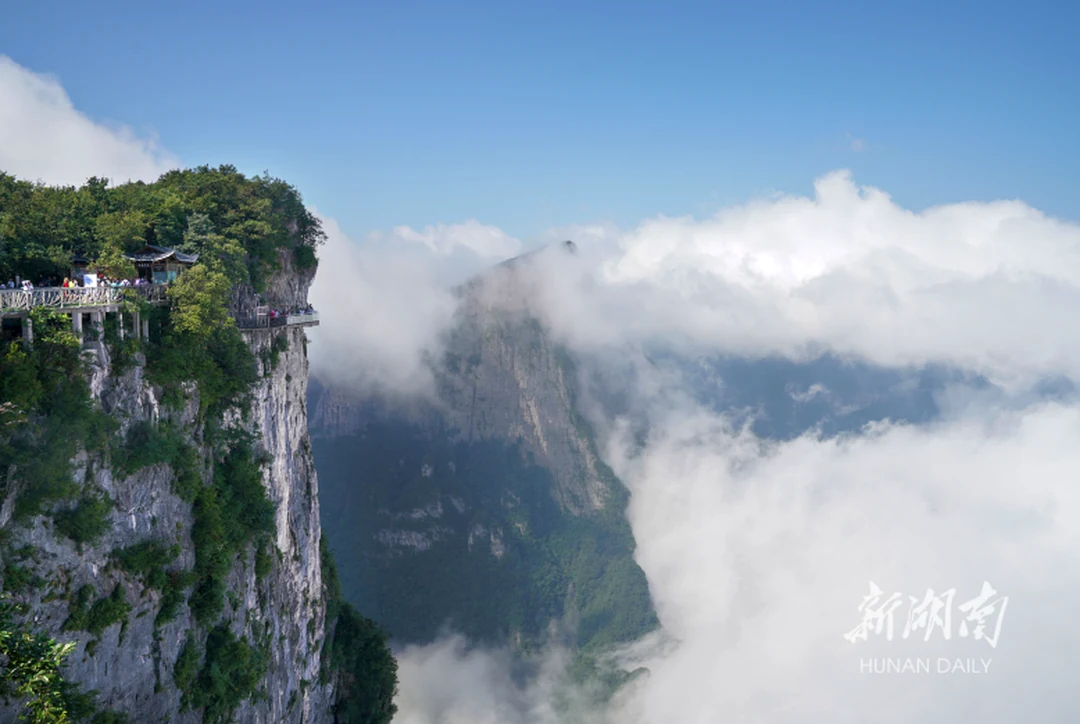
The route alignment of the Tianmen Mountain Cableway is a feat of terrain engineering that creates a unique non-traditional spatial connection in the world. Rather than starting from a remote mountain base like conventional cableways, its departure point is anchored right in the bustling urban center of Zhangjiajie city. From the elevation of the urban basin, the cable line stretches dramatically across nearly seven and a half kilometers to climb straight up to the misty summit of the sacred mountain. This routing required exact calculations in aerodynamics and geotechnical engineering to position support towers safely across hazardous karst sinkholes and fissures, withstand powerful localized gusts inside deep valleys, and maintain a maximum cable incline of nearly 38 degrees on the final spans—a gradient that tests the limits of human perception.
Gliding through the air is a sequential visual journey across four distinct landscape tiers, unfolding gradually like a grand natural scroll with every span of cable. The first tier begins amid the lively rhythm of city streets, where cabins glide past high-rise rooftops, intersecting roads, and the modern pulse of a transforming tourist city. Leaving the urban edge behind, travelers immediately enter a second tier rich with peaceful Xiangxi countryside charm, featuring lush cornfields, thriving orchards, and gentle terraced fields tucked beside traditional stilt houses of the Miao and Tujia peoples. Rural calm then gives way to a third, dramatic tier: a rugged primeval limestone valley. Here, dense temperate vegetation blankets sheer thousand-foot gray cliffs, while deep below winds the Tongtian Avenue (“Avenue Leading to Heaven”) with its ninety-nine bends twisting like a white dragon coiled around the steep slope.
The final landscape tier—and the climax of the ride—arrives as the cable cabin cuts through thick mist to enter the immortal realm atop the mountain. Shrouded year-round in clouds formed by valley humidity meeting cold high-altitude air, the Tianmen summit greets visitors with a mystical, quiet expanse where bizarre karst pinnacles appear and vanish in midair. Differences in temperature and pressure between the base station in the city basin and the summit station create a vivid sense of ecological transition, carrying travelers from bustling everyday life straight into a grand scene that feels lifted from Tang and Song dynasty ink paintings.
Set within the Lishui River valley, the departure station of the Tianmen Mountain Cableway sits along Dahuaban Road in central Zhangjiajie, realizing a rare spatial planning model worldwide: a direct City-to-Summit connection. Unlike most tourist cableways that place their base in secluded foothills, the station architecture blends into daily city life, creating a striking visual contrast. From the modern reinforced-concrete station platform, cabins glide slowly over moss-covered tiled roofs, pass above bridges crossing silt-red waters and busy boulevards, and then leave the mundane world behind to head straight into gray clouds embracing the towering karst massif.
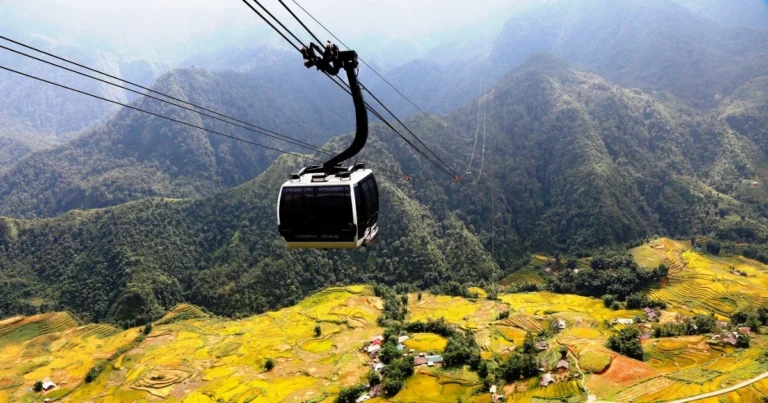
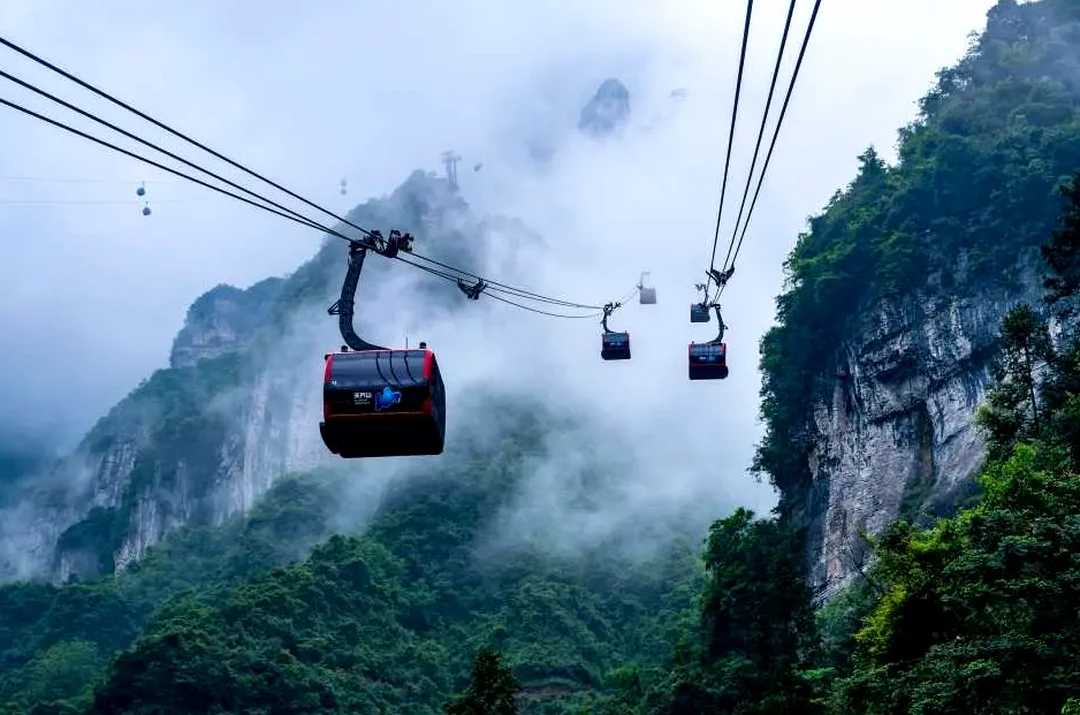
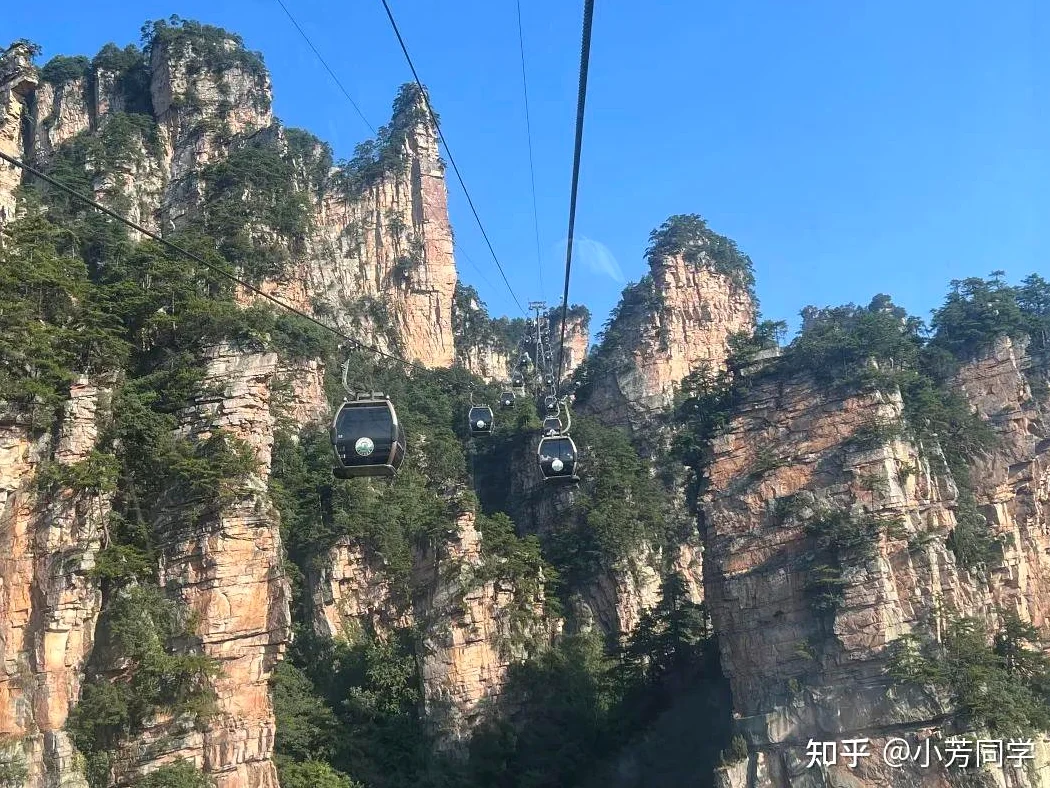
This aerial transport system is a showcase of precision mechanical engineering and contemporary structural design, featuring a record-breaking single-axis length of 7,455 meters. To support this aerial lifeline across deep valleys and steep slopes, 98 massive steel towers are anchored firmly into ancient geological strata, acting like sturdy vertebrae in midair. A fleet of 98 brightly painted cabins—each crafted with a standard capacity of 8 passengers—runs in smooth rotation to achieve a transport capacity of 2,400 people per hour. During the breeze-swept ride lasting 28 to 35 minutes, passengers experience a dramatic shift in elevation with a vertical rise of 1,279 meters, watching vegetation transition from lush subtropical forest at the base to primeval moisture-loving moss forest clinging to high cliffs.
The visual drama reaches its peak on the final stretch, where the steel cables strain up a remarkable 37-degree incline—an exceptionally steep angle for large-scale passenger cableways globally. Seated inside reinforced glass cabins, riders feel a rush of excitement as the gondola tilts sharply, brushing close past millennia-weathered karst rock needles as it climbs toward the sky gate. From this suspended vantage point, views open endlessly down into the deep valley, where Tongtian Avenue—with its 99 hairpin turns symbolizing the Nine Heavens—curves gracefully like a white silk ribbon mid-slope amid rolling cloud banks below.
Arriving at the upper station at over 1,400 meters, the cableway does not end its role; instead, it opens into a sophisticated network of auxiliary transit built deep into the cliffside. The summit station layout aligns directly with two dramatic cliff-hugging walkways: the thrilling Coiling Dragon Cliff walkway (Guigu Plank Road), linked to legends of the recluse master Guiguzi, and the East Cliff walkway (Dongtian Plank Road) pointing toward misty fairyland vistas. Notably, the system also connects directly with a multi-tier mountain-penetrating escalator network operating quietly inside solid limestone, carrying travelers smoothly between the high summit and the base of Tianmen Cave without disrupting the integrity of the heritage landscape. The skillful pairing of imported precision mechanics with dramatic mountain topography makes the Tianmen Mountain Cableway an engineering milestone that weaves human ingenuity into Hunan’s ink-wash landscape.
As dusk settles behind the sheer limestone peaks of Tianmen Mountain, mystical Xiangxi transitions into an enchanting stage of visual art. The centerpiece of nightlife at the foot of the mountain is the world-scale live-action musical *Tianmen Fox Fairy* (天门狐仙), staged under chief director Zhang Yimou and leading Chinese artistic talents. What makes the production extraordinary is that an entire deep natural canyon and the towering thousand-meter Tianmen cliff face serve as a permanent backdrop. Spanning tens of thousands of square meters outdoors in the mountain forest, the open-air stage turns every tree, blade of grass, and gust of wind through the rocks into part of the drama, blurring the line between untouched nature and theatrical craft.
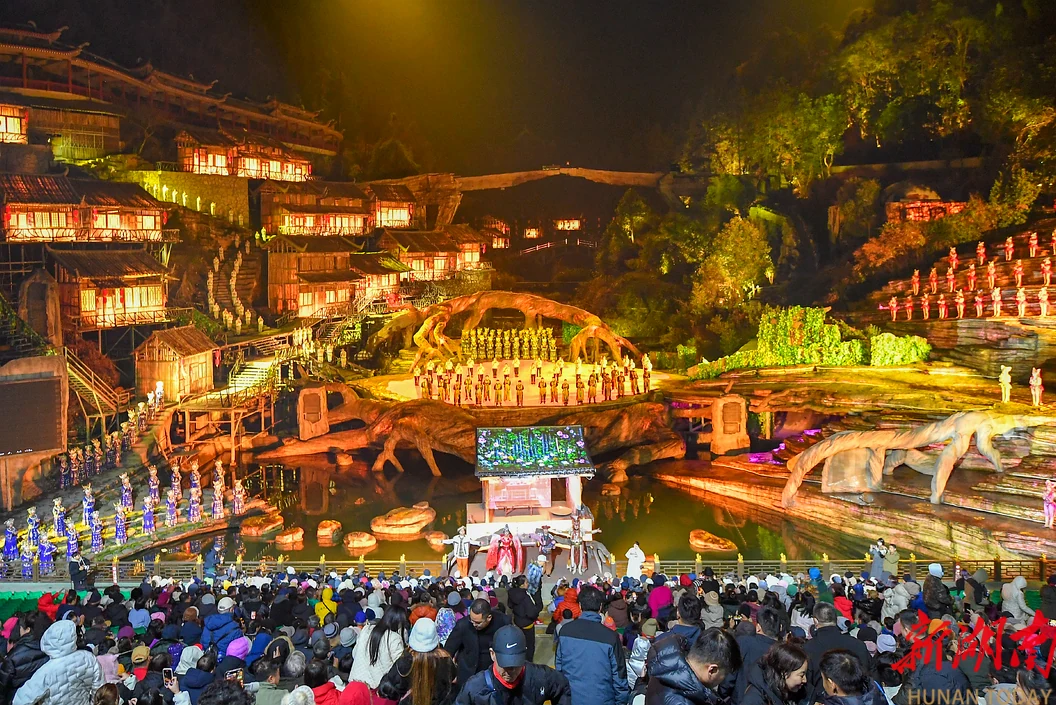
The show recounts a poignant Hunan folk romance between Bai Yutian, a thousand-year-old white fox spirit, and Liu Hai, a poor woodcutter. To portray a love crossing mortal and immortal realms, high-output lighting technology projects across the face of Tianmen Mountain, turning the misty peak into a vibrant velvet canvas. High-tech mist effects, hydraulic stages, aerial zip-line rigging, and a glowing artificial moon suspended mid-air create a breathtaking visual spectacle. In the quiet canyon, soulful Xiangxi folk songs ring out from a chorus of more than a hundred local performers, mingling with trickling mountain streams and the rhythmic clack of wood-splitting mallets to move audiences deeply.
Stepping away from the grandeur of the canyon stage, evening cultural life in Xiangxi continues to draw visitors with the quiet charm of Diaojiaolou (吊脚楼)—traditional stilted timber houses of the Tujia and Miao peoples passed down through centuries of history. Below the Tianmen range, multi-story wooden homes cling to rocky slopes, extending sturdy pine stilts above calm waters. At nightfall, rows of bright red lanterns glow beneath sweeping eaves, illuminating wisps of evening hearth smoke. It is a moment when villages welcome guests with local warmth, where crackling fires warm tables rich with regional flavors such as savory smoked bacon (*larou*), spicy Xiangxi fish and tofu stews, and fiery herbal-fermented sticky corn liquor.
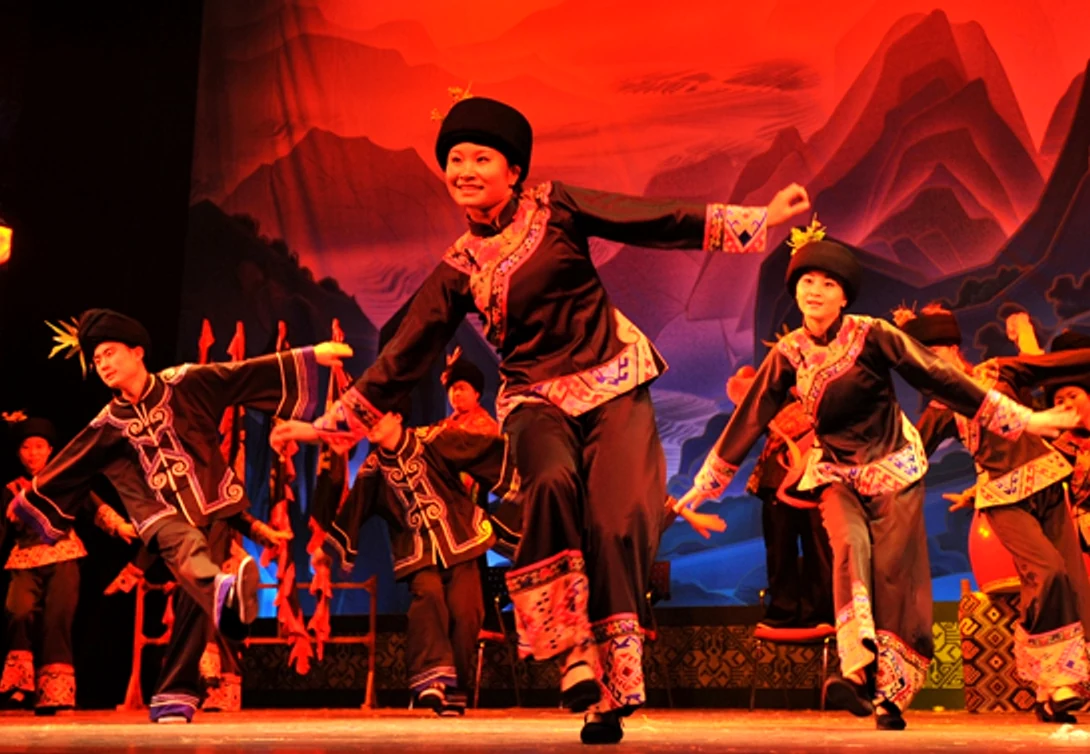
Late into the night, the atmosphere around the Tianmen Mountain cableway corridor grows lively with community traditions rich in human warmth. The gentle melody of the Lusheng reed-pipe blends with the lively steps of the Baishou Dance (摆手舞)—a traditional Tujia dance performed to ward off evil spirits and pray for abundant harvests by young women in brocade attire embroidered with gleaming silver thread. Along time-worn bluestone paths, light from Anhua dark tea stalls and handicraft shops reveals the simple, peaceful daily life of locals. This blend of high-tech cliffside light performance and timeless highland culture paints a vivid, poetic night portrait of Xiangxi that lingers in every visitor’s memory.
Xiangxi cuisine stretching beneath the towering Tianmen peak is more than a blend of spices; it is a cultural chronicle of the Tujia and Miao peoples. In a highland region wrapped in mist much of the year, high humidity and mountain drafts have shaped a distinctive culinary philosophy: using fiery heat to dispel dampness and refreshing sourness to aid digestion. Stepping out of the cable cabin, aromas of pickled chili, tsaoko cardamom, and woodsmoke draw travelers in, opening up rustic flavors steeped in history.
Holding pride of place on traditional Zhangjiajie tables is *Sanhaguo* (“Three-Pot Dish”), a classic dish carrying poignant memories from the feudal era. Local lore records that during the Jiajing reign of the Ming dynasty, when Tujia soldiers received urgent orders to march south to fight coastal raiders just before New Year, village elders gathered three main ingredients—pork belly, pig offal, and tofu—into a single large pan so the troops could celebrate New Year early. Today, this rustic dish has been refined into a celebrated specialty served either as a spicy dry stir-fry or a rich hotpot. Thick slices of pork and chewy small intestines absorb fiery Xiangxi chili paste, numbing wild Sichuan pepper, and crisp dried radish, bubbling over charcoal to evoke the bold spirit of Tujia warriors.
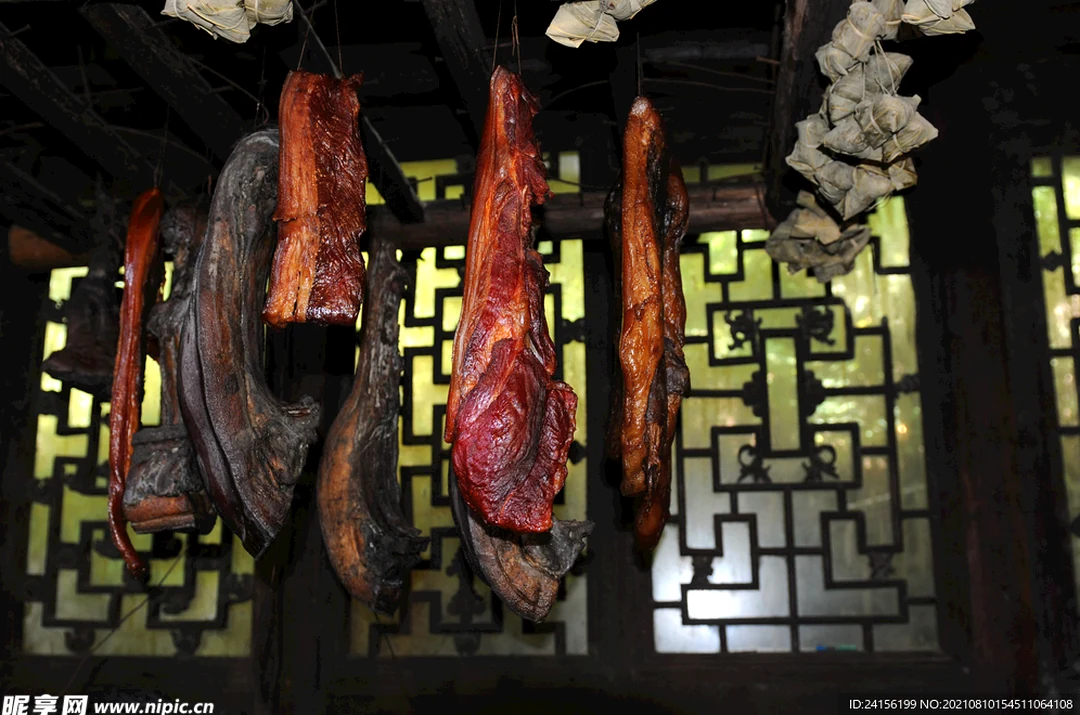
Exploring lanes near the cableway station, visitors will spot strings of ruby-red Tujia smoked pork hanging above charcoal hearths inside wooden homes. Native black pigs raised freely on steep slopes yield firm meat that is seasoned with coarse salt, Sichuan pepper, and herbal corn liquor before months of steady smoking. The key to Tianmen smoked pork lies in tending a gentle fire solely with pine wood, old cypress, dried tangerine peel, and dried pomelo peel. Translucent amber fat and deep pink lean meat, when stir-fried with early-season bamboo shoots or young garlic scapes, release an earthy mountain aroma—rich yet never heavy, leaving a lasting smoky finish on the palate.
Against the crisp chill of the karst highlands, a steaming hotpot of Tianmen Mountain sturgeon or catfish is an essential tasting experience. Raised in pure subterranean waters flowing through the mountain’s limestone strata, the scaleless fish has snow-white, sweet flesh completely free of any muddy taste. The broth distills traditional sour-pickling craft, where mountain tomatoes, bamboo shoots pickled with bird’s eye chili, and Xiangxi rice vinegar come together for a clean tang and gentle chili tingle. As fresh slices of fish cook in the bubbling pot, the pure sweetness of the fish blends with the tangy-spicy broth to awaken every sense after a long skyward journey.
Sampling local flavors feels even more complete at street stalls serving crispy fried river-shrimp cakes, known locally as *baba*. Fresh tiny stream shrimp scooped from underground brooks below Tianmen cliff are mixed with finely ground upland rice flour, scallions, and local pepper, then slipped into hot oil. Each golden, crisp cake steams as it comes out, cracking lightly with every bite and carrying the sweet, nutty taste of river silt. Sipping a cup of fragrant Tianmen Mountain mist tea scented with wildflowers lets travelers carry the simple, warm spirit of Xiangxi deep into memory.

High-mountain climate conditions in Zhangjiajie shift noticeably across the seasons, directly shaping visibility and views from inside the cable cabin. The most ideal time to ride through the sea of clouds at Tianmen Mountain is April to May, when flora awakens from winter dormancy, azaleas bloom along rocky slopes, and cool air averages 15 to 22 degrees Celsius. September to October is equally stunning, when crisp autumn skies clear up, fiery red and gold maples color the vertical limestone cliffs, and clouds drifting through the sky gate appear most frequently. Experienced travelers generally avoid July and August, when base-valley temperatures can exceed 35 degrees Celsius and peak domestic travel surges noticeably lengthen transfer queues.
Choosing the right sightseeing route is key to maximizing the experience without overtaxing your stamina. Among the three main routes operated by management, Route A is widely considered the classic and most logical option for most visitors. It begins directly at the downtown station in Yongding District, carrying passengers along the 7,455-meter cable line straight up to the summit area above 1,400 meters. From there, visitors walk along the dramatic cliffside Coiling Dragon Cliff walkway, experience the thrilling Glass Walkway with transparent load-bearing panels revealing the abyss below, and then enter the 12-tier mountain-penetrating escalator system stretching nearly 900 meters. The escalators descend to the plaza before Tianmen Cave, opening a dramatic view of the 131.5-meter natural arch before descending the steep 999 steps or taking secondary escalators to board shuttle buses back down the 99 hairpin turns of Tongtian Avenue into the valley.
Tianmen Mountain Scenic Area typically welcomes visitors from 06:30 to 18:00 during peak seasons from spring through autumn, and adjusts hours to 08:00 to 16:30 in winter for safe operation when snow covers the mountain. All-inclusive admission tickets for Route A generally range around 275 to 278 RMB per person, covering the one-way long cableway, scenic area entry, mountain escalators, and internal shuttle buses. Visitors only need to pay a small fee of about 5 RMB to rent velvet shoe covers before stepping onto the Glass Walkway to keep the glass clear, plus chairlift tickets if they wish to visit Wangyi Pavilion. Tickets are strictly registered to passports with facial-recognition checks at gates, so arriving within your reserved time slot is mandatory to avoid being denied boarding.

The karst plateau terrain means temperatures atop Tianmen Mountain run 3 to 5 degrees Celsius cooler than the valley floor below, accompanied by gusty mountain winds funneled through gorges. A light water-resistant windbreaker and warm layers are therefore essential items, even on warm summer days. Wearing dedicated athletic shoes with high-traction treads helps protect ankles and prevent slipping on damp wooden decking or mist-slicked stone slabs. In addition, travelers should stay cautious of ultra-cheap tour offers from unofficial agents outside bus or train stations, which often carry hidden risks of forced shopping stops at disguised herbal medicine or jade shops. Looking for pure leisure itineraries that commit to zero commercial shopping stops helps keep the focus on the natural wonder. For a relaxed trip with a well-paced schedule and attentive support from knowledgeable local guides, travelers can consider booking a all-inclusive tour package to enjoy the dramatic beauty of this miniature highland realm with peace of mind.