Nestled along the deep sapphire surf of the port city of Busan, Haeundae Beach (海云台海水浴场) is far more than a windswept stretch of golden sand—it is a quiet chronicle spanning more than a millennium. The origins of this celebrated name reach back to the 9th century, during the twilight of the Unified Silla Dynasty. At that time, the eminent scholar, poet, and statesman Choe Chi-won (857–?), having concluded a distinguished academic and bureaucratic career abroad in Tang China, returned to his homeland on the Korean Peninsula. Wandering southward in search of a secluded sanctuary away from the political turbulence of Silla’s declining court, the poet arrived along this unspoiled southern coast and was utterly captivated by the majestic sight of surging azure waves merging with layers of drifting white clouds.
Before that breathtaking, otherworldly vista, Choe Chi-won took a sword or sharp chisel and personally carved the three Chinese characters “Haeundae” (海云台) into a flat boulder atop a rocky outcrop on Dongbaekseom Island. Those ancient characters carry a profound poetic meaning—a viewing terrace where sea and clouds unite as one—while embodying a scholar’s yearning to transcend worldly vanity. Choe Chi-won’s thousand-year-old stone inscription endured through the rise and fall of the Goryeo and Joseon dynasties, withstanding centuries of coastal gales to survive intact today as a priceless historical and cultural monument—and the spiritual origin of the entire Haeundae bay.
Entering the turbulent modern era during the Japanese colonial period (1910–1945), Haeundae’s untouched coastline began a transformative shift in urban infrastructure and function. The defining turning point arrived in 1935 with the official opening of the Donghae Nambu Railway Line. The arrival of this modern rail artery spurred large-scale planning and development, establishing Haeundae as the very first integrated natural hot spring and beach resort complex on the Korean Peninsula. Mineral- and sulfur-rich thermal springs just inland combined with a gentle crescent shoreline to turn the area into an exclusive retreat for elites of the era, laying the foundation for Korea’s nascent coastal tourism industry.
Following the scars of war and South Korea’s miraculous postwar reconstruction in the second half of the 20th century, Haeundae rapidly evolved into a premier national vacation hub. In the 1990s, the South Korean government officially designated the entire Haeundae district a Special Tourist Zone, triggering major coastal beautification initiatives, expanded oceanfront parks, and sleek seaside boulevards. Centuries of historical prestige provided a rock-solid springboard for relentless growth, attracting massive capital investment and ever-growing waves of international travelers across each successive era.
Haeundae’s contemporary skyline reached dazzling new heights in 2019 with the completion of the Haeundae LCT The Sharp supertall complex. Anchored by its iconic Landmark Tower soaring to 411.6 meters, this architectural marvel reshaped Busan’s entire coastal silhouette and propelled Haeundae into the ranks of the world’s most glamorous beachfront metropolises—widely dubbed by international media and travelers as the “Miami of Asia.” The seamless dialogue between Choe Chi-won’s thousand-year-old granite inscription on Dongbaekseom and the sky-reflecting glass facades of 21st-century skyscrapers writes a living epic where dynastic heritage and modern energy move side by side with every ocean wave.
Viewed through the lens of traditional East Asian geomancy (feng shui), Haeundae possesses an auspicious landscape of the highest order, sculpted by nature along the southeastern coast of the Korean Peninsula. The beach unfolds in the classic baesan imsu (“backed by mountains, facing water”) formation, anchored solidly against the rolling ridges of Mount Jangsan and nestled beside the gentle slopes of Wausan—known locally as “Lying Ox Hill” for its serene, reclining silhouette. Directly ahead stretches the boundless expanse of the East Sea opening toward the Pacific Ocean, where warm currents circulate vital energy day and night. Both ends of the shoreline are naturally sheltered by rocky headlands and peninsulas, forming a crescent bay that gathers auspicious energy, blunts fierce offshore storms, and keeps nearshore waters calm and inviting.
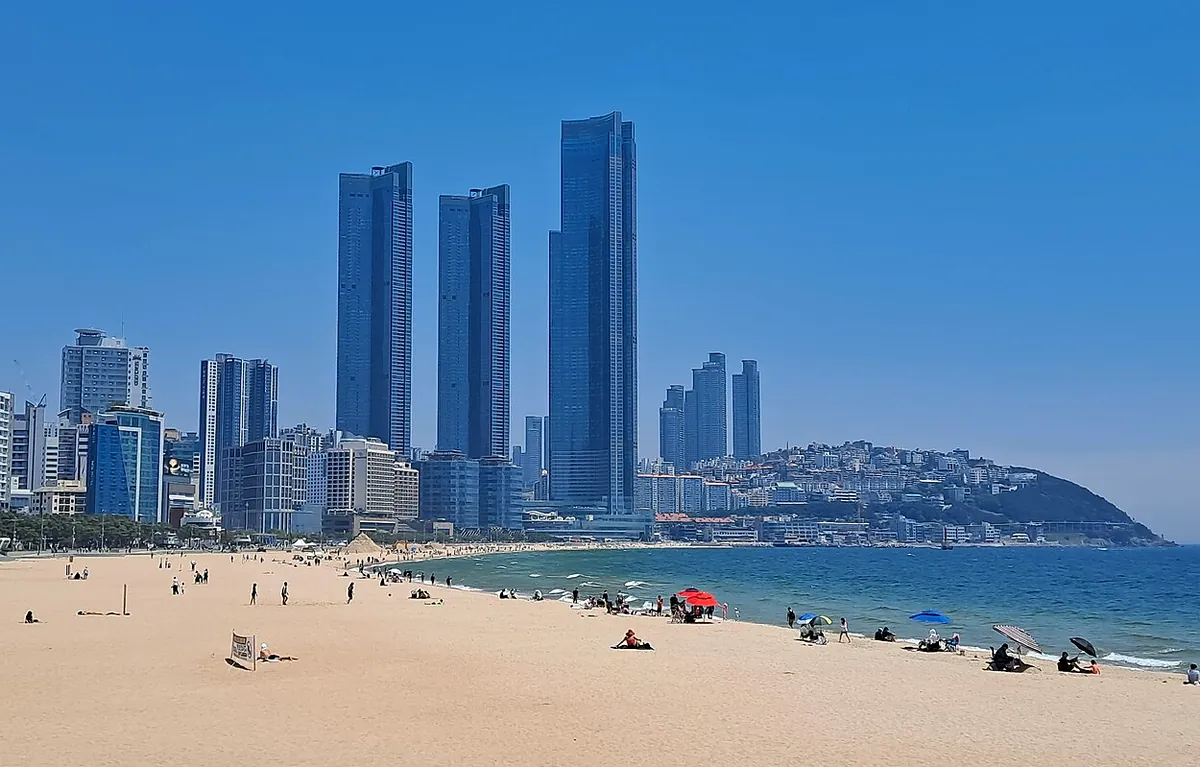
At the heart of this topographic masterpiece lies a velvety golden beach stretching roughly 1.5 kilometers, with a sandy width ranging dynamically between 30 and 50 meters depending on tidal cycles. Haeundae’s sand is no ordinary marine sediment; it is an exceptional blend of fine quartz grains washed down from inland by the ancient Chuncheon Stream and crushed seashells polished over tens of millennia by ocean surf. Its measured, gentle gradient extends shallow waters well offshore, creating a mirror-like surface reflecting turquoise skies. At the western tip of the crescent lies emerald-green Dongbaekseom—once an isolated island blanketed in rustling pines and camellia blossoms, now joined to the mainland by natural sedimentation and jutting gracefully into the sea as a natural windbreak against southwesterly monsoons.
Toward the northeastern end, the coastline rises abruptly into dramatic sea cliffs, opening onto the celebrated Dalmaji-gil (“Moon-Viewing Road”) winding along the flank of Wausan Hill. Shaded by ancient groves of coastal pines and native cherry trees, this scenic ridge was praised by Joseon-era scholars as one of the Eight Scenic Views of Dongnae, famed for watching the full moon rise out of the sea. At dusk, a full moon casts a shimmering golden path across deep ocean waters against dark cliffside pines in a tableau at once contemplative and expansive. Come spring, thousands of mature cherry trees burst into bloom and scatter petals across the hillside, transforming the bay into a breathtaking canvas where lush forest green meets endless ocean blue.
What truly defines Haeundae’s stature today is its masterful fusion of contemporary urban planning and original coastal geology. Busan’s urban planners transformed an unspoiled shoreline into a multi-tiered public waterfront where seaside promenades and flowering groves run gracefully parallel to the sand. Soaring skyscrapers such as Haeundae LCT The Sharp and luxury beachfront resorts behind the promenade never disrupt the natural harmony; instead, they create a dramatic skyline contrasting rugged coastal cliffs, mysterious ocean depths, and the dynamic pulse of a world-class port city. Beneath this geological foundation, natural thermal aquifers rich in radium and mineral salts still flow quietly through fractured bedrock, endowing Haeundae with a priceless hydrothermal resource alongside its majestic scenery.
Gazing back from the ocean toward Haeundae’s gentle curve, the skyline represents far more than a boundary between sea and sky—it is a bold expression of architectural futurism built upon disciplined urban design. Dominating this modern panorama is the beachfront Haeundae LCT The Sharp megacomplex, highlighted by its 101-story Landmark Tower rising over 400 meters into the clouds. Clad in aqua-tinted reflective glass capturing every shifting hue of the Korea Strait, the complex integrates ultra-luxury residences with the acclaimed six-star Signiel Busan hotel—offering an elevated sanctuary suspended in the sky with breathtaking panoramic views across the entire bay.
Beyond the towering steel-and-glass icons anchoring the eastern shore, the district’s architectural identity is further defined by the Busan Cinema Center, an artistic temple located in neighboring Centum City. Designed by the acclaimed Austrian architectural firm Coop Himmelb(l)au, this deconstructivist landmark resembles a monumental kinetic sculpture, crowned by a sweeping cantilevered roof that seems to defy gravity. Officially certified by Guinness World Records as the longest cantilevered roof on Earth, its underside is woven with tens of thousands of brilliant LED lights, turning the flagship venue of the annual Busan International Film Festival into a dazzling stage of light bridging indoor theaters and an open-air plaza.
Haeundae’s enduring vitality and global stature are equally reinforced by a vast transit infrastructure that erases geographic distance with seamless precision. High-speed KTX trains whisk travelers from Seoul across the Korean Peninsula to Busan in just two hours and fifteen minutes, connecting directly with Busan Metro Line 2 to bring visitors steps from the soft sand. At the same time, travel from Gimhae International Airport is streamlined by expressways and coastal boulevards, forming a seamless multimodal corridor linking Korea’s southeastern shore to global tourism and commerce.
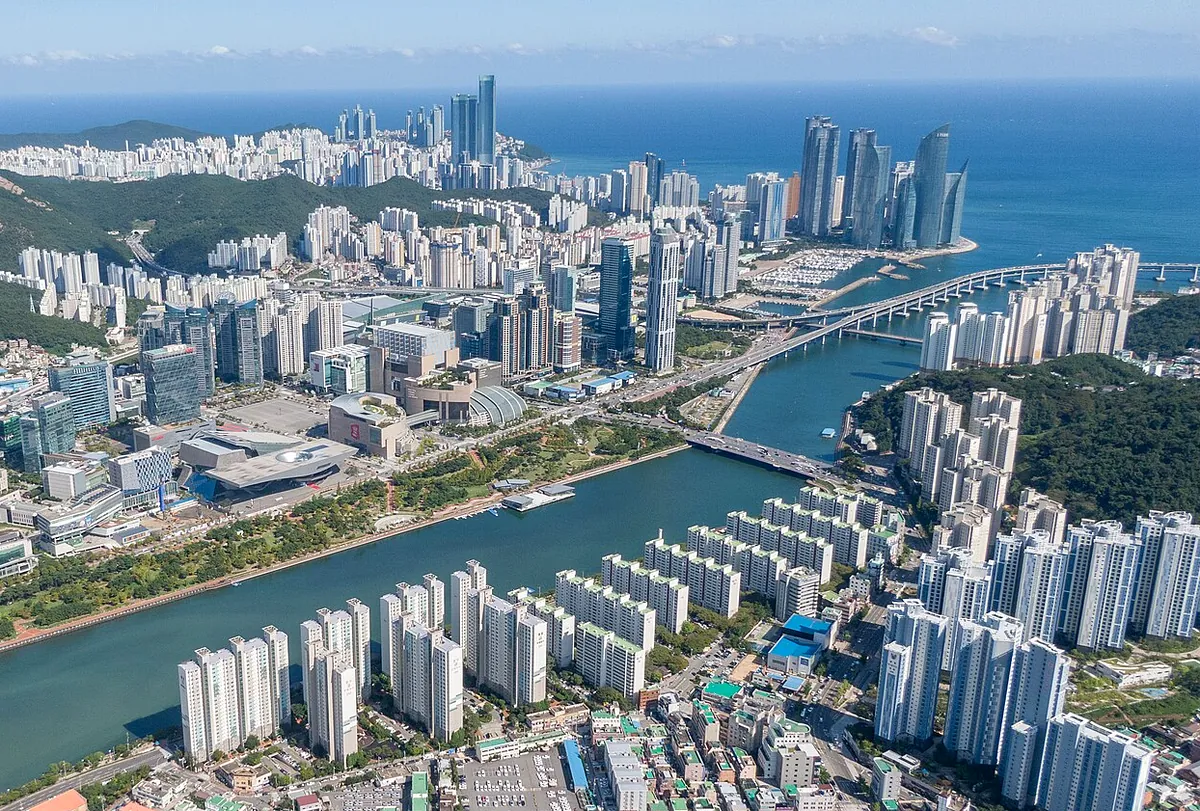
Most notably, Haeundae’s spatial vision achieves a rare human-centered triumph by harmonizing rapid urban growth with industrial heritage through the Haeundae Blueline Park project. A decommissioned coastal stretch of the historic 20th-century Donghae Nambu railway has been brilliantly reborn as a nearly five-kilometer oceanfront eco-park. Colorful Sky Capsules glide along an elevated track through pine canopies and sea cliffs, while the nostalgic Beach Train trundles leisurely below from Mipo Station past the quaint fishing port of Cheongsapo toward Songjeong. This thoughtful blend of infrastructure preservation and imaginative public space turns every meter of Haeundae’s shoreline into a benchmark of sustainable landscape architecture.
When violet-blue twilight sinks deep into the Korea Strait, Haeundae Beach sheds its tranquil daytime demeanor to become a spectacular stage of light where untamed ocean meets sleek urban civilization. The supreme beacon of nightlife here is Haeundae LCT The Sharp, whose 411.6-meter Landmark Tower commands the night horizon. Reflective curtain walls outfitted with smart architectural lighting ignite in unison, casting millions of shimmering colors across the gentle surf lapping the crescent shore. Flanked by ultra-luxury hotels and curving waterfront towers along adjacent Marine City, Haeundae after dark wears the glamorous aura of an “Asian Miami,” where neon urban brilliance blends seamlessly with the endless salt breeze of the sea.
Far from a static cityscape, Haeundae’s nights come alive through interactive visual spectacles powered by smart tourism technology. Along the 1.5-kilometer sandy promenade, laser projections and multimedia installations periodically transform the shoreline into a boundless open-air gallery. During annual lighting festivals, simulated waves crafted from millions of LED lights ripple down the beach, merging with immersive projections to create the illusion of bioluminescent ocean currents spilling across the sand. Woven into these displays are poetic tributes to Silla scholar Choe Chi-won: where a millennium ago a lone poet carved “Haeundae” into cliffside stone to watch clouds drift over moonlit waves, modern creators now compose a digital epic resurrecting coastal legends and classical verse.
Stepping inland from the beach onto Gunam-ro—the central pedestrian boulevard linking Haeundae Station directly to the surf—nighttime energy erupts into vibrant street culture. This wide promenade is a mecca for busking, where independent performers gather to deliver soulful indie ballads, improvisational jazz, and dramatic magic or fire-dancing shows under warm streetlamps. Visitors and locals alike gather casually on stone steps, sipping chilled beer while soaking in the harmony of acoustic guitars and distant crashing waves. The open-hearted spirit of an international port city shines on every block, dissolving language barriers in shared music and spontaneous applause.
Rounding out the evening is a culinary adventure inside Haeundae Traditional Market, a historic market dating back to the early 20th century tucked just off the bustling main avenue. Beneath rows of glowing red lanterns, rich aromas wafting from traditional food stalls awaken every sense. Here, Gyeongsang coast’s famous spicy straw-grilled hagfish (ggomjangeo) sizzles over glowing charcoal alongside bubbling earthenware pots of dwaeji gukbap (pork rice soup), preserving the hearty soul of Busan comfort food. Contrasting with the rustic charm of the night market are glamorous rooftop bars perched atop beachfront skyscrapers. Hundreds of meters above the surf, raising a cocktail while gazing out over the night bay—with Gwangan Bridge sparkling like an emerald necklace across the water—lets travelers feel the full magnetic allure of a coastal playground that never sleeps.
Exploring Haeundae’s coastline would be incomplete without diving into the rich, deeply rooted gastronomy of Busan. Local cuisine here is far more than a clever blend of seasonings; it is a living chronicle of coastal resilience forged through generations of maritime life and historical upheaval. From the steaming alleys of Haeundae Traditional Market to upscale oceanfront boulevards, Busan’s culinary landscape spans every register: hearty, generous fisherman’s fare born of wind and sea alongside refined contemporary fine dining.
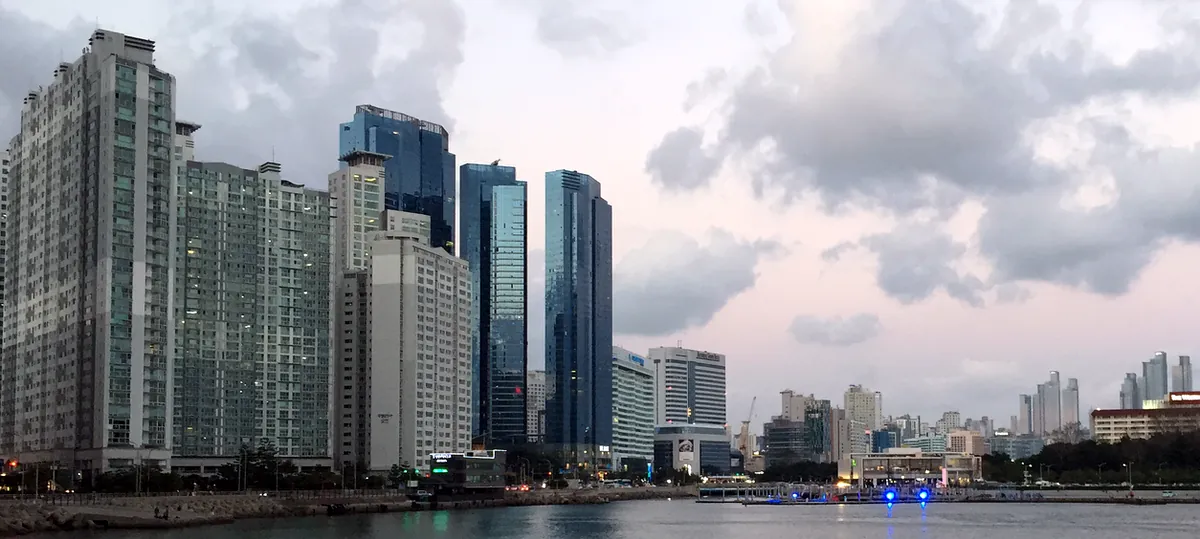
The dish most intimately bound to Busan’s identity is Haeundae Dwaeji Gukbap (pork and rice soup). Born during the lean, tumultuous years of the mid-20th century, this humble soup has become an irreplaceable culinary heirloom. Pork marrow bones are simmered nonstop for over ten hours over low heat to extract a milky-white, velvety broth naturally sweet and rich without artificial additives. Served bubbling hot in an earthen bowl, generous slices of tender boiled pork mingle with fresh chives tossed in fiery chili powder, raw garlic, and salty fermented shrimp paste (saeujeot) carrying a crisp tang of the sea. One spoonful of steaming broth instantly awakens the palate and chases away brisk ocean breezes.
Standing beside pork soup as a living artifact of Korean War history is Busan Milmyeon (cold wheat noodles). During the wartime upheaval, refugees fleeing south to Busan longed for their northern buckwheat cold noodles (naengmyeon). With buckwheat virtually unavailable, they ingeniously kneaded wheat flour from international relief shipments into golden, uniquely chewy noodles. A bowl of milmyeon in Haeundae is a masterclass in refreshing contrasts: springy wheat noodles submerged in chilled beef-and-herb broth crowned with slushy ice crystals, topped with sliced boiled meat, crisp cucumber ribbons, half a hard-boiled egg, and a spoonful of fiery red chili paste. Sweet, sour, salty, and spicy notes collide in bracing coldness to create a flavor profile found nowhere else.
Follow the golden shoreline toward the traditional market and a dazzling world of live seafood unfolds in bubbling aeration tanks brimming with catches from the East Sea. The quintessential raw delicacy in Haeundae is sannakji—live octopus scooped straight from the tank by skilled chefs, swiftly chopped while its tentacles still wriggle, and dipped generously into pure sesame oil sprinkled with sea salt and toasted sesame seeds. Its crisp snap and gentle suction deliver an unforgettable sensory rush. Haeundae is equally celebrated for whole steamed snow crab: sweet, firm, snow-white leg meat is delicately extracted before the rich crab tomalley is folded into steaming rice, crisp seaweed, and sesame oil inside the crab shell to create savory crab-shell fried rice.
Completing Haeundae’s culinary map is an elevated fine-dining scene boasting Michelin-recognized restaurants and premier Hanwoo Korean beef barbecue houses. Prized native Hanwoo beef—intricately marbled with delicate ribbons of fat—is seared over glowing oak charcoal to lock in sweet, melt-in-your-mouth juices. After an indulgent feast, nothing beats strolling up pine-scented Dalmaji-gil Hill, claiming a breezy balcony seat at a specialty roastery cafe, and sipping an aromatic pour-over while gazing across the twinkling lights of Haeundae Bay.
Haeundae Beach reveals its most enchanting face not during the sweltering peak of July and August—when tens of thousands of bright parasols blanket the sand—but during the serene shoulder seasons of May–June and September–October. In late spring and early summer, Busan’s coastal weather is remarkably gentle, hovering in the comfortable low-to-mid twenties Celsius with soft sunlight sparkling across clear waters. Autumn, from September through October, drapes the bay in crisp, expansive clarity: deep cobalt skies, cool sea breezes rustling through Dongbaekseom’s pines, and amber sunsets gilding the fine quartz sand. While the natural beach remains open around the clock for moonlit strolls past glowing lighthouses, official swimming zones and dedicated lifeguards operate from 9:00 AM to 6:00 PM during the formal beach season to ensure swimmer safety against sudden currents.
Exploring this vibrant seaside district is effortless thanks to South Korea’s world-class public transit network. Busan Metro Line 2 serves as the primary artery carrying travelers from bustling hubs like Seomyeon and Nampo straight to the coast. Step out of Haeundae Station via Exit 3 or Exit 5 onto tree-lined Gunam-ro pedestrian boulevard leading directly to the surf, or alight at Jung-dong Station for an easy stroll toward mist-draped Dalmaji Hill. A preloaded T-money transit card unlocks seamless rides across subways and city buses without fumbling for spare change. For late-night returns or groups traveling with luggage from Busan KTX Station or Gimhae International Airport, the local Kakao T ride-hailing app offers transparent metered fares, pinpoint GPS pickup, and smooth navigation without language barriers.
In a world-famous resort city, transparent spending keeps your trip relaxed and enjoyable. Rather than falling for suspiciously cheap tour itineraries built around high-pressure shopping detours at subpar outlets, savvy travelers prioritize strict no-shopping standards that protect precious sightseeing time. When shopping for designer fashion or refined souvenirs, Shinsegae Centum City—recognized by Guinness World Records as the world’s largest department store—and neighboring Lotte Department Store offer fixed pricing and instant tax-refund counters. Meanwhile, for authentic street eats, Haeundae Traditional Market right off the beach lets visitors sample fragrant straw-grilled sea eel or steaming dumplings at honest, clearly posted prices.
Getting to Haeundae has also grown smoother thanks to streamlined international entry procedures. Eligible passport holders can apply online for a Korea Electronic Travel Authorization (K-ETA) prior to departure for swift airport immigration clearance, while travelers transiting to third countries or qualifying for regional visa-free programs can easily enjoy a coastal stopover in Busan. Carrying comprehensive travel insurance and respecting strict beach regulations—including zero littering and no unauthorized fireworks—ensures the shoreline stays pristine for everyone.
Crafting a seamless itinerary covering transit connections, ideal viewing hours, and historically rich landmarks takes deep local insight. To make your journey to South Korea’s southern coast completely effortless and worry-free, joining a thoughtfully curated all-inclusive tour package removes every logistical or language hurdle—leaving you free to savor every ocean breeze and timeless poetic vista of thousand-year-old Haeundae.