Amidst the flow of time in the ancient capital of Beijing, Tiananmen is not merely a defensive gate tower, but an enduring witness to the earth-shattering historical turning points of China’s dynasties. In the fifteenth year of the Yongle reign (1417), when deciding to move the capital north from Nanjing, Emperor Yongle Zhu Di ordered the construction of the main gate leading into the Imperial City, naming it Chengtianmen—carrying the reverent meaning of “Receiving the Mandate of Heaven to rule the realm”—modeled after the original Chengtianmen in Nanjing. Under the exceptional craftsmanship of Master Kuai Xiang, a renowned master of the Xiangshan builder guild from Wu County, Suzhou, an elegant three-tiered wooden gate tower was completed in the eighteenth year of Yongle (1420). However, the initial destiny of the structure was intertwined with countless hardships: in the first year of Tianshun (1457), lightning burned the wooden tower to the ground; it was not until the first year of Chenghua (1465) that Minister of Works Bai Kuei led a large-scale reconstruction, converting the architecture into a majestic and sturdy tower fortress.
History continued to scar the monument with fire and smoke in the seventeenth year of Chongzhen (1644), when the rebel army of the闯王 (Li Zitchen) breached the capital, turning the gate tower into ashes once again under the flames of war. It was not until the eighth year of Shunzhi (1651) under the Qing dynasty that Emperor Shunzhi (Fulin) issued an imperial edict for a comprehensive three-year restoration, officially renaming Chengtianmen to Tiananmen. The new name carried the profound philosophy of “Receiving the Mandate from Heaven, Pacifying the Country and Governing the People,” reflecting the aspiration to bring peace to the nation and comfort the masses. By the twenty-seventh year of Kangxi (1688), the majestic white marble foundation and the upper-tier teak wood tower were elaborately completed, officially shaping the magnificent imperial architectural appearance that endures to this day.
During the autocratic monarchical era, the space in front of the Tiananmen gate tower was a sealed T-shaped corridor named Tianbulang, also known as Tianya. This austere red brick wall enclosed the sacred imperial axis, strictly prohibiting the footsteps of the common folk, and served as the location for the core ministries of the Six Ministries: Personnel, Revenue, Rites, War, Punishments, and Works. This place was once the sacred site for the court’s most sacred ritual of power called “Golden Phoenix Issuing Decrees”—where the emperor sat high above the gate tower, and the imperial edict proclaiming to the realm was placed in the beak of a gold-plated wooden phoenix, slowly lowered by ropes for officials kneeling below to receive amidst solemn ritual music.
That closed curtain of the forbidden palace was truly torn away when the wheel of history rolled into the twentieth century. On May 4, 1919, the May Fourth Movement erupted as over three thousand students and intellectuals gathered in massive protests before the gate, transforming the ancient imperial space of power into the first socio-political stage of the modern era. The greatest turning point was established on October 1, 1949, when Chairman Mao Zedong stood atop the Tiananmen gate tower to read the Proclamation of the Founding of the People’s Republic of China before three hundred thousand compatriots. Entering the period of 1958–1959, as part of the “Ten Great Buildings” project, the entire feudal Tianya brick wall was demolished for a major renovation, spectacularly expanding the square’s area from 11 hectares to 44 hectares (440,000 square meters) paved with super-load-bearing granite. Century-defining structures successively rose around this spatial axis: the Monument to the People’s Heroes (1958), the Great Hall of the People to the West, the Museum of the Chinese Revolution to the East, and later Chairman Mao Memorial Hall on the Southern axis (1976–1977).
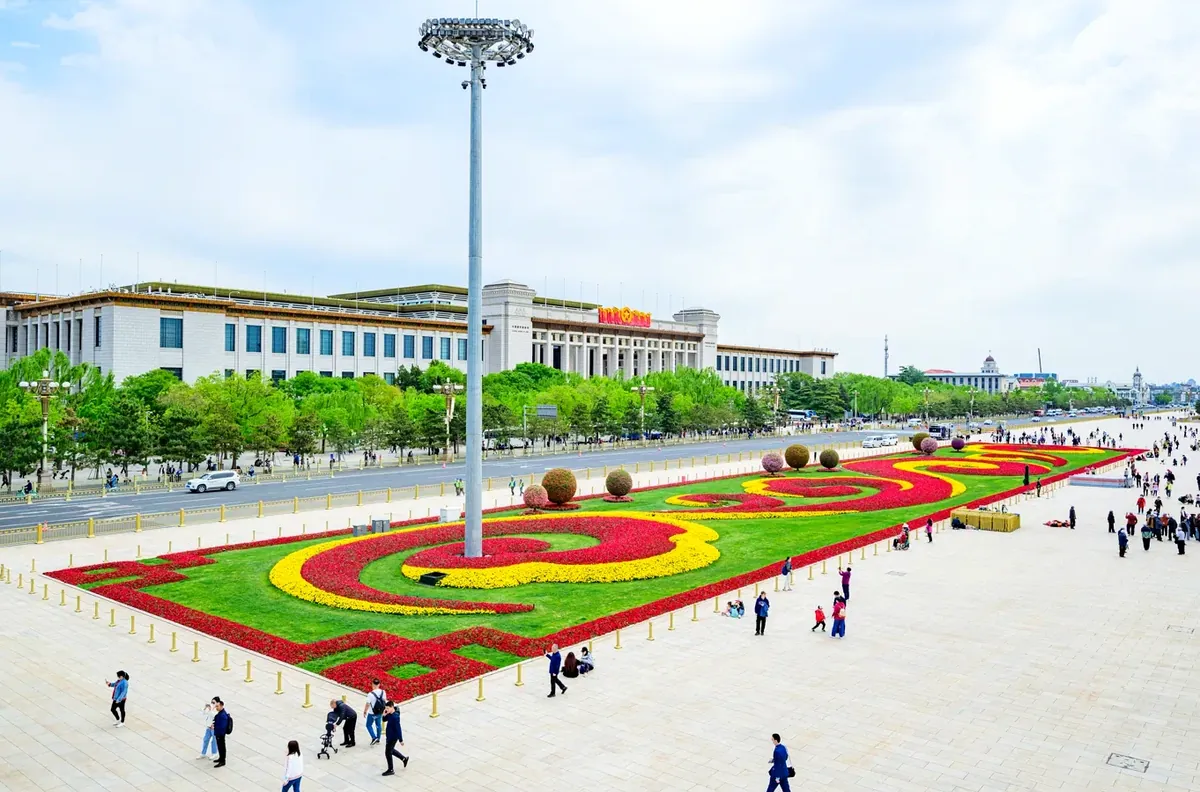
Now, wandering across the vast stone courtyard, travelers are treated to a magnificent harmony between historical depth and contemporary rhythm. In the foreground of the view toward the East, artisans have meticulously created colossal floral carpets with vibrant crimson and bright gold interwoven into graceful curved wing shapes, bringing a brilliant vibrancy to the open space. The central high lamppost reaches straight into the clear sky, illuminating the leisurely strolling crowds, while the background reveals the majestic, solemn beauty of the National Museum of China with its endless rows of massive pillars.
Located right in the heart of the sprawling Chang’an Avenue in Dongcheng District, Tiananmen Square serves as a versatile anchor along Beijing’s famous Central Axis. This urban spatial axis, dating back over seven centuries, has recently been honored by UNESCO as a World Heritage site, forming a nearly eight-kilometer-long vital artery running straight from South to North. In the planning concepts of imperial feng shui masters from the Ming and Qing dynasties, the square was not merely an empty buffer zone in front of the imperial palace, but a convergence point for the vital energies of the entire North China Plain, where layers of supreme power met and intertwined with the mortal realm.
The terrain here fully embodies the classic imperial feng shui philosophy known as “Sitting North and Facing South.” Behind the square lies the austere Forbidden City complex alongside the towering Jingshan Park, acting as the Guardian Mountain (Zhen Shan) and creating a sturdy backing like the Black Tortoise to shield the imperial capital from northern cold winds. From this solid backing, the vista opens widely and deep toward the vibrant South, stretching smoothly past the solemn Zhengyangmen (Qianmen) gate and reaching straight to the sacred Temple of Heaven. This flow of feng shui created a righteous and upright axis, symbolizing the absolute harmony between favorable weather, advantageous terrain, and the Son of Heaven’s ruling will aligned with the Mandate of Heaven.
}
The panoramic view from above captures the majestic scenery of Tiananmen Square with a geometric layout of precise symmetrical precision down to the centimeter. Right in front of the solemn red of the Tiananmen Gate and the vibrant yellow glazed tile complex of the Forbidden City, the vast space opens up with the Monument to the People’s Heroes and Chairman Mao Zedong Memorial Hall at its center. The overall picture clearly reveals a perfectly balanced East-West order as the Great Hall of the People stands impressively and majestically on the left, harmoniously mirroring the imposing National Museum of China on the right in the heart of the bustling metropolis.
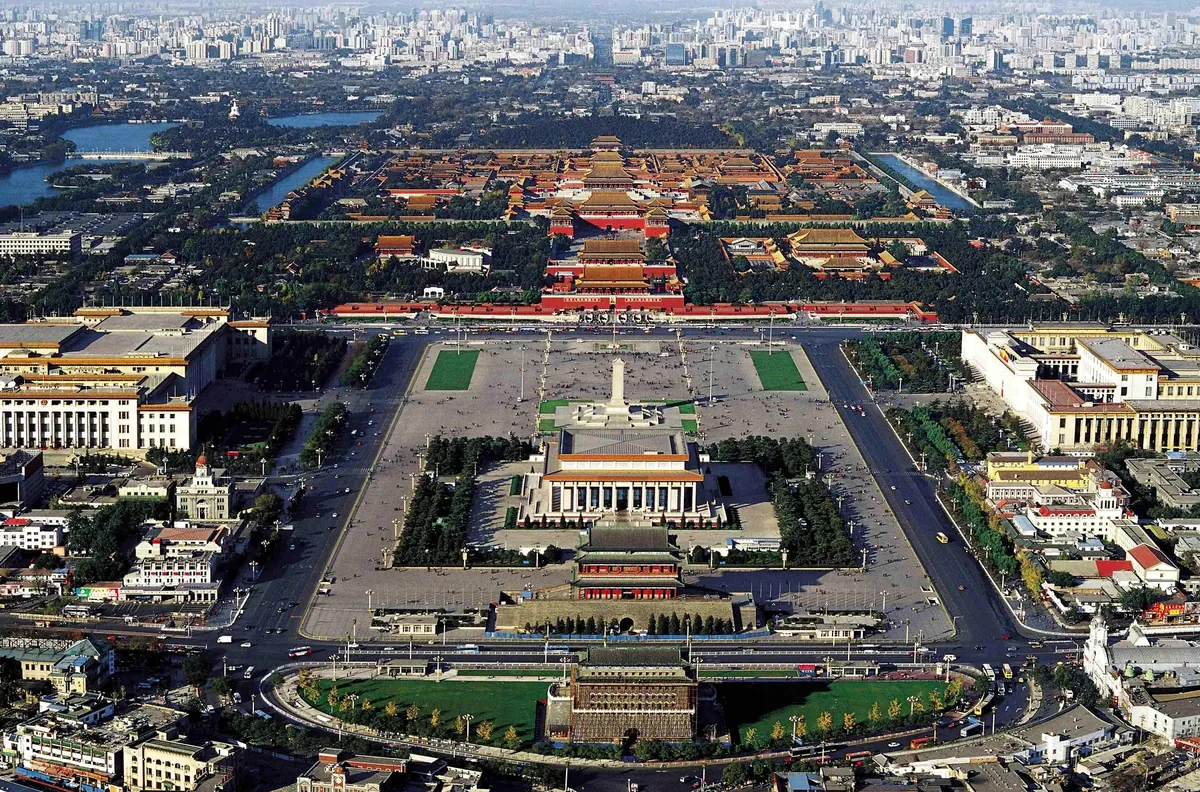
The contemporary spatial structure of the square is established based on the traditional principles of yin-yang balance while reflecting the governance ideology of the new era. Along the western axis, the Great Hall of the People rises high with rigorous classical columns, symbolizing the foundation of legislative power and the united will of the working masses. Corresponding perfectly on the eastern axis is the National Museum of China, a colossal cultural treasure preserving over five millennia of civilization alongside the heroic upheavals of revolutionary history. The static tension between these two massive structures acts like balanced wings connecting the depth of ancestral heritage and the rhythm of modern creation.
Dominating the optical center of the entire grand complex are the Monument to the People’s Heroes and the Chairman Mao Zedong Memorial Hall, serving as extraordinary historical links. The presence of these structures has transformed the enclosed Confucian imperial axis of the feudal era into an open people’s square, where modern state organizational order blends smoothly into a thousand-year-old feng shui structure. Every planning line and every granite paving stone exudes an enduring capital-founding spirit, turning the gateway of the capital into an immutable symbol of political power and Eastern cultural identity.
Nestled peacefully and majestically along the thousand-year spirit path of the capital city of Beijing, Tiananmen Square overwhelms visitors with one of the world’s most expansive open spaces, stretching across a total area of 440,000 square meters. With a north-south length of 880 meters and an east-west width spanning up to 500 meters, this grand square can accommodate millions of people simultaneously during major national parades and solemn commemorative holidays. The spatial structure here fully inherits the ancient Eastern urban planning philosophy with an absolute symmetrical axis, opening up a vast vista that seamlessly connects the solemn imprints of feudal dynasties with iconic modern structures.
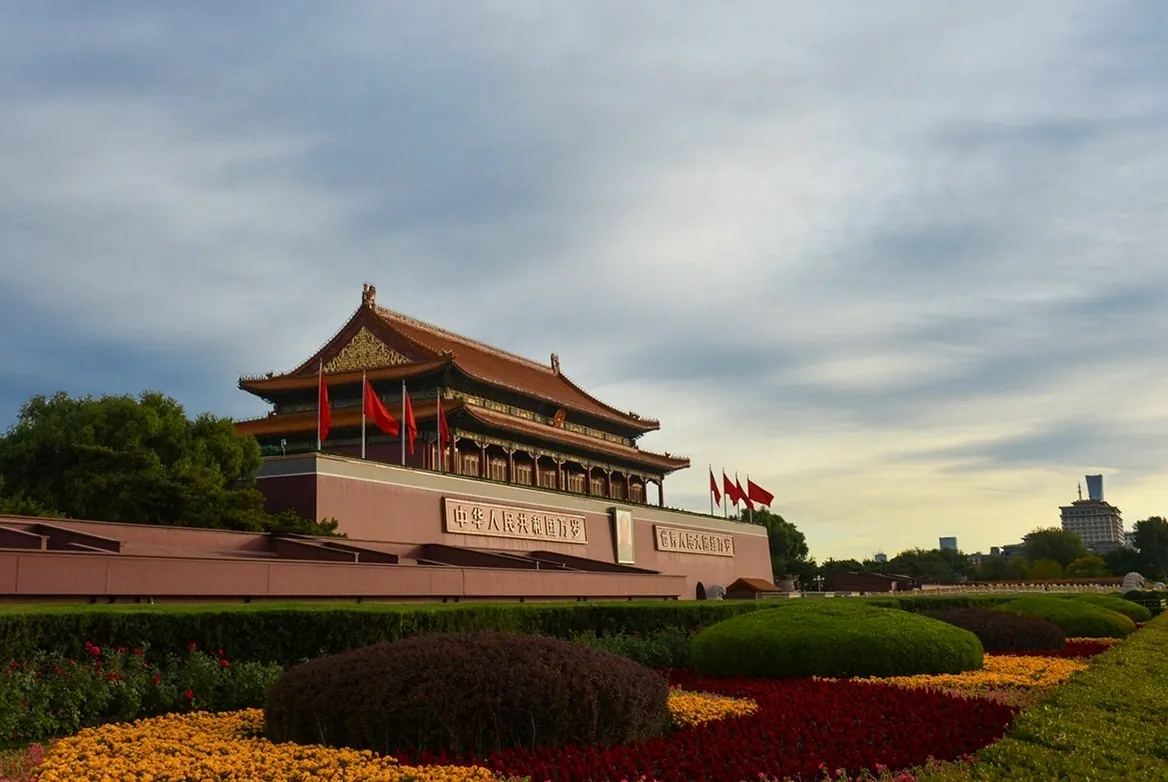
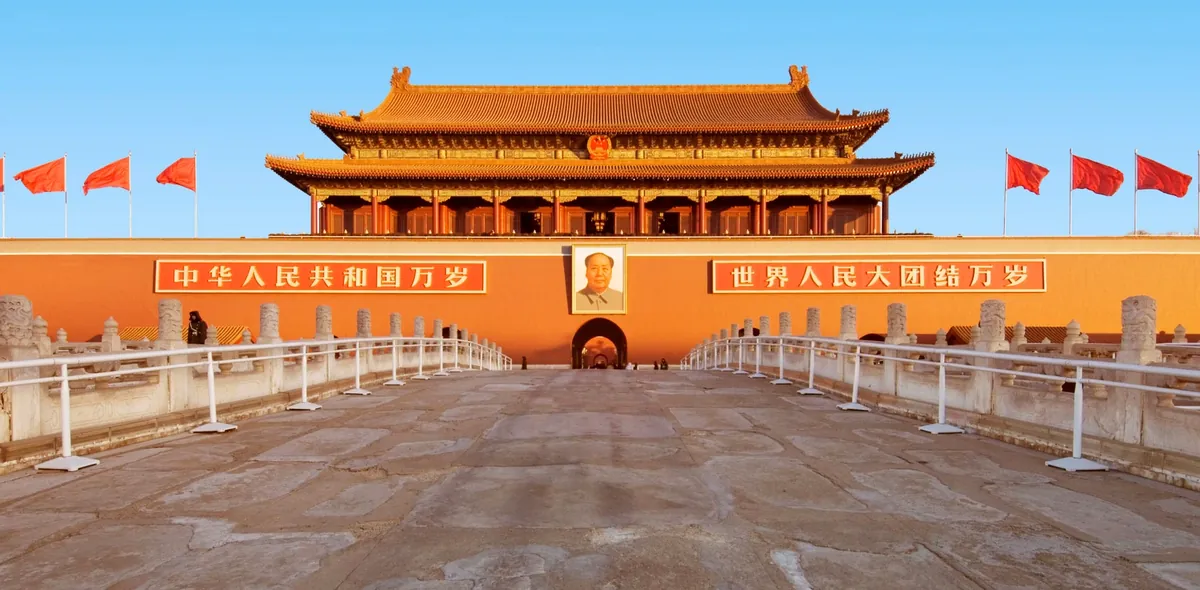
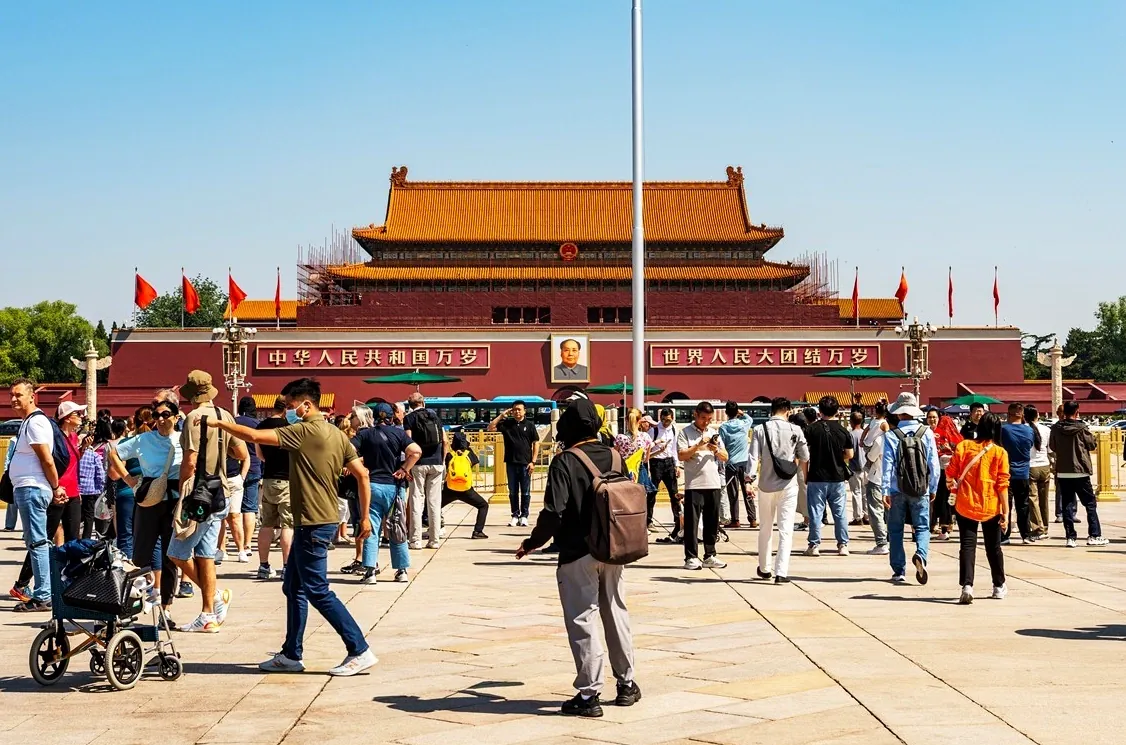
The first highlight that captures every traveler’s gaze upon setting foot in the square is the majestic Tiananmen Gate Tower, standing out against the clear sky with crimson-painted walls and golden tile roofs gleaming brilliantly under the sunlight. Right in the center of the gate’s facade, the solemn large portrait of Chairman Mao Zedong presides over the curved royal archways, creating a beauty that blends classical court art with the spirited atmosphere of a new era. At the foot of the wall, streams of visitors from all over the world leisurely stroll, admiring the magnificent historical structure in a peaceful and airy atmosphere.
The Tiananmen Gate Tower is a masterpiece crystallizing the pinnacle architectural standards of the Ming and Qing dynasties, featuring a double-eaved hip-and-gabled roof structure with gently curved eaves, completely covered in pure yellow glazed tiles representing imperial authority, adorned with rows of mythical guardians along the roof edges to ward off fire and evil spirits. The tower rises 34.7 meters high with a facade width of exactly 9 bays reaching 66.4 meters and a depth of 5 bays reaching 25.4 meters, perfectly corresponding with the Hexagram of the Supreme Sovereign in the I Ching—representing the ultimate status of an emperor. The massive red brick base is pierced by 5 arched doorways, of which the central archway was once the supreme sacred Imperial Way reserved exclusively for the emperor when entering and leaving the imperial city. Above the archway hangs the large portrait of Chairman Mao Zedong, standing 6 meters tall, 4.6 meters wide, and weighing up to 1.5 tons, accompanied by two rows of symmetrical couplets celebrating the solidarity of the country and people worldwide.
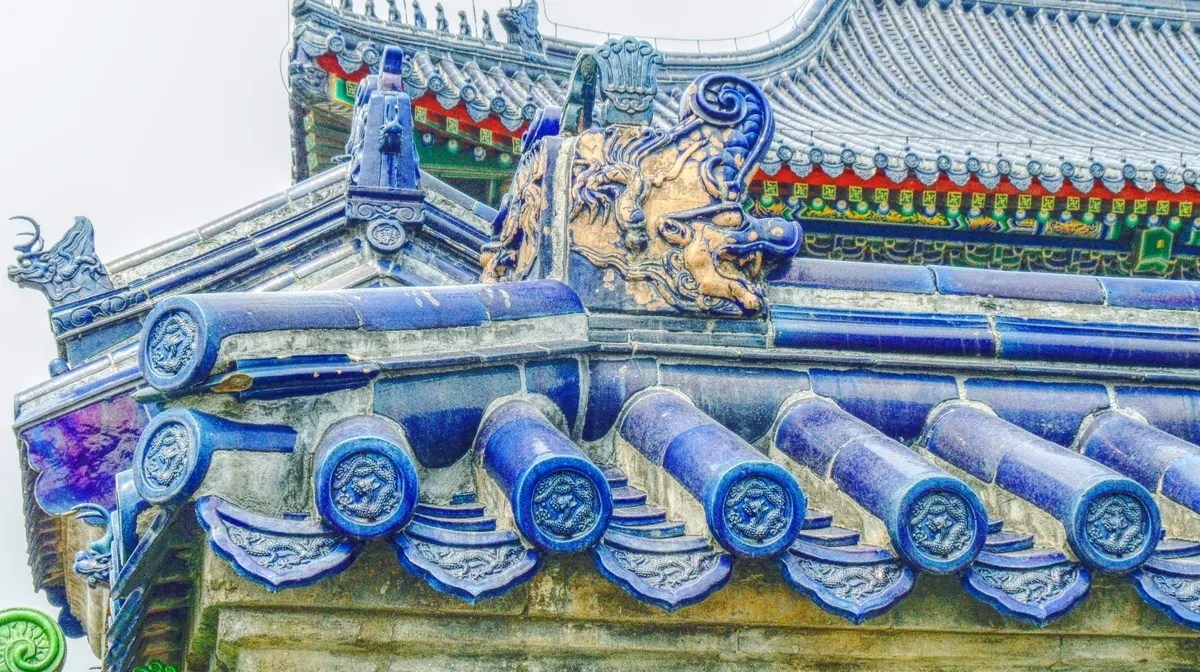
Guarding the front of the gate tower is a system of seven pristine white Han-white marble Outer Jinshui Bridges spanning the clear blue water, delicately carved with intricate wave and cloud patterns. Feudal hierarchy is strictly reflected in the position of each bridge: the largest central span was reserved exclusively for the emperor, the two adjacent bridges were pathways for imperial relatives, the next two were for senior officials of the third rank and above, and the two outermost spans belonged to officials of the fourth rank and below. Adjacent to these are a pair of monolithic white marble Huabiao columns standing 9.57 meters tall, weighing over 20 tons, meticulously carved with dragons winding gracefully through thousands of clouds. Atop each pillar sits a divine Xiezhi beast embodying two deeply instructive meanings: the pair in front of the gate, known as "Wang Jun Gui" (gazing for the sovereign’s return), gazes into the distance awaiting the emperor’s return from border inspections to rectify state affairs, while the rear pair, known as "Wang Jun Chu" (gazing for the sovereign’s departure), looks straight into the inner palace to remind the monarch not to indulge in crimson pavilions and gilded halls, but instead to travel incognito to understand the sufferings of the common people.
Standing proudly at the center of the grand square is the Monument to the People’s Heroes, a towering 37.94-meter-tall obelisk constructed from massive granite blocks with a total weight exceeding 10,000 tons. The front of the monument bears eight gold-inlaid characters reading "The People’s Heroes are Immortal" personally penned by Mao Zedong, while the reverse side features a touching commemorative inscription composed by Premier Zhou Enlai. At the base of the monument are eight large relief sculptures carved in Han-white marble vividly depicting the heroic historical milestones of the revolutionary movement from the Opium Wars to the founding of the nation, completing an architectural masterpiece that perfectly harmonizes ancient imperial grandeur with the spirit of a new era.
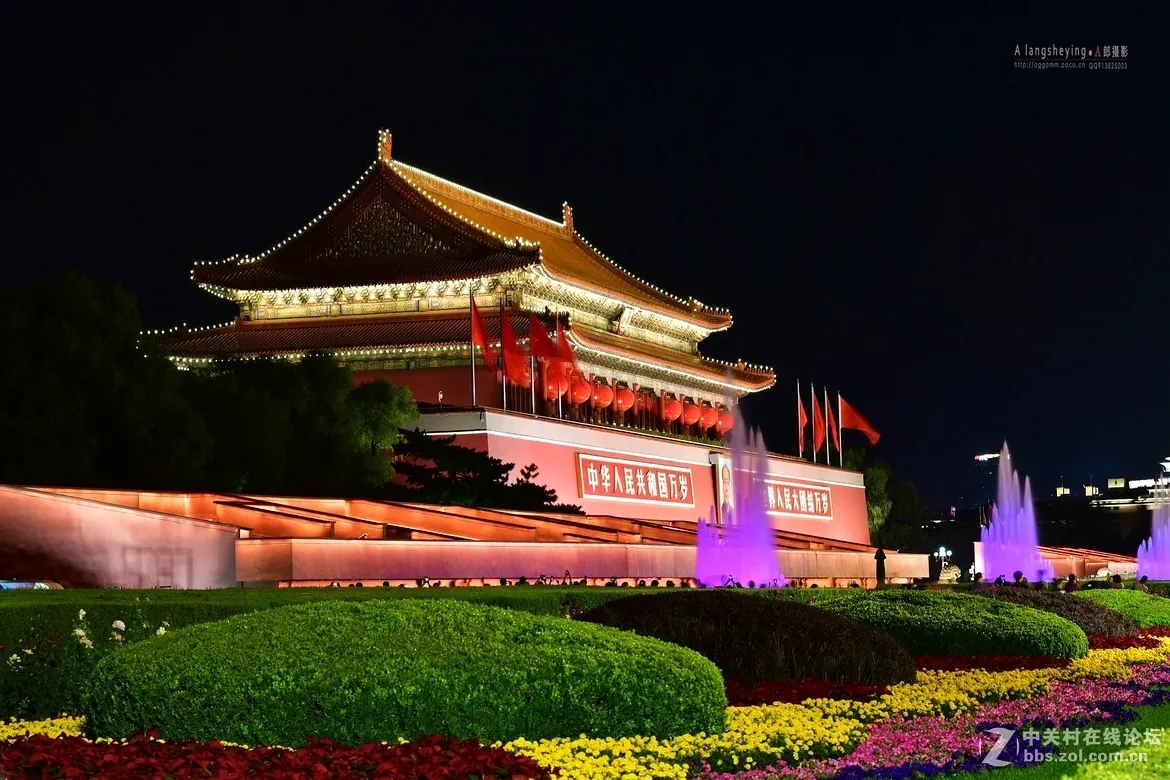
As the last rays of daylight begin to slant behind the Western Hills, Tiananmen Square enters a solemn visual transition ceremony, beginning with the highly symbolic national flag-lowering ritual. Unlike the fixed rules of civilian clocks, the exact moment of the flag lowering is calculated down to the second using astronomical software based on geographic coordinates and the precise moment the upper rim of the sun touches Beijing’s horizon. Amidst the twilight blanketing the vast granite courtyard, the honor guard detachment of the Chinese People’s Liberation Army, in immaculate uniforms, marches with absolute solemnity and precision across the Jinshui Bridges toward the central flagpole. Amidst the quiet atmosphere of tens of thousands of witnesses watching closely, the red flag slowly descends to a solemn rhythm, merging with the moment when the entire illumination system of the complex simultaneously lights up, transforming the political center into a magnificent nightscape.
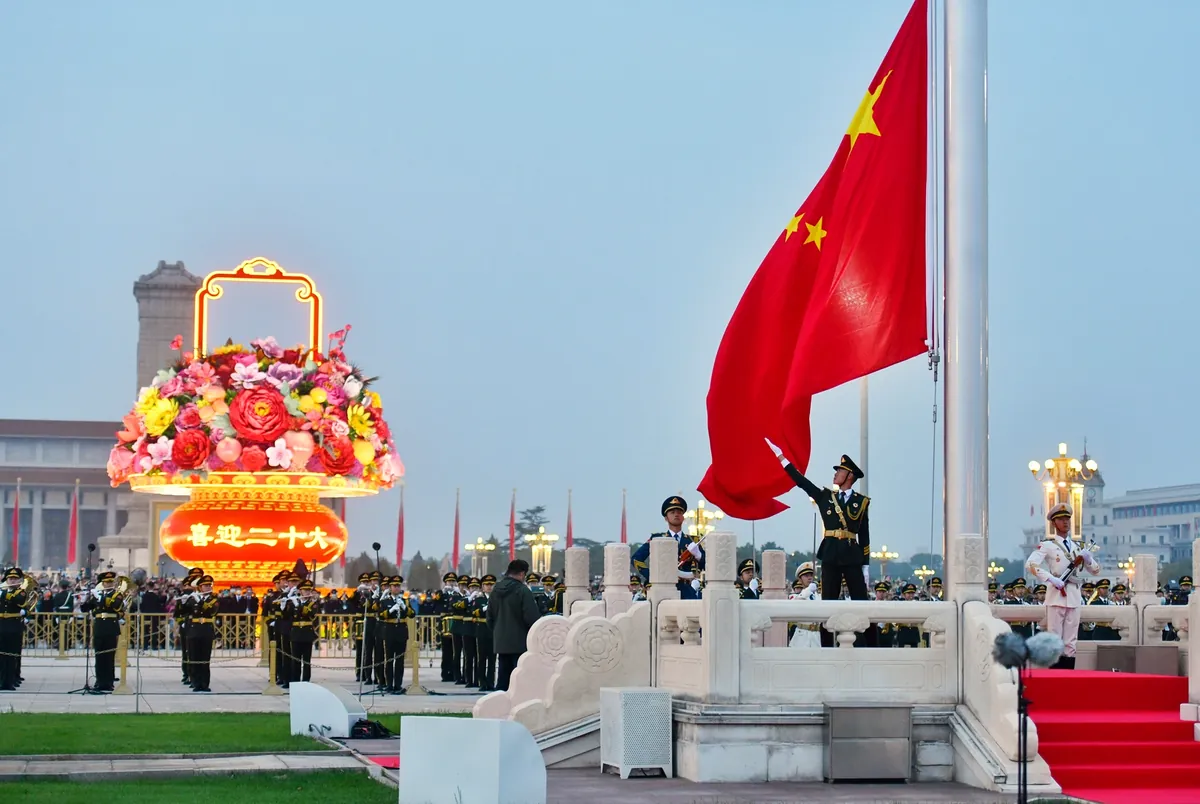
The lighting art system at Tiananmen is arranged with rigorous calculations regarding optics and Eastern architectural aesthetics to honor the millennium-old Beijing Central Axis. When night fully falls, next-generation recessed LED strips and warm-spectrum spotlight arrays simultaneously awaken historical details: from the weathered dark crimson city walls and gracefully curved eaves to the brilliant yellow glazed tiles of Tiananmen Gate Tower. At the base of the walls, the Ming-dynasty white marble Jinshui Bridges shimmer like glowing gems over the clear moat, creating a classic color contrast between cinnabar red, imperial gold, and white jade. Along Chang’an Avenue running past the square’s facade, lotus-shaped street lamp arrays cast a warm glow, guiding the view far into the distance toward the two massive structures of the Great Hall of the People and the National Museum of China, shaping a majestic spatial expanse resembling a brocade tapestry of a royal night banquet.
Alongside its pristine solemn beauty, Tiananmen Square at night also transforms into a stage for cutting-edge visual interactive technology through Digital Twin and Augmented Reality (AR) applications. Based on millimeter-detailed LiDAR remote sensing data of Beijing’s Central Axis—a recently honored World Heritage site—visitors present at the square can point their smart devices toward the night sky to observe 3D light graphics vividly recreating the imperial city’s structure across different historical eras. Structures that have faded into the past, such as the Daming Gate from the Yongle era (later renamed Daqing Gate, then Zhonghua Gate), along with the endless U-shaped corridors of the ancient imperial way, materialize shimmering right against the real sky, harmoniously blending the six-century-old flow of history with future lighting technology.
The nocturnal rhythm of Tiananmen Square does not end behind security barriers but continues flowing seamlessly southward, passing through the imposing Zhengyangmen Gate to merge with the bustling vitality of the Qianmen Old Street and Dashilar districts. Here, brilliant light from hundreds of traditional red silk lanterns casts reflections upon the smooth blue flagstones of the Qianmen Avenue pedestrian zone, shimmering on the red-and-gold painted signs of centuries-old historic shops. The faint scent of jasmine from late-night white jade-scented tea at the Zhangyiyuan tea house blends with the melodious strains of the erhu and the high-and-low pitched vocals of classic Beijing opera drifting from brilliantly lit theaters like Guangdelou. This cultural lifestyle space stretching well past midnight is the exquisite harmonization between the regal majesty of the northern square and the poetic, worldly breath of southern Beijing’s urban life.
Stepping past the majestic archway of Qianmen at the southern edge of Tiananmen Square, the solemn atmosphere of the political space immediately gives way to the prosperous culinary world of the ancient capital. Cuisine around the Tiananmen axis is not merely a stop to satisfy the palate, but a historical epic preserving both the essence of imperial court dining and the authentic daily life of Old Beijing. At the center of this heritage landscape, Beijing roast duck stands tall as the supreme symbol, shaped by a centuries-old classic rivalry between two legendary culinary schools.
Right on Qianmen Avenue, the veteran branch of Bianyifang opens the door back to 1416 during the reign of Emperor Yongle of the Ming dynasty, even before the completion of the Forbidden City and Tiananmen Square. Bianyifang is the exclusive representative preserving the closed-oven roasting technique, known as “muan lu”. The duck does not come into direct contact with an open flame but is cooked entirely by the heat accumulated in the thick brick walls of the oven after being heated until glowing hot. This enclosed heating method helps retain every tender, juicy, and naturally sweet fiber of the meat without drying it out. The direct counterpart to this ancient school is Quanjude, a brand founded in 1864 during the Tongzhi era of the Qing dynasty, famous for its open-oven hanging-hook roasting technique, known as “huogua lu”. Plump ducks are neatly hung on iron hooks, continuously rotated over flickering flames fueled entirely by old apple and pear tree wood from the suburbs. The duck skin thus achieves a crispy, paper-thin texture that melts on the tip of the tongue and releases the pure aroma of fruitwood smoke. A standard serving of roast duck ranges from 298 to 368 yuan, carved exquisitely by master chefs right in front of diners, rolled up with thin pancakes, scallions, cucumbers, and rich sweet bean sauce.
When the chilly northern winds sweep across the vast courtyards of Tiananmen, the culinary soul of the capital gathers completely in the legendary mutton hot pot of Donglaishun, a time-honored brand established in 1903. The restaurant space exudes a nostalgic vibe centered around pure red copper hot pot vessels engraved with intricate patterns, utilizing vertical chimneys fueled by glowing charcoal. Donglaishun’s hot pot broth maintains the classic light philosophy, consisting solely of clear spring water simmered with a few slices of onion, fresh ginger, and red goji berries. The highlight lies in the purebred lamb from the Inner Mongolian grasslands, hand-sliced so thin it is almost translucent; when dipped into the boiling broth for just a few seconds, it cooks to perfection, retaining its pristine sweet tenderness without any gamey odor. The lamb slice is then dipped generously into a bowl of rich sesame paste, accented with a few drops of flavorful red fermented bean curd, spicy chili oil, and chopped cilantro, creating a warming flavor harmony that banishes the piercing northern cold.
Leaving behind the lavish restaurants, local flavors winding through the Hutong alleys around Qianmen paint the most authentic portrait of Beijing’s urban life. Zhajiangmian (noodles with soybean paste) captivates travelers with hand-pulled, chewy noodles generously coated in a thick, savory fried soybean paste stir-fried with rich minced pork belly, served with a side of eight fresh julienned vegetables such as cucumber, radish, bean sprouts, and green peas. Right on the street corner is the famous Xiaoxiang Luzhu shop, where Luzhu Huosha (pork intestine soup with baked wheat cake) emits billowing steam from a seasoned herbal broth of simmered pork offal and lungs, blended with savory fried tofu and small pieces of baked flatbread soaking in a spicy sauce. For those passionate about authentic local experiences, a bowl of Douzhi (fermented mung bean milk) with its pungent, warming, and comforting sour taste, enjoyed alongside a golden, crispy fried dough ring (Youtiao), is the exact benchmark for a true Beijing palate. Closing the culinary journey around the square is the image of glowing red Tanghulu (candied fruit skewers) sparkling in the twilight, where each tart hawthorn fruit is encased in a crunchy malt sugar coating, carrying the sweet taste of childhood memories lingering at the corners of the imperial capital.
To step into the symbolic heart of Beijing, a prerequisite that every traveler must remember is the mandatory real-name registration regulation. The entire Tiananmen Square currently does not maintain any on-site paper ticket counters; instead, all visits must be booked in advance via the WeChat Mini Program named “天安门广场预约参观”. The booking portal opens precisely at 12:00 PM daily for the schedule of the seventh day ahead, requiring international visitors to input their passport numbers with absolute accuracy. The system divides access into four specialized time slots including early morning flag-raising, morning, afternoon, and evening flag-lowering; therefore, identifying your visiting needs is the first step to securing a valid pass amidst the bustling crowds.
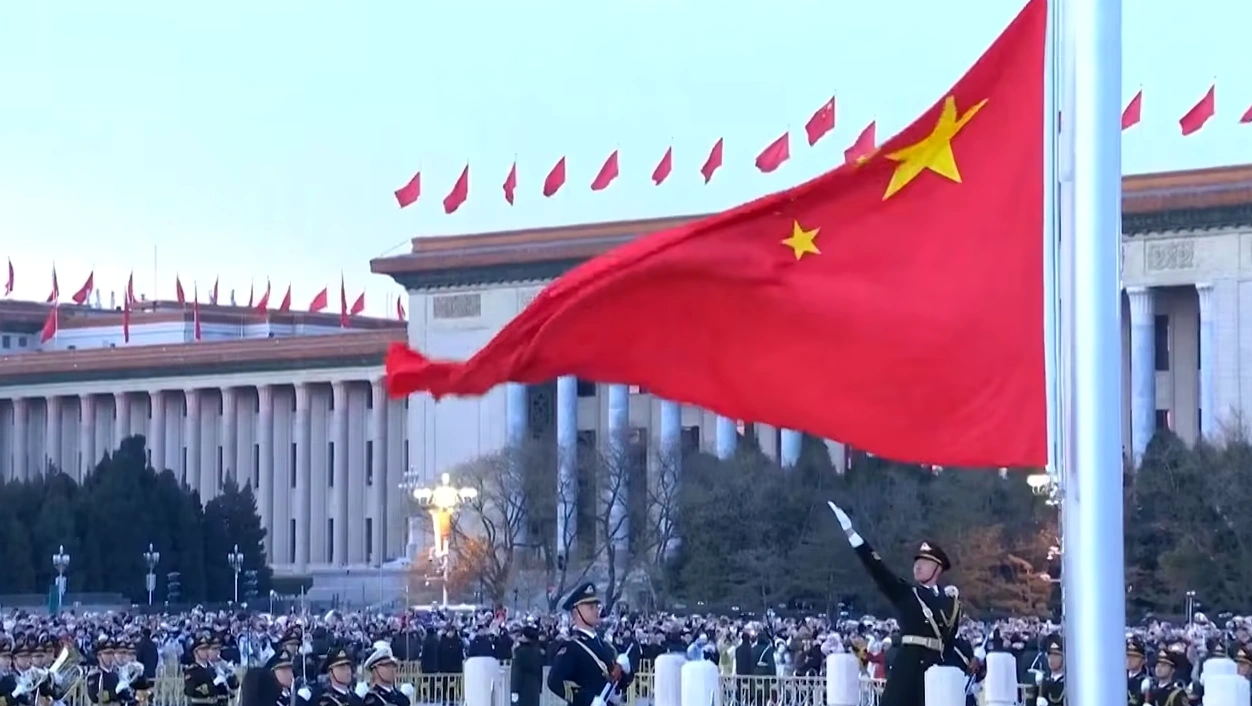
For those eager to witness the solemn moment of the flag-raising ceremony, timing strategy plays a decisive role in the entire experience. The 96 elite soldiers of the Chinese People’s Liberation Army Honor Guard perform the national flag-carrying ritual with crisp goose steps, marching precisely 138 steps from the foot of Jinshui Bridge straight to the central flagpole. The flag-raising time is not fixed, varying daily according to astronomical algorithms based on the moment the sun breaks the local horizon, ranging from 4:45 AM in mid-summer to 7:35 AM on cold winter days. To secure a prime spot right against the barrier with a direct view of the flagpole, visitors need to arrive at the security checkpoints 90 to 120 minutes before the ceremony amidst the quiet atmosphere of the capital at dawn.
Security standards at the square area are always maintained at a Level 1 alert with one of the world’s strictest multi-layered screening systems. Every traveler must pass through at least two rigorous inspection rounds combining original passport verification, optical facial recognition scanners, and X-ray portals for carry-on luggage. The strictly prohibited items list includes lighters, matchboxes, all kinds of knives, scissors, sharp metal objects, liquefied gas spray cans, drone flycams, as well as any form of non-standard banners, slogans, and flags. Any carelessness regarding personal belongings will result in security forces denying entry to the area or spending hours resolving administrative procedures at the security checkpoint booth.
The capital’s public transportation system provides an extremely convenient and economical solution for accessing the square. Metro Line 1 takes passengers directly to Tiananmen East or Tiananmen West stations, opening a direct path to the sidewalk of Chang’an Avenue. Alternatively, choosing Metro Line 2 or Line 8 to stop at Qianmen Station, then using Exit A or B, will reveal a spectacular panoramic view of the ancient Zhengyangmen before entering the heart of the square. The ideal time of year to fully enjoy the scenery here is autumn, lasting from September to November, when Beijing’s weather is golden and dry with ideal temperatures ranging from 15 to 22 degrees Celsius. Visitors should especially avoid the Golden Week from October 1 to 7 to avoid being submerged in massive crowds, or choose the quiet winter to admire the white snow covering the red palaces, though specialized thermal clothing must be carefully prepared.
Besides procedural barriers, alertness to commercial tourism traps is an indispensable preparation for every trip. Unusually cheap tour programs often trade this off by trapping passengers for one to two hours at jade workshops in the Changping outskirts under sophisticated setups by “fellow-townsmen heirs”, or at disguised traditional medicine clinics borrowing the names of Bao Phu Linh and Dong Nhan Duong pharmacies to take pulses and diagnose critical illnesses for profit. To touch true cultural depth without compromising rights, wise travelers always prioritize itineraries adhering to the “No Shopping” standard, staying in downtown hotel chains from the 2nd to 3rd Ring Road, and equipped with specialized Wireless Whisper headsets to fully experience every historical story. This scientific exploration route is currently perfectly integrated into the Beijing – Suzhou – Hangzhou – Wuzhen – Shanghai 7N6D tour, opening up the opportunity to admire millennial heritage in a civilized, relaxing, and fully quintessence-valued manner.