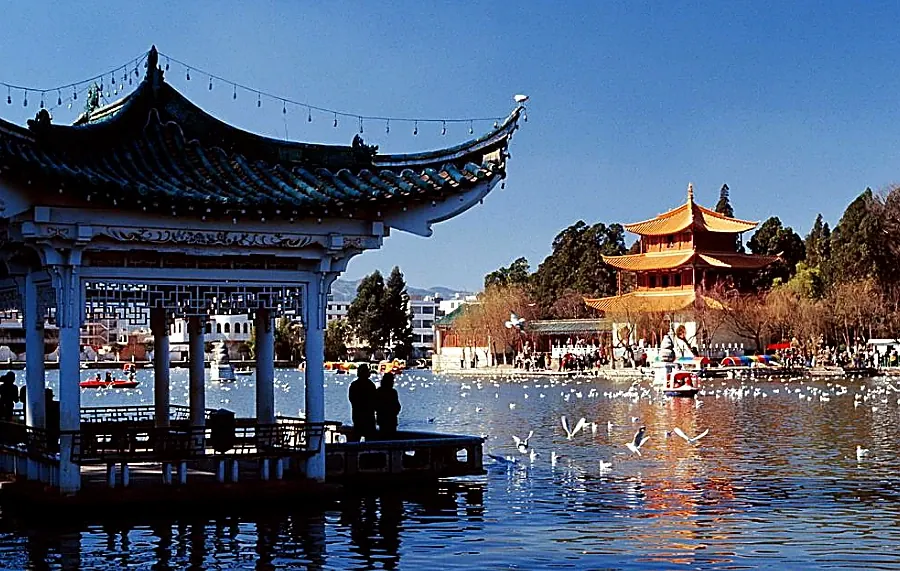
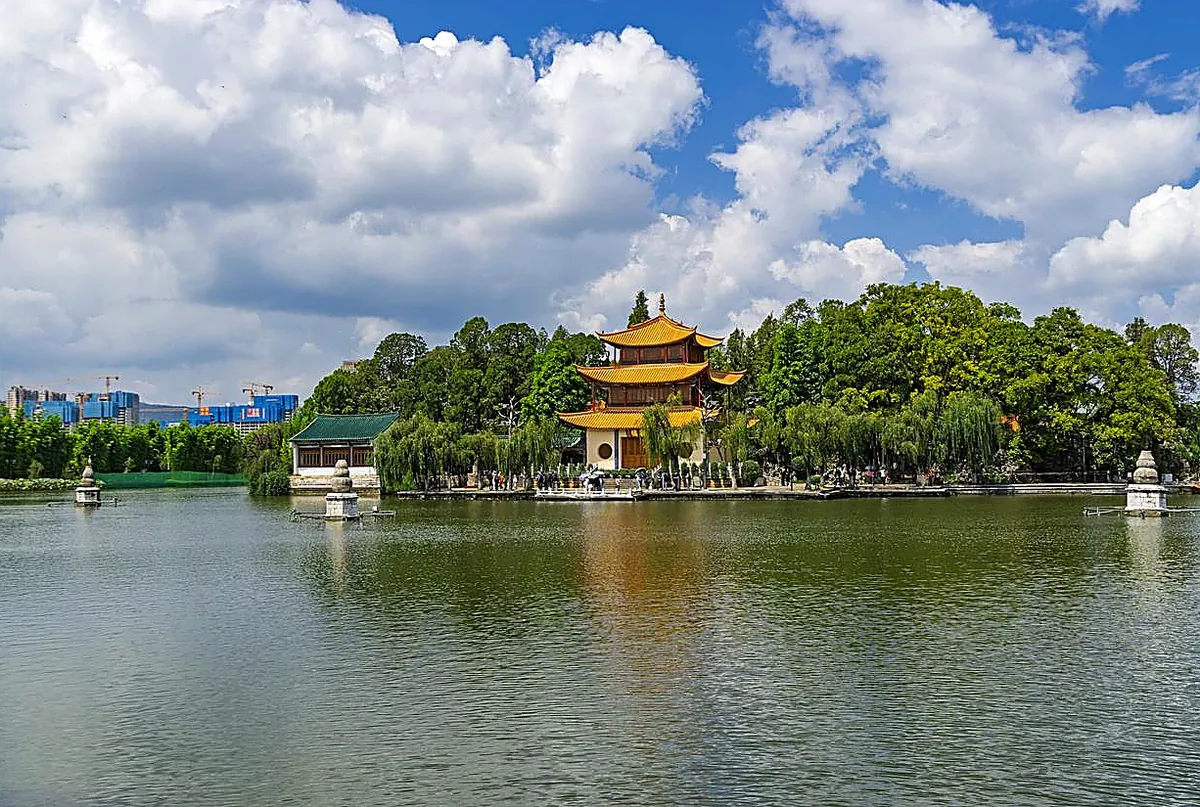
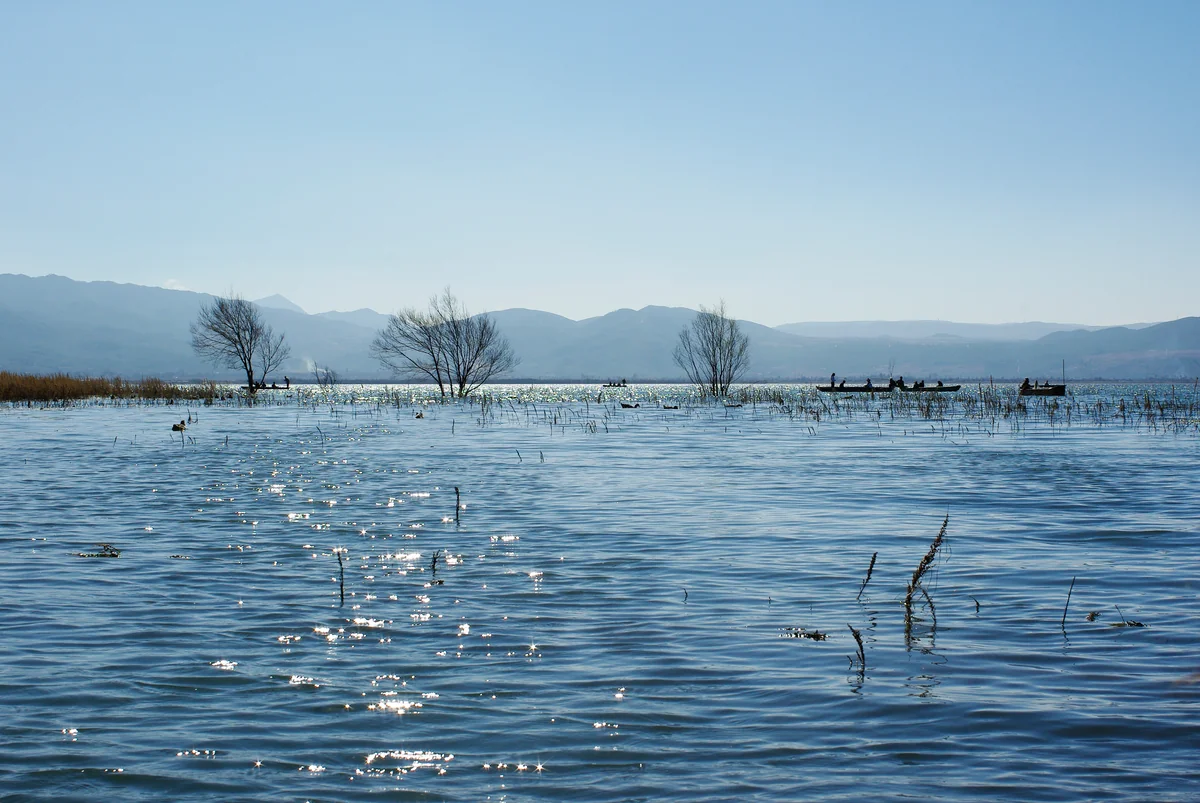
Rising majestically along the northern shore of expansive Dianchi Lake in southwestern Kunming, Grand View Pavilion (Daguanlou) stands as a proud historical witness across eras of Yunnan’s storied frontier. Far more than a scenic lookout tower, this landmark has long served as a cultural and spiritual pinnacle—distilling the vitality of mountains and waters, poetic soul, and poignant historical turns of the “City of Eternal Spring.”
Tracing back to the prosperous years of the Qing Dynasty, the precursor to this famed pavilion first took shape between 1690 (29th year of Kangxi) and 1696 (35th year of Kangxi). At that time, Yunnan Governor Wang Jiwen personally oversaw planning and construction, erecting a graceful two-story pavilion reflected in clear waters to create a scenic retreat admiring the lush green of the Western Hills and the emerald expanse of Dianchi Lake.
After more than a century of weathering, its original timber structure gradually deteriorated. In 1828 (8th year of Daoguang), Yunnan Judicial Commissioner Ruan Jin’guang—recognizing the site’s auspicious geomantic setting—led a landmark reconstruction expanding the building from two stories into a grand three-story pavilion. Yet tragedy struck again in 1857 (7th year of Xianfeng) when wartime fires reduced the pavilion and precious relics to ashes. Refusing to let this masterpiece remain in ruins, Yunnan Governor Ma Rulong and local scholars raised funds in 1866 (5th year of Tongzhi) and faithfully rebuilt the three-story pavilion in the form admired today.
Although its timber-and-tile architecture is refined and graceful, what truly turned Grand View Pavilion into a legend across China is the 180-character couplet composed by scholar Sun Ranweng upon ascending the tower. Hailed by posterity as the “Greatest Long Couplet Under Heaven,” this literary tour de force was originally inscribed onto front-hall pillars in flowing semi-cursive (*xingshu*) calligraphy by Lu Shutang, uniting calligraphic artistry with deep philosophical insight.
If the first line of the couplet paints a sweeping natural portrait of Dianchi Lake across four seasons amidst drifting mist, the second line condenses millennia of historical drama and dynastic shifts across Yunnan—culminating in the heroic allusion to Kublai Khan’s forces crossing the roaring Jinsha River on leather rafts to pacify Dali and unite Yunnan within the realm. In recognition of its unmatched historical, architectural, and literary value, Grand View Pavilion was listed as a Yunnan Provincial Cultural Heritage Site in 1983 and designated a Major Historical and Cultural Site Protected at the National Level by the State Council in 2013.
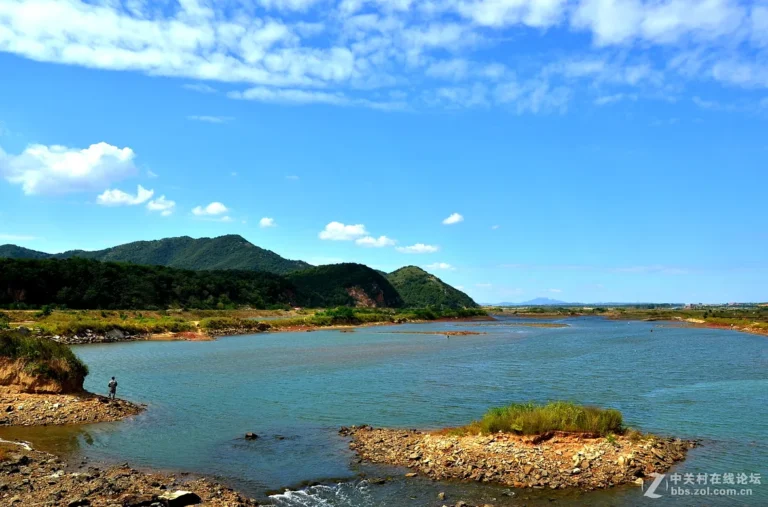
Grand View Pavilion stands proudly upon the Jinhua Peninsula in southwestern Kunming, where the natural essence of the Yunnan Plateau converges. Its location exemplifies traditional geomantic siting: backed by the stable, fertile terrain of central Kunming to the north while facing south to welcome vital energy from Caohai (“Grass Sea”)—the fertile marsh basin and key aquatic gateway of Dianchi Lake. Stretching across more than 300 square kilometers—known to ancients as “five-hundred-li Dianchi”—Dianchi’s waters meet the peninsula like a graceful shoe tip reaching into rippling currents, forming a rare “gathering water, sheltering wind” setting amidst highland mist.
The crowning highlight of Grand View Pavilion’s topographical layout is its visual axis across Dianchi Lake engaging directly with the Western Hills along the western shore. Gazing across the emerald waves of Caohai from upper pavilion levels, visitors take in soaring Taihua Peak and the undulating Biji ridge—whose natural profile resembles a reclining maiden with flowing hair amidst clouds, affectionately called “Sleeping Beauty Mountain.” This interplay between Grand View Pavilion to the east and the Western Hills across Dianchi’s mirror-like waters establishes a balanced landscape composition where sturdy mountain peaks and nurturing waters converse in harmony.
Qing scholar Sun Ranweng captured this auspicious geography in his “Greatest Long Couplet Under Heaven,” framing the four cardinal directions around the pavilion as a living cosmological tableau: spirited Golden Horse to the east, spreading Biji phoenix wings to the west, coiling Snake Hill sheltering the north like a dragon, and graceful white egrets soaring south. Positioned right at the convergence of these four directional currents, Grand View Pavilion absorbs mountain grandeur and turns boundless sky and water into part of its own architectural soul.
Harmonizing with the wider landscape is the surrounding Grand View Park, transitioning smoothly from natural lakeside wetlands into classical southern ink-wash garden design blended with highland openness. Along the southern shore, gentle waves lap against moss-tinted stone embankments mirroring swaying weeping willows. Winding channels, serene lotus ponds, and arched stone bridges pace the stroll before opening onto the vast expanse of Dianchi Lake—creating scenery at once contemplative and expansive.
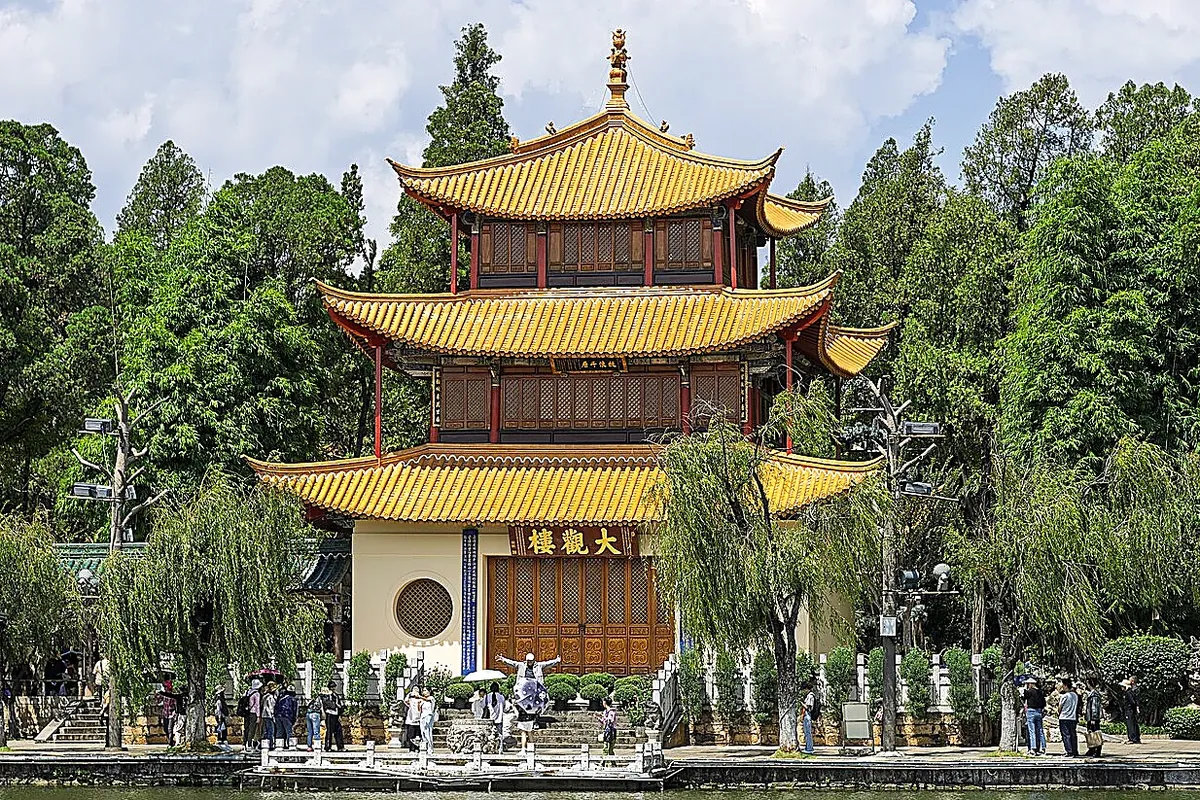
Poised serenely beside Dianchi’s waters, Grand View Pavilion crystallizes central Yunnan timber-and-stone architecture, uniting classical geometry with traditional mountain-and-water feng shui. Built on a symmetrical square plan covering roughly 400 square meters (with a ground-floor footprint of 140 square meters), the three-story structure rises on solid stone foundations and local hardwood framing crafted by generations of Yunnan master builders. Around its base stretches an open stone-paved moon terrace (*yuetai*) for catching breezes and admiring moonlight; along the southern shore, the terrace measures 21.3 meters from east to west and 4.75 meters deep, raised over a meter above the water as a grand vantage point over rolling waves and distant Western Hills.
Seen from afar, Grand View Pavilion captivates with its “triple-eaved overhanging roof with a pointed spire” (*sanchong yanchuan jianding*)—three stacked eave tiers tapering gracefully toward a pointed pinnacle. This roof structure distributes heavy tile weight across rafters and purlins while pitching rainwater cleanly during southern monsoon squalls. Its defining character lies in the bold upward sweep of its corner eaves: rather than the soft, gentle curves of Jiangnan pavilions, Daguanlou’s corner eaves thrust upward with vigorous, resolute lines that local Yunnan carpenters liken to the sweeping blade of Guan Yu’s Green Dragon Crescent Glaive—serving both structural bracing and a geomantic talisman guarding calm waters across the lake.
Stepping up the stone threshold inside, expansive views yield to intricate craftsmanship. The building features carved beams and painted rafters (*diaoliang huadong*) adorned with gilded clouds, flames, rolling waves, and mythical beasts accented in classic blues and greens. All three stories feature exterior wrap-around galleries (*waihuilang*) lined with slender yet sturdy turned wooden balustrades, opening panoramic views from each level: the ground floor close to lakeside flora, the middle floor catching highland breezes over Dianchi, and the top floor commanding a sweeping view of Kunming.
Gracing twin main pillars before the front hall is Sun Ranweng’s famed 180-character couplet, carved in fine running script on prized timber and gilded in gold leaf to dignify the entrance hall. Though modest in floor area compared with imperial palaces, Grand View Pavilion achieves supreme refinement in timber joinery, sightline composition, and scholarly poise—standing as a treasured jewel of traditional Chinese pavilion architecture.
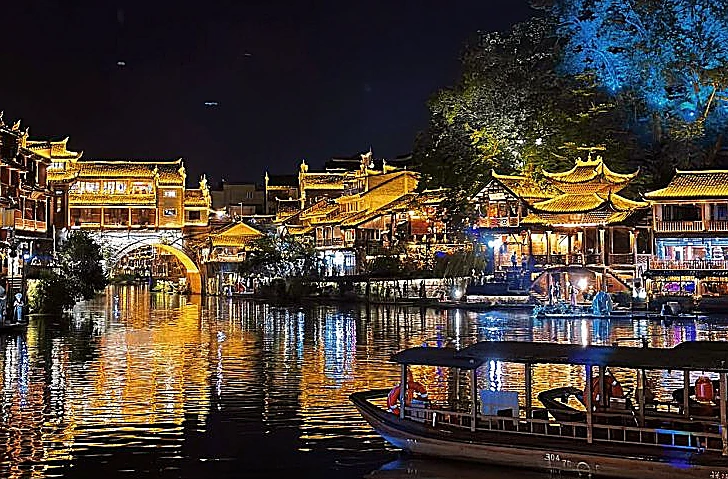
As crimson sunset fades behind the quiet ridges of the Western Hills and casts shadows across still Dianchi waters, Grand View Pavilion and the Jinhua Peninsula shed their daytime stillness to don a radiant mantle of light art. Evening in Kunming unfolds like an illuminated scroll as subtle architectural lighting highlights the three-story silhouette: warm golden light traces glazed ridges, sweeping corner eaves, pointed spire, and wrap-around galleries so the ancient tower seems to glow from within, reflecting across rippling bay waters like a celestial pavilion on earth.
A highlight of nocturnal life here is large-scale water-surface light and projection artistry. Using Dianchi’s broad waters as a natural stage, contemporary artists combine ink-wash visual projection and 3D mapping to evoke a thousand years of Yunnan history. Amid drifting mist and the resonant pluck of *guzheng* strings, phrases from Sun Ranweng’s 180-character couplet drift across the lake alongside laser beams and water jets recalling Golden Horse and Biji peaks and ancient expeditions across the frontier.
Along stone bridges and willow-lined embankments, traditional evening strolls bring classical charm to life. Beneath thousands of glowing court-style silk lanterns, visitors in Hanfu and *qipao* wander past waterside pavilions where local artists perform graceful Kunqu opera excerpts and bamboo flute melodies carried on cool lake breezes—turning an evening walk into a poetic meeting between present and past.
To savor Grand View Pavilion’s quiet magic after dark, few experiences match boarding an ornate dragon-and-phoenix painted pleasure boat for a night cruise on Dianchi Lake. Gliding out from Jinhua Pier across open water lets you admire the illuminated pavilion mirrored beneath moonlight while sipping aged ripe Pu-erh tea, tasting freshly baked rose *xianhua bing* pastries, and listening to gentle oars ripple the water—revealing why this historic tower remains an enduring jewel of the City of Eternal Spring.
Leaving the quiet pavilion behind, stroll toward Daguan Road along the waterfront, where traditional Yunnan (*Dian*) culinary flavors thrive. Kunming cuisine around Dianchi Lake favors natural highland ingredients and restorative cooking methods over flashy knife-work—flowing naturally from longtime willow-shaded eateries as an essential part of visiting southern China’s famed landmarks.
Crowning the culinary map is Crossing-the-Bridge Rice Noodles (*Guoqiao Mixian*), a century-old Yunnan classic served as a mindful ritual: a steaming tureen of rich broth simmered for hours from free-range hens, pork ribs, and marrow bones is sealed beneath a golden layer of goose fat that traps heat near boiling. Diners slide in gossamer-thin slices of pork loin, aged Xuanwei ham, crisp bamboo shoots, and tender pea shoots—cooked in seconds by trapped heat—before adding smooth rice noodles for a rich yet balanced, non-greasy bowl.
Alongside *Guoqiao Mixian* stands *Qi Guo Ji* (“Steam-Pot Chicken”), an intangible culinary treasure celebrating Jianshui purple-clay pottery. Cut chicken pieces are arranged inside a special clay pot with a central hollow steam tube—with no water added—and steamed over a boiling pot for hours as rising steam condenses into pure, deeply flavorful soup while meat turns fall-off-the-bone tender yet juicy.
Everyday street snacks around Grand View Pavilion also capture local character: flaky multi-layered *Pao Subao* pastry buns filled with savory pork and shiitake mushrooms, golden butter-fragrant *Mandang Baba* introduced along the Yunnan–Vietnam railway era, charcoal-toasted *Kao Erkuai* rice cakes brushed with sesame and chili sauces and wrapped around pickled mustard greens, and refreshing cold *Liang Mixian* or *Douhua Mixian* noodles on warm afternoons.
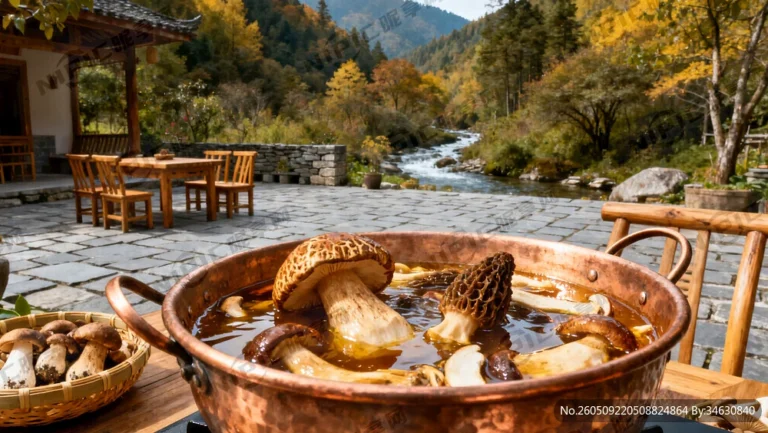
Visiting in late summer through autumn brings another seasonal highlight: wild forest mushrooms. The fertile plateau yields prized wild fungi such as fragrant pine-scented black *ganba* mushrooms and rich *niuganjun* (boletes), flash-seared in hot woks with garlic cloves and local green chilies for an unforgettable taste of Yunnan’s mountains.
Positioned gracefully along Dianchi’s breezy northern shore inside Grand View Park at 284 Daguan Road in Xishan District, Kunming, Grand View Pavilion is easily reached via the modern transit network of Yunnan Province. From central districts or Kunming subway stations, public buses including Routes 4, 22, 52, 95, 100, and 104 stop directly at Daguanlou or right outside the park’s main gate, while taxis and self-drivers find designated paid parking near the entrance. Grand View Park typically opens daily from 7:00 AM to 7:00 PM (extending occasionally to around 9:30 PM during lantern festivals or night lake tours). Allow two to three unhurried hours to cross willow-lined stone bridges, admire the three-story golden-tiled pavilion, and read Sun Ranweng’s 180-character couplet—using an audio guide or reviewing its historical allusions beforehand for deeper appreciation.
When arranging lake boat rides or souvenirs, book through official park piers and authorized shops with posted prices rather than unsolicited street touts, and follow respectful etiquette: never touch historic plaques or couplets, avoid rubbing stone inscriptions, and keep Dianchi’s shoreline clean. From Vietnam, reaching Kunming is convenient via the Lao Cai–Hekou border crossing (with a border pass or group visa) or direct flights to Kunming Changshui International Airport; ensure your passport has at least six months’ validity, set up Alipay or WeChat Pay ahead of time, and pack light layers, a sun hat, and sunglasses for Kunming’s near-2,000-meter plateau climate. For a seamless journey pairing Grand View Pavilion’s poetic heritage with dramatic alpine scenery without logistical hassle, consider the 4D3N Hekou – Kunming – Jiaozishan Snow Mountain Tour.