post_content
Welcome to VDS Travel’s premium international travel guide section, where we give wings to inspiring and upscale journeys. Today, we will step into one of China’s most vibrant and unique cities – Chongqing, and explore its proud heart: the Jiefangbei (Liberation Monument).
Chongqing, the foggy mountain city with the enchanting nickname “8D metropolis,” always knows how to leave visitors in awe with its magical blend of thousand-year history and surreal architecture. Amidst this multi-dimensional urban landscape, the Jiefangbei is not merely a historical landmark, but a living symbol of resilience, national pride, and the relentless heartbeat of a city that never sleeps. This is where past and present intersect, where every brick and every light tells a story of strong upward growth.
The Jiefangbei in Chongqing is more than just a destination; it is a multi-sensory experience, a journey to touch the soul of Chongqing. From the heroic historical stories hidden behind each stone slab to the bustling, vibrant atmosphere of Southwest China’s most prosperous pedestrian street, Jiefangbei offers you unforgettable moments. Let VDS Travel turn the pages of this guide to fully explore the beauty and profound meaning of the Liberation Monument, preparing you for an emotional and memorable all-inclusive 4-day 3-night Chongqing Mono tour.
1. Jiefangbei Chongqing: A Heroic Historical Symbol & Profound Meaning
The Jiefangbei, also known as the Liberation Monument, is not simply a piece of architecture but a valuable historical relic, a proud symbol of both Chongqing and China. To truly understand the stature of this landmark, we need to travel back in time to the heroic pages of history that forged its eternal value.
• Origins from the “Spiritual Fortress” Amidst the Smoke of War
The history of the Liberation Monument begins during the fierce years of the Second Sino-Japanese War (1937-1945). When Nanjing fell, Chongqing became the wartime provisional capital of the Republic of China, bearing the heavy responsibility as the center of resistance against Japanese fascism. Throughout this period, Chongqing endured thousands of devastating air raids by the Japanese air force, turning the city into a sea of ruined flames. However, the people of Chongqing did not back down; they stood resiliently, turning every street corner into a spiritual fortress.
In 1940, to boost the morale of the people and the military, the government had a structure built in the city center, initially called the “Spiritual Fortress” (精神堡垒). This was a wooden tower, about 7.7 meters high, symbolizing indomitable will, the spirit of solidarity, and faith in victory. The “Spiritual Fortress” was not merely a physical milestone but a spiritual lighthouse, illuminating the path through the darkness of war and becoming a great source of encouragement for the people of Chongqing during their most arduous days. It served as a constant reminder of sacrifice, patriotism, and a peaceful future that everyone was striving for.
• Transformation into the “Monument to the Victory of the Anti-Japanese War”
After 8 years of protracted and arduous resistance, victory finally smiled upon China. On September 3, 1945, Japan formally surrendered, ending World War II. To commemorate this momentous event, the “Spiritual Fortress” was demolished and replaced with a sturdier structure named the “Monument to the Victory of the Anti-Japanese War” (抗战胜利纪功碑). This is a solid stone pillar, 27.5 meters high, constructed of reinforced concrete, meant to honor the fallen heroes and mark the nation’s great victory. What is special and extremely meaningful is that the Jiefangbei is the only anti-fascist victory monument that still exists and is preserved intact in China, serving as a vivid testimony to Chongqing’s historical role in the patriotic war.
This structure is not only a monument but also a symbol of rebirth and hope after painful losses. It stands tall in the heart of the city, acting as an affirmation of the power of human will and the ability to overcome all challenges to reach peace and prosperity.
• Rebirth with the Name “Liberation Monument” After 1949
In 1949, after the founding of the People’s Republic of China, the “Monument to the Victory of the Anti-Japanese War” was renamed once again, carrying a new meaning suited to the era: the “Liberation Monument” (解放碑). This name not only commemorated the liberation of Chongqing from Kuomintang control but also symbolized the liberation of the entire Chinese nation from oppression, opening a new era of independence and sovereignty. Since then, the name Jiefangbei has been associated with the monument, becoming an inseparable part of Chongqing’s identity.
The Chongqing Liberation Monument has witnessed countless historical ups and downs, from the fierce war days to the period of strong reconstruction and development. It is not merely an inanimate architectural block but a chronicle in stone, recounting the story of courage, resilience, and the aspiration for freedom of a nation. Whenever standing before the Jiefangbei, visitors not only admire an architectural work but also feel the flow of history, listen to the echoes of the past, and gain a deeper understanding of Chongqing’s undying spirit.
2. Unique Architecture & Central Location of the Jiefangbei
The Jiefangbei in Chongqing stands out not only for its historical value but also for its unique architecture and strategic location, making it an unmissable highlight in any Chongqing tour.
• A Sturdy Tower in the Heart of the Metropolis
The Jiefangbei Liberation Monument is a square cylindrical tower, 27.5 meters high, standing proudly right in the central intersection of Yuzhong District – the busiest and most important area of Chongqing. This height is not merely a number but holds symbolic significance, recalling important historical milestones. The body of the tower is built of gray granite, giving it a solemn, sturdy, and timeless appearance. The four sides of the tower are carved with ancient Chinese characters, recording the formation history and significance of the monument, serving as a place for visitors to learn more about the past stories.
The top of the monument is intricately designed, featuring a large clock on all four sides, symbolizing the passage of time and the continuous development of the city. At night, the top of the tower is brilliantly illuminated, turning Jiefangbei into a sparkling lighthouse that attracts all eyes and creates a magical, shimmering scene in the heart of Chongqing.
• Golden Location: The Central Intersection of Yuzhong District
The location of the Chongqing Jiefangbei Liberation Monument is one of the most important factors creating its charm. Situated right at the central intersection of Yuzhong District, this is not only the geographical center but also the economic, cultural, and entertainment hub of the city. Yuzhong District is a peninsula surrounded by the Yangtze River and the Jialing River, gathering most of the administrative offices, large commercial centers, high-end hotels, and other famous attractions.
From Jiefangbei, visitors can easily access every corner of Chongqing via a modern public transportation system, especially the subway. This location also makes the monument a familiar meeting spot for locals and an ideal starting point for any 8D urban exploration journey. The hustle and bustle surrounding Jiefangbei have turned this place into a living symbol of development, of a modern and dynamic Chongqing.
• Connection to the Bustling Pedestrian Street & Bayi Food Street
Surrounding the Jiefangbei Liberation Monument is one of the busiest pedestrian streets in Southwest China. This area is planned as a large open space, reserved exclusively for pedestrians, creating favorable conditions for tourists and locals to freely shop, dine, and entertain. Modern skyscrapers with giant LED screens surround the monument, creating an impressive contrasting scene between history and the future.
In particular, the Jiefangbei pedestrian street also connects directly to Bayi Food Street (Bayi Haochi Jie), a culinary paradise that any food lover cannot miss. Here, visitors can enjoy countless characteristic dishes of Chongqing, from spicy hotpot, longevity noodles, and xiaomian, to attractive street snacks. The combination of a solemn historical monument, a modern commercial center, and a vibrant food street has turned Jiefangbei into a versatile destination, meeting all the needs of visitors, from cultural exploration to urban life experiences.
The Chongqing Jiefangbei Liberation Monument is not simply a milestone on the map but a beating heart, converging the essence of the past and the energy of the present, inviting every visitor to come, feel, contemplate, and immerse themselves in the fast-paced yet charming rhythm of Chongqing.
3. Jiefangbei – The Bustling 8D Urban Heart & Shopping, Culinary Paradise
If the Jiefangbei Liberation Monument is the historical soul, the area surrounding it is the beating heart of Chongqing – a bustling, modern, and enchanting 8D metropolis. Jiefangbei is not merely a check-in spot but a top-tier commercial, entertainment, and culinary center where visitors can fully experience the vibrant rhythm of the mountain city.
• Jiefangbei Pedestrian Street: Endless Shopping & Entertainment Paradise
Surrounding the Jiefangbei monument is a large pedestrian street, dubbed the “Wall Street of Chongqing” or the “Shopping Paradise of Southwest China”. This place gathers a series of high-end shopping malls, flagship stores of renowned international brands such as Louis Vuitton, Gucci, Chanel, Prada, along with leading fashion, cosmetics, jewelry, and electronics brands. Visitors can spend the whole day strolling around the shops, admiring the latest collections, or looking for unique items.
Not only for shopping, Jiefangbei pedestrian street is also a diverse entertainment center. Modern cinemas with advanced 3D and 4D technology, luxurious karaoke bars, vibrant bars, and other entertainment areas are all ready to serve visitors. In the evening, this area becomes magically shimmering with brilliant LED lights from skyscrapers and giant 3D screens broadcasting vivid advertisements, creating an impressive urban space bearing the strong imprint of a futuristic city.
• Bayi Food Street: Discovering Chongqing’s Spicy Flavors
For food lovers, Bayi Food Street (Bayi Haochi Jie) is a must-visit destination when coming to Jiefangbei. Located right next to the monument, this street is a labyrinth of flavors where visitors can fully enjoy the culinary essence of Chongqing – one of China’s “Four Great Culinary Traditions”.
The most famous specialty must be Chongqing hotpot with its numbingly spicy broth characterized by Sichuan peppercorns and dried chilies. In addition, visitors should also try other dishes such as:
- Xiaomian: A famous spicy noodle dish, often eaten for breakfast, featuring a rich broth, minced meat, peanuts, and herbs.
- Changshou Mian (Longevity Noodles): Traditional noodles symbolizing longevity, usually eaten during festive occasions and celebrations.
- Mala Xiang Guo (麻辣香锅): A dry hot pot where you choose your ingredients, and the chef stir-fries them with spicy characteristic mala sauce.
- Pao Jiao Feng Zhua (Pickled Pepper Chicken Feet): A crunchy, fiery, and appetizing snack that tickles your taste buds.
- Hong Tang Ci Ba (Brown Sugar Glutinous Rice Cakes): A sweet, chewy, and fragrant dessert that helps soothe the spiciness after a meal.
The atmosphere at Bayi Food Street is always bustling and lively with enticing aromas spreading everywhere, creating an authentic and unforgettable street food experience.
• Unique 8D Urban Culture Experience
Jiefangbei is not just a place for shopping and dining, but also a place to feel the uniqueness of Chongqing – the 8D city. The concept of “8D” not only refers to the complex mountainous terrain and multi-layered transportation routes, but also reflects the multi-dimensional nature of urban culture and lifestyle. At Jiefangbei, visitors can clearly witness the intersection between modern skyscrapers and historical alleys, between advanced technology and well-preserved traditional cultural features.
In the evening, when brilliant lights illuminate the entire neighborhood, Jiefangbei transforms into a giant stage where visitors can admire spectacular light shows, massive LED screens broadcasting digital art pieces, and feel the relentless energy of a city that never sleeps. This is an ideal place for walking, sightseeing, taking photos, and immersing oneself in the flow of life of the Chongqing locals.
Upon arriving at the Chongqing Liberation Monument, visitors are not just visiting a historical relic but stepping into a colorful world where all senses are awakened. This will undoubtedly be an indispensable highlight in your all-inclusive 4-day 3-night Chongqing Mono tour.
4. “Million-Like” Check-In Spots at the Liberation Monument
The Liberation Monument is not merely a historical symbol but also a virtual living “sanctuary” where visitors can find countless unique angles to capture impressive “million-like” photos. With the combination of ancient and modern architecture and a vibrant urban atmosphere, Jiefangbei delivers unmistakable frames.
• The Liberation Monument from Every Angle
The focal point of every photo is undoubtedly the Liberation Monument itself. Standing 27.5 meters tall right in the middle of the intersection, it creates a perfect backdrop for iconic photos.
- Panoramic angle: Step back slightly to capture the entire monument along with the surrounding skyscrapers. The photo will clearly demonstrate the intersection between history and modernity, between the tranquility of the heritage and the hustle and bustle of the city.
- Close-up shots: Focus on the details of the tower body, the ancient Chinese characters, or the large clock on top. These photos will provide a deeper insight into the architecture and significance of the monument.
- Night photography: This is the “golden” time to photograph the Liberation Monument. When brilliant lights illuminate the entire area, the monument becomes sparkling and magical. The light from the surrounding giant LED screens also creates unique color effects, turning each photo into a work of art.
• Unique Reflections from Glass Buildings
The Jiefangbei area is surrounded by a series of skyscrapers with shiny glass facades. These reflective surfaces create extremely impressive visual effects, especially during the day when sunlight shines or at night when electric lights glow brightly.
- Reflective photography: Find an angle where the monument or the surrounding urban landscape is reflected on the glass surfaces of the buildings. These photos often carry a surreal, unique, and artistic beauty.
- Mirror effect photography: Use puddles after the rain or other flat reflective surfaces to create a mirror effect, bringing depth and symmetry to the photo.
• Pedestrian Street & Vibrant Urban Life
Not only featuring the monument, the vibrant atmosphere of the Jiefangbei pedestrian street itself is also an endless source of inspiration for “million-like” photos.
- Street photography: Capture the moments of locals and tourists bustling back and forth, street vendors, and street performances. These photos will tell the story of urban rhythm, diversity, and the dynamism of Chongqing.
- Photos with giant LED screens: Stand in front of giant 3D LED screens, especially at night, to create impressive photos with vibrant lighting and color effects.
- High-angle shots: If you have the chance, find a rooftop café or restaurant on a high floor of a nearby building to take a panoramic view of the pedestrian street and the monument from above. The photo will offer an expansive, majestic view of the scale and bustle of Jiefangbei.
• Bayi Food Street & Appealing Dishes
Bayi Food Street is not only a place to taste but also a place to photograph appetizing and colorful delicious dishes.
- Food photography: Take close-ups of bright red Chongqing hot pot bowls, appealing bowls of xiaomian, or fragrant skewered grilled food. Pay attention to lighting and plating to make the food truly alluring.
- Atmospheric photography: Capture the hustle and bustle of eateries, long queues of people, or chefs preparing food. These photos will convey the vibrant atmosphere and distinctive flavors of Chongqing cuisine.
With its diversity of landscapes and atmosphere, the Chongqing Liberation Monument is undoubtedly an ideal destination for photography enthusiasts and those who want to preserve beautiful memories on their all-inclusive 4-day 3-night Chongqing Mono tour.
5. Exploring Destinations Near Jiefangbei: Expanding Your Chongqing Journey
The prime location of the Liberation Monument not only makes it easy for visitors to explore the central area but also serves as an ideal starting point to reach many other famous landmarks of Chongqing. From Jiefangbei, you can easily travel to iconic destinations, ranging from ancient to modern, creating a diverse and rich Chongqing travel journey.
• Hongyadong: A Fairytale Village in the Heart of the City
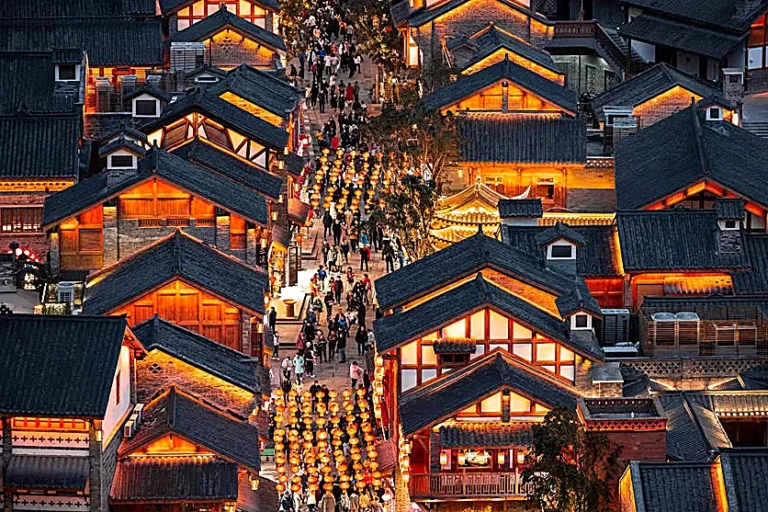
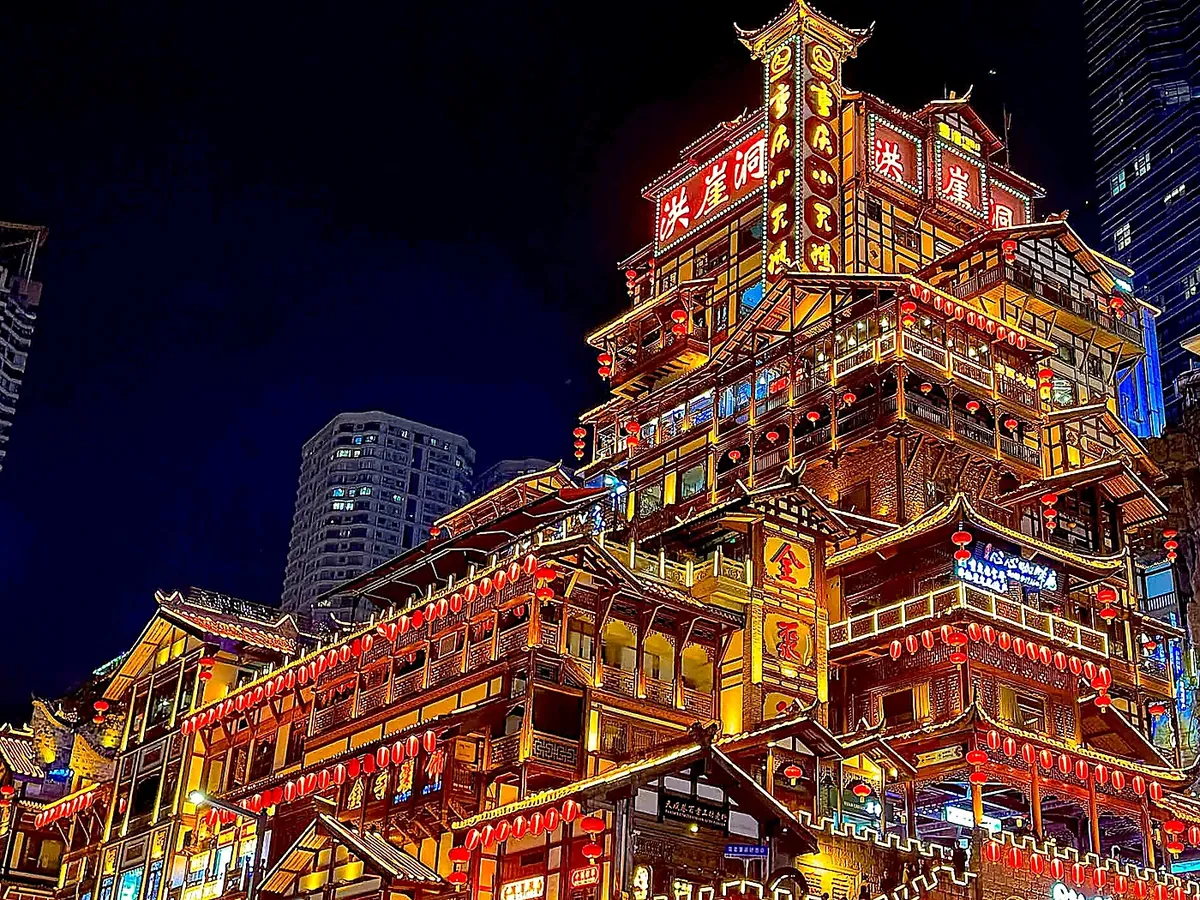
Just a short walk or a quick taxi/bus ride from the Jiefangbei Liberation Monument, Hongyadong is an absolute must-visit destination in Chongqing. This unique architectural complex is built in the traditional Ba-Shu Diaojiaolou (stilt house) style, featuring wooden houses hanging precariously over cliffs overlooking the Jialing River.
- Unique Architecture: Hongyadong spans 11 floors, with each level serving as a distinct world filled with souvenir shops, restaurants, tea houses, and hotels. The intricate architecture gives visitors the feeling of wandering into a fairytale labyrinth.
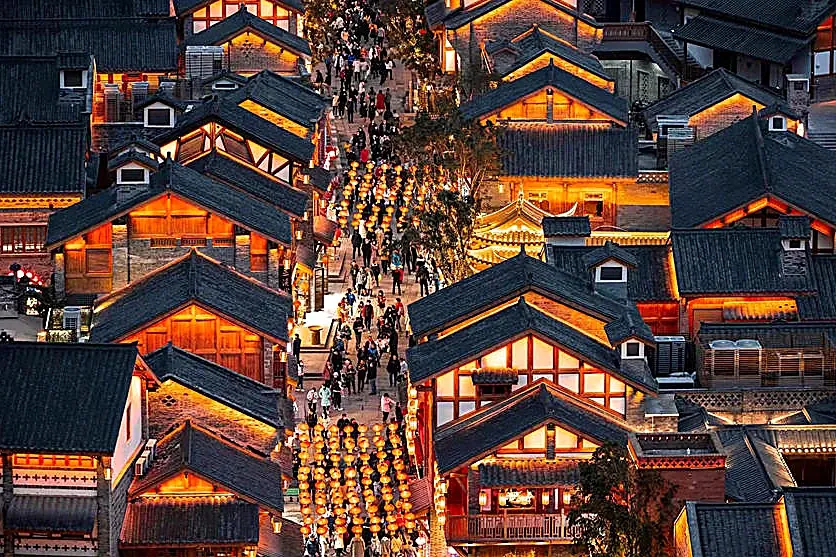
- Magical Night Scenery: In the evening, Hongyadong is brilliantly illuminated by thousands of red lanterns and warm golden lights, creating a shimmering, magical setting often compared to the “Bathhouse” in Ghibli’s famous animated film “Spirited Away”. It is one of the best photography spots in Chongqing.
- Dining and Shopping Experience: Visitors can savor local delicacies, shop for traditional handicrafts, and soak in the bustling atmosphere of the ancient district.
• Liziba Station: An 8D Transportation Wonder
To fully experience the uniqueness of Chongqing as an “8D metropolis,” visitors must definitely stop by Liziba Station. This place is famous for Metro Line 2 passing right through a high-rise residential building—a truly one-of-a-kind spectacle in the world.
- Surreal Architecture: The train not only passes through the building, but a station is also located directly inside it, spanning from the 6th to the 8th floors. This is a brilliant engineering solution to tackle Chongqing’s complex terrain and high population density.
- Unique Check-in Spot: Visitors often gather at an opposite viewing balcony to capture the moment the train rushes in or out of the building. This scene is not only impressive but also showcases the creativity and adaptability of the people of Chongqing.
• Ciqikou Ancient Town: A Millennia-Old Village
About a 30-40 minute subway ride from Jiefangbei, Ciqikou is a millennia-old ancient town deeply steeped in Chongqing’s traditional culture. It is the ideal place to escape the urban hustle and bustle and immerse oneself in a peaceful, ancient ambiance.
- Ancient Architecture: Ciqikou Ancient Town preserves numerous traditional wooden houses, vintage stone-paved alleys, and sacred temples.
- Culture and Cuisine: Visitors can enjoy local street foods such as Ciqikou noodles, ginger candies, and stinky tofu, as well as shop for traditional handicrafts like ceramics, paintings, and tea sets.
- Cultural Experience: Visit old tea houses, watch folk art performances, or simply stroll through the narrow streets to feel the atmosphere of old Chongqing.
• Three Gorges Museum: Exploring History & Culture
Located near the Great Hall of the People, the Three Gorges Museum is a modern institution showcasing the history, culture, and geography of the Three Gorges region and Chongqing. It is the ideal place to gain a deeper understanding of the grand Three Gorges Dam project, ancient Ba-Shu culture, and Chongqing’s development.
• Great Hall of the People: An Architectural Symbol
The Chongqing Great Hall of the People is a grandiose architectural masterpiece built in traditional Chinese style, inspired by the Temple of Heaven in Beijing. It is one of Chongqing’s architectural icons, frequently used for major events and conferences.
Combining the Jiefangbei Liberation Monument with these nearby destinations will give you a comprehensive and profound perspective of Chongqing—from history to modernity, and from traditional culture to the remarkable growth of an enchanting 8D metropolis. Let VDS Travel accompany you on your journey to discover these wonders.
6. VDS Travel Expert Tips for Jiefangbei & Chongqing
To ensure a truly memorable and fulfilling
all-inclusive 4-day 3-night Chongqing mono tour, especially when exploring the Jiefangbei Liberation Monument and its surrounding areas, VDS Travel would like to share invaluable insights from our international travel experts.
• The Ideal Time to Visit Jiefangbei & Chongqing
- Spring (March – May): The weather is cool, pleasant, and with little rain, making it ideal for walking around and exploring attractions. Natural scenery also begins to refresh.
- Autumn (September – November): This is considered the best season for traveling to Chongqing. The weather is dry and mildly sunny, neither too hot nor too cold. Notably, in October, the leaves begin to change colors, creating romantic vistas.
- Avoid Summer (June – August): Chongqing is famously known as one of China’s “Four Great Furnaces,” with temperatures soaring very high in the summer, which can be uncomfortable for travelers.
- Avoid Major Chinese Holidays: Such as National Day (early October) and Lunar New Year, as domestic tourist crowds surge, service prices rise, and attractions become overcrowded.
• Getting To & Around Jiefangbei
- Getting to Chongqing: Chongqing Jiangbei International Airport (CKG) is the main gateway. From the airport, you can take Metro Line 10 or Line 3 to the city center.
- Getting to Jiefangbei:
- Metro: This is the most convenient and fastest way. You can take Line 1 or Line 6 to Jiaochangkou Station (较场口) or Linjiangmen Station (临江门), then walk for a few minutes to reach the Jiefangbei Liberation Monument.
- Taxi/DiDi (ride-hailing app): Popular and convenient, especially if you are traveling in a group or have lots of luggage. Make sure the driver turns on the meter or confirms the price before starting the ride.
- Bus: There are many bus routes passing through the Jiefangbei area, but it can be a bit complicated if you are not familiar with the system.
- Getting around Jiefangbei: This area is a pedestrian zone, so walking is the best way to explore. Be sure to wear comfortable shoes.
• Accommodation Near Jiefangbei
The Jiefangbei area is the heart of Chongqing, featuring a wide range of accommodation options from luxury hotels to budget hostels, suiting every budget. The advantage of staying near Jiefangbei is its convenience for transportation, dining, and shopping.
- Luxury hotels: JW Marriott Hotel Chongqing, Grand Hyatt Chongqing, The Westin Chongqing Jiefangbei.
- Mid-range hotels: Citadines Raffles City Chongqing, Hilton Chongqing.
- Budget hotels/Hostels: There are many options around the area, which you can easily find on booking apps.
• Language & Communication
- Mandarin is the main language. English is not widely spoken, especially outside of major hotels and tourist attractions.
- It is recommended to install a translation app on your phone (such as Google Translate with image translation features) to assist with communication.
- Learning a few basic Chinese phrases such as “Ni hao” (Hello), “Xie xie” (Thank you), and “Duoshao qian?” (How much?) will be very useful.
• Currency & Payment
- The currency is the Chinese Yuan (CNY).
- China is a pioneer in mobile payments. WeChat Pay and Alipay are the two most popular payment applications. Most shops and restaurants accept payments via QR codes. You can link your international credit card to these apps or use VDS Travel’s all-inclusive tour packages so you don’t have to worry about payment issues.
- International credit cards (Visa, Mastercard) are accepted at major hotels and upscale shopping malls, but not widely accepted at small shops or traditional markets.
• Safety & Health
- Chongqing is generally a safe city. However, always remain vigilant against pickpockets in crowded places.
- Bring necessary personal medications.
- Stay hydrated, especially in the summer.
- If you are not used to eating spicy food, be careful when trying local dishes. You can ask for “bu la” (not spicy) or “wei la” (mildly spicy).
• Suggested Itinerary to Explore Jiefangbei in Chongqing Mono 4-Day 3-Night All-Inclusive Tour
- Day 1: Arrive in Chongqing, check into your hotel near Jiefangbei. In the afternoon, explore the Jiefangbei Liberation Monument, stroll along the pedestrian street, and go shopping. In the evening, enjoy Chongqing hot pot at Bayi Food Street and admire the dazzling night view.
- Day 2: In the morning, visit Hongyadong, explore its unique architecture, and shop for souvenirs. In the afternoon, experience the light rail passing through a residential building at Liziba Station. In the evening, you can take a cruise on the Yangtze River to enjoy the night view of Chongqing.
- Day 3: Visit Ciqikou Ancient Town, learn about traditional culture, and enjoy local cuisine. In the afternoon, you can visit the Three Gorges Museum or the Chongqing People’s Great Hall.
- Day 4: Free time for souvenir shopping or relaxing before heading to the airport for your return flight.
With these travel tips, VDS Travel believes that you will have a truly smooth, safe, and memorable trip to the Jiefangbei Liberation Monument in Chongqing. Let us turn your dream of exploring Chongqing into reality!