Nestled beside the poetic Li River in Guilin, Yangshuo West Street—known in Chinese as Yangshuo Xi Jie (阳朔西街)—carries more than 1,400 years of layered cultural history. Originating in the tenth year of the Kaihuang reign under Emperor Wen of Sui (590 CE), it began as a modest riverside settlement serving as a vital waterway transit hub along the Li River basin. Merchant boats plying up and down the river with agricultural produce, fine silks, and rock salt transformed this narrow strip of land wedged between towering limestone peaks into a thriving settlement, laying a solid foundation for a prosperous inland river port throughout China’s imperial dynasties.

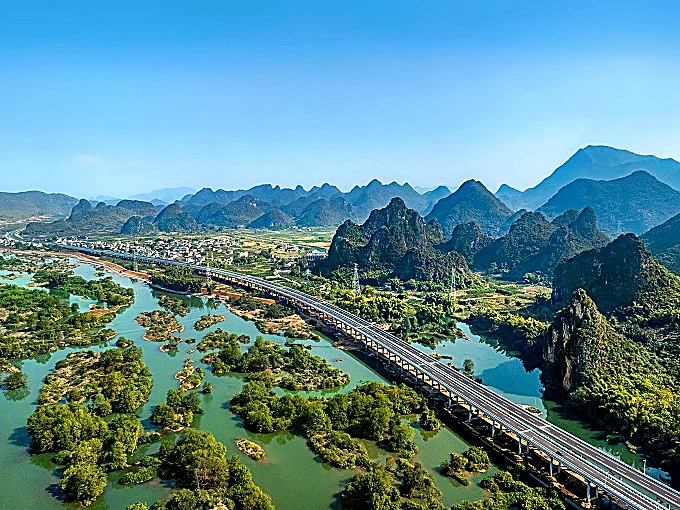
Enveloping this historic quarter is the breathtaking mountain-and-water scenery of Yangshuo’s one-of-a-kind karst topography. The emerald river winds like a jade silk ribbon, nourishing lush green paddy fields before sweeping directly past the bases of thousand-year-old limestone pinnacles. Dotted along the riverbanks are the rustic tiled roofs of traditional local villages veiled in drifting mist, forming an inspiring natural backdrop that sheltered the commercial lifeblood of the old town across changing eras.
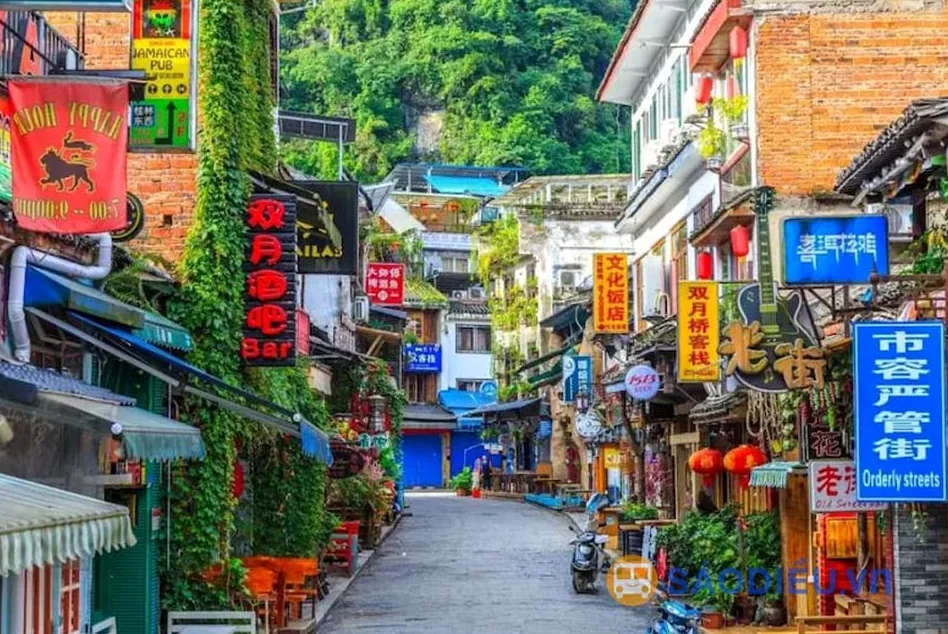
Through the Tang and Song dynasties and into the Ming and Qing periods, the street’s spatial layout gradually crystallized into a classic Lingnan market town. Stretching less than a kilometer along dark bluestone flagstones, the street showcases traditional architecture defined by gracefully upturned yin-yang clay roof tiles, weathered gray brick walls, and slender timber framing. Local merchants skillfully converted ground-floor storefronts into traditional herbal apothecaries, teahouses, artisan workshops, and riverside inns—fostering lively trade and making Yangshuo an essential stop for literati and travelers admiring the landscapes of Guangxi.
History took a dramatic turn in the 1980s when China launched its Reform and Opening-Up policy under Deng Xiaoping. Celebrated in classical poetry for centuries, Yangshuo’s extraordinary scenery—combined with newly opened borders—unexpectedly made it China’s pioneering magnet for independent Western backpackers. Travelers from Europe and North America carrying heavy packs, film cameras, and a passion for Eastern culture chose this historic riverside lane as a long-term haven.
This remarkable encounter between free-spirited Western travelers and warmhearted local residents gave birth to the nickname “West Street.” Once an insular river town, Yangshuo’s residents—from bamboo raft boatmen on the Yulong River to elderly grandmothers selling paper fans and roasted chestnuts—quickly picked up fluent English to welcome international guests in the 1990s. The harmonious blend of Ming- and Qing-era heritage houses with open-air cafés alive with Western music created a one-of-a-kind “global village,” elevating West Street from a Sui-dynasty ferry landing into Guangxi’s most vibrant cross-cultural crossroads.
Situated at the heart of the celebrated karst landscape of northeastern Guangxi Zhuang Autonomous Region, Yangshuo West Street occupies an exceptionally auspicious geomantic setting aligned with the classical Eastern ideal of “backed by mountains, facing water.” Surrounded by million-year-old limestone peaks rising like natural screens against fierce storms while bordering the emerald curve of the Li River, this location embodies wealth-gathering water energy and creates a sheltered microclimate—shielded from dry northern winter winds while catching cool valley breezes throughout summer.
Local historical records trace the spatial core of the old quarter back to 590 CE during the Sui dynasty, accumulating over fourteen centuries of lived history. Unlike rigid checkerboard street grids common in lowland capitals, West Street follows the natural contours of mountain slopes and river channels. Originating as a bustling feudal relay post and timber-and-produce landing, early builders stepped their foundations gently down toward the Li River. Running nearly eight hundred meters in a subtle bow-like curve opening toward the water, the main thoroughfare both dissipates seasonal flood currents and unveils ever-changing visual vistas around every bend for strolling pedestrians.
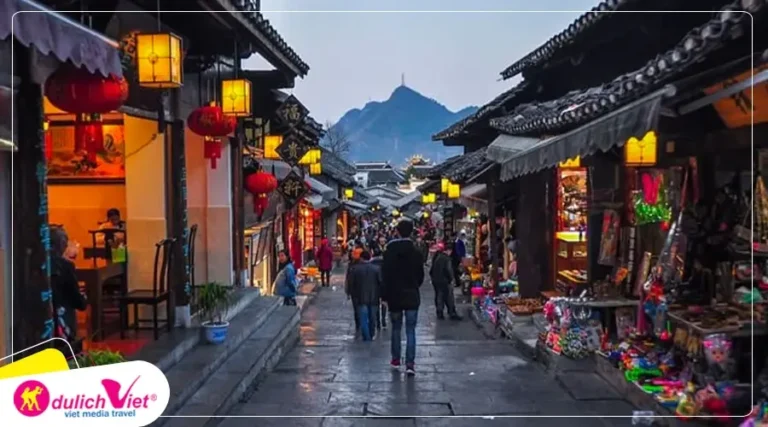
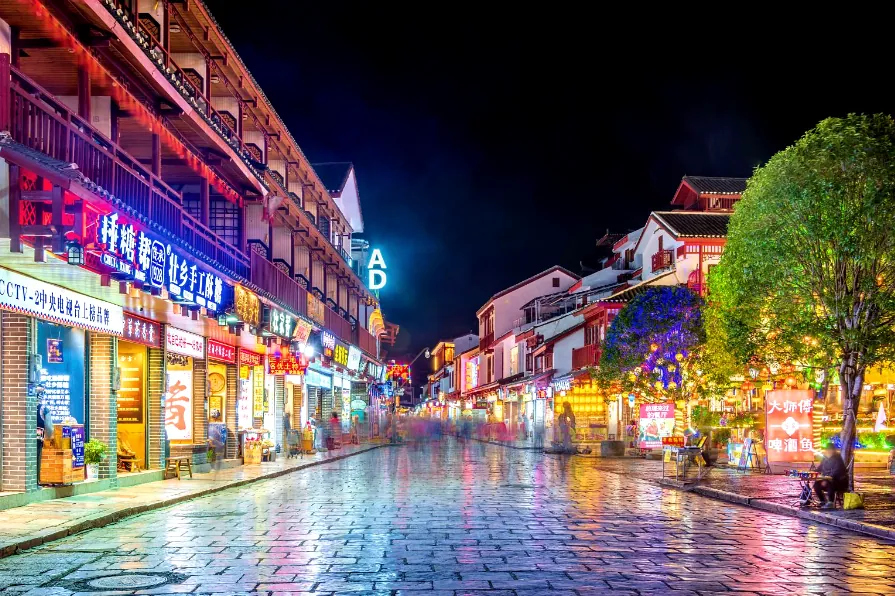
Harmony between natural terrain and human craftsmanship shines through the use of local materials and Ming–Qing vernacular design. West Street is paved entirely with blue-veined limestone flagstones quarried from neighboring karst formations—worn mirror-smooth by centuries of merchant and traveler footsteps to shimmer under daytime sun and lantern glow at night. Flanking both sides, historic houses preserve authentic Southern Lingnan architecture with refined ash-gray brick walls, steeply pitched multi-layered yin-yang clay roofs built to shed tropical downpours swiftly, and narrow verandas with slatted wooden screens designed to encourage natural cross-ventilation against riverside humidity.
West Street’s streetscape never feels isolated; rather, it integrates seamlessly into Yangshuo’s sweeping mountain-and-water panorama. From open courtyards and second-story wooden balconies, visitors gaze directly out at bamboo-shoot-shaped karst spires piercing the azure sky, blurring the boundary between town and wilderness. With the mighty Li River in front and the gentle Yulong River network to the southwest acting as giant reflecting mirrors wrapped in morning mist, the fusion of solitary karst peaks, winding waterways, and millennial town life turns West Street into a living masterpiece of vernacular planning.
Across more than fourteen centuries since its founding in 590 CE, Yangshuo West Street has steadfastly preserved the soul of an ancient Li River port. Its architecture expresses classic Ming–Qing Lingnan aesthetics—moss-dappled gray brick walls, intricately carved wooden eaves, and curved clay roofs catching river breezes—above time-polished bluestone flagstones glowing beneath strings of red lanterns. Since the cultural opening of the 1980s, European-style sidewalk cafés and lively bars have been thoughtfully woven inside historic timber shophouses, creating a visual tapestry at once deeply nostalgic and vibrant with modern energy.
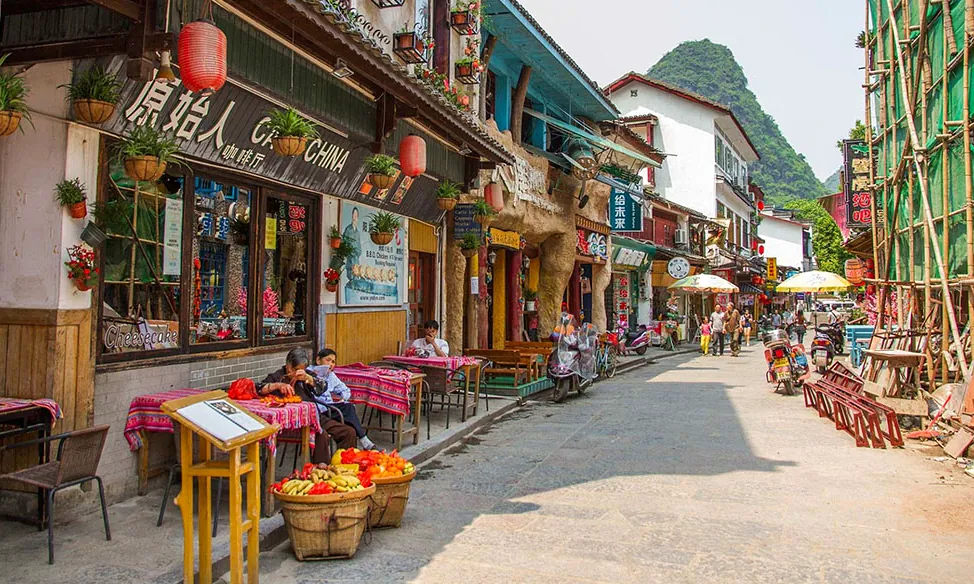
Unfolding in a graceful S-curve shaped by towering karst hills and ancient river landings, West Street branches into an intimate web of crisscrossing side lanes leading past centuries-old homes. Ground floors feature removable wooden folding shopfronts opened wide to welcome passersby, while upper mezzanine levels retain original old-growth pine roof trusses and traditional swastika-lattice windows. Dotted among heritage roofs are bilingual signs born during the Western backpacker boom—when local farmers and boatmen alike learned to converse comfortably in English, earning the street fame as Guangxi’s singular “International Village.”
Major infrastructure investments over recent decades have transformed accessibility to this historic town. Linked by high-speed rail just over two hours from provincial capital Nanning and connected by modern expressways directly from Guilin, Yangshuo welcomes tens of millions of visitors annually. The iconic Li River cruise from Guilin to West Street Pier—long hailed among the world’s most scenic waterways—serves as a grand liquid gateway into the old commercial quarter, backed by substantial conservation funding that restored gray-brick facades, buried overhead utilities, and installed tasteful architectural lighting.
West Street’s cultural and culinary appeal resonates powerfully alongside world-renowned live outdoor spectacles, headlined by Impression Sanjie Liu, directed by Zhang Yimou using twelve real karst peaks and the Li River itself as a natural stage. Modern travel preferences increasingly eschew rushed shopping-stop tours in favor of authentic ecological immersion—pairing boutique retreats along the Yulong River valley with culinary indulgences like spicy Yangshuo beer fish, rich Guilin rice noodles, and fragrant osmanthus cakes.
As dusk drapes a velvet curtain over the Li River, Yangshuo West Street sheds its daytime serenity to emerge as a dazzling, sleepless nocturnal banquet. Illuminated by strings of crimson lanterns blended with contemporary neon, Ming- and Qing-era gray-brick houses with curving tiled eaves take on an enchanting glow. Centuries-worn flagstones shimmer with reflections from open-air Western bars and traditional teahouses alike—fusing graceful Eastern architecture with cosmopolitan vitality to captivate every evening visitor.
Over fifteen hundred years of history since the Sui dynasty have imbued West Street with a remarkably relaxed poise despite its lively nightlife. Since becoming Southern China’s pioneering stop for adventurous Western travelers during the Reform era, the quarter has cultivated an unmistakable identity as a global village tucked inside a dramatic karst valley. Winding down narrow lanes, acoustic guitars and live jazz drifting from sidewalk pubs mingle with the savory aroma of sizzling Yangshuo beer fish, sweet steamed osmanthus cakes, and steaming bowls of Guilin snail noodles—while multilingual conversation, clinking glasses, and warm candlelight erase every cultural boundary.
Yet the true centerpiece of Yangshuo’s nocturnal artistry lies on the grand natural stage of Impression Sanjie Liu, the live-action spectacle masterminded by acclaimed director Zhang Yimou. Shattering conventional theater walls, the production uses a two-kilometer stretch of the Li River as its stage and twelve towering limestone peaks as its natural backdrop. Against the dark night sky, high-powered spotlights sweep across karst cliffs, turning silent stone peaks into monumental light sculptures while hundreds of local fishermen maneuver bamboo rafts across the water, trailing billowing red silk ribbons and glowing oil lamps mirrored in the ink-black river. Resounding Zhuang folk songs echo through the valley amid drifting mist and theatrical lighting, uniting humanity and nature in unforgettable grandeur.
Returning from the river spectacle, travelers often unwind in rooftop lounges or tucked-away corner bars at the quiet far end of the street to savor a more contemplative nocturnal rhythm. Rather than rushing through crowded souvenir shops, discerning visitors linger on dark wooden balconies gazing out at silhouetted karst peaks beneath faint stars while strollers wander beneath glowing umbrellas below—capturing the timeless magic of Yangshuo after dark.
Across more than fifteen centuries since its Sui-dynasty origins in 590 CE, Yangshuo West Street has preserved not only memories of bustling Li River trade, but also a rich Lingnan culinary heritage. Beneath the eaves of historic Ming–Qing timber-and-brick houses, local gastronomy unfolds as a colorful tapestry where centuries-old family recipes harmonize seamlessly with the open-minded spirit of an international crossroads.
Reigning supreme at the center of local flavors is famed Yangshuo Beer Fish, a culinary masterpiece capturing the essence of this mountain-and-water landscape. Fresh river fish netted from the crystal-clear waters of the Li River—left with scales intact so they crisp up with a signature snap—are flash-seared in a blazing iron wok and braised in local craft malt beer alongside fiery fresh chilies, ripe red tomatoes, and wild mountain herbs. Brought to the table steaming hot in a glossy amber reduction, the dish awakens every sense with tender, succulent flesh infused with malty depth.
The secret behind Beer Fish’s enduring acclaim lies in substituting local beer for water during braising—completely eliminating any muddy river-fish notes while coaxing out the flesh’s pure natural sweetness. Every family kitchen along West Street guards its own closely held recipe, from the exact ratio of earthenware-aged chili paste to locally brewed Guangxi beer. Each juicy bite delivers a bold interplay of richness and tongue-tingling spice followed by a clean, sweet finish that reflects the open-hearted character of riverfolk living among the karst peaks.
Alongside Beer Fish, local culinary heritage shines in steaming bowls of Guilin River Snail Rice Noodles (Luosifen / Guilin rice noodles). Smooth, springy round rice noodles are blanched and ladled with rich broth simmered for hours from mountain stream snails and pork marrow bones infused with over a dozen traditional spices including star anise, cassia bark, cloves, and aged tangerine peel. Tangy pickled bamboo shoots, crunchy roasted peanuts, and vibrant red chili oil brighten the quiet stone alleys—serving as an authentic taste of everyday Lingnan life across generations.
Completing a gastronomic stroll down West Street is the delicate sweetness of traditional Osmanthus Cake. Fragrant autumn osmanthus blossoms are carefully hand-harvested, steeped in wild mountain honey, and steamed with pure white glutinous rice flour into tender, jade-translucent cakes. Wandering across moss-rimmed flagstones at dusk with a warm cup of osmanthus tea and a fragrant square of cake, travelers quickly understand why West Street’s culinary culture has enchanted poets and wanderers from around the world for generations.
Despite tracing its roots back over fifteen hundred years to 590 CE, Yangshuo West Street has no turnstiles or fixed closing gates. This gray-flagstone boulevard pulses as a living riverside community whose rhythm shifts dramatically from hour to hour. Early morning brings quiet serenity as Ming–Qing tiled roofs cast reflections across dew-wet stones, while the street’s true East-meets-West energy awakens vibrantly from 4:00 PM until 2:00 AM. As sunset settles behind limestone peaks, red lanterns merge with neon bar signs amid fragrant aromas of sizzling beer fish and live music from around the globe.
Reaching this scenic gem from Vietnam is remarkably straightforward thanks to modern cross-border transit links. Travelers commonly cross via Friendship Pass (Huu Nghi Quan) in Lang Son, continuing roughly three hours by coach or rail to Nanning, capital of Guangxi. From Nanning Station, high-speed trains whisk passengers straight to Yangshuo Station in just two to two and a half hours. Alongside the Nanning–Guilin–Yangshuo expressway, the classic Li River boat cruise from Guilin Pier to Yangshuo remains the most poetic approach—widely acclaimed as one of the world’s most breathtaking river journeys.
Regarding entry formalities, Vietnamese travelers can enter conveniently depending on their itinerary: organized tour groups qualify for streamlined group visas or e-visas, while eligible border residents can use border travel permits through Friendship Pass. Upon checking into hotels or boutique resorts in Yangshuo’s karst valley, original passports are registered directly into the national lodging system. Practically speaking, cashless mobile payments dominate nearly everywhere; linking an international credit card to major Chinese mobile payment apps prior to departure ensures effortless transactions for e-bike rentals, souvenirs, and dining.
To experience Yangshuo’s authentic character, travelers should stay mindful of deceptive bargain tour pricing. Ultra-cheap packages frequently divert guests into high-pressure shopping stops for overpriced jade, herbal remedies, or tea, cutting deeply into genuine sightseeing time. Responsible, modern travel favors transparent no-shopping itineraries dedicating every hour to nature and local culture—such as drifting on a tranquil bamboo raft down the Yulong River in the morning, cycling past ancient villages and terraced paddies in the afternoon, and spending the evening mesmerized by Zhang Yimou’s Impression Sanjie Liu on the Li River.
Ultimately, no journey to Yangshuo is complete without savoring its signature local table—from fresh Li River beer fish braised with chilies and tomatoes to hearty Guilin snail noodles and fragrant autumn osmanthus cakes. For a seamless journey through timeless mountains and waters free from visa hassles, transit logistics, or language barriers, choosing a thoughtfully curated all-inclusive Guilin tour package ensures complete peace of mind as you immerse yourself in nature’s masterpiece and old-town charm.