Viewed from the perspective of Lingnan cultural geography, the Yulong River is not merely a tranquil tributary of the Li River system, but the cradle preserving millennia of sedimentary civilization within Yangshuo County. Its winding flow through majestic limestone mountain ranges once served as a vital water and land transport lifeline, connecting fertile agricultural valleys with ancient administrative networks. Originating from the semi-mountainous region north of the county seat, the river has silently accompanied the footsteps of indigenous tribes and successive waves of northern migrants, witnessing the profound fusion between Lingnan customs and central feudal governing institutions across historical shifts in China.
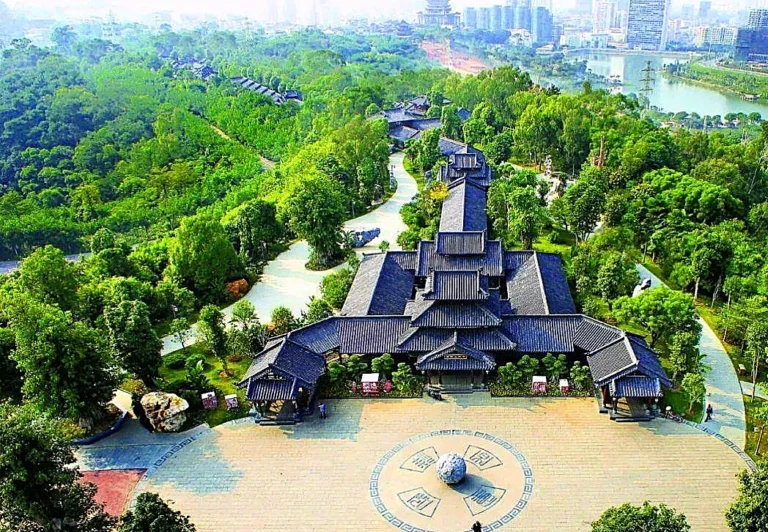
The most ancient administrative imprint still clearly visible along this jade-blue bank is located in Jiuxian Village, which preserves the ruins of the Quy Nghia ancient city established in the early Zhenguan era under Emperor Taizong of the Tang Dynasty. Across a vast archaeological site estimated at roughly 40,000 square meters, traces of rammed-earth city walls mixed with stone along sections of ancient bluestone paths still quietly linger amidst green fields and sharp karst peaks. Quy Nghia City at that time served not only as a regional administrative stronghold in the southern frontier, but vividly reflected the Tang Dynasty’s characteristic “jimi” (loose rein) ruling policy, where the central government harmonized power with indigenous chieftains to maintain borderland stability. Spanning over a millennium of territorial evolution from the Tang era, converging through the Song dynasty until its complete incorporation into Yangshuo County, this ancient district has preserved the spatial structure of an intact traditional clan settlement.
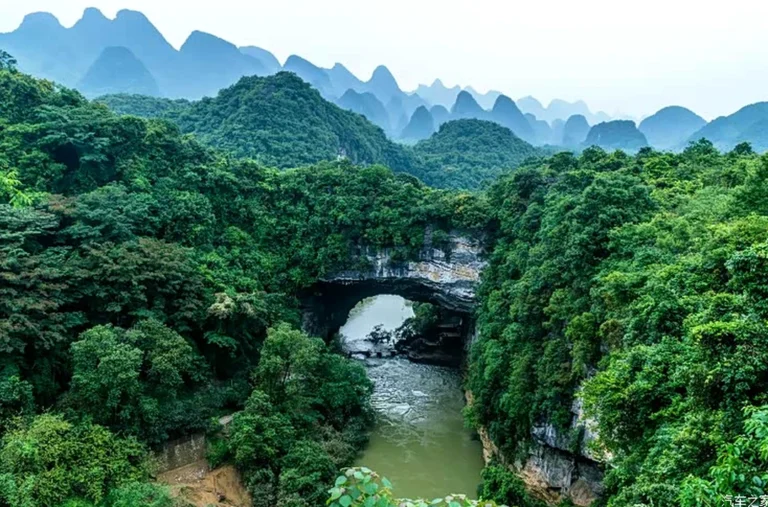
Alongside military fortification institutions, economic and commercial prosperity during ancient times along the Yulong River basin is most convincingly evidenced through Guangxi’s renowned “three major ancient stone bridges” system. The most ancient among them is Xianqui Bridge, initiated in the 5th Xuanhe year under Song Huizong (1123). Enduring over nine centuries of mountain weathering and floods, the mossy stone arches of Xianqui Bridge still stand firm as an engineering miracle of mortarless stone-jointing craftsmanship from Song craftsmen. Upstream, Fuli Bridge was constructed during the Ming Dynasty with a history exceeding 500 years, prominent for its soaring semi-circular stone arch structure spanning flat waters like a long rainbow casting reflections upon the green-jade riverbed, forging perfect balance between civil utility and native geomantic arts.
The centerpiece of the entire heritage system along the river is Yulong Bridge, impressively present within Yulong Village under Baisha Town. Local steles and ancient gazetteers record that this grand bridge was commissioned in the 10th Yongle year under Ming Chengzu (1412), possessing a typical single-arch rainbow bridge structure with precisely calculated blue-stone spans. For over six hundred years, Yulong Bridge has borne countless pack-horse caravans, literati, and traveling merchants traversing the ancient trade route connecting inland mountain regions with delta plains. Today, pausing to admire and walk slowly across millennial stone slabs, travelers still perceive the roaring pulse of history flowing alongside the millennial heartbeat of the legendary river.
Examining hydrological geography and mountain-range geomancy, the Yulong River holds the status of the longest right-bank tributary of the legendary Li River flowing through Yangshuo County. Originating southwest of Danjiatuan in Yongbin Village, Nanbianshan Township, located at the southernmost tip of Lingui District within Guilin City, the river’s source gathers quintessence from hundreds of small upper-stream creeks before surging relentlessly eastward. Reaching Jinbao Township in Yangshuo County, the waters meander, altering directions to flow peacefully along a northwest-southeast axis. Stretching over 40 kilometers with a soft jade-blue ribbon-like winding basin, this geomantic watercourse successively waters the most fertile realms across four townships: Jinbao, Baisha, Putao, and Gaotian. The breathtaking conclusion of the current unfolds right at the renowned Gongnong Bridge area, converging the “three waters merge into one current” dragon pulse as the Yulong River blends with the Jinbao and Tianjia rivers, engineering a majestic confluence before merging completely into the mother Li River.
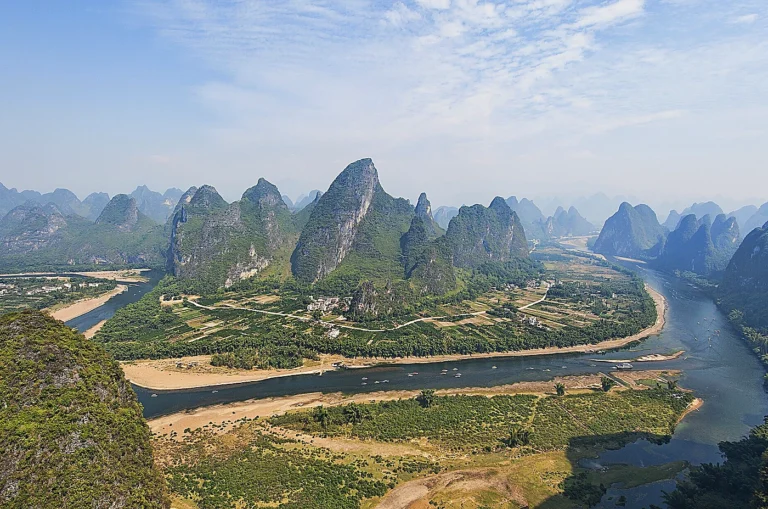
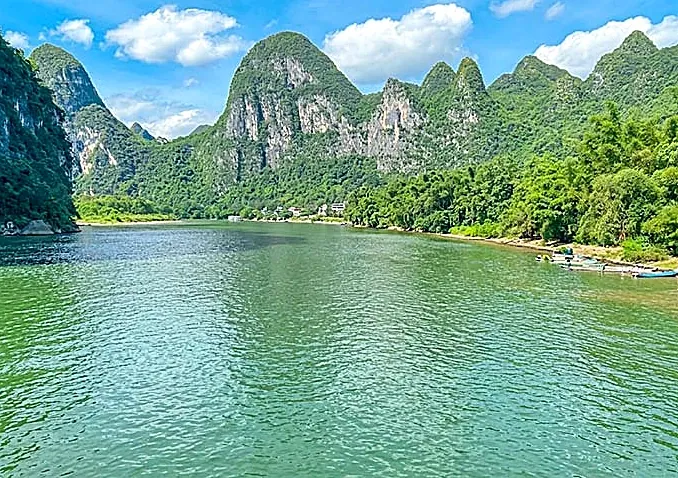
Regarding natural topographic planning, both banks of the Yulong River nestle peacefully deep within the core of the world’s most exemplary peak-cluster and peak-forest karst landform region. Local topography showcases spectacular stratification between “fenglin” (isolated limestone peak forests) and “fengcong” (clustered limestone peaks connected at bases), forging boundless green mountain arrays. Every millennial limestone mountain with bizarre shapes and sheer vertical cliffs reflecting upon crystal-clear mirror-flat waters achieves ink-wash aesthetic realms known as “island reflections over lucid emeralds.” Unlike the expansive, magnificent macro-scenery of the Li River main stream, the Yulong basin conceals ethereal, gentle, and contemplative grace. Along both riverbanks, endless rice fields divide into checkerboard cells woven like damask silk, appearing beneath emerald-green phoenix bamboo groves swaying year-round, turning this location into an exemplary model for the flawless fusion between pristine nature and ancient paddy-field farming culture. This otherworldly charm grants the river the moniker “Little Li River” alongside legendary praise from traveling literati everywhere: “Not the Li River, yet surpassing the Li River”—meaning despite lacking the Li River name, its pristine scenery surpasses the main stream itself.
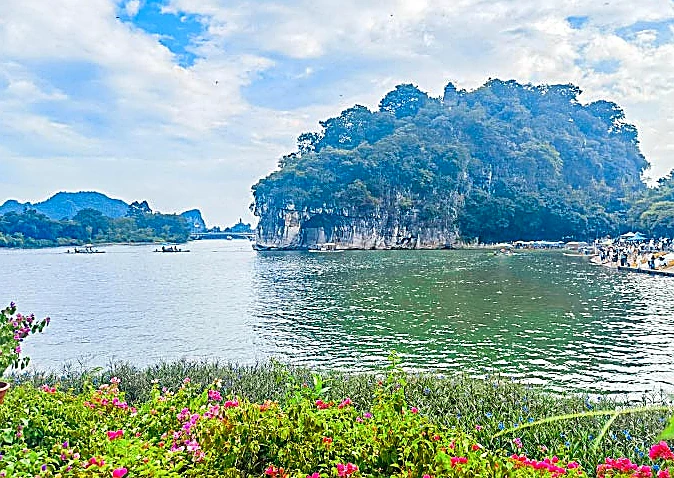
The focal point of geomantic landscape structures across the entire basin erupts most brilliantly around border areas surrounding Gongnong Bridge. At this special geographical coordinate, millennia of geological tectonic faults arranged a majestic natural screen featuring surging mountains and reflecting waters to forge unique creation masterpieces. Most prominent among them is the “Camel Crossing the River” scenic spot, where towering limestone mountains sculpt a giant two-humped camel slowly wading across blue rivers amidst misty vapors. Accompanying this is “Fenglou Sunrise,” where radiant morning glows of dawn dye Phoenix Tower peaks red, transforming water surfaces into magnificent boundless mountain-and-water paintings. Amidst pristine ecological values, unhurried bamboo raft paddles gliding across confluence zones open complete, tranquil perspectives. This location serves not only as a visual intersection between slow-flowing waters and limestone mountains soaring straight into skies, but represents a wind-sheltering energy-gathering land delivering absolute peace to souls.
From a human-geographical standpoint, spaces enclosing both river banks are positioned as Guilin’s premier ecological-cultural complex. The Yulong River National Tourist Resort and Scenic Area is planned across total acreage ranging from 63.6 to 86 square kilometers, forging complete buffer corridors between towering karst cones and natural wetland basins. Spatial structures here reflect traditional Lingnan settlement environment creation thinking, where each residential point, bridge, or wharf is calculated per natural terrain, avoiding rough disruptions to karst geomorphologies highly sensitive to erosion.
The pinnacle of tangible heritage reigning along waterways is the ancient stone arch bridge system, testifying to superb mechanical and engineering craftsmanship from centuries past. Most prominent is Yulong Bridge, measuring 36 meters long, 4.2 meters wide, with arch heights soaring 9 meters. The special feature turning this work into a folk architecture masterpiece lies in the “diaoshi tuofeng ganshi” technique—using squared stone blocks interlocked exquisitely per self-supporting arch structures without utilizing a single drop of lime mortar. Thanks to balanced counterweights, the bridge stands resiliently against hundreds of severe flash floods across rainy seasons without shifting. Nearby stands Fuli Bridge, measuring 30 meters long, 5 meters wide, and reaching 10 meters high; its body curves gracefully in semi-circular arches, possessing broad single-arch spans casting complete circular reflections upon blue waters like full moons of ancient wharves.
Harmonizing with ancient bridges are Ming-Qing clan and village clusters, most notably Jiuxian Village featuring grand mansions sprawling across thousands of square meters. All mansions here strictly obey native geomantic principles featuring “backing north and facing south,” welcoming benign breezes while shielding against harsh northern cold currents. Architecture bears southern flavors featuring contemplative dark-green fired brick walls and double-layered gray-ash tile roofs. Punctuating buildings are soaring stepped horsehead firewall gables alongside magnificent scholar panel doors crafted from dark wood pierced with botanical and auspicious eight-treasure motifs, reflecting austere lifestyles and profound scholarship of prominent centennial clans.
In modern integrated conservation strategies, authorities deployed large-scale rural ecological enhancement projects named “five dismantlings, five clearances, five constructions.” This process systematically rezoned encroaching structures, cleared local sewage discharges, and re-established green walking and cycling trail networks hugging shores. This green transport infrastructure planning skillfully linked ecological ferry wharves like Shuiyedie, Wanjing, and Qima into unified entities, opening pastoral scenery combined with high-end accommodations hidden beneath ivory bamboo groves. The entire landscape ensemble forges distinctive highlights, where observers admire and perceive pristine fusions between traditional architectural arts and contemporary ecological breaths.
As the sun slowly descends behind towering karst ranges, the Yulong River valley enters magical visual and emotional transformations, shedding daytime bustle to don contemplative, illusory cloaks. Vibrant orange-red sunset hues gradually yield to misty vapors rising from crystal-clear mirror-flat waters. Yulong nights open without noisy mechanical sounds, settling into absolute silence as rivers empty of daytime bamboo rafts, leaving only winds rustling through drooping bamboo and millennial folk rhythms echoing along ancient waters.
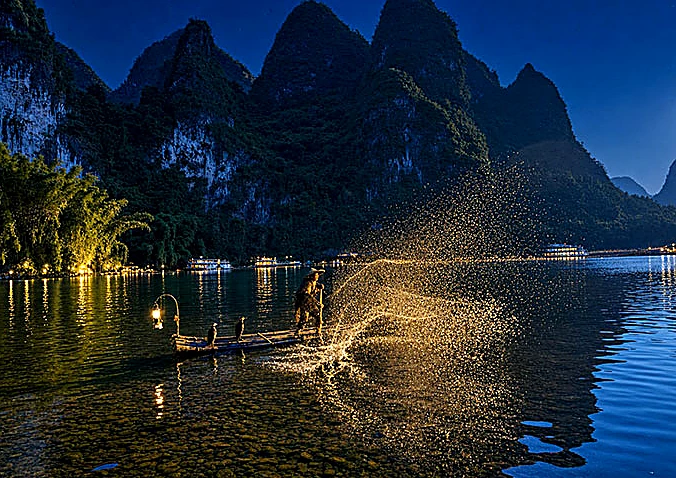
Unlike commercialization and dazzling neon lighting common across modern tourist spots, the Yulong River scenic area strictly obeys nocturnal conservation philosophies and natural optical pollution controls. Along ancient villages like Jiuxian, Qima, or trails crossing Ming-era Yulong Stone Bridge, lighting is punctuated solely by warm yellow landscape strips hidden subtly beneath grasses and boulder banks. Gentle illumination washes across tree canopies casting reflections upon river surfaces, creating scenes of “fishing fires twinkling, bamboo shadows swaying,” evoking classical Jiangnan ink-wash poetry. Eco-resorts and pastoral restaurants nestled amidst rice fields exclusively employ indirect lighting reflected through rustic materials like rammed-earth walls and mossy gray-ash tile roofs, ceding complete space to endless frog symphonies and riverside insect calls beneath star-studded skies.
Merely miles away from the tranquil Yulong River toward confluence nodes with the Li River, Yangshuo’s nightlife bursts brilliantly via epochal lighting performance art. The centerpiece is the celebrated real-scene grand musical drama *Impression Liu Sanjie* staged by master director Zhang Yimou alongside collaborators Wang Chaoge and Fan Yue. Spanning a natural water basin reaching two square kilometers, the work uses twelve towering karst limestone mountains as colossal backdrops with night skies serving as infinite theaters. High-power lighting systems coordinate with mist effects to transform millennial cliffs into magical folding screens reflecting upon calm waters. Hundreds of indigenous fishermen aboard crude wooden boats glide amidst glowing red laser light, lifting Zhuang folk songs high into silent skies, forging majestic epics honoring millennial harmony between humanity and southern nature.
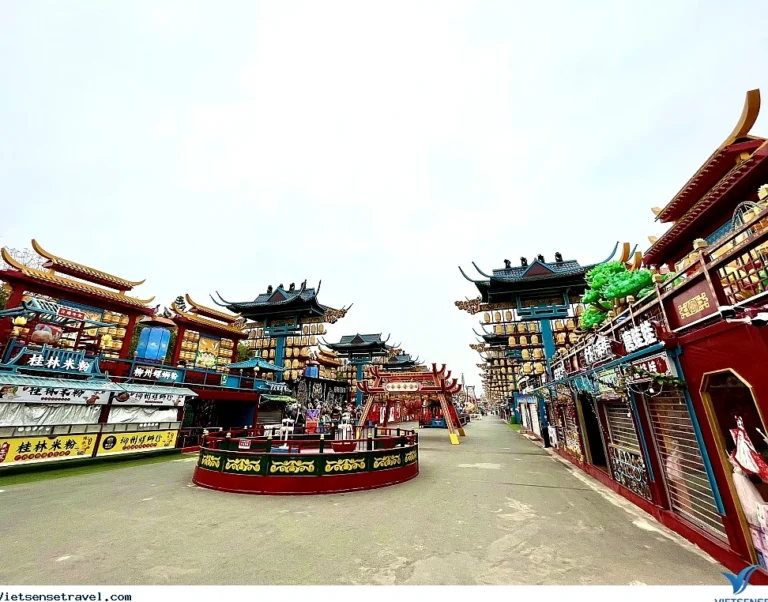
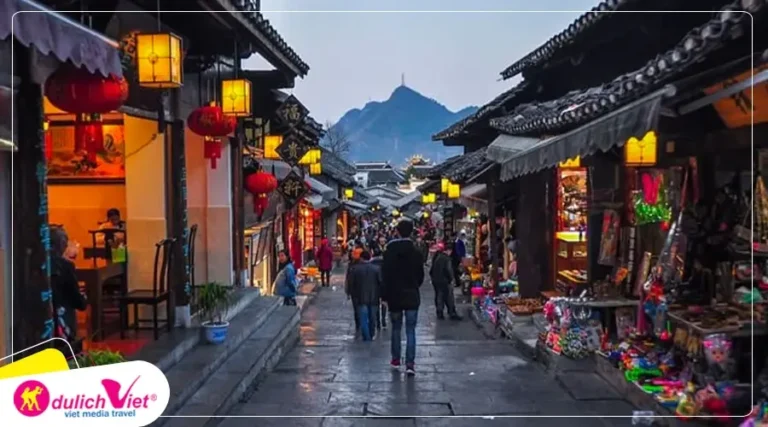
Following transcendent real-scene art, Yangshuo’s nightlife guides travelers toward rich culinary experiences beneath red lanterns hung high across antique taverns. Amidst chilly night air carrying osmanthus fragrances, gathering to savor heirloom Yangshuo beer fish—fresh fish caught from upper freshwater sources braised with local beer, ripe tomatoes, and fresh chilies radiating pungent spicy flavors—proves unforgettable. This opens mystical boundaries between the pristine serenity of the Yulong valley and glittering lighting art along the Li River, crafting delicate harmony within mesmerizing heritage spaces of picturesque mountains and waters.
The Yulong River’s current not only deposits silt across fertile karst valleys but nourishes endemic freshwater aquatic ecosystems, laying solid foundations for culinary cultures fusing refined Lingnan flavors with pungent, rich northern Guangxi profiles. Unlike imperial northern complexities, Yangshuo’s culinary charm carries robust mountainous and riverine souls, where native meals reflect truthful characters and refined tastes of millennial ancient towns.
Reigning supreme atop Yulong River basin culinary maps is Yangshuo beer fish, a masterwork elevated to local intangible cultural heritage. Core ingredients demand live river carp or catfish freshly netted from crystal Yulong River waters or nearby Li River streams. Artisans maintain shimmering scales, dropping whole fish into massive cast-iron woks boiling with rapeseed oil. After searing both sides until golden-crisp with crispy pancake-like scales, chefs add ripe tomatoes, red and green bell peppers, wild bird’s-eye chilies, and heirloom herbs. The defining flavor rests in local Guilin maltose beer poured over fish bodies, sealing lids for high-heat braising. Beer vapors eliminate fishy odors, soften snow-white fish flesh, and condense into amber-hued rich sauces, harmonizing natural mineral spring sweetness, tart tomato acidity, and lingering spicy warmth. Renowned centennial eateries like Xie Dayi maintain this simmering craft across decades, turning every beer fish pot into unforgettable sensory experiences for gourmets exploring romantic wharves.
Alongside beer fish, Guilin traditional mixed rice noodles anchor daily life for dwellers across Yulong banks. Unlike coastal flat noodles, local noodle souls reside in broth spoons simmered painstakingly for hours from beef marrow bones, pork leg bones, alongside twenty medicinal herbs like star anise, cardamom, clove, and cinnamon. Rice noodles made from indica rice soaked in karst river waters possess characteristic chewiness, blanched and drizzled with fragrant rich savory broths, topped with crispy-skinned roasted pork, braised beef slices, spicy pickled bamboo shoots, and crunchy pickled long beans. Diners toss noodles thoroughly to let sauces coat flavor layers, sipping hot bone broth alongside, fully perceiving deep traditional culinary wisdom.
Beyond celebrated dishes, culinary treasures along Yulong banks preserve creative outputs from leisure farming, notably Yangshuo lava-stone stuffed snails. Plump apple snails harvested from limestone stream beds have flesh extracted, minced with black pork belly, wood ear mushrooms, and fragrant perilla leaves, then restuffed into shells and simmered with dried chilies and bean paste. Snails infused with perilla aromas, pork richness, and chewy textures forge fascinating fusions. Wandering ancient villages like Jiuxian or Baisha, travelers encounter native mothers shaping wormwood rice cakes fragrant with field herbs, or gathering around farmhouse tables featuring Lipu taro pork belly, stir-fried free-range chicken with ginger, and fresh garden vegetables. These rustic yet deep flavors forge distinct charms, reflecting pure culinary cultures and peaceful lifestyles amidst mountain-water realms.
The Yulong River resembles a winding green ribbon, where natural current rhythms harmonize with native service standards prioritizing ecosystems above all. Completely distinct from noisy motorized bamboo rafts along the Li River, all rafts along the Yulong River are traditional joined bamboo floats, operated purely via human muscle power through local boatmen’s skilled hands and single bamboo poles. Water transport routes divide into distinct operational tiers, most prominently upper stretches from Jinlongqiao Bridge to ancient Jiuxian Village. This classic bamboo raft route spans nearly two hours, gliding past centennial stone arch bridges and overcoming exhilarating cascading dams where raft bows plunge into white foam before gliding smoothly across mirror-flat waters.
For families with elderly or young children seeking peace and quiet, downstream routes from Shuiyedie Wharf to Wanjing Wharf offer ideal choices thanks to gentle currents, mild slopes, and pastoral scenery draped in emerald bamboo shades. Currently, scenic area authorities apply strict real-name electronic ticketing systems to control visitor loads, protect riverbeds, and safeguard fair rights for travelers. International travelers should bring valid passports with valid entry visas to complete ticket verification at ferry gates before departures during peak midday hours.
Concluding water voyages, perfect stops to cap off wandering days are Gongnong Bridge, where triple river confluences forge expansive watery basins. This stone bridge has long served as Yangshuo’s celebrated free sunset-viewing coordinate, offering panoramic vistas of “Camel Crossing the River”—natural limestone mountains shaping giant camels wading across rivers, glowing brilliantly beneath setting sun rays. For continuing land experiences, optimal transport involves renting sports bicycles or electric scooters near wharves, cruising unhurriedly along ecological trails linking the Ten-Li Gallery and Yulong River basin. Asphalt trails winding past rapeseed flower fields, corn patches, and gray-tiled homes exude boundless freedom impossible via four-wheeled vehicles.
Ensuring complete journeys and absolute safety requires vigilance against roadside commercial tourist traps. Never transact with “ye dao”—unlicensed touts gathering at intersections, and resolutely reject offers for uninsured “parachute rafts” or unverified specialty herbs and medicines. Local river regulations mandate standard life jackets throughout bamboo raft journeys; furthermore, valuable electronics like smartphones and cameras must be secured inside waterproof pouches before rafts plunge across cascading dams. For seamless, standardized journeys free from complex booking or language barriers, joining the Nanning – Yangshuo – Guilin 4D3N Tour serves as optimal solutions to peacefully immerse in southern picturesque mountain-water masterpieces.