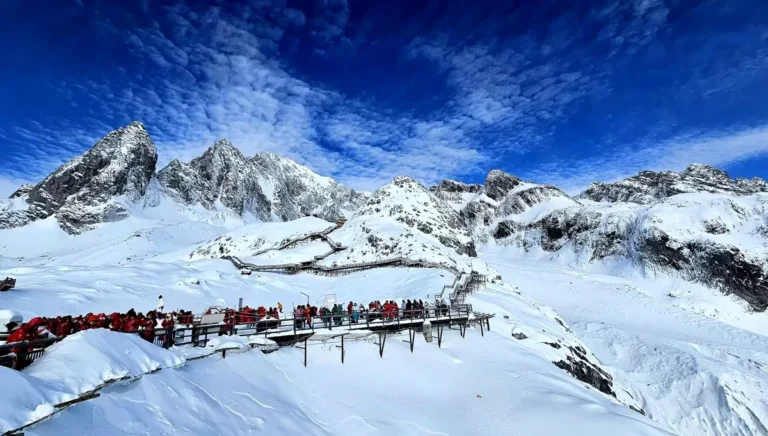
Beneath the towering presence of Jade Dragon Snow Mountain, veiled in clouds year-round, Lijiang did not begin with grand stages or modern lights—it grew out of more than eight centuries of historical layers across a remarkable southwestern frontier. The open-air landscape spectacle Impression Lijiang is far more than a visual performance; it is the voice of mountain stone and an echo from deep history left by resilient pioneers who opened the land. To feel every breath and the fiery gaze of local performers on the red-earth stage, audiences must turn back through stirring chronicles shaped by shifting eras and imperial dynasties.
Tracing time back to the turbulent transition between the late Song and early Yuan dynasties, the basin plain below the snow peaks saw its first foundations of an ancient town. Across more than eight hundred years of change, the town’s name shifted repeatedly with political power. Under the Yuan Dynasty, historical records knew it as Dayechang. Entering the early Ming Dynasty, when the Naxi chieftain submitted to the court and received the famed surname Mu, the settlement was renamed Dayan Xiang—evoking a giant emerald-green stone inkstone fed by crystal meltwater from snowy peaks. Through the Qing Dynasty, it became Dayan Li before the Republican era officially designated it Dayan Town in 1929.
Lijiang’s rise and endurance are organically tied to a vital trade artery: the Ancient Tea Horse Road. Winding across deep gorges of the Hengduan Mountains and the Qinghai–Tibet Plateau, this storied route grew from ancient southern silk-road networks. At a crucial border crossroads, Lijiang became a decisive staging hub where hardy caravan horsemen (Mabang) braved perilous terrain to trade compressed Pu-erh tea cakes for strong Tibetan horses. Under generations of Mu tusi rule, the town evolved into a vibrant cultural crossroads where mysterious Naxi Dongba pictographs mingled harmoniously with Tibetan Buddhism and Han Confucian traditions.
Priceless tangible and intangible heritage accumulated over centuries carried Lijiang onto the world stage through historic milestones. In December 1986, China’s State Council named Lijiang among the second batch of National Famous Historical and Cultural Cities. Eleven years later, in December 1997, UNESCO inscribed the Old Town of Lijiang on the World Heritage List. Upon this rich foundation of frontier trade, bold caravan spirit, and reverence for mountain nature, the idea of an epic outdoor performance took shape—giving birth to a remarkable work of art set directly within the landscape.
Sitting along the southeastern rim of the rugged Hengduan range in northwestern Yunnan Province, Lijiang holds a geographic position shaped by millennia of tectonic shifts. Bordering Diqing Tibetan Autonomous Prefecture to the northwest, leaning toward the rushing Nu River gorge on the west, reaching toward ancient Dali in the southwest, and opening northeast toward Liangshan in Sichuan, its transition from the high Qinghai–Tibet Plateau into the Yunnan–Guizhou basin forms a dramatic mountain screen gathering rich southern vitality.
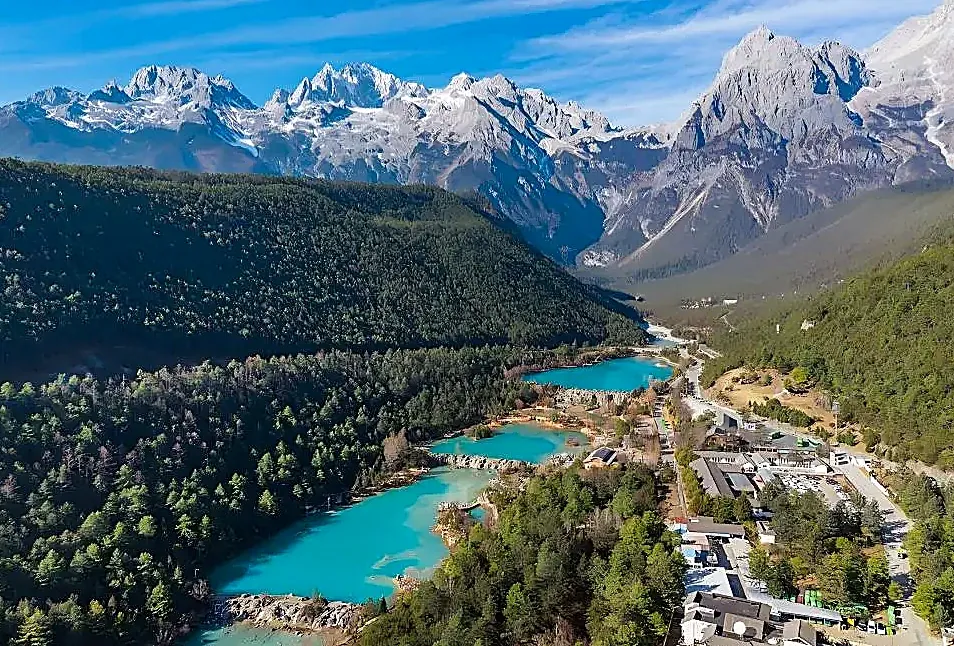
Shaping the entire feng shui and spirit of the land is Jade Dragon Snow Mountain piercing white clouds overhead. In traditional Naxi belief, the snow-clad peaks are not merely natural scenery, but the living embodiment of Sanduo—the supreme protective war deity guarding the tribe’s survival and prosperity since antiquity. Ancient glacial ice filters through limestone strata and melts into pure spring water feeding the Jade River (Yuhe) channels. Flowing naturally by the principle of weaving through lanes and past every household, clear water threads through the old town to nourish life across Lijiang.
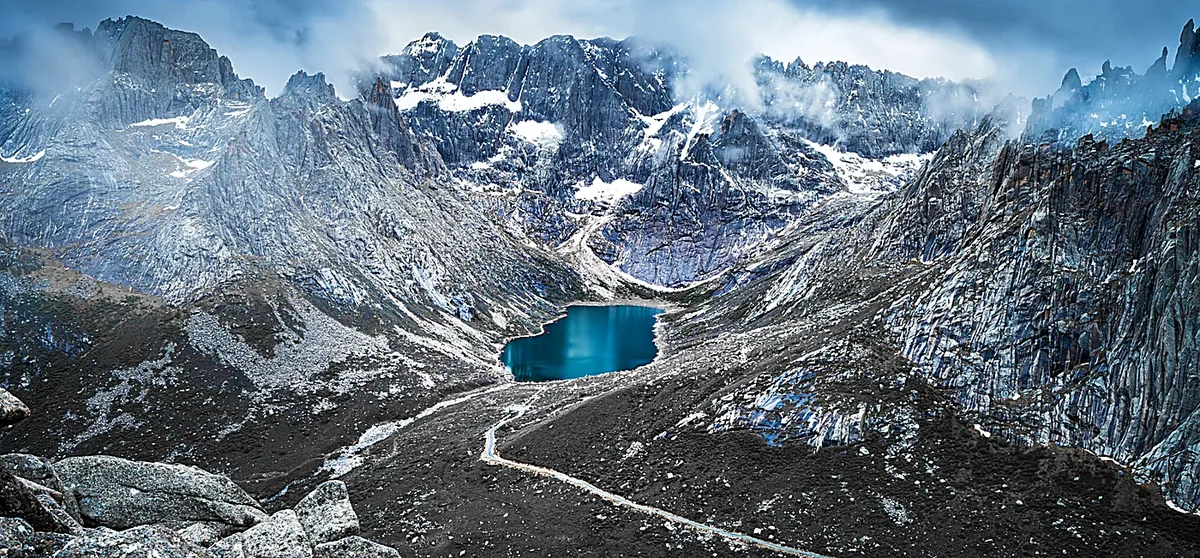
Between the open Ganhaizi Meadow and the jade-clear Blue Moon Valley, the stage of Impression Lijiang sits at an astonishing 3,100 meters above sea level. Rather than heavy-handed alteration of the geology, the venue is carved directly into red highland earth to form a sweeping open-air semicircular amphitheater with an unobstructed 360-degree view in crisp mountain air. Gentle hillside slopes become dynamic performance tiers, while rich red highland basalt contrasts sharply against cool gray limestone cliffs rising sheer behind.
This setting fulfills a refined geomantic ideal: taking towering snow peaks as a permanent backdrop and open heaven and earth as a grand stage. Backing directly onto the thirteen peaks of Jade Dragon Snow Mountain anchors the site while turning the entire valley into a natural amphitheater of sound and light. Mountain winds sweeping through gorges, bright sunlight sliding down slopes, and clouds drifting past eye level paint an ever-changing picture hour by hour—honoring the stage like a sacred altar amid snowy peaks.
Standing out across level Ganhaizi Meadow at the foot of Shanzidou Peak on Jade Dragon Snow Mountain, the outdoor theater for Impression Lijiang rises above 3,100 meters in elevation. It is one of the world’s most elaborate open-air performance venues in a demanding high-altitude setting. Instead of disturbing pristine scenery, chief director Zhang Yimou and the architectural team followed the principle of using mountains as backdrop and terrain as stage—excavating a sunken circular bowl echoing an ancient arena yet shaped with rugged, angular Eastern spirit.
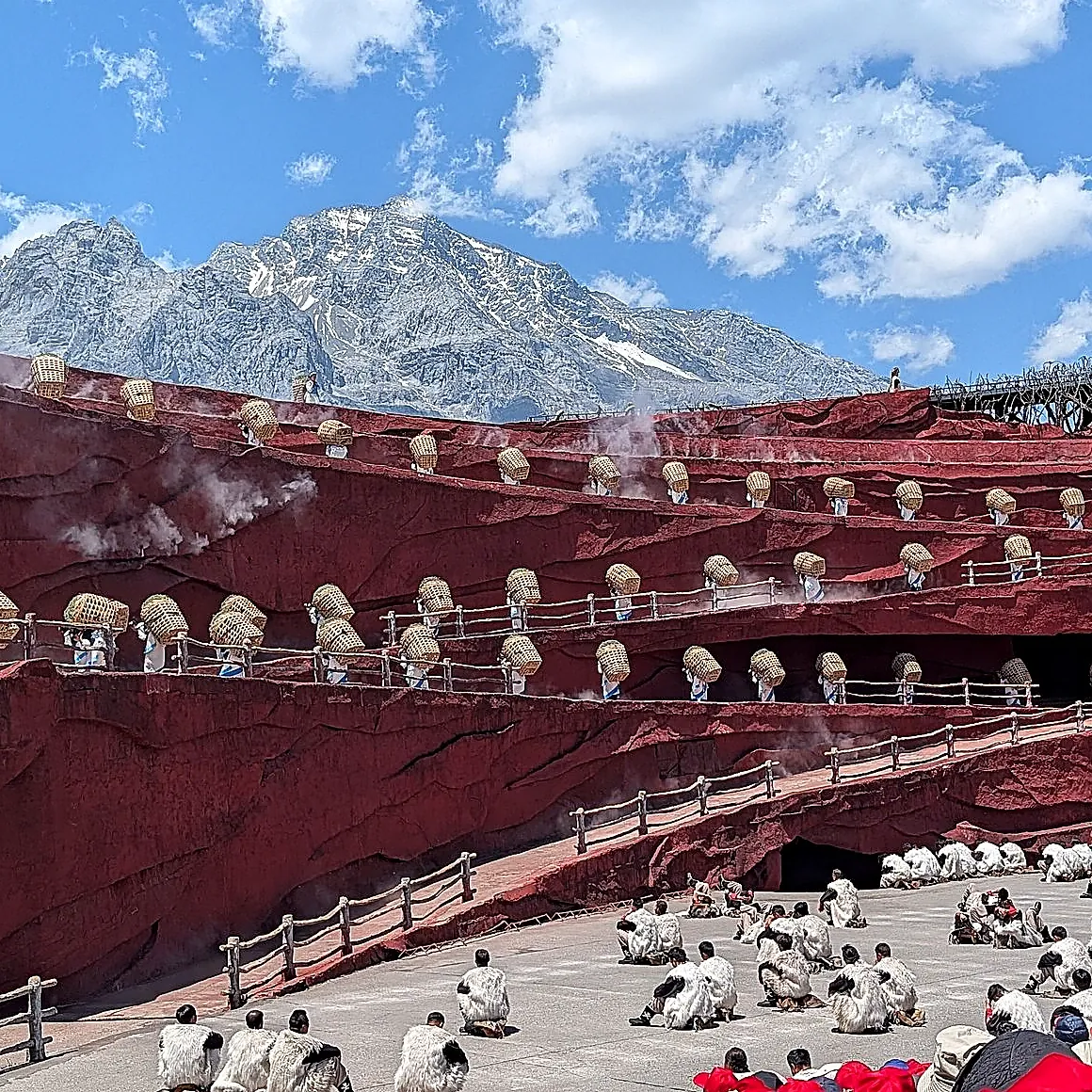
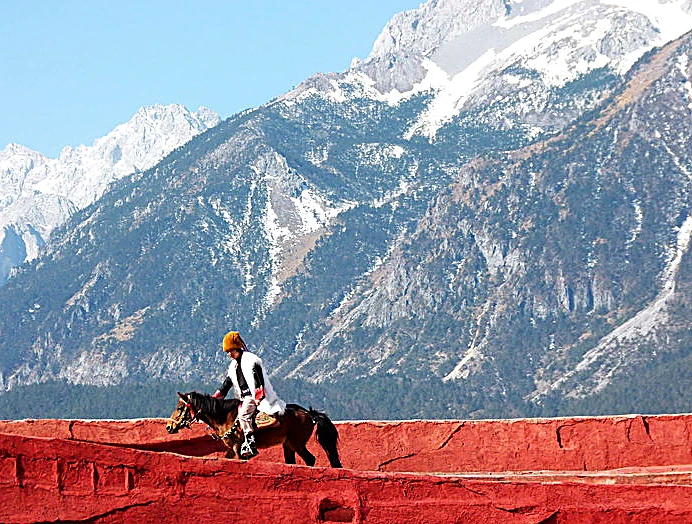
The most striking visual feature is its sweeping tiered walls in fiery brick-red tones, standing in bold contrast against the eternal snow-white peaks of Jade Dragon along the horizon. Surface finishes evoke southwestern red sandstone, directly recalling arid red-earth stretches and perilous trails that Tea Horse Road horse caravans once crossed over centuries. Steep zigzag ramps cutting across the deep-red stage floor both tier the space and allow dozens of horses to gallop simultaneously. Seen from above, it looks like a dramatic geological fissure opening from the earth to cradle mountain peoples’ stories.
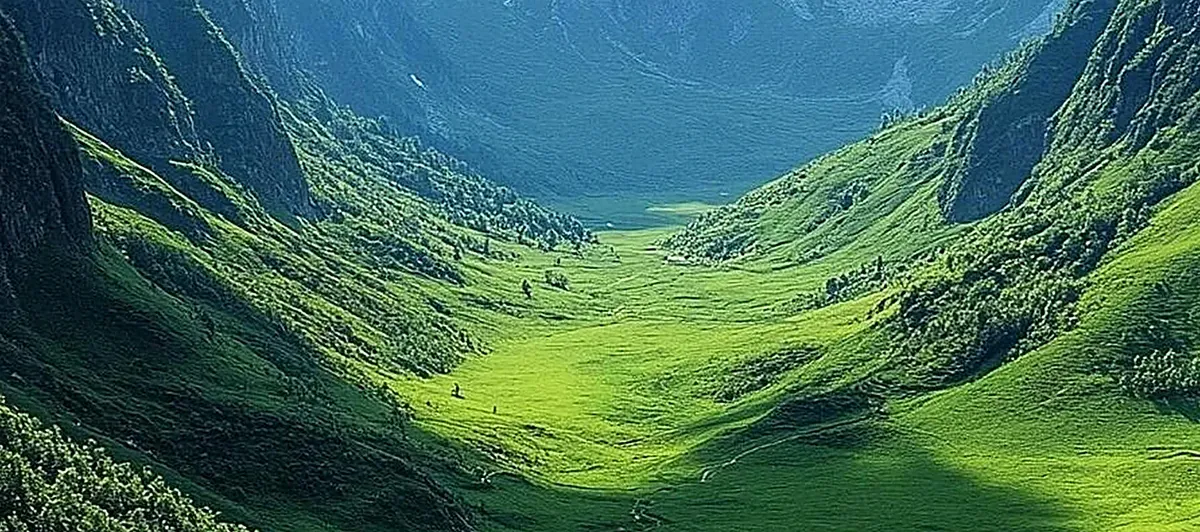
Ringed around the sunken stage bowl are supporting structures modeled faithfully after traditional Naxi dwellings. Local architecture recreates the classic “Three Courtyards and One Screen Wall” layout—three timber rooms framing a courtyard opposite a wind-and-energy screen wall. Upper structures combine timber and stone, using minimally dressed pine logs joined with gray slate and straw-mixed earth walls. Layered yin-yang tiled roofs curve gently, accented by mountain orchids and cold-hardy alpine plants—turning backstage areas and walkways into a true Naxi mountain village beneath the clouds.
In capacity and practical operation, the natural hillside semicircular seating holds over 2,800 spectators per show while preserving broad 360-degree sightlines. With no artificial roof, high-wattage stage spotlights, or indoor LED walls, the show leaves visual effects to nature itself. Crisp highland sunlight, drifting mist around limestone peaks, and sudden mountain breezes become living lighting and special effects—drawing viewers into a surreal space where human design and wild nature blend seamlessly.
The theatrical space of Impression Lijiang breaks free from conventional stage boxes. Guided by directors Zhang Yimou, Wang Chaoge, and Fan Yue, the entire production unfolds inside the Ganhaizi basin above 3,100 meters, framed directly by the thirteen cloud-kissed peaks of Jade Dragon Snow Mountain. Rather than artificial light rigs or complex machinery, nature serves as master lighting director: bright alpine sun on red earth, mist curling across slopes or dissolving into blue sky, and brisk gorge breezes bringing occasional daytime snow flurries make every performance a singular, unrepeatable event.
The enduring soul of this outdoor epic comes not from celebrity stars or conservatory dancers, but from the sweat, breath, and heartbeats of more than five hundred everyday farmers and herders from local ethnic groups—including Naxi, Yi, Tibetan, Bai, Miao, and Pumi. Stepping from cornfields, pastures, and mountain villages with sun-weathered skin, sturdy frames, and spirited eyes, they bring authentic vitality to the stage. When a yak-horn call pierces quiet air and dozens of horses thunder across packed earth, the production vividly recreates life-or-death journeys along the Ancient Tea Horse Road. Bronze bells clinking in rhythm, whips cracking in the wind, and bare feet treading rocky slopes evoke caravans carrying tea, salt, and silk across snowy passes linking Yunnan, Tibet, and South Asia.
Emotional intensity peaks in the segment “Toasting the Snow Mountain,” where stout caravan men raise bowls of highland barley liquor, call out across snowy slopes, and drink in tribute to sacred peaks and steadfast brotherhood. Fierce frontier hardship then gives way to lyrical grace in “From Heaven to Earth,” which interprets the ancient Naxi legend of “Jade Dragon Love Suicide.” Below white peaks, devoted lovers bound by strict feudal norms enter the “Third Kingdom of Jade Dragon”—a mythic realm above the clouds filled with flowers and sweet springs free from earthly sorrow. Lamenting songs woven with chants of Dongba elders transform grief into a timeless tribute to freedom and pure love.
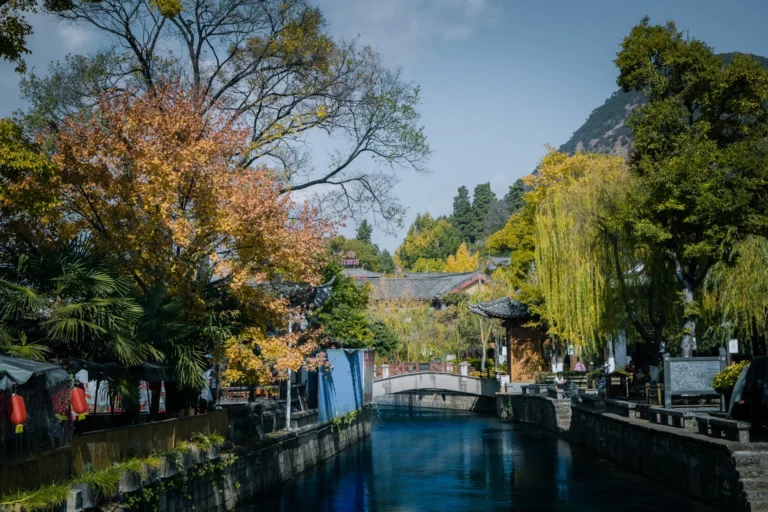
As the snow-mountain show concludes and dusk settles over the Lijiang valley, the sensory journey continues smoothly into evening life in Dayan Old Town. Leaving high mountain quiet behind, the centuries-old town glows warmly as tens of thousands of red lanterns reflect along Jade River canals and pine-timber eaves. Clear stream water threads past stone slabs, carrying floating candle lotus lanterns sent off with wishes for peace. Around Sifang Square, a crackling bonfire signals traditional Dajiao circle dancing. Naxi women wearing “stars and moon” shawls with seven embroidered stars on the back join hands with Tibetan, Yi, and visiting guests in widening circles—stepping in time to bamboo flutes and wooden drums while erasing language barriers across the southwest.
After taking in the stirring mountain epic on the outdoor stage, experiencing Lijiang’s soul is incomplete without tasting traditional Naxi food. Living in a limestone valley above 2,000 meters amid crisp mountain air and chilly winds, locals shaped a rustic, thoughtful cuisine rooted in wild ingredients and traditional balance—highlighted by three classic flavors: pan-seared chickpea jelly, salt-cured pork-rib hotpot, and rich highland stews.
As a delicate starter remembered by generations of travelers, Ji Dou Liang Fen (chickpea jelly) is hard to top. This naturally dark-gray jelly is made from chickpeas grown on steep slopes around the Snow Mountains. Firm slices are pan-fried gently in rapeseed oil until both sides turn golden and crisp with nutty aroma while staying silky smooth inside—brightened by a spoonful of savory dressing made with crushed garlic, aged vinegar, chili oil, and fragrant cilantro. Balancing that light dish is a hearty cold-night staple: cured pork-rib hotpot (La Paigu). Naxi cooks cure free-range pork ribs with coarse salt and high-proof corn liquor, hanging them for months in mountain wind to dry. Simmered slowly in a clay pot with aromatic black cardamom broth, the cured ribs release savory fragrance and make a rich base for poaching wild matsutake and bolete mushrooms fresh from the forest.
Alongside steaming hotpots, local street snacks reflect a thousand years of Tea Horse Road trade. Topping the pastry list is Lijiang Baba—flaky, crisp outside yet soft and airy within—offered in two distinct styles: sweet fillings rich with Jinsha red sugar and honeyed rose petals, or savory fillings of diced cured bacon and fragrant scallions. Along quiet canals, aromas of Naxi grilled fish seasoned with dried chili and numbing forest pepper, crispy herb-scented rice-and-blood sausage, and puffing charcoal-grilled tofu with creamy centers tempt passing walkers. Inside traditional timber homes, a bowl of rich churned yak butter tea or thick-sliced yak beef hotpot remains a warm welcome against high-plateau chill.
The lasting charm of local cooking lives on in everyday family-run eateries decades old. Along quiet Wuyi Road, Snack Shop No. 88—operating for over thirty years—keeps charcoal warm and preserves traditional chickpea jelly and seasoning recipes prepared by capable Naxi hands. Near Sifang Square, long-standing La Paigu kitchens keep fires glowing into the night with wind-cured ribs hung under old eaves and broth simmering over charcoal. Enjoying simple dishes beside rippling Jade River water beneath moss-kissed tiles under a highland moon lets travelers feel the bond between high-altitude performance art and a warm, resilient people.
Reaching the open-air theater of Impression Lijiang in Ganhaizi Meadow (甘海子) calls for thoughtful route and physical preparation. To travel from central Lijiang Old Town up to the base of Jade Dragon Snow Mountain above 3,100 meters, visitors can catch dedicated shuttle buses departing near the big waterwheel at the north edge of the old town. Fares run around 15 RMB each way for a roughly 90-minute ride past green cornfields and pine woods before broad snow-mountain plains open ahead. If taking a taxi or private car, confirming round-trip terms and pickup/drop-off points upfront helps avoid delays in mountain areas.
Jade Dragon Snow Mountain Scenic Area enforces strict real-name ticketing tied to personal identification. International visitors should keep their original passport safely on hand, as mountain entry gates, shuttle buses, and theater admissions require passport scanning and facial verification. Because Impression Lijiang performances typically run at midday and early afternoon—such as 11:10 AM and 1:30 PM—when crowds arrive together, booking bundled tickets covering mountain entry, cable cars, and show seating through authorized channels in advance is key to securing your preferred slot.
Because the theater sits completely outdoors on red highland ground with no roof cover, spectators are exposed directly to northwestern Yunnan weather. Sunlight above 3,100 meters carries strong UV radiation alongside brisk winds descending from the thirteen snow peaks. Bring UV-blocking sunglasses to ease glare, apply high-SPF sunscreen, and dress in layers—such as a windproof shell, thermal base layer, or light down jacket. Those sensitive to altitude shifts or with cardiovascular or blood-pressure concerns should carry a portable medical oxygen canister and pace themselves slowly to acclimatize comfortably.
In winding old-town lanes, occasional brokers posing as guesthouse hosts may push overpriced private cars or ultra-cheap day tours aimed at steering guests toward fake Tibetan silver, cordyceps, or notoginseng shops. To protect the pure artistic spirit of your trip, politely decline unverified offers, stick to official transport routes, and buy local specialties only at reputable established shops. Keeping these practical habits in mind makes watching the Naxi epic a smooth, memorable highlight.
To enjoy this grand outdoor performance without worrying about ticket bookings or mountain logistics, travelers can join an organized itinerary such as our Dali – Lijiang – Shangri-La – Kunming tour package (5D5N & 6D6N) with attentive service and knowledgeable local guides.