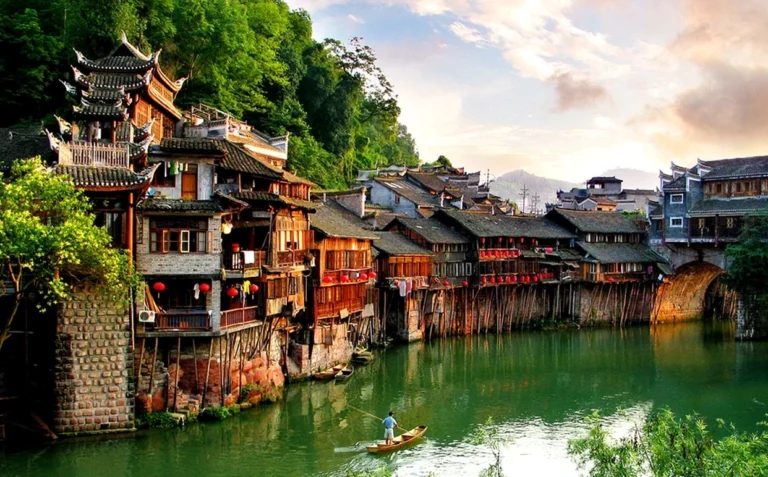
Nestled quietly beside the Yong River, which has rolled through countless historical ups and downs, the land of Nanning once bore the ancient designation of Yongzhou, serving as a steadfast fortress across the southern frontier. Tracing the endless river of history back, from the era when Emperor Qin Shi Huang conquered Lingnan through the Han dynasties, this land was already a settlement cradle for indigenous Baiyue and Luoyue populations—those who breathed souls into brilliant Dong Son bronze drum-casting craftsmanship, turning resonant metallic tones into immortal symbols of early authority and belief. Entering the Song Dynasty, Yongzhou transformed into one of the most bustling borderland trade gateways, serving simultaneously as a hereditary Tusi administrative center harmonizing central court authority with local chieftains. Throughout succeeding Ming and Qing dynasties, the harmonious cohabitation of Zhuang, Dong, Miao, and Dao ethnic groups continued enriching a profound folk cultural sediment, where Then melodies, reed-pipe music, and customs intertwined deeply into highland living roots.
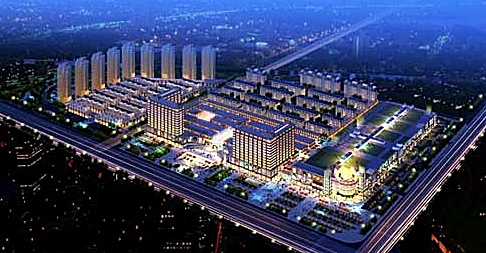
Fully inheriting that millennial heritage lifeline, Nanning Everbright City officially premiered right on the eve of the Year of the Rabbit Spring Festival, located along Songxiang Road in the Wuxiang New Area, Liangqing District. This is not merely a commercial infrastructure project but a strategic lever in the city’s nighttime economy development master plan, systematically planned by the Jinshang Tianhua Cultural Tourism Group under the leadership of founder Liu Peng. With contemporary New National Trend aesthetic thinking, the night street space has cleverly reconstructed legendary tales of the fairy singer Liu Sanjie whose voice moves mountain forests, combining with pioneering legends of carving mountains to open Guangxi’s frontiers, turning every square meter into a living open museum amidst prosperous urban landscapes.
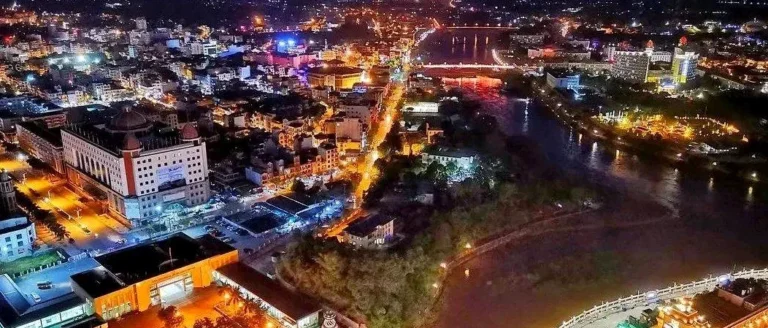
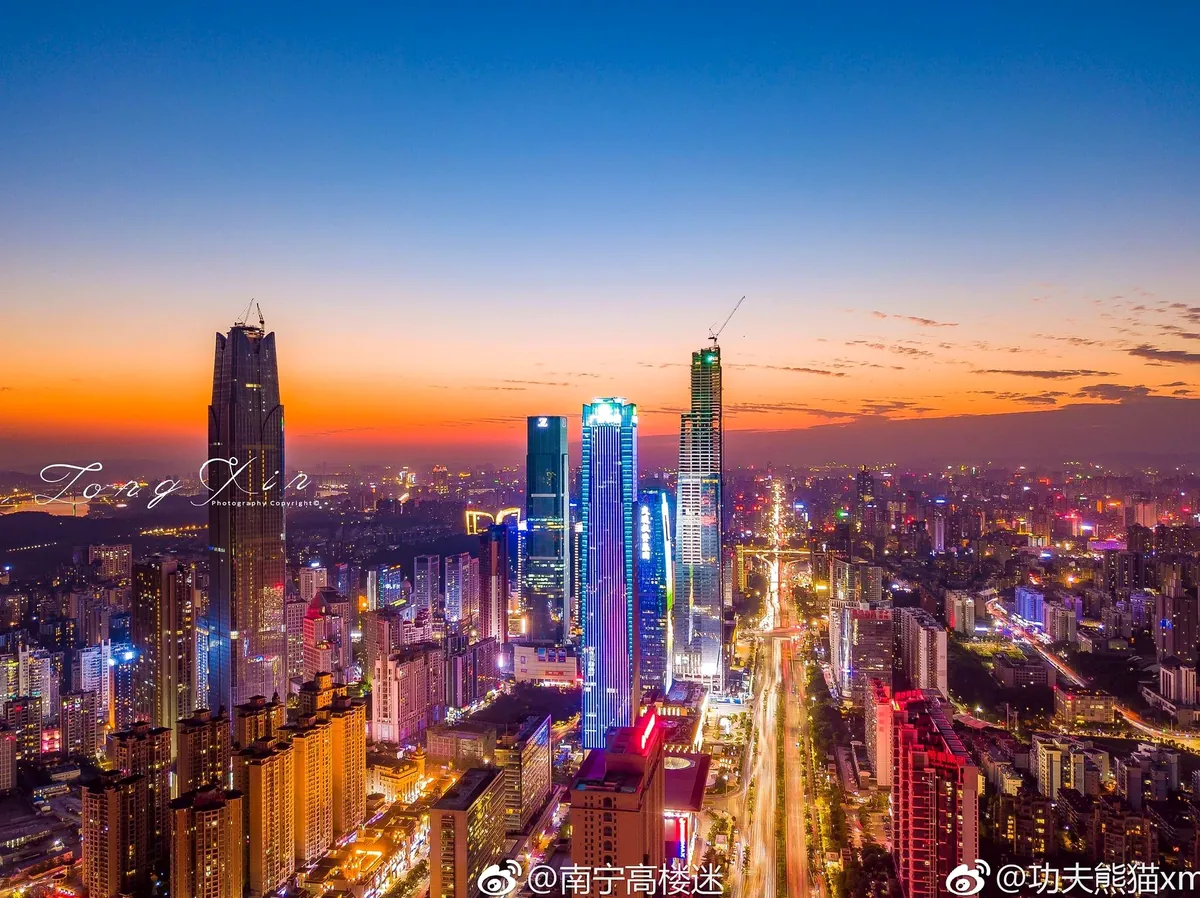
As twilight gradually descends across a sky shifting magically from deep blue to vibrant pinkish-orange, the entire new urban district panorama emerges like an enchanting futuristic painting. Skyscrapers and modern high-rises simultaneously illuminate thousands of glamorous lights, reflecting the majestic and dynamic character of a new economic center. Below, the expansive arterial road records relentless traffic movements, weaving sparkling light trails like glowing lava currents, guiding travelers from hurried daily routines straight into the glittering festival world of the night street.
The presence of Nanning Everbright City in Liangqing District is vivid proof of the process of redefining heritage spaces in the digital age. Every carved detail featuring flame motifs, stylized Luoyue bronze drum patterns, or rows of brilliant crimson antique lanterns is meticulously calculated to honor ethnic diversity across the autonomous Zhuang region of Guangxi. Amidst an atmosphere saturated with aromas from traditional food stalls and echoing highland folk melodies, millennial history no longer rests quietly within moldy ancient pages, but surges with fierce vitality across every wandering traveler’s footsteps.
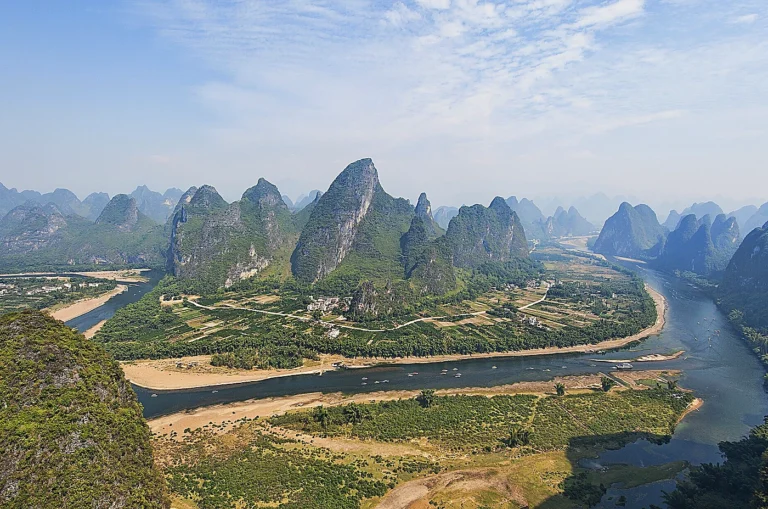
Impresively present at a prime location within the center of the Wuxiang New Urban Area, the Nanning Everbright City complex is constructed along one of the most prosperously developing spatial axes of Guangxi’s capital. This location not only benefits from advanced urban infrastructure but fully inherits the quintessence of a land intersecting undulating mountain ranges and bountiful hydrological systems. Surrounding landscapes are embraced by two gigantic green lungs: Wuxiangling Forest Park and Wuxiang Lake Park, forging a pristine ecological buffer strip completely detached from the rigidity typical of modern commercial megastructures.
According to traditional Eastern geomancy, the project rests entirely within a legendary layout named “Five Elephants Bowing to Yong” (五象朝邕)—a millennial spiritual symbol protecting ancient Yongzhou territories. The rear pillow of the entire complex relies sturdily on Wuxiangling (五象岭), namely the majestic Five Elephants Mountain range. Legend holds that since primordial times, five celestial elephants descended to roam the southern realm, captivated by the gentle beauty of azure waters that they stopped to bow their heads drinking from the Yong River, turning into stone for millennia to forge a natural protective screen blocking storms and gathering peaceful vital energy for native inhabitants. This sturdy mountain backing delivers imposing, majestic, and comprehensive protection for bustling activity spaces below.
The perfect counterbalance to sturdy mountains behind is the open water-gathering bright hall in front. Adjoining directly the vast hydrological network of Wuxiang Lake Park and the Yong River nurturing alluvial deposits for millennia, this zone establishes the formation of “Outer mountains enclosing, inner waters winding.” Water currents circulate smoothly and leisurely like a winding jade belt, converging toward central spaces resembling a gigantic Treasure Basin. In human-geographical beliefs, converging waters at bright halls represent financial liquidity and prosperous qi, transforming this land into a wealth-gathering basin nurturing bustling commercial life thrumming all night long without depleting vitality.
Whenever twilight falls, that entire geomantic landscape awakens brilliantly through panoramic perspectives along peaceful riverbanks. From pedestrian bridges glowing with warm street lighting, crowds stroll leisurely observing settling urban rhythms. Far across opposing banks, towering buildings stand majestic, simultaneously showcasing light dances from tens of thousands of colorful LED strips reflecting sparkling upon rippling water surfaces. The delicate interweaving of modern glass architectures and antique pavilion roofs curving with glazed tiles forges a magnificent nocturnal painting, carrying futuristic breaths while preserving southern ancient antique souls.
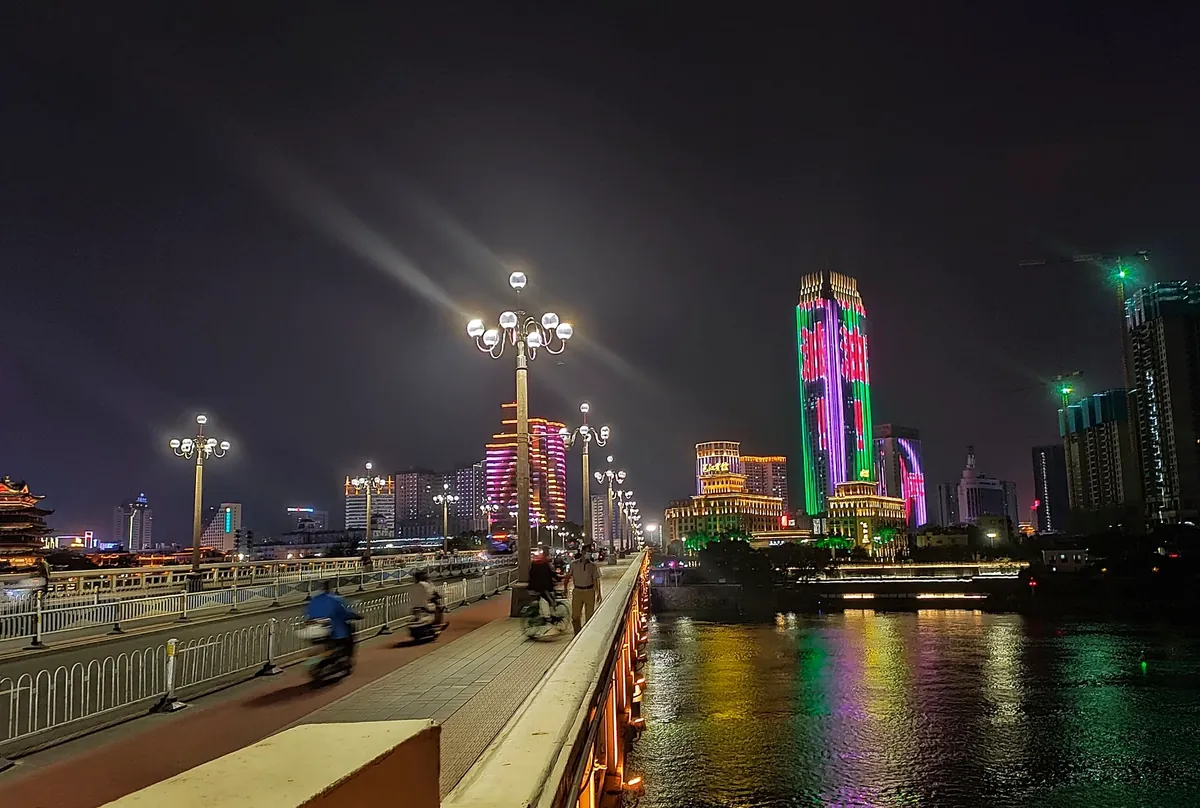
Natural landscape planning is thus never detached from overall project schemes but becomes an integral soul of Nanning Everbright City. Gentle lakeside topography is cleverly calculated so refreshing breezes carrying natural moisture thread through stalls and antique streets, dispelling stifling summer nights in the south. Harmoniously combining native soils and contemporary aesthetic thinking has turned this night street into a representative destination where travelers admire majestic mountain and river contemplative beauty while immersing in boundless prosperous worldly atmospheres.
Nanning Everbright City’s space is planned like a soft silk ribbon stretching 666 meters along its main axis, a number implicitly harboring deep Eastern geomantic philosophies regarding smooth sailing and complete prosperity, conveying “Sixfold Smoothness” (六六大顺). With a scale exceeding 33,000 square meters of constructed floor area, this cultural space project cleverly fuses urban prosperity with millennial ethnic heritage, distributing over 160 traditional stalls alternating alongside 16 multi-ethnic performance stages. Every pathway and street corner here serves not merely as commercial sightseeing stops but acts as a living architectural museum where traditional carpentry and Lingnan ancient aesthetic thinking are precisely reconstructed.
The foremost prominent imprint across overall spatial structures is the presence of Wind and Rain Bridge (风雨桥), a reconstruction of the legendary Chengyang Bridge masterpiece belonging to Dong compatriots from Sanjiang. The entire bridge is crafted completely via peerless precision mortise-and-tenon wood joining techniques without utilizing a single iron nail, resting sturdily across time through intricate interlocking joints. Multi-tiered layered roof tiles curve gracefully into space, blending with contemplative Dong Drum Towers (侗族鼓楼) standing majestic nearby. Drum towers feature multi-sided tapering pyramidal forms soaring straight into skies, covered tightly in moss-steeped gray yin-yang tiles, serving as sacred symbols for communal solidarity and repositories of ancestral voices from ancient villages.
Continuing highland heritage lineages, the complex faithfully recreates Diaojiaolou stilted house complexes (吊脚楼) characteristic of Miao and Zhuang peoples. Stilted houses elevate via slender yet sturdy timber column systems, featuring charming curved verandas named Beauty Railings (美人靠)—where ancient highland maidens leaned back embroidering and gazing at village scenery. Across wooden walls, partitions, and eaves, artisans painstakingly carved symbolic motif systems of Yongzhou Bronze Drums featuring radiant sun patterns emitting rays, soaring Lạc birds, and majestic war junks riding waves. Those ancient symbols interweave rhythmically with diamond-patterned motifs shimmering in colors filtered from Zhuang Brocade weaving arts (壮锦 – Zhuang Brocade), forging visual fields overflowing with native aesthetics.
Beneath Nanning’s night skies, pedestrian streets ignite into magnificent fairy-tale festival scenes as hundreds of warm yellow lanterns hang suspended along traditional streets and building balconies. Amidst bustling crowds welcoming spring, magical cross-flows between past and present unfold as deep blue laser light beams tear through nights, sweeping across soaring curved tile roofs. Right in the heart of ancient streets, a magnificent artistic landscape cluster stands out featuring a gigantic wheel covered in royal red and yellow hues, becoming a magnetic visual focal point embodying prosperous souls across entire fairgrounds.
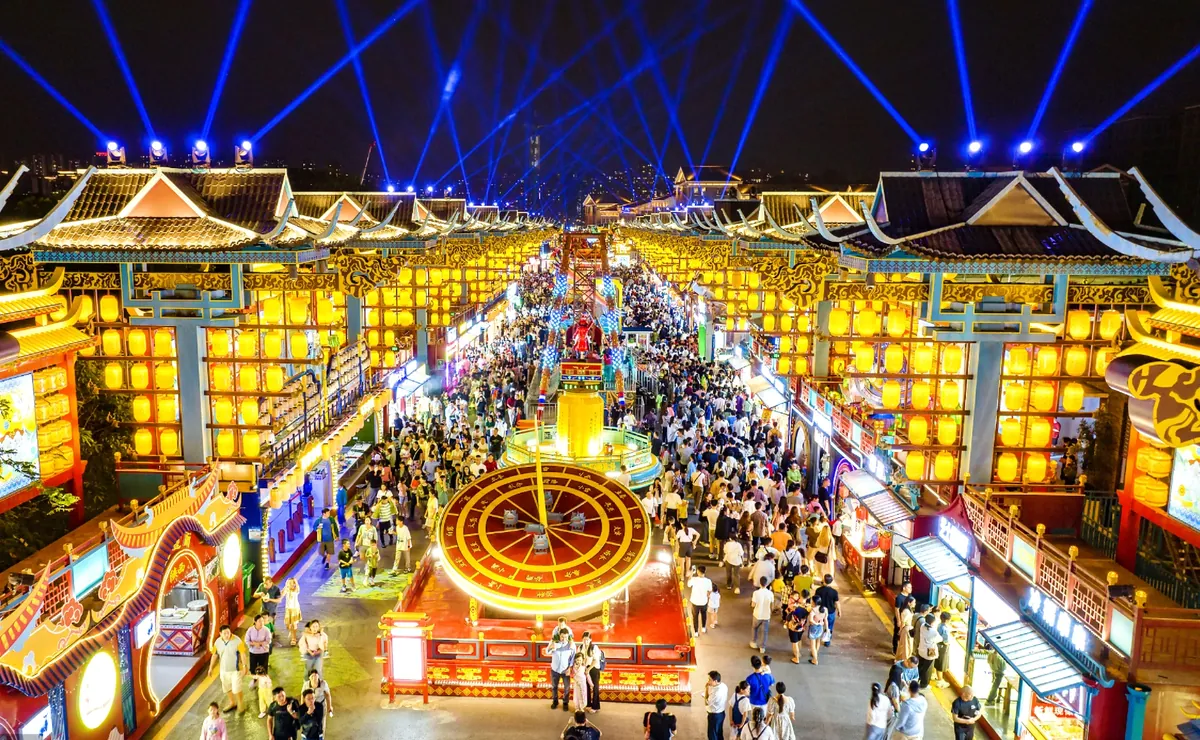
The synthesis of grand planning scale and meticulous attention to traditional details has turned Nanning Everbright City into an endless epic regarding architectural spaces. Sixteen satellite stages distributed across main axes act as interconnected artistic links, where contemporary digital lighting elevates khen flute dances, Tinh lute music, and bustling folk rhythms. The entire 33,000+ square meter area delivers breathtaking visual tourism experiences while fully honoring intangible cultures of Zhuang, Miao, Dao, and Dong ethnic groups, evoking deep nostalgic emotions in prosperous urban centers.
When twilight descends along Yong River banks, Nanning Everbright City sheds daytime stillness to don magnificent imperial robes woven from modern lighting technology. The entire night street space is shaped under New National Trend aesthetic schools combined with Cyberpunk sci-fi styles, forging contrasting yet astonishingly harmonious visual universes. Across expansive spaces, tens of thousands of traditional red lanterns hang suspended along streets simulating Lingnan ancient tile roofs, interweaving with rhythmic laser lighting sweeping night skies. Artificial mists pumped densely from rock crevices combine with water-screen LED matrices and advanced 3D Mapping projection arts, transforming every brick and eave into shimmering multicolored mirrors, guiding travelers into magical boundaries between ancient pasts and sci-fi futures.
Nestled peacefully in majestic splendor at central avenues stands the towering Hundred Birds Paying Homage to the Phoenix Pillar, a sculptural masterpiece carrying profound Eastern auspicious concepts, integrated with smart sensors enabling continuous color shifts matching rhythmic sound ranges of contemporary symphonies. Nearby, visitors’ vision is completely overwhelmed by the towering Mechanical Zhuang Goddess statue standing tall across plazas. Crafted elaborately from metals combined with luminescent polymer materials, the statue representing Lingnan frontier spirits remains unfrozen, blinking smoothly, gently tilting heads, and waving welcoming greetings to visitors. Whenever water screens activate, hypnotic light beams sweep across intricate mechanical details across the goddess’s face, forging majestic visual effects where ancient matriarchal cultural symbols blend absolutely with scientific technological breaths of new eras.
The soul forging endless prosperous heartbeats in Nanning Everbright City rests in a network of sixteen satellite stages distributed across spaces yet linked tightly within continuous rotating performance frameworks. Performances initiate rhythms from 6:00 PM and extend continuously until 10:30 PM nightly, ensuring every stopping step encounters vibrant melodies or dances. Across stages, pristine folk melodies of native inhabitants are honored at peak splendor: echoing rustic antiphonal mountain songs of Zhuang youths and maidens in intricate hand-embroidered brocade costumes, resonant bronze gongs echoing from frontier reclamation dawn, and crisp clacking rhythms of ethnic bamboo pole dances inviting all ages to join harmony. Contemplative Lingnan ancient atmospheres grow increasingly profound as string music resonates through traditional classical tracks, blending with bustling bidirectional crowds.
As nights deepen, nightlife ascends via hypnotic, dramatic visual interactions. Travelers are captivated by classic Tumbling Doll (Bất Đảo Ông) performances, where female dancers embody antique doll beauties, wearing flowing garments, gracefully curving mid-air to distribute souvenirs and touch interacting visitors. Adjoining this, spaces erupt via spectacular kung-fu fire-breathing circus acts, where blazing fire tears through darkness, combining with surround sound systems and matrix laser lights to push crowd emotions to exhilarating peaks. Harmonious resonance between traditional folk performance arts and advanced real-scene stage engineering turns Nanning Everbright City into a multi-tiered nighttime cultural sightseeing hub, awakening travelers’ senses across endless fusions of sound and light.
When brilliant lanterns illuminate ancient streets across Nanning Everbright City, spaces instantly transform into living sensory fields, gathering millennial culinary identities of Lingnan strips and native ethnic communities. Wisping smoke rises from glowing red kitchens carrying bustling stir-frying sounds, guiding travelers’ steps into layered flavors crystallized from fertile soils, where heirloom recipes passed down across generations preserve pristine ancient souls.
Present solemnly across flavor pictures is Zhuang five-color sticky rice, a sacred symbol imbued with aesthetic natural philosophy. This dish transcends color combinations of brilliant red, yellow, purple, black, and ivory-white sticky rice grains, representing meticulous craftsmanship via traditional wild herbal dyeing methods. Zhuang artisans forage deep forests for red maple leaves, gardenia fruits yielding bright yellow, deep purple perilla leaves, and young ash-soaked maple buds to extract mystical black hues. Rice grains absorb plateau essence, steaming in wooden baskets to release gentle herbal aromas, packing blessings for bountiful harvests, harmonious yin-yang balance, and village prosperity.
Venturing deeper into rustic stalls, visitors encounter intangible cultural uniqueness of Gongcheng butter tea, traditional beverages known as coffee of Guangxi’s mountain ranges. Under artisans’ nimble hands, selected green tea buds enter roaring iron woks alongside sliced aged ginger, crushed garlic, and rich lard. Small wooden pestles mash ingredients continuously under high heat until tea essences and pungent ginger blend, extracting thick dark golden broths. Steaming butter tea bowls are served with crispy popped rice and roasted peanuts; sipping slowly reveals initial astringent flavors transforming into warming spicy aftertastes lingering in throats before settling into deep sweet finishes, dispelling cold and clearing meridians.
Millennial urban breaths of Yongcheng display unmistakably through unmistakable fragrant aromas of Nanning Laohuyou noodles. Legend attributes origins to affectionate gestures curing wind-colds for close friends, requiring decisive high-heat techniques over roaring flames. Repeatedly tossing fresh minced meat, pickled bamboo shoots, bird’s-eye chilies, and dark fermented black beans unleashes pungent aromas across spaces. Simmered bone broths are poured directly into bubbling woks, forging spicy noodle bowls where tart bamboo shoot acidity stimulates taste buds, making diners break into refreshing sweats during chilly nights.
Culinary symphonies at night markets enrich via celebrated Liuzhou snail noodles alongside vibrant fruit platters. Snail noodle broths simmer for hours from deep-river snails with cardamom, star anise, cinnamon, and red chili, forging tongue-piercing spicy profiles yet sweet bone-marrow aftertastes, elevating chewy noodle strands topped with crispy fried bean curd and pickled bamboo shoots. Concluding tasteful journeys, Guangxi pickled fruit platters featuring crispy green mangoes, papayas, guavas, and plums marinated in heirloom vinegar-sugar with spicy chili powder deliver refreshing crunchiness, perfectly balancing senses and etching unforgettable culinary memories.
The Nanning ancient street operates under Lĩnh Nam nighttime rhythms, opening completely free of admission fees 24/7 to welcome global travelers. Although open spaces welcome strolling anytime, bustling souls alongside folk performance activities and native cuisine only initiate past 4:00 PM daily, when wisping smoke rises from legacy grills and stalls open. The golden timeframe to start field excursions falls around 5:30 PM, when skies shift into magical blue hour hues. Immediately following, from 6:30 PM to 10:30 PM, the complex glows in glamorous lantern seas, igniting prosperous antique town visions lasting all night long.
Thanks to Nanning City‘s planned infrastructure, traveling to night streets remains convenient via flexible transport. For public rail networks, optimal routes involve boarding Metro Line 3 southward, alighting at Qingge Lu Station, exiting via Exit D, and transferring via taxis or public bicycles along flat 1.5 km roads. Alternative metro routes include Metro Line 2 to Pingliang Interchange Station, followed by 5-minute taxi rides. Surface public transit features urban bus routes W8, 117, and B2 with nearby stops. For prioritized mobility, travelers operate Didi ride apps or wave traditional taxis with destination “南宁之夜” along Songxiang Road; departures from Chaoyang Square take 20–25 minutes costing 25–35 RMB.
To enjoy scenic beauty without crowded hustle, field advice prioritizes weekday visits from Monday to Thursday, avoiding weekends, national holidays, or Spring Festivals. At main gates, shops rent traditional costumes affordably; wearing flowing Hanfu garments or intricate Zhuang/Miao embroidered attire highlights photo mementoes amidst pavilions. Economically, streets operate cashless; 100% of culinary stalls, souvenir booths, and services require QR code scanning via WeChat Pay or Alipay. Foreign travelers should pre-install apps and link international payment cards for seamless specialty purchases.
Exploring this glittering southern urban space completes seamlessly within cross-border itineraries through arterial border gates, where travelers join the All-Inclusive Dongxing China Tour Package for safe, cost-optimized journeys leaving unforgettable cultural memories.