Standing tall at the center of Lin’an Ancient Town in Jianshui County, within the Hani and Yi Autonomous Prefecture of Honghe in Yunnan Province, Chaoyang Tower in Jianshui stands like a quiet witness to the deep flow of time. This historic gate tower originally bore the name Yinghui Gate—the eastern gateway welcoming the bright morning sun of southern Yunnan, while serving as a vital pass for trade and frontier military defense. Tracing history back to the Yuanhe reign of the Tang Dynasty (806–820), when the Nanzhao Kingdom ruled the southwest, the site began as an earthen fortification called Huili City. In the ancient language of the indigenous Yi people, “Huili” carried the simple meaning of “Great Sea”—an expansive lake basin evoking a fertile valley where waters gathered before evolving into a bustling town across more than a millennium.
The turning point that shaped the tower’s grand appearance came only when Central Plains courts established firm control in southern Yunnan. In 1387—the twentieth year of Hongwu under Ming founder Zhu Yuanzhang—the imperial court decreed the establishment of the Lin’an Guard to consolidate administration and garrison troops along the southern frontier. Just two years later, in 1389 (the twenty-second year of Hongwu), local officials and troops carried out a monumental rebuild: dismantling the simple earthen wall to construct a sturdy, imposing fortress of brick and stone. Right at the strategic eastern gate, the Yinghui Gate tower—the direct forerunner of Chaoyang Tower—rose proudly into the clouds, marking its shift from an early outpost into an enduring symbol of power and culture.
One of the striking milestones that astonishes historians and architectural scholars alike is Chaoyang Tower’s founding date. Completed in 1389, this grand gate tower predates Chengtian Gate in Beijing—the forerunner of the famed Tiananmen, begun in 1417 (the fifteenth year of Yongle)—by a full 28 years. With three tiers of sweeping, upturned eaves soaring gracefully like phoenix wings against the sky, scholars through the ages have praised it in formal phrases such as “the key pivot linking the famed domain of Diannan” and “a grand frontier vantage of sweeping ascent.” Every timber beam and bluestone slab at its base reflects top-tier military architecture fused with early Ming court aesthetics.
Across the shifting fortunes of the Yuan, Ming, and Qing dynasties, Chaoyang Tower served not only as a military stronghold, but also as a vantage point witnessing fierce political upheavals in the southwest. In 1647—the fourth year of Shunzhi under the Qing Dynasty—anti-Qing, pro-Ming resistance flared as Li Dingguo, a renowned commander of the Da Xi forces, led a large army into the key town of Lin’an. Beneath the imposing shadow of Yinghui Gate tower, the frontier general camped with his troops and shaped the campaign, leaving a stirring mark of dynastic turmoil. Alongside military history, Jianshui cemented its scholarly reputation through its distinctive “One Temple, Three Schools” tradition—where the Jianshui Confucian Temple alongside Lin’an Prefectural School and Jianshui Subprefectural School taught Confucian learning side by side, turning the frontier town into one of the south’s brightest centers of letters.
Enduring more than six centuries of warfare and powerful earthquakes across the southern Yunnan basin, Chaoyang Tower in Jianshui still preserves its original timber-and-stone structural frame, standing tall like a living chronicle. That remarkable endurance attests both to the mortise-and-tenon mastery of ancient craftsmen and to the resilience of local inhabitants through turbulent eras. Recognized among China’s sixth batch of Major Historical and Cultural Sites Protected at the National Level, the tower continues to welcome dawn and draw travelers eager to touch a storied past.
Commanding the eastern end of old Lin’an’s central axis (today’s Jianzhong Road), Chaoyang Tower holds a prime position in Jianshui’s fortifications. Its grand facade faces due east to welcome fresh vital energy and the first rosy rays of sunrise over distant horizons. Because of this eastward orientation welcoming the rising sun, the upper tower became known as Chaoyang Tower (“Facing the Sun”), while the massive archway below carried the name Yinghui Gate (“Welcoming Radiance”). In traditional Eastern geomancy and city planning, placing a major gateway to greet morning sunlight symbolizes uprightness and clarity while gathering lasting prosperity for the surrounding border region.
Viewed across the broader landscape, Jianshui was long known to ancients as a fertile basin ringed by layered mountain ranges like a natural fortress, watered by the gentle Lujiang River winding west to east to nourish surrounding villages. Standing at the eastern gateway, Chaoyang Tower acted both as a key military lookout and as a focal point of the plain’s dragon vein. From this watchtower, predecessors could survey and control the broad Kaiyong plain to the east, guard trade routes leading toward Gejiu and the Red River basin to the south, and connect north through Tonghai into the Kunming plain. Blending rugged mountain-and-river terrain with human construction created a poised “mountains behind, water ahead, guarding the pass” stance—giving the tower a dual character: a vital frontier stronghold anchoring Yunnan’s borderlands, and a tranquil scholarly sanctuary nurturing Confucian learning and imperial examination success.
Right before the tower, open Chaoyang Square acts as a spacious buffer connecting modern daily life with a millennium of history. On misty mornings when dew still clings to glazed tiles, slanting dawn sunlight casts the imposing shadow of the old gate across smooth bluestone slabs along Lin’an’s lanes, creating a rare blend of majesty and calm. Around the base, banyan and century-old shade trees mingle with warm brick walls—softening the sternness of a feudal military fortress into the lush green ecology of a highland basin.
The lively interplay between architecture and nature here is heightened by flocks of swallows over centuries. Beneath graceful upturned eaves and intricate bracket sets, countless old timber crevices have offered sheltered nesting spots for southern swallows. When dusk settles over the gate—washing three wooden tiers in warm amber-gold—flocks of swallows wheel across crimson clouds before chattering home beneath the eaves. Ancients captured this poetic sight as “ancient tower at sunset, swallows returning to the eaves,” etching it into generations of memory and making Chaoyang Tower a timeless meeting ground of nature and history.
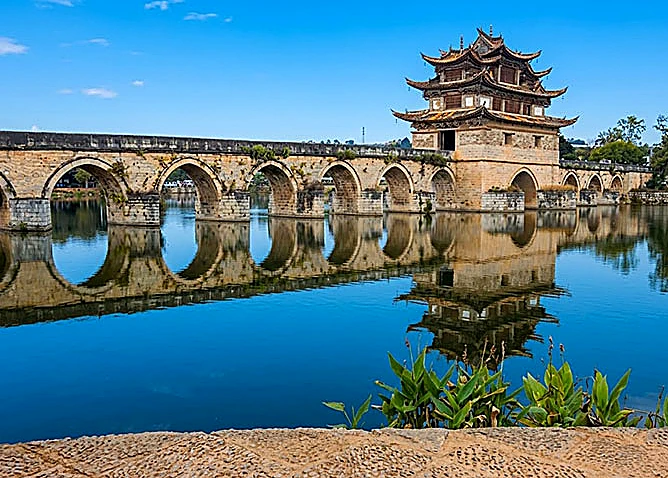
Seen from afar, Chaoyang Tower impresses travelers with a commanding silhouette against southern Yunnan skies, sturdy as an ancient peak defying centuries. Built over a footprint of 2,312 square meters and rising 24.45 meters tall, the tower sits serenely atop a solid masonry base constructed of hand-fired local gray brick. Its body rises with a “triple-eave xieshan (hip-and-gable) roof”—three layered curved roof tiers arranged in the dignified xieshan form reserved for imperial and major ceremonial structures. The main facade spans five bays (26.8 meters wide) with three bays in depth (13.5 meters), achieving balanced, imposing proportions that project the strength of a premier Ming southern frontier outpost.
Yet the true soul and longevity of this masterpiece lie in the intricate timber framework concealed beneath its sweeping roofs. The entire tower is supported by 48 towering solid-timber pillars joined tightly through pure mortise-and-tenon joinery without a single iron nail. Wrap-around galleries on all four sides provide breezy ventilation for sunny, windy highland weather while supporting three roof tiers whose upturned corner eaves spread like eagle wings in flight. While Chaoyang Tower’s grand profile resembles Tiananmen in Beijing, it actually greeted the morning sun nearly three decades earlier—blending Central Plains palace building canons with frontier defense into a classic treasure of ancient fortification craft.
The tower’s humanistic depth shines through celebrated calligraphic plaques mounted on its east and west sides. Facing Jianshui’s morning sun on the east hangs a horizontal plaque inscribed with four characters—”Xiong Zhen Dong Nan” (“Mighty Bulwark of the Southeast”)—written by renowned calligrapher Tu Rulin during the Shunzhi reign of the Qing Dynasty. Its vigorous, sweeping strokes convey the weight of an administrative and military center guarding southeastern Yunnan. Conversely, the west side carries a running-cursive plaque reading “Fei Yue Tian Nan” (“Soaring Across the Southern Sky”), said to draw inspiration from the wild cursive brushwork of Tang master Zhang Xu—creating a poetic dialogue between solemn stone-and-timber architecture and lyrical artistic freedom.
Stepping into the quiet interior fragrant with aged wood, visitors encounter a sacred guardian treasure: a great bronze bell cast during the Hongzhi reign of the Ming Dynasty. Standing nearly two meters tall and weighing over two tons, its thick bronze body is richly adorned with swirling clouds and cast relief motifs. Whenever struck, its deep, resonant tone echoes through sturdy timber beams, breaking the quiet and carrying miles across the old Lin’an valley. Once used to sound watch alerts or mark hours for townsfolk, its ring still feels like an enduring heartbeat linking modern travelers with the spirited resolve of frontier soldiers past.
As sunset fades behind layered mountains west of Lin’an, Chaoyang Tower enters its most enchanting hour of the day. Setting aside its quiet, weathered look after more than six hundred years, the ancient tower comes alive as architectural lighting switches on across the structure. Warm golden spectrums trace glazed roof edges, bringing out the triple-eave xieshan profile alongside layers of beams, tenons, and dougong brackets. Upturned corner eaves like phoenix wings reach into deep night sky, creating a luminous spectacle like a golden celestial palace suspended in air, echoing the grandeur of a thriving borderland.
Below the sturdy gate base, Chaoyang Tower Square serves as the lively heart of Jianshui’s evening life. With no stiff divide between historic monument and everyday warmth, the square becomes one of Yunnan’s most vibrant community gathering spots. As reed pipes, stringed instruments, and rhythmic percussion ring out, Yi, Hani, and Han residents gather to join traditional dances. Crisp clacking beats of the traditional Medicine Box dance blend with lively circle steps of the graceful Lezuo dance—drawing visiting travelers into the circle and erasing language barriers across the frontier.
Around time-smoothed bluestone steps, light wisps of smoke carrying distinctive street-food aromas drift through the air. Locals and visitors sit together at low tables set near the base, sipping rich southern Yunnan Pu-erh tea brewed over glowing charcoal and listening to the gentle sizzle of puffing Jianshui grilled tofu. Stories of past days and everyday life unfold in a warm, unhurried setting—where lively conversation and folk music paint a genuine picture of an enduring southern town.
One of the finest evening experiences is climbing stone steps up to the outer gallery of the upper story. Leaning against wooden railings in cool evening breezes and looking west, visitors take in a sweeping view of Lin’an Ancient Street stretching for miles. Thousands of red lanterns hung before doorways light up together like two fiery dragons winding through quiet night, illuminating Ming- and Qing-era courtyard homes and old wells half-veiled in evening mist—like a slow-motion film carrying you back to a bustling historic frontier town.
Settled within Chaoyang Tower’s moss-kissed presence are not only memories of ancestors and Ming–Qing garrisons, but also the culinary soul of southern Yunnan. Heading Jianshui’s celebrated food heritage—listed on Yunnan’s provincial intangible cultural heritage roster—is Zitao steamed pot chicken (Qi Guo Ji). Its secret lies in a Jianshui purple-clay steamer pot with a hollow conical steam tube rising from the center of the base. Following the traditional “not a single drop of water” rule, tender free-range chicken seasoned lightly with fresh ginger and local herbs is arranged inside with zero added water; over hours of steaming, vapor rises through the central tube and condenses back into a clear, amber-gold broth. Chicken turns fork-tender while holding its shape, blending with pure marrow sweetness. To taste this classic, food lovers often head to the century-old Lin’an Restaurant at No. 2 Lin’an Road or relax in the quiet courtyard setting of Xiangmanlou.
As sunset fades below Chaoyang Tower, Jianshui’s old-town evening comes alive around glowing coals of West Gate grilled tofu. The soul of this simple snack comes from sweet spring water of the millennia-old Daben Well near the West Gate, which yields tender, hand-pressed squares about a cun wide. Across narrow lanes around Chaoyang East Gate, guests gather around low square tables and glowing charcoal grates as vendors turn tofu with quick hands. Each time a puffed, golden-crusted square with a soft, creamy center is eaten, the vendor places a dried corn kernel into a small bowl in front of the diner to count the tab—a charming folk tally custom passed down through generations. Dipping hot tofu into savory fermented-tofu sauce or spicy dried chili powder releases rich soybean fragrance on the spot.
Mornings in Jianshui begin with the gentle simmer of Caoya rice noodles—a distinctive flavor unique to this fertile basin. Caoya is a native aquatic shoot thriving in Jianshui’s marshy soil, crisp, pale white, and delicate like miniature ivory shoots. As bone-and-chicken broth bubbles away, crisp tender Caoya and thin meat slices are blanched right into springy rice noodles, sending up fragrant steam. The crisp, refreshing sweetness of Caoya paired with rich broth clears away morning chill and brightens quiet old streets.
Lin’an’s culinary map spans everyday snacks to grand banquets—from refreshing cold rice rolls (liang juan fen) in tangy-spicy dressing and Hani-style grilled whitefish to elaborate Qi Guo banquet feasts in historic estates. Over afternoon tea near Chaoyang Tower, traditional sweets once served to emperors—such as crisp, maltose-fragrant Jianshui Lion Cake or flaky multi-layered Yanwosu pastry—carry heritage forward, turning old-town dining into a living chronicle every bit as captivating as its architecture.
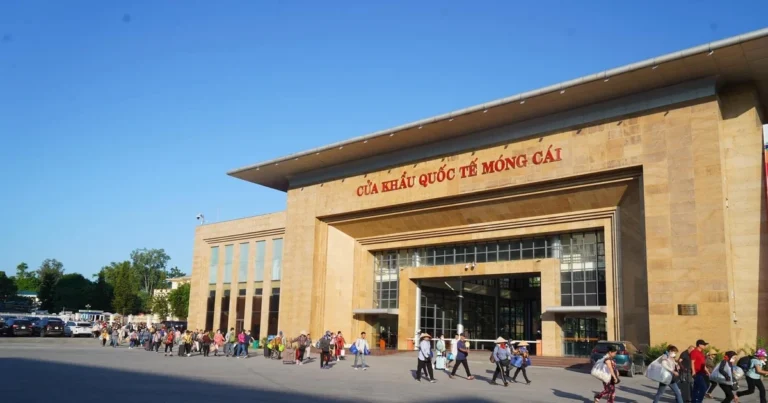
Positioned gracefully at the eastern end of Lin’an Avenue in Lin’an Town, Jianshui County, Honghe Prefecture, Chaoyang Tower serves as a natural starting point for exploring Yunnan’s past. From the Lao Cai – Hekou international border crossing, after clearing customs, travelers can easily take trains or long-distance buses through mountain gorges to Jianshui Railway Station. Right outside the station square, regular public buses such as Line 919 and Line 13 run directly to the ancient town gate. Once inside the old town, traffic is calm; strolling on foot over time-smoothed bluestone slabs or riding vintage yellow sightseeing trams lets you soak in quiet lanes at an easy pace.
The surrounding square stays open 24 hours a day as a lively open-air living room for locals—filled in the morning with songbirds and gentle exercise, and by night with warm community dances. However, ascending the tower to view its timber joinery and Ming-era bronze bell is open daily from 8:00 AM to 6:00 PM, with ticket sales and new admissions closing at 5:30 PM. Admission to climb the tower typically costs just 15 to 20 RMB per person—a modest preservation fee that lets visitors step onto upper timber galleries and take in Lin’an’s east–west axis.
For photography, timing light makes all the difference at Chaoyang Tower. Late afternoon from around 4:00 PM until sunset offers golden west-facing light that highlights the bold characters on the “Xiong Zhen Dong Nan” plaque. After dark, when architectural lights shine brightly, setting up a tripod along the central axis of the opposite square captures smooth light trails from passing traffic below—creating a cinematic contrast between modern motion and a six-hundred-year-old tower.
Around the square, a little local know-how helps you enjoy Jianshui’s specialties without commercial pitfalls. Street vendors near the gate sell souvenirs including glossy brown ceramics, but authentic Jianshui Zitao involves intricate clay-inlay carving and hand-pebble burnishing—so it is best to buy directly from established workshops on Zitao Street where pieces carry artisan seals rather than mass-molded imitations. For traditional grilled tofu, sit at low tables around charcoal grates where vendors count dried corn kernels or beans into a small bowl as you eat—typically around 0.5 to 1 RMB per piece—dipped in savory-spicy seasoning full of highland character.
Rounding out a stroll beneath Chaoyang Tower’s sun-warmed eaves, a well-paced itinerary blending historic fortifications with rich local food offers a deeply rewarding cultural trip; travelers interested in detailed routes and local traditions can explore our Honghe Prefecture tour package to experience the timeless spirit of southern Yunnan.