Barkhor Old Street is located at the historical heart of Lhasa in the Tibet Autonomous Region, with its urban layout and sacred space inextricably tied to the 7th-century reign of Tsenpo Songtsen Gampo. As the Tibetan Empire entered an era of territorial expansion and political consolidation, the monarch resolved to relocate the capital to the Kyichu Valley, designating it the administrative and spiritual center of the entire realm. The creation of Barkhor’s urban space originated with the construction of the Jokhang Temple atop an ancient marshland, following the counsel of his Chinese consort, Princess Wencheng, and his Nepalese consort, Princess Bhrikuti. According to Tibetan historical chronicles, the terrain had previously been interpreted through Himalayan geomancy as a supine demoness, and erecting the Jokhang Temple alongside surrounding monasteries served to anchor and pacify the geomantic energy of the land. Thousands of goats were used to haul earth from surrounding mountains to fill the marsh, establishing a solid foundation for the central sanctuary around which a closed circular pilgrimage path gradually emerged—the direct precursor to today’s Barkhor circuit.
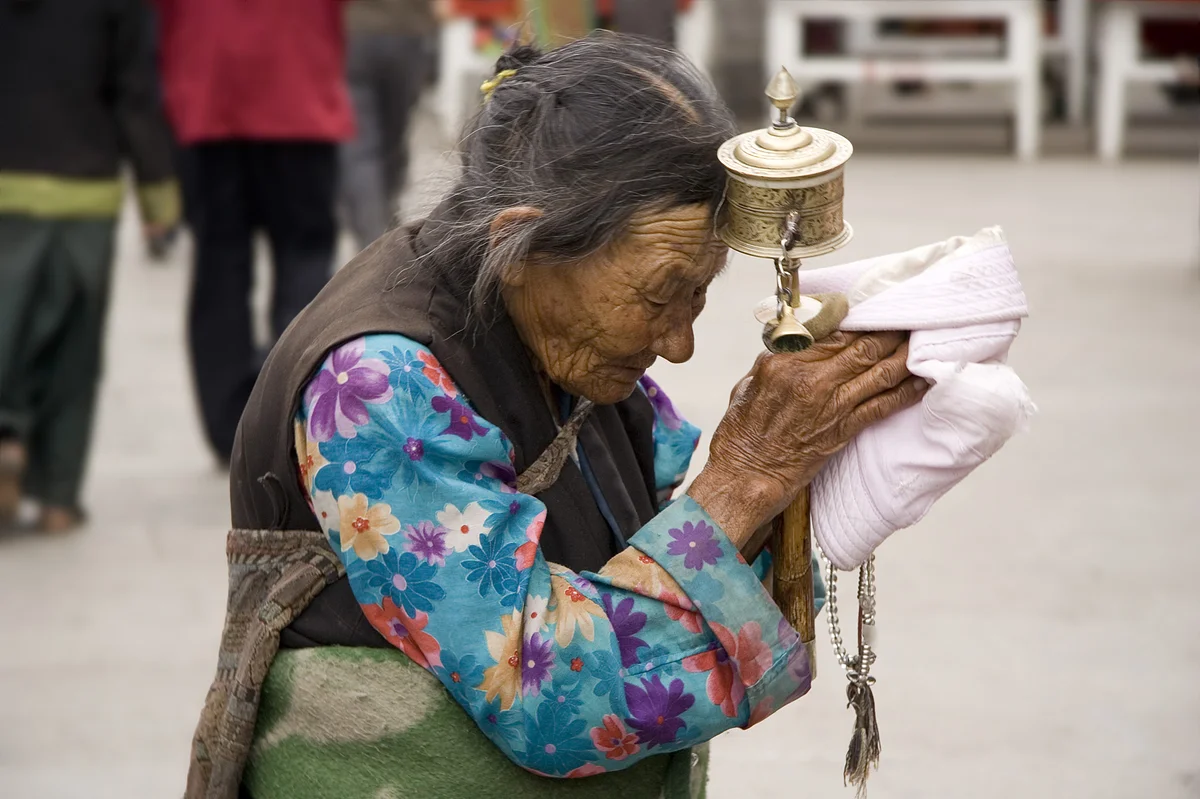
The historical evolution of Barkhor Old Street faithfully mirrors the shifting tides of political, religious, and social power in Tibet across centuries. Following the decline of Songtsen Gampo’s dynasty, Lhasa in general—and the precincts encircling the Jokhang Temple—experienced periods of decline and renewal under local feudal lords and successive Buddhist orders. By the 15th century, the rise of the Gelugpa school founded by Tsongkhapa ushered in a transformative era for Barkhor. The district was expanded and reinforced, emerging as the focal axis for major religious observances, most notably the Great Prayer Festival (Monlam Chenmo). Buildings lining the circuit were redeveloped to accommodate clergy, nobility, and merchants arriving from India, Nepal, Kashmir, and mainland China. This convergence of commerce and faith transformed Barkhor from a purely devotional pathway into a high-altitude mercantile hub where vital arteries of the western Silk Road intersected, trading signature goods such as brick tea, fine silks, precious medicinal herbs, and intricate metalwork.
Barkhor’s spatial structure is defined by a closed pilgrimage circuit encircling the Jokhang Temple, strictly adhering to the cosmological philosophy of Tibetan Buddhism. In human geography, this is the route along which thousands of devotees perform the kora ritual, walking clockwise around the sacred sanctuary while reciting the mani mantra or executing full-body prostrations. Residential architecture lining the street bears unmistakable indigenous hallmarks: thick stone walls, traditional Tibetan painted and gilded timber window frames, and subtle stylistic influences from Nepal and the Ming–Qing dynasties. These multi-story dwellings historically utilized ground floors for storage or livestock, while upper levels housed family living quarters and private household shrines. Over centuries—despite enduring armed conflicts, natural disasters, and urban redevelopment policies—Barkhor has preserved its ancient architectural morphology, standing as a living museum of plateau building techniques and decorative arts.
The cultural significance and symbolic role of Barkhor Old Street extend far beyond those of an ordinary historical landmark, embodying the spiritual core of Tibetan identity. For the local community, Barkhor is a sacred realm where the pulse of everyday life merges seamlessly with spiritual practice. Every paving stone and street corner breathes religious history, as generations of Tibetans affirm their devotion to the teachings of rebirth and karma through ceaseless kora circumambulation. Its symbolic stature also lies in sustaining the continuity of oral traditions, Vajrayana Buddhist rituals, and ancestral handicrafts such as bronze casting, woodcarving, and woolen carpet weaving. Simultaneously, the quarter serves as a historic crossroads among Asian peoples, testifying to centuries of trade and cultural synthesis on the roof of the world.
Amid modern urban development, Barkhor Old Street faces formidable challenges in balancing the preservation of tangible and intangible cultural heritage against the pressures of mass tourism. Heritage authorities have undertaken major restoration initiatives to safeguard the traditional architecture of historic buildings while upgrading underground infrastructure to serve vast numbers of pilgrims and international visitors each year. Nevertheless, rapid commercialization poses complex questions regarding how to preserve the district’s traditional demographics and inherent sanctity. Even so, fortified by more than a millennium of resilience, Barkhor remains the cultural epicenter of Lhasa, safeguarding the dramatic, intricate, and storied chapters of Tibetan civilization across golden ages and eras of upheaval alike.
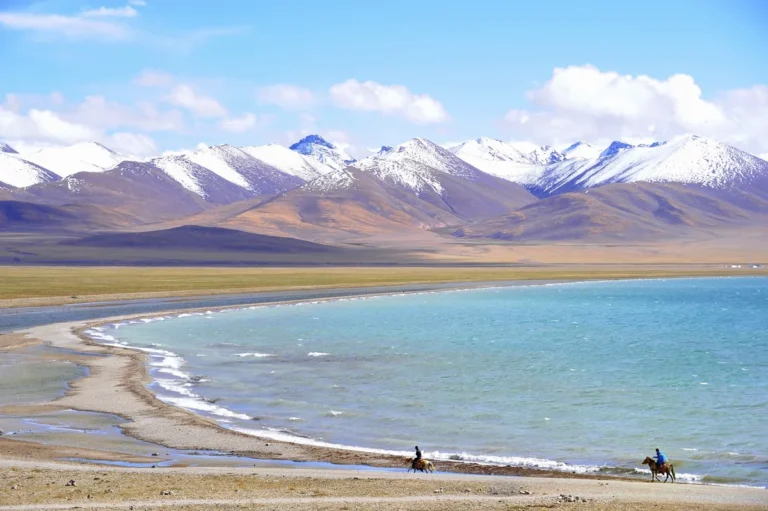
The Lhasa Valley, home to Barkhor Old Street, occupies a tectonic basin along the Lhasa River, a major tributary of the Yarlung Tsangpo system on the Tibetan Plateau. The terrain is powerfully shaped by regional fault lines, forming a broad valley ringed by towering peaks of the Trans-Himalaya range. Sitting at an average elevation of roughly 3,600 meters above sea level, the area experiences a demanding climate marked by wide diurnal temperature swings, intense solar radiation, and concentrated seasonal rainfall. The urban evolution of Barkhor Old Street is inseparable from these natural conditions, as wind patterns, solar angles, and shallow groundwater dictated how inhabitants organized the site starting in the 7th century CE. When King Songtsen Gampo, founder of the Tibetan Empire, chose to move his capital to Lhasa, he confronted a vast marshland known as Wothang, dominated by the saline Lake Tsanggu. Transforming this wetland into a seat of royal and spiritual authority required remarkably sophisticated land reclamation, stone embankments, and water-channeling engineering for the era, laying the earliest foundations for urban growth around the Jokhang Temple.
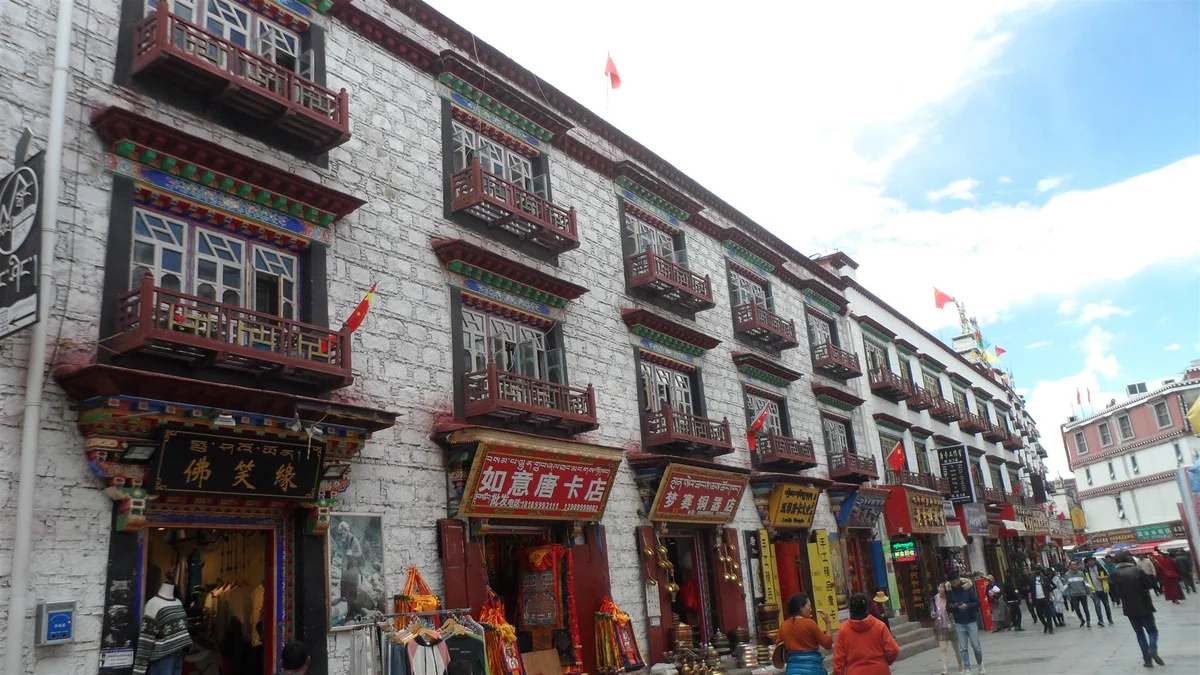
The master urban layout of Barkhor Old Street adheres faithfully to the Tantric Buddhist mandala principle, with the Jokhang Temple serving as the cosmological axis mundi. From this sacred center, urban space radiates outward in concentric rings corresponding to sacred pilgrimage circuits. The innermost ring traces the immediate perimeter of the Jokhang’s main sanctuary; next lies the intermediate circumambulation corridor known as the Nangkor inside the temple complex; and the largest, most vital outer circuit defining the entire historic quarter is the Barkhor. Far more than a mere thoroughfare, the Barkhor circuit acts as a spatial organizing spine governing the surrounding street grid. The old town’s plan is organic—evolving naturally yet disciplined by radial axes anchored in the clockwise flow of pilgrims. Interlacing alleyways twist through the neighborhood, yet consistently feed back into the closed loop around the Jokhang, forming a cohesive spatial network where boundaries between sacred monastic precincts and everyday secular life have dissolved over centuries.
Spatial division within residential and public buildings across Barkhor vividly reflects the traditional social hierarchy of Tibetan nobility, monastic orders, and local townspeople. Residential compounds—known as khangtsen or zhol—are typically built in compact rectangular blocks with thick stone walls battered inward to deflect biting winds and maximize daytime solar heat absorption. Interior floors are strictly stratified by civic function and domestic life. The ground floor customarily served as storage rooms, livestock pens, or utility spaces due to lower temperatures and ground dampness. The mezzanine and upper stories housed primary living quarters, reception halls, and family prayer rooms illuminated through signature trapezoidal windows that flare wider at the base and taper toward the top. This spatial configuration not only optimizes passive thermal performance in an alpine climate, but also generates a rhythmic, continuous streetscape that unifies the district visually while remaining rich in architectural detail.
The landscape enveloping Barkhor Old Street presents a striking yet harmonious contrast between historic human-built fabric and the majestic plateau wilderness. Viewed from the flat rooftops of traditional homes, the cityscape unfolds as a sea of whitewashed and ochre-trimmed earthen roofs crowned with fluttering prayer-flag poles. In the distance, snow-dusted Himalayan peaks provide a monumental geographical backdrop, framing sightlines and reminding inhabitants of human humility before untamed nature. The spatial transition from narrow, shaded alleys into the expansive plaza before the Jokhang Temple stands as a masterpiece of traditional urban design. This plaza acts as a grand transitional threshold where thousands of pilgrims perform full-body prostrations, generating a powerful social and spiritual energy that defines the entire historic core.
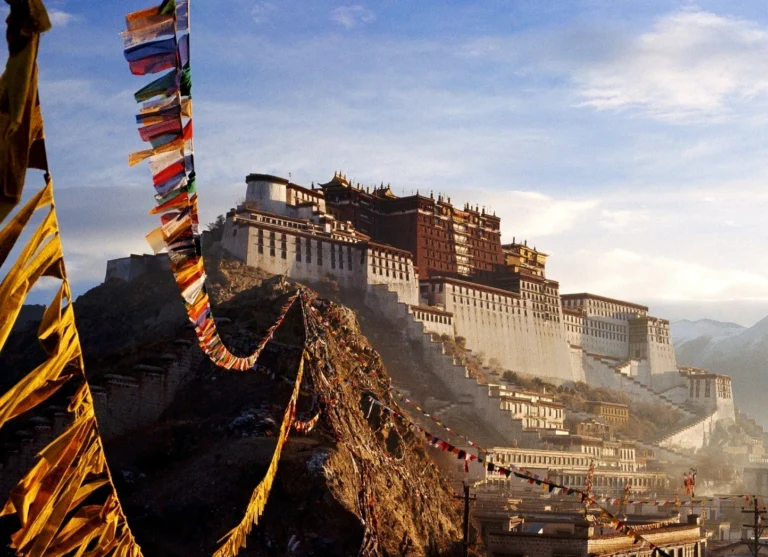
Building materials and surface finishes play a decisive role in crafting the distinctive visual identity of Barkhor Old Street. Local granite, highland pine, clay earth, rammed soil, and yak or sheep hair are skillfully integrated into load-bearing structures and enclosure walls. Stone facades are typically finished in crisp white limewash along the main body and crowned with deep red or black earthen friezes signifying the religious or secular status of each structure. Timber window frames are intricately carved with geometric patterns and Buddhist emblems, framed by black-and-white fabric valances symbolizing spiritual protection in indigenous belief. Strings of five-colored prayer flags stretched across rooftops and wires create ribbons of constant motion beneath the brilliant plateau sun, softening the rugged solidity of massive stone walls. This refined interplay of raw natural materials and sacred symbolism has sustained an enduring cultural landscape capable of withstanding both harsh weather and historical upheaval.
Barkhor’s historical trajectory also illustrates the adaptability of traditional urban planning amid rising population density and modern foot traffic. Although primary lanes retain their original pedestrian-and-pack-animal width, building interiors have undergone thoughtful renovations to support contemporary commerce and hospitality. Strict regulations governing building heights, facade materials, and architectural massing have successfully prevented jarring modern intrusions, preserving the medieval urban character largely intact. The seamless coexistence of traditional trades—such as bronze wares, handwoven woolen rugs, and incense—with living pilgrimage rituals keeps the quarter vibrant, transforming Barkhor into a living museum of Tibetan plateau architecture and urbanism.
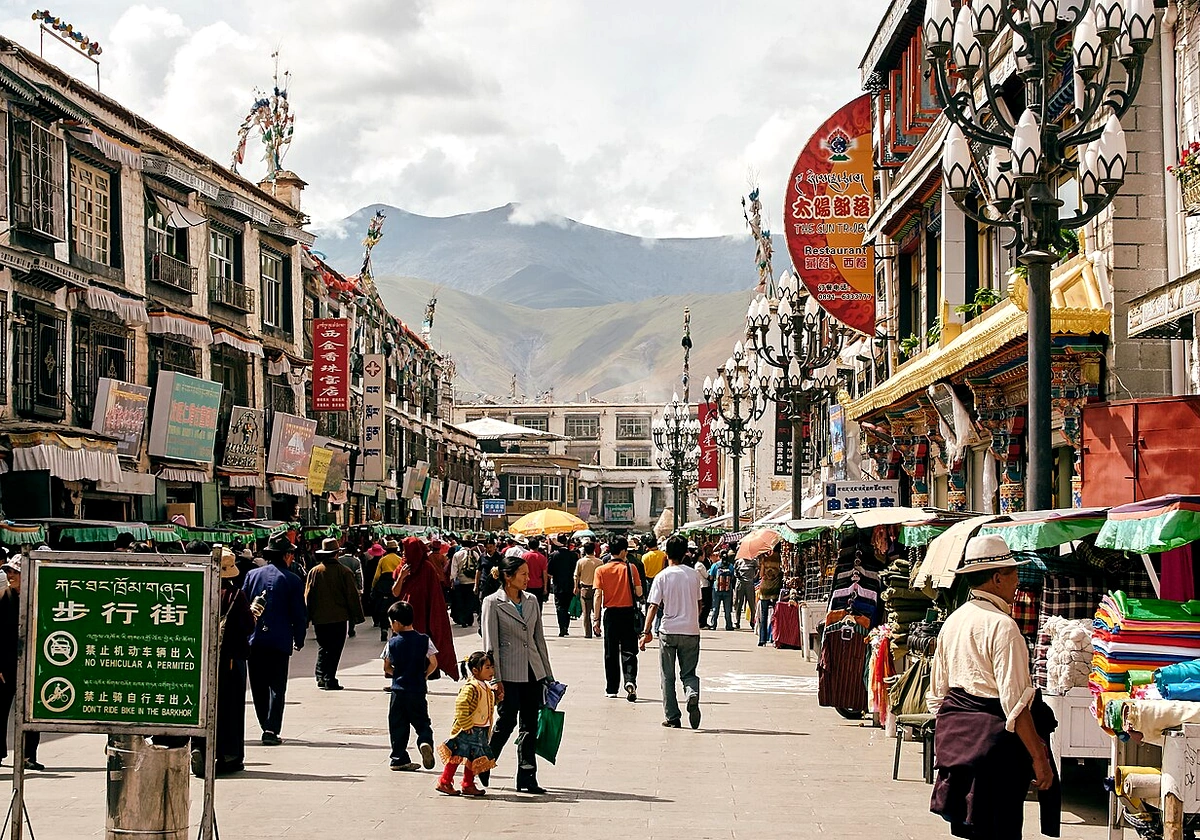
Barkhor Old Street in Lhasa, Tibet Autonomous Region, originated in the 7th century during the reign of Tsenpo Songtsen Gampo alongside the founding of the Jokhang Temple. Across more than a millennium, this urban fabric has maintained a concentric circular layout revolving around its sacred core, directly embodying Tibetan Buddhist cosmology. Rather than emerging from secular municipal planning, Barkhor evolved organically from an ancient pilgrimage pathway along which devotees circumambulated the Jokhang clockwise. This gradual spatial accretion produced an intricate tapestry of domestic and monastic architecture where every square meter is shaped by Tantric scriptures and highland settlement traditions.
Construction materials in Barkhor Old Street represent an ingenious adaptation to the demanding climate of the Qinghai–Tibet Plateau, characterized by extreme temperature fluctuations, intense solar radiation, and relatively sparse precipitation. Load-bearing walls of traditional houses are built from locally quarried slate paired with thick rammed earth—often reaching up to one meter thick at the base to maximize thermal insulation and seismic resilience. Local clay mixed with straw and mud is compacted in successive layers by hand or wooden tampers to create monolithic, sturdy walls. Another hallmark Tibetan technique involves coating exterior walls with naturally pigmented earth washes—most notably iron-oxide red ochre and lime white—visually distinguishing monastic edifices from secular residences.
Timber framing within Barkhor architecture showcases the sophisticated carpentry of traditional Tibetan master builders, who rely on intricate mortise-and-tenon joinery without a single metal nail. Interior structural skeletons utilize highland pine or cypress transported from southern valleys, prized for high flexural strength and natural resistance to pests. Exposed beam ends are meticulously beveled and adorned with geometric motifs or stylized depictions of clouds and rolling waves. Traditional flat roofs are constructed in multiple layers: wooden rafters overlaid with bamboo matting or willow branches, topped with a thick layer of clay mixed with crushed gravel known as arga. Workers then tamp the arga layer rhythmically with heavy stone pounders in unison, creating a seamlessly waterproof surface that doubles as a sunlit terrace for daily chores and hoisting prayer flags.
Woodcarving artistry in Barkhor centers prominently on window frames, doorways, and interior details imbued with profound religious symbolism. Tibetan windows characteristically flare wider at the bottom in a trapezoidal profile—an engineering solution that both maximizes natural light entering dim interiors and conveys visual stability. Above the window frames hang pleated black-and-white fabric valances embroidered with swastika or Dharma-wheel motifs, sheltered beneath small wooden lintel eaves carved with dragon heads or wrathful guardian deities. Master carvers use hand chisels to sculpt multi-layered reliefs depicting the Eight Auspicious Symbols—the treasure vase, golden fish, lotus flower, white conch shell, endless knot, victory banner, Dharma wheel, and royal parasol—each radiating protective and auspicious energy in Vajrayana tradition.
The aesthetic philosophy of Barkhor Old Street is deeply rooted in Buddhist concepts of sacred space and impermanence. Absolute bilateral symmetry is intentionally absent from the district’s overall plan; instead, the town grows organically in harmony with natural contours and sightlines converging on the Jokhang. Architectural color schemes follow strict canonical codes: white signifies purity and wisdom, deep red embodies power and compassion, and dark blue or black window borders invoke the fierce protection of guardian deities against malevolent forces. Juxtaposing raw stone and earth against vivid prayer banners and wall-hung thangka paintings generates a potent sensory atmosphere, continually reminding passersby of the interplay between the earthly realm and spiritual transcendence.
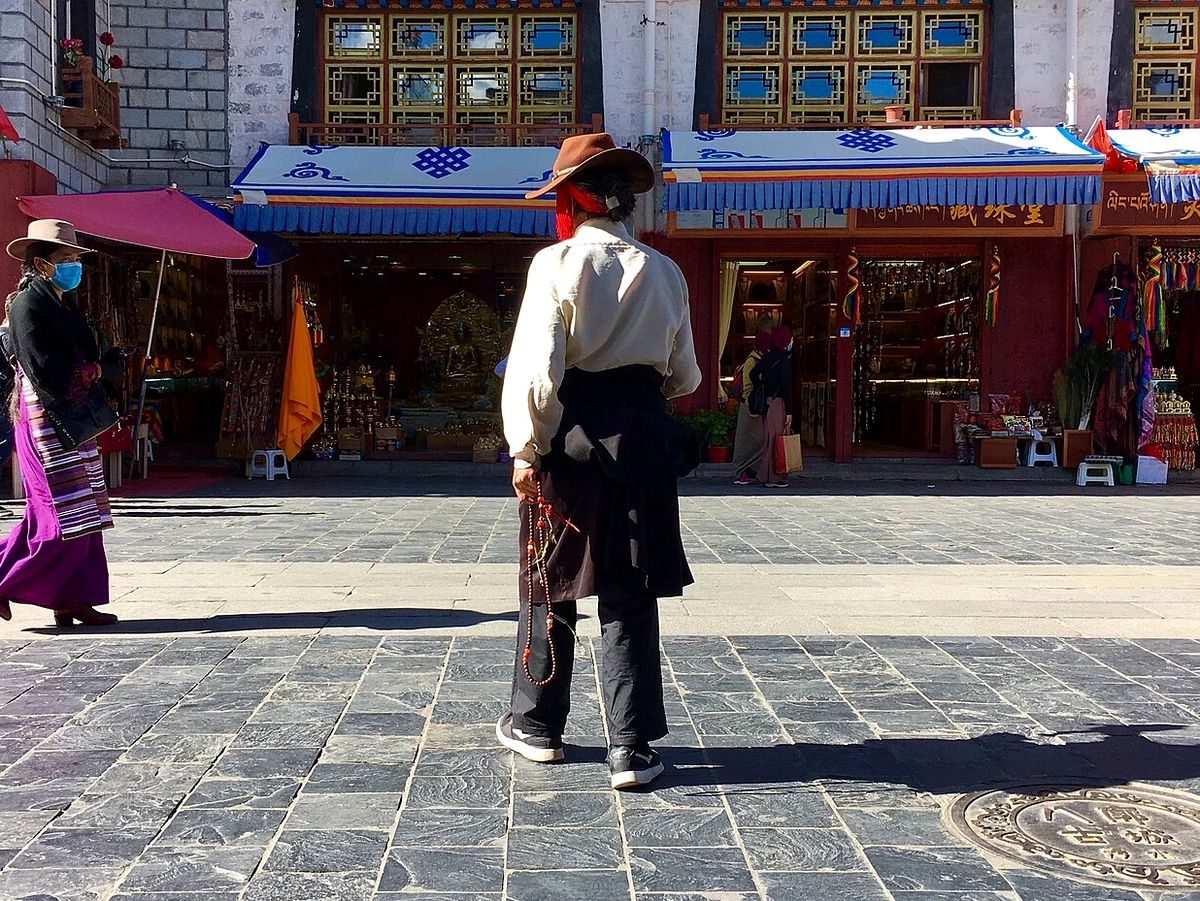
Layers of symbolic meaning in Barkhor are also expressed through exterior ritual ornaments and architectural customs woven into daily community life. Rooftop corners of prominent houses frequently feature ceramic incense burners smoldering with fragrant juniper branches, alongside protective ram-horn talismans and lungta prayer flags fluttering to dispel negative energy and summon cosmic good fortune. Viewed from above, the entire urban massing forms a three-dimensional mandala; as pilgrims walk the circuit around the old quarter, they symbolically enact an inward journey toward spiritual awakening. The preservation of these ancestral construction methods across centuries testifies to the enduring vitality of a highland civilization where architecture serves not merely as physical shelter, but as a visual scripture recording Tibetan philosophy, cosmology, and devotion.
Barkhor Old Street in Lhasa, Tibet Autonomous Region, forms an urban environment rich in historical, religious, and cultural heritage spanning more than a thousand years. Emerging around the Jokhang Temple in the 7th century under Tsenpo Songtsen Gampo, the area initially took shape as a devotional circumambulation path encircling the central sanctuary. Over time, the space bordering this outer circuit evolved into a multifaceted settlement where traditional Tibetan architecture intersected with trans-Himalayan commerce. Extending across hundreds of hectares, the district’s sub-zones are organized around Tantric Buddhist spiritual principles harmonized with everyday indigenous community life, offering a rich, multi-layered experience for urban anthropologists and travelers alike.
An on-site exploration of Barkhor Old Street naturally begins at its spiritual epicenter: the Jokhang Temple. The broad plaza fronting the monastery serves as the most vital gathering point of the entire quarter, where monks and pilgrims arriving from the farthest reaches of the plateau perform daily full-body prostrations. Far more than an ordinary civic square, this space is a living religious sanctuary reflecting the profound faith that has shaped Tibetan society for centuries. Surrounding Jokhang Square are historic buildings constructed of rough-hewn granite finished in signature white limewash with black-trimmed trapezoidal windows. From this focal point, pedestrian arteries radiate in concentric rings, strictly following the clockwise direction of the Tibetan Buddhist kora ritual that governs all human movement through the district.
The optimal route for experiencing Barkhor Old Street begins by joining the pilgrim flow along the outer Barkhor Street circuit, moving clockwise around the Jokhang Temple. Walking counterclockwise is considered a serious breach of local religious custom, making respect for this directional flow essential to engaging thoughtfully with local culture. Stretching roughly one kilometer, the circuit is paved with large flagstones worn smooth by the footsteps of millions of devotees over centuries. Lining both sides is a continuous succession of traditional mercantile stalls offering ritual essentials such as yak-butter votive lamps, hand-held prayer wheels, prayer malas crafted from bodhi seeds or bone, and aromatic highland herbal incense. This wealth of ritual wares offers an intimate window into artisanal crafts and traditional commerce thriving within a modern city.
Stepping off the main Barkhor Street circuit, a labyrinth of narrow alleyways leads into residential sub-quarters that serve as the living arteries of Lhasa’s indigenous Tibetan community. Bearing traditional names, these quiet lanes draw explorers deep into multi-story vernacular compounds centered around sun-drenched highland courtyards. Houses here characteristically feature inward-sloping walls engineered to withstand frequent seismic activity across the geologically complex Himalayan region. Wandering these residential pockets reveals intricate architectural details, including timber columns carved with Buddhist motifs and colorful pleated door curtains hung to ward off misfortune and invite blessings into the household. Life here moves at an unhurried pace, insulated from the bustle of commercial storefronts lining the main thoroughfares.
An essential highlight when exploring Barkhor Old Street is its collection of historic mansions once belonging to ancient Tibetan aristocratic families or influential reincarnate lamas who administered the region. Notable among them are historic noble estates and former residences of pre-20th-century feudal officials. Significantly grander in scale than ordinary dwellings, these compounds feature fortified perimeter walls, intricately carved gateways, and watchtowers echoing ancient defensive architecture. Examining these residences yields valuable insight into Lhasa’s historical social stratification, where secular governance and religious authority intertwined within the same urban fabric. Today, many of these mansions have been repurposed as private museums, traditional woolen carpet galleries, or atmospheric local teahouses inviting deeper cultural discovery.
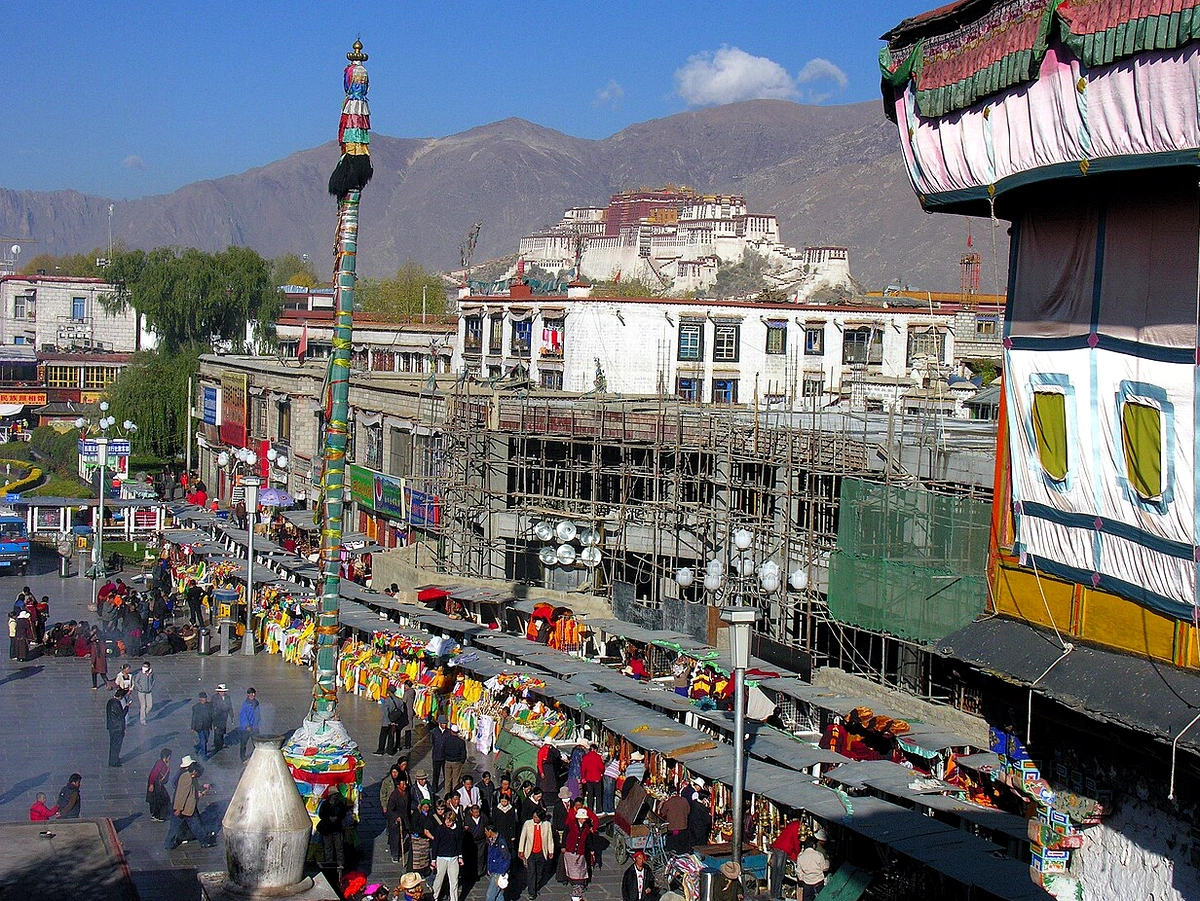
Alongside historic monuments and vernacular architecture, the traditional open-air market spanning the broad courtyards on Barkhor’s southwestern flank offers a striking glimpse into regional socioeconomic life. Here, nomadic traders from distant regions such as Kham and Amdo gather to sell quintessential products of the vast grasslands, including hand-knotted sheep’s-wool rugs and jewelry set with agate, amber, and genuine turquoise. Nomadic merchants dressed in thick sheepskin chubas trimmed with fur and elaborate braided hairstyles adorned with antique silver coins create an unforgettable anthropological tableau. Experiencing this market calls for keen observation and respect for time-honored trading customs, where bargaining traditionally unfolds through silent finger-grasps concealed inside wide coat sleeves—a discreet practice maintained for generations.
Completing an on-site exploration of Barkhor Old Street are the traditional teahouses tucked behind modest wooden doors down quiet alleys. A Tibetan teahouse is far more than a place to sip a warming beverage against the chill of an altitude exceeding 3,600 meters; it functions as the primary community gathering hall for local residents. Each morning, locals congregate to enjoy salty butter tea churned from brick tea and pure yak butter, exchanging news, discussing religious matters, or simply sharing everyday stories. Pausing inside a traditional teahouse allows travelers to immerse themselves in authentic Tibetan daily life, observing how patrons drink from prized wooden bowls or chased metal cups and gaining a deeper appreciation for the tight-knit communal spirit of plateau dwellers.
Taken together, the sub-zones and pathways of Barkhor Old Street in Lhasa form a cohesive urban cultural ecosystem where centuries of architectural history remain alive in every breath of contemporary life. Approaching this space from a cultural travel perspective rewards unhurried exploration through successive spatial layers—from the sacred central plaza to tranquil residential lanes and lively open-air markets. Every step along the time-worn flagstones of the pilgrimage circuit deepens one’s appreciation of the bond uniting humanity, nature, and faith on the roof of the world—transforming an ordinary sightseeing walk into an enduring dialogue between past and present.
The spatial ring encircling the Jokhang Temple in central Lhasa forms the Barkhor pilgrimage circuit—an ecosystem of services, amenities, and indigenous culture that has endured across centuries of geopolitical change on the Tibetan Plateau. Rather than functioning merely as a circular roadway, this urban microcosm weaves spiritual devotion, traditional commerce, and everyday Tibetan life into a seamless whole. Along flagstones polished smooth by millions of devotees, artisanal workshops, local eateries, and community spaces operate according to a distinctive social rhythm shaped by Vajrayana Buddhism. Understanding this service ecosystem requires appreciating the concentric spatial hierarchy radiating outward from the Jokhang sanctuary: the innermost Nangkor devotional corridor, the intermediate Barkhor commercial-pilgrimage ring, and the outer ring of historic residential neighborhoods.
Commercial activity along the Barkhor circuit directly reflects the needs of pilgrims arriving from far-flung regions such as Kham, Amdo, and Ü-Tsang. Local shopkeepers maintain specialized stalls offering sacred articles including prayer malas crafted from bodhi seeds, bone, or agate, woodblock-printed scriptures on traditional handmade paper, and finely chased copper holy-water ewers. Local artisans work directly outside small woodshops and silversmith studios along the lane, casting ritual bells, hammering seven-metal singing bowls, and fashioning ceremonial implements. The enduring authenticity of these cultural trades lies in their continued functional devotion rather than mere tourist novelty: buyers and sellers interact through both commerce and shared spiritual reverence, turning each modest shop into a social waypoint along the circular circumambulation around the central temple.
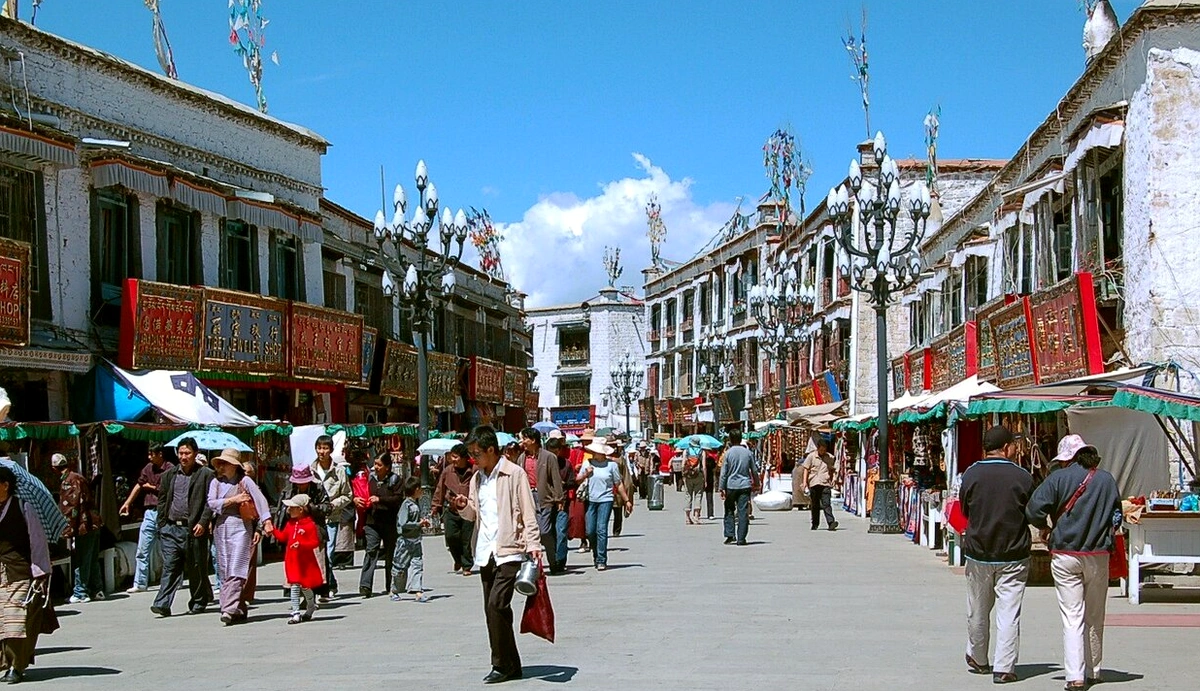
Local culinary specialties serving residents and pilgrims around Barkhor offer a vivid window into human ecological adaptation at elevations above 3,600 meters. Traditional butter-tea houses cluster thickly along alleys branching off the main street, serving as vital neighborhood social hubs. Inside, pots brewed from compressed dark brick tea churned with pure yak butter and a pinch of Himalayan pink salt are poured continuously into porcelain or turned-wood bowls. Accompanying butter tea is tsampa—roasted highland barley flour kneaded by hand directly in the bowl with tea and dried churpi cheese into an energy-dense staple ideally suited to the cold plateau climate. Stalls displaying air-dried yak meat suspended from iron hooks, barley pastries, and prized high-altitude medicinals such as cordyceps and saffron further define a food market deeply rooted in alpine ecology.
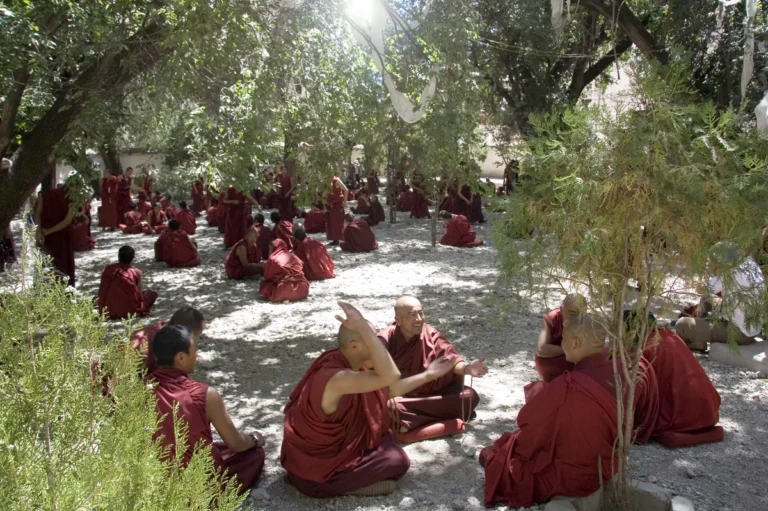
Community life around Barkhor unfolds according to a daily cadence governed by religious observance. From early dawn, as the first rays of sunlight strike the gilded roofs of the Jokhang Temple, hundreds of pilgrims begin performing full-body prostrations across worn flagstones, producing a steady, resonant cadence echoing down surrounding alleys. Public space here recognizes no rigid boundary between commerce and community gathering: shopfront steps double as resting benches where elders recite scriptures together, while open courtyards become play spaces for neighborhood children watched over collectively by the community. Crimson-robed monks mingling among townspeople dressed in traditional chuba robes create a rich social tapestry in which social distinctions dissolve within the shared sanctity of the kora circuit.
Everyday residential life inside the multi-story traditional houses around Barkhor reflects extended family structures and household economies anchored in urban heritage. Built from local stone, pine timber, and rammed earth—and accented by signature black-and-white bordered trapezoidal windows—these dwellings typically house shops or storage on the ground floor while reserving upper floors for multi-generational family living. Residents maintain a tightly knit neighborhood ethos reinforced through major religious festivals such as Losar (Tibetan New Year) and Monlam Chenmo, when neighbors come together to refresh whitewashed walls, hang new lungta prayer flags on rooftop poles, and keep communal lanes clean.
Modern hospitality and visitor amenities entering Barkhor’s buffer zone undergo careful adaptation to comply with historic preservation and urban landscape regulations. Boutique accommodations converted from former Tibetan noble mansions or traditional courtyard inns offer guests direct immersion in indigenous interior aesthetics, featuring hand-carved wooden furnishings, geometric handwoven woolen carpets, and solar-assisted heating paired with traditional stoves. Visitor services have increasingly professionalized while respecting local heritage—such as employing knowledgeable local guides deeply versed in the history of every street corner and mani stone wall. Harmonizing modern comfort with historical authenticity keeps Barkhor’s service ecosystem vibrant, ensuring it remains a living cultural heartbeat rather than a static museum.
Overall, the ecosystem of services, amenities, and indigenous cultural spaces around Barkhor Old Street is a complex social organism shaped by centuries of interaction among people, faith, and Lhasa’s demanding highland environment. Every modest shop, corner butter-tea house, and neighborhood custom testifies to the enduring resilience of Tibetan culture amid modern urbanization. Examining these layered spaces yields valuable anthropological insight into how a traditional community safeguards its identity through micro-commerce and daily spiritual practice—revealing Barkhor not merely as a sightseeing stop, but as a living sanctuary where past and present flow together on the roof of the world.
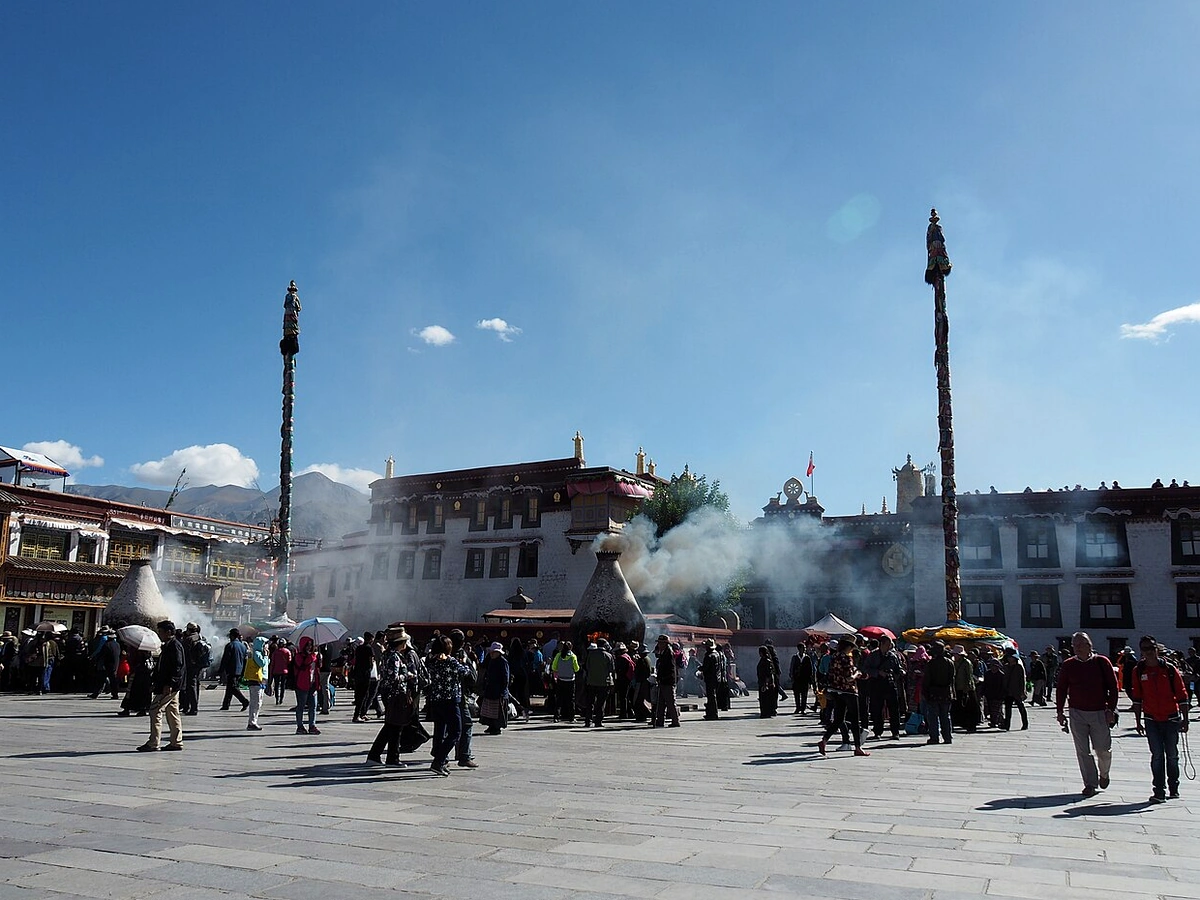
Planning an on-site visit to Barkhor Old Street in Lhasa requires thoughtful preparation encompassing physical acclimatization, cultural awareness, and a clear understanding of legal and religious protocols specific to the Tibet Autonomous Region. Situated at an average altitude exceeding 3,600 meters above sea level, this historic urban quarter encircles the sacred Jokhang Temple, sustaining a spiritual and cultural ecosystem over a millennium old. The prime window to visit and explore Barkhor runs from May through October, when temperatures are relatively mild, atmospheric oxygen levels are at their most stable, and major religious festivals take place frequently. However, travelers seeking to observe authentic local pilgrimage life with fewer crowds will find spring and late autumn—particularly April or November—far quieter and deeply rewarding.
Climatically, Lhasa experiences an arid continental plateau climate marked by dramatic temperature swings between day and night. Even during warm summer months, daytime highs around 20°C can plunge rapidly toward or below freezing once the sun sets. Dressing in adaptable layers is therefore essential: start with a moisture-wicking thermal base layer, add an insulating mid-layer such as lightweight down or wool fleece, and finish with a windproof, water-resistant outer shell to block brisk gusts funneling through narrow alleys. Because ultraviolet radiation in Lhasa ranks among the highest in the world due to high altitude and thin air, UV-protective sunglasses, a wide-brimmed hat, a neck gaiter, and high-SPF broad-spectrum sunscreen are indispensable for protecting eyes and skin outdoors.
The single greatest physical challenge facing visitors to Barkhor is altitude sickness, medically known as acute mountain sickness. Ascending from lowland elevations to nearly 4,000 meters requires a deliberate period of acclimatization. One of the most gradual and popular overland ways to reach Lhasa from inland China is the Qinghai–Tibet Railway, whose steady ascent allows the body to adjust progressively to lower atmospheric pressure. For travelers flying into Lhasa Gonggar International Airport, strict rest during the first 24 to 48 hours is vital: avoid strenuous exertion, skip overly hot showers, and maintain high fluid intake to counter the plateau’s extreme dryness.
Beyond physiological and weather considerations, Barkhor’s architectural and social spaces operate under strict traditional etiquette that every visitor should understand and respect. Regarding local transit, Barkhor’s historic core is completely closed to private motor vehicles, preserving a dedicated pedestrian network for pilgrims, local residents, and walkers. The main street forms a closed devotional ring around the Jokhang Temple, and a fundamental religious rule requires all pedestrians along this circuit to walk clockwise—moving in harmony with spinning prayer wheels and sacred chants echoing from surrounding shrines.
Legal and security regulations in the region also call for thorough administrative preparation. Under special tourism regulations governing the Tibet Autonomous Region, foreign nationals visiting Lhasa and Barkhor Old Street must travel through an authorized licensed tour operator to obtain a Tibet Travel Permit prior to departure, and must carry both their passport and permit at all times due to security checkpoints stationed at entrances to the historic quarter. When entering religious monuments, temples, or active devotional spaces, modest attire is mandatory—avoid shorts, sleeveless tops, or short skirts—and hats and sunglasses must be removed before stepping inside sacred halls.
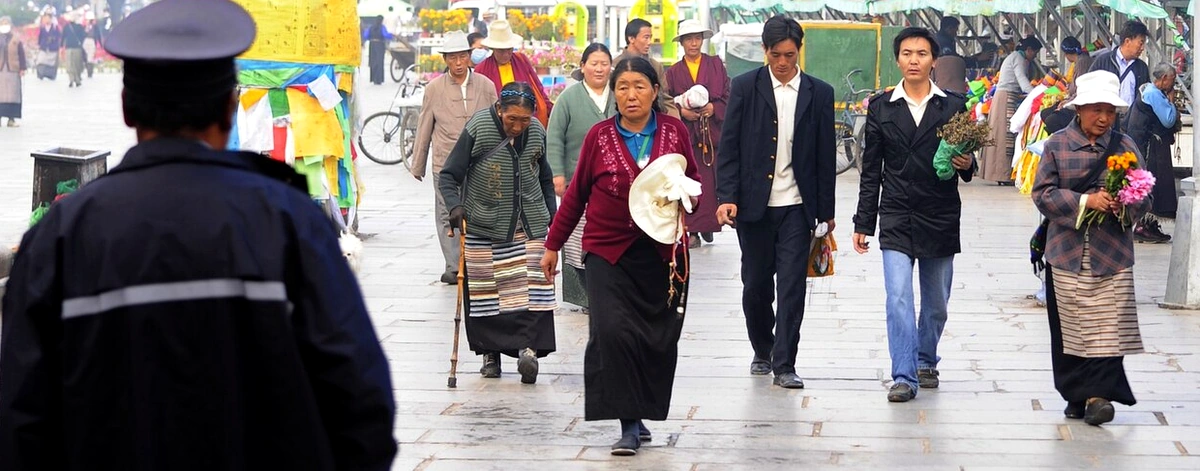
Photography and fieldwork etiquette in Barkhor Old Street also require clear cultural sensitivity. Before photographing local residents—especially monks or devotees performing full-body prostrations—always ask permission politely and respect any refusal. Photography is strictly prohibited inside the main sanctuary halls of the Jokhang Temple and neighboring monasteries unless explicit permission is granted by temple authorities. Touching sacred artifacts, Buddha statues, or ritual vessels—or stepping over pilgrims’ prostration mats—is considered deeply disrespectful in Tibetan Buddhist tradition. Preparing well therefore means not only packing for altitude and cold, but also cultivating genuine cultural mindfulness so that every moment in Barkhor Old Street unfolds smoothly, safely, and meaningfully.
To experience this journey to the fullest alongside a local guide, travelers can explore our 6D5N Tibet Lhasa – Shigatse tour featuring a thoughtfully curated itinerary.