Sera Monastery, located on the northern hillside of the Lhasa Valley, Tibet, represents one of the three greatest monasteries belonging to the Gelugpa sect, also known as the Yellow Hat school of Tibetan Buddhism. Commenced in 1419 under the patronage of Jamchen Chojey Shakya Yeshe, a close disciple of Tsongkhapa—the great religious reformer who laid the foundation for the Gelugpa order—this architectural complex not only reflects the prosperity of a monastic lineage but also marks a profound transitional stage in the political and religious power structure of the snow-covered plateau. The historical context of Sera Monastery’s formation is closely tied to efforts to consolidate a rigorous monastic academic system and expand the influence of the emerging sect amid the fragmentation of local feudal forces at that time. The name Sera, according to local folklore and historical texts, originates from the phenomenon of wild roses blooming all over the hillside when construction began, although linguistic researchers suggest this may be a transliteration from Sanskrit or a local term describing the steep topography of Mount Tatpu’s slope.
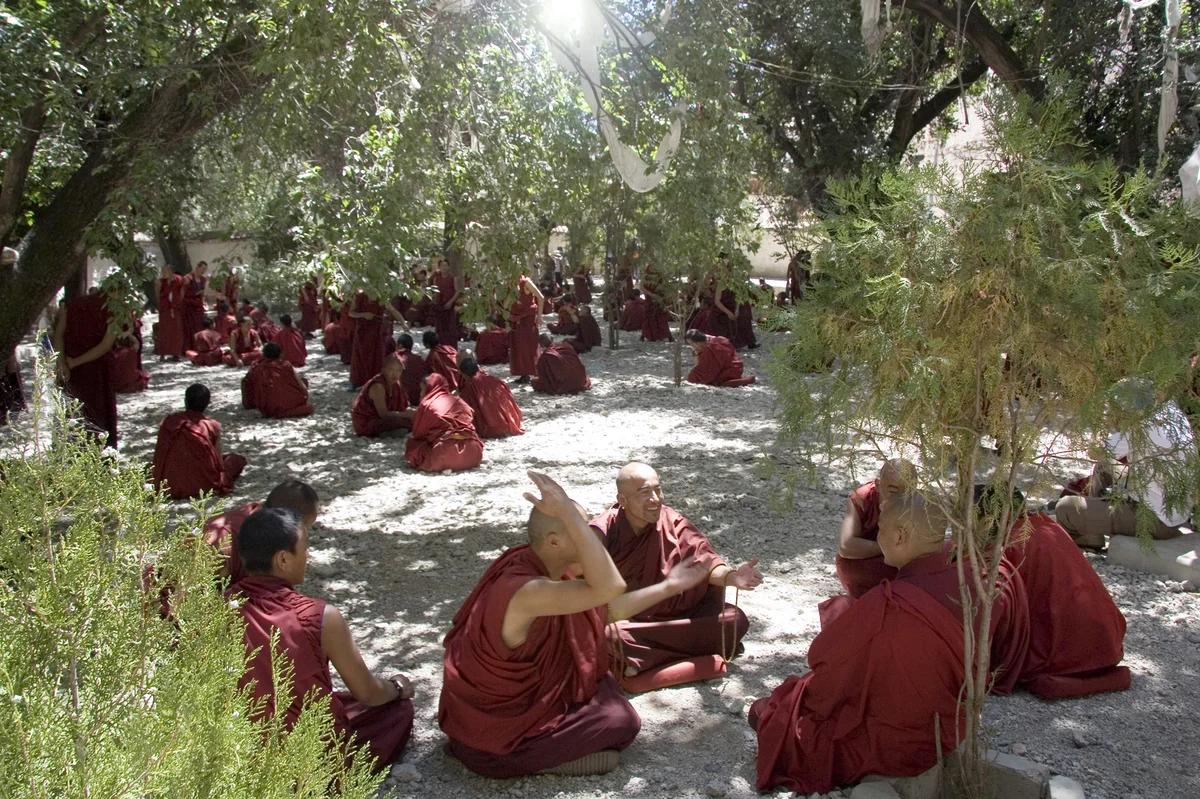
The historical progression of Sera Monastery underwent many centuries of ups and downs, tied to the political destiny of the entire Tibetan region. During its golden age before the twentieth century, this monastery operated as an autonomous city attracting thousands of monks from all regions of the Himalayan Buddhist world, including Mongolia and the borderlands of China. The education system at Sera was organized into major colleges such as Sera Je, Sera Ngagpa, and Sera Mey, each dedicated to the deep study of Mahayana sutras, emptiness philosophy, and Buddhist logic. The philosophical debate sessions held daily in the monastery’s gravel courtyards were not merely a method of imparting knowledge but also symbolized the spirit of rigorous dialectical debate, maintaining the vitality of Buddhist academic traditions across generations. Sera Monastery’s contribution to Buddhist knowledge was not limited to Tibet’s borders but spread widely throughout Inner Asia through complex religious and political relations among the Dalai Lamas, Panchen Lamas, and Chinese feudal dynasties such as the Ming and Qing.
From the perspective of symbolic power, Sera Monastery once held a pivotal role in stabilizing social order and shaping the cultural life of Lhasa’s residents. The monastery’s wealth accumulated over centuries through offerings from nobility, merchants, and devout believers turned this place into a living museum containing countless priceless religious artworks. Ancient frescoes depicting protective deities, Buddhas, and lineage masters, along with thousands of gold-gilt bronze statues, rare woodblock-printed scriptures, and jade ritual vase vessels, all bear witness to the supreme craftsmanship of traditional Tibetan artisans. However, Sera’s history also records tragic upheavals, especially during the mid-twentieth century when major political events completely altered the traditional social structure of the region, leading to a significant decline in active monks and heavy intervention from state administrative agencies into internal religious affairs.
Despite the harsh fluctuations of time and history, Sera Monastery has preserved its irreplaceable symbolic value in the consciousness of modern Tibetans. Traditional religious rituals, especially the Sera Qagqor festival or daily scriptural debate sessions, continue to be maintained, attracting special interest from anthropology researchers, religious historians, and international tourists. Preserving this architectural complex requires major efforts from cultural heritage management authorities to maintain the originality of the main assembly halls, monk dormitories, and sacred stupas against the pressure of time and crowds of pilgrims. The stature of Sera Monastery thus far transcends the framework of a purely religious monastic institution, becoming an enduring historical witness reflecting the complex intersection among metaphysical philosophical thought, feudal political power, and the vibrant vitality of Tibetan cultural identity over centuries.
Sera Monastery, located on the northern hillside of the Lhasa Valley in the Tibet Autonomous Region, represents one of the peaks of spatial planning and architectural art in Vajrayana Buddhism. Founded in the 15th century by Jamchen Chojey Sakya Yeshe, a close disciple of Tsongkhapa—the founder of the Gelugpa sect—this architectural assembly testifies to a design philosophy highly adaptable to the harsh terrain conditions of the plateau. Geographically, the monastery occupies a strategic position at an altitude of over 3,700 meters above sea level, sprawling across the granite slopes of the Tatipuk mountain range. Choosing this location not only adhered to traditional Tibetan feng shui principles of backing onto mountains while facing water to absorb spiritual energy but also met practical requirements for defense, spatial control, and access to water sources from high mountain streams cascading down into the Lhasa Valley.
The master planning layout of Sera Monastery fully reflects the strict religious and administrative hierarchical structure of the Yellow Hat order. The complex is not a uniform architectural mass but a composite ensemble comprising major assembly halls, specialized monastic colleges called Dratsang, residences for senior tulkus, and hundreds of monastic cells for monks. The entire area is arranged along a primary south-to-north axis, hugging the natural slope of the hillside. The elevation differences among architectural levels create a gigantic terraced courtyard system where buildings in the rear always stand higher than those in front, ensuring that views from main structures remain unobstructed and sunlight can maximally illuminate central courtyards—an important factor in cold plateau architecture.
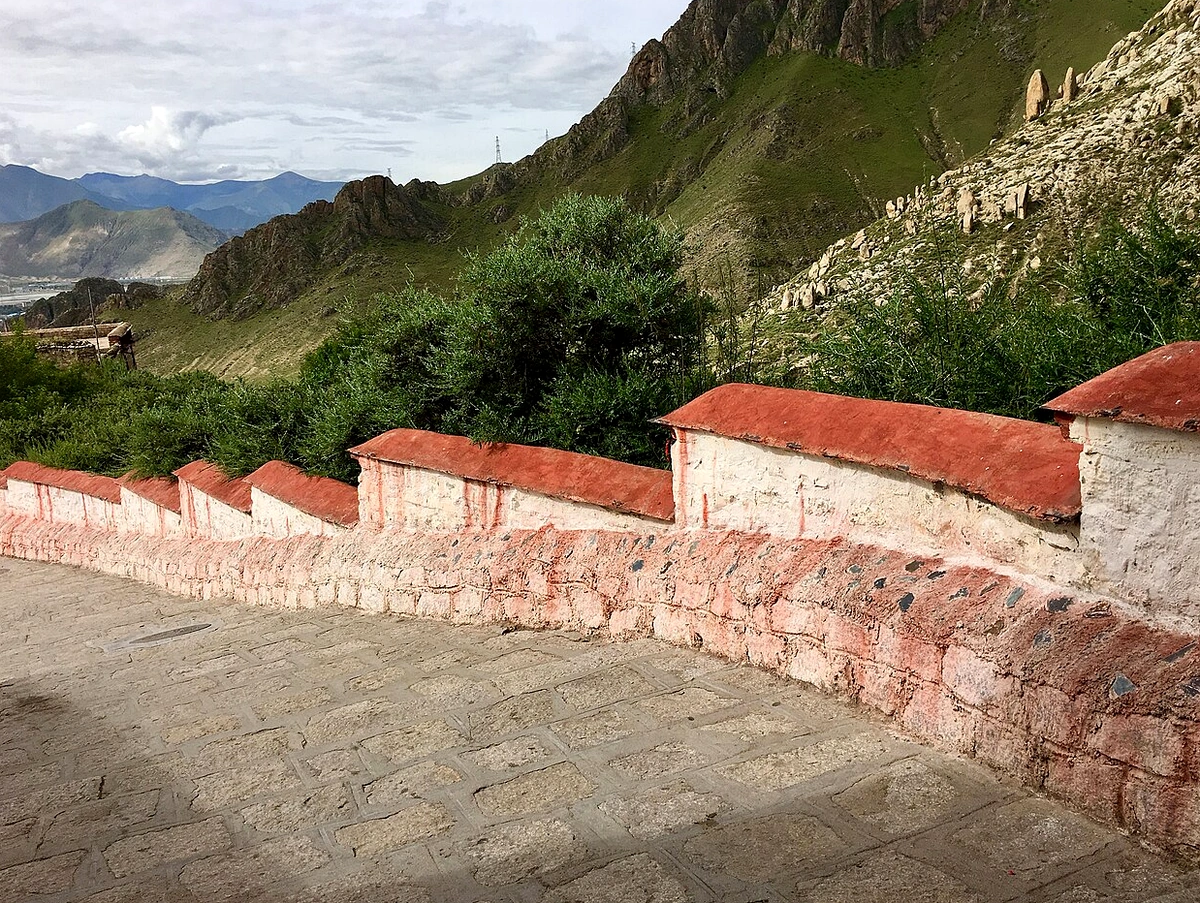
The spatial division solutions inside the monastic complex are clearly defined through the presence of three major Dratsangs, including Sera Je, Sera Mey, and Ngagpa Dratsang. Each Dratsang operates as an autonomous unit with separate living, study, and ritual areas, revolving around a central debate courtyard and a chanting hall called Tsokchen. These spaces are interconnected through a network of narrow alleys, steep stone staircases, and thick rammed earth walls painted in the characteristic white and red of Tibetan architecture. This spatial division not only solves circulation logistics for thousands of monks within a confined area but also creates clear boundaries between public spaces for pilgrims and sacred, private spaces for deep spiritual practice among senior practitioners.
Regarding materials and construction techniques, Sera’s architecture demonstrates deep understanding of local physical conditions. Main load-bearing walls are built using local stone combined with thick rammed earth, possessing high thermal insulation properties that help maintain warm indoor temperatures during harsh winters and cool spaces during summers. The foundations of buildings are anchored directly into natural rock slabs of the Tatipuk hillside, creating solid bonding against subsidence or earthquakes that might occur along the Himalayan tectonic belt. Interior wooden structures such as pillars, horizontal beams, and bracket systems are all meticulously carved, using pine and fir timber imported from southern forest regions, then coated with natural lacquer and gold leaf to resist humidity and erosion over time.
The landscape system surrounding Sera Monastery plays an essential role in shaping the overall spatial experience. Unlike plain monasteries enclosed by expansive artificial gardens, Sera’s landscape is intertwined with the majesty and pristine nature of the plateau. Behind the monastery are sheer cliff faces where meditation and solitary retreat took place in natural caves centuries ago. In front of the monastery opens the vast expanse of the Lhasa Valley, where melting glacial rivers create groundwater streams nourishing narrow agricultural strips cultivated by monks for self-sufficiency. The contrast between heavy, solid man-made architecture and the immensity, tranquility of surrounding nature creates a powerful impression of human insignificance before the universe, while reinforcing the monastery’s ultimate purpose as a place detached from the mundane world toward enlightenment.
Open spaces inside the monastery, especially debate courtyards, are planned with strict architectural proportions. Sera Monastery’s debate courtyard lies open-air under the shade of ancient willow trees, surrounded by covered corridors so monks can observe and participate in doctrinal combat under all weather conditions. The courtyard surface is paved with large flat stone slabs, providing stability for hundreds of monks standing or moving flexibly during traditional debate gestures. Arranging these courtyards at different elevations allows the sound of debates to echo across cliff faces, creating a distinct auditory atmosphere found only in major Tibetan monasteries, where philosophy is not merely studied through texts but resounds through clapping and forceful dialectical articulation.
Natural lighting and ventilation systems in Sera’s assembly halls also testify to the intelligent spatial planning mindset of ancient architects. Since exterior stone walls must be over a meter thick for load-bearing and thermal retention, windows are typically designed in an inverted trapezoid shape, narrow on the outside and flaring widely inward. This design maximizes sunlight entering dark interiors while minimizing heat loss outward. Skylights and high roofs allow smoke from hundreds of yak butter lamps to escape effectively, keeping worship spaces airy even as incense and butter fat burn continuously during religious rituals lasting day and night.
Viewed on the plane of world architectural history, Sera Monastery is not merely a pure religious relic but also a miniature urban planning engineering feat at extreme altitude. The perfect combination of rugged terrain, sustainable native building materials, coherent functional tiered layouts, and magnificent natural landscapes has created an architectural entity with timeless vitality. Every building, every step path, and every courtyard at Sera carries deep symbolic values concerning the Buddhist cosmology, reflecting efforts to conquer and harmonize with nature by generations of Tibetan monks and artisans over the past six centuries.
Sera Monastery, one of the great monasteries of the Gelugpa school belonging to Tibetan Buddhism, located on the southern slope of Mount Tatphuk about five kilometers north of central Lhasa, was founded in 1419 by Jamchen Chojey Shakya Yeshe, an outstanding disciple of Tsongkhapa. This architectural complex spreads across a large area, reflecting a self-sufficient monastic urban community with main shrines, Buddhist philosophy schools, monk residences, and roadway systems deeply imprinted with high-land monastic architecture. Creating Sera Monastery required profound understanding of the steep hillside terrain, leading ancient architects to apply terraced leveling methods, maximally utilize natural sunlight, and protect structures from harsh winds blowing from the Lhasa Valley. The overall structure strictly adheres to Buddhist cosmological principles, where each building is not simply a dwelling or religious activity venue, but also a material symbol of a mandala, recreating the structure of the universe according to canonical concepts.
Construction materials for Sera Monastery were extracted mainly from the very earth and surrounding mountains, creating absolute harmony between artificial structures and the natural landscape of the Himalayas. Local granite was roughly hewn but bound using dry-stacking techniques combined with mud mortar and straw, producing thick walls with a slight inward inclination. This inclined wall structure characteristic not only possesses aesthetic value but is also a sturdy engineering solution to combat frequent earthquake hazards in this complex geological tectonic region. Walls one to two meters thick at the base provide exceptionally thermal insulation, keeping interiors warm during freezing winters and cool during dry summers. Alongside stone, pine and fir timber imported from southern forests of Tibet or border regions was used for load-bearing pillars, purlins, and ceilings. Traditional wooden joinery techniques without metal nails were thoroughly applied by master carpenters, allowing structures high elasticity against powerful geological tremors.
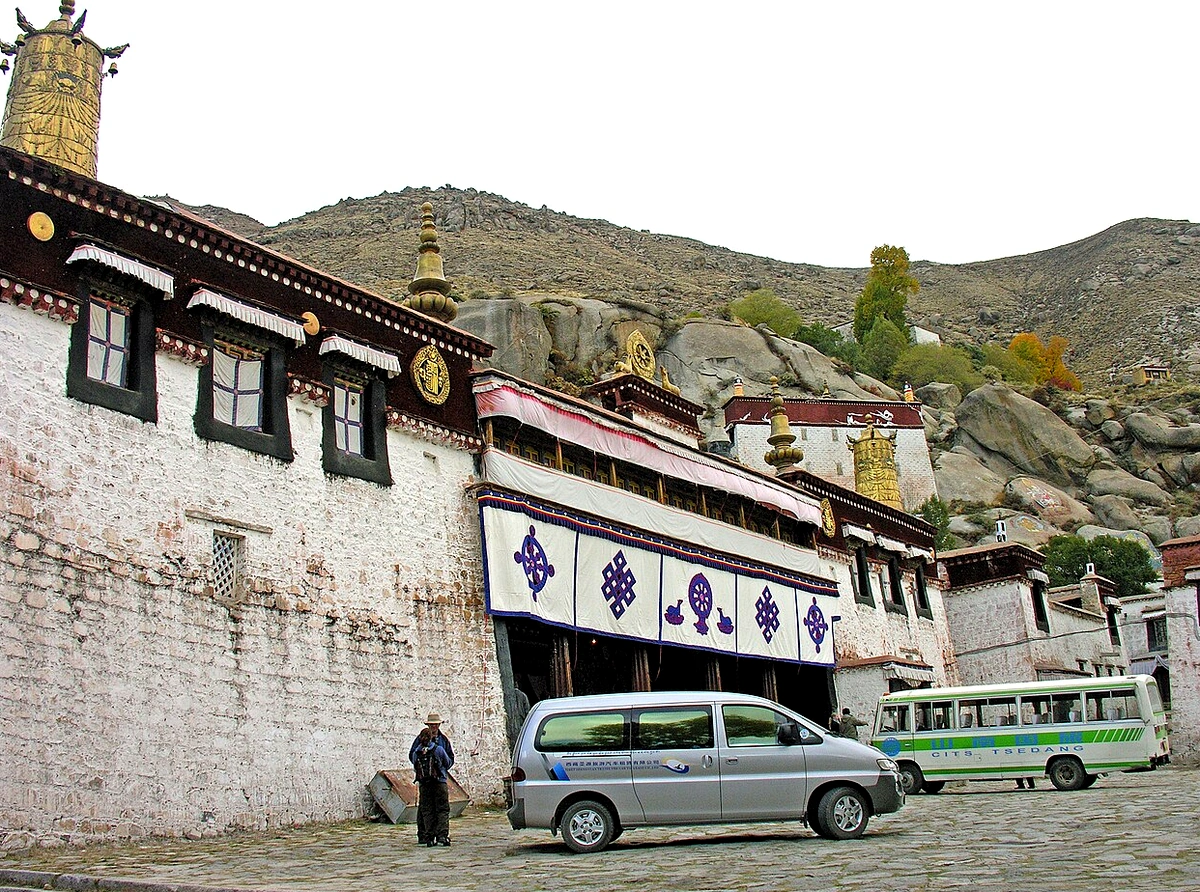
Exterior surfaces of main shrine buildings at Sera stand out with white lime coats whitewashed annually by the monastic and lay community, creating strong contrasts with window frames and eaves painted jet-black and dark brown. Window frames are designed in inverted trapezoids, narrow at the top and widening downward, an ancient military and monastic architectural feature of Tibet optimized to let light into dim interiors while minimizing gale-force wind pressure hitting glass panes or curtains. Upper eaves of large halls are decorated with dried willow or hibiscus branch strips, dyed dark red or black, tightly pressed and wrapped with embossed copper strips depicting dharma wheels, screws, and auspicious symbols. This detail has not only decorative value but is also an engineering heritage from pre-Buddhist times, when tightly bound branch layers reduced loads pressing onto rammed earth walls below and prevented rainwater seepage into flat roof structures.
Entering interior spaces of shrines like Tsokchen or major tratsangs, woodcarving and surface decoration arts reach peak sophistication in Tibetan culture. Large load-bearing wooden pillars sit on meticulously hand-carved lotus stone bases, supporting column capitals shaped like blooming lotus flowers or snow lions bearing ceiling weights. Along horizontal and vertical beams, artisans embossed stylized vine motifs, legendary Buddhist mythological creatures like Makara, Naga, and Garuda, interspersed with Sanskrit mantras written in ancient Lantsa scripts. Wooden surfaces are coated with multiple layers of natural oil paint mixed with real gold powder and crushed mineral stones like cinnabar, malachite, and azurite, creating subdued palettes glowing with metallic radiance under dim lights of hundreds of yak butter lamps.
Sculpting arts for Buddha statues and senior masters at Sera strictly follow canonical proportions regulated in religious art technical treatises. Large gilded bronze statues, typically Shakyamuni or Gelugpa lineage patriarchs, were cast using traditional lost-wax methods, then covered in thin gold leaves and embellished with gemstones like jade, agate, and red coral on foreheads and chests. The demeanor of these statues exudes absolute tranquility, with half-closed eyes gazing downward introspectively, symbolizing deep meditative states and universal compassion. Surrounding shrines, fresco systems lining rammed earth walls recount the Buddha’s life, lineage transmission histories, and realms of samsara. Fresco painting techniques here use natural mineral colors mixed with animal hide glue, preserving color durability across centuries despite plateau humidity and temperature extremes.
Sera Monastery’s aesthetic philosophy is tied to the concept of impermanence and mental transformation through material art. Architectural spaces were not designed to overwhelm through worldly ostentation, but to guide pilgrims’ minds from chaotic mundane worlds outside into inner stillness when progressing inward through courtyards, dark corridors, and finally confronting light emanating from main altars. The combination of heavy stone, warm wood, cold metal, and vibrant colors symbolizes the harmony of five cosmic elements according to Tibetan Buddhist philosophy, including earth, water, fire, wind, and space. Every architectural detail, from stone steps worn smooth by millions of monks over six centuries to thin silken strips fluttering on window frames, carries deep symbolic meaning concerning enlightenment journeys and the eternity of Dharma thought amidst cold stone plateaus.
Sera Monastery, located at the foot of Mount Tatipu in Lhasa’s northern outskirts, represents one of the greatest Tibetan Buddhist architectural complexes belonging to the Gelugpa school, also known as the Yellow Hat order. Commenced in the 15th century under the patronage of Sakya Yeshe, a close disciple of Tsongkhapa, this monastery was once a large-scale monastic academy with thousands of monks congregating from across Himalayan highlands. Sera’s overall structure was planned along a miniature cosmic mandala model, where each sub-zone carries distinct religious, philosophical, and communal functions. The immersive exploration journey here requires visitors to deeply understand this spatial order not to miss core values of world cultural heritage. The monastic complex spreads across a gentle slope, facing south to capture maximum sunlight, a crucial condition for architecture at altitudes over 3,600 meters above sea level.
The approach route to the monastery begins at the southeast main gate, where visitors step through white walls enclosing the entire complex featuring characteristic architecture of snow-white plateau regions. Immediately upon passing the gate, spaces open with a large cobblestone courtyard leading straight to central assembly halls. The most important building in this area is Tsokchen, or the Great Assembly Hall, where entire monastic communities congregate during major religious rituals. Inside Tsokchen, giant wooden pillars carved elaborately and lacquered in red and gold support high ceilings hanging with hundreds of ancient thangka silk applique paintings reflecting Gelugpa lineage transmission histories. Surrounding walls are covered with frescoes detailing bodhisattvas, protective deities, and senior masters in natural mineral hues preserving solemnity across centuries. Moving through dim corridors smelling of burning yak butter from traditional oil lamps creates unique emotional dimensions for observers before venturing deeper into specialized academic areas.
Venture deeper north of the Great Assembly Hall lies a system of three major specialized monastic colleges, including Sera Me, Sera Je, and Ngagpa Tratsang, each undertaking independent Buddhist philosophical education programs. Sera Je is the largest college, once attracting numerous student monks from Mongolia and neighboring Buddhist lands to study Esoteric and Exoteric teachings. Architecture of these colleges is designed with large rectangular courtyards surrounded by multi-story buildings for teaching and monk lodging. The unmissable highlight here is the Sera debate courtyard, located in the northwestern part of the complex, hosting world-famous Buddhist philosophical debate rituals every weekday afternoon. The debate courtyard is an outdoor space with flat gravel flooring shaded by tall trees, forming an open yet rigorous academic forum where monks practice questioning and refuting to clarify deepest Buddhist texts.
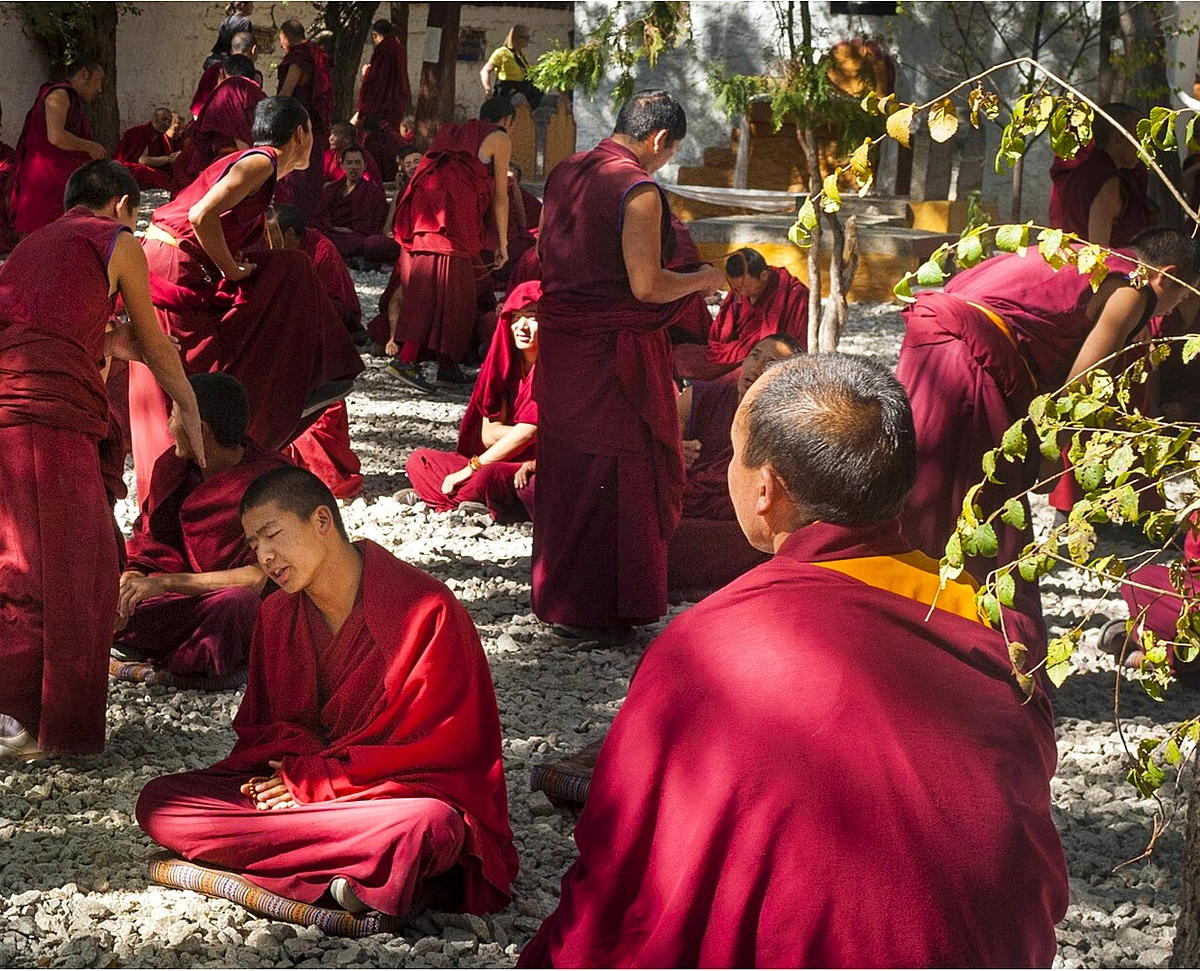
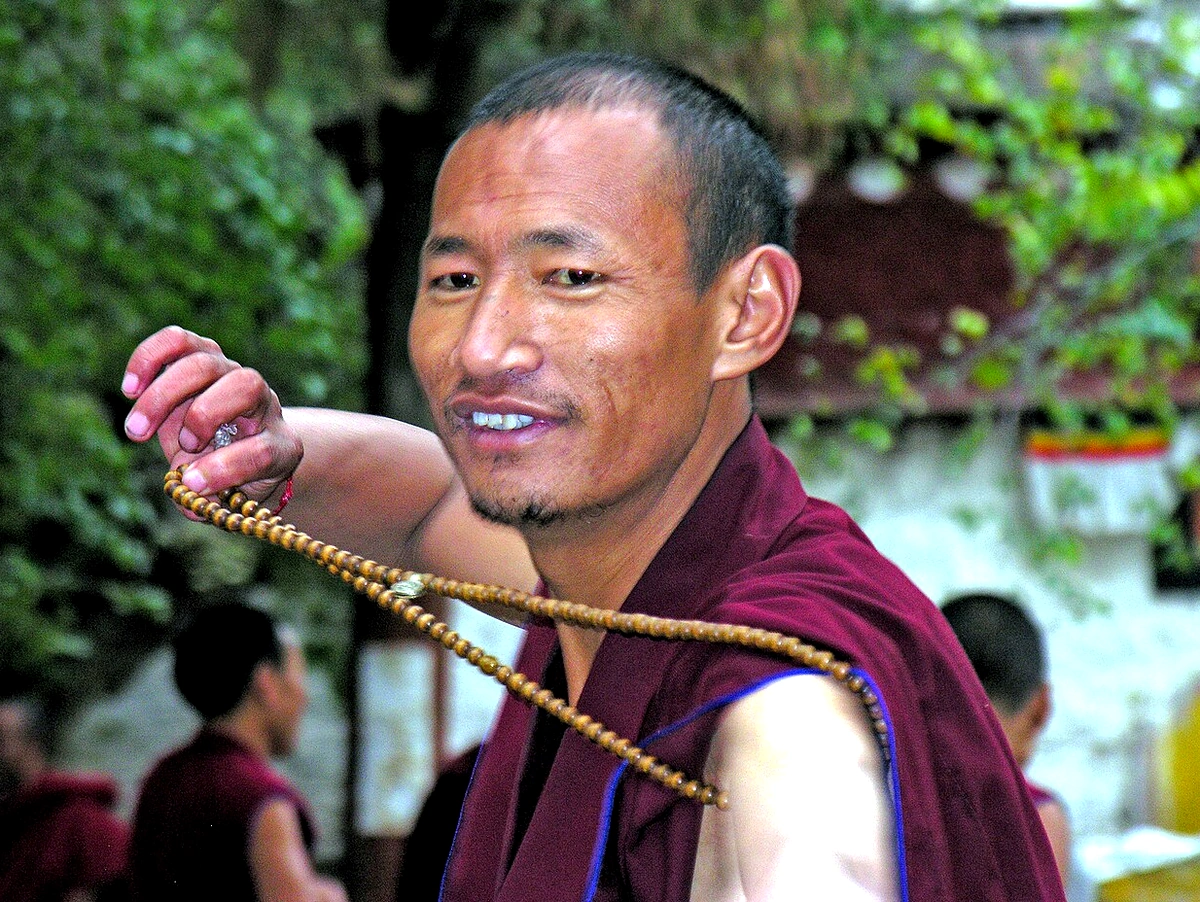
Experiences at the debate courtyard require delicate observation and absolute respect for traditional monastic codes of conduct. Visitors and researchers typically stand around the perimeter to observe expressive body language among monks. A monk standing with powerful arm gestures and striking claps emphasizes arguments against opponents sitting cross-legged on the ground. Clapping actions symbolize awakening wisdom, dispelling ignorance, and affirming sharp logical reasoning based on Madhyamaka or Prajnaparamita foundations. Visitors can fully feel tense yet spiritually energetic philosophical atmospheres blanketing the courtyard throughout afternoon debate sessions from mid-afternoon until sunset behind western Lhasa ridges.
Leaving the debate courtyard, the journey continues upward toward steeper slopes behind the monastery, housing retreat cells and auxiliary shrines linked to founding legends. This area includes hermitages like Sera Choding, where Tsongkhapa stayed to author his most important treatises on Vajrayana thought. Trails leading up these high hermitages follow steep cliffs past countless Mani stone slabs carved with Om Mani Padme Hum mantras in ancient Tibetan script and hand-drawn rock paintings bearing highland folk religious imprints. Trekking these routes requires good physical stamina and careful altitude adaptation preparation; in return, sweeping vistas encompass the vast Lhasa Valley with the Kyi Chu river meandering like a silver ribbon through barley fields and traditional villages.
The final stop in immersive experiences at Sera is the treasure shrine area scattered around main complex corners, preserving thousands of gilded bronze statues, ancient ritual instruments, and palm-leaf Buddhist scriptures. These artworks possess high aesthetic value from Tibetan painting and sculpture schools while serving as priceless historical documents for religious researchers. Concluding the tour, circumambulating the monastery clockwise with locals along kora paths outside fortress walls yields comprehensive views of spiritual life tightly binding humans to sacred spaces, wrapping up profound academic explorations into one of Himalayan Buddhism’s greatest philosophical centers.
Sera Monastery’s spiritual architectural complex, situated on the northern hillside of Lhasa at altitudes over 3,000 meters above sea level, not only defines a premier Tibetan Buddhist research center but also establishes a specialized local service, economic, and cultural ecosystem. Surrounding lands long ago transformed into symbiotic living spaces where daily monastic routines harmonize directly with local residents’ and pilgrims’ rhythms. Across centuries, this spatial structure developed layers of services supporting religious life, from offering ritual items and herbal teas to traditional guesthouses for travelers from distant grasslands coming to Lhasa for pilgrimage. These services do not follow modern commercialization standards but operate on traditional economic principles tied to monastic life, where every product and service bears distinct indigenous Tibetan religious and cultural imprints.
Local cultural spaces around Sera Monastery are defined through traditional markets and worn pilgrim pathways. Along willow-shaded paths leading to the main entrance, local vendors sell numerous handicraft items carrying high religious symbolism. Observers easily spot artisans crafting mani prayer wheels, coppersmiths hammering ritual bells, and shops providing herbal incense formulated according to traditional Tibetan Buddhist lineages. These items meet practical monastic needs while acting as cultural bridges between secular worlds and sacred domains. Commercial activities here proceed slowly, imbued with dialogue and mutual respect, reflecting Buddhist humanistic philosophies embedded in local retail transactions.
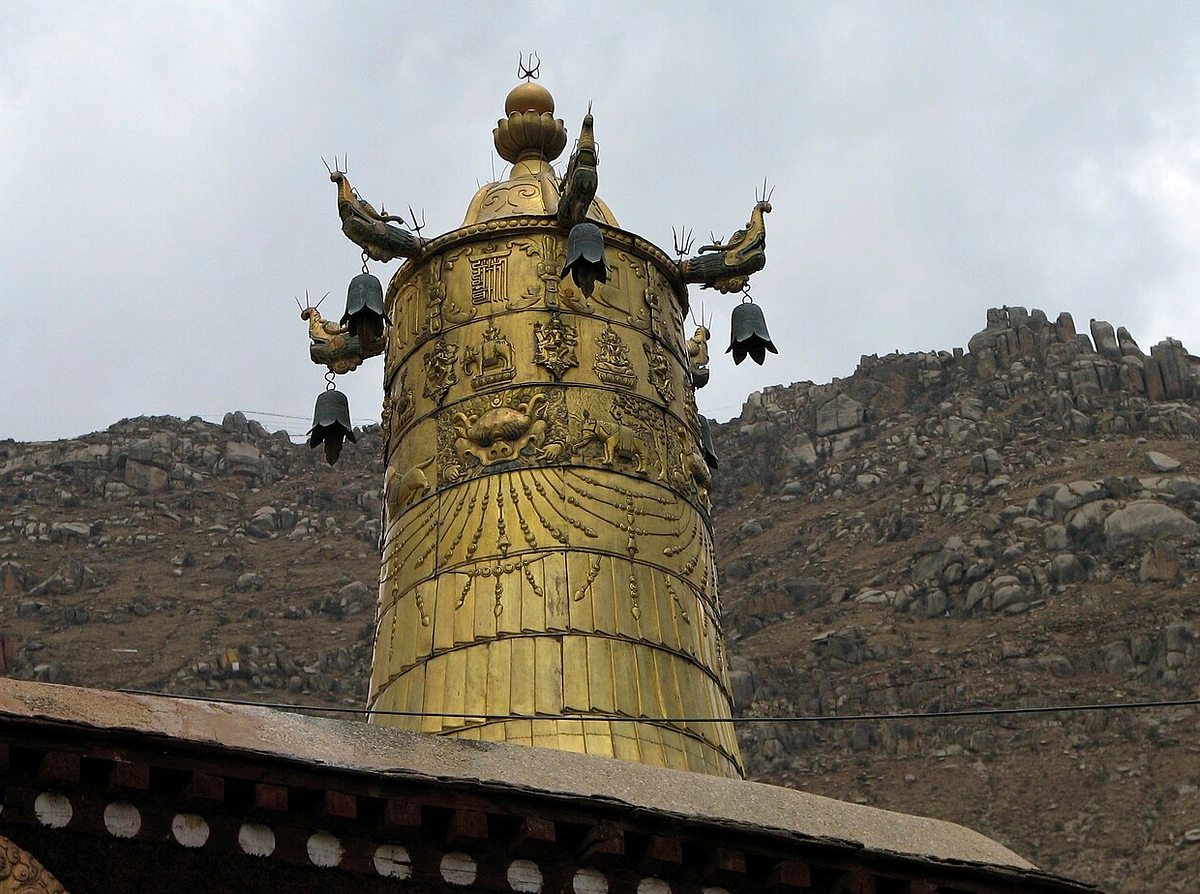
Local cuisine serving communities around Sera Monastery forms an important chapter in understanding Tibetan highland lifestyle cultures. Small eateries and traditional butter tea houses clustered in alleys surrounding the complex provide highland cold-climate dishes. Yak butter tea, an indispensable daily beverage, is churned continuously in large wooden barrels via traditional rhythmic churning combining black tea, yak butter, and Himalayan pink salt. Alongside, dishes like tsampa roasted barley flour, thukpa mutton noodle soup, and momo yak meat dumplings are prepared elaborately to provide essential caloric intake under harsh weather conditions. These eateries double as important social spaces where locals, practitioners, and travelers gather to discuss current affairs, harvests, or legends surrounding monastery origins.
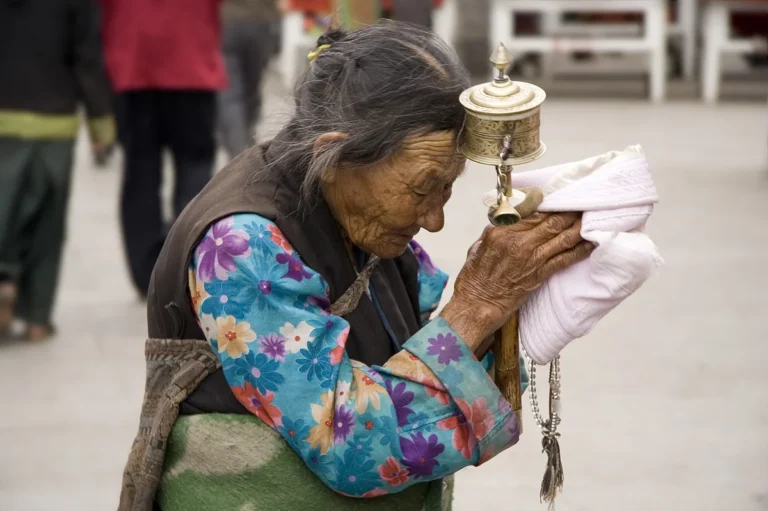
Resident communities surrounding Sera Monastery display strong social cohesion based on ethnic structures and long religious traditions. Most households living here boast multi-generational ties providing logistical support for the monastery, from barley farming and livestock breeding to participating in architectural preservation. Local children grow up amid chanting echoes from shrines every dawn, while elders spend most days circumambulating monastery walls, never dropping prayer beads while chanting Om Mani Padme Hum. Public spaces around the monastery lack modern urban noise, replaced by internal stillness intertwined with gongs, conch shells, and rhythmic footsteps of unceasing pilgrims.
Cultural experience services here also include exposure to traditional arts, prominently thangka painting and butter sculpture. Small workshops scattered near the monastery open for observers to understand meticulous creation processes for religious artworks. Painters use pigments extracted from natural minerals like malachite, cinnabar, and genuine gold leaf to portray deities and mandalas with staggering detail. This requires absolute mental focus and strict adherence to sacred geometric proportions in Buddhist scriptures. Through these experiential services, travelers gain deeper insights into Tibetan aesthetic and spiritual dimensions beyond standard sightseeing frameworks.
Infrastructure and lodging utilities around Sera Monastery adapted flexibly to host pilgrims and international scholars conducting research. Traditional guesthouses follow native architectural styles featuring thick stone walls, carved wooden window frames, and sun-drenched central courtyards. Staying here offers authentic plateau living experiences where water and energy are consumed consciously to protect fragile Lhasa valley ecosystems. Guesthouse owners often supply valuable info regarding upcoming rituals, Gelugpa monk debate schedules, and conduct codes required inside sacred spaces.
The intersection between monastic and secular life around Sera Monastery creates a unique model of living cultural ecosystems where economy, faith, and social life fuse perfectly. Services and utilities here do not serve pure entertainment purposes but function to nurture Tibetan cultural traditions across generations. From butter lamps prepared by locals to warm butter tea welcomed travelers, every action reflects sustainable ethical and spiritual values. Researching and experiencing this space requires deep cultural sensitivity and respect for local preservation efforts amid modern world shifts.
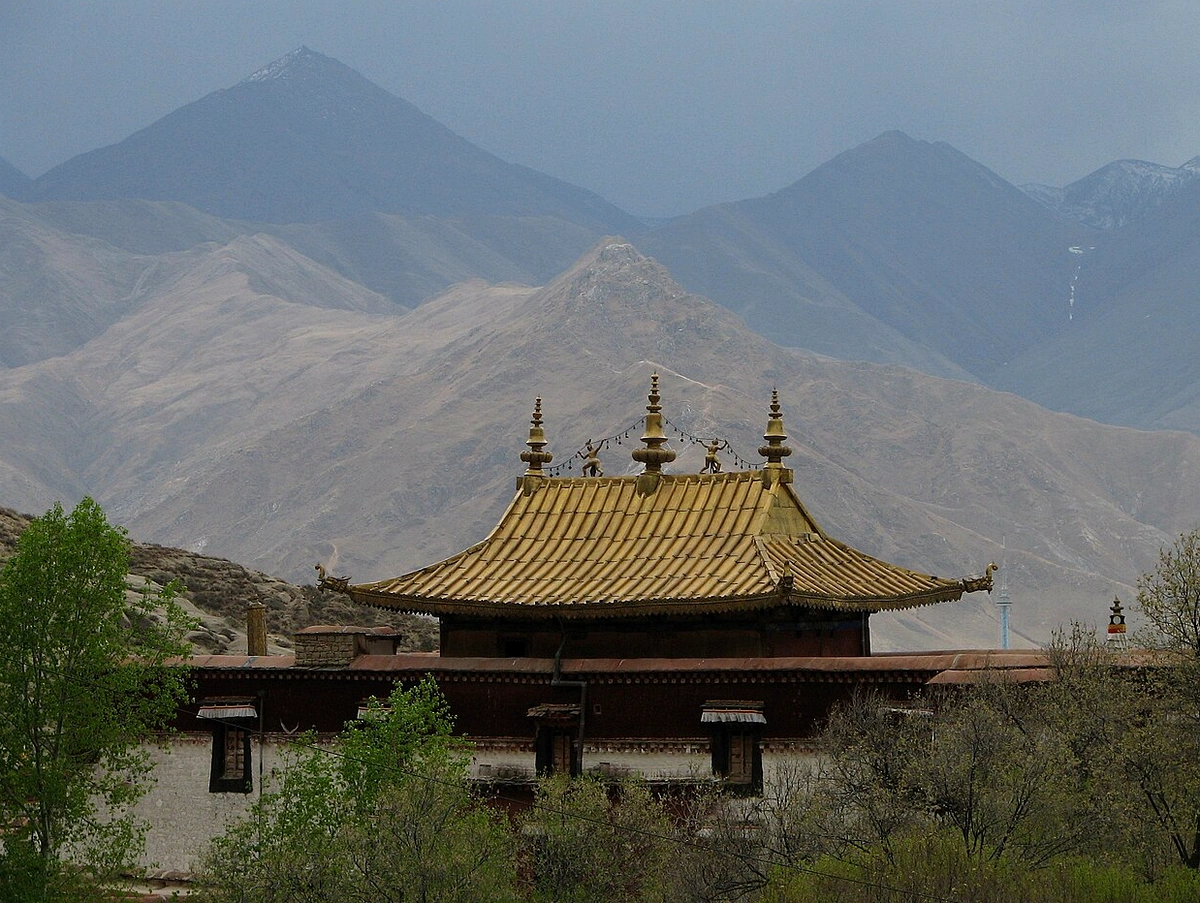
Sera Monastery, one of three great university monasteries of the Gelugpa school of Tibetan Buddhism, sits at approximately 3,700 meters above sea level right at the foot of Mount Tatpuk in Lhasa’s northern suburbs. Planning field trips to such sacred and geographically harsh locations requires scientific preparation concerning time, stamina, and absolute respect for local cultural norms. The golden time window to approach this monastery spans from May to October annually, when climatic factors are milder than biting Tibetan winters. During this time, atmospheric oxygen remains thin, but daytime temperatures range comfortably between 15 and 20 degrees Celsius, facilitating walking tours across ancient stone steps and expansive courtyards. Conversely, November to April brings severe cold, often dropping below freezing at night alongside dry cold winds and high acute altitude sickness risks due to reduced atmospheric pressure in winter.
Within a single sightseeing day, prime time for observing full monastic life is the afternoon, especially starting from 3:00 PM on weekdays, Monday through Friday. This marks the timing for monk philosophical debates in eastern courtyards, a centuries-old religious academic event attracting anthropologists and international tourists. Arriving thirty minutes prior helps travelers secure vantage points without disrupting monk scholars’ intense focus. Mornings suit peaceful contemplation of main shrine architecture like Tsokchen or ancient thangkas preserved across dynasties, when natural light illuminating frescoes creates optical effects on traditional rammed earth walls.
Transportation options from central Lhasa are diverse but require careful consideration based on body altitude adaptation. Public transit includes inner-city buses connecting central squares or Barkhor old quarters to northern suburbs, offering immersive experiences into daily Tibetan life. However, first-time plateau visitors should register official taxis or rent cars with local drivers familiar with terrain to conserve physical energy, avoiding excessive walking or climbing before adapting to low atmospheric pressure. Bicycling, while theoretically feasible, is discouraged due to steep slopes and severe lung capacity reduction during high-exertion exercise near 4,000 meters altitude.
Clothing preparation for entering Sera Monastery requires strict compliance with traditional standards and body-protection principles against plateau weather fluctuations. Visitors must dress modestly and formally, wearing long-sleeved shirts covering shoulders and pants or skirts extending below the knees, strictly avoiding tight clothing, shorts, or deep necklines out of respect for sacred spaces. Due to Lhasa’s large day-night temperature ranges and high UV radiation intensity, layering clothes is the wisest survival strategy. Innermost layers should wick sweat well, middle layers provide thermal wool or synthetic fleece insulation, and outer layers require windproof, light waterproof jackets. Certified UV-filtering sunglasses, wide-brimmed hats, and high-SPF sunscreen are mandatory items protecting vision and skin against harsh plateau sun.
Behavioral regulations and internal monastery rules are strictly managed by administrative boards and local monastic communities to preserve tangible and intangible heritage. Filming and photography inside main prayer halls are completely banned to prevent ancient religious artworks from flash damage and maintain ritual solemnity. In afternoon debate courtyards, visitors may take distant photos while maintaining distances, strictly avoiding telephoto lenses pointed directly at monks’ faces or interrupting debate gestures. When moving through corridors and shrines, movement directions must strictly follow clockwise paths, circumambulating stupas and prayer wheels in traditional Buddhist Kora directions.
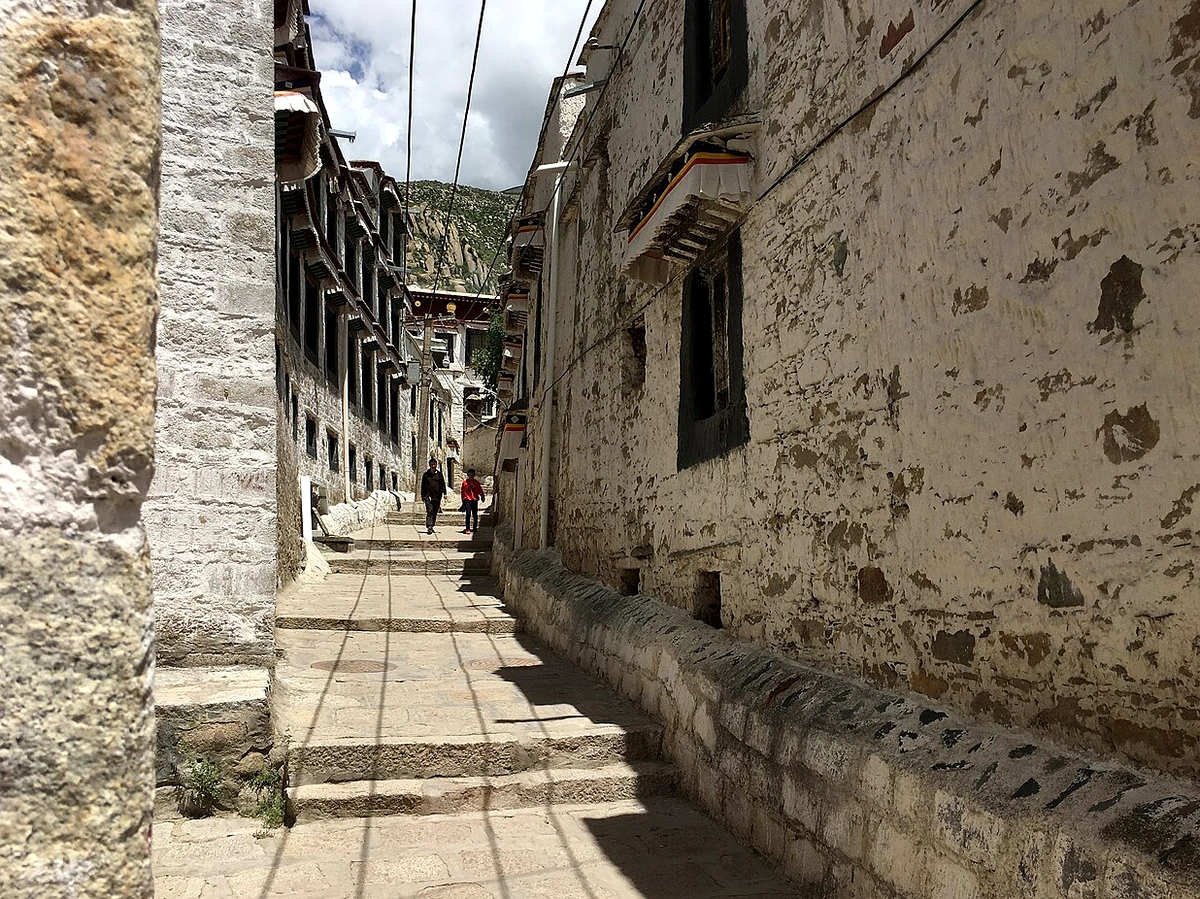
Physical fitness and personal medical factors must be prioritized during fieldwork preparations at Sera Monastery to prevent and handle acute mountain sickness. Before departing for the monastery at least two days prior, visitors should rest quietly in central Lhasa, minimizing strenuous physical activity, avoiding alcohol and stimulants constricting blood vessels and reducing oxygen absorption. Drinking warm water, consuming digestible carbohydrates, and stocking doctor-prescribed cerebral circulation aids are essential self-protection measures. Within monastery grounds, if severe headaches, dizziness, nausea, or breathing difficulties occur, visitors must immediately notify guides or seek nearby medical post assistance for emergency oxygen supply, ensuring absolute safety for cultural exploration journeys.
To fully experience this journey with a local guide, you can refer to the Tibet Lhasa – Shigatse 6 Days 5 Nights Tour with a pre-arranged itinerary.