Nurtured along the tranquil Yong River, which has witnessed generations of historical shifts in ancient Yongzhou, Xiangsi Lake Town is forged as a majestic link between the millennial heritage of the Lingnan region and the aspiration to revive indigenous culture. The name “Xiangsi” (Yearning/Lovesickness) for this water town is no whimsical poetic fancy, but stems deeply from the native flora along the shores of Xiangsi Lake—where red bean (rosary pea) trees grow naturally through the ages. That geographical and botanical source miraculously intersected with a peerless High Tang poetic masterpiece by the Poet Buddha Wang Wei: “Red beans grow in southern lands, when spring arrives, how many branches bloom? I pray you gather many, this thing evokes the utmost yearning.” The red branches and crimson beans of the South under the poet’s brush transformed into an eternal symbol of nostalgic yearning, to become, centuries later, the defining soul of a land gathering romantic splendor in Nanning.
Fundamentally distinct from ancient port towns formed spontaneously along commercial currents—such as tranquil Huangyao or picturesque Yangshuo—Xiangsi Lake Town emerged from a national-level 4A cultural project, bearing the mission of restoring a “living museum” of intangible heritage. Within this space, cultural strata are not frozen behind glass cabinets, but vividly recreate the pristine lives of twelve indigenous ethnic groups that have inhabited Guangxi for ages, notably the Zhuang, Dong, Miao, and Dao. The town’s spirit is woven through the immortal legend of the fairy singer Liu Sanjie with antiphonal melodies echoing across mountain forests, blending with the worship of the Baiyue mother goddess Nüwa the creator, forging an early mythological humanistic field deeply rooted in Luoyue civilization.
Observed in panoramic aerial views, Xiangsi Lake Town appears like an ancient ink-wash painting spread wide beside expansive waters, where traditional dwellings with dark gray tiles and pristine white walls interweave harmoniously with natural topography. The centerpiece of the entire complex is a soaring, multi-tiered conical tower—a structure crystallizing exquisite traditional carpentry, standing out amidst a network of winding bluestone-paved paths shaded by greenery and a gentle winding canal channeling water into the heart of the town. The lakeside pier bustles with visitors strolling leisurely to admire rustic wooden boats rocking gently upon ripples, sketching a picturesque landscape that is both expansive and solemn.
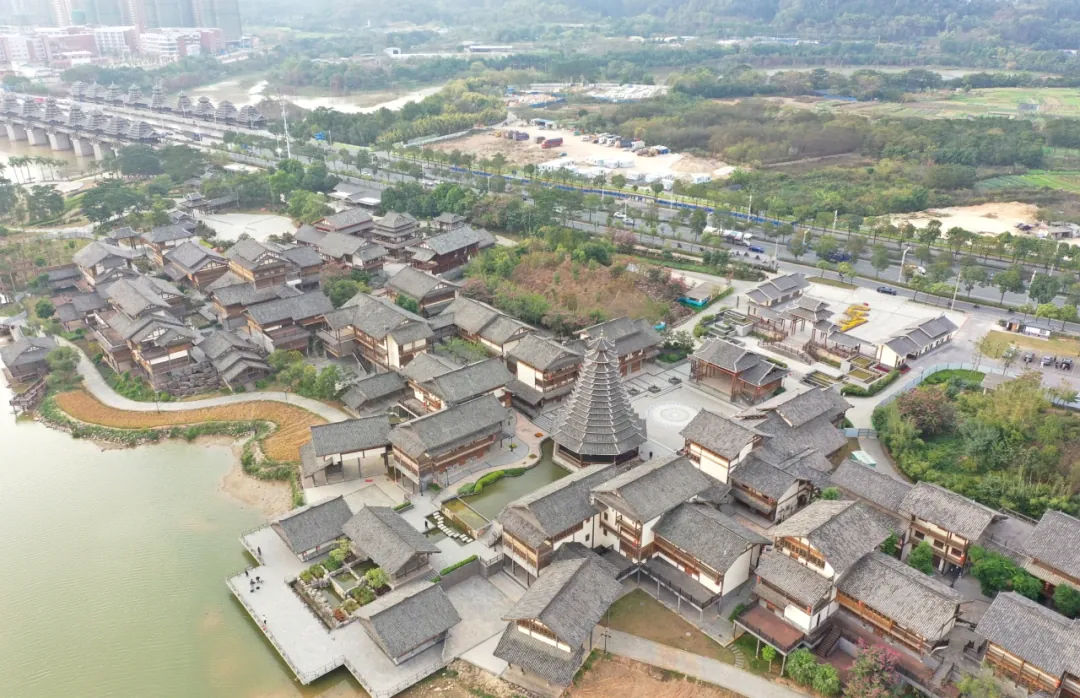
To faithfully recreate the spirit of traditional mountain villages, all timber frames and mortise-and-tenon joints here were crafted by the skilled hands of renowned master carpenters from Sanjiang belonging to the Dong ethnic group—heir to intangible heritage secrets of wood-joining joinery without using a single iron nail. Every chisel mark and carving on the tie beams, pavilions, or Drum Towers strictly inherits millennium-old folk architectural codes, preserving the morphological genes of ancient Baiyue tribes. This meticulous craftsmanship ensures every street corner and eaves not only possesses a purely antique appearance, but truly breathes the ancient breath of shifting highland agriculture, riverine life, and animistic indigenous beliefs.
Amid the rapid urbanizing tempo of the new century, Xiangsi Lake Town stands tall as a coordinate anchoring memory, reflecting the spectacular continuity of Lingnan historical eras. From primordial traces along the Yong River during the Qin and Han dynasties, through ups and downs of Yongzhou prefectures during the Tang and Song, up to today’s vibrant cultural creative space, this place testifies to a cultural entity constantly self-renewing yet never losing its native roots, turning nostalgic “yearning” into a mesmerizing, tangible reality.
Situated at No. 31 Xiangsi Lake East Road, Xixiangtang District, Nanning City, Xiangsi Lake Town inherits a rare prime coordinate within a valley embracing sweeping ecological breezes. Viewed from landscape geography and traditional Eastern geomancy, the overall spatial arrangement fully exhibits the posture of “backing against mountains, facing water, gathering water and accumulating wealth.” The rear anchor behind the town consists of sturdy, gentle inverted-bowl hills acting as a solid “backing mountain” screen shielding against cold northern winds, while the front facade opens wide to the expansive open space of Xiangsi Lake to gather vital energy and spiritual focus. The water source of the lake is not isolated, but connects naturally through underground veins with the Yong River—the mother river nourishing Nanning’s vitality for millennia, engineering a bountiful “bright hall gathering water” structure that accumulates auspicious energy and preserves tranquil life for the entire region.
A breathtaking highlight within this picturesque landscape composition is the multi-span corridor bridge stretching proudly across the mirror-flat water. Above the bridge deck, a complex of traditional Chinese architectural pavilions featuring multi-tiered upturned eaves connects sequentially, casting reflections upon the peaceful flowing river. Beneath breezy azure skies and daytime sunlight casting sharp shadows, the bridge stands tall as an artistic link between rolling green hills in the distance and urban life near the horizon, opening an expansive vista on the harmony between nature and human creation.
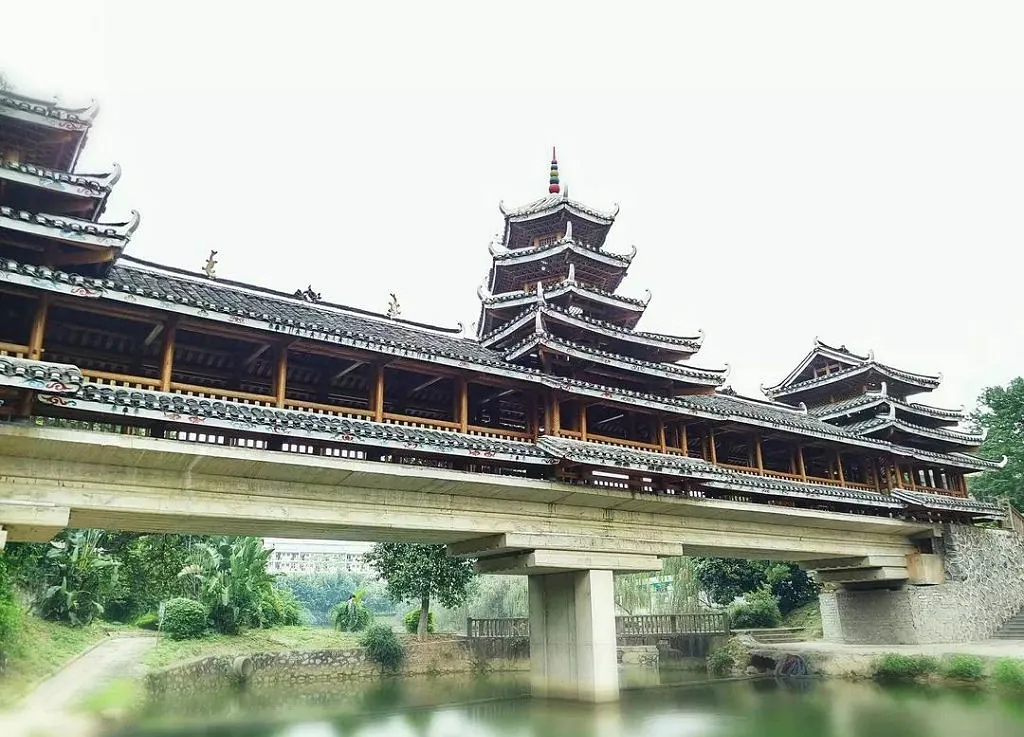
The presence of the aquatic network linked to wind-and-rain bridges and covered corridors delivers not only antique aesthetic value but also crucial environmental regulation functions. Situated in the Lingnan monsoon tropical climate region featuring prolonged summers with very high temperatures and humidity, open water surfaces paired with natural ventilation architecture transform the town into an isolated wetland microclimate zone. Blistering heat is absorbed and dissipated when sweeping across the lake, continuously circulating cool breezes deep into every alley, generating a microclimate characterized by “no severe winter cold, mild summer heat”—free from piercing winter frosts while shady and insulated from stifling urban concrete blocks.
Encompassing this exquisite geomantic framework is a lush native vegetation ecosystem flourishing year-round, weaving emerald hues across the valley. Scattered along slopes stand mature camphor trees exhaling gentle fragrances to repel insects, interspersed with patches of slender spotted bamboo swaying gently in green breezes. Matching the town’s poetic name, ancient rosary pea trees cast quiet shadows by the water, harmonizing with weeping willows along the shore and patches of water lilies blooming peacefully upon the serene lake. Multi-layered natural greenery connects closely with primordial hills, forming a green lung protecting serene living rhythms, turning Xiangsi Lake Town into a tranquil sanctuary isolated entirely from urban hustle.
Spanning a total construction area exceeding 70,000 square meters, Xiangsi Lake Town is a living restoration masterpiece gathering over 50 prototype architectural complexes crafted meticulously by hand according to traditional “architectural canon” standards of three indigenous tribes: Dong, Zhuang, and Miao. The heart of the entire spatial structure rests within the Wind and Rain Bridge structure, also known as the Flower Bridge, recreated at a precise 1:1 scale from the legendary Chengyang Bridge in Sanjiang. This massive bridge is a triumph of pure fir timber “carpentry craftsmanship,” employing interlocking mortise-and-tenon (Sunmǎo) techniques without using a single iron nail or metal peg. Tiered pavilions and watchtowers with soaring upturned eaves rising into space serve both as sturdy wind and rain shelters across time, and as communal gathering spots steeped in the affection of highland dwellers.
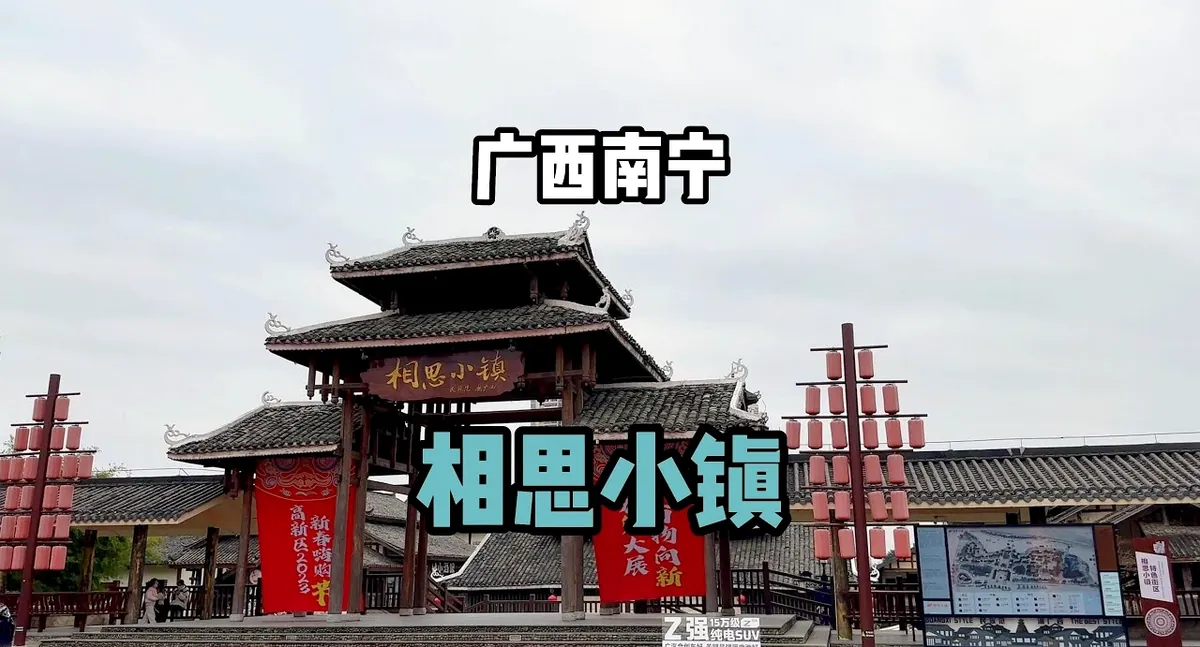
Right at the solemn central position of the ancient town, a towering multi-tier ancient pavilion rises proudly with layers of dark tiles stacked in traditional East Asian architectural style, resembling the spreading canopy of a millennial cedar tree standing firm amid southern skies and earth. This massive timber tower is surrounded by antique wooden stilted houses, where rustic verandas cradle rows of crimson lanterns, evoking the peaceful charm of ancient villages. Stone block staircases and mossy retaining walls in the foreground guide traveling footsteps deep into the sacred heart, housing a colossal cowhide-headed wooden drum once beaten to summon village gatherings, shaping a multi-tiered spatial composition of immense solemnity and antiquity.
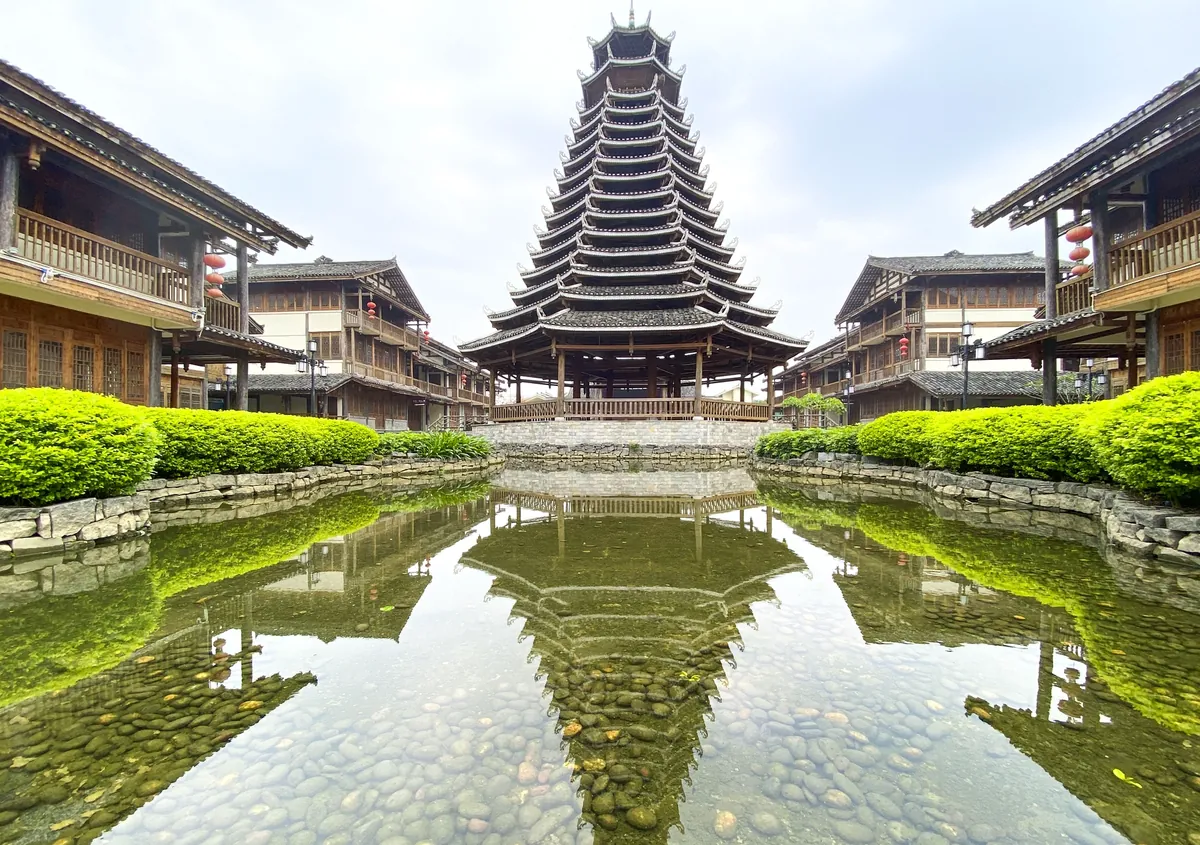
Continuing the spatial current along the flat lake shore is the unique Diaojiaolou stilted house complex of the Miao and Zhuang compatriots, designed under traditional stilted structures featuring timber beams cantilevered boldly over turquoise waters. Ancient architectural philosophy shines through disciplined zoning: the ground floor remains open for ventilation, dampness prevention, and blocking malarial valley vapors; the upper floor features sturdy wooden flooring serving as living, sightseeing, and weaving spaces. Gray clay tiles mingled with dark brown larch-wood wall planks create a time-stained visual palette, simultaneously rustic and resilient against subtropical downpours.
Alongside monumental timber structures, Xiangsi Lake Town is an intricate museum of carved totems down to the finest detail. Strolling along bridge corridors and antique buildings, observers encounter Zhuang bronze drum motifs carved elaborately with sun images radiating 12 solemn rays, interspersed with ancient flying bird motifs soaring eternally. Upon column bases and wooden railings, the frog deity Mǎguǎi is carved vividly as a sacred prayer sent to the skies praying for favorable weather and bountiful harvests. Every window latch, partition, and indigo-dyed fabric trailing by the eaves bears the imprint of the Butterfly Mother—the primordial water-ancestor in ancient Miao mythology, forming a visionary epic deeply connecting humans, deities, and natural wildlife.
As dusk gradually settles past 6:30 PM, Xiangsi Lake Town sheds its daytime tranquility to don a splendid golden cloak, matching the epithet “Yongcheng’s minor Fenghuang” affectionately bestowed by poets. The entire ancient architectural complex awakens under the resonance of tens of thousands of crimson lanterns, brilliant carp lanterns symbolizing auspiciousness, and matrices of glowing oil-paper umbrellas. Every curved eaves contour of the Wind and Rain Bridge and ancient towers is outlined with warm yellow LED spectra, casting reflections upon the calm lake to forge a dreamlike silver-gold realm connecting reality with the distant past of millennial Baiyue civilization.
Gazing across the panoramic ancient town reflecting upon gentle waters at nightfall, travelers cannot help marveling at the gorgeous splendor of a miniature capital in the heart of Nanning. Traditional wooden building complexes tier upwards, glowing under warm amber lantern light, dotted with enchanting colors casting prolonged shimmering trails across calm waters. At the center of the town layout, a solemn multi-tiered pagoda rises proudly, becoming a brilliant visual focal point in the night space. The lakeside foreground is covered in lush green vegetation brimming with vitality, while in the distant corner on the left, modern city skyscrapers loom faintly, staging a spectacular synthesis between ancient heritage imprints and contemporary prosperity.
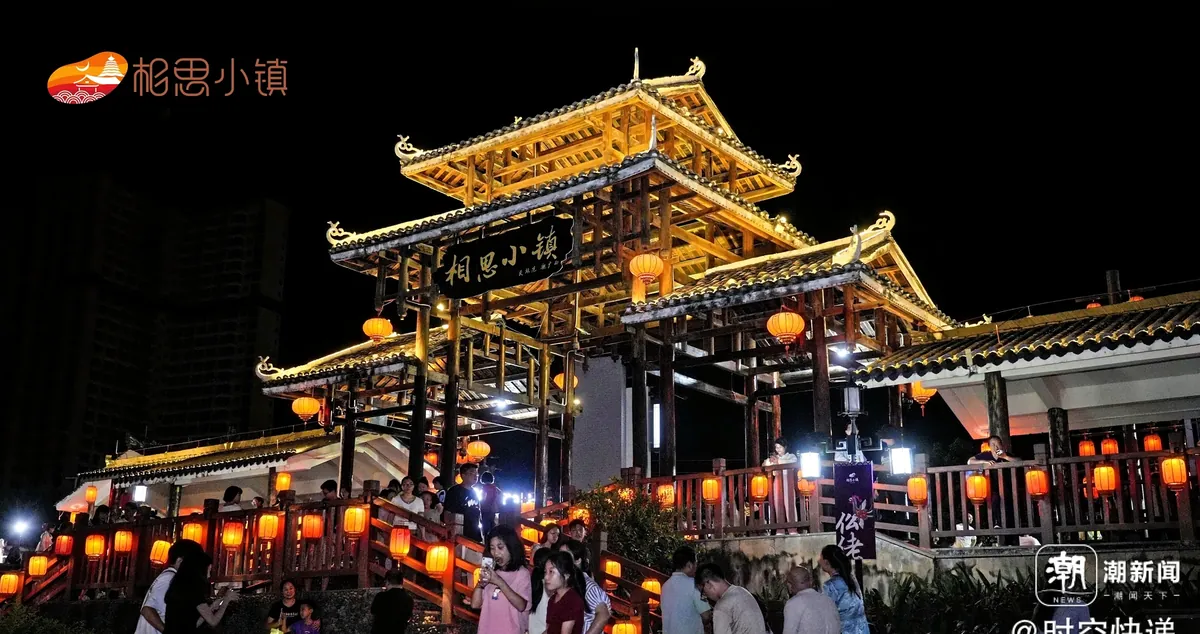
The core vitality of Xiangsi Lake Town’s nights lies in the harmonious resonance between live theatrical performances and hearty folk flavors. At the Central Drum Tower Square, blazing bonfires illuminate the space during the “Hundred Tribes Torch Evening Party.” Travelers from everywhere, strangers no more, hold hands tightly alongside Zhuang and Miao maidens in traditional costumes, lifting voices and steps in joyful circle dances echoing across the village and town. The famed “High Mountains and Flowing Water” welcoming ritual is also recreated with bold vigor, where fragrant rice wine pours continuously from multi-tiered buffalo horns down to silver cups, blending with antiphonal folk songs challenging the courage and hospitality of frontier travelers.
Notably, during major festivals and celebrations, the waters of Xiangsi Lake transform into a stage for the peerless art of “Da Tiehua” (Molten Iron Fireworks)—a national intangible cultural heritage with a millennium-old history. Under master artisans’ skilled hands, molten iron at searing temperatures up to 1,600 degrees Celsius is tossed into the night sky using professional wooden ladles, striking the liquid metal forcefully with wooden clubs. At that moment, tens of thousands of fire sparks burst like natural fireworks, pouring down like golden meteor showers upon glittering lake waters, weaving a magnificent spectacle leaving all witnesses breathless.
The blending of brilliant halos from dark-green tiled eaves and rustic wooden walls turns the ancient town into a premier travel photography capital nationwide. Beneath enchanting night skies, visitors don exquisite Zhuang brocade costumes, Miao attire adorned with sparkling silver crowns chiming with every step, or flowing Hanfu robes. Every time-stained wooden wall, winding bridge, and row of crimson lanterns becomes a living film set, immersing travelers entirely in an endless antique dream within ancient Yongzhou.
The culinary space at Xiangsi Lake Town is a living heritage map, filtering and preserving untouched Ba-Shu and Lingnan culinary quintessence and primordial ecological identity. Dining culture here is not merely nutritional intake, but a profound symbiotic philosophy between humans and nature, transforming wild floral and herbal gifts into wise therapeutic remedies. Along antique bluestone alleys redolent of kitchen smoke, visitors easily encounter heirloom delicacies passed down across generations of indigenous tribes like the Zhuang, Miao, and Dong, creating a gastronomic journey that is simultaneously rustic and mystical.
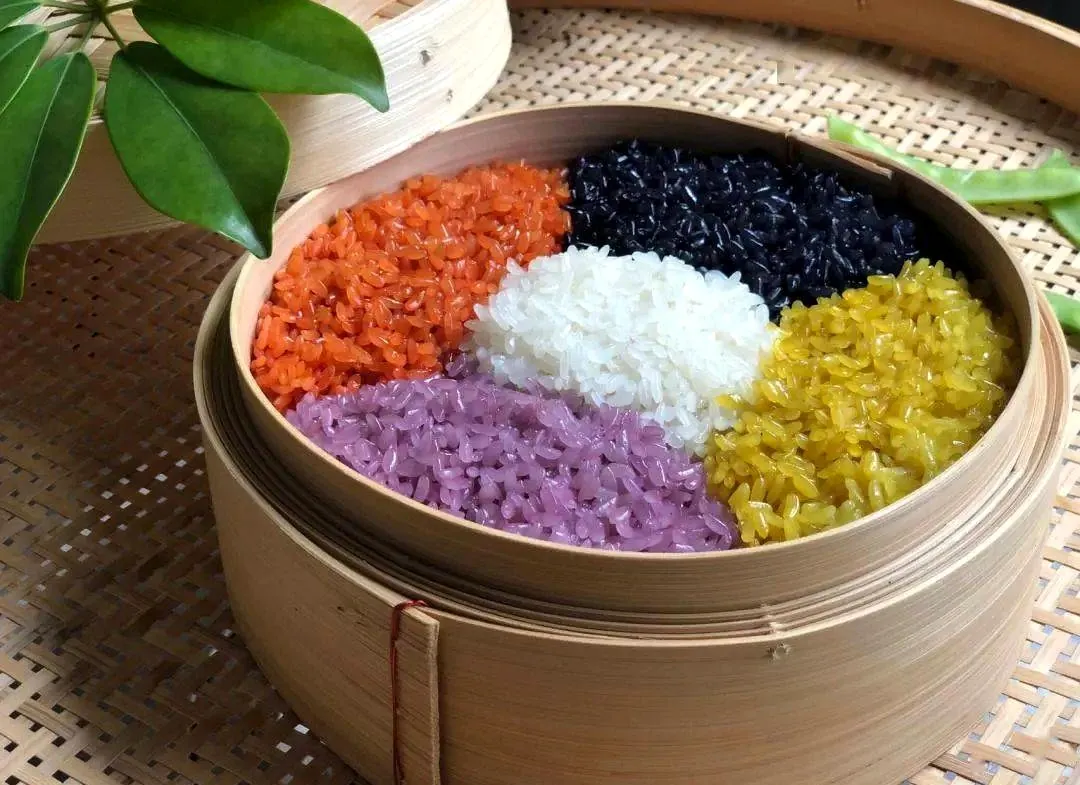
Proudly present at traditional market corners is the celebrated five-color sticky rice of the Zhuang compatriots, a sacred offering presented to heavens and earth praying for warm, abundant harvests. The vibrant colors of each glossy glutinous rice grain are dyed entirely from natural wild herbs: mystical black filtered from soaked sweetleaf fern leaves, brilliant red and dark purple from fringe-flower plant stems and leaves, alongside vibrant yellow from gardenia fruit or Chinese mahonia flowers. Each glutinous rice grain is chewy and fragrant with mountain forest herb aromas, pairing with crispy roast pork belly or finely ground roasted sesame powder to deliver a rustic yet rich gustatory structure. Nearby, the butter-tea churning ritual of Gongcheng and Dong ethnics delivers a nostalgic sensory experience. Artisans place green tea buds, aged ginger, and fresh garlic into hot tea-seed oil woks, continuously mashing them with wooden pestles until releasing a thick broth before blending with boiling water. Steaming butter-tea bowls, sprinkled with crispy roasted rice, rich peanuts, popped corn, and scallions, open with a sharp bitter-astringent taste that instantly transforms into a sweet, cool aftertaste in the throat, offering miraculous wind-dispelling and dampness-relieving benefits amid the humid southern climate.
Mentioning native culinary lifelines, Laohuyou Rice Noodles cannot be omitted—the premier acclaimed delicacy of Nanning through ages. The intense appeal of this snack stems from high-heat stir-frying techniques where crispy pickled bamboo shoots, dark fermented black beans exuding rich aromas, fried garlic, and spicy red bird’s-eye chilis are tossed vigorously in smoking cast-iron woks before adding fresh meat and rich bone broth to boil together with smooth rice noodles. Sour, spicy, and savory broths stimulate every taste bud, making diners happily break into a sweat. Mingled with that culinary symphony is green bamboo-tube roasted sticky rice, where rice grains absorb clean bamboo sap, and charred edges wrap around chewy textures, served alongside river fish skewers clipped in bamboo and wrapped in banana leaves grilled over glowing charcoal exuding smoky aromas.
As dusk settles across the ancient town, the sky shifts into warm sunset amber, blanketing traditional tile-roof houses bearing classical Chinese architectural lines. Along the bustling bluestone pedestrian street, hundreds of brilliant red lanterns are lit simultaneously, casting magical firelight across crowded throngs strolling leisurely. Beneath silent wooden eaves, compact food stalls stand shoulder to shoulder, firing up continuously and exhaling wisping smoke carrying rustic culinary flavors inviting visitors to pause and sample traditional snacks.
Beyond hot fireside dishes, renowned Nanning pickled fruit platters (Toan Da) create a refreshing, stimulating touch for ancient town street flavors. Crispy green mango slices, thinly sliced papaya, crunchy guava, or juicy plums are submerged in vinegar-sugar water blended with heirloom recipes, then shaken thoroughly with fine spicy chili powder, forging an instant sour-spicy-salty-sweet symphony awakening the olfactory senses. Concluding the capital gastronomic journey, nothing is more poetic than tilting a rustic earthenware wine jar brewed by highland farm households. Translucent white rice wine distilled entirely from rustic sticky rice features clean sweetness infused with mellow countryside fermentation yeast, encapsulating the heartfelt kindness and magnanimous character of Xiangsi Lake Town.
Xiangsi Lake Town presents itself as an open, expansive space, welcoming visiting travelers completely free of charge 24 hours daily without collecting any admission fees. Nonetheless, its cultural and commercial life truly awakens when handicraft workshops, teahouses, and food streets open to guests from 10:00 AM until 11:00 PM. Particularly, lantern systems and artistic lighting spectra are lit simultaneously from 6:30 PM to 10:30 PM, transforming the entire town into a lavish banquet mirroring upon blue waters. According to experienced travelers, the ideal golden timing to fully admire the scenery spans from 4:30 PM to 9:00 PM. At this time, descending sunset paints antique golden hues across wooden stilted house timbers before yielding to brilliant, shimmering night spectacles.
Transport networking connecting to the small town is exceptionally convenient thanks to Nanning’s modern infrastructure infrastructure. Travelers easily board Metro Line 1 heading west, alight at Xiangsi Lake West Station via Exit A, then catch a taxi for roughly 1.5 km or enjoy a leisurely 15 to 20-minute stroll along the tree-lined lakeside road. Additionally, selecting Qingxuan Railway Station and taking a taxi proves a fast transit solution. For those wishing to immerse in daily life via public transit, bus routes 54, 55, 66, and 807 all run directly past the Guangxi University for Nationalities station or adjacent Xiangsi Lake East station. For travelers starting directly from Chaoyang Square center, taxi fares range merely between 25 and 35 RMB.
Within the culinary heritage of the Zhuang people at Xiangsi Lake Town, five-color sticky rice remains the most vibrant symbol of hospitality and prayers for abundant harvests. A close-up photograph of a rustic wooden bucket preserving five sticky rice layers displaying contrasting hues—deep purple, golden yellow, bright orange, jet black, and ivory white—neatly arranged in fan-shaped spreads. Cradling hands around the wooden bucket rim not only express respect for glutinous rice quintessence dyed entirely from wild Lingnan herbs, but unveil a pure culinary experience deeply imbued with borderland geography.
To ensure your excursion runs smoothly and avoids unexpected hassles, keep several practical field tips in mind. Renting traditional Zhuang or Miao costumes for commemorative photos is highly popular, yet travelers should proactively survey pricing across shops, negotiate transparently regarding makeup styles, raw photo file counts, and delivery deadlines. When savoring street food flavors, choosing stalls with publicly posted pricing ensures peace of mind. Furthermore, the town features numerous wooden boardwalks close to water alongside stone steps that become slippery at night due to mist; thus, supportive anti-slip footwear paired with summer mosquito repellent serve as essential health protection gear.
Regarding entry formalities, passengers departing from Vietnam must ensure passports remain valid for at least 6 months alongside valid entry visas or border crossing travel permits prior to departure across international border gates. To make dining and handicraft shopping transactions smooth without cash barriers, pre-activating international e-wallets like WeChat Pay or Alipay is optimal. For travelers wishing to combine exploring Xiangsi Lake Town with a culturally vibrant cross-border journey comfortably and thoughtfully, choosing the All-Inclusive Dongxing China Tour Package opens a seamless voyage from customs clearance to comprehensive transit arrangements.