Across more than two millennia of history in the fertile Lingnan region, Guangzhou has consistently stood as southern China’s premier maritime trading gateway. From early frontier expansion under the Qin and Han dynasties, through the prosperity of the Tang and Song eras to the bustling Thirteen Factories of the Qing Dynasty, the Pearl River has quietly witnessed tides of rise and change while welcoming cultural winds from across the globe. More than a lifegiving waterway, the Pearl River is a living witness to grand historical transformations. Entering the modern era, urban growth has not erased traditional identity; instead, it has inspired locals to build a human bridge where a thousand years of history meets contemporary pulse. The vision of the first dedicated pedestrian landscape bridge spanning both banks of the Pearl River was born from that ambition—opening a new architectural chapter along the storied river.
To find a name worthy of the bridge’s cultural stature, city authorities and researchers held a large-scale public vote that drew more than 170,000 ballots. Rising above hundreds of proposals, “Haixin Bridge” (海心桥) was chosen and officially adopted. The name carries deep philosophical and historical layers: drawn from the idiom “the sea embraces a hundred rivers,” reflecting the open, generous character of Cantonese people while honoring its position as the “heart of the river city.” Equally resonant, the name directly echoes the ancient origins of the Maritime Silk Road. “Haixin” also forms a harmonious triad continuing the historical lineage of two celebrated Pearl River bridges—Haizhu Bridge and Hai’an Bridge. Locals affectionately call the bridge “Little Phoenix Eye” (Xiao Fengyan) for its graceful curve resembling the corner of a phoenix’s eye gazing down upon silt-laden waters.
The architectural soul and silhouette of Haixin Bridge bear the scholarly mark of Academician He Jingtang—one of China’s foremost contemporary architects, famed for expressing Chinese identity in the China Pavilion at Expo 2010 Shanghai. Working alongside experts from the Architectural Design and Research Institute of South China University of Technology and leading structural engineers, He Jingtang wove regional philosophy and modern spirit into every member. As the seventeenth bridge crossing the Pearl River from Haizhu District, it is the city’s first inclined-arch, curved-girder pedestrian bridge. Its arch profile draws inspiration from the Lingnan guqin zither and traditional flower boats—evoking grandeur and strength alongside light, flowing grace in the river breeze.
Following rigorous construction and quality inspections, structural completion was achieved in April 2021, and the bridge officially opened to the public on June 25 of that year. Its opening marked a milestone in waterfront planning along the southern metropolis, linking the cultural and economic axis from Haixinsha Island toward the dazzling Guangzhou Television Tower. More than a pedestrian walkway, Haixin Bridge has become a vibrant cultural landmark where a millennium of maritime trade and Lingnan’s outward-looking spirit meet modern city life.
In Lingnan urban feng shui, the Pearl River has long been regarded as a vital vein gathering auspicious energy and sustaining Guangzhou’s prosperity. Haixin Bridge stands at a pivotal node of the new central urban axis, often likened to the luminous heart of the city’s open living room. Far from merely connecting two banks, its placement reflects a deep philosophy of gathering heaven-and-earth vitality: at this bend, the Pearl River widens into an expansive water-gathering basin symbolizing abundant, steady, and ever-circulating fortune across eras of southern growth.
Viewed on the spatial master plan, both ends of the bridge serve as a seamless transition between serene nature and lively urban rhythm. Its northern landing touches down gently at the Art Park on the eastern tip of Ersha Island in Yuexiu District—a lush green island in the city that preserves quiet charm and a rich artistic atmosphere. Counterbalancing it on the south bank in Haizhu District, the bridge connects directly beside the western flank of Canton Tower—affectionately nicknamed “Little Slim Waist” by locals for its slender curves—right next to the modern Guangzhou International Media Harbor. This setting creates a smooth shift from tranquil parkland to dynamic economic icon, establishing a harmonious Yin–Yang balance in the riverside skyline.
In terms of hydrology and spacing along the river, Haixin Bridge sits at a well-calibrated distance from major Pearl River crossings. Upstream, it lies roughly 300 meters from the historic Guangzhou Bridge; downstream, about 1,600 meters away, rises the modern profile of Liede Bridge. This positioning gives the bridge a peaceful breathing space between two busy traffic corridors—respecting the river’s natural flow while offering walkers a rare open vantage point to watch currents roll without engine noise.
Standing on the deck and looking out in every direction reveals a captivating panorama where land, water, and skyline meet in striking contrast. Looking south takes in the thriving Haizhu Peninsula, the growing Pazhou convention and digital economy zone, and the slender silhouette of Canton Tower rising toward the clouds. Looking north toward the opposite bank, skyscrapers of the Tianhe CBD rise like majestic man-made peaks framing the lush greenery of Ersha Island below. Clear water, oasis-like lawns, and cloud-brushing towers weave a modern feng shui axis showcasing an eco-smart metropolis in Lingnan.
Seen from afar, Haixin Bridge arches across the Pearl River like a fluid stroke of steel calligraphy amid Guangzhou’s modern cityscape. Beyond linking the north and south banks, it entered global architectural history by setting world records for the longest navigation span and widest deck among inclined-arch, curved-girder pedestrian bridges. Engineers summarized its demanding engineering essence in five characters: “Curved, Inclined, Difficult, Large, High”—referring to complex three-dimensional curvature, a single inclined arch geometry, intricate fabrication and erection, broad span and scale, and exacting technical standards. Structurally, it employs an asymmetric composite system combining a single inclined steel arch with a continuous curved steel box girder—turning static load engineering into a sweeping sculpture over open water.
To bring this iconic silhouette to life, the design team drew deeply from centuries-old Lingnan cultural motifs. Curves along the main girder and inclined arch echo the graceful strings of a guqin and the flowing “water sleeves” (shui-xiu) of traditional southern opera. This ribbon of steel mirrors the rhythm of Pearl River waves while conversing visually with Canton Tower to the south and the Zhujiang New Town central axis to the north. Fabricating and assembling spatial curved steel segments demanded millimeter-level tolerances, while geometry control and marine lifting had to contend with shifting tides and heavy river traffic along one of Guangzhou’s busiest waterways.
More than a feat of structural mechanics, Haixin Bridge exemplifies human-centered design by dividing its deck into two distinct east–west zones. The eastern side features a smooth, continuous, barrier-free fast-walk corridor where brisk walkers and joggers can move freely without weaving through sightseeing crowds, while enjoying sweeping views of calm Pearl River waters and the modern architecture of Haixinsha Island. Conversely, the western side is arranged like a stepped floating plaza inspired by terraced natural landscapes.
Along the western zone, architects integrated graceful arched canopies that provide shade and shelter from tropical showers while adding sculptural rhythm. Beneath the canopies sit tiered composite-wood seating steps where visitors can relax, chat, read, or watch sunset colors paint the river gold. Thoughtful details across the deck—tactile paving strips for visually impaired visitors, gentle wheelchair ramps, concealed slip-resistant drainage, and misting nozzles to cool surfaces on hot summer days—reflect care for everyday urban life. Combining large-scale engineering, precision steelwork, and human warmth, the bridge stands as a fresh symbol of Lingnan urban civilization.
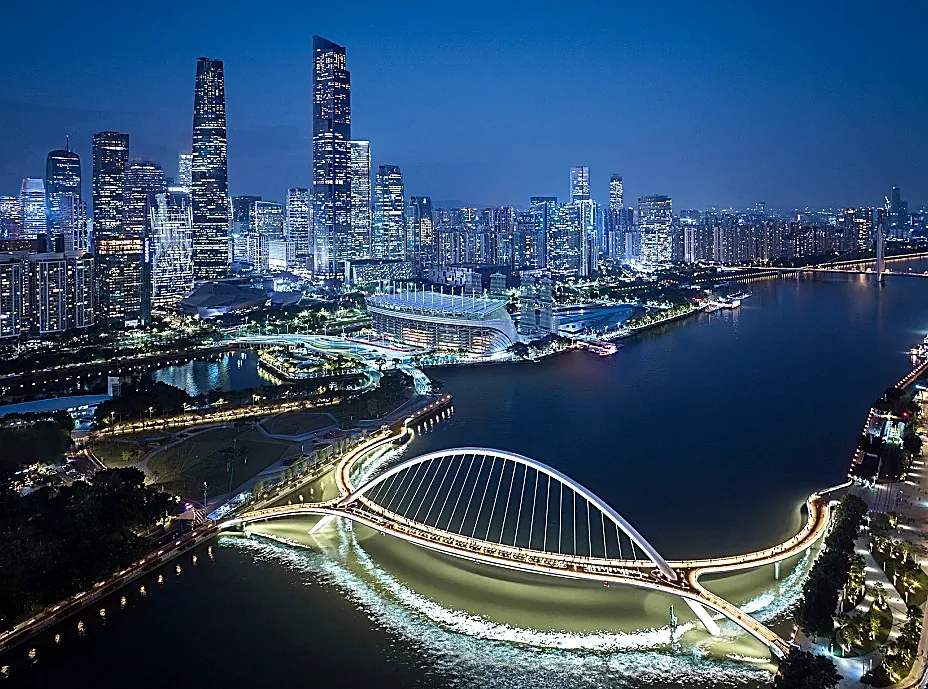
As dusk settles over the Pearl River, the boundary between calm and lively blurs into one of southern China’s most dazzling evening spectacles. Haixin Bridge shifts from a daytime sculptural form into a luminous ribbon spanning a thousand-year waterway. Smart landscape lighting tucked cleanly along the curved steel arch and glass balustrades outlines its slender lines without glaring into walkers’ eyes. Soft amber tones along the decking blend with shimmering reflections off the water, making every step feel like walking across a stage suspended in evening air.
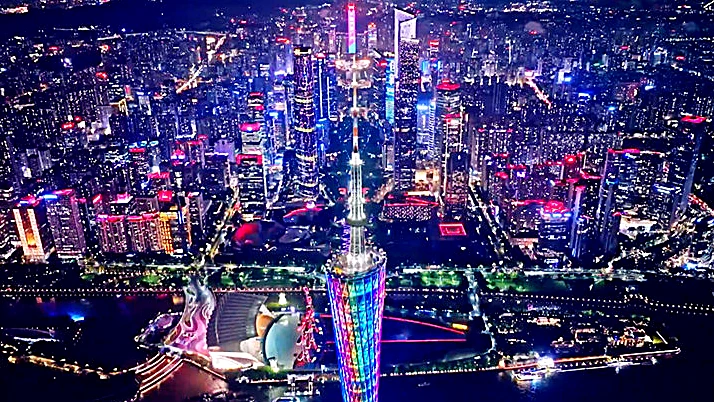
At the heart of the new waterfront axis, Haixin Bridge becomes a stage for visual dialogue among the city’s premier architectural icons. From the eastern arch, views are drawn immediately to neighboring Canton Tower, fondly called “Little Slim Waist” for its graceful hourglass curve. Once night falls fully, Canton Tower cycles through vibrant spectrums—shifting from regal rose-red to dreamy violet or deep blue—while laser beams shoot skyward and reflect across the river in harmony with Haixin Bridge’s subtle glow.
Across the river on the north bank, skyscrapers of the Tianhe financial hub and Huacheng Square glow like a modern crystal forest. Landmarks such as the Guangzhou International Finance Center and CTF Finance Centre light up matrix LED displays, turning the entire waterfront into a giant multimedia canvas. From viewing decks on Haixin Bridge, visitors take in a 360-degree visual interplay where rippling water, sharp modern geometry, and programmed light rhythms converge—placing you right at the center of a panorama where ancient Maritime Silk Road trade meets vibrant modern commerce.
Nighttime at Haixin Bridge feels all the more alive with Pearl River cruise boats gliding beneath the span. Illuminated vessels pass through the navigation channel leaving trails of silver and gold ripples on dark water. Soft music drifting up from boat decks mingles with river breezes and lively voices along the promenade, capturing the spirit of Guangzhou as a city that never truly sleeps. It is a favorite spot for photographers chasing long-exposure shots, couples seeking evening views beneath the tower, and locals unwinding beside the river—turning bridge and shore into an open-air evening celebration of Lingnan.
An old saying praises “Eating in Guangzhou” as a culinary art where pure ingredients meet refined craftsmanship. Stepping down from the curving ramps of Haixin Bridge, both banks of the Pearl River open into a rich food journey. From modern dining hubs beneath Canton Tower and quiet shaded spots on Ersha Island to century-old lanes in Yuexiu, Haizhu, and Xiguan, the area forms a flavor map uniting timeless tradition with modern flair.
A signature local tradition is “morning tea” (zaocha), a cultural ritual woven deeply into Cantonese life across generations. Sitting beside a breezy stretch of the Pearl River with a pot of Tieguanyin or aged Pu-erh tea for a leisurely “one cup of tea, two dim sum items” brings quiet pleasure. Cantonese dim sum tables showcase classics: translucent crystal shrimp dumplings with sweet, bouncy shrimp and tender bamboo shoots, spare ribs steamed with fermented black beans and Shaoxing wine, and golden charcoal-dusted buns oozing rich, sweet-savory salted egg yolk custard.
Leaving the teahouse, smoky aromas from charcoal roasting ovens lead into traditional Cantonese roast meats (siu mei). Foremost among them is Shenjing roast goose—a proud icon of Cantonese cuisine. Plump geese are seasoned with aromatic herbs, glazed with a thin layer of maltose, and roasted in clay ovens until the skin turns amber and crisp as glass while rich fat melts into tender, juicy meat. Dipping warm slices into light plum sauce balances gentle tang with savory richness on the palate.
Lingnan’s river heritage also lives on in everyday dishes rooted in old port memories. Lijiao Dingzi boat congee traces its origins to flower boats moored along the Pearl River, featuring rice simmered until velvety and cloud-like with dried squid, crisp jellyfish, fresh fish fillets, toasted peanuts, and crispy fried dough sticks. Alongside it, piping-hot sliced beef congee, silk-thin steamed rice rolls (cheung fun) drizzled with sweet soy sauce and scallion oil, and cooling sweet soups of red bean with century-aged dried tangerine peel (chenpi) round out a diverse culinary palette.
That flavor quest can continue effortlessly along historic streets like Beijing Road or quiet alleys in Xiguan. Beneath the tiled eaves of century-old restaurants, family recipes remain in the hands of seasoned cooks. Blending Haixin Bridge’s modern vibrancy with enduring traditional flavors gives Guangzhou a distinct cultural character that lingers with any food-loving traveler.
Walking across the graceful steel ribbon of Haixin Bridge reflects the orderly pace of Guangzhou’s urban life. The bridge opens to pedestrians daily from 7:00 AM to 11:00 PM—spanning from morning mist over the river until high-rise lights dim into quiet night. Although entry is free, management enforces strict crowd-flow controls to protect structural safety and keep walkways comfortable. Visitors should complete real-name registration in advance via the official “Haixin Bridge” WeChat mini-program, then scan their QR pass at entry gates on either end. International travelers using passports can keep a digital copy handy or visit the staffed service desk at the bridge approach for smooth verification amid busy crowds.
Public transit to Haixin Bridge is straightforward and well connected from two contrasting sides of the river. Approaching from the vibrant south bank, Guangzhou Metro Line 3 and the APM automated people mover stop at Canton Tower Station—just steps from the iconic tower and the southern bridge ramp. Approaching from the greener, quieter north bank, city buses bound for Ersha Island stop near Ersha Island Art Park, letting you stroll across shaded lawns onto the gentle northern approach. Starting from Ersha Island feels especially poetic, transitioning smoothly from the artsy calm of Xinghai Concert Hall and the Guangdong Museum of Art to an open bridge overlooking wide river views.
To keep the bridge peaceful for strolling and sightseeing, non-motorized wheeled vehicles—including shared bikes, scooters, and skateboards—as well as pets are strictly prohibited. Visitors explore on foot across stone paving and landscaped decking. Lingnan has a subtropical maritime climate, so in summer and autumn breezy river winds can pick up alongside sudden afternoon thunderstorms; packing a sturdy wind-resistant umbrella, sunglasses, and a light jacket helps keep your walk comfortable.
Sunset—when clouds glow west of the river and city lights switch on—is the busiest time on Haixin Bridge as cameras turn toward both banks. For cleaner photo angles and quieter views, visiting in the peaceful early morning or after 9:00 PM—when crowds thin and night cruisers leave glowing trails across the water—is a favorite trick among seasoned travelers. To enjoy this vibrant waterfront alongside top highlights of the Pearl River Delta without worrying about bookings or transfers, consider joining our thoughtfully planned 4-day, 3-night Guangzhou – Shenzhen tour package.