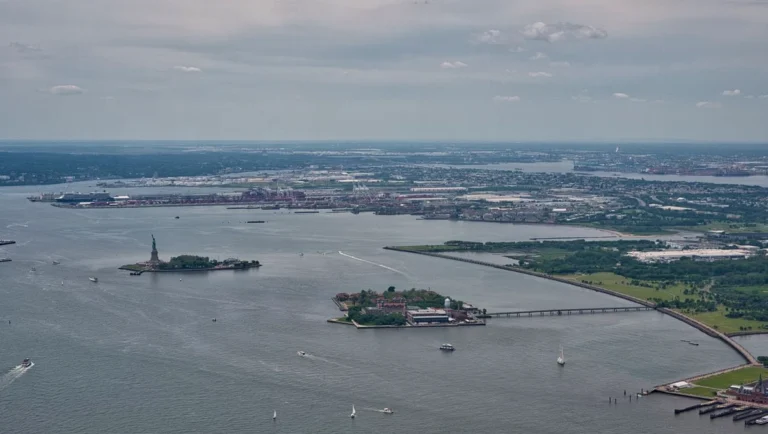
Amid the breezy delta where the Hudson River meets the wide expanse of New York Harbor, the towering copper monument holding aloft a fiery torch has long stood as an enduring symbol of human liberty. Yet the story of how this masterpiece came to be begins at an evening gathering at a residence in Glatigny, near Versailles in France, around the mid-1860s. There, political thinker and president of the French Anti-Slavery Society Édouard René de Laboulaye—a devoted admirer of the American Constitution and its democratic institutions—proposed a bold idea to fellow artists and intellectuals: the people of France should join together to build a grand monument as a gift to the United States to mark the centennial of the signing of the Declaration of Independence. That proposal was more than a diplomatic gesture; it was a tribute to the Union victory after the bloody American Civil War and the abolition of slavery, while reaffirming the enduring bond between the two sides of the Atlantic since the days when the Marquis de Lafayette stood alongside George Washington.
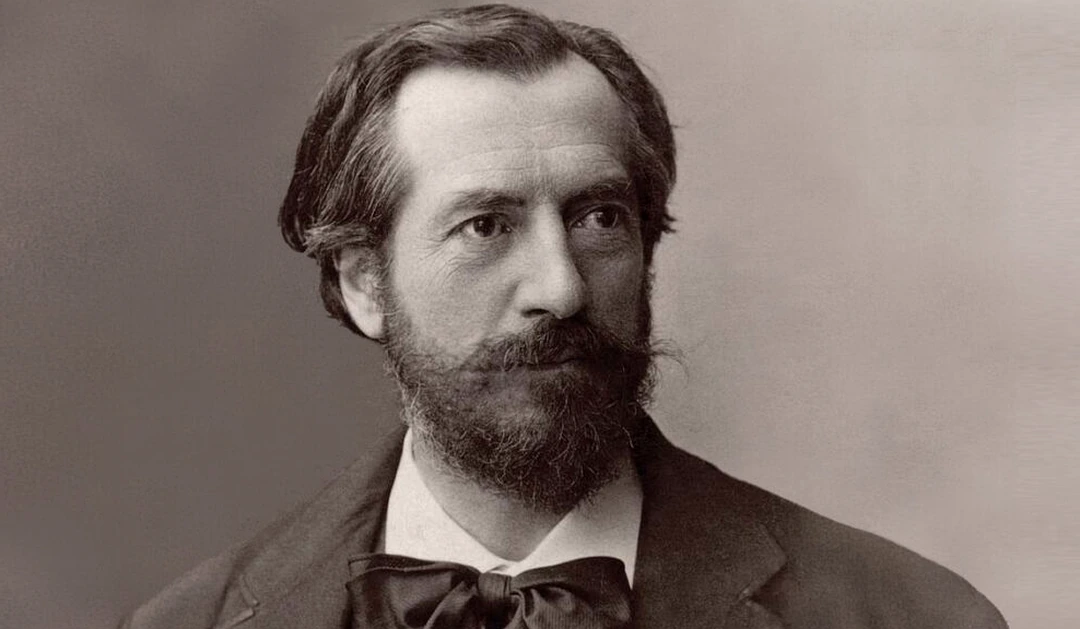
Laboulaye’s vision sparked a lasting passion in the talented young Alsatian sculptor Frédéric Auguste Bartholdi. As soon as the French Third Republic took shape following the upheaval of the Franco-Prussian War, Bartholdi sailed across the ocean to the New World in search of a setting worthy of a life’s work. Looking out over bustling New York Harbor, where ocean vessels from around the globe converged, his eye landed on small Bedloe’s Island, strategically positioned like a natural outpost. He set out to create the statue officially titled in French La Liberté éclairant le monde—Liberty Enlightening the World. Inspired by Libertas from ancient Roman mythology, she wears a seven-rayed crown representing light shining across seven continents and seven seas, raises a torch of enlightenment in her right hand, holds a tablet inscribed with the date of independence in Roman numerals in her left, and stands over broken shackles of tyranny at her feet.
From an engineering standpoint, this sculptural landmark was a mechanical marvel ahead of its time, bringing together leading French minds of the era. Initially, renowned architect Eugène Viollet-le-Duc was tasked with designing an internal support structure using a masonry core alongside repoussé copperwork. After his sudden death in 1879, Alexandre Gustave Eiffel—the brilliant engineer whose name would later become synonymous with the iconic tower along the Seine—stepped onto the project. Working with colleague Maurice Koechlin, Eiffel introduced a groundbreaking structural system: instead of a heavy, brittle masonry pillar, he designed a flexible iron-and-steel lattice truss with a sturdy four-legged central pylon, allowing the outer skin of more than three hundred thin copper sheets—only about 2.4 millimeters thick—to expand and contract with temperature shifts and sway gently in fierce ocean gales without cracking.
After years of hard-won fundraising among everyday working people in both countries—boosted by public campaigns led by newspaper publisher Joseph Pulitzer—the statue was disassembled into 350 individual pieces and packed into 214 wooden crates, carried across the Atlantic to New York Harbor aboard the frigate Isère. On October 28, 1886, amid misty skies, booming cannon fire, and cheering crowds, U.S. President Grover Cleveland presided over the dedication ceremony before international delegations. From that moment on, the monument stood not only for Franco-American friendship, but also as a beacon of hope welcoming millions of immigrants arriving near Ellis Island in search of freedom and opportunity.
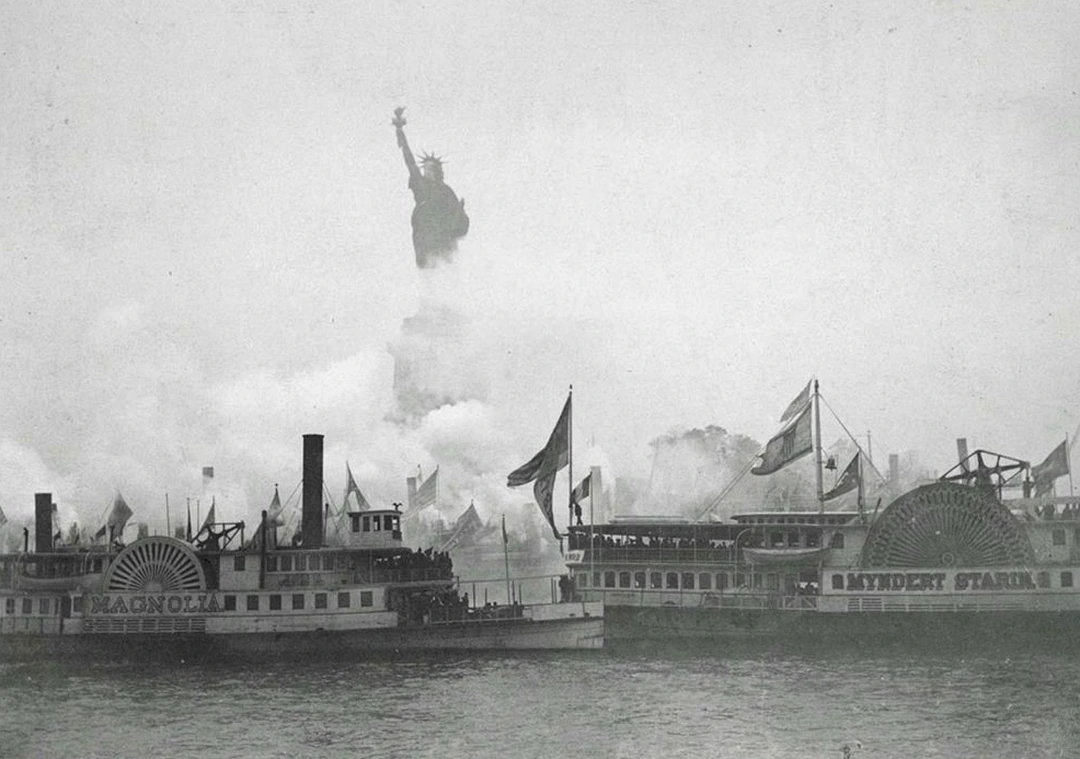
Set apart on Liberty Island—covering roughly five hectares in Upper New York Bay—the Statue of Liberty holds a commanding strategic position in both coastal geography and tidal flow. Here, the currents of the Hudson River, the East River, and the approach to the open Atlantic converge. In traditional Eastern geomancy, it is the classic picture of waters gathering and nurturing vitality, where ocean tides bring life and movement into the sheltered harbor before fanning out across the delta. Positioned facing southeast, the statue catches the early light rising over the East Coast horizon while looking out toward the sea like a welcoming presence for travelers crossing from Europe.
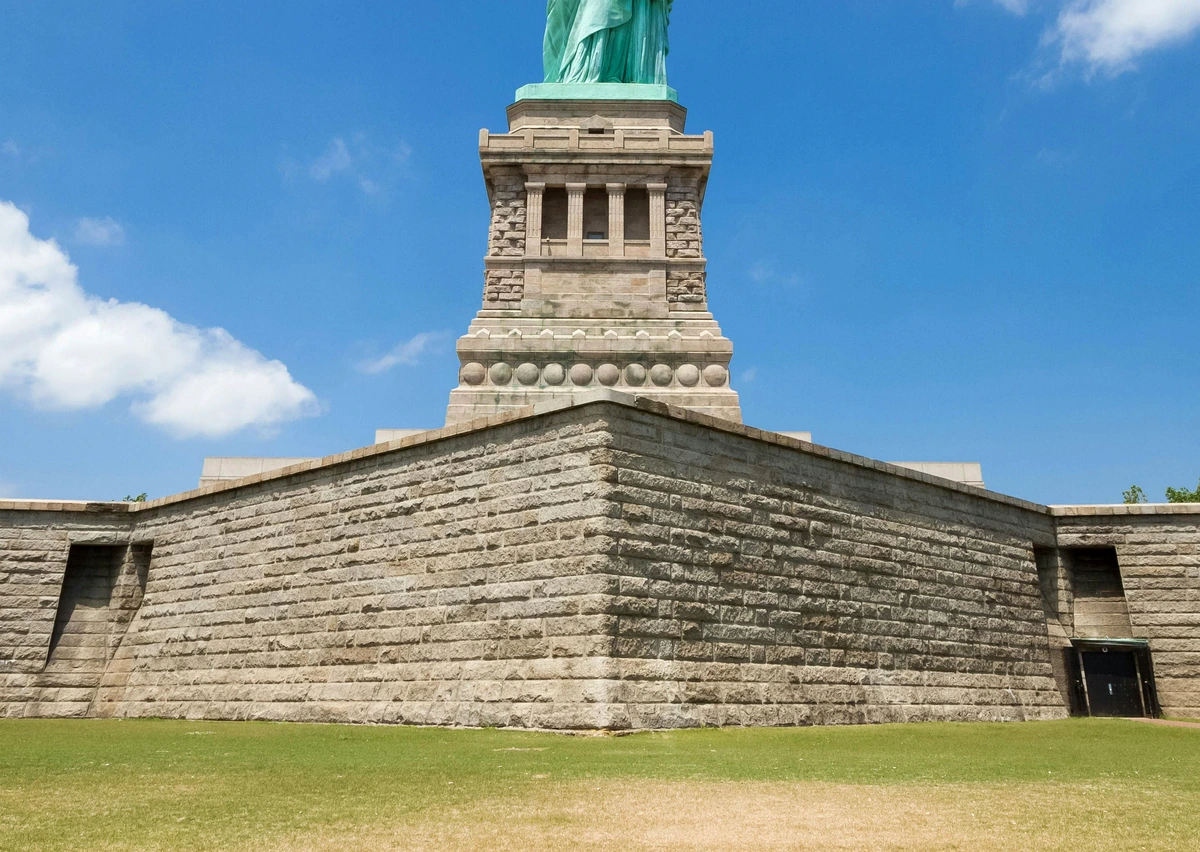
Right next to Liberty Island lies Ellis Island, the historic immigration station once crossed by more than twelve million newcomers seeking a fresh start. Their proximity across the water forms a resonant historic corridor across the mouth of New York Harbor. Rather than standing directly on loose sand, the monument is anchored atop the granite star-shaped walls of Fort Wood, an eleven-pointed coastal defense fort built in the early nineteenth century. Turning a former military fortification into the base for a symbol of peace and freedom was a striking architectural shift by its planners.
To support the colossal figure, architect Richard Morris Hunt designed a monumental granite pedestal rising nearly forty-seven meters, echoing the stepped lines of ancient truncated pyramids and classical motifs. Beneath the calm surface of stone and copper lies the forward-looking engineering of Gustave Eiffel. Instead of solid masonry that could buckle under its own weight, Eiffel created an internal iron-and-steel truss frame anchored by four main legs with flexible bracing. This design lets the statue expand and contract across the East Coast’s four seasons and sway safely by a few centimeters when battered by strong coastal storms.
Wrapping that ingenious skeleton are more than three hundred pure copper plates shaped by Frédéric-Auguste Bartholdi and French artisans using traditional repoussé hammering. Each sheet is remarkably thin—around 2.4 millimeters, roughly the thickness of two stacked coins—and attached to the iron framework using insulating strips to prevent galvanic corrosion. Exposed to salty sea air year after year, the copper’s original reddish-brown sheen gradually oxidized into a soft turquoise patina, blending the monument naturally with the sky and waters of New York.
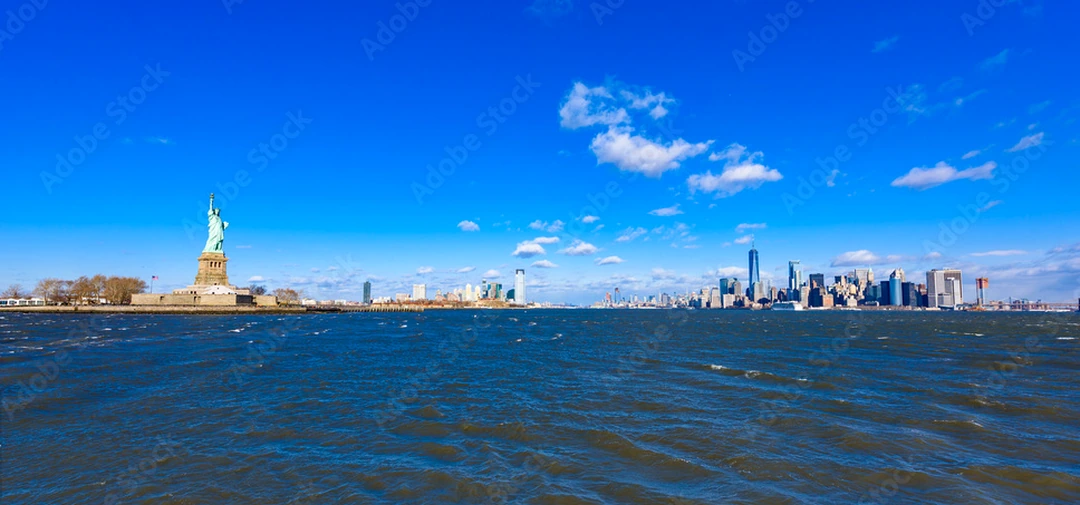
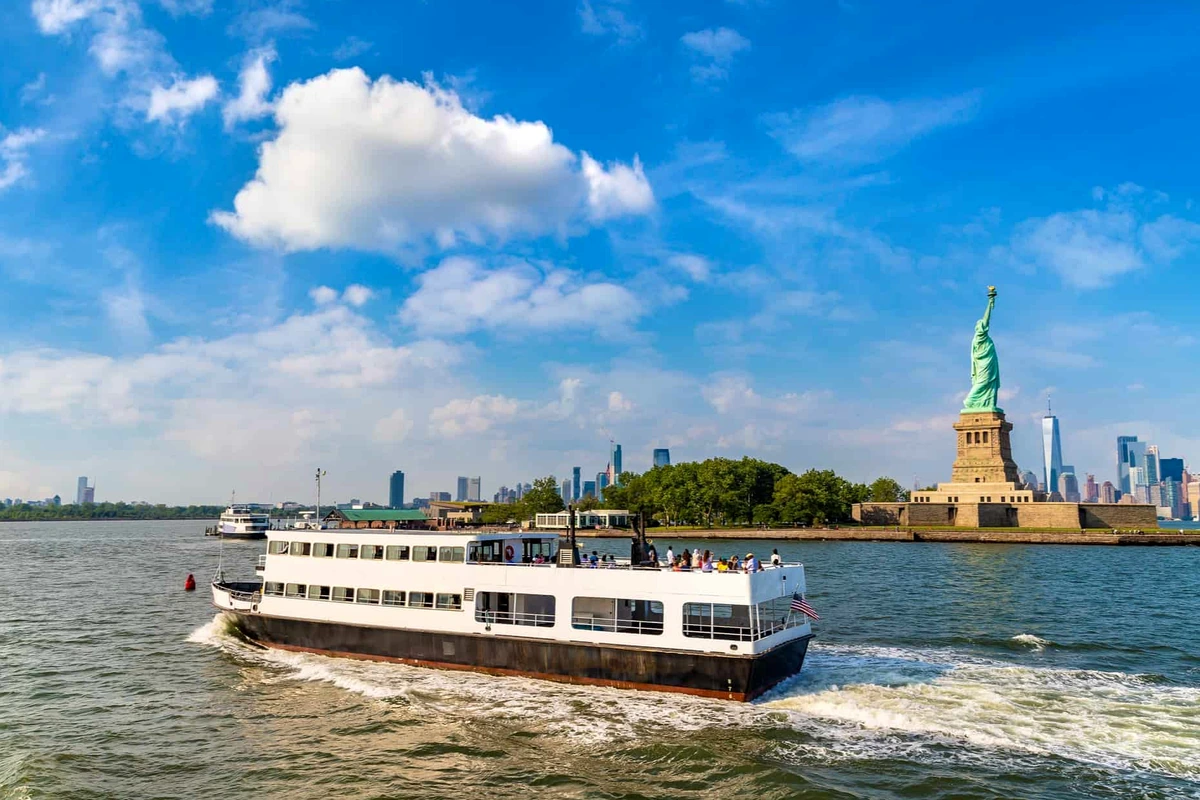
Seen on the boat ride to Liberty Island across the blue waters of Upper New York Bay, the monument rises as a landmark of nineteenth-century engineering. Measuring roughly 93 meters from the base of its foundation to the tip of the torch—with the figure of Liberty herself standing 46 meters tall—its scale does more than anchor the East Coast skyline; careful optical proportions allow visitors on deck or across the water in Manhattan to read the sweep and poise of her flowing robes from afar.
Behind an exterior that looks carved in stone for the ages lies extraordinary metalwork: a copper skin just 2.4 millimeters thick—about the thickness of two coins stacked together. Sculptor Frédéric-Auguste Bartholdi used French repoussé craft, hammering more than three hundred copper sheets over wooden forms to shape the figure’s contours, drapery folds, and composed expression. Over more than a century in Atlantic salt air, the raw copper naturally weathered into a protective verdigris patina that shields the metal beneath from the elements.
Supporting hundreds of tons of copper is the pioneering iron-and-steel skeleton engineered by Alexandre-Gustave Eiffel, who later made his name with the Paris tower bearing his surname. Eiffel moved away from heavy load-bearing brick walls and devised a central lattice tower with flexible secondary beams so the copper skin could attach without locking rigidly to the core. Thanks to this design, the statue moves naturally with seasonal temperature swings and sways gently in storm winds without cracking, with calculated deflections of roughly eight centimeters at the head and more than twelve centimeters at the torch.
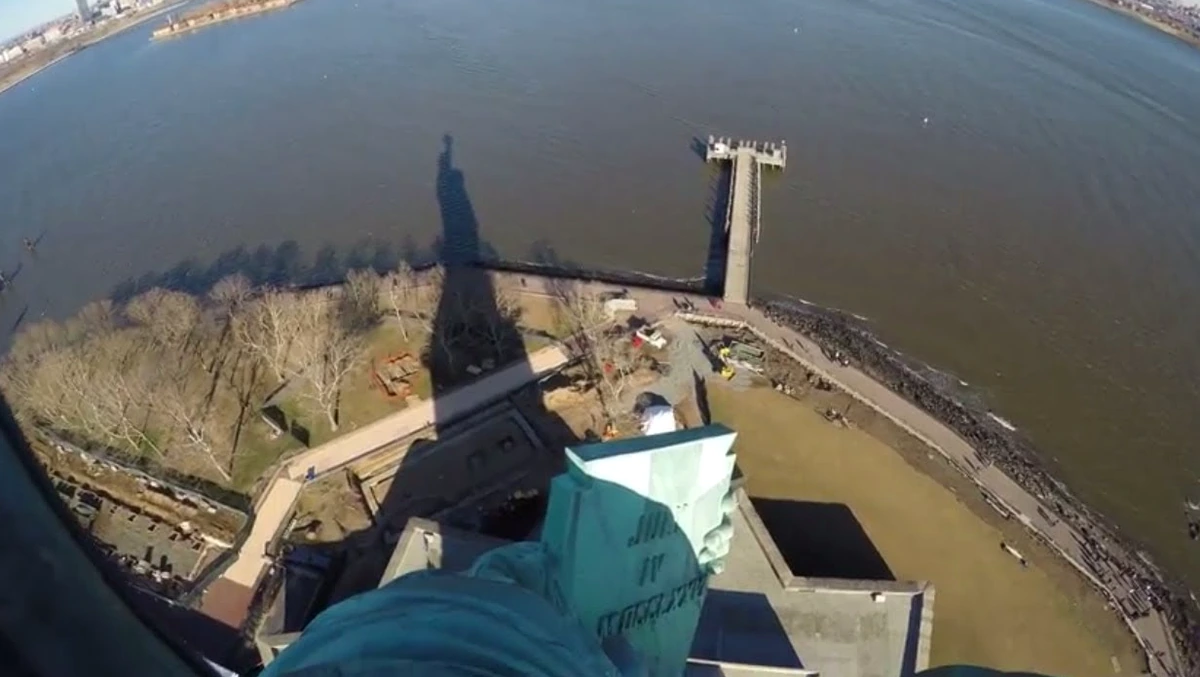
The brightest focal point of the monument is the torch raised high in her right hand toward the sky. Rainwater intrusion and past lighting alterations damaged the original torch, leading to its removal in 1984 for preservation. In its place stands a faithful replica of Bartholdi’s design finished in 24-karat gold leaf. Catching morning sunlight or nighttime floodlights, the pure gold gleams alongside the seven-rayed crown, which opens onto twenty-five windows looking out over the harbor.
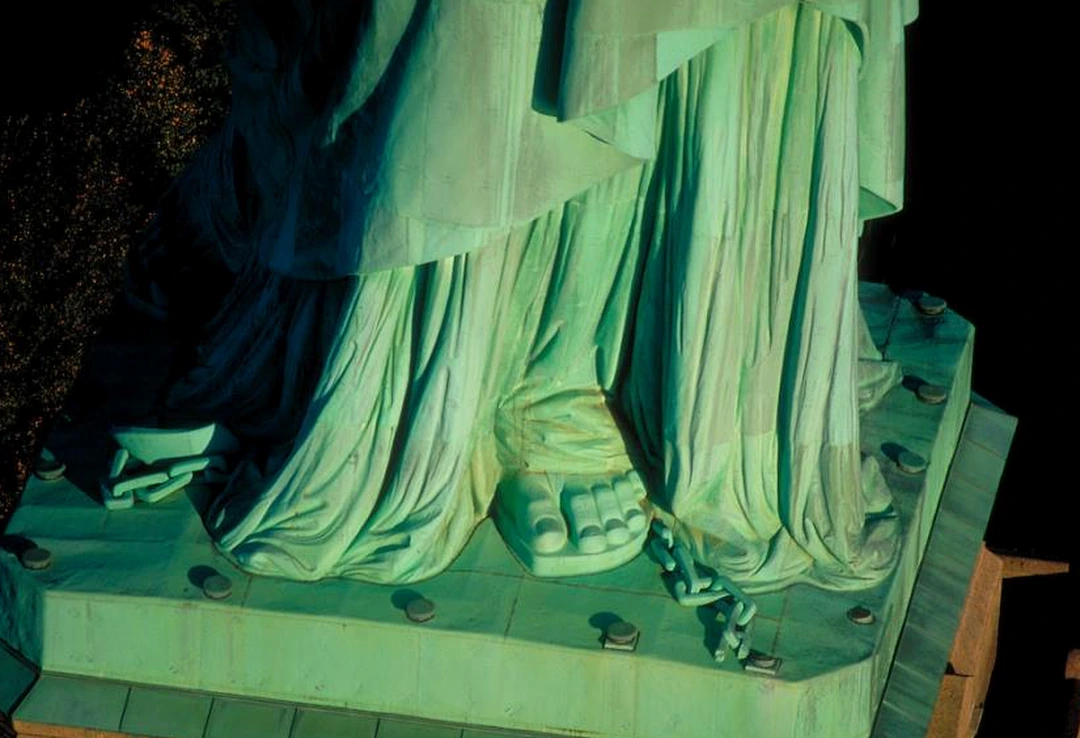
The statue’s imagery is completed by details at its base that underscore themes of liberation. Beneath the folds of her robe at the foot of the granite pedestal lie broken shackles, symbolizing the end of tyranny and bondage. In her left hand, she holds a tabula ansata tablet inscribed with July 4, 1776 in Roman numerals—balancing the light of the torch with the rule of law in a lasting bronze-and-copper statement at the mouth of the Hudson.
As amber sunset fades behind the towers of New Jersey, New York Harbor shifts into a dramatic evening scene. The familiar patina of the monument gives way to the deep night over the Hudson estuary where Atlantic salt water meets river currents. After dark, the Statue of Liberty becomes a luminous sculpture of light, fulfilling sculptor Frédéric-Auguste Bartholdi’s early hope of creating a guiding beacon for ships crossing the ocean to the New World. Where nineteenth-century lighting technology had limits, modern illumination brings that vision vividly to life across the bay.
Her nighttime presence is shaped by precision architectural LED lighting arranged around the eleven-pointed granite star of Fort Wood. Warm white light with high color rendering traces the folds of her Roman stola, highlighting Libertas’s calm features and the seven rays of her crown. High above, the 24-karat gold-leaf torch catches directed beams so the flame appears to glow warmly against the night sky, serving as the brightest focal point in Upper New York Bay.
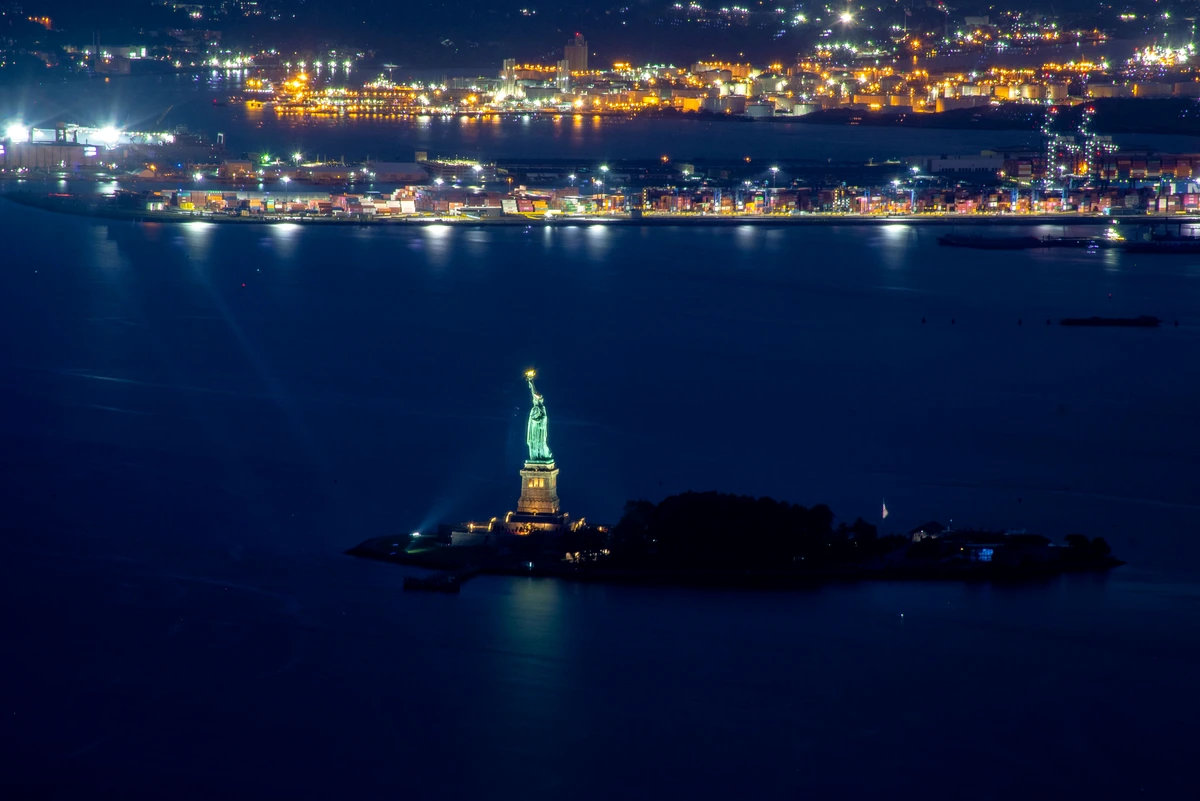
Seeing the statue lit up at night is closely tied to evenings out on the Hudson. Evening harbor cruises depart from piers such as Pier 83 or Chelsea Piers, gliding south with shifting views of the nearly 93-meter monument rising against a dark sky. Behind her, Lower Manhattan glows with One World Trade Center and the lights of Wall Street’s financial district. Riders on the Staten Island Ferry can also catch this view passing Liberty Island, where water lapping the hull and distant boat horns set a quiet, nostalgic mood.
Back on shore, viewing the lit monument from southern Manhattan offers a calmer pace. In The Battery at the southern tip of the island, benches along the waterfront promenade let you watch the golden torch across the water in the sea breeze. For a more dressed-up evening, waterfront restaurants and rooftop spots in Battery Park City or the South Street Seaport frame the torch reflected in the Hudson against a soft harbor haze—a fitting way to take in a landmark that has lit the night through changing times.
Liberty Island itself is carefully preserved as a historic site, so you will not find large restaurants or full-service dining on the island. Instead, the food story connected to the Statue of Liberty begins as soon as the ferry docks at Battery Park, opening onto the Financial District and Lower Manhattan. For generations, this southern tip of Manhattan was a first stop for immigrants arriving from Europe, turning its streets into a rich mix of neighborhood bakeries, pizzerias, and delis shaped by over a century of city life.
Stepping off the boat near the waterfront, a classic New York bagel breakfast is a staple way to start the day. Rooted in the baking traditions of Ashkenazi Jewish immigrants who arrived through New York in the late nineteenth century, a well-made bagel is boiled briefly before hot-oven baking—giving it a thin, glossy, crisp crust and a dense, chewy interior. Split and spread with smooth cream cheese, then topped with thin slices of lox, red onion rings, and briny capers, it is a hearty morning ritual that has fueled dockworkers, Wall Street commuters, and locals alike.
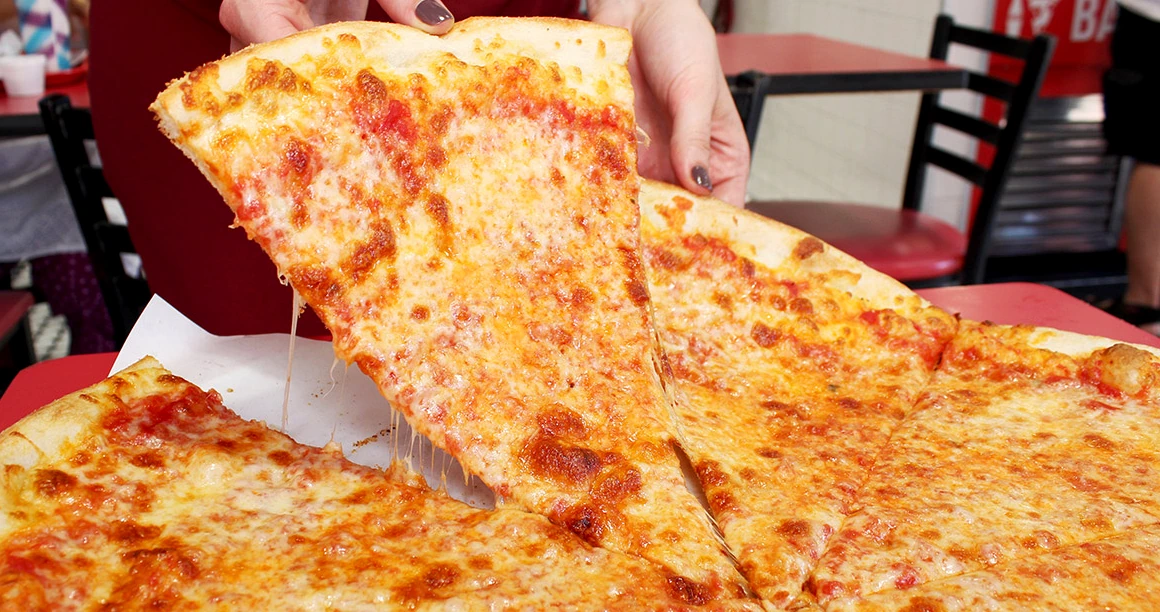
Heading into the narrow streets of the Financial District beside The Battery, the aroma of hearth-baked dough and herbs points toward another New York street-food classic: thin-crust New York-style pizza. Brought over by Italian immigrants from Naples in the early twentieth century, a classic slice is wide, with a blistered, lightly charred crust and a tender center that folds neatly lengthwise in one hand while walking. Topped with slow-simmered San Marzano tomato sauce, crushed garlic, oregano, and melted mozzarella, a hot slice on a breezy corner captures the brisk energy of the city.
To round out the classic food map near the ferry landings, a stop at Katz’s Delicatessen—operating continuously since 1888 near the Lower East Side—is well worth making for a pastrami sandwich. Prime beef brisket is cured with salt and a spice blend of cracked black pepper, coriander, cloves, and garlic for over three weeks, smoked over hardwood, and steamed for hours until tender. Piled high between slices of dark rye with sharp mustard and served alongside crisp half-sour pickles, its rich, savory, peppery, and tangy flavors echo the hard work and hope of earlier generations near the harbor.
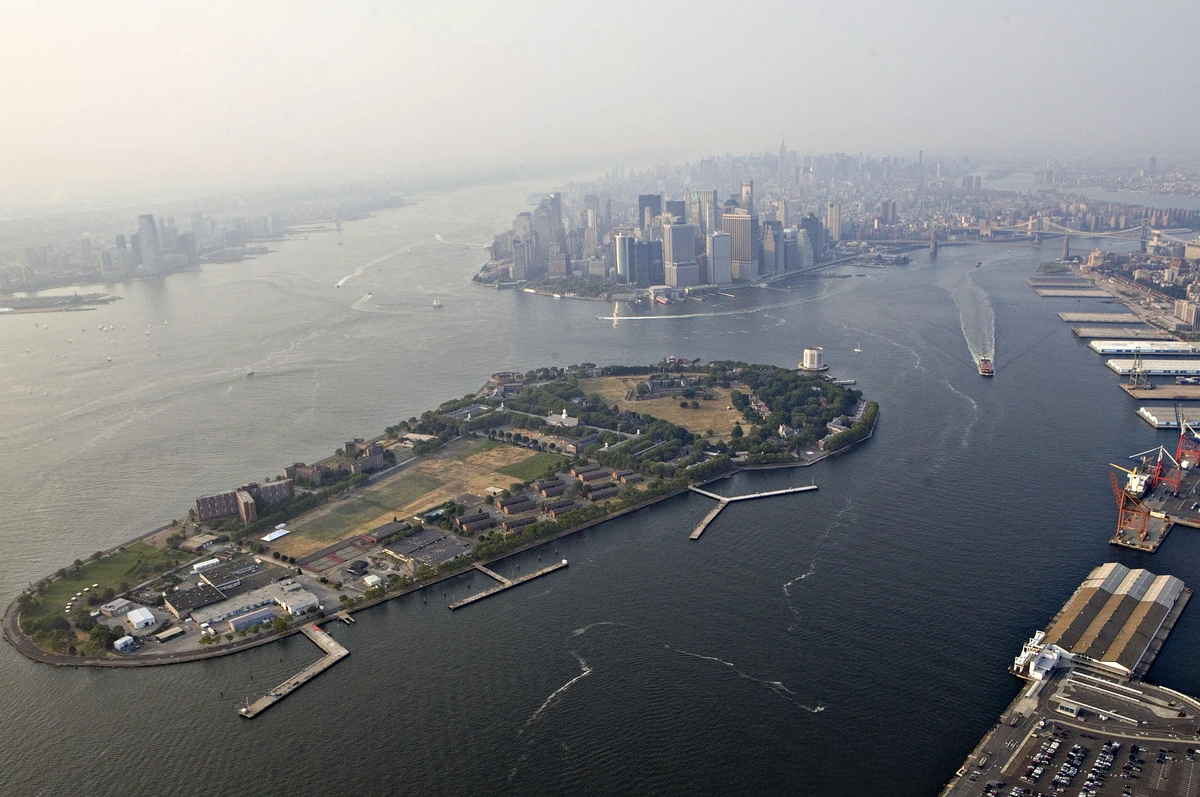
Visiting the Statue of Liberty takes a bit of planning since Liberty Island sits out in the harbor and is reached only by boat via the authorized operator, Statue City Cruises. Depending on where you stay, ferries depart from two spots across the water: Battery Park at the southern tip of Manhattan in New York, or Liberty State Park in Jersey City, New Jersey. From Manhattan, taking the subway is straightforward via the 1 train to South Ferry or the 4 and 5 trains to Bowling Green. Departing from Liberty State Park offers convenient parking, open grounds, and often shorter boarding lines.
Tickets are managed by the National Park Service across three tiers and require advance booking. General admission tickets cover grounds access on the islands and exterior views of the monument. Pedestal access inside Fort Wood and especially crown tickets are limited and often sell out two to three months ahead on the official booking site. Climbing to the crown—roughly twenty stories up via a narrow, steep 162-step metal spiral staircase—requires good physical fitness and comfort in tight spaces. Every valid ferry ticket includes round-trip access to Ellis Island and the National Museum of Immigration.
Ferries run year-round except Thanksgiving and Christmas Day, with morning departures around 9:00 AM and late-afternoon returns shifting seasonally. Plan on four to six hours for the trip and aim for one of the earliest boats of the day. Arriving early helps you beat midday crowds and gives you clean morning light across the statue’s green patina.
Security screening at the ferry terminals follows airport-style procedures. All visitors pass through metal detectors and carry-on bags go through X-ray machines before boarding. Weapons, sharp objects, lighters, pepper spray, drones, and oversized luggage or large backpacks are prohibited. Visitors with pedestal or crown tickets must store personal items—aside from a small camera, phone, and necessary medication—in paid lockers at the base before heading up the stairs.
Weather on the harbor often feels windier and sharper than inland due to breezes off the Atlantic. Winter brings chilly gusts that call for layered warm clothing, gloves, and a knit hat, while summer sun reflecting off water and stone calls for sunglasses, sunscreen, and a brimmed hat. Sturdy, comfortable walking shoes make paved paths and steps much easier. On the return ferry in late afternoon, stand toward the port stern for a classic view of Lower Manhattan’s skyline glowing in warm sunset light.
Taking in the harbor breeze and seeing the torch lit against the sky feels even more relaxed when tickets, ferry logistics, and screening are sorted out ahead of time. Joining a complete U.S. East and West Coast tour package is a practical option if you want advance reservations handled and a smooth way to experience one of America’s defining landmarks.