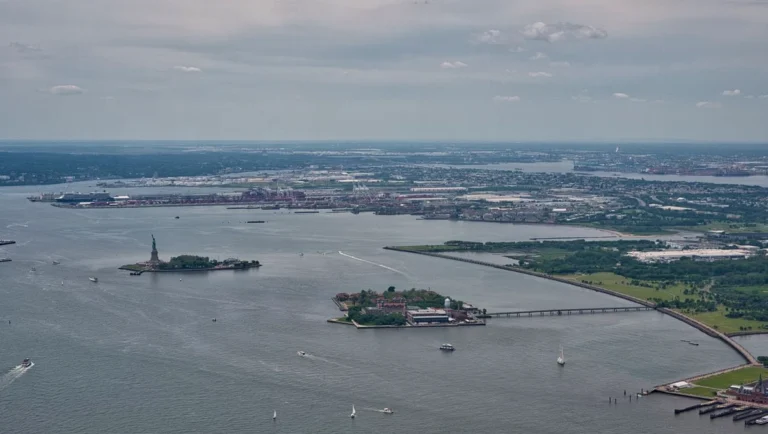
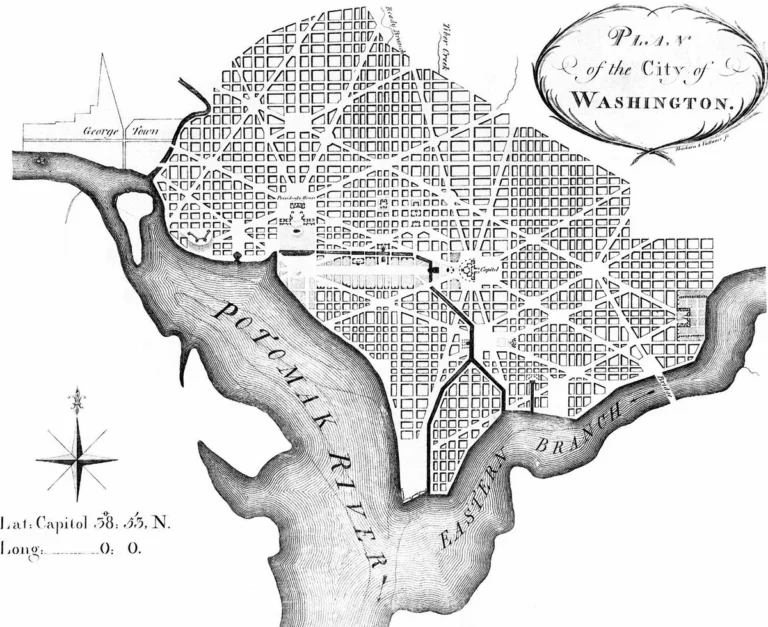
Before rising to become the world’s most powerful financial capital, the narrow strip of land at the southern tip of Manhattan Island was known to the Indigenous Lenape people of the Munsee language group by the tranquil name Mannahatta, meaning “island of many hills.” For centuries, this terrain consisted solely of untamed tidal flats, dense oak forests, and natural creeks—where the Lenape cultivated corn and beans and harvested seafood along the shores of New York Harbor. The first major turning point arrived in 1624, when the Dutch West India Company officially landed on these new shores and established a colonial outpost named Nieuw Amsterdam. From a modest fur-trading post operated by seafaring merchants, the settlement was swiftly swept into fierce geopolitical rivalries among the Western maritime superpowers of the era.
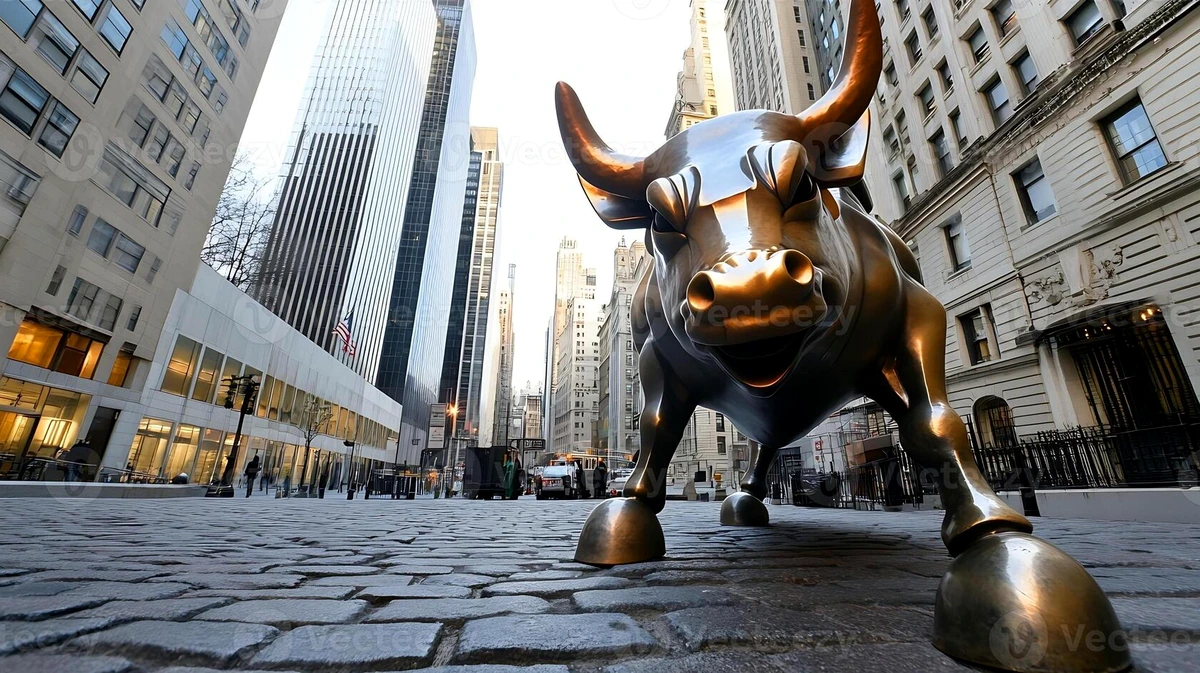
Confronted with the constant threat of raids from Indigenous tribes and escalating territorial expansion pressure from the English in New England, Director-General Peter Stuyvesant issued an emergency military decree in 1653. He ordered soldiers and settlers to construct a formidable defensive palisade of sharpened wooden stakes measuring exactly 2,340 feet (approximately 713 meters) in length and about 12 feet high, cutting across the peninsula from the East River shoreline to the Hudson River. This fortified rampart not only demarcated the survival boundary between the Dutch settlement and the northern wilderness, but also directly gave birth to the original geographical name “De Waal Straet,” the precursor to today’s Wall Street. When British Royal forces took over the colony without firing a single shot in 1664 and renamed the territory New York, the defensive wall was gradually dismantled to make way for brick buildings and bustling shops. The dirt lane along the old stockade officially transformed into a vital commercial thoroughfare, hosting commodity auctions alongside trade in grain, tobacco, and early financial contracts.
The historic pivot that cemented Wall Street’s enduring financial stature was inscribed on May 17, 1792. Beneath the shade of an ancient buttonwood tree standing opposite 68 Wall Street, 24 of New York’s most prominent merchants and brokers gathered to sign the legendary “Buttonwood Agreement.” This brief yet groundbreaking document established standardized rules of commercial conduct, fixed commission rates, and granted trading preference among its signatories, thereby giving birth to the New York Stock Exchange (NYSE). Across more than two centuries of triumphs and turmoil, this narrow bend measuring less than a mile long has witnessed countless eras of prosperity alongside devastating global economic shocks—reaching a painful nadir on October 19, 1987, known as “Black Monday.” In a single fateful trading session, the Dow Jones plummeted 22.6%, wiping out hundreds of billions of dollars and plunging the financial community into profound disarray.
Amid the somber aftermath of that financial crisis, an urban art legend was conceived through extraordinary courage. Renowned Italian-American sculptor Arturo Di Modica worked in secret for two full years, investing a staggering $350,000 to $400,000 of his personal savings to cast his masterpiece “Charging Bull”—a solid bronze sculpture weighing over three tons, captured mid-charge in a pose of unstoppable momentum. On the fateful night of December 15, 1989, under a blanket of falling snow, Di Modica and his associates executed a daring act of “guerrilla art” by trucking the statue in and covertly installing it directly in front of the main entrance of the New York Stock Exchange beside a giant Christmas tree, as a priceless gift to the American people to inspire resilience in overcoming adversity. Although initially impounded by police for unauthorized placement, an overwhelming wave of public and artistic support prompted city officials to relocate the sculpture to Bowling Green Park on December 20, 1989. From an unheralded street-corner installation, the fierce bull became permanently woven into the fabric of Lower Manhattan, evolving into an immortal emblem of optimism, prosperity, and the resilient revival of global financial markets.
Lower Manhattan owes its awe-inspiring skyline as a global financial center to the Manhattan Prong—an ancient geological formation dating back hundreds of millions of years. The bedrock supporting dozens of multi-million-ton skyscrapers here is composed of exceptionally dense metamorphic strata, notably Manhattan Schist, Hartland Formation, and Inwood Marble. It is precisely where Manhattan Schist rises closest to the surface at the island’s southern tip that engineers gained a millennia-old anchor, enabling them to drive deep caissons and massive reinforced concrete mat foundations to stabilize monuments of financial power against howling ocean gales.
In terms of topography and natural drainage, this district occupies a remarkably gentle slope. Originating from the prominent central ridge running along the historic axis of Broadway, the terrain tapers gradually toward both flanks to meet centuries-old land reclamation zones along the East River and Hudson River waterfronts. One of the most fascinating aspects of urban planning here is that while the vast majority of Manhattan Island is governed by the rigid orthogonal grid of the Commissioners’ Plan of 1811, the Wall Street area steadfastly preserves its organic, free-flowing street layout dating back to seventeenth-century Dutch Nieuw Amsterdam. Winding, narrow lanes resembling natural rock canyons flanked by towering walls defy every right-angled convention, generating distinctive aerodynamic wind tunnels and microclimates where sunlight flashes briefly through high skyward crevices before yielding to tranquil shadow.
The main artery of Wall Street begins at the southeast along the bustling East River waterfront, stretches northwestward, and terminates squarely at the heart of Broadway, forming an urban and economic corridor characterized by converging energy. The western terminus of this historic avenue is symbolically anchored by the solemn stone facade of historic Trinity Church, creating a profound duality between the realm of material wealth and a quiet spiritual sanctuary. A short distance south lies Bowling Green—New York City’s oldest public green space, established in 1733—serving as a calming oasis of balance amid the high-voltage metropolis.
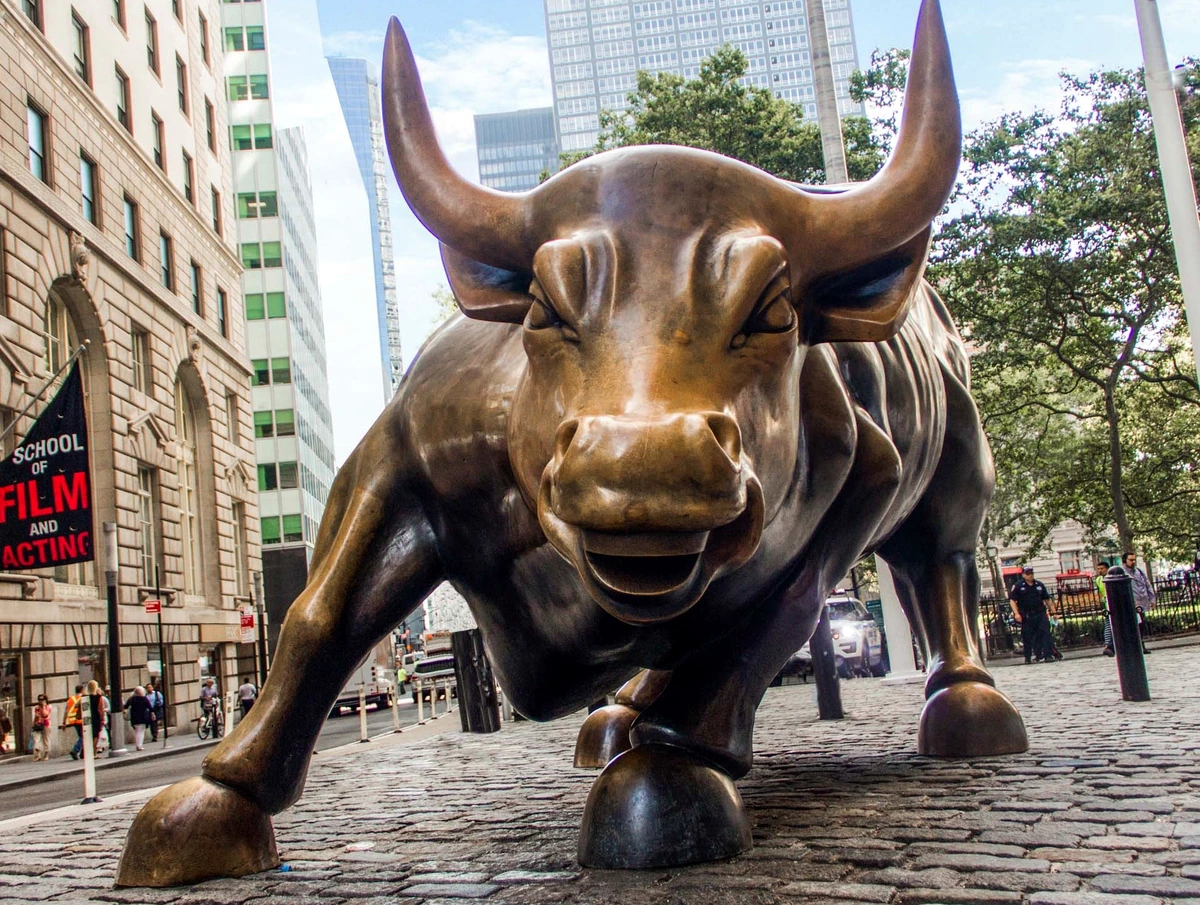
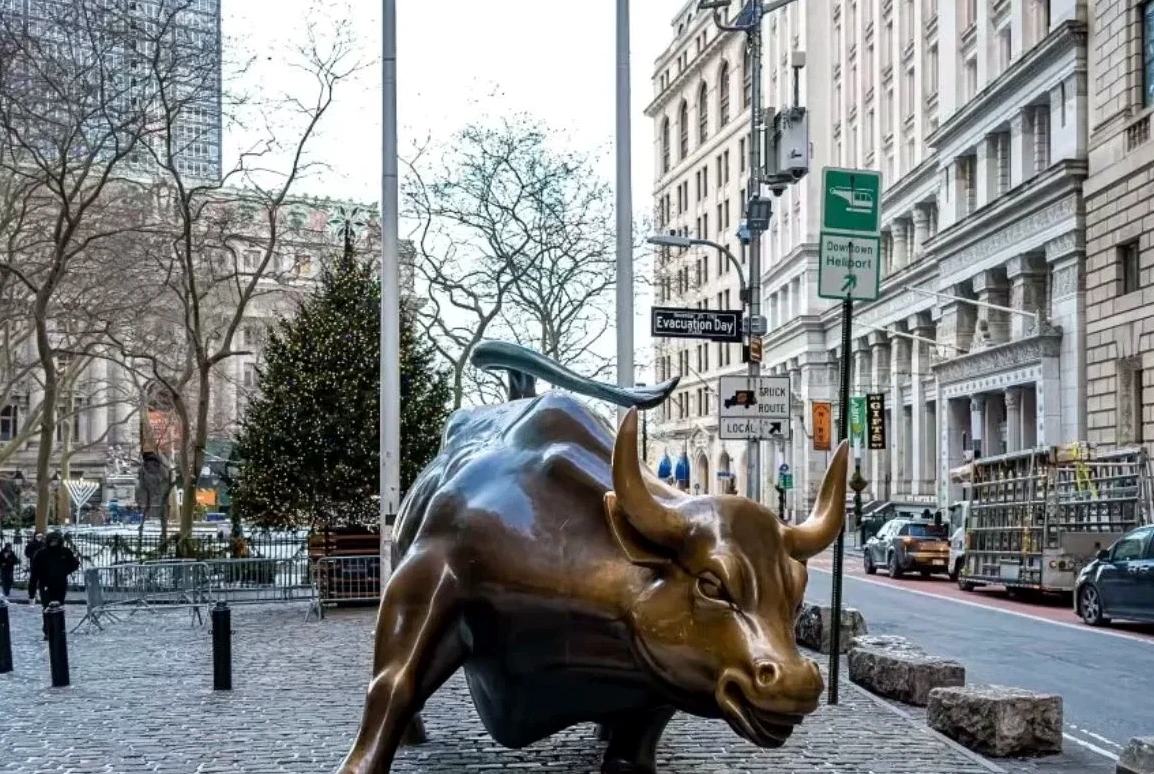
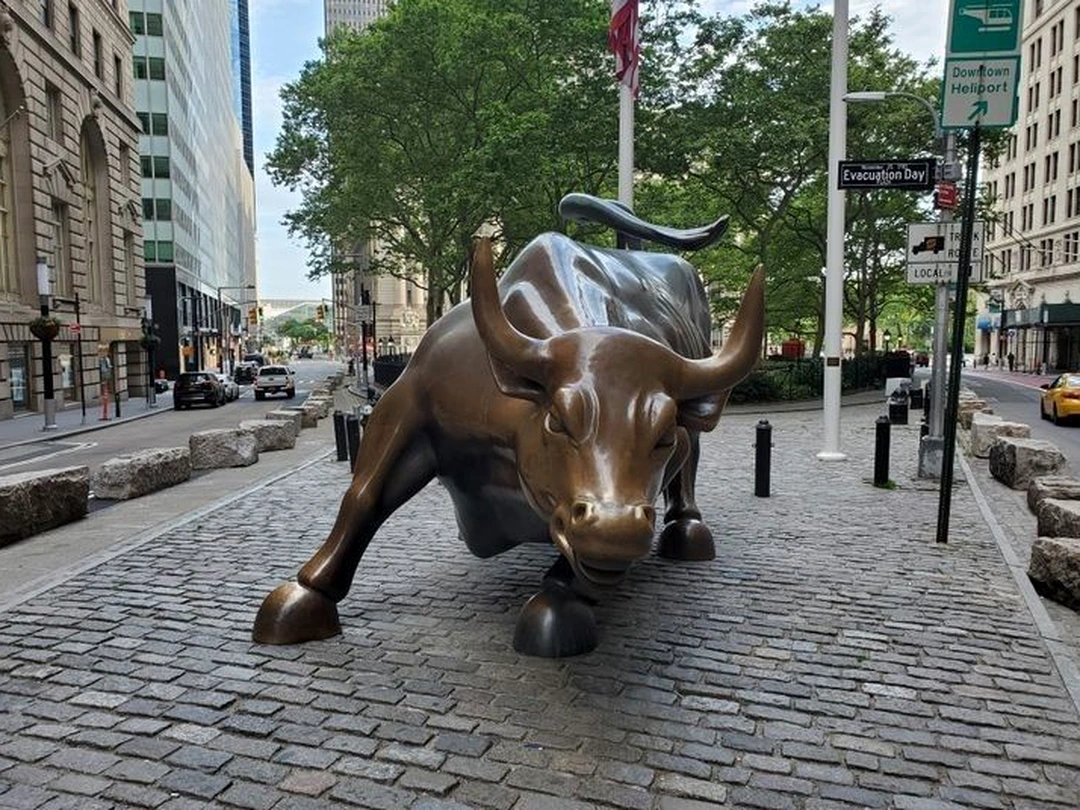
Presiding over the triangular plaza of Bowling Green stands the sculptural masterpiece Charging Bull. Carefully positioned for landscape composition and kinetic visual impact, the massive bronze statue faces directly north, confronting the relentless stream of vehicles and pedestrians surging down Broadway. With its head lowered, sharp horns thrust upward, rippling muscles coiled with raw power, and tail lashed dramatically mid-air, the sculpture radiates an intense field of visual energy—poised to charge through every obstacle and harness the ceaseless momentum of the planet’s busiest economic hub.
Despite standing proudly atop ancient bedrock, Lower Manhattan perpetually confronts immense pressure from rising sea levels and fierce coastal storms—culminating in the devastating impact of Superstorm Sandy in 2012, when record storm surges paralyzed underground power grids and flooded subway stations with seawater. That historic crisis spurred New York authorities to launch a sweeping subterranean engineering revolution. Integrated coastal resilience initiatives now combine deployable floodwalls, reinforced bulkheads paired with flood-tolerant terraced parks, backflow-preventing drainage networks, and automated high-capacity pumping stations. These cutting-edge underground systems weave seamlessly into the historic bedrock, forming a robust hydraulic shield safeguarding the arteries of global finance against the mounting challenges of climate change.
Nestled within the historic triangle of Bowling Green Park, the Charging Bull of Wall Street stands as an enduring testament to pinnacle metal-casting craftsmanship in modern Western art. Sculpted by the master hands of Italian-American artist Arturo Di Modica, this monumental work was brought to life at the renowned Bedi-Makky Art Foundry located in Brooklyn’s Greenpoint neighborhood. Artisans meticulously employed the lost-wax bronze casting method—an intricate manual process demanding absolute precision across every stage of mold creation, molten metal pouring, and the seamless welding of dozens of individual bronze sections. The completed sculpture commands extraordinary dimensions, measuring 16 feet (4.9 meters) in length, 11 feet (3.4 meters) in height, and weighing a net 7,100 pounds (approximately 3,200 kilograms). To support its bulging musculature and forward-thrusting horns without sagging or deforming under gravity and harsh weather, Di Modica engineered an intricate internal armature of stainless steel inside the hollow bronze shell, creating an extraordinarily resilient load-bearing structure.
In terms of visual language and aesthetic anatomy, the sculpture exudes latent kinetic force through every sinew and muscle fiber. The beast is captured at the exact split second before lunging forward: its forelegs crouch low to grip the cobblestone pavement, its hindquarters and arched back coil to store energy, its tail curls like a leather whip lashing through the air, and its lowered head glares fiercely straight ahead. Over decades, natural bronze oxidation combined with millions of tactile encounters from visitors’ hands has created captivating contrasts of light and patina—most notably the gleaming golden sheen across the horns and snout set against the darker, weathered bronze tones of its rugged contours.
Leaving the Bowling Green triangle to ascend the granite canyon of Wall Street opens up a premier architectural ensemble reflecting the golden age of American financial dominance in the nineteenth and early twentieth centuries. Anchoring the intersection of Broad Street and Wall Street is the headquarters of the New York Stock Exchange at 11 Wall Street, a magnificent Beaux-Arts landmark designed by architect George B. Post in 1903. The building’s crowning visual centerpiece is its colonnade of six monumental white marble Corinthian columns soaring 50 feet high, supporting an intricately carved pediment titled Integrity Protecting the Works of Man—imparting the solemn grandeur of an ancient Roman temple standing tall in the industrial age.
Diagonally across this historic crossroads stands Federal Hall National Memorial at 26 Wall Street, completed in 1842 in the Greek Revival style. The edifice faithfully echoes the classical proportions of the Parthenon with baseless Doric columns carved from famed Tuckahoe marble, framing a central rotunda and the former trading hall of the U.S. Sub-Treasury. Completing this heritage corridor are the majestic silhouette of Trinity Church at 79 Broadway—an English Gothic Revival masterpiece completed in 1846 by architect Richard Upjohn featuring a 281-foot brownstone spire—and the Cunard Building at 25 Broadway, inaugurated in 1921 in the Neo-Renaissance style with a lavishly frescoed vaulted great hall, composing an exquisite symphony of realist sculpture and human architectural heritage.
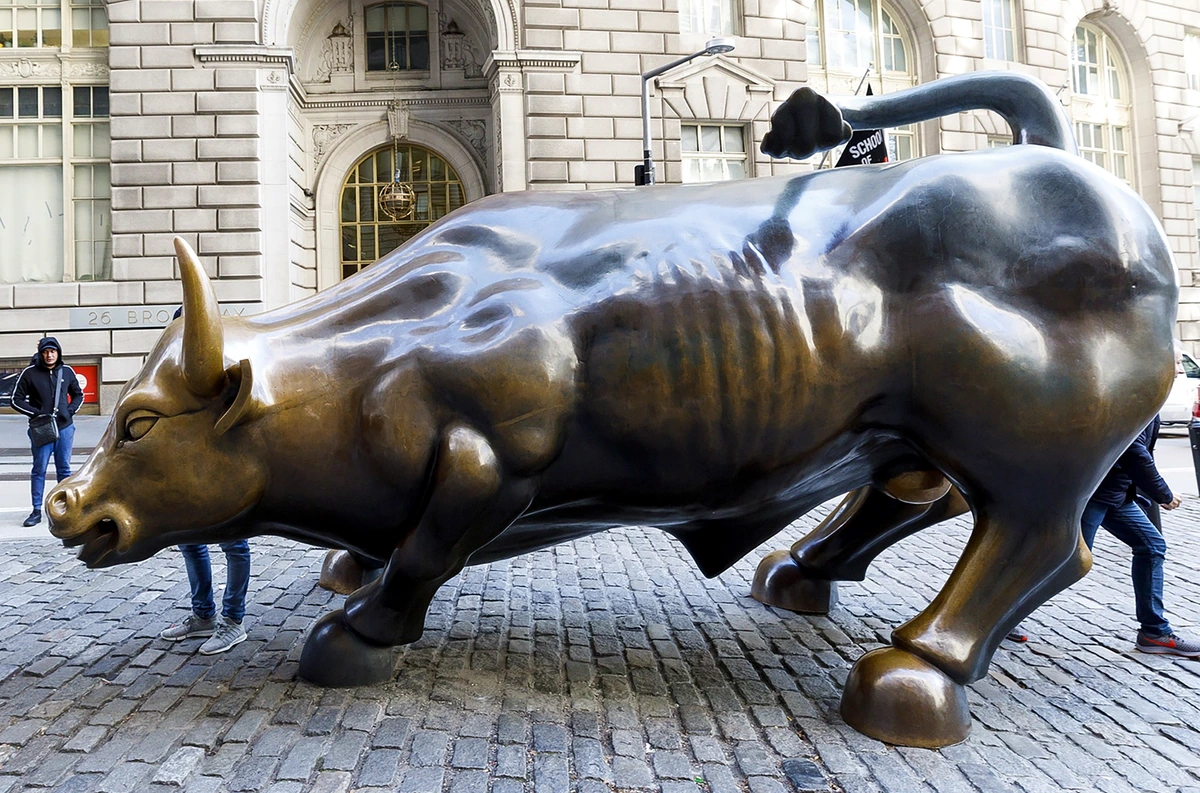
As twilight descends into the deep financial canyons of Lower Manhattan, Wall Street undergoes a dramatic spatial transformation. Harsh daytime glare reflecting off glass and steel yields to evening shadows enveloping Beaux-Arts and Art Deco towers. At this hour, sophisticated architectural lighting managed by the Downtown Alliance works its visual magic, turning Indiana limestone and gray granite facades into luminous bas-reliefs seemingly suspended in midair. Classical cornices and the imposing Corinthian columns of Federal Hall and the New York Stock Exchange glow beneath cool-spectrum uplighting, creating a serene, theatrical stage that stands in stark contrast to the frenetic flow of capital concluded hours earlier at the closing bell.
Heading south along Broadway toward the green oasis of Bowling Green, visitors’ eyes are immediately drawn to the dedicated lighting installation illuminating Arturo Di Modica’s iconic Charging Bull. Unlike the cool tones bathing surrounding banking towers, the three-ton bronze statue is highlighted by precision fixtures blending modern LED technology with high-intensity metal-halide lamps. Warm amber beams angled with exactitude accentuate every rippling muscle, defiant pointed horn, and contour of bare metal. This specialized illumination celebrates the mirror-smooth golden patches of bronze polished over decades by millions of visitors from around the globe touching the statue for financial good fortune. Beneath the bull’s hooves, light casts long, crisp shadows across the granite flagstones, transforming the sculpture into a living colossus quietly gathering strength in the heart of the urban night.
Once the clock strikes 7:00 PM EST, an almost surreal stillness blankets the entire historic financial district. The roar of traffic, hurried footsteps of stockbrokers, and clamorous daytime deal-making fade away, giving way to an atmospheric quietude bordering on the dreamlike. Wall Street after dark is filled with deeply evocative ambient sounds: the steady hum of massive subterranean HVAC ventilation fans, the rhythmic cadence of patrolling police boots striking historic stone pavements, and—every quarter hour—the deep, resonant tolling of bronze bells from Trinity Church’s spire echoing down narrow lanes that have witnessed centuries of Western capitalism.
Beneath that tranquil street-level calm lies an alluring subterranean nightlife curated for discerning connoisseurs. Tucked behind foot-thick steel vault doors that once guarded the impenetrable gold reserves of historic financial institutions, celebrated speakeasies and private clubs open doors to refined indulgence. Beneath flickering candlelight dancing across famed Guastavino-tiled vaulted ceilings, guests can savor a classic Manhattan cocktail crafted from top-shelf rye whiskey and sweet vermouth, evoking the gilded era of nineteenth-century financiers. Pairing the rich, savory depth of a thick-cut Delmonico steak with the lingering aroma of fine cigar smoke along shaded historic corners elevates an evening in Lower Manhattan to the pinnacle of cultural sophistication and timeless nostalgia.
Dining in Lower Manhattan’s Financial District has never been merely about culinary pleasure; it has long functioned as an institutional ritual intertwined with the power history of investment banks, prestigious law firms, and brokerage houses. Tucked beneath the shadows of towering granite skyscrapers, the local culinary map weaves together centuries-old colonial taverns and some of America’s most opulent power dining rooms. Amid a world where capital moves by the millisecond, sitting down in a classic dining room is not just how sharp minds recharge—it is where billion-dollar mergers have been sealed with handshakes over aged spirits.
Standing proudly at 56 Beaver Street since 1837, Delmonico’s holds a storied place in history as the first fine-dining restaurant in the United States. Stepping through its grand arched entrance transports diners back to the prosperous Gilded Age, complete with Pompeii-inspired mosaic floors, gleaming mahogany paneling, and sparkling crystal chandeliers. Delmonico’s is the birthplace of enduring icons of Western gastronomy—most famously the signature Delmonico Steak, cut from richly marbled ribeye and seared over glowing coals to lock in juicy, natural sweetness. It is also the birthplace of timeless Eggs Benedict, crowned with velvety hollandaise over rich poached eggs, having hosted legendary patrons ranging from author Mark Twain to titans of the Morgan and Vanderbilt dynasties.
Reaching even further back into the fiery era of the American Revolutionary War, Fraunces Tavern at 54 Pearl Street stands as a living witness and the oldest surviving commercial building on Manhattan Island. Opened by proprietor Samuel Fraunces in 1762, this Georgian red-brick landmark served as a vital headquarters for General George Washington. In the upstairs Long Room on December 4, 1783, the future first President of the United States delivered an emotional farewell address to his closest officers before resigning his commission to Congress. Today, the ground floor of Fraunces Tavern preserves the authentic ambiance of an eighteenth-century colonial taproom with rugged timber beams, serving dozens of craft ales alongside savory beef and ale pot pies, while the upper floors are meticulously maintained as a Revolutionary War museum housing priceless historical artifacts.
Venturing deeper into the network of historic cobblestone lanes, 1 Hanover Square is home to Harry’s Cafe & Steak, tucked serenely inside the vaulted basement of a stately bank building dating back to 1873. Founded in the mid-twentieth century, it quickly became the quintessential temple of the power lunch and a beloved gathering spot for Wall Street traders unwinding after intense sessions on the exchange floor. Harry’s culinary reputation centers on premier USDA Prime beef dry-aged for weeks in strictly temperature- and humidity-controlled rooms, allowing natural enzymes to tenderize the meat and concentrate deep umami richness. Savoring a sizzling steak paired with an ice-cold gin martini garnished with a lemon twist in its warmly lit dining room—while listening to tales of market-shaking trades—captures the authentic cultural identity and bold spirit of the world’s financial capital.
Standing proudly at the historic crossroads where Bowling Green opens onto the southern gateway of Broadway, Charging Bull occupies a completely open public plaza, welcoming visitors 24 hours a day, 365 days a year without barriers or admission fees. In sharp contrast to the breathless daytime bustle of the global financial hub, the ideal window to admire the sculpture in serene solitude is between 5:00 AM and 7:00 AM Eastern Standard Time (EST). At dawn, the first rays of morning light slip through narrow gaps between skyscrapers, illuminating the gleaming bronze surface unobstructed by dense crowds. While the bull welcomes close-up public access, the adjacent nerve center of global capital markets—the New York Stock Exchange headquarters at 11 Wall Street—remains strictly closed to general walk-in visitors. Access to its legendary trading floor is reserved exclusively for financial professionals, designated market makers, and delegations holding special security clearance.
To navigate the dense labyrinth of limestone canyons across Lower Manhattan, the smartest and fastest mode of transit is the New York City Subway (MTA). Travelers can easily plan their route via key underground stations: Bowling Green station (4 and 5 trains) brings passengers up to street level just steps from the statue; Wall Street station (2, 3, 4, and 5 trains) leads directly into the heart of the financial district; while Broad Street station connects conveniently via the J and Z lines. Emerging from the dim corridors of century-old subway tunnels into the soaring neoclassical grandeur overhead delivers an unforgettable visual contrast for every first-time visitor.
An on-site visit to Charging Bull has long been intertwined with iconic Wall Street folklore rituals. Millions of travelers from across five continents line up patiently to touch and rub the bull’s snout, sharp horns, and especially its testicles—a symbolic gesture believed to bring financial luck, enduring capital, and prosperity. Because decades of constant touching have polished these bronze surfaces to a slick sheen, visitors should mind their footing amid lively crowds pressing in for photos. For photography enthusiasts seeking to capture the true essence of the Financial District, the premier vantage point lies along the northern sidewalk of Bowling Green looking south. Using a wide-angle lens from this spot frames the muscular bronze beast in full charging stance set against a dramatic backdrop of vertical skyscrapers rising like sheer cliff walls along Broadway.
Beneath its lively exterior as a world-famous landmark, Wall Street operates as a Tier-1 global security zone protected under some of the world’s strictest surveillance protocols. The entire district falls under continuous monitoring by dense camera networks, elite armed patrols from the NYPD Counterterrorism Bureau, Federal Reserve Police units, and private security teams. Any breach of public order—such as leaving bags or backpacks unattended on sidewalks, flying consumer drones, or obstructing traffic flow—triggers immediate armed response protocols. Visitors should adhere strictly to posted security signage, refrain from climbing onto the statue, and keep personal belongings secure at all times to ensure a smooth, safe visit.
Strolling through this crossroads of financial power, architectural heritage, and storied Wall Street legends leaves an indelible mark on any journey across America. To weave this unforgettable stop into a seamless cultural and historical itinerary without worrying about complex travel logistics, travelers can join an all-inclusive East-to-West Coast USA tour package, where every legendary corner of New York is explored in rich, insightful detail.