Viewed from the western bank of the Huangpu River, where the historic mansions of the Bund cast their quiet reflections across the water, the eastern shore was once an untamed alluvial marshland shrouded in the dim shadows of fishing hamlets and aging agricultural warehouses. History truly turned a new page only when visionary leader Deng Xiaoping launched the comprehensive reform and opening-up strategy for Pudong in the spring of 1990. This landmark decision was far more than an administrative expansion or coastal economic initiative—it was the starting signal that reshaped Shanghai’s entire destiny on the global financial map. Amid the surging tide of China’s emerging market economy, municipal leaders and master planners envisioned a monumental landmark to serve as the defining emblem of a new era: the Oriental Pearl Radio & Television Tower (东方明珠广播电视塔).
The ambition to create an engineering marvel was entrusted to the East China Architectural Design & Research Institute (ECADI), led by chief architect Jiang Huancheng. Accepting this historic mandate from the Shanghai Municipal Committee and People’s Government, Jiang Huancheng and his team refused to follow the conventional template of monotonous cylindrical Western broadcast towers of the era. Instead, their design seamlessly fused cutting-edge structural engineering with the timeless soul of classical Chinese poetry. The immortal verse “Large pearls and small pearls cascading onto a jade platter” (Dazhu xiaozhu luo yupan) from Tang Dynasty master poet Bai Juyi’s masterpiece Pipa Xing—evoking crystalline lute notes falling like pearls onto jade—was transformed into bold spatial geometry, turning the tower into an extraordinary modern monument soaring straight into the sky.
In July 1991, construction officially broke ground on the Lujiazui Peninsula, launching a relentless three-year race of engineering and innovation. The soft alluvial silt along the Huangpu riverbank posed formidable challenges in load-bearing capacity and ground settlement, compelling Chinese engineers to pioneer massive foundation concrete pours, prestressed reinforced concrete systems, and hydraulic jacking techniques unprecedented on the mainland. Despite complex post-Cold War geopolitical headwinds, the Pudong construction site blazed with floodlights day and night—standing as a vivid testament to the iron resolve and technological self-reliance of an awakening nation determined to reclaim its place as a premier economic powerhouse.
On October 1, 1994—coinciding with the National Day of the People’s Republic of China—the historic moment arrived as the towering spire was officially inaugurated and broadcast its very first television signals. The proud silhouette of the Oriental Pearl Tower not only resolved broadcasting coverage across the expanding Shanghai metropolis, but also stood as an unmistakable declaration of China’s dramatic economic rise. From that day forward, this jeweled spire beside the Huangpu rose as the proud heart of Lujiazui—an enduring monument marking Shanghai’s transformation from a traditional industrial port into a twenty-first-century global financial capital.
From an urban geodetic standpoint, the Oriental Pearl Tower commands one of the most auspicious locations along East China’s coast: the tip of the Lujiazui Peninsula in Pudong District. The name Lujiazui (“Lu Family Point”) dates back to the Ming Dynasty, honoring the family of eminent scholar Lu Shen, an illustrious Hanlin Academy reader who settled and built his estate along the eastern bank of the Huangpu River. Through the lens of classical geomancy (feng shui), the Huangpu sweeps around this bend in a graceful curve embracing the land—a formation known as “Jade Belt Encircling the Waist” (Yudai Chanyao). In traditional feng shui, slow-moving waters wrapping around an alluvial headland gather vital energy and generate enduring prosperity. Rising straight from the focal point of this river bend like a jade hairpin anchoring the dragon vein, the Oriental Pearl Tower turned the entire Lujiazui Peninsula into a symbol of soaring eastern vitality.
The tower’s setting grows even more dramatic when viewed directly opposite the Bund—the stately row of early modern Western-style landmarks lining the Puxi shore. Between the two banks, the Huangpu River acts as a symbolic boundary across time: the western shore preserves the sedimented elegance of twentieth-century Neoclassical and Art Deco granite edifices, while the eastern bank, anchored by the Oriental Pearl Tower, thrusts boldly toward the future in steel and glass. Here, natural hydrology and masterly urban planning unite in rare harmony as morning river mist softens towering concrete silhouettes into a deeply evocative modern skyline.
Across the cultural map of the lower Yangtze Delta, the tower serves as the crowning link in the classic “Jiangnan Route” connecting Hangzhou, Suzhou, and Shanghai. Where Hangzhou’s West Lake evokes serene, poetic nostalgia steeped in millennial legends and Suzhou enchants with tranquil classical gardens and crisscrossing canals, the Oriental Pearl Tower in Shanghai completes the grand finale of any Jiangnan journey. The waters that once nurtured southern silk weaving and tea culture converge at the river mouth, transforming into the vibrant economic pulse at the tower’s base—symbolizing the leap from traditional ink-wash heritage to pinnacle industrial civilization.
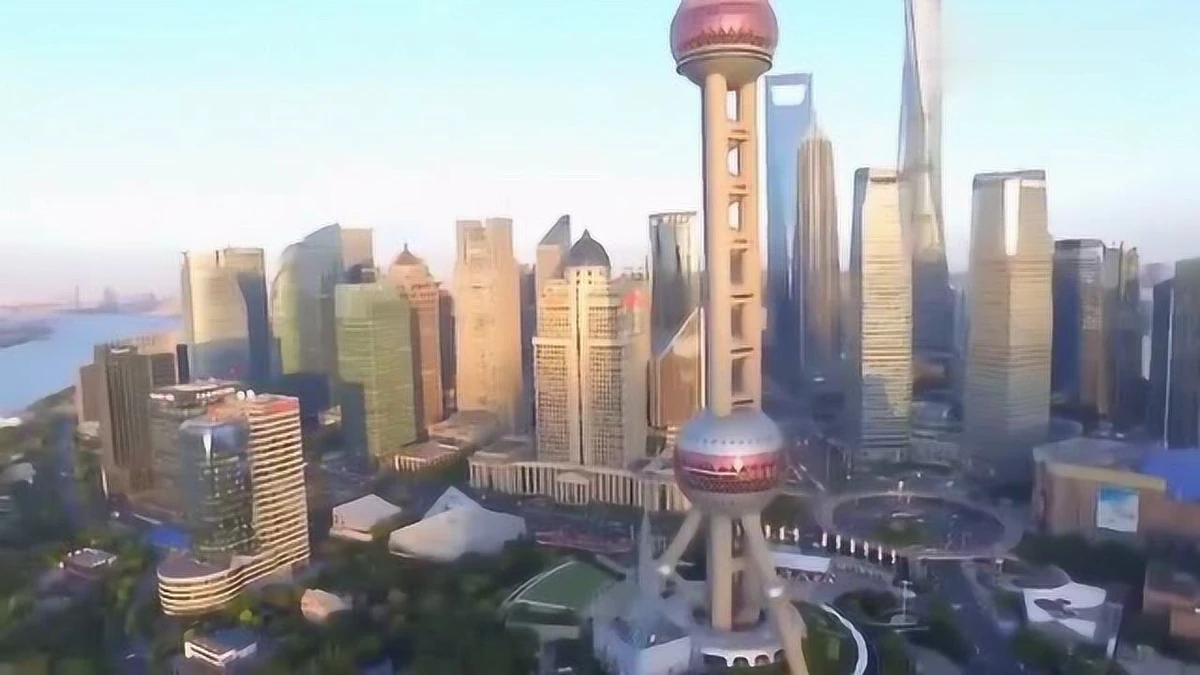
The urban fabric surrounding the tower is supported by seamless infrastructure connecting the waterfront to travelers arriving from around the world. From Shanghai’s two major international gateways—Pudong International Airport (PVG) and Hongqiao International Airport (SHA)—visitors reach the city center effortlessly via the Beijing–Shanghai high-speed rail corridor or the ultra-fast Maglev train. Deep beneath the tower’s plaza runs Shanghai Metro Line 2, the city’s primary east–west artery: stepping out of Exit 1 at Lujiazui Station brings travelers face-to-face with the colossal spire soaring above the roundabout, opening sweeping views across lush green parks and Century Avenue encircling this historic peninsula.
Rising proudly beside the historic bend of the Huangpu River, the Oriental Pearl Tower carves an unforgettable silhouette into Shanghai’s skyline at an impressive total height of 468 meters. For over a decade—from its inauguration in 1994 until 2007—this monumental broadcast and telecommunications structure stood as the tallest man-made edifice in mainland China, serving as the pioneering emblem of Lujiazui’s economic ascent. Behind its steel and concrete frame lies a triumph of modern structural engineering backed by massive investment and the visionary urban ambition of East Asia’s foremost industrial powerhouse.
The genius of the tower’s architectural vocabulary lies in its seamless fusion of futuristic structural design with classical East Asian poetic depth. Chief architect Jiang Huancheng and his team drew inspiration from Tang poet Bai Juyi’s famous line in Pipa Xing: “Large pearls and small pearls cascading onto a jade platter.” Eleven spheres of varying sizes clad in iridescent tempered reflective glass and precision titanium-alloy panels are strung artfully along three massive inclined columns—each nine meters in diameter and anchored into the earth at a sturdy 60-degree angle—creating the illusion of a giant strand of luminous pearls descending from the heavens onto the emerald ribbon of the city.
Interior spaces are organized vertically into distinct cultural, entertainment, and observation zones guiding visitors along an emotional arc from past to future. Housed within the expansive pedestal at the tower’s base is the Shanghai Municipal History Museum, preserving thousands of rare artifacts and life-size dioramas chronicling over 700 years of Shanghai’s evolution—from a quiet coastal fishing village to the bustling treaty-port era of Republican-period merchant houses and banks. Ascending higher, the lower sphere at 90 meters opens into a vibrant “Space City” featuring high-tech attractions, multi-dimensional theaters, and futuristic interactive zones.
Higher still, the second major sphere at 263 meters serves as the main sightseeing gallery, offering sweeping 360-degree views across both Pudong and Puxi. Its heart-stopping highlight is the transparent glass-bottomed skywalk suspended at 259 meters: stepping onto flawless load-bearing glass, visitors feel as though they are floating mid-air directly above streams of miniature traffic and the historic Bund waterfront across the river. Just above the main deck sits the celebrated revolving buffet restaurant, where diners savor gourmet cuisine while the cityscape turns smoothly through a complete rotation every hour.
The highest public vantage point crowns the uppermost small sphere—the “Space Capsule” at 350 meters. Lifting visitors above drifting clouds, this futuristic observation pod offers a serene sense of detachment high above the sprawling megacity far below. Rising above the Space Capsule, the broadcast antenna mast pierces the sky to complete the tower’s proud 468-meter stature—a lasting monument uniting masterly mechanical engineering with classical Chinese aesthetic grace.
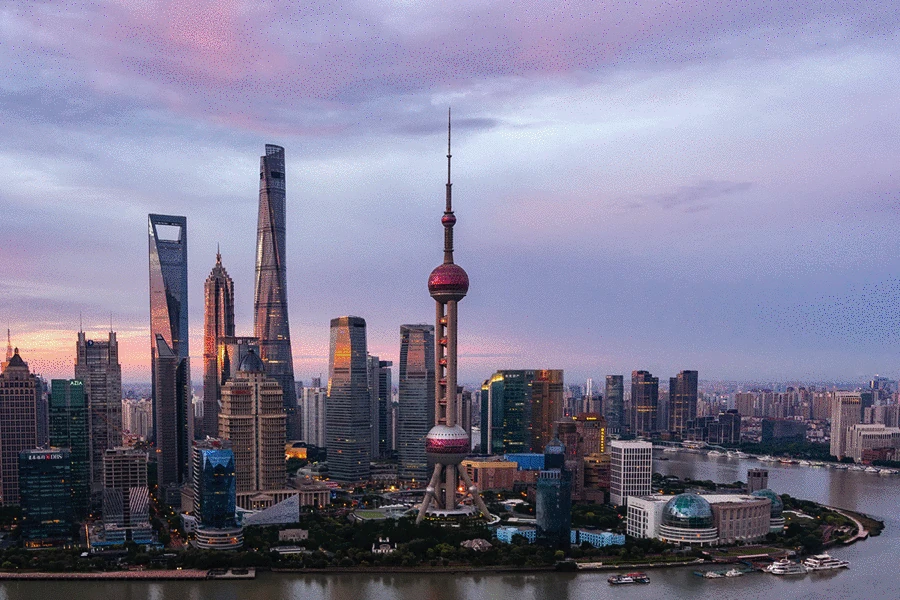
As dusk settles over the Huangpu River, the twilight transition across Lujiazui stages one of East Asia’s most breathtaking daily spectacles. Between roughly 4:30 PM and 6:30 PM—cherished by photographers as the golden hour—warm amber sunset light washes across the giant steel-and-glass spheres of the Oriental Pearl Tower before gliding over the calm waters dividing Shanghai’s two historic shores. Standing along the western promenade of the Bund looking east, or gazing back from high inside the tower toward the classic architecture of the Bund, visitors witness a striking visual dialogue between early modern heritage and the futuristic pulse of a sleepless megacity. The Huangpu River acts like a giant mirror gathering every fading ray of sunlight, turning the skyline into an unforgettable living canvas.
Once night falls, the Oriental Pearl Tower awakens instantly as the glowing centerpiece of Lujiazui’s urban light symphony. Hundreds of thousands of matrix LEDs and advanced laser projectors ignite in unison, transforming the 468-meter structure into a soaring multi-chromatic beacon. Light displays shift fluidly from auspicious ruby crimson to emerald cyan and ethereal violet, shimmering across the dark river below. Synchronized with neighboring supertall icons such as Jin Mao Tower and Shanghai Tower, the illumination turns the entire financial peninsula into a monumental open-air light stage celebrating urban vitality.
Beyond admiring the tower from afar, nighttime inside its suspended spheres offers glamorous, poetic experiences high above the city. More than 260 meters up, the revolving restaurant glides through a full 360-degree panorama of illuminated Shanghai every hour, while below the transparent glass skywalk, headlights along Century Avenue streak past like shooting stars. Shanghai’s nocturnal energy continues seamlessly down along the riverfront, where classic jazz melodies drift from waterfront lounges and deep ship horns echo across the water—blending cosmopolitan sophistication with timeless local atmosphere.
Crowning the nocturnal experience inside the observation decks are next-generation augmented reality (AR) and virtual reality (VR) installations that take visitors on a breathtaking journey across time. Through digital lenses, travelers trace Shanghai’s metamorphosis from 1843—when the opening of its treaty port transformed a low-lying river town into a bustling maritime gateway of wooden junks—through the cosmopolitan twentieth-century concession era and onward to a visionary 2050 skyline of multi-level aerial transit and smart green architecture. Gazing down at the glittering real city below while exploring digital visions of past and future captures the enduring spirit of this iconic landmark.
Nestled within the bustling Lujiazui Peninsula, the dining scene around the Oriental Pearl Tower reflects the rich evolution of Haipai and local Shanghai cuisine (沪菜 – Hucai). Rooted in the fertile waterways of Jiangnan and enriched by classic banquet artistry and international influences from the treaty-port era, authentic Shanghainese cooking centers on four guiding principles: nong you chi jiang (“rich oil and crimson sauce”)—prizing glossy mahogany glazes, deep savory-sweet balance, and a clean, lingering finish. Surrounded by cloud-piercing skyscrapers, culinary discovery here begins with deep respect for seasonal Jiangnan ingredients.
The signature culinary experience built directly into the tower itself is the revolving buffet restaurant housed inside the second major sphere at 267 meters. Completing a smooth 360-degree rotation every two hours, the dining room unfolds sweeping views of the Huangpu’s dramatic bend and the Bund’s historic waterfront architecture. Suspended high in the sky, refined classical Chinese specialties meet international seafood spreads—featuring crisp sweet-and-sour squirrel-shaped mandarin fish, delicate fish-maw soup simmered with matsutake mushrooms, and glossy roast duck carved tableside.
Back at ground level, traditional Shanghainese comfort food shines in heirloom Hong Shao Rou (红烧肉)—the celebrated red-braised pork belly that has enchanted gourmets for generations. Selected cuts with evenly layered lean meat and marbling are diced into neat jade-seal squares, seared, and braised slowly with rock sugar, aged dark soy sauce, and authentic Shaoxing huangjiu rice wine. When the lid lifts, glossy amber cubes glisten with tender, melt-in-your-mouth richness balanced by deep savory-sweet complexity.
Right next door inside the prestigious IFC Mall dining venues, Xiaolongbao (小笼包) soup dumplings showcase supreme culinary precision. Each delicate parcel wraps fresh minced pork and rich gelatinized pork-skin and marrow broth inside gossamer-thin dough pleated into at least eighteen uniform folds. When the bamboo steamer lid rises in fragrant clouds of steam, connoisseurs lift each dumpling gently by its top knot, nibble a tiny opening to sip the sweet, piping-hot broth, and dip the rest in Zhenjiang black vinegar accented with slivers of fresh ginger.
When crisp autumn winds arrive, gourmets seek out prized Yangcheng Lake Hairy Crab (阳澄湖大闸蟹). Raised in cool, clear suburban lake waters, these seasonal delicacies develop rich, golden roe and sweet, snow-white meat—best enjoyed steamed with aromatic perilla leaves alongside a warm cup of brown-sugar ginger tea. Rounding out local street flavors is a humble bowl of scallion oil noodles (葱油拌面) at neighborhood eateries: springy round wheat noodles tossed in deeply caramelized scallion oil and pure soy sauce, evoking warm nostalgia for old Shanghai.
Thoughtful advance preparation around entry formalities and logistics ensures a smooth visit to the Oriental Pearl Tower. Eligible international travelers can take advantage of China’s 144-hour visa-free transit policy at Pudong or Hongqiao International Airports, making it easy to admire this architectural icon during short stopovers without obtaining a visa in advance. For longer stays and deeper cultural exploration, securing a Category L tourist visa through a Chinese Visa Application Service Center prior to departure is essential.
Shanghai’s exemplary public transit system makes reaching the tower effortless. Metro Line 2 runs straight from Puxi across the river into Pudong, delivering passengers directly to Lujiazui Station. Stepping out of Exit 1 or Exit 2 places you immediately on the elevated circular pedestrian skywalk, where unobstructed upward angles frame the Oriental Pearl Tower’s gleaming spheres at their most dramatic. Observation decks and the history museum typically operate daily from 8:30 AM to 9:30 PM, with late afternoon standing out as the prime time to ascend—catching sunset over the Bund followed by the city’s dazzling evening light show.
Because Lujiazui draws heavy crowds year-round, smart planning saves valuable time. Rather than queuing for hours at ground-level ticket booths, book timed-entry observation tickets online in advance for swift security clearance. In busy areas such as the glass-bottomed skywalk and high-speed elevator lobbies, keep personal belongings, cameras, and travel documents secure at all times.
Seasoned travelers often favor either independent travel (FIT) with full schedule flexibility or curated premium itineraries guaranteed free of compulsory shopping stops (No-Shopping Premium Tours). Such thoughtfully designed journeys eliminate high-pressure retail detours, leaving ample time to explore Pudong’s remarkable transformation and enjoy refined Shanghainese dining high above the city. For a seamless, stress-free vacation backed by reliable service standards, consider joining a carefully crafted all-inclusive China tour package.