Looking back at the early 1980s, Shanghai’s economic landscape experienced a challenging downturn in the face of the rapid breakthrough of Southern Special Economic Zones like Shenzhen and Zhuhai. At that time, the West Bank of the Huangpu River—known as the historic Puxi—struggled under the weight of suffocating population pressure and aging urban infrastructure dating back to the Republic of China era. In stark contrast to this crowded bustle, the Pudong strip across the river was then merely a desolate, barren agricultural floodpan covered with boundless reeds and dilapidated, gloomy warehouses. The people of Shanghai still passed around a bitter proverb back then: “Better a bed in Puxi than a house in Pudong” (Ning yao Puxi yi zhang chuang, bu yao Pudong yi tao fang – 宁要浦西一张床,不要浦东一套房) as evidence of the gaping developmental chasm between the two riverbanks.
The turn of the century that completely changed the port city’s destiny officially unfolded in 1990, when leader Deng Xiaoping signed off on the historic strategy named “Developing and Opening Pudong”. Personally led by then-Mayor and Shanghai Party Secretary Zhu Rongji, along with his successor Huang Ju, they directly oversaw the master planning of the Lujiazui financial metropolis. Realizing that the old 210-meter television tower on West Nanjing Road could no longer meet the technical broadcasting requirements nor the stature of a world-class financial center, the city government decided to create a “visual anchor” project. This project was expected not only to serve as an information transmitter but also to stand as a towering architectural declaration, positioning Pudong’s rise on the international stage.
The heavy responsibility was entrusted to the East China Architectural Design and Research Institute (ECADI), under the command of Chief Architect Jiang Huancheng, architect Leng Banli, and the country’s finest structural engineering team. After days of precise calculations for every load parameter and storm-wind resistance, the rhythm of construction began to shake both banks of the Huangpu. On July 30, 1991, the first foundation pile was driven deep into the alluvial mud of the Lujiazui peninsula. Through extraordinary efforts, the core concrete structure reached a height of 350 meters on December 14, 1993. Just half a year later, on May 1, 1994, a modern hydraulic lifting system successfully installed the colossal 118-meter metal antenna mast atop the tower, bringing the overall height to the milestone of 468 meters. By October 1, 1994, the first experimental radio and television signals were broadcast amid overwhelming joy.
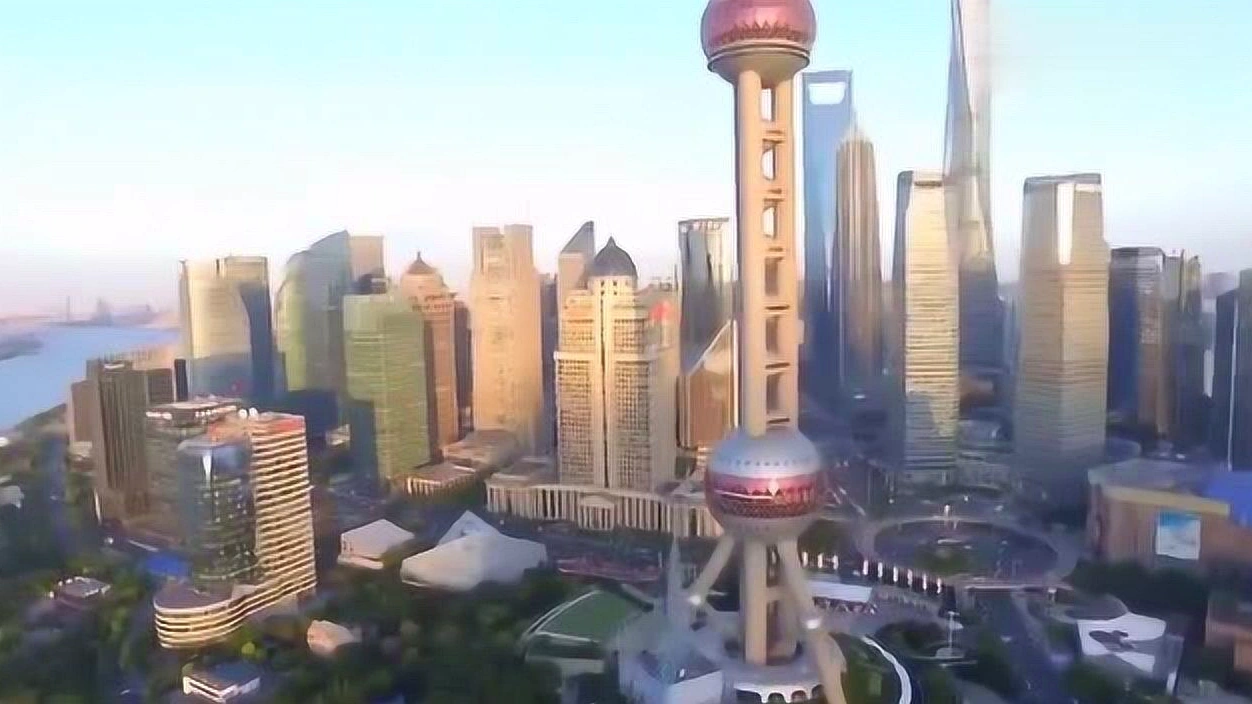
In the panoramic picture of the modern Pudong urban area, the Oriental Pearl Radio and Television Tower proudly stands in the foreground as a vibrant historical witness along the Huangpu River. The massive architecture with spherical blocks simulating pearls suspended in mid-air creates a unique visual fulcrum, contrasting yet perfectly harmonizing with the cluster of skyscrapers piercing the blue skies in the background. Under the harmonious light of a prosperous metropolis, the graceful yet sturdy silhouette of the television tower bears witness to the spectacular transformation from a muddy wasteland of yesteryears into one of Asia’s most brilliant financial centers and tourism symbols.
May 1, 1995, marked a historical milestone when the structure officially cut its ribbon to welcome its very first visitors. In that solemn ceremony, General Secretary and President Jiang Zemin personally presented a meticulously handwritten calligraphy piece with the eight characters “Dongfang Mingzhu Guangbo Dianshi Ta” (东方明珠广播电视塔), which is displayed solemnly as a cultural certificate enduring through time. Throughout the period from 1994 to 2007, this structure maintained its crown as the tallest man-made architecture in Chinese territory. Recognized as a National 5A Tourist Attraction in 2007 and continuing to welcome an explosive stream of vitality through the Shanghai World Expo 2010 mega-event, the Oriental Pearl Tower is not merely a miracle of modern construction but has transformed into a soul, fully portraying the epic shifting times of Shanghai on its journey to becoming a global metropolis.
Located at 121°29’55” East longitude and 31°14’24” North latitude, the Oriental Pearl Tower occupies one of the most prime geographical locations on the Shanghai urban planning map. The structure stands proudly right at the tip of the Lujiazui peninsula—a rich alluvial crescent-shaped strip embraced by the spectacular bend of the Huangpu River right at its confluence with the Wusong Creek, also known as the historic Suzhou Creek. This natural confluence point is not only the vital waterway trade artery of the Yangtze River delta plain, but also the heart of the Lujiazui financial center, where every inch of land crystallizes global economic and geopolitical value.
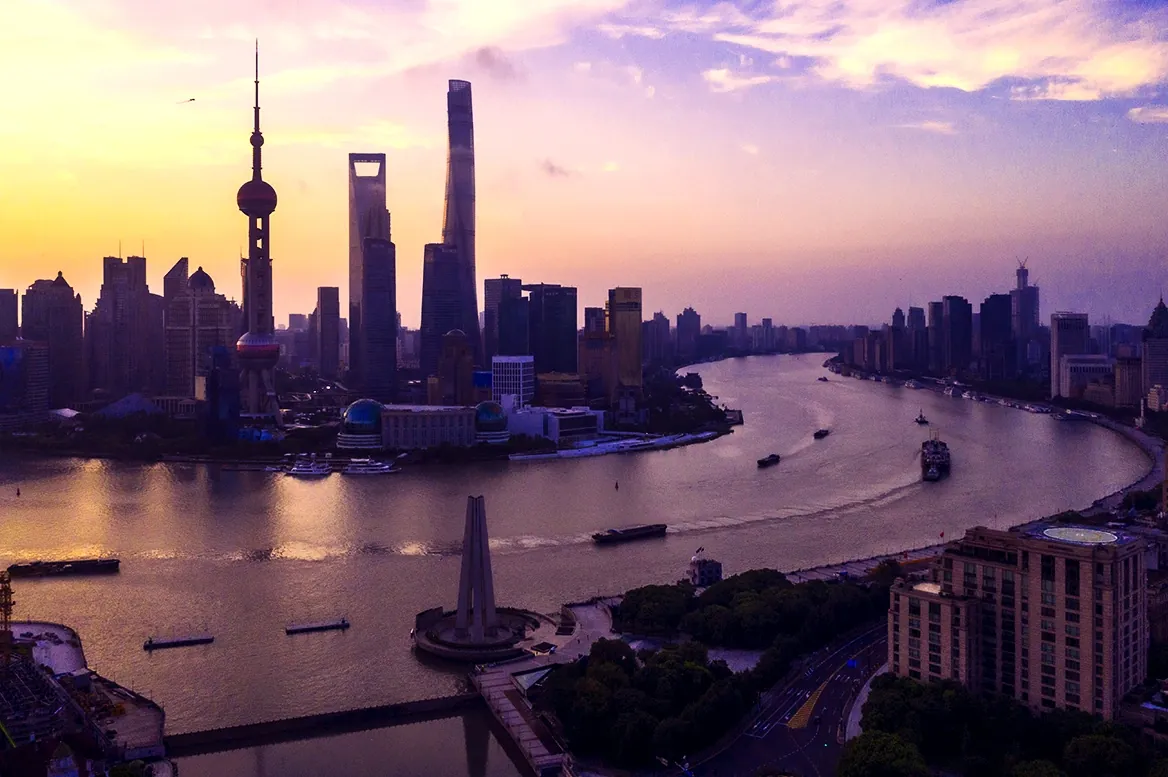
In traditional Eastern feng shui concepts, the impressive terrain where the tower is located is hailed as an extremely rare “Twin dragons playing with a pearl, water gathering to generate wealth” configuration. The rolling, gently winding Huangpu River creates a “huai bao shui” formation—an arm of water fully embracing the floodplain, preventing prosperous energy from dissipating and gathering it completely at the bright hall (mingtang). Standing at the focal point of the water bend’s curve, the Oriental Pearl Tower acts like a iconic heritage sitting amidst the dragon vein, directly guarding and activating the financial energy source for the entire East China coastal strip. The harmony between river water qi and the enduring earth qi here is evaluated by feng shui masters as the natural origin that propelled Shanghai’s extraordinary prosperity from a riverside town into a world-class economic center.
This panoramic photograph captures the proud silhouette of the Oriental Pearl TV Tower soaring straight into the deep, clear blue sky of Shanghai. Behind the unique circular bridge structure lies the winding ribbon of the Huangpu River, acting as a natural boundary reflecting the magnificent skyline. The scene expands with a juxtaposition of magnificent skyscrapers on the modern Pudong East Bank and the historic Puxi West Bank, portraying an open urban spatial composition where the television wonder becomes the absolute visual focal point amidst the contemporary architectural complex.
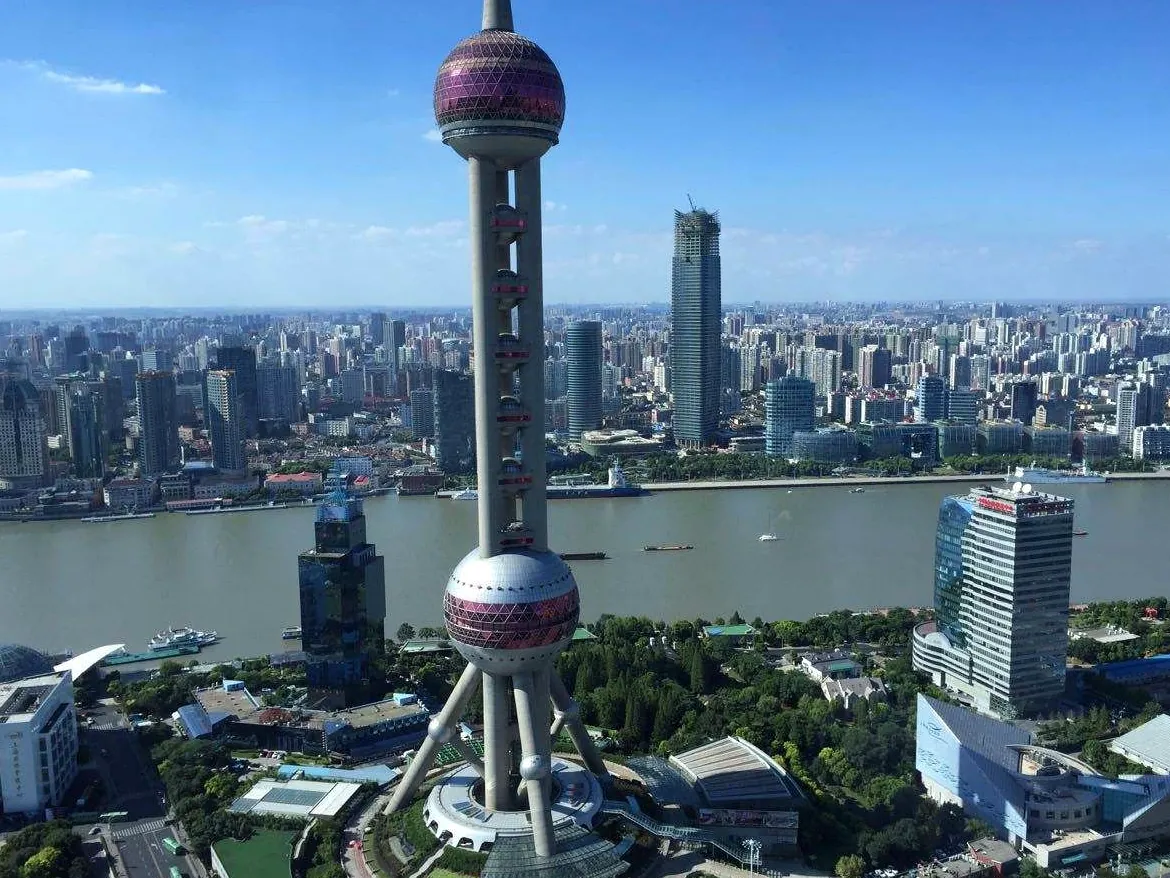
The surrounding spatial landscape of the tower unfolds a dramatic dialogue between the East and West banks of the city. Viewed from the base of the tower across the Huangpu River is the magnificent Neo-Classical and Art Deco architectural complex from the 19th century along the Bund, representing the bustling modern-day port past. Opposite across the mirroring surface of the water is the youthful silhouette of Pudong with its pioneering tower leading the way for the 21st century’s ascent. The interweaving of the quiet colonial heritage on the Puxi side and the futuristic heartbeat on the Pudong side creates a multi-layered urban landscape, elevating the visual experience for anyone admiring the city from the skyline.
Behind its graceful beauty soaring into the air lies an engineering marvel that conquered complex subterranean strata. The entire Lujiazui peninsula was formed on young river alluvial sediments, characterized by water-bearing sand and mud layers with very high porosity and compressibility. To firmly anchor a reinforced concrete structure weighing hundreds of thousands of tons, construction engineers had to deploy a specialized friction bored pile foundation system, driving more than 60 meters deep through the water-bearing sand layers to firmly grip the stable geological strata below. This solid foundation structure acts as a giant subterranean anchor system, keeping the construction firmly standing against rising high tides from the river mouth and severe tropical storms that frequently sweep across the Pacific coast.
Under the lens of architectural planning, the Oriental Pearl Tower is a magnificent symphony between futuristic structural thinking imbued with a spatial breath and classical Chinese poetics. The design plan by the talented architect Jiang Huanicheng fully distilled the spirit of the immortal verse in the masterpiece “Song of the Pipa” by the great Tang dynasty poet Bai Juyi: “Large and small pearls fall on a jade plate”, evoking the image of large and small pearls cascading down onto a pristine jade tray. Upon that aesthetic foundation, the structure proudly rises 468 meters with a complex consisting of 11 reflective glass-wrapped steel spheres of varying diameters, strung together seamlessly by a system of vertical cylindrical tubes. Supporting the entire massive architectural structure as if suspended in the clouds is a system of three inclined reinforced concrete pillars with a gigantic diameter of up to 9 meters, firmly slanted into the deep foundation core, opening up an extremely sophisticated and tight multi-layered functional space.
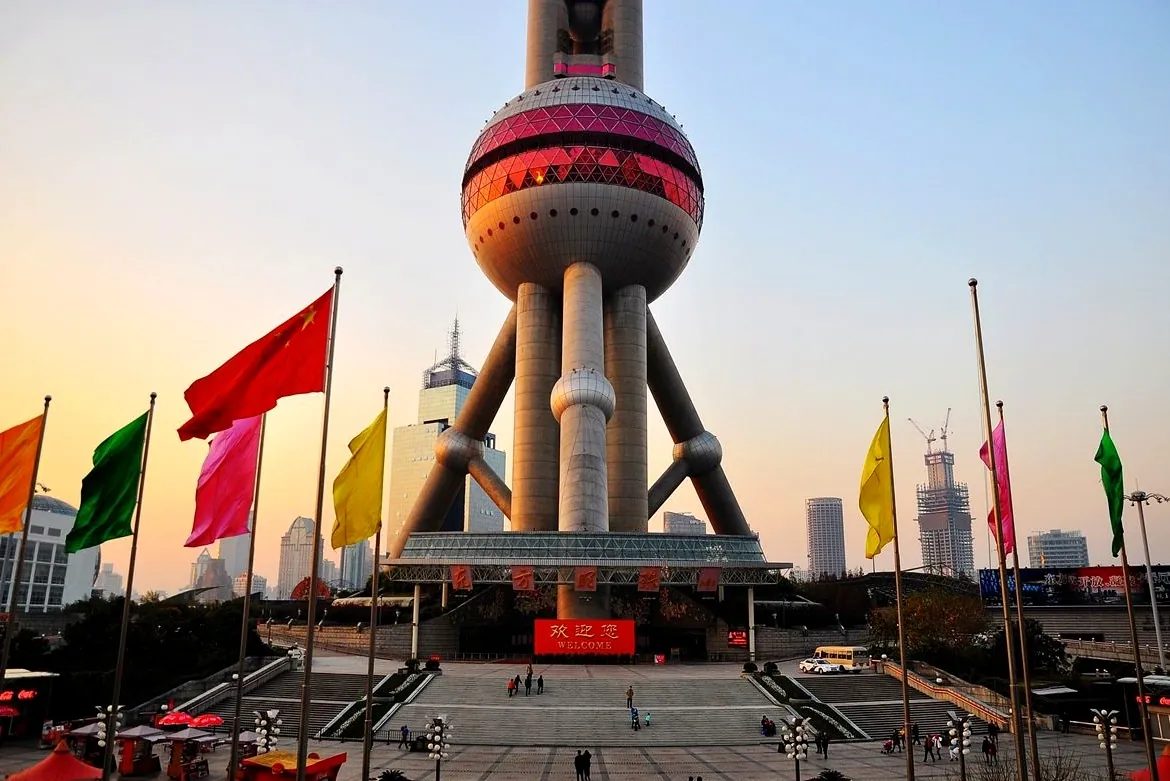
Upon stepping foot into the central plaza area at the base of the tower, visitors are immediately overwhelmed by the grand scale of the entrance leading to the building’s podium. The expansive plaza space is paved with flat stones, dotted with colorful international flags fluttering alongside China’s national flag on slender, soaring metal flagpoles. Right at the entrance steps leading into the tower block, a bright red welcome sign with the word “WELCOME” stands out like a warm greeting in the heart of the metropolis. Under the clear dawn or the moment of dusk dyeing the late sunlight in gold, the concrete base and the series of steel bridges soaring straight into the sky contrast spectacularly with the dense skyscrapers surrounding the Lujiazui financial district.
Exploring the deep connotations of the tower must begin from the 0-meter level at the base floor, which nestles peacefully between the exhibition hall and the Shanghai Urban History Development Museum. This exhibition space resembles a living chronicle in shapes, gathering hundreds of meticulously crafted 1:1 scale wax figures combined with original dioramas. Each historical footage is smoothly unfolded, from the days when Shanghai was still a desolate fishing village nestled beside the river, through the period of concession division by Western powers, to the brilliant golden age of the “Paris of the East” in the 1930s with its bustling pubs, banks, and clanging trams. Ascending to the lower sphere at an altitude of 90 meters named Capsule A, visitors will step into the sci-fi world of Space City with interactive entertainment complexes and spectacular indoor virtual reality roller coasters.
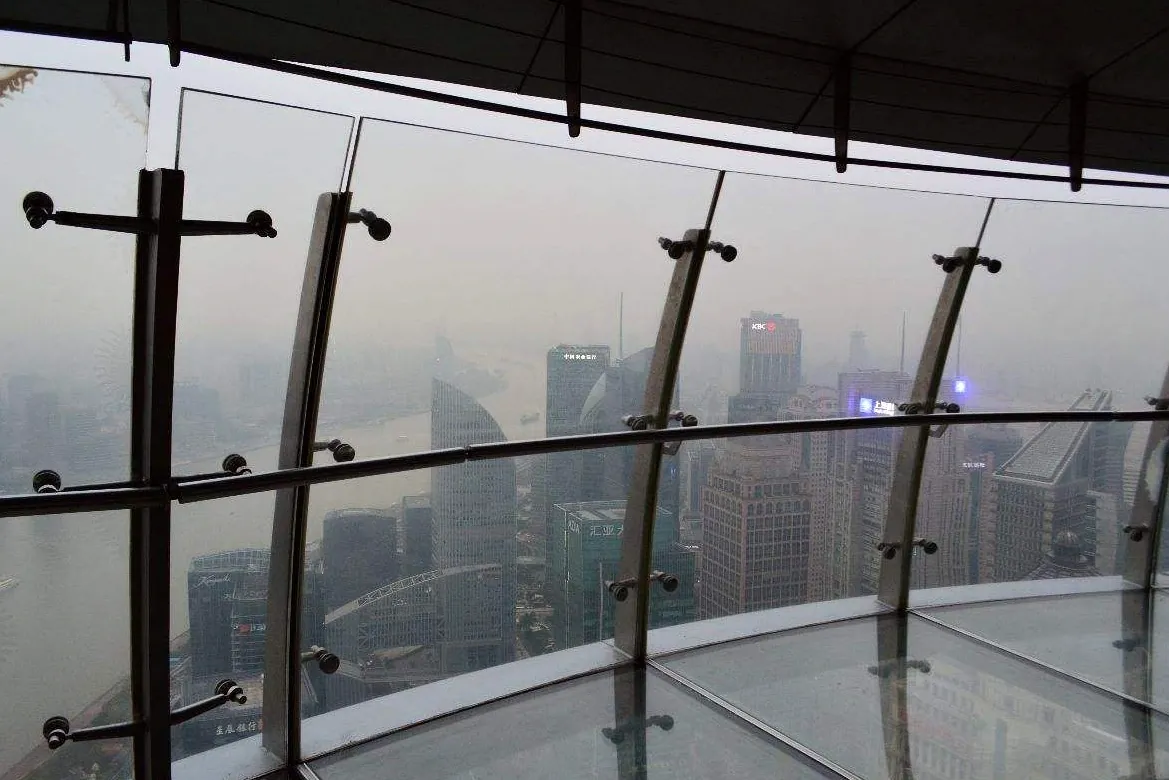
The core of the experience converges fully at the second-largest sphere named Capsule B, stretching from the 259-meter to the 267-meter level. At an elevation of 259 meters, a fully transparent glass-paved outdoor promenade measuring 150 meters long and 2.1 meters wide opens up an exhilarating visual challenge. Each thick multi-layered tempered glass panel is capable of bearing a load of up to 2 tons per square meter, allowing visitors to leisurely stroll amidst the open void and gaze down at traffic appearing as tiny as ants below. Directly above, at the 263-meter level, is the main 360-degree indoor observation deck, which encompasses the contrasting beauty of the ancient architecture along the West Bank’s Bund and the futuristic skyscraper forest of the East Bank. Accenting this upscale experience is Asia’s largest rotating Asian-European buffet restaurant at a height of 267 meters, where diners can savor premium cuisine while taking in the full 360-degree panoramic city views, rotating smoothly once every 120 minutes.
Soaring proudly at the towering 351-meter level is the topmost sphere, named Capsule C or the space module. Designed like an interplanetary space exploration simulator observatory, it immerses visitors in a serene feeling completely detached from the hustle and bustle of the mortal world. Concluding this visual journey is a specialized 118-meter solid steel antenna mast reaching straight from the top of the sphere to the ultimate elevation of 468 meters, serving as the high-power radio and television broadcasting heart for the entire Yangtze River Delta, and standing as a testament to the exemplary fusion of infrastructural engineering and a twentieth-century cultural symbol.
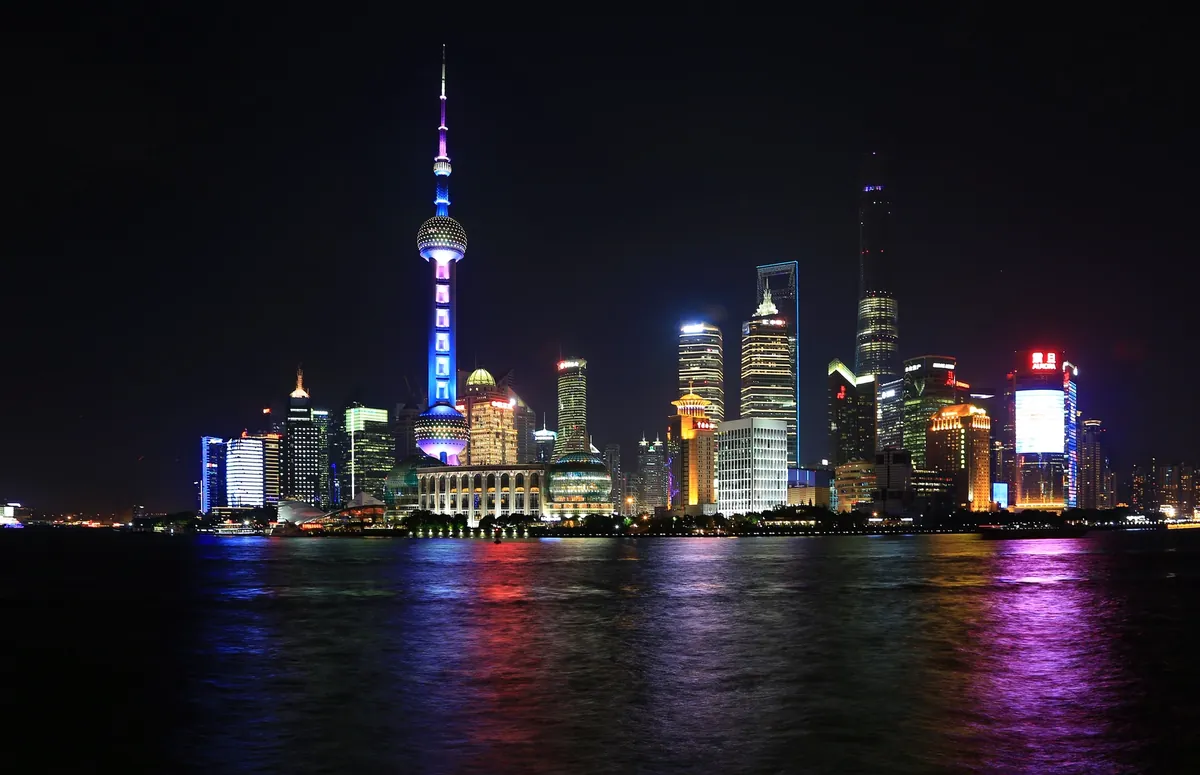
As the sunset begins to slant toward the west of the city, the time between 4:45 PM and 5:00 PM every afternoon becomes the most precious golden hour to witness a transforming Shanghai. Standing from the high-altitude observation decks, travelers will witness three mystical transitional phases of natural and artificial landscapes: first, the Huangpu River ribbon dyed in late-day glows; next, the poetic twilight moment when avenues begin to flicker with lights; and finally, the explosive brilliance of a magnificent light banquet as night officially blankets the megacity. Every breath of time seems to freeze on the calm water surface, where cruise ships light up brightly, parting the waves and carrying the vibrant energy of a glamorous night.
Right as the clock strikes 6:00 PM in winter or 7:00 PM in summer, a synchronized visual performance unfolds with absolute precision, amazing everyone who witnesses it. The entire artistic lighting system of the skyscrapers in the Lujiazui peninsula and the classical Western architectural complex along the Bund across the river simultaneously light up in a split second. The space instantly transforms into a grand real-life stage where the Huangpu River acts as a giant mirror reflecting the magical contrast between the century-old past of the West Bank and the futuristic vision of the East Bank. Millions of intertwined light beams paint the most magnificent skyline in the East, affirming its status as a global financial center that never sleeps.
The centerpiece of this luminous dance is the eleven-sphere structure of the Oriental Pearl Tower, converging the peaks of modern visual presentation technology. All the spherical blocks are wrapped in a smart multi-color LED lighting system, capable of programming millions of color shades to the rhythm of urban symphonic melodies. Behind this glamorous brilliance lies an exemplary sustainable development mindset, as the lighting system integrates green microchip solutions meeting strict LEED EBOM international certifications, helping reduce carbon emissions by up to thirty-two percent compared to traditional halogen lighting systems. The tower’s beauty thus goes beyond pure visual aesthetics, symbolizing the harmonious philosophy between technological marvels and urban ecological conservation responsibility.
The vibrant nightlife of Shanghai is not confined to the skies; it also spreads powerfully down to the waterfront space at the foot of the tower, where the pulse of the nighttime economy beats vibrantly. Along the Pudong riverside promenade, visitors can easily immerse themselves in open spaces featuring outdoor bars filled with improvised jazz melodies, street chamber concerts, and enchanting interactive light art exhibitions. To fully feel the soul of this glamorous night, travelers often head to the Dongjinchen ferry crossing. As the ferry cuts through the silver-shimmering water toward the Jinling Pier, looking up at the sky where the tower rises proudly among thousands of artificial stars, one truly understands why people still liken this magnificent pagoda to the brightest pearl reflecting a new millennium.
Alongside the symbol of the Oriental Pearl Tower, the cultural dimension of local Benbang cuisine forms the foundational culinary school shaping the taste buds and soul of Shanghai. Originating from the rustic kitchens of old fishing villages along the Huangpu River and later blossoming brilliantly during the modern concession era, Benbang cuisine stays strictly loyal to the core philosophy of “Nongyou Chijiang” (濃油赤醬 – heavy oil and thick sauce). This is the master art of balancing glossy oils with dark soy sauce and pure rock sugar, creating a rich, luscious sauce with an alluring reddish-brown hue that is both deeply savory and delightfully lingering with a memorable salty-sweet aftertaste.
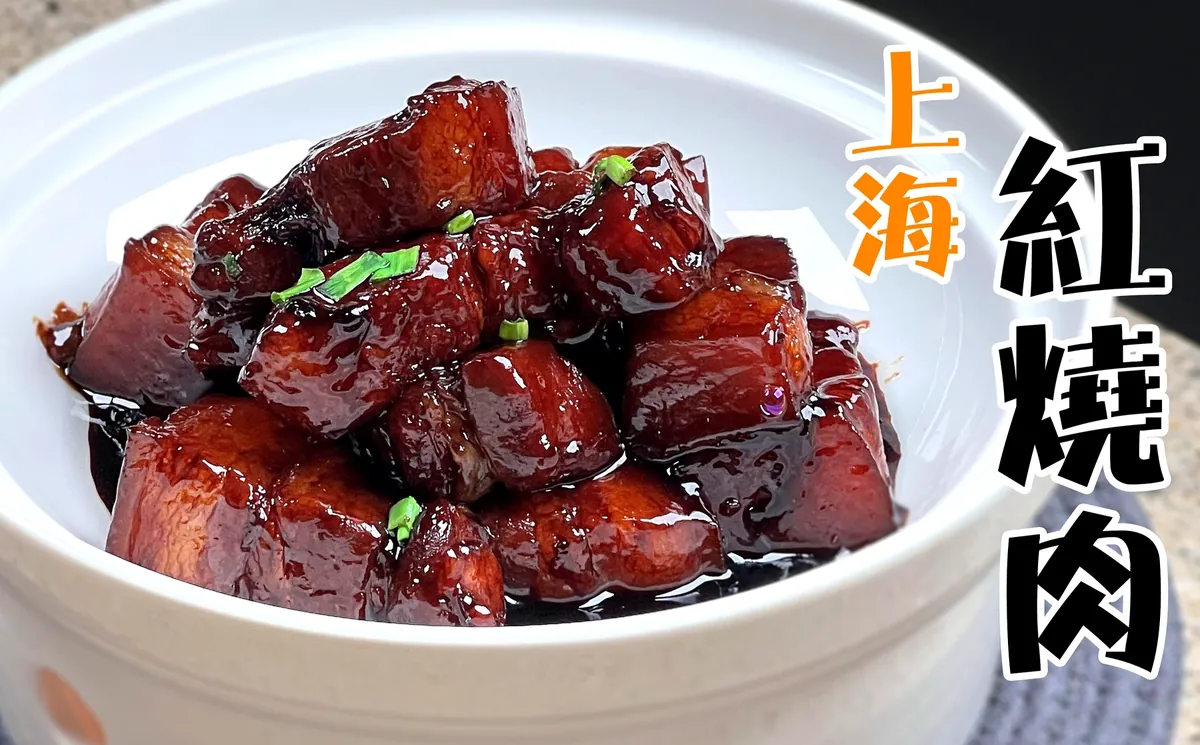
The crowning convergence of the “Nongyou Chijiang” art is Shanghai Braised Pork Belly (上海红烧肉), a delicacy found on almost every traditional family banquet table. Each block of five-layer pork belly is meticulously cut into dice-sized cubes by the chef, then slow-braised for hours over a simmering fire with fine Shaoxing aged rice wine, pure soy sauce, and pristine rock sugar. Under precise temperatures, the fat transforms into a jade-like transparency, while the lean meat becomes tender without falling apart, coating itself in a shimmering amber glaze; when placed in the mouth, it melts smoothly, releasing a rich, velvety fat entwined with the ultimate harmonious sweet and salty flavor.
Contrasting with the rich, hearty nature of the braised dish is the exquisite, meticulously crafted Nanxiang Soup Dumpling (Nanxiang Xiaolongbao) – the famous soup dumpling originating from the ancient town of Nanxiang in the former Jiading County. Reaching the pinnacle of Jiangnan dimsum shaping artistry, each dumpling is a micro-masterpiece with a dough wrapper rolled so thin that the meat filling inside is clearly visible, meticulously folded by artisans with exactly 18 uniform pleats. The minced fresh pork filling is enveloped in a rich broth jelly rendered from concentrated bone marrow; when steamed in bamboo baskets, the broth liquefies into a bubbling, delicately sweet soup. Food connoisseurs typically bite a small corner of the wrapper to sip the piping hot, fragrant meat broth before enjoying the filling dipped in aged Shaoxing vinegar and julienned young ginger.
When the chilly autumn breezes sweep across the Bund from September to the twelfth lunar month, gourmets eagerly hunt for Yangcheng Lake hairy crabs (Dazhaxie). This rare aquatic delicacy is at its absolute best when steamed whole with perilla leaves to balance its cooling nature and fresh ginger to neutralize any fishy odor. Upon peeling away the hard shell, snow-white, firm crab meat with a profound, delicate sweetness is revealed, tightly intertwined with golden, rich, and intensely savory crab roe that mesmerizes every diner. To reach the pinnacle of this autumn delicacy, scholars and gourmands often head to Wang Bao He (王宝和), a century-old tavern hailed as the “ancestor of crab and wine” in Shanghai.
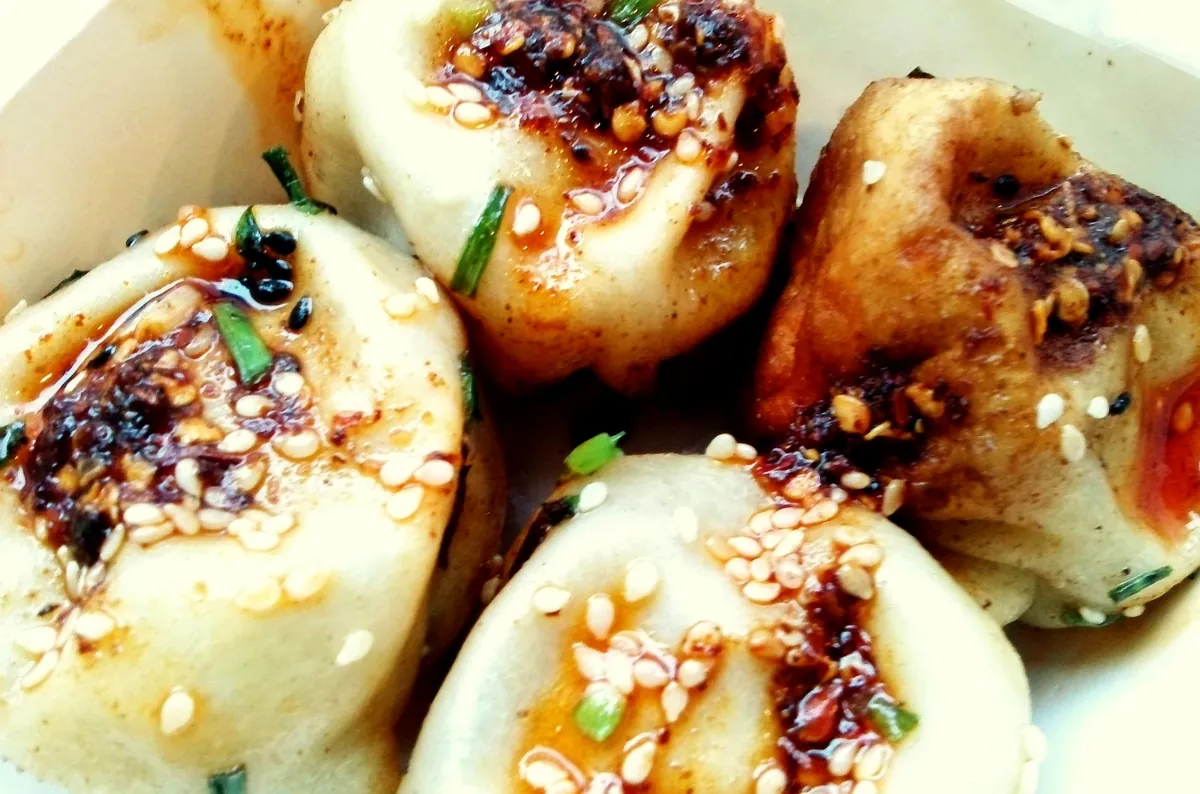
Alongside these aristocratic flavors, the culinary landscape around the Lujiazui axis also features Pan-fried Pork Buns (Shengjianbao), a quintessential representative of popular street food. Unlike steamed dumplings, Shengjianbao are made from moderately fermented dough, neatly arranged in thick-bottomed iron pans filled with oil to pan-fry the bottoms into a golden-brown, crispy crust, generously topped with nutty roasted sesame seeds and fragrant scallions. Savoring a plate of Shengjianbao at the famous Yang’s Dumpling chain, artfully situated in the underground level of the IFC mall right at the base of the tower, is a humble yet utterly satisfying experience for travelers’ taste buds.
Concluding the culinary journey along the Huangpu River, experiencing the premium Asian-European buffet at the revolving restaurant 267 meters up the Oriental Pearl Tower elevates emotions to new heights. With prices ranging from roughly 368 to 438 Chinese Yuan per person, diners can savor fresh seafood delicacies while letting their minds drift with the slow, hour-long rotation, watching the magnificent urban life transform from the vibrant sunset casting over the Bund until the entire forest of skyscrapers lights up the night sky.
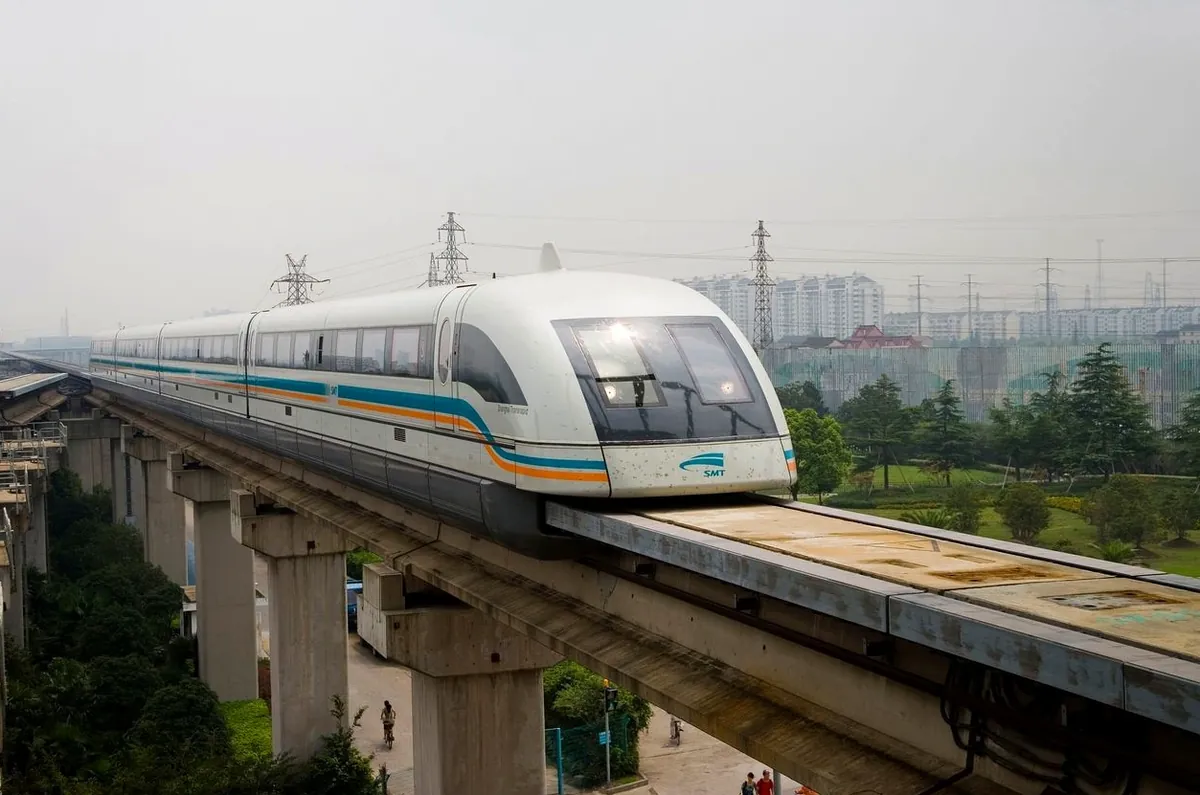
To ensure your journey to conquer the architectural symbol of Lujiazui goes smoothly, mastering Shanghai’s state-of-the-art transportation network is an essential preparatory step. From Pudong International Airport, visitors can experience the thrill of gliding on magnetic levitation with the famous Maglev train, operating at extraordinary speeds from 300 to 431 km/h to complete the journey to Longyang Road station in just 7 minutes and 20 seconds, before transferring to Metro Line 2 for a 6-stop ride to Lujiazui station. Here, Exits 1 and 2 lead you straight out to the spacious plaza at the foot of the tower. Alternatively, the newly inaugurated Metro Line 14 is an optimal choice with Exits 9A and 9B connecting directly to the tower’s commercial basement. For those seeking nostalgia for the old riverine lifestyle, the rustic Dongjin ferry connecting East Jinling Road Wharf on Puxi to Dongchang Road Wharf on Pudong for just 2 Yuan per trip offers a wonderful opportunity to admire the majestic tower rising from the waves of the Huangpu River.
Shanghai’s appeal in recent years has also been strongly reinforced by the 144-hour transit visa-free policy applicable to citizens of 54 countries entering through international airport ports such as Pudong or Hongqiao. This flexible regulation allows international travelers to freely stay for a full 6 days within the Shanghai – Jiangsu – Zhejiang economic triangle without applying for a mainland visa in advance. Right after admiring the city panorama from hundreds of meters high, you can visit adjacent luxury shopping centers like IFC Mall or Super Brand Mall to take advantage of the on-site 11% departure VAT refund policy, helping save a considerable budget when shopping for upscale fashion and tech brands.
However, the flip side of the tourism boom is the trap of cheap tour packages, commonly known as “zero-dollar tours”. Many unrepeatable travel agencies include the Oriental Pearl Tower in their itineraries, but in reality, they merely drop off tourists on the riverbank for a hurried 15-minute photo op. If visitors want to step into the elevator to go up to the observation deck, they are often pressured to pay an additional surcharge of 50 to 70 USD, a price twice as high as the listed ticket counter rate. Worse still, these tours often cut short the actual sightseeing time to herd tourists into designated shopping stops to cover their losses. Here, travelers easily fall into elaborate psychological traps: from the theatrical “recognizing a fellow countryman for massive discounts” acts at Pudong jade shops, free pulse-diagnosis tricks followed by prescriptions for expensive herbal medicines at locations impersonating the renowned Dong Ren Tang pharmacy, to Suzhou silk workshops that kick back commissions of 30% to 50% to tour guides. The best way to protect your personal rights is to prioritize pure, no-shopping tour lines with a clear contract committing to tickets for the 263-meter observation deck and the 259-meter suspended corridor.
Before passing through the strict security checkpoint, every traveler is required to present their original passport to complete the real-name ID scanning process in accordance with federal security standards. When stepping out onto the transparent glass skywalk at an altitude of 259 meters, management requires visitors to wear specialized shoe covers provided on-site to prevent scratches that could damage the clarity of the tempered glass surface. Individuals with a history of heart conditions or acrophobia should carefully consider before stepping onto the load-bearing glass floor, as the unfocused spatial effect looking straight down at the avenue below can cause extreme dizziness. Meticulously preparing every technical detail and choosing a professional itinerary such as the Shanghai – Wuzhen – Hangzhou – Beijing 7D6N Tour will be your passport ensuring a splendid journey, where you can touch the vibrant pulse of the Pearl of the Orient without a single worry.