In the heart of Kunming—the ancient city celebrated as the eternal “Spring City” of Yunnan—the Jinma Biji Archways stand tall, like a silent witness to the shifting tides of history. Originating in the early 17th century, this iconic structure had its first stone laid in the Year of the Xin-You (1621), the first year of the Tianqi era under the reign of Emperor Xizong of Ming. The figure responsible for shaping its appearance and overseeing this grand project was the then-Governor of Yunnan, Wang Jiwen. Tasked with stabilizing the border and asserting the cultural influence of the Central Plains in this remote southwestern territory, the Ming official dedicated his efforts to mobilizing local resources to plan a unique, symmetrical pair of archways, establishing this site as a spiritual anchor and a symbol of enduring authority for centuries.
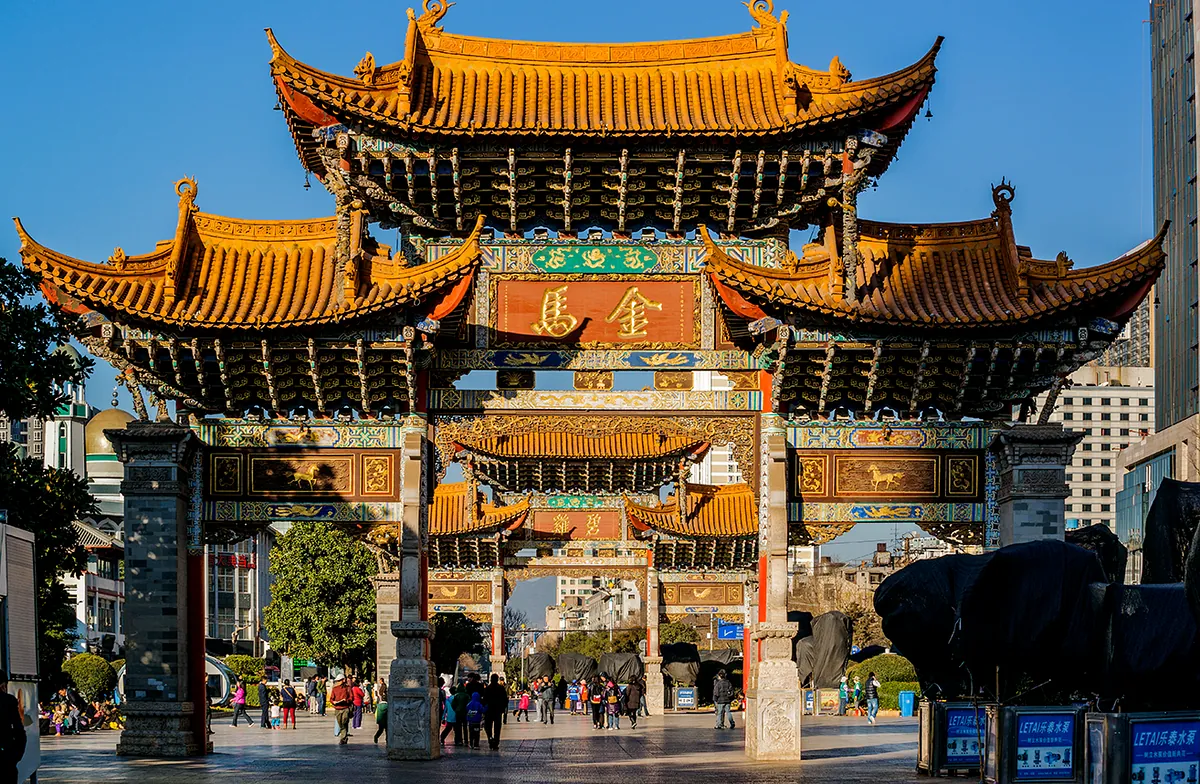
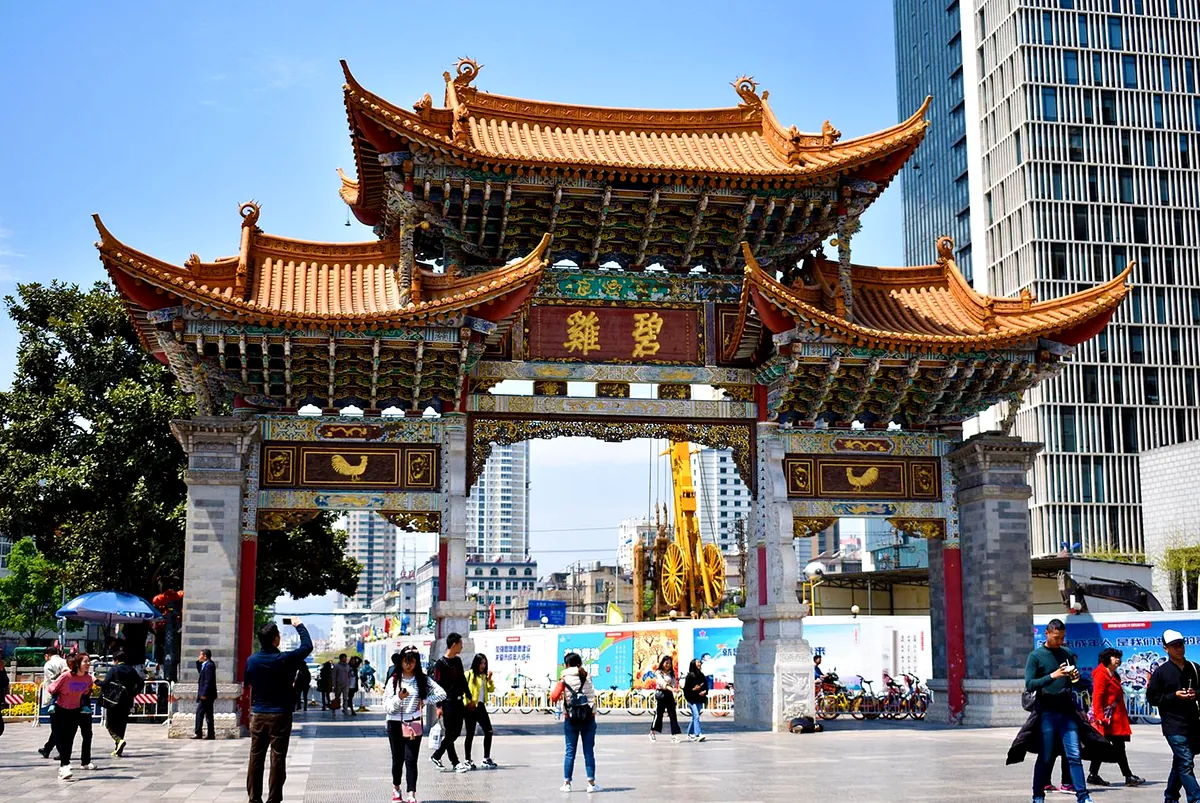
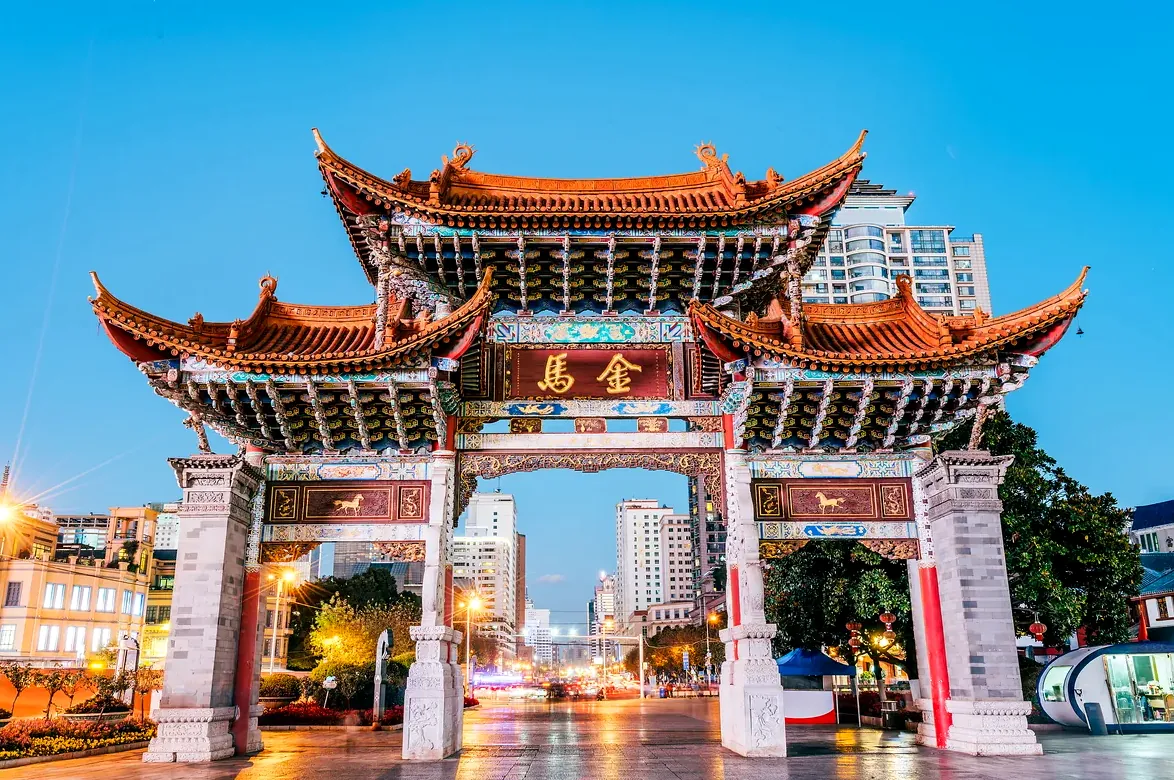
Gazing at the photograph, travelers are immediately drawn to the dignified character of the traditional archway, steeped in the classic architectural style of the East. The sweeping, curved eaves are covered in golden glazed tiles that shimmer brilliantly under the clear blue sky, harmonizing with the complex bracket system and meticulously carved dragon and cloud patterns. Prominently displayed in the center of the front plaque are the sharp, bold Chinese characters “Jinma” (金马). Behind this ancient, legendary scene lies a bustling open square, creating a fascinating visual contrast with the modern high-rise buildings rising densely in the background.
More than just a commemorative monument, the Jinma Biji Archways are the crystallization of a profound indigenous mythology that has been deeply ingrained in the consciousness of the Dianchi Lake residents since the Western Han Dynasty. Legend has it that Emperor Wu of Han was once captivated by the myths of the Golden Horse (Jinma) of the East and the noble Jade Rooster (Biji) hidden in the western mountains, frequently sending envoys thousands of miles to search for these national treasures. Under the construction of Governor Wang Jiwen, these legends were materialized into two symmetrical arches facing two famous mountains: the Jinma Archway in the East facing Jinma Mountain, and the Biji Archway in the West guarding the Biji Mountain range. This elaborate arrangement once created a rare astronomical phenomenon in history, where the shadow of the crescent moon from Biji and the shadow of the sunset from Jinma would meet on the ground at a single point, creating the famous legend of “Jin-Bi Intertwined Radiance.”
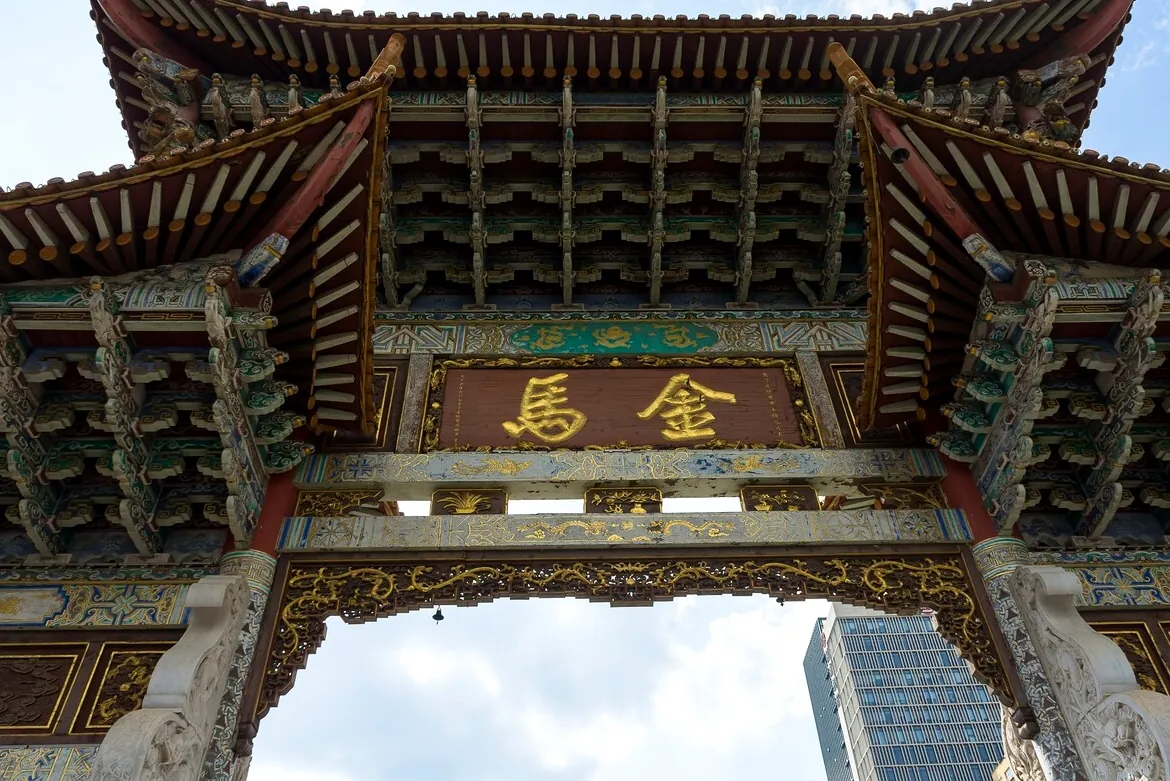
Despite its supreme sacred status, the fate of this historical site could not escape the turbulent storms of modern history. Having stood resiliently against the elements, earthquakes, and the fierce political shifts from the Ming to the Qing dynasties for over three hundred years, the archway complex was carefully restored several times during the reigns of Emperors Kangxi and Guangxu. Regrettably, in 1950, amidst the wave of urban infrastructure reconstruction and traffic planning, the two original precious wooden archways were demolished. This disappearance left a significant void in the cultural memory of Kunming for nearly half a century, leaving the pride of the Diannan region to linger only in ancient texts and the nostalgia of local generations.
The aspiration to revive this heritage found a powerful voice in 1998, when local authorities launched a comprehensive strategy to reconstruct the Jinma Biji Archways on their original coordinates. Based on archaeological records and precise archival drawings, master craftsmen resurrected the two archways, each nearly twelve meters high and eighteen meters wide, re-establishing the exquisite wooden mortise-and-tenon joinery and vibrant imperial colors in the spirit of the 17th century. The 1998 restoration did not merely revive a lost ruin; it marked a spectacular transformation of the entire area, turning a static historical site into a bustling cultural pedestrian hub where modern life harmonizes perfectly with the sediment of a thousand years of history.
Located in the heart of Kunming city in Yunnan province, the Jinma Biji complex enjoys a rare and auspicious feng shui location on the Yunnan-Guizhou Plateau. This area sits at the center of the Kunming basin at an average altitude of nearly two thousand meters above sea level, surrounded by natural basin terrain, with the vast, breezy Dianchi Lake to the south. In traditional feng shui geography, this space is considered the central meridian that gathers the vital energy of the entire “Spring City,” where the sun and moon converge and flowers bloom throughout the four seasons, thanks to abundant groundwater and a cool, monsoon-influenced subtropical climate year-round.
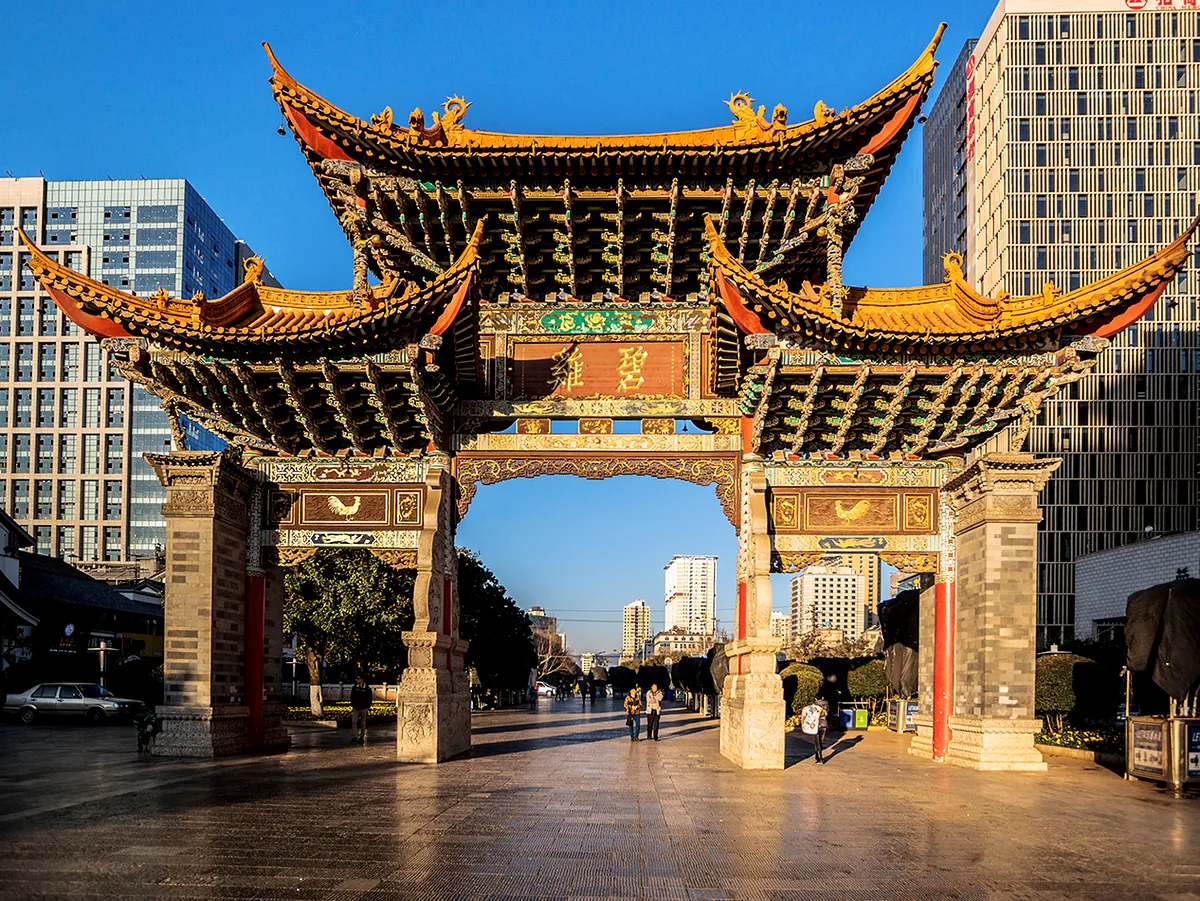
Standing majestically at the intersection of bustling urban life, the traditional gateway structure (paifang) of Jinma and Biji stands tall as an enduring cultural symbol. This precious timber triple-archway complex features a towering three-bay, four-pillar structure, highlighted by intricate dougong bracket systems supporting proudly upturned curved tile roofs meticulously carved with dragons and phoenixes. Every stroke of vibrant gilded red paint and antique jade tile stands proudly, creating a breathtaking visual contrast with the surrounding modern glass-paneled high-rises, opening a picturesque bridge between Kunming’s millennial past and contemporary breath.
The geographic location of the Jinma and Biji gateways was shaped along a cyclical East-West feng shui axis, reflecting the ultimate philosophy of Yin and Yang harmony by Ming dynasty master planners. The eastern side of the city is guarded by the Jinma Mountains, carrying the spiritual energy of the Golden Horse, symbolizing Yang energy and radiant sunlight; while the west is guarded by the Biji Mountains—the Western Hills range—embodying the spirit of the Emerald Rooster, representing Yin energy and the mystical beauty of clear moonlight. Located just tens of meters apart along an absolute precise astronomical azimuth, the two gates create the magnificent phenomenon of “Jinbi Jiaohui” (Golden Horse and Emerald Rooster intersecting radiance) when the shadows of the two arches merge under the resonance of the setting sun and the rising full moon, expressing aspirations for a peaceful land with favorable weather.
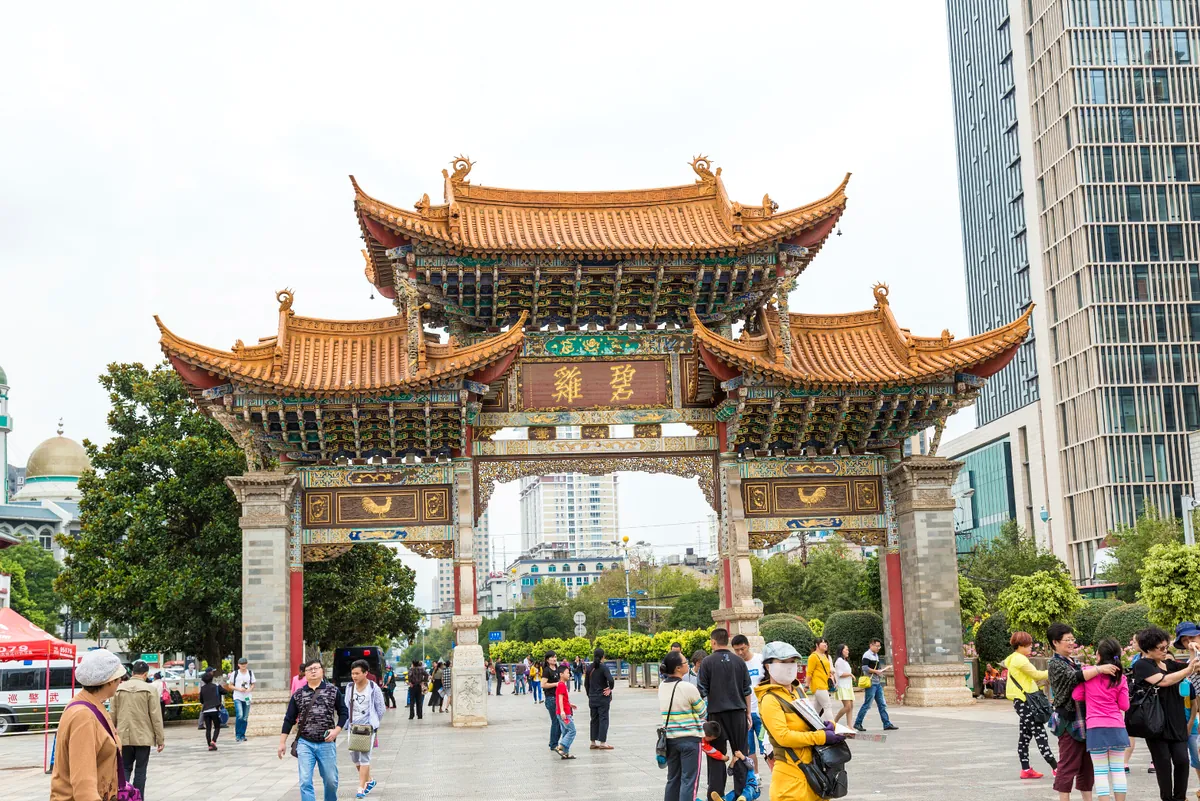
Regarding spatial planning and economic geography, the coordinates of the Jinma Biji pedestrian street serve as a crucial starting point on the famed Ancient Tea Horse Road heritage route, opening a vital artery from Kunming through the ancient kingdom of Dali, Lijiang Ancient Town, and stretching straight up to the mystical sacred land of Shangri-La. For a millennia, caravan traders carrying Pu’er tea, silk, and herbs chose this place as a gathering point for vital energy and luggage inspection before venturing into the treacherous gorges of the Hengduan Mountains. The flat terrain and converging trade routes from all directions transformed this center into one of the most prosperous transit hubs in the southwestern borderlands.
Entering the era of expanded international connectivity, this iconic location continues to affirm its geostrategic bottleneck role as Kunming becomes the headquarters for cross-border economic corridor routes. Through the modern high-speed railway system and vital highway networks spreading across Southeast Asia, from the Jinma Biji node, the flow of goods and travelers can easily transfer directly southward to Laos, Thailand, or Vietnam. The fertile basin topography combined with timeless planning vision has turned this square into a unique landscape space, where the tranquility of natural mountains and lakes blends seamlessly with abundant commercial vitality and overflowing developmental energy.
Presenting an impressive presence at the convergence point of Kunming’s vital energy, the Jinma Biji complex stands as a masterpiece of spatial planning where the boundary between feudal memories and contemporary urban life is delicately dissolved. The overall structure is organized along an east-west axis carrying profound cosmological symbolism, where the two memorial gates stand facing each other across a spacious natural flagstone-paved square. The Jinma Gate dominates the East, facing the Jinma Mountain range to welcome the brilliant dawn, while the Biji Gate nestles peacefully in the West, located by the Biji Mountain range to catch the sunset falling over Dianchi Lake. This symmetrical arrangement not only satisfies strict imperial feng shui canons but also establishes a majestic visual field, guiding travelers into the intersection of time.
Regarding geometric scale, each gateway tower rises exactly 12 meters high and spans up to 18 meters wide. This golden ratio creates a dignified, sturdy stance without feeling heavy, thanks to the graceful curves of the traditional flying eaves system. The complex underwent major restoration and reconstruction in 1998, when Kunming prepared to host the International Horticultural Exposition, marking a major turning point in Yunnan province’s heritage conservation mindset. The reconstruction project was not merely a copy of the past but a revival of construction techniques: the entire core load-bearing frame was reinforced with modern reinforced concrete hidden inside to resist earthquakes and withstand plateau weathering, while the entire exterior cladding strictly adhered to traditional carpentry techniques dating back to the Ming dynasty.
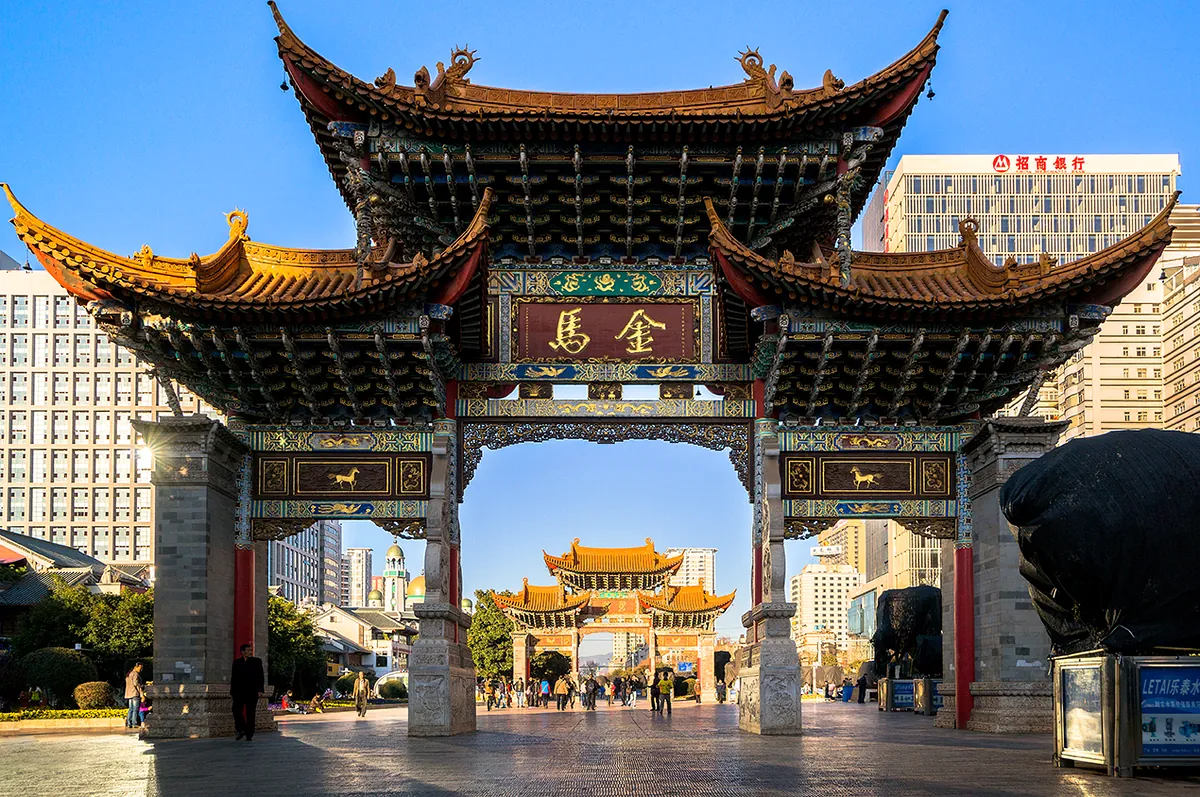
Delving into every architectural detail, connoisseurs cannot help but marvel at the multi-layered interlocking bracket art (dougong) meticulously woven together without the use of a single metal nail. The outstretched bracket arms support the glazed tile roof system, shimmering with amber gold blended with emerald green hues, creating a brilliant visual effect under the deep blue sky of the City of Eternal Spring. Beneath the crossbeam arches, Yunnan artisans have intricately carved motifs of auspicious clouds, water waves, and mythical beasts with varying depths. The Golden Horse (Jinma) Gate stands out with its brilliantly gilded horizontal board and relief sculptures of galloping steed trampling upon clouds, symbolizing yang energy and vitality; conversely, the Jade Rooster (Bixi) Gate exudes elegance with the graceful imagery of a majestic jade phoenix spreading its wings, representing harmonious yin energy and tranquility.
The space surrounding the two archways is planned as a vast commercial and cultural entity, seamlessly connecting with the jewelry, silk, and traditional culinary avenues. The scale of investment extends beyond the two ceremonial gates themselves to encompass tens of thousands of square meters of surrounding landscape, including an artistic lighting system simulating mystical astronomical phenomena, anti-slip stone-paved walkways, and four-season flower beds. The most distinctive feature of this overall space is the extraordinary harmony: the magnificent wooden architecture bearing the flavor of the Ming dynasty’s Yongle era stands confidently and proudly amidst the encirclement of steel-glass skyscrapers and multinational shopping centers. Thus, this complex is not turned into a dead museum artifact, but rather becomes a vibrant heritage anchor, keeping Kunming’s historical soul steadfast amidst the swirling currents of modernization.
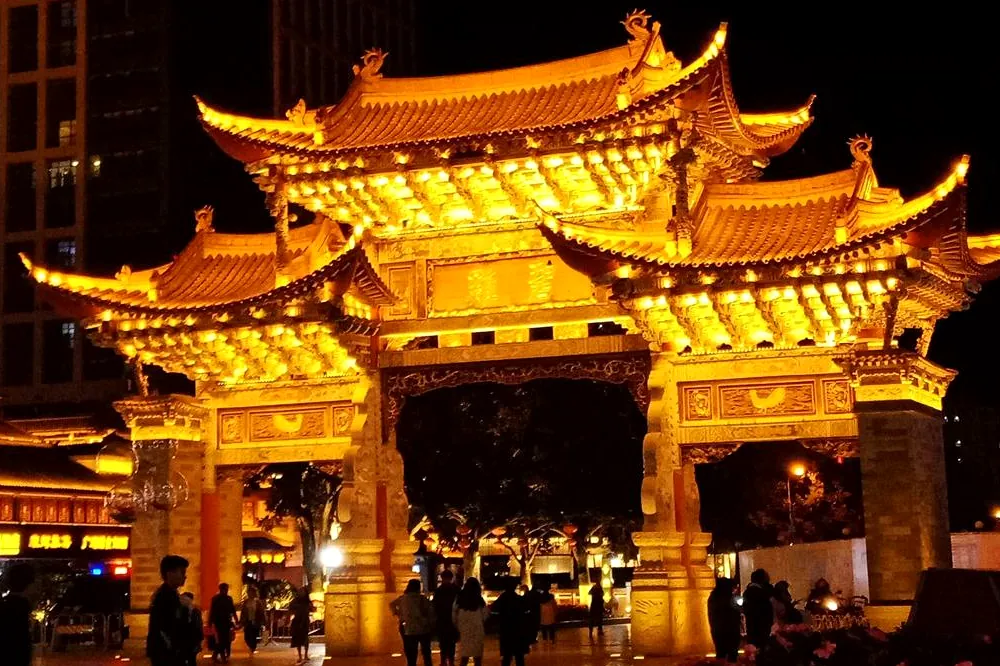
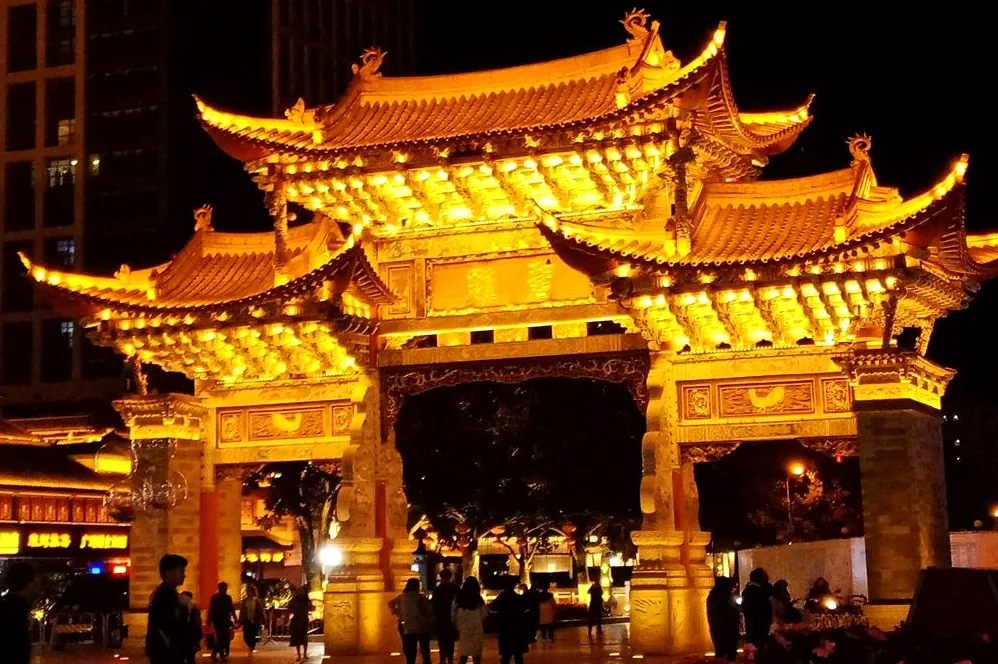
As dusk falls over the Dianchi Plateau, the city of Kunming sheds its daytime solemnity to don the radiant attire of a southern city of lights. The focal point of this magical transformation is none other than the Jinma Bixi Fang complex, where the two renowned archways stand proudly opposite each other, becoming a vivid live-action stage reflecting the soul of the Spring City. At night, the square transforms into an enchanting visual feast, where the currents of time from the Ming dynasty seem to freeze amidst countless novel light spectra, arousing the curiosity of travelers from near and far who flock to discover the endless prosperous heartbeat.
Beneath Kunming’s silent night sky, the traditional Chinese architectural archway appears extremely magnificent with its proud, upturned curved tile roofs stretching toward the dark sky. The artistic lighting system embraces every intricate detail of the dougong structural lines, illuminating the elaborately carved dragon, phoenix, and winding floral patterns crafted by the hands of ancient master sculptors. The brilliantly red-painted and gold-gilded horizontal boards sparkle under warm electric light, exuding a regal yet graceful solemnity, turning the centuries-old wood and stone structure into an enchanting masterpiece of light sculpture in the heart of the city.
The lighting art at Jinma Bixi Fang is not merely about illuminating a heritage site, but a ingenious restoration of the astronomical wonder known as the Intersection of Sun and Moon that astonished the world for centuries. Legend has it that once every sixty years during the Mid-Autumn Festival, when the sun sets in the west and the full moon rises in the east, the shadow of the Bixi gate casting eastward and the shadow of the Jinma gate casting westward would gradually shift and perfectly intersect on the ground. Today, lighting engineers have utilized smart LED systems and precise optical algorithms to recreate this rendezvous shadow every night, turning the harmony between yin and yang, between cool moonlight and blazing sun, into a unique visual performance.
Leaving the focal point of the two majestic archways, visitors’ footsteps immediately blend into the most vibrant nightlife rhythm of Central Yunnan stretching along the Sanshi and Jinbi streets. The night atmosphere here is filled with the renowned flavors of Yunnan cuisine, from the steaming smoke of famous Crossing-the-Bridge Rice Noodles rich with old chicken broth, the alluring spicy kick of Jianshui grilled tofu sizzling on glowing charcoal stoves, to the delicate aroma of freshly baked, crispy rose pastries. Amidst the lively invitations from traditional taverns and teahouses, the melody of traditional Flower Lantern music occasionally echoes, blending with the rustic acoustic guitar strumming of young street artists, weaving a vibrant multi-layered acoustic tapestry.
}
The allure of the Golden Horse and Jade Rooster (Jinma Biji) arches at night also lies in its groundbreaking future planning, as this real-world space prepares to integrate VR technology and multi-sensory interaction directly into the heritage site. Future travelers will not just admire the architecture with the naked eye; they will be able to wear visual devices to immerse themselves in the bustling caravans of the Ancient Tea Horse Road, witness the Ming Dynasty official Mu Sheng supervising the construction of the gates, or touch the mystical Golden Horse and Jade Rooster legends right in the square. The synergy between historical depth, contemporary light art, and advanced digital technology has transformed this place into an invaluable open-air museum, where the past and present engage in a constant dialogue with every breath of the night.
Under the breezy sky of Kunming, the Golden Horse and Jade Rooster square appears in all its majestic glory, where traditional Chinese archways (paifang) stand tall, showcasing the architectural artistry of the Ming and Qing dynasties with their soaring curved roofs, intricately carved with dragons, phoenixes, and cloud-fire patterns. Behind the ancient silhouette of the second archway lies a spectacular intersection with modern urban life, where high-rise buildings embrace the stone-paved square. It is from this vibrant heritage heart that the fragrant aromas of local cuisine begin to spread, leading travelers into a unique culinary journey through the Yunnan plateau.

Speaking of the culinary soul of the Golden Horse and Jade Rooster old street, “Crossing-the-Bridge” rice noodles (Guo Qiao Mi Xian) always hold the most revered position in the hearts of diners. This famous dish, originating from a touching story in Mengzi about a scholar’s wife’s devotion, has been elevated into an artistic dining ritual. A serving of noodles arrives like a miniature banquet with a bowl of broth, boiled for hours from old hen, duck, and pork bones, with a shimmering layer of fat on the surface that acts as a magical heat insulator. Diners will sequentially drop paper-thin slices of salmon, tender pork, quail eggs, and various herbs and young bamboo shoots into the giant glazed ceramic bowl, before adding the chewy rice noodles so the residual heat gently cooks each ingredient to absolute harmony.
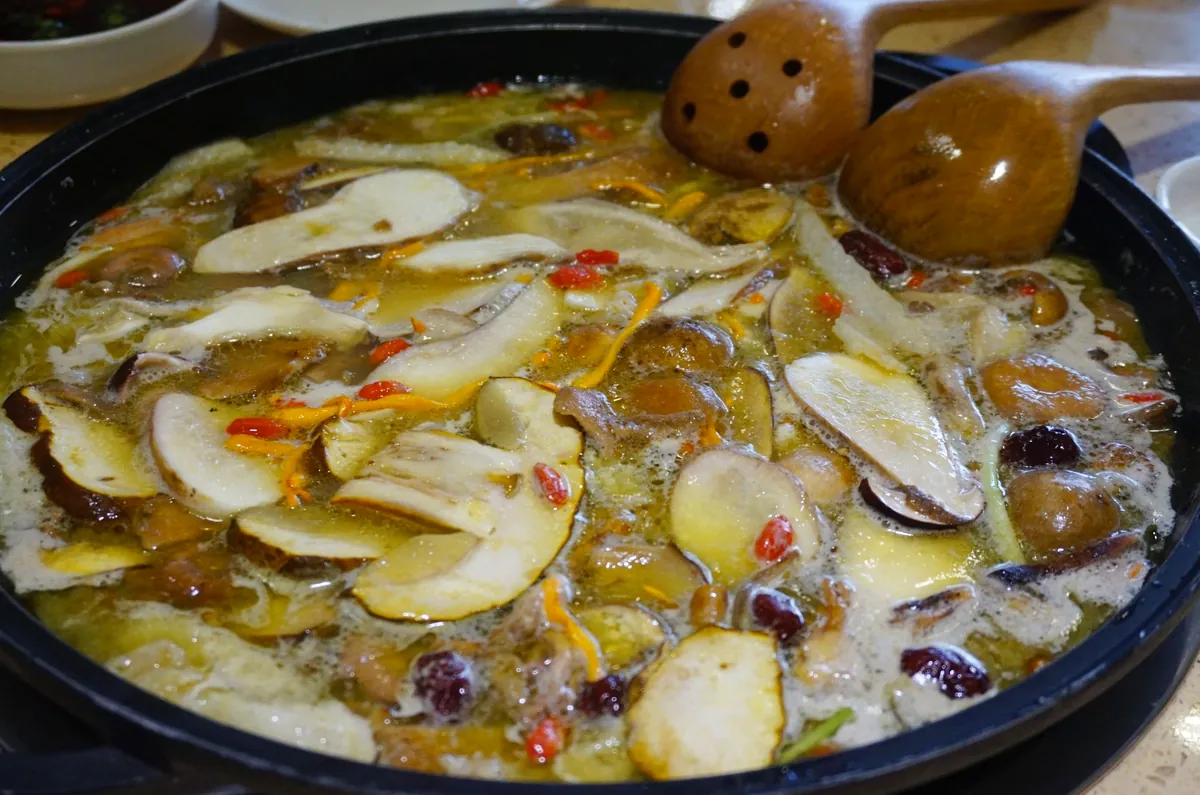
Moving away from the steaming noodle bowls, the culinary space around the two ornamental pillars also captivates travelers with the famous wild mushroom hot pot – an invaluable gift from the vast Yunnan wilderness. Located in an ecological region with one of the highest densities of wild mushrooms in Asia, traditional family-run eateries here serve pure broths distilled from matsutake, porcini, morel, and termite mushrooms freshly harvested from the high mountain slopes. The process of enjoying this dish is strangely disciplined; the owner always places a small hourglass on the table, and the hot pot must boil vigorously for exactly twenty minutes to allow the mushroom essential oils to fully integrate and to completely neutralize any natural compounds that might cause intoxication. The amber-colored broth, sweet from the roots of herbs, carries the deep flavor of the forest floor into every crisp, succulent mushroom, providing an unforgettable, refined experience.
Amidst the delicious flavors of the land of eternal spring, the rose pastry (Xian Hua Bing) represents the elegance and sophistication of ancient imperial culinary culture. Dating back to the Qianlong era of the Qing Dynasty, when it was served as a royal delicacy, this round pastry encapsulates the color and fragrance of rose petals from the outskirts of Kunming. The thousand-layer crust, made from thinly rolled flour mixed with mutton fat or rapeseed oil, is baked over glowing coals until it turns golden and becomes so crispy that it crumbles at the slightest touch. Inside is a filling of rose petals marinated in rock sugar and natural honey, which, upon biting, releases a light, gentle sweetness that lingers on the tongue, becoming a refined gift that anyone visiting this street would want to cherish and take home.
Strolling through the small alleys around the Golden Horse and Jade Rooster as night falls, the culinary picture here is not merely about satisfying the palate but also a reunion between historical heritage and enduring folk life. The fragrant smoke of grilled food wafting from clay-grilled tofu stalls and the clatter of chopsticks blending with the melodic calls of traditional chefs create a rustic yet enchanting atmosphere. Under the warm light cast from the red lanterns hanging high, each traditional flavor, like a crystallization of the plateau’s air and human ingenuity, turns the pedestrian street into a living museum of Southwest Chinese culinary culture.

The Jinma Bijiji Square is a completely open architectural complex, welcoming travelers from all over twenty-four hours a day without any admission fees. However, the bustling commercial rhythm around the two wooden paifang arches only truly awakens from 10:00 AM until midnight, when traditional flower tea houses, silk shops, and food stalls brightly illuminate strings of red lanterns. To fully admire the beauty of the “Spring City,” visitors should prioritize visiting between March and April, when cherry blossoms and jacarandas along Dianchi Lake bloom in unison, or from October to November, when red maple leaves and ginkgo rows turn brilliant gold under the crisp autumn weather, accentuating the turquoise tiles and the solemn, gold-leafed bracket arms of the Jinma Arch.
Kunming’s modern transportation infrastructure makes accessing this heritage site extremely convenient. From Kunming Changshui International Airport or Kunming Railway Station, the most optimal and economical mode of transport is the underground metro system. Travelers can take Metro Line 3 and disembark at Wuyi Lu station (五一路), or catch Metro Line 1 and Line 2 and stop at Dongfeng Square station (东风广场). From the designated exits, it is just a leisurely 7 to 10-minute walk along Nanping Pedestrian Street before the towering silhouettes of the two ancient archways gradually come into view. If choosing a traditional taxi or local ride-hailing services, visitors only need to save the Chinese characters “金马碧鸡坊” on their mobile device so the driver can take them directly to the Jinbi Road intersection.
In one of Southwest China’s leading digital technology-driven cities, physical paper cash is almost entirely absent in daily transactions. To conveniently pay for everything from street food like Jiahua Flower Cakes to traditional cross-bridge rice noodles at Qiuxiangyuan, international tourists must install and activate international credit cards (Visa or Mastercard) integrated into Alipay or WeChat Pay before departure. Additionally, preparing a travel SIM card with international roaming capabilities or a dedicated eSIM will ensure uninterrupted access to navigation maps, translation apps, and QR code scans at border checkpoints, free from the constraints of the domestic network firewall.
Yunnan has long been designated as the prosperous trading crossroads for Burmese jade, Ruili gemstones, and fine silver handicrafts of the Bai ethnic minority. When strolling around the streets adjacent to Jinma Bijiji, visitors can easily be drawn to numerous shops displaying flashy jewelry. Hard-earned advice from field culture researchers is never to spend money on jade and gemstone items at private establishments that cannot present national quality inspection certificates (NGTC or CMA certificates). Deep discount offers ranging from 70% to 90% under the guise of “foreign trade clearance” or “inherited family jade” are actually sophisticated commercial traps targeting foreigners. To fully enjoy the historical depth without being pressured by shopping psychology, travelers should proactively choose “No Shopping” tour itineraries, thereby preserving precious time to peacefully contemplate the magnificent harmony between the shadows of the sun and the moon on earth.
Regarding regulatory procedures, ordinary passport holders need to complete their tourist visa applications (L Visa) at Chinese Visa Application Service Centers or register for an electronic group visa through designated international travel agencies at least two weeks in advance. At the immigration counter of the international border gate, visitors must carefully keep the blue arrival card stub tucked inside their passport until the return journey is completed. Thoroughly researching all administrative aspects and selecting a professional all-inclusive tour package will be the optimal solution to help travelers feel secure in exploring the profound beauty of the Jinma Bijiji heritage in the heart of ancient Kunming.