Nestled in the heart of the prosperous and ancient city of Suzhou, Shantang Street (known in Vietnamese as Phố cổ Thất Lý Sơn Đường) is likened to the “soul”—a delicate silk ribbon stretching across space and time within the fertile Jiangnan region. Within an exploratory itinerary covering China’s golden tourist route of Beijing, Shanghai, Hangzhou, Suzhou, and Wuzhen, a stop at Shantang Street unfailingly evokes a profound, contemplative, and deeply nostalgic sentiment that no modern metropolis can ever replicate.
Geographically, Shantang Street is located in the northwestern section of Suzhou City, within Jiangsu Province, China. This historic street stretches approximately seven Chinese li (roughly 3.5 kilometers, or more precisely about 3,829 meters), connecting the Changmen City Gate area in the east to the renowned scenic Huqiu Mountain (Tiger Hill) in the west. What makes Shantang Street’s layout uniquely distinctive is the flawless parallelism between land and water routes: on one side flows a tranquil canal where wooden paddleboats glide gently across the water, while on the other lies a flat, moss-draped paved stone path flanked by continuous houses and shops bearing profound traditional architectural imprints.
The history of Shantang Street’s formation and development is closely intertwined with the esteemed poet and statesman Bai Juyi during the Tang Dynasty. In the fourth year of the Baoli era under Emperor Muzong of Tang (825 AD), when Bai Juyi assumed office as the Prefect of Suzhou, he inspected the region and recognized that travel between Suzhou city and Tiger Hill was severely impeded by low-lying, marshy, and frequently flooded terrain. Driven by strategic vision and a profound love for the people, he mobilized imperial laborers to dredge the waterways while simultaneously constructing a grand roadway alongside a parallel canal.
Ever since its completion, Shantang Street rapidly evolved into the most vital water and land transportation lifeline of the region. Traversing the Song, Yuan, Ming, and Qing Dynasties, the location transcended a mere trading route to rise as the most bustling cultural, commercial, and entertainment center across the entire Jiangnan area. During the Ming and Qing Dynasties, Shantang was lauded as “the most prosperous street in the Divine Land,” serving as a gathering ground for literati and scholars, wealthy merchants, famed theatrical troupes, and accomplished courtesans.
If Beijing represents imperial authority through its majestic Forbidden City, and Shanghai epitomizes modern globalized living rhythms, then Suzhou—with Shantang Street at its zenith—embodies the purest incarnation of Jiangnan aesthetics. Cultural researchers regard this site as a “living specimen” of commercial culture and urban civic life in feudal China.
The symbolic significance of Shantang Street rests not merely on its 1,200-year history, but equally on its immaculate preservation of the “parallel land and water transport” model—an extraordinarily unique ancient urban planning scheme. Visiting Shantang Street on an exploration across five grand historical cities, travelers not only feast their eyes on picturesque natural scenery but touch the millennial historical and cultural pulse of Chinese civilization, where every brick and every tiled roof whispers tales of a bygone golden era.
Upon setting foot on Shantang Street, visitors are immediately overwhelmed by an ancient, uniform, and exquisitely refined architectural tableau. Unlike heavily commercialized old quarters across the globe, Shantang Street preserves nearly intact its traditional urban spatial structure bearing the characteristic architectural style of ancient Jiangnan.
Residential and commercial architecture along Shantang Street represents a fluid synthesis of Suzhou architectural style (Su school) and subtle Hui style (Anhui architecture) influences. Dwellings here typically span two to three stories, constructed using traditional timber-framed techniques with grayish-white load-bearing brick walls. The most striking visual highlight is the pristine white-painted walls paired with dark yin-yang tiled roofs, creating a classic contrasting color palette of black and white—simple yet exceptionally refined, evoking traditional Chinese landscape paintings.
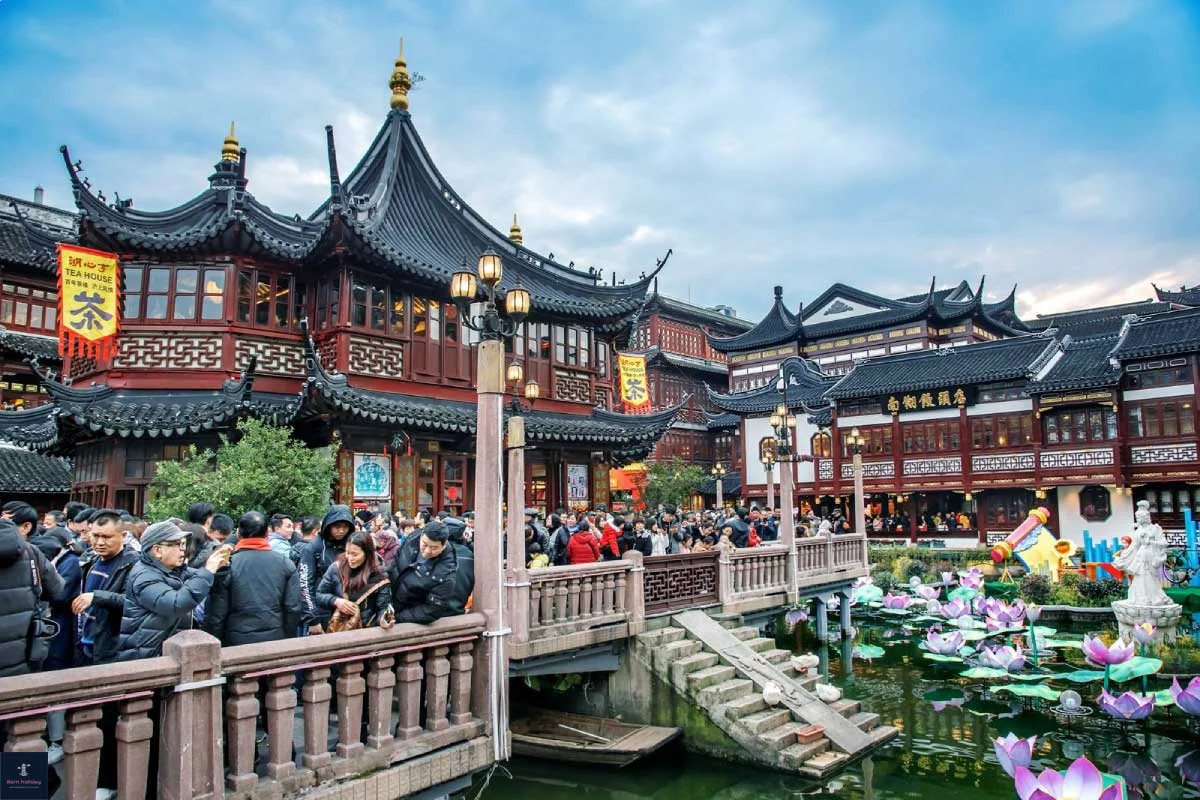
Crowded tourists visiting traditional Chinese ancient architecture beside a lotus-filled lake.
Shopfront facades along the old street frequently feature intricate louvered wooden doors paired with artistic circular (moon gates), hexagonal, or vase-shaped windows. Above doorways hang precious timber shop signs inscribed with gilded Chinese characters or inlaid mother-of-pearl, exuding the nostalgic charm of bygone mercantile houses. Following the smooth bluestone-paved pathways, dense rows of red lanterns line the eaves; as night falls, the warm golden glow radiating from thousands of lanterns reflecting off the canal’s surface fashions a mystical, shimmering ambiance straight out of a fairy tale.
Shantang Street’s scale extends beyond a single pedestrian walkway into a multi-tiered spatial network featuring ancient stone bridges spanning the Shantang Canal. Along the street’s length sit numerous historic arched stone bridges, epitomized by Tonggui Bridge, Antai Bridge, and the Yamiao Bridge. Constructed from monolithic granite, these bridges have been embraced by moss over centuries of rain and sunshine, framing breathtaking perspective views.
Impressive and magnificent scenery at Shantang Street Old Town, Suzhou
Gazing downward from the apex of these stone bridges, visitors capture panoramic daily scenes of local life: wooden boats laden with fruits, tea sets, or passengers gliding past, leaving gentle ripples; riverside houses featuring wooden balconies projecting directly over the water, where mothers and grandmothers wash clothes or dry garments in quintessential Jiangnan style. This environment creates a powerful visual impact, evoking instant awe and continuous shutter clicks from photography enthusiasts.
To fully appreciate the beauty of Shantang Street throughout a China-wide journey, travelers require a methodical experiential plan, combining walking tours exploring every nook with enjoying distinctive local leisure activities.
A mandatory activity upon reaching Shantang Street is boarding a traditional hand-rowed boat (*manzhun huafang*). Admiring the old quarter from water level offers an entirely distinct perspective compared to walking ashore. As the wooden boat glides smoothly over the turquoise canal, passengers listen to the rhythmic splashing of the boatman’s oars, admire weeping willows draping over the water, and examine centuries-old ancient houses leaning against the canal up close. The ideal time for a boat ride is at dusk during sunset or right after nightfall when lanterns light up brilliantly.
Tonggui Bridge and the river junction area: This represents the most classic photography angle along Shantang Street. From here, you capture layered historic canal-side houses, bustling boats, and radiant lantern light forming perfect compositional frames for classic Chinese-style check-in photos. Shantang Street Archway: The grandiose gateway featuring exquisite wood-carved architecture, bearing feudal imprints right at the main entrance of the old street. This marks the primary stop to capture photos commemorating your Suzhou exploration. Shantang Culture and History Museum (Guanyin Pavilion / Yuhuang Temple): A repository for precious artifacts detailing the street’s formation history, featuring solemn temple architecture with upward-curving eaves pointing toward the sky. Riverside tea houses with antique balconies: Charming petite tea houses lining the canal banks, where you can sip premium Suzhou jasmine tea while sitting on balconies watching crowds stroll the old street.
Traveling to Shantang Street is not merely an ocular feast of ancient architecture, but a peak culinary adventure uniting long-standing traditional delicacies of Suzhou—one of China’s major culinary cradles (belonging to the Su/Huaiyang culinary schools).
Strolling down the lengthy street, visitors are instantly seduced by alluring aromas wafting from roadside eateries. Below is a list of absolute must-try specialty foods when visiting Shantang Street:
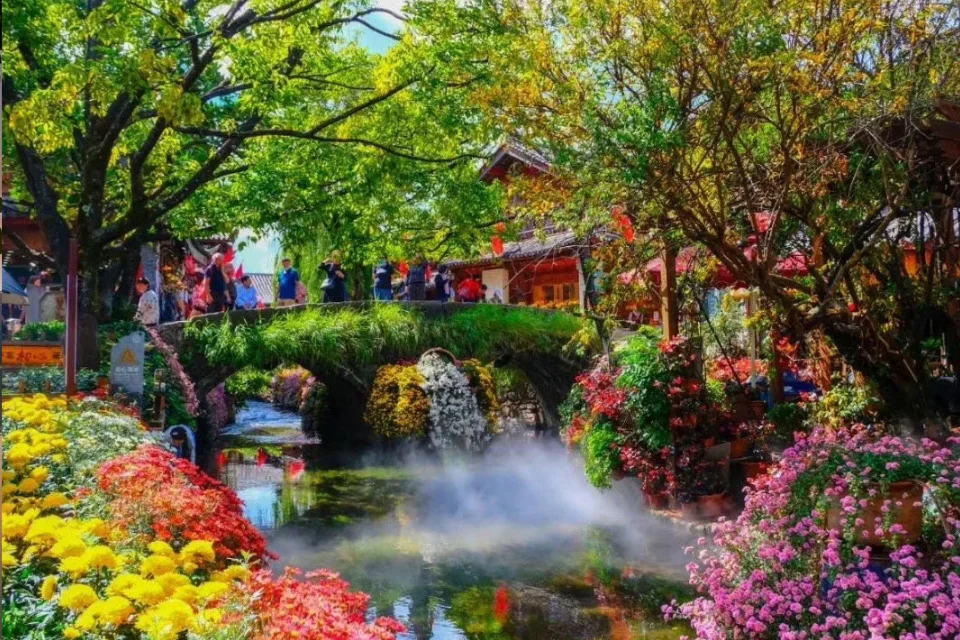
Poetic stone bridge scenery blanketed in flowers and shady greenery in Suzhou’s old town.
Osmanthus Cake (Guihuagao): A traditional dessert made from glutinous rice flour, cane sugar, and fresh osmanthus flowers. Featuring ivory-white or pale-yellow hues, it delivers a gentle sweetness and rich osmanthus fragrance lingering across the palate. Peanut Candy and Suzhou Tanghulu: Traditional handicraft candy stalls draw crowds watching artisans skillfully stretch and cut candy. Candied hawthorn skewers feature crispy sugar shells encasing ripe hawthorns, balancing sweet and sour notes. Suzhou Noodles: Famed noodles featuring broths simmered from chicken bones, fresh fish, and herbs for hours, offering natural translucent sweetness. Noodles are thin and moderately chewy, served with braised duck in soy sauce, Dongpo pork, or shelled fresh shrimp. Suzhou Soup Dumplings (Xiaolongbao / Shengjianbao): Distinct from Shanghai xiaolongbao, Suzhou soup dumplings feature slightly thicker dough skins encasing rich pork fillings and piping-hot soup; bite a small hole to sip the broth before enjoying the filling. Squirrel-Shaped Sweet and Sour Fish (Songshu Guiyu): A celebrated imperial dish crafted from snakehead fish, intricately scored to resemble a squirrel, deep-fried until crispy, and drizzled with a thick sweet-and-sour tomato reduction and roasted pine nuts. This represents the pinnacle of Suzhou culinary carving and preparation arts.
Shantang Street is equally a shopping paradise for traditional handicraft souvenirs carrying the cultural identity of the Jiangnan region as gifts for loved ones and friends:
Premium Suzhou Silk: Suzhou has historically been renowned as China’s silk capital. Along the old street lie numerous shops vending pure silk products like scarves, qipao dresses, and silk fabrics featuring exquisite hand-embroidered motifs. Suzhou Hand-Embroidered Silk Paintings (Su Xiu): Among China’s “Four Great Embroideries.” Intricately crafted double-sided hand-embroidered artworks depicting peacocks, peonies, and lifelike natural scenery, displaying the peak artistry of Suzhou embroiderers. Suzhou Jasmine Tea and Tea Sets: Jasmine tea here is scented manually from prime green tea buds and fragrant jasmine blossoms, delivering refined, relaxing flavors. Wooden Handicrafts and Traditional Folding Paper Fans: Meticulously hand-painted paper fans or decorative items carved from precious woods featuring calligraphy.
To ensure your journey exploring Shantang Street in particular and China’s tourist routes overall unfolds smoothly and perfectly, VDS Travel experts share a detailed practical handbook from A to Z for travelers.

Impressive and magnificent scenery at Shantang Street Old Town, Suzhou
Suzhou features a temperate monsoon and subtropical climate with four distinct seasons. Nevertheless, the ideal times to visit Shantang Street are spring (March to May) and autumn (September to November):
Spring (March – May): Mild weather, blooming flowers, canal-side willow branches sprouting lush green leaves, highly favorable for walking strolls and photography. Autumn (September – November): Dry weather, clear blue skies, pleasant cool air. This marks the osmanthus blooming season filling all streets with fragrance. Timing note during the day: Visit Shantang Street starting around 3:00 PM to capture daytime scenery, witness sunsets over the canal, and continue enjoying the magical glowing beauty of thousands of lanterns after nightfall (from 6:00 PM onward).
Within the framework of China tours (Beijing – Shanghai – Hangzhou – Suzhou – Wuzhen), reaching Suzhou is extremely convenient thanks to developed high-speed rail networks:
Interprovincial travel: From Shanghai to Suzhou takes a mere 25 – 30 minutes via high-speed train (G-train). From Beijing to Suzhou requires roughly 4.5 to 5 hours by high-speed rail. From Hangzhou to Suzhou takes about 1.5 hours. Intramural travel in Suzhou to Shantang Street: Subway: Utilize Line 2 of the Suzhou Metro, alighting at Shantang Street Station (山塘街站), exiting via Exit 3, and walking a few minutes to reach the old street gates. Taxi or Ride-Hailing (Didi): Highly popular and convenient when traveling from other city attractions like Lingering Garden or Tiger Hill.
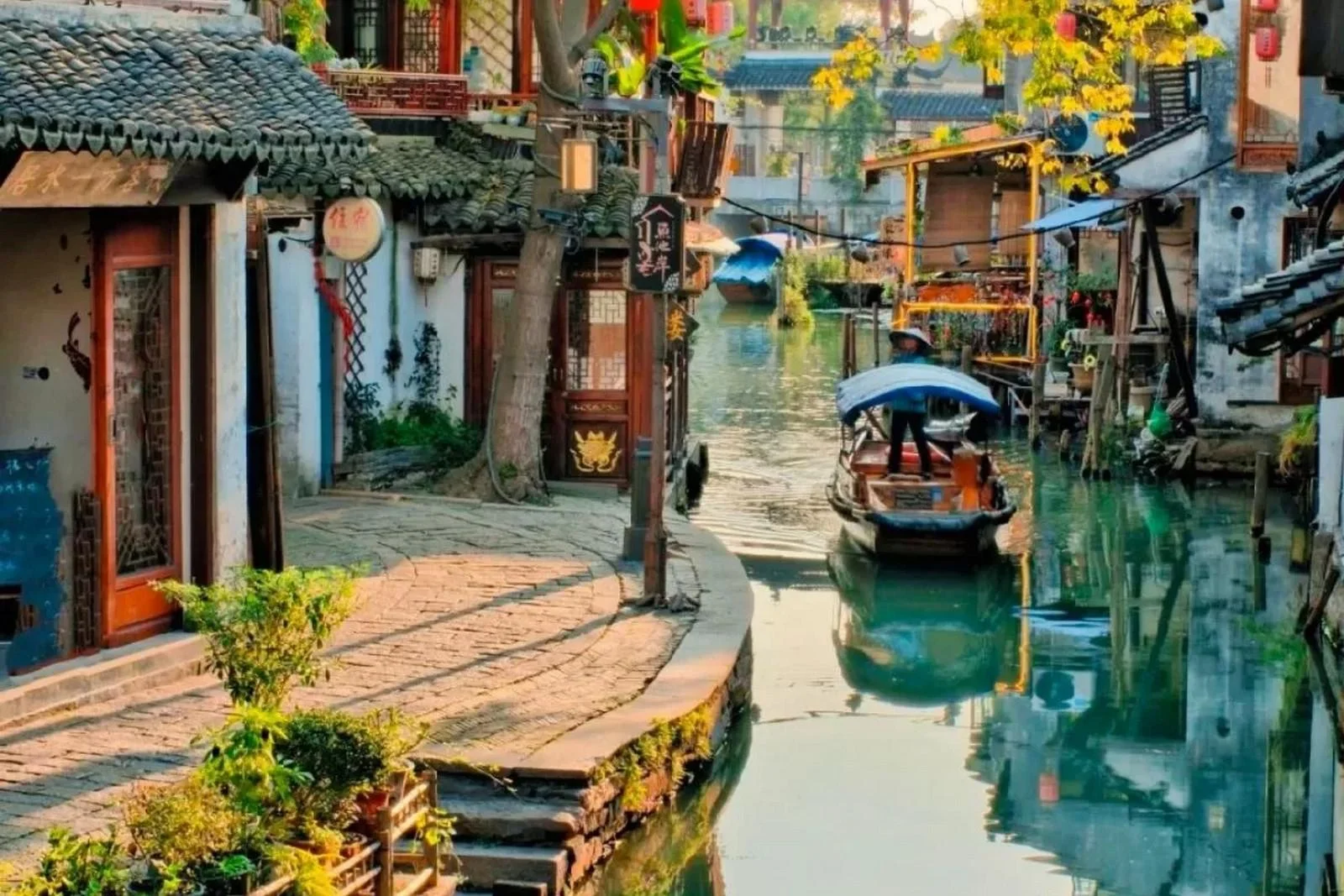
Poetic waterways and traditional old streets in Suzhou, China.
Shantang Street Old Town opens freely for visitors to tour without admission fees day and night. However, certain experiential services inside require fees:
LISTED SIGHTSEEING TICKET & SERVICE PRICE TABLE
Electronic payments: In China broadly and Shantang Street specifically, nearly all shops, eateries, and street vendors utilize mobile payment apps like WeChat Pay or Alipay. Travelers should prepare and link international bank cards to these apps prior to travel. While cash remains accepted, it is less common and vendors occasionally struggle with small change. Conscientiousness in maintaining cleanliness: Shantang Street is a strictly preserved national historic monument. Visitors must absolutely avoid littering, defacing ancient walls, and complying with local regulations. Respecting residents’ living spaces: Part of the old quarter remains residential. When photographing residential zones or communal activities, request permission beforehand and avoid loud noises disrupting residents’ lives, especially late at night.
No, Shantang Street Old Town opens completely free of charge for self-guided tourist visits day and night. You only purchase tickets when utilizing paid services such as canal boat rides or touring specialized interior museums and shrines.
The ideal duration to experience the space fully spans 3 to 4 hours (typically starting from late afternoon into the evening). This timeframe suffices for strolling the street’s length, visiting souvenir shops, enjoying local gastronomy, boating during sunsets, and admiring the old quarter glowing beneath lanterns at night.
The most convenient, rapid, and economical approach is taking high-speed rail from Shanghai Railway Station or Shanghai Hongqiao Station to Suzhou Railway Station. Train travel takes a mere 25 – 30 minutes. Upon arriving in Suzhou, transfer to Metro Line 2 to reach Shantang Street Station directly.
The finest moment at Shantang Street falls between 5:30 PM and 8:00 PM. This is when the sky transitions into twilight before dusk, and thousands of red lanterns are simultaneously lit brilliantly, reflecting glowing light upon the canal waters to forge nostalgic Jiangnan scenery breathtakingly beautiful to behold.
Authentic products bearing Suzhou imprints that you can procure as gifts include: premium silk items (scarves, qipao), exquisite Suzhou hand-embroidered art, fragrant Suzhou jasmine tea, alongside traditional confections like osmanthus cake and candied hawthorn skewers.