The historical flow of Nuremberg does not begin from hazy mythological legends, but is sharply defined in writing from the High Middle Ages, opening a volatile chronicle of one of the most powerful metropolises in Europe. World historians and German scholars mutually agree upon the milestone of 1050 as the starting point for the city’s official history, when the name Norenberc first appeared solemnly in a royal charter. Under the lens of historical linguistics, the etymology Norenberc stems from Old High German, purely meaning the rocky hill, accurately reflecting the perilous and strategic terrain of this land long before humans laid the first bricks to build a solid defense system.
Nuremberg’s destiny from its inception was closely linked to the most glorious dynasties within the Holy Roman Empire, witnessing the rise and transformation of major feudal powers such as the Salian dynasty, the Hohenstaufen house, and the Luxembourg dynasty. As early as 1050, Emperor Henry III laid the first foundation stones for royal power here. By the 12th century, under the reign of the famous Emperor Frederick I, the rocky hill was further expanded on a large scale to become the majestic Imperial Castle (Kaiserburg), the headquarters of the entire empire. Nuremberg’s political peak was established in 1356, when Emperor Charles IV officially promulgated the historic document known as the Golden Bull. According to the core provisions of this document, any emperor succeeding to the throne of the Holy Roman Empire was required to summon the first meeting of the Imperial Diet right in Nuremberg, turning it into the unofficial capital and political heart of the entire Central Europe.
Nuremberg’s prosperity was built not only on royal political power but also guaranteed by supreme economic and legal privileges. In 1219, Emperor Frederick II issued the Great Charter of Liberties, officially elevating Nuremberg into a Free Imperial City (Freie Reichsstadt). This exclusive status granted the city administrative autonomy, financial self-management, and trade freedom, transforming it into one of the busiest trading hubs along transcontinental trade routes in the Middle Ages. The religious and ideological turning point knocked on this metropolis’s door in 125, when Nuremberg decided to peacefully transition to the Lutheran Protestant faith, becoming one of the beacons of the Protestant Reformation in Germany.
Alongside political power and economic prosperity, Nuremberg was simultaneously the cradle that produced the artistic and cultural peaks of the Northern Renaissance. The great figure of Albrecht Dürer (1471–1528), the genius master painter and printmaker, remains the highest humanist symbol that the city bequeathed to humanity. The artistic, philosophical, and scientific legacies left behind by Dürer and contemporary intellectual generations shaped Nuremberg’s unique cultural identity, transforming it into a gathering place of intellect and beauty.
However, the wheel of history also ruthlessly rolled over this city amidst the flames of World War II, when terrifying allied air raids wiped out nearly ninety percent of the inner city’s ancient architecture, turning centuries-old heritage into a desolate wasteland. Yet, from those tragic ashes, the resilient spirit of Nuremberg’s citizens rose strongly. They carried out one of the greatest feats in human history regarding heritage conservation: the campaign of anastylosis based entirely on medieval cadastral maps and surviving pictorial records. Every single sandstone block and steep gable roof angle was restored with absolute precision, bringing a medieval Nuremberg back from the dead, standing tall as an immortal testament to the timeless vitality of European culture.
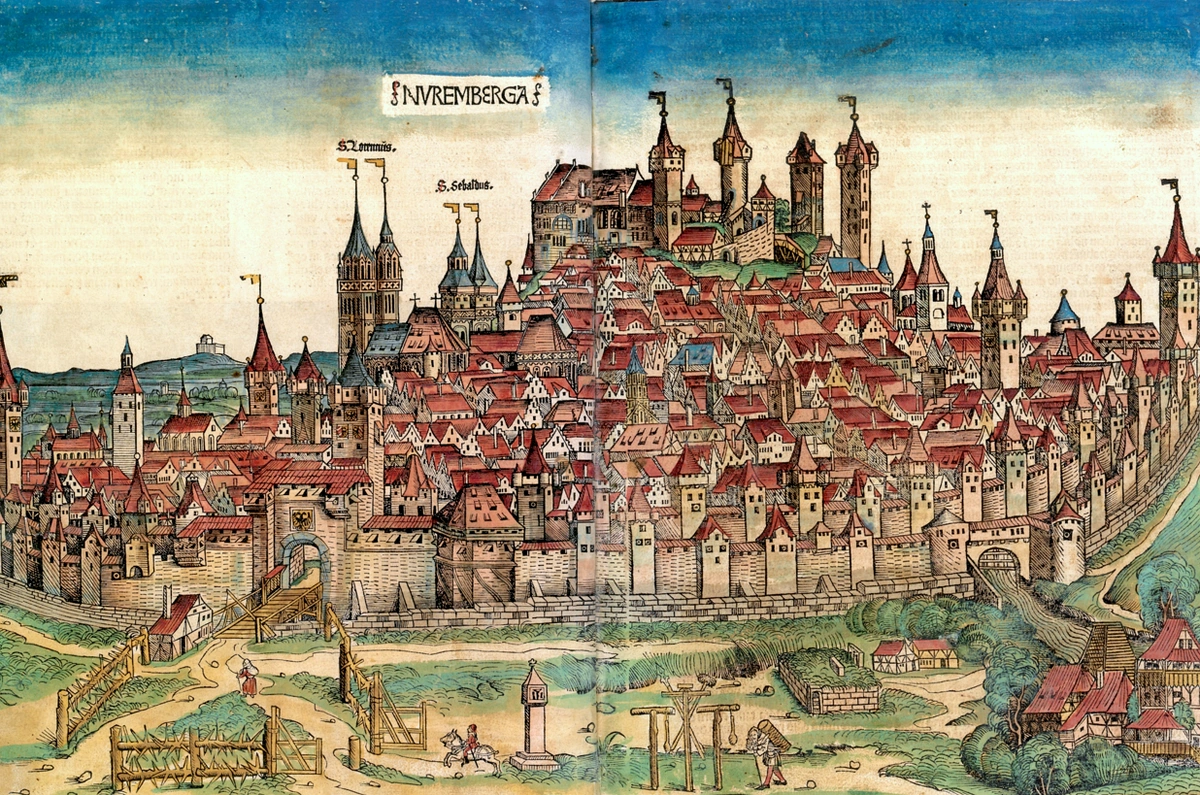
Viewed through the combined lens of classical Eastern feng shui and Western urban landscape ecology, Nuremberg’s spatial structure is one of medieval Europe’s masterpieces of natural-adaptive planning. Guarding the northern part of the city is the precipitous elevation of natural red sandstone, the domain of the illustrious Kaiserburg castle complex. In terms of military topography and human geography, this terrain forms a solid backing acting as a perfect “mountain support,” completely shielding the entire inner city area below from winter northern winds and all strategic enemy viewpoints. Cutting across the heart of the city along the east-west axis is the gentle yet vital Pegnitz River, dividing the ancient metropolis into two key parishes: St. Sebald in the north and St. Lorenz in the south, actualizing the “water-facing” philosophy to attract vital energy, wealth, and facilitate water and land commerce for generations.
Nuremberg’s water defense system does not stop at the natural flow of the Pegnitz River but is thoroughly exploited through tributary branches and a system of artificially excavated surrounding moats, weaving a closed aquatic network to fend off sieges from afar. On that geographical foundation, the city’s urban planning clearly reflects the philosophy of “power decentralization” combined with “supreme commerce” thinking. The northern half of the city, under the majestic shadow of the Kaiserburg fortress, was shaped as the center of imperial and religious power with magnificent cathedrals. Conversely, the southern half lying across the Pegnitz is bustling with secular commerce, handicraft workshops, and the autonomous center of the citizenry. Both worlds are tightly connected by ancient bridges spanning the river, most notably the Henkersteg (Executioner’s Bridge) imbued with distinct timber-frame architecture.
Along with population explosion and economic prosperity across periods, Nuremberg grew along the model of organic concentric circles, gradually expanding through historical stages to be fully embraced by a massive fortification wall system (Stadtmauer). Stretching for a total length of approximately 5 kilometers, this solid wall strip is punctuated by exactly 128 defensive watchtowers arranged at equal intervals, forming an unassailable protective perimeter. The fortress construction techniques of that era required meticulous calculations regarding the load-bearing capacity of locally quarried red sandstone, combined with deep moats and perilous gateways to optimize the combat efficiency of the city-defending militia. Through all temporal vicissitudes, this unique planning structure retains its value entirely, turning Nuremberg into a living textbook on the art of military architecture and medieval capital siting.
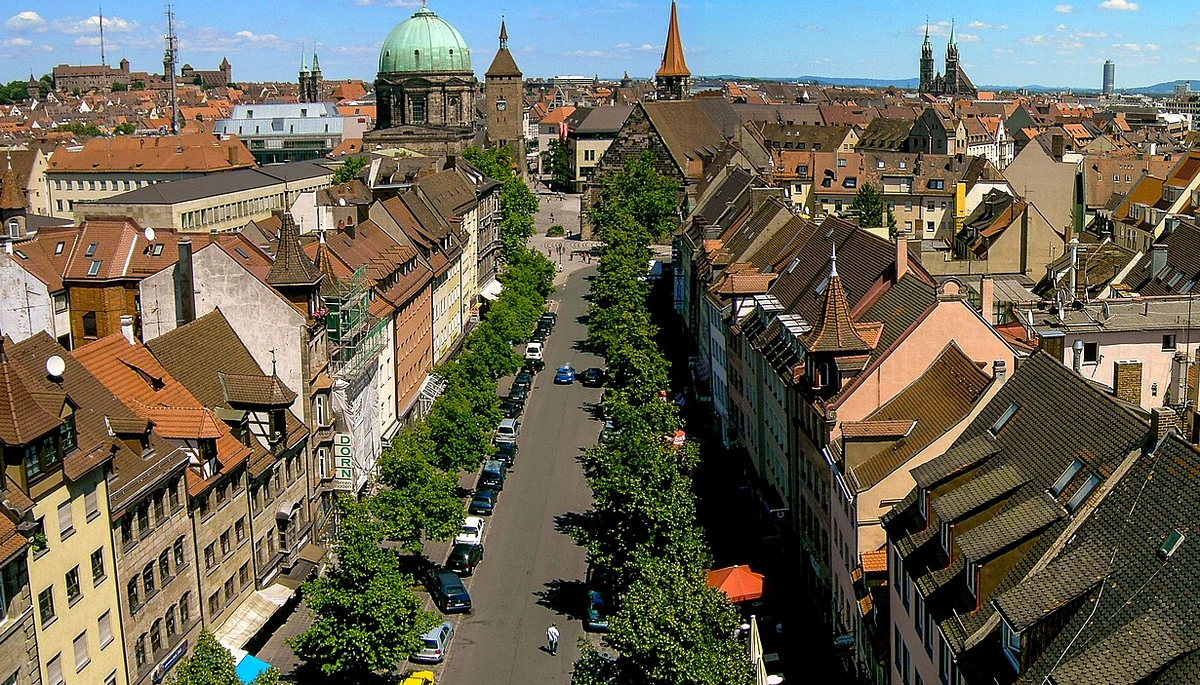
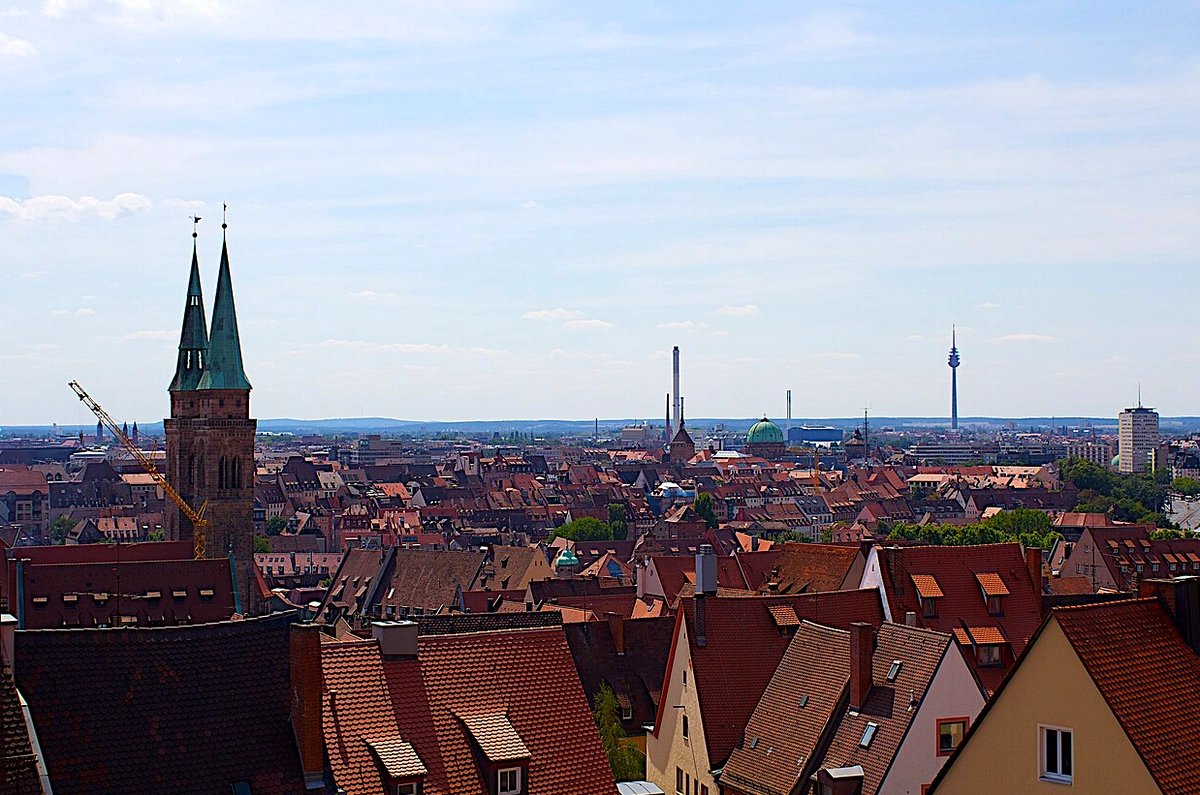
Stepping into Nuremberg’s urban space is like wandering into a living architectural museum, where the construction art essence of Franconia in southern Germany is fully and proudly portrayed. The spatial structure here is a harmonious intersection between traditional half-timbered architecture and the majestic Gothic style of stone buildings. Overall, structures in Nuremberg not only adhere to strict medieval technical principles but also express visionary urban planning thinking, where every inch of land is tied to defensive, residential, and imperial power-glorifying needs.
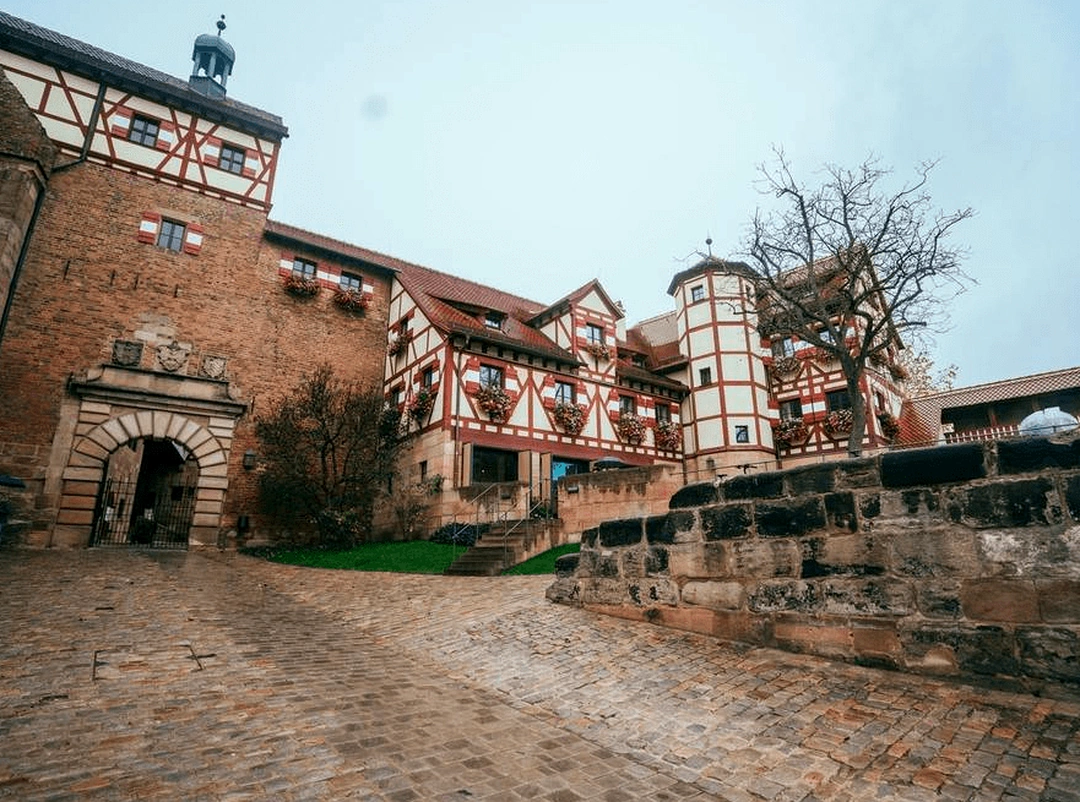
The solid foundation of architectural works here mostly utilizes red sandstone from the Castle Hill (Burgberg) hills, quarried directly on-site by artisans to build house foundations and solid city walls. Layered atop that sturdy stone base is a unique superstructure system made of oak and aged pine timber frames. Medieval artisans applied advanced mortise-and-tenon techniques, allowing wooden components to connect tightly without requiring metal nails, giving structures excellent elasticity against time and weather fluctuations. The most easily recognizable feature of Nuremberg residential facades is the design where upper floors cantilever out over the ground floor. This technique not only optimizes usable area in the narrow space of the old town but also creates an immensely impressive visual aesthetic with walls interweaving red stone hues, dark tones of raw timber, and small windows.
Reigning atop the highest point of the city’s terrain is the Kaiserburg Imperial Castle Complex, the supreme symbol of power for Holy Roman Emperors who chose this place as their ruling stronghold. Kaiserburg’s architecture is a complex yet harmonious collection of various military and royal palace components. Prominent among them is the Sinwell Tower, a solid defensive structure with panoramic views over the surrounding valley, acting as the sentinel eye of the entire fortress. Right next to it is the Deep Well, a medieval hydraulic engineering marvel excavated straight through deep, hard rock to ensure an endless fresh water supply for the stronghold during prolonged sieges. More notable than all within the palace precinct is the Double Chapel, a two-story stacked religious architectural masterpiece embodying the strict philosophical demarcation between the king’s position and the common knight class during sacred rituals.
Leaving the majestic atmosphere of the elevated fortress, the flow of medieval life converges at the Central Market Square, home to the decorative fountain known as the Schöner Brunnen (Beautiful Fountain). This masterpiece stands nineteen meters tall, designed by the talented hands of stone-sculpting master Heinrich Beheim. The structure evokes the shape of a Gothic church spire reaching toward the sky, intricately carved from large stone blocks with a total of forty brightly painted stone statues depicting the entire ideological, philosophical, mythological, and core historical figures of the Holy Roman Empire. Surrounding the fountain is an exquisitely hand-wrought iron fence, preserving an enduring folk legend across centuries that any tourist who spins the three gold rings attached to the fence will encounter good fortune and have their wishes come true.
The practical scale of Nuremberg’s architectural landscape does not stop at individual buildings but forms a seamless urban ensemble testifying to the talented hands, refined aesthetic sense, and superb material-crafting techniques of medieval artisan generations. Through historical ups and downs and wartime devastation, the spatial structure and characteristic Franconian architectural lines here are still restored and preserved intact, turning Nuremberg into an open textbook for anyone wishing to trace back to the golden architectural origins of European feudalism.
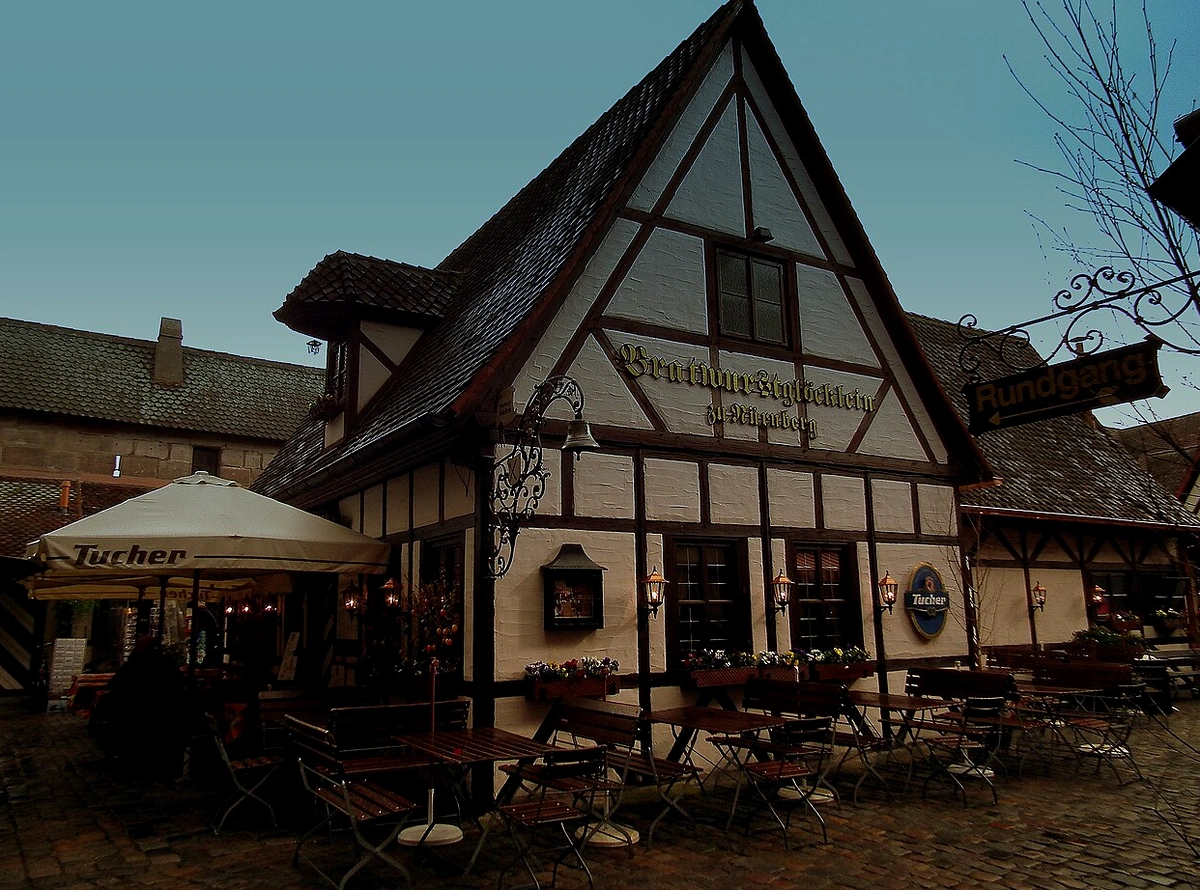
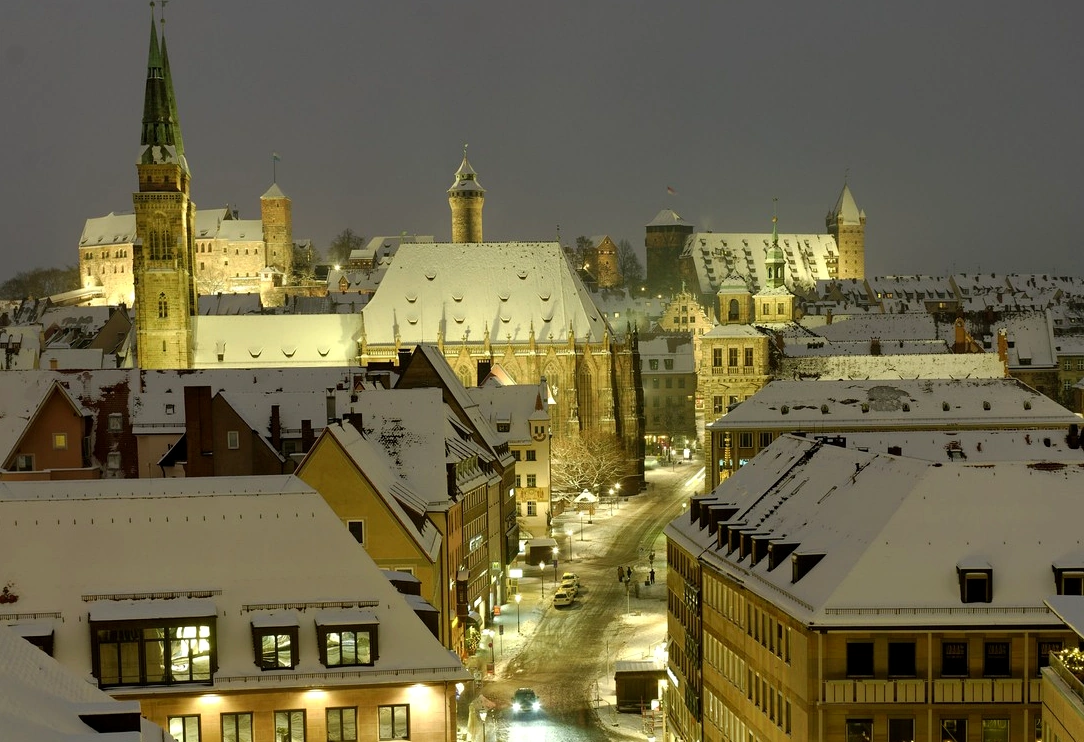
When night falls and hazy mist blankets the steep roofs of the Franconian region, Nuremberg enters a completely different appearance where the boundary between present and past seems to dissolve. Unlike the glaring, flashy look of modern metropolises, nighttime lighting art in this medieval city is meticulously planned, adhering to principles of historical respect and emotional depth. The entire urban lighting system utilizes warm color temperatures ranging from 2200K to 2700K through modern LED technology cleverly concealed. Thanks to this technique, the gloomy red hue of desert sandstone walls and dark brown of the Fachwerk timber-frame structure are truthfully and vividly recreated down to every wood grain and ancient lime plaster line.
Looking back from afar, the Imperial architectural complex featuring the main tower of the Imperial Fortress and the ancient wall system is honored by an angled long-range floodlighting system, creating majestic stereoscopic blocks cutting across the night sky. Along narrow, winding alleys, light does not emanate from glaring high-pressure lamps but from hand-wrought iron wall lanterns simulating medieval prototypes. That yellowish, gentle light casts down onto rain-glossed cobblestone streets, painting magical shimmering streaks of light as if luring travelers to step backward in time to past centuries.
Nighttime space in Nuremberg is not only quietly gazing at architecture but also awakened by captivating live-action performances, most notably the artistic walking program with the traditional Night Watchman tour, known as Nachtwächterführung. Amidst the hazy ambiance of the old town, an artist dressed in accurate medieval night attire, wearing a wide-brimmed hat, carrying an iron lantern emitting flickering light and holding a long halberd spear, transforms into a night watchman. Amidst echoing footsteps on ancient stone slabs, the night watchman utters deep patrol chants, recounting secret inner-court anecdotes, strict Renaissance city council rules, or mysterious tales hidden behind narrow windows.
Every step travelers take following the lantern light touches deep indigenous cultural layers, where nighttime life blends community warmth with historical profundity. The pinnacle of appreciation and communal art space here is the globally renowned Christkindlesmarkt Christmas market, an intangible cultural heritage deeply rooted in 1628. From late November until December 24th annually, the Central Market Square (Hauptmarkt) bursts into a sea of light and the fragrant aroma of Lebkuchen gingerbread alongside Glühwein mulled wine.
The opening moment of the Christmas market is always the focal point of live-action performance art when the Christkind character—a young girl wearing golden angel-like shimmering ribbons with large wings behind her—appears on the balcony of the Church of Our Lady (Frauenkirche). From that height, amidst tens of thousands of eyes gazing upward in absolute silence, she recites the traditional poem to officially open the festival. That pure resonance blends with church bells and light from thousands of candles, creating an endless winter symphony deeply etched into the minds of anyone who has ever stepped foot in this magical medieval land.
Stepping past soaring ramparts and gloomy Gothic vestiges of Nuremberg, exploring this medieval metropolis cannot be considered complete without a profound experience of local cuisine. Passed down through centuries, culinary culture here is not merely sensory gratification, but a living museum of craft art where medieval heirloom recipes still whisper stories of the Franconian land. Amidst fragrant smoke from ancient charcoal grills and the enticing aroma of herbs, Nuremberg cuisine emerges as a proud intangible cultural heritage linked to the lives and souls of artisans across generations.
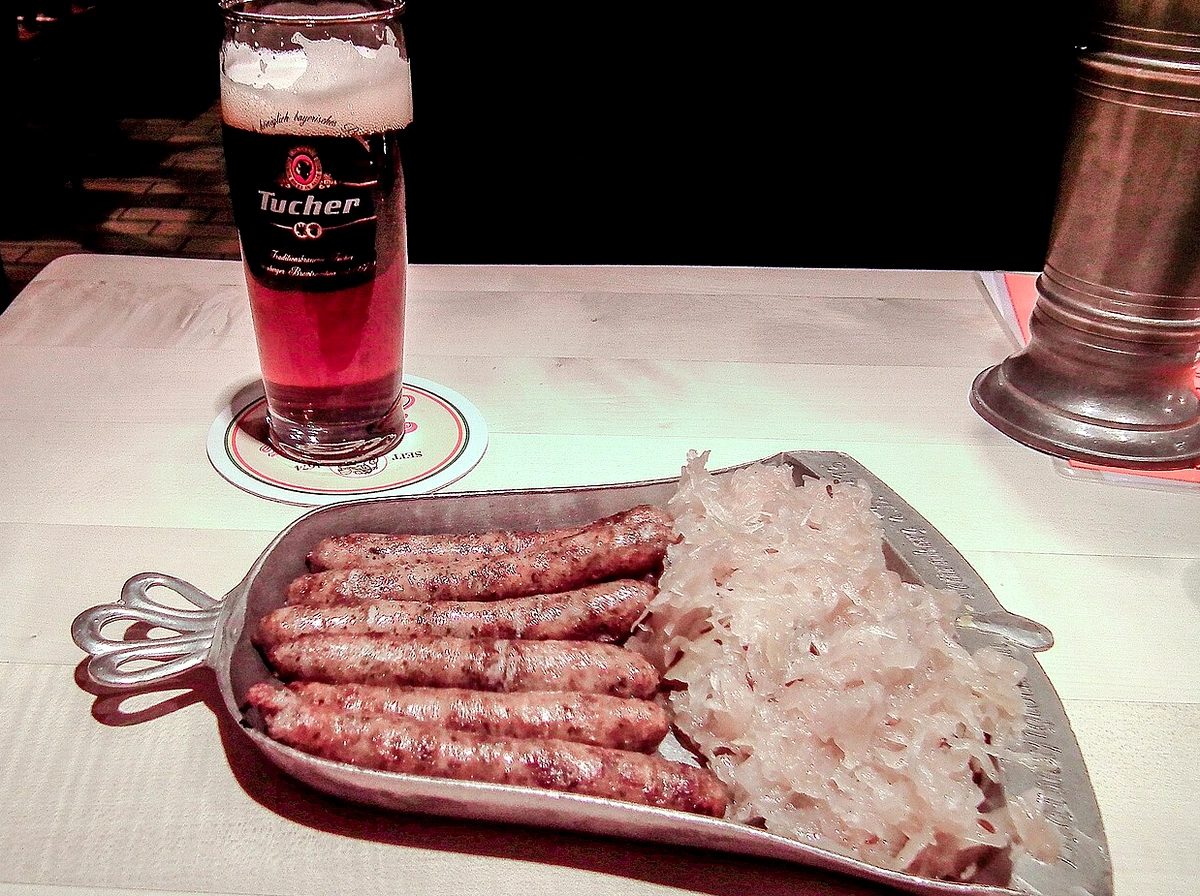
Occupying the central position on the traditional culinary map is the famous Nürnberger Bratwurst sausage, a culinary icon with a long history recorded since 1315. The special feature making this dish cross Germany’s borders to reach global prominence lies in its characteristic compact size, measuring only 7 to 9 centimeters in length and weighing between 20 and 25 grams. To create this authentic flavor, master sausage makers must meticulously select premium lean pork combined with fatty pork belly, then season it with a generous amount of fresh marjoram (Majoran)—the herb providing the soul of the dish—along with salt and white pepper. Preparation requires equal meticulousness as the sausages are quickly grilled over beechwood (山毛櫸) coals, creating a fragrant charred crust while keeping the interior juicy and sweet. According to local tradition, this is typically enjoyed as “Drei im Weggla”—meaning three sausages tucked in a small bread roll, or served with sauerkraut and pungent horseradish (辣根), creating an unforgettable flavor explosion.
Besides the savory flavor of sausages, Nuremberg captivates travelers with a sweet heritage surviving since 1395, namely Nürnberger Lebkuchen gingerbread. Within Germany’s diverse gingerbread world, the premium product line named “精選黑薑餅” (Elisenlebkuchen) is considered the peak masterpiece of medieval baking craftsmanship. Strict regulations from the bakers’ guild require the content of nutritional nuts like hazelnuts, walnuts, and almonds in the dough to reach at least 25%, while flour is reduced to a minimum or nearly omitted. This precious mixture is thoroughly blended with cinnamon, cloves, nutmeg, fresh ginger, and pure honey before baking on thin wafer layers. The result yields soft, rich gingerbread infused with Eastern spice aromas and the natural nutty flavor of nuts, once regarded as precious gifts in royal court banquets.
Nuremberg’s culinary cultural experience concludes perfectly over a glass of unique local wine named Frankenwein. Cultivated and distilled from rare ancient Silvaner grapes on the gentle slopes of the Franconian region, this wine possesses a refined, mineral-rich taste and perfectly balanced structure. What gives Frankenwein its unmistakable mark is the traditional flask style called “Bocksbeutel” with a unique flattened bulbous design, recalling medieval travelers’ leather water flasks. Raising a glass of Bocksbeutel wine alongside a plate of hot Bratwurst sausages or savoring a piece of fragrant Elisenlebkuchen gingerbread amidst the ancient square space brings travelers a profound multisensory experience where past and present blend into one within every heartbeat of this medieval city.
To explore the medieval city of Nuremberg thoroughly and avoid unnecessary confusion, this field guide provides detailed and accurate information regarding timetables, transportation methods, budget considerations, and practical tips gathered from field expeditions. Mastering the operating schedules of iconic landmarks will help you fully command your time amidst this gloomy historical space while optimizing your cultural experience without facing long queues or sudden closures.
Regarding the most crucial highlight, the Nuremberg Kaiserburg Imperial Fortress, visiting schedules are clearly divided by season to preserve monuments and ensure visitor safety. From April to September, the site opens to welcome visitors from 09:00 AM to 06:00 PM, while from October to March of the following year, operating hours are adjusted shorter, from 10:00 AM to 04:00 PM. Sincere advice from travel experts is that visitors should book combination tickets for the main tower and palace in advance via the official portal to save queuing time. Meanwhile, the residence of Northern Renaissance master Albrecht Dürer (Albrecht-Dürer-Haus) opens from Tuesday to Sunday weekly, from 10:00 AM to 05:00 PM, extending until 08:00 PM on Thursdays to serve the public visiting specialized exhibition spaces, noting that this museum is completely closed on Mondays.
Transportation options to Nuremberg are extremely convenient thanks to Germany’s modern public transit network. Travelers departing from Frankfurt or Munich can easily catch direct ICE high-speed trains running straight to Nuremberg Central Station (Hauptbahnhof) without complex transfers. Once arriving at the Altstadt old town area, all historical architectural spaces are within perfect walking distance, allowing you to leisurely stroll past timber window frames, dark gray timber-framed walls, and mossy street corners without relying on motor vehicles. To avoid missing prime moments, an ideal day-trip itinerary can be arranged as follows: morning starts by conquering the Kaiserburg summit and visiting the Albrecht-Dürer Memorial; midday features traditional grilled sausages at ancient eateries around the market; afternoon continues toward St. Sebaldus Church and admiring the Schöner Brunnen fountain; and when night falls, immerse yourself in a unique night tour with a night watchman recreating medieval daily life vividly.
Beyond itineraries, minor details regarding attire and finances will determine your comfort throughout the trip. A unique characteristic of Nuremberg is that all street pavement within the old town area is paved with medieval cobblestones. Through centuries of wear, stone surfaces have become extremely slippery, so high heels, thin-soled shoes, or smooth-soled fashion shoes must never be worn. Visitors must equip specialized walking shoes with good grip to protect ankles and prevent slips. In winter, weather in Bavaria is typically very cold, damp, and windy, making onion-layer dressing with multiple thin thermal layers the optimal solution. Furthermore, at traditional open-air market stalls or small family-run artisanal bakeries, paying with Euro cash remains the most common method, so always keep a sufficient amount of cash in your wallet.
Hopefully, these practical guidelines will become your reliable companion, helping you confidently step into Germany’s enchanting medieval world. To turn these encyclopedia pages into reality with meticulous care from cultural research experts, you are invited to explore the detailed itinerary via the Germany – Austria – Hungary – Czech Republic 9N8D tour to begin your journey touching Europe’s heritage treasure trove.