When stunning footage or classic postcards of Vietnam appear before our eyes, the image of Ha Long Bay—with thousands of magnificent limestone islands sculpted by time, proudly rising from the emerald green waters—is usually an unmistakable symbol. It is a beauty that has captivated countless souls, a World Heritage site that anyone longs to admire at least once. However, the appeal of Ha Long is not merely confined to that majestic natural scenery. The land of the sacred Dragon has been transforming, weaving a multi-toned harmony where the pristine beauty of the heritage blends delicately with the depth of a millennia-old indigenous culture and the vibrant pulse of a modern, dynamic coastal city.
n
Ha Long Tourism
Ha Long today is no longer simply a stopover to gaze at a wonder. It is a multi-layered journey of exploration, where every street corner, every body of water, and every experience holds its own stories, inviting travelers to delve deeper and feel more fully. From the majestic tranquility of ancient caves, where time seems suspended on each cliffside, to the bustling, colorful energy of lively street festivals; from the rustic, authentic charm of coastal fishing villages to the luxury and class of upscale resorts and cruises—all of this creates a captivating Ha Long, a destination capable of awakening all senses and enriching the traveler’s soul. Ha Long today is an invitation to step into a multi-colored world, a relentless adventure between enduring values and inspiring changes.
I. Why Choose Ha Long? Decoding the Appeal of a Global Wonder
On the world tourism map, there are names that are an invitation in themselves, and Ha Long is certainly one of them. But what has created this powerful appeal, transcending geographical and cultural boundaries, to turn this land into a global icon, a destination that every travel enthusiast puts on their “must-visit in a lifetime” list? The answer does not lie in a single factor, but in the miraculous resonance of outstanding natural values, cultural-historical depth, and an unceasingly thriving urban vitality.
Ha Long City: The Harmony Between Mining Industrial Past and International Tourism Future
Ha Long City, the prominent heritage of Quang Ninh province, is not merely a gateway leading travelers to the majestic Ha Long Bay World Natural Heritage. It is itself a multi-layered destination, a youthful and rapidly developing urban center where past and present, industry and services, local culture and international currents blend together to create a distinct and captivating identity. The journey to explore Ha Long would not be complete if it only stopped at the bay’s surface while missing the vibrant pulses and fascinating stories of this coastal city.
Located in the central position of Quang Ninh province, Ha Long City possesses a strategically significant geographical location. Situated about 165 km east of the capital Hanoi and only around 70 km northeast of the port city center of Hai Phong, Ha Long is not only an easily accessible tourist destination but also plays a key link in the northern key economic growth triangle: Hanoi – Hai Phong – Quang Ninh. With the expansion of its administrative boundaries, Ha Long has become a provincially administered city with the largest natural area in the country, surpassing provinces like Bac Ninh, Ha Nam, Hung Yen and comparable in scale to the centrally-run city of Da Nang. Ha Long’s terrain is extremely diverse, a blend of undulating hills and mountains belonging to the Dong Trieu – Mong Cai arc in the north and northeast, lush green valleys, narrow coastal plains, and a vast island region with thousands of entities large and small. This diversity not only creates rich natural landscapes but also opens up great potential for multi-sectoral and multi-disciplinary development.
Ha Long’s climate, with its distinct characteristics, also contributes to the charm and diverse experiences for travelers throughout the four seasons. Heavily marked by the tropical monsoon coastal climate of northern Vietnam, the weather here is divided into two relatively distinct seasons. Winter, usually lasting from around November of the previous year to April of the following year, brings a Ha Long with cool, sometimes chilly, and drier weather compared to summer. The average temperature during this season hovers around 16.7°C, and strong northeast monsoon spells can drop temperatures as low as 5°C, especially in the bay areas or mountainous regions. Winter days are often cloudy, occasionally accompanied by early morning drizzle and wispy fog, creating a mystical, serene, and uniquely personal Ha Long landscape. Conversely, summer, starting in May and lasting until around October, endows Ha Long with a vibrant, energetic atmosphere. The average temperature in this season is 23.7°C, and peak days in June and July can reach up to 37°C, ideal for beach activities. However, this is also the rainy season, with concentrated rainfall and the risk of being affected by tropical depressions or storms, especially from July to September, sometimes extending into October. Understanding these climatic characteristics is a key factor for travelers to choose the most suitable travel time for their preferences and plans.
Before becoming a globally renowned tourist city, this land was known as Hon Gai town, a name closely tied to Quang Ninh’s long-standing coal mining history. Hon Gai in the past was not merely an important mining industrial center but also a landmark marked by many historical ups and downs through the wars of national defense. A milestone occurred on December 27, 1993, when the Vietnamese Government issued a Decree officially establishing Ha Long City on the basis of the entire area and population of Hon Gai town. The decision to rename the city after Ha Long Bay—the majestic natural wonder located in the southern part of the city—was not simply an administrative change. It was considered a strategic vision and a strong shift in building the brand and repositioning the urban role. Notably, this event took place almost simultaneously with Ha Long Bay’s first recognition as a UNESCO World Heritage Site in 1994. The powerful resonance between the city’s name and the international reputation of the Bay created a tremendous impetus, helping Ha Long quickly attract the attention of tourists and investors, laying a solid foundation for breakthrough and comprehensive tourism development in the following decades.
n
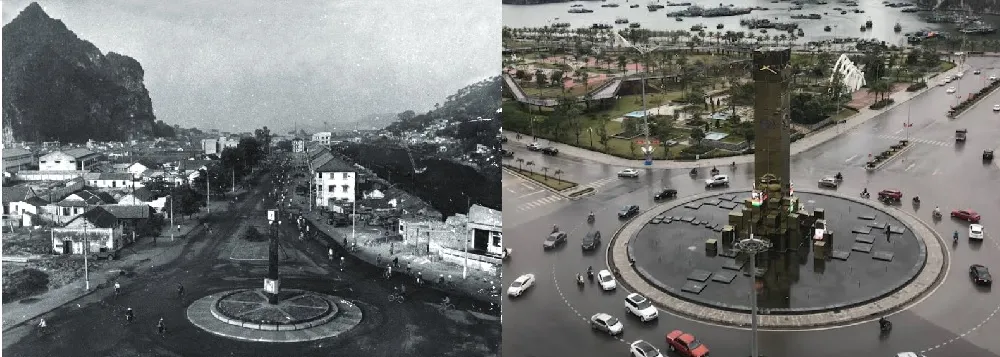
The old clock tower (left) and present (right) is the center of Hon Gai town, the predecessor of Ha Long city
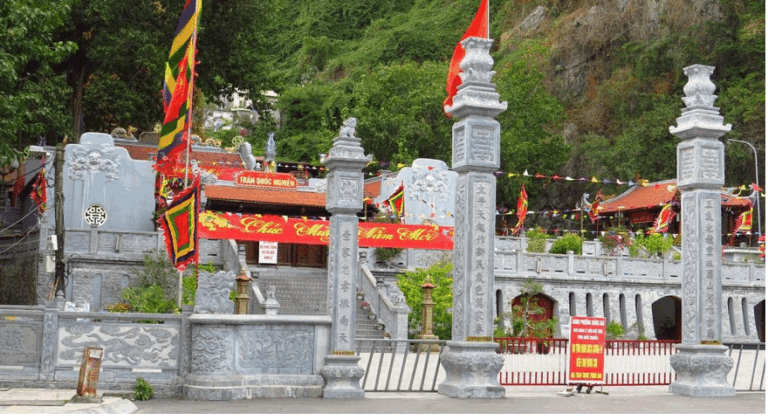
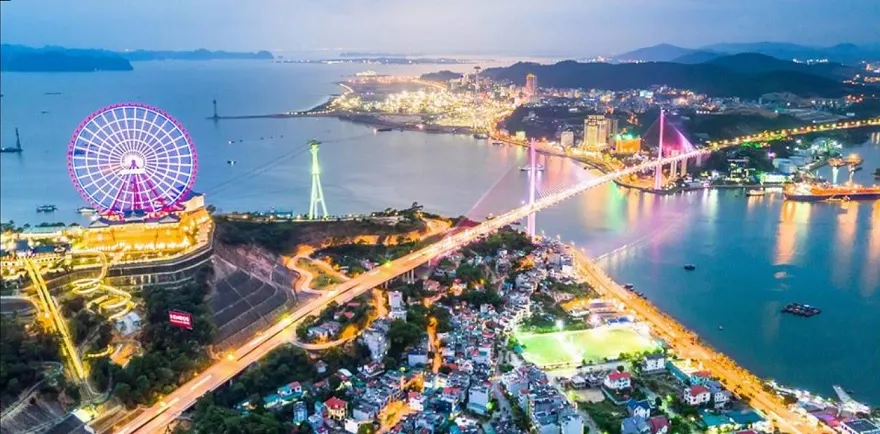
To fully experience the diversity of the city, visitors need to explore its main urban areas, each with its own distinct charm. Among them, Bai Chay is known as the tourism hub, representing the modern and dynamic face of Ha Long. Stretching along the bay are well-planned artificial white sand beaches, towering luxury hotels and resorts, and world-class entertainment complexes such as Sun World Ha Long Park. Nightlife in Bai Chay is also extremely vibrant with bustling restaurants, bars, night markets, and pedestrian streets, making it an ideal destination for those seeking convenience and a lively resort atmosphere. In stark contrast, Hon Gai (the central area of the former Hon Gai town) offers a more local, peaceful, and understated experience. This is the administrative, political, economic, and cultural center of the city as well as the entire Quang Ninh province. Visitors to Hon Gai can better perceive the daily rhythm of local life, explore traditional markets like Ha Long Market 1, and visit iconic architectural landmarks such as Quang Ninh Museum or the Dolphin Palace. Bai Chay Bridge, a modern architectural feat and a symbol of connection, has eliminated the geographical division between Hon Gai and Bai Chay across Cua Luc Bay. And one cannot forget Tuan Chau Island, situated slightly apart and connected to the mainland by an artificial road about 2km long. For a long time, Tuan Chau has affirmed its position as an important tourism, resort, and entertainment hub, gathering numerous high-end resorts, beautiful artificial beaches, diverse recreational spots, and especially Tuan Chau International Passenger Port, one of the main departure points for cruises exploring Ha Long Bay. This division not only enriches the travel experience but also reveals a multifaceted Ha Long possessing a “dual identity,” where visitors can choose to immerse themselves in the lively atmosphere of Bai Chay, seek out cultural values in Hon Gai, or enjoy upscale resort spaces in Tuan Chau.
Ha Long Bay – Where the Dragon Descended: Discovering the Global Value of the UNESCO Masterpiece
If Ha Long City is a dynamic urban area rising strongly, then Ha Long Bay is the soul, the priceless treasure that has put this land on the world map. The name “Ha Long” – “Where the dragon descended” – itself evokes a mythical space, a sacred land crafted by mystical creatures in the Vietnamese mindset. And indeed, the beauty and values of Ha Long Bay have transcended national boundaries, becoming a heritage cherished and admired by all humanity.
n
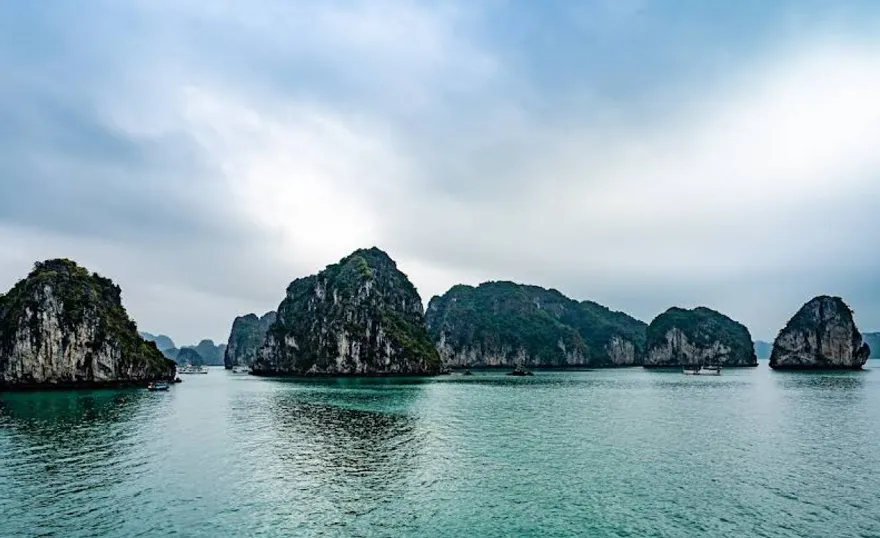
Ha Long Bay, the land associated with the legend of the descending Dragon, is the tourism symbol of Ha Long
International recognition of Ha Long Bay is undeniable proof of its exceptional stature. This heritage has been honored twice as a World Natural Heritage Site by the United Nations Educational, Scientific and Cultural Organization (UNESCO). First in 1994, the world officially recognized the Bay’s outstanding aesthetic value, a breathtaking beauty. In 2000, Ha Long Bay was inscribed for the second time, this time for its outstanding global geological and geomorphological values, affirming its unique position in Earth’s evolutionary history. Not stopping there, in 2012, Ha Long Bay was proudly voted by the global community as one of the New 7 Wonders of Nature, a noble title stemming from the love and admiration of millions of people across the planet. And most recently, in 2023, alongside the expansion of the Heritage with Cat Ba Archipelago (Hai Phong), the biodiversity value of the entire region was further emphasized and recognized at the world heritage level, adding another remarkable achievement to this legendary bay’s honors list.
Speaking of aesthetic and scenic value, Ha Long Bay is truly a unique natural masterpiece—a magnificent landscape that no words can fully describe. Imagine a vast expanse of sea measuring about 1,553 km², where nearly two thousand limestone islands of all sizes and fascinating shapes rise majestically from calm, emerald-green waters. Each island is a unique natural sculpture, sometimes resembling an incense burner, sometimes an elderly fisherman in deep contemplation (Hon Ong La Vong), or a pair of affectionate roosters (Hon Trong Mai). The magical blend of stone, water, and sky, with shades shifting every moment of the day and every season of the year, creates a one-of-a-kind landscape—a beauty that is both majestic and poetic, capable of touching even the most artistic souls.
n
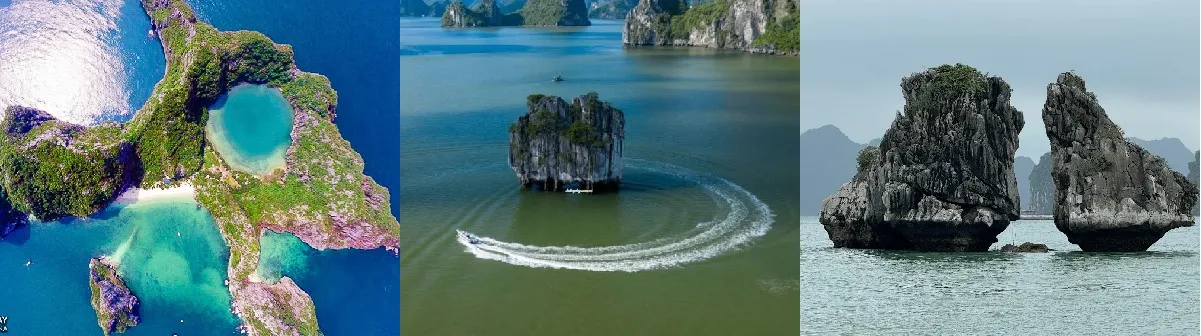
Dragon Eye Island, Incense Burner Islet, and Fighting Cocks Islet are all iconic islands of Ha Long Bay
Beyond its external beauty, Ha Long Bay also holds a millions-of-years-old story of geology and geomorphology. It is considered one of the world’s most typical and complete examples of a mature karst landscape in a humid tropical climate, heavily influenced by marine transgressions and regressions across multiple eras. The complex geological history spanning over 500 million years has left its mark through isolated karst towers (fenglin) and clusters of conical peaks (fengcong) reaching a rare degree of perfection. Inside the limestone islands lies a magical cave world, featuring hundreds of large and small caves, each with its own unique beauty, adorned with magnificent stalactites and stalagmites formed by the relentless dissolution and regeneration of limestone.
n
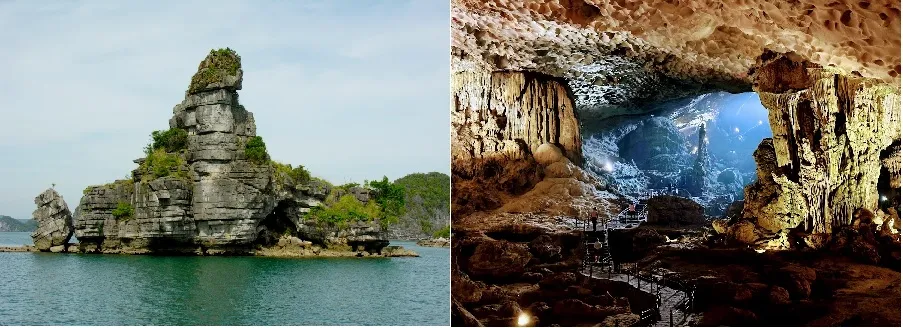
Xep Islet (left) and Sung Sot Cave (right) are the results of a complex geological history spanning over 500 million years
Hidden within this magnificent natural panorama is a latent biodiversity treasure. Ha Long Bay, especially when considered together with the Cat Ba Archipelago, is a convergence of typical tropical marine ecosystems such as coastal mangroves, vibrant coral reefs, secluded saltwater lakes within the limestone islands, and tropical rainforests on the karst formations. These ecosystems are the common home to thousands of flora and fauna species, including many rare and endemic species listed in the Vietnam and World Red Books, contributing to the region’s immense scientific and conservation value.
Finally, one cannot overlook the cultural and historical depth of Ha Long Bay. This land is considered one of the cradles of ancient Vietnamese civilization, with the presence of three successive prehistoric cultures: the Soi Nhu, Cai Beo, and Ha Long cultures, dating from 3,000 to 18,000 BC. Rich archaeological sites discovered in caves such as Tien Ong, Trong, and Trinh Nu have partially revealed the lives of our ancestors.
n
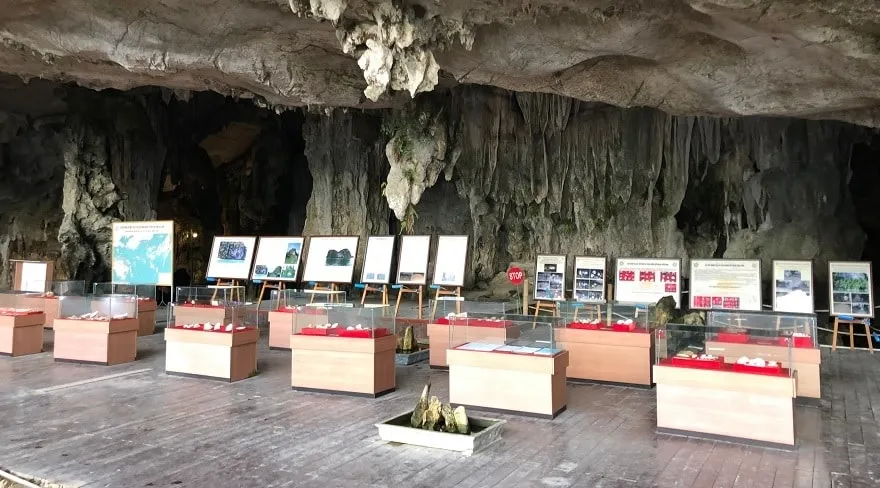
Exhibition area for prehistoric artifacts of the Ha Long culture period at Tien Ong Cave (a sightseeing spot included in overnight cruise itineraries)
Ha Long Bay is also a witness to many important historical events, from the nation’s heroic naval battles on the historic Bach Dang River to the bustling bustle of the ancient Van Don trading port—a vital international trade center for centuries. All of these deep layers of value weave together to create a Ha Long Bay that is not only scenic in landscape but also rich in history and culture, truly a heritage we can be proud of and cherish.
II. Detailed Itinerary Planning for the Perfect Ha Long Trip 2025
A trip to Ha Long, whether it is your first time or a much-anticipated return, always requires careful preparation to ensure every moment is complete. With the continuous development and constant innovations in tourism products, grasping the most up-to-date information will be the key to helping you craft a truly perfect voyage of discovery—from choosing the ideal time, optimal transportation, and luxury accommodations to planning your budget smartly.
A. The Golden Time to Visit Ha Long: Which Season is the Most Beautiful?
Choosing the right time to visit Ha Long is not merely about arranging your personal schedule; it also directly impacts your experience of the weather, scenery, tourist density, and service costs. Each season in Ha Long wears its own distinct beauty, bringing different emotional resonance.
Spring (usually from March to April) is favored by many for its pleasant weather, with temperatures fluctuating between 17–24°C. The warm air, occasionally lingering wisps of morning mist, and gentle drizzle add to the bay’s poetic charm as trees sprout and flowers bloom. This is also the time when many unique traditional festivals take place in Quang Ninh, such as the Yen Tu Festival, Long Tien Pagoda Festival, or the Japanese Cherry Blossom Festival in the city, offering rich cultural experiences.
Summer (lasting from May to about September, potentially extending into October) is the peak season for domestic tourism. Temperatures typically range from 28−37°C, with clear blue skies and brilliant golden sunshine, making it ideal for seaside activities such as swimming, kayaking, or participating in water sports. However, this is also a hot and humid season with frequent rain and a high risk of storms, especially in July and August. Travelers should closely monitor weather forecasts and be prepared for sudden changes in their itinerary. The crowds and increased service prices are also factors to consider.
Autumn (usually from October to November) is considered by many travel enthusiasts to be the best time to visit Ha Long. The weather becomes significantly cooler, with an average temperature of about 24−26°C, less rain, high clear skies, and golden sunshine. The sea is generally calmer, which is very favorable for bay cruises and outdoor activities. The number of international tourists usually increases during this season, while domestic visitors decrease compared to summer, providing a more peaceful and comfortable atmosphere for sightseeing.
Winter (usually from November or December to February of the following year) brings a tranquil and somewhat chilly Ha Long. The average temperature is about 14−17°C, with occasional strong cold fronts that can cause temperatures to drop even further. This season is often cloudy, with fog and drizzle, especially in the mornings, creating a mystical and dreamy beauty for the bay. This is the peak season for international tourists who seek a quiet atmosphere and a unique perspective on the heritage site.
Balancing between peak and off-peak seasons is also very important. International peak months are usually March, April, October, November, and December, while domestic peak travel is concentrated from May to August and during major holidays. Traveling during the off-peak season can help you save costs and avoid crowds, but you must accept that the weather may be less stable or that some services may be limited. In particular, the risk of disruption due to storms during the peak summer season (July, August) is a significant factor to consider when planning, as it can lead to tour cancellations or sudden itinerary changes.
B. Getting to Ha Long: Optimal Options from Hanoi, Hai Phong, and Neighboring Provinces
Thanks to strong investment in transport infrastructure in recent years, traveling to Ha Long has become more convenient and faster than ever, offering a wide range of options regarding vehicles, travel time, and costs.
From Hanoi (distance of 160-180km): The capital city of Hanoi is the most popular starting point for travelers visiting Ha Long.
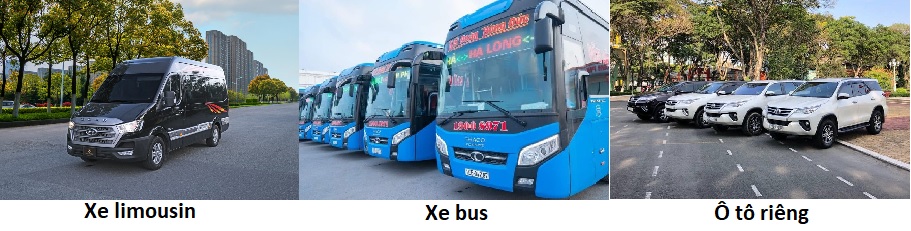
Transportation from Hanoi to Ha Long
From Hai Phong (distance of 45-70km): With a short distance and modern highway system, traveling from Hai Phong to Ha Long is extremely quick.
Getting Around Ha Long: Which Transport Option Suits You Best?
The variety of transportation options within Ha Long reflects the diverse range of travelers and the geographical spread of attractions, from the bustling city center to the coastal tourist areas.
C. The Ideal Place to Stay in Ha Long: From 5-Star Resorts to Cozy Homestays
Ha Long boasts a diverse and extensive range of accommodation options, ready to meet every traveler’s needs, preferences, and budget. From magnificent 5-star resorts with panoramic views of the wonder bay, modern hotels meeting international standards, and luxurious holiday villas offering absolute privacy, to convenient serviced apartments, budget-friendly guesthouses, and cozy, personalized homestays. This variety ensures that every visitor can find their ideal “home away from home” for their days exploring Ha Long.
Choosing where to stay will significantly shape your overall experience. The Bai Chay area is the busiest tourist hub, home to many high-end hotels (such as Vinpearl Resort & Spa Ha Long and Wyndham Legend Halong) and close to major entertainment spots like Sun World, the beach, and the night market, offering a vibrant and modern atmosphere. However, this area can be crowded and more expensive, especially during peak season. The Hon Gai area, the city’s administrative center, offers a more authentic and quieter local experience with more affordable accommodation options, making it convenient for exploring traditional markets and local cuisine. Traveling between Hon Gai and Bai Chay is quite easy via the Bai Chay Bridge. Additionally, Tuan Chau Island is a resort and entertainment oasis, home to many luxury resorts (such as La Paz Resort Tuan Chau), private beaches, entertainment complexes, and serves as the main departure point for bay cruise ships. This area is suitable for those seeking a secluded retreat and integrated entertainment activities, though prices may be higher and it is slightly detached from mainland attractions.
n
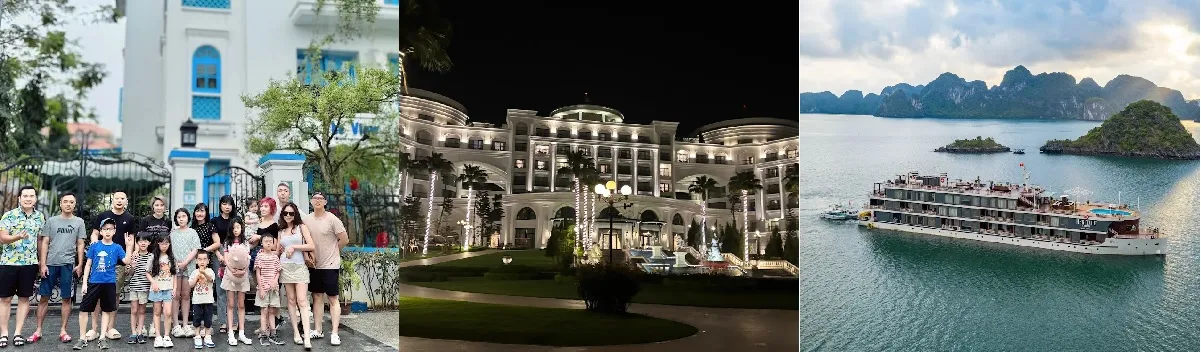
Outstanding accommodation types in Ha Long such as Villas, Hotels, or overnight cruises on Ha Long Bay
Beyond traditional star-rated hotels, serviced apartments (condotels) like Alacarte Ha Long Bay or Citadines Marina Halong are becoming increasingly popular, offering home-like comfort suitable for families or groups of friends. Homestays and guesthouses with more affordable prices, concentrated in both Bai Chay and Hon Gai, are ideal choices for young travelers or those wanting a closer, more interactive experience with local residents. And of course, we cannot forget the most unique and top-tier accommodation experience: staying overnight on a cruise ship in the heart of Ha Long Bay, an option that will be covered in more detail in Part III.
Comparison of Areas and Accommodation Types in Ha Long
III. Exploring Ha Long: Unforgettable Experiences from the Open Sea to the Vibrant Mainland
A journey to Ha Long is more than just a trip; it is a multi-dimensional adventure where the majestic natural beauty of a World Heritage site blends with the dynamic, modern pulse of a coastal city constantly on the rise. From quiet, reflective moments in the heart of the deep bay to exciting experiences at world-class entertainment hubs, Ha Long offers a harmonious blend of experiences that cater to every emotion and preference of travelers.
A. Ha Long Bay: Immersing Yourself in the Endless Beauty of a World Heritage Site
The heart and soul of Ha Long is the Bay itself—a sculptural masterpiece of nature twice honored by UNESCO as a World Natural Heritage site and recognized as one of the New Seven Wonders of Nature. Stepping into the bay is like entering another world, where time seems to stand still among thousands of limestone islands of all shapes and sizes, casting their reflections upon the emerald-green waters.
1. Natural Masterpieces Not to Be Missed in the Heart of the Bay
Ha Long Bay is a massive natural geological museum, concealing a spectacular system of caves and iconic islands, each with its own story and legend. Sung Sot Cave (Surprise Cave), located on Bo Hon Island, truly lives up to its name by opening into an overwhelming space with three vast chambers, adorned with countless million-year-old stalactites and stalagmites that shimmer under the lights like a royal palace. Equally magical are Thien Cung Cave and Dau Go Cave, a famous pair of caves located nearby. Thien Cung Cave captivates with its magnificent, mystical beauty, reminiscent of a grand space associated with the legend of the Dragon King’s wedding. Meanwhile, Dau Go Cave carries an ancient, majestic beauty, featuring massive stone pillars and historical marks of the place where Tran Hung Dao once hid wooden stakes in preparation for the legendary Bach Dang battle. Another unique experience is exploring Luon Cave, a crescent-shaped water tunnel where visitors must take a bamboo boat or kayak through a low stone archway to enter a calm, enclosed lagoon surrounded by towering cliffs—a peaceful, isolated world. Additionally, other distinctive caves such as the mysterious Dark and Bright Cave or Tien Ong Cave with its archaeological sites are must-visit destinations for those who love exploration.
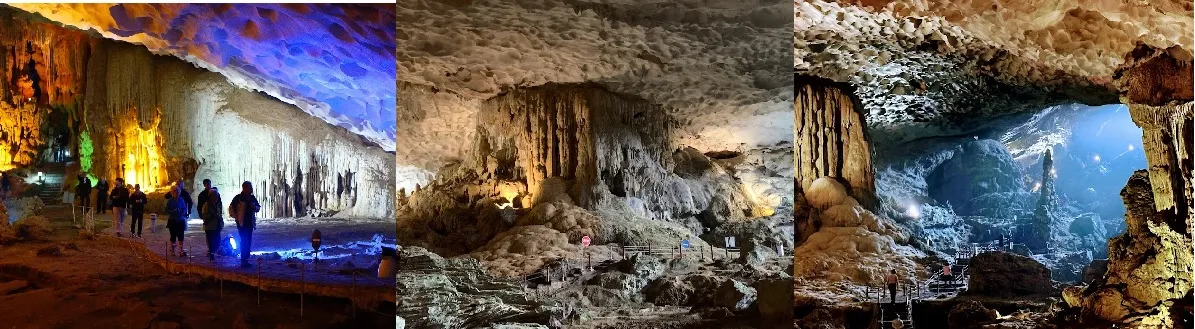
Thien Cung Cave, Dau Go Cave, and Sung Sot Cave are the 3 most beautiful and largest caves in Ha Long Bay
Beyond the mystical caves, the islands and beaches of Ha Long Bay are essential highlights. Titop Island, named after the Soviet cosmonaut Gherman Titov, is one of the most beautiful islands in the bay, featuring a crescent-shaped white sand beach and clear blue water perfect for swimming. Visitors can also conquer nearly 400 steps to reach the island’s peak, capturing a panoramic view of the poetic Ha Long Bay. The immortal symbol of love and Ha Long tourism is Hon Trong Mai (Fighting Cock Islet), an image of two rock formations resembling a pair of chickens affectionately leaning their heads together in the middle of the sea. Soi Sim Island offers a pristine beauty with rich vegetation, hills covered in seasonal myrtle flowers, and a quiet beach. And there are countless other iconic islands, such as the uniquely shaped Stone Dog Islet or the sacred Incense Burner Islet, which is featured on Vietnam’s 200,000 VND banknote.
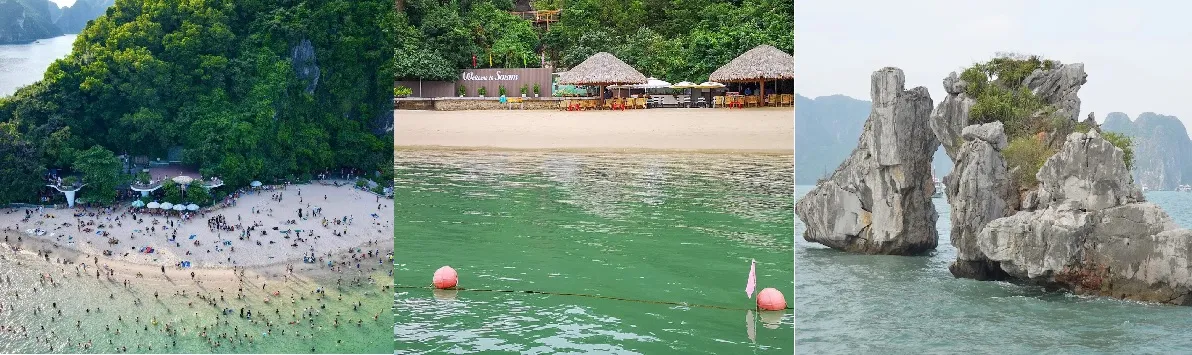
Titop Island, Soi Sim Island, and Fighting Cock Islet are among the most prominent islands in Ha Long Bay
For travelers seeking a quieter space, less affected by crowds, Bai Tu Long Bay to the northeast and the adjacent Lan Ha Bay (part of the Cat Ba Archipelago, Hai Phong) are excellent choices. Both bays possess a pristine, charming beauty with hundreds of large and small islands and pristine white sand beaches, perfect for deeper exploration voyages and peaceful relaxation.
To help travelers easily visualize and choose the destinations that best suit their preferences, the table below provides a detailed summary of the characteristics, activities, and access methods for each prominent location.
2. Halong Bay Cruise Selection 2025: Which Itinerary is Right for You?
To fully experience the beauty of Halong Bay, choosing the right cruise tour is extremely important. The Halong Bay Management Board has established fixed sightseeing routes, each with a unique itinerary and different stops to suit visitors’ diverse time and preference needs.
The currently popular daytime routes (Routes 1 to 5) are already familiar to many travelers. Route 1, typically lasting 3-4 hours, is ideal for those with limited time, focusing on near-shore attractions such as Thien Cung Cave, Dau Go Cave, and iconic islets like Fighting Rooster Islet (Hon Trong Mai), with a reference ticket price for 2025 of around 310,000 VND/person. Route 2, dubbed the most beautiful and popular route, offers a longer duration of about 5-6 hours or more, taking visitors to famous wonders like Sung Sot Cave (Surprise Cave), Titov Island (for swimming and hiking), and Luon Cave (for kayaking), with reference ticket prices similar to Route 1. Routes 3 and 4 head further out, focusing on fishing village culture explorations (such as the Cua Van Floating Cultural Center on Route 3) or more pristine areas (such as Vung Vieng Fishing Village, Co Cave on Route 4), with a similar duration and a reference ticket price of about 260,000 VND/person for 2025. Route 5 combines sightseeing highlights of Halong Bay with transit to Gia Luan pier on Cat Ba Island (Hai Phong), lasting about 5-6 hours with ticket prices equivalent to Routes 1 and 2.
A notable update for travelers in 2025 is that the Halong Bay Management Board plans to launch 3 new sightseeing routes (Routes 6, 7, and 8) starting May 1, 2025, aimed at diversifying products and offering fresh, unique experiences. Route 6 (5-6 hours, ticket price 150,000 VND) promises to take visitors to less-explored corners of the bay such as Elephant Foot Rock (Hon Chan Voi), Ba Cua Lagoon, and ending at Gia Luan Pier (Cat Ba). Route 7 (12 hours, ticket price 600,000 VND) is positioned as an “all-in-one” comprehensive route, visiting highlight spots of all four traditional routes, perfect for those with ample time who want an all-encompassing experience. Notably, Route 8 (3-4 hours, ticket price 70,000 VND) opens up an entirely new romantic experience featuring a sunset dinner cruise on the bay, running from the Cruise Port to the Nam Cau Trang area (Column 8) and back.
In addition to daytime tours, travelers can also choose overnight Halong Bay cruises to fully absorb the magical beauty of the heritage site, especially during sunrise and sunset. For an overview and easy comparison, the Halong Bay Daytime Cruise Comparison Table will provide detailed information on the itineraries, destinations, duration, and ticket prices of each route, helping you make the most informed choice.
| Routes | Price | Sightseeing Attractions |
|---|---|---|
| VHL1 | 310,000 VND/person | Thien Cung Cave – Dau Go Cave – Stone Dog Islet (Hon Cho Da) – Ba Hang Cave – Incense Burner Islet (Hon Dinh Huong) – Fighting Rooster Islet (Hon Trong Mai) |
| VHL2 | 310,000 VND/person | Soi Sim Beach – Titov Island – Sung Sot Cave – Tung Sau Lagoon – Me Cung Cave – Bo Nau Cave – Luon Cave – Trong Cave – Trinh Nu Cave – Dong Tien Lake |
| VHL3 | 260,000 VND/person | Cua Van Floating Cultural Center – Tien Ong Cave – Ba Ham Lake – Ba Men Temple – Ang Du – Bamboo Forest |
| VHL4 | 260,000 VND/person | Co Cave (Thien Canh Son) – Thay Cave – Cap La Cave – Vong Vieng – Tung Ang ecological zone – Cong Do Island – Hon Xep Park |
| VHL5 | 310,000 VND/person | Thien Cung Cave – Dau Go Cave – Stone Dog Islet – Ba Hang – Incense Burner Islet – Fighting Rooster Islet – Gia Luan Pier (Cat Ba – Hai Phong) |
| VHL6 | 150,000 VND/person/trip | Elephant Foot Rock – Ba Cua Lagoon – Tung Lam Island – Cap Bai Islet (the final point of the journey bordering Gia Luan, Lan Ha Bay – Hai Phong) |
| VHL7 | 600,000 VND/person | Ha Long Bay sightseeing following itineraries VHL1-2-3-4 (only applicable for day-trip cruise ships) |
| VHL8 | 70,000 VND/person/trip | Tuan Chau International Passenger Port – Ha Long International Passenger Port – Nam Cau Trang Port |
3. Ha Long Cruises: Luxury Retreats in the Heart of the Wonder
Exploring Ha Long Bay by cruise is more than just a mode of transport; it has become a high-class retreat experience and an essential part of the journey for sophisticated travelers. The Ha Long cruise market is incredibly vibrant and rapidly evolving, especially in the luxury segment, offering a wide range of options from cozy, traditional wooden boats to modern, opulent 5-6 star super-yachts, often described as “floating hotels” amidst the wonder. This shift reflects an elevation in how Ha Long serves its visitors, moving beyond simple sightseeing to focus on delivering personalized, unique experiences and superior service quality. Modern cruise amenities are incredibly diverse, ranging from luxurious cabins with private balconies overlooking the bay, exquisite Asian-European restaurants, and stylish deck bars to relaxing spas, jacuzzis, and integrated recreational activities such as kayaking, cooking classes, or morning Tai Chi sessions. Recognition from reputable organizations like Tripadvisor, which ranks Ha Long cruise experiences among the best in the world, further confirms the exceptional quality of this service.
n
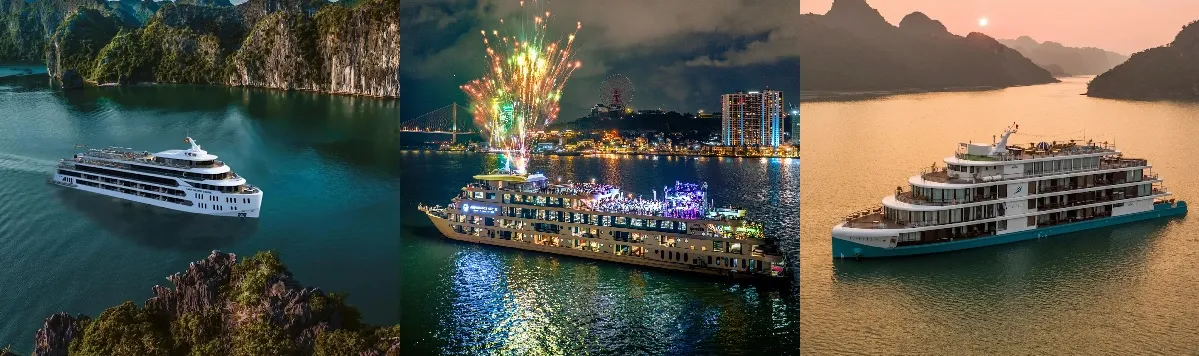
Currently, cruise services in Ha Long are divided into 3 main types: day-trip cruises, dinner cruises, and overnight cruises
For travelers with limited time, day-trip cruises are a popular choice, typically lasting from 4 to 8 hours. Many day cruises today are heavily invested in design and service, offering a premium experience comparable to overnight cruises, such as Ambassador, La Casta, Sea Octopus, or Light, with tour prices ranging from approximately 680,000 VND to 1,450,000 VND per guest.
However, to fully appreciate the mystical beauty of Ha Long Bay, from the pristine sunrise to the vibrant sunset and the shimmering night sky over the sea, an overnight cruise is an unparalleled experience. Highly rated cruise lines favored by many international travelers include the classically designed Emeraude Classic Cruise, the Dragon Legend Junk Indochina with its itinerary exploring the pristine corners of Bai Tu Long Bay, or ultra-luxury lines such as Paradise Peak Cruise, Signature Halong Cruise, Bhaya Cruise, and Au Co Cruise. A typical 2-day 1-night itinerary often includes visits to famous caves (such as Bright-Dark Cave, Trung Trang Cave in the Lan Ha Bay area), swimming at beautiful beaches (like Ba Trai Dao), kayaking, and participating in cooking classes and Tai Chi sessions. Prices for an overnight experience vary widely, from under 2,250,000 VND/person for mid-range cruises to over 11,250,000 VND/person for ultra-luxury vessels.
Additionally, dinner cruises for sunset viewing are also a romantic choice for couples or groups of friends looking to enjoy a special moment on the bay. These usually last 3-4 hours in the evening, with notable names such as V-Dream, Iris, Symphony, Sea Octopus, and Ambassador, with reference tour prices from 700,000 VND to 1,000,000 VND per guest.
The abundance of cruise options requires travelers to be more careful in researching and selecting a reputable provider that fits their budget and expectations. The “Suggested Ha Long Cruises” tables below will provide useful information for your reference.
Suggested Overnight Ha Long Cruises
Recommended Day Cruises
4. Top Most Memorable Experiences on Ha Long Bay
Beyond sightseeing from the vessel, Ha Long Bay invites travelers to immerse themselves in nature and local culture through a variety of exciting and interactive activities. Kayaking or taking a bamboo boat ride is one of the most beloved activities, offering the chance to freely explore small caves such as Luon Cave, the Ba Hang area, lagoons hidden behind limestone cliffs, and get closer to the majestic beauty of the bay. Kayak rental prices typically range from 50,000 VND to 100,000 VND per person per hour or per turn, but are often included in cruise tours.
n
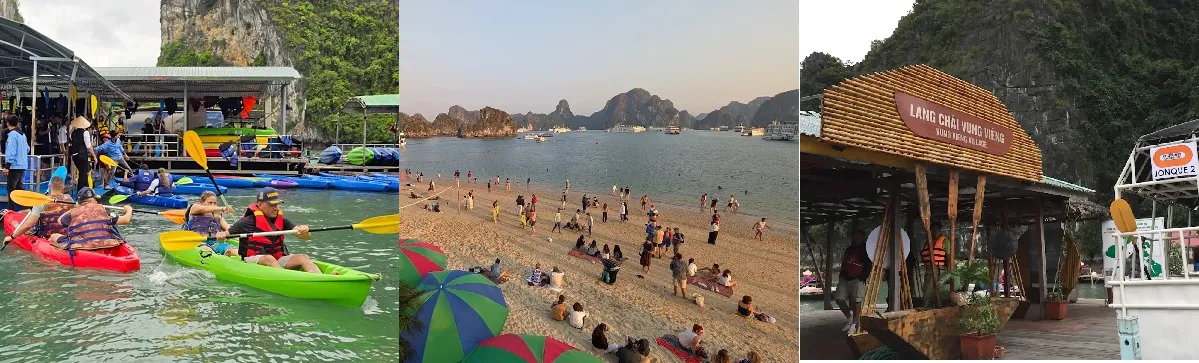
Kayaking, swimming, or visiting fisherman villages on Ha Long Bay are among the most exciting experiences
Swimming at powdery white-sand beaches with crystal-clear blue waters like Titov Island, the Ba Trai Dao area, or Soi Sim beach is a wonderful way to relax and enjoy the sea breeze. For those who love active pursuits, climbing to the peak of islands like Titov (featuring stairs) rewards you with stunning panoramic views of the bay. Some more adventurous tours may even include deep-water soloing (rock climbing) for experienced travelers.
Visiting traditional floating fishing villages like Cua Van or Vung Vieng—though many residents have now been relocated to protect the heritage—still offers an opportunity to learn about the unique cultural life of a fishing community deeply connected to the sea for generations. Additionally, discovering the mystical and magnificent beauty within famous caves like Sung Sot (Surprise) Cave or Thien Cung Grotto is an indispensable part of the journey.
IV. Ha Long Tourism on Land: A Colorful Center of Entertainment & Culture
Not only does Ha Long Bay captivate visitors, but the mainland city is also a vibrant world filled with modern entertainment centers, iconic architectural landmarks, and rich cultural spaces, offering equally compelling experiences.
1. Sun World Ha Long Park: “Conquer” an Endless Entertainment Paradise
Located at a prime address at No. 9 Ha Long Road, Bai Chay Ward, Sun World Ha Long Park is a world-class entertainment and tourism complex, and a must-visit destination for all ages. Spanning an impressive 214 hectares, this complex has truly transformed the landscape of Bai Chay, turning it into a modern entertainment hub that attracts millions of visitors every year. Stepping into Dragon Park, visitors can test their courage with a series of international-standard thrill rides, such as “Phi Long Thần Tốc” (Dragon’s Run) – a super roller coaster reaching speeds of up to 105 km/h, “Theo Dấu Chân Rồng” (Dragon’s Track) featuring consecutive spiral loops, or “Tê Giác Cuồng Nộ” (Raging Rhino) taking you on 360-degree mid-air rotations. In addition, there are milder rides suitable for families and children. To beat the summer heat, Typhoon Water Park offers a refreshing world filled with countless thrilling water slides like “Lốc Xoáy Liên Hoàn” (Multi-Storm), “Thử Thách Mãng Xà” (Python Challenge), and “Cưỡi Rồng Vượt Thác” (Dragon Waterfall Ride), alongside relaxing zones like “Sóng Thần” (Tsunami) and “Dòng Sông Lơ Đãng” (Lazy River). However, visitors should note that the water park may close during the winter season (typically from October to April of the following year) for maintenance.
n
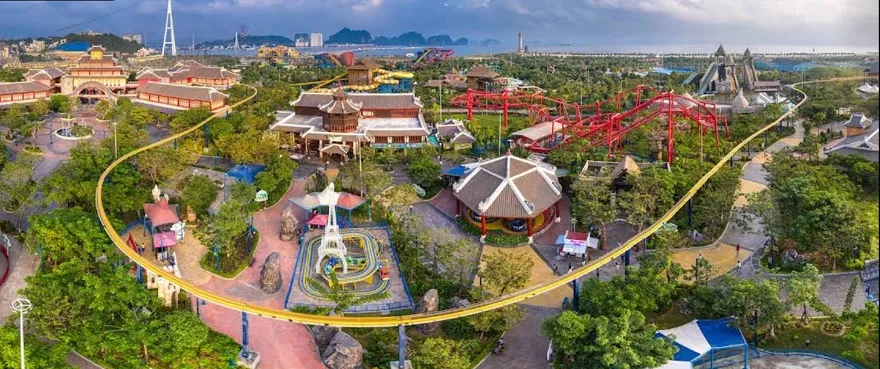
Sun World Ha Long is one of the most exciting entertainment spots when traveling to Ha Long
Your journey to explore Sun World would not be complete without experiencing the Queen Cable Car – a world record-holder recognized by Guinness for having the largest cabin capacity (230 people per cabin) and the highest cable car tower. From the cable car, you can enjoy panoramic views of Ha Long Bay and the coastal city. The destination of the cable car is the Mystic Hill (Sun Hill), home to the Sun Wheel – one of the highest observation wheels in the world, the serene Zen Garden, the Wax Museum (additional fee may apply), the Kidoland children’s play area, the Samurai Slide, and the Bao Hai Linh Thong Tu spiritual complex.
2. Tuan Chau Island: The Timeless Appeal of a Coastal Entertainment Hub
Tuan Chau Island, connected to the mainland by a roughly 2km-long causeway, has long been a familiar and captivating destination. Tuan Chau Beach is an expansive, free-access artificial beach perfect for swimming and water sports such as windsurfing and jet-skiing. The island’s main highlight is Tuan Chau International Amusement Park (Tuan Chau Park). It is famous for its dolphin, seal, and sea lion shows that attract large crowds, especially children, with fixed daily showtimes. The “Legendary Ha Long” water music show used to be a grand artistic performance; however, visitors should double-check its operational status as it may currently be undergoing upgrades. Additionally, the park features a thrill-ride zone and a children’s fantasy world. The Tuan Chau International Passenger Port also plays a vital role, serving as the departure point for numerous Ha Long Bay cruises.
n
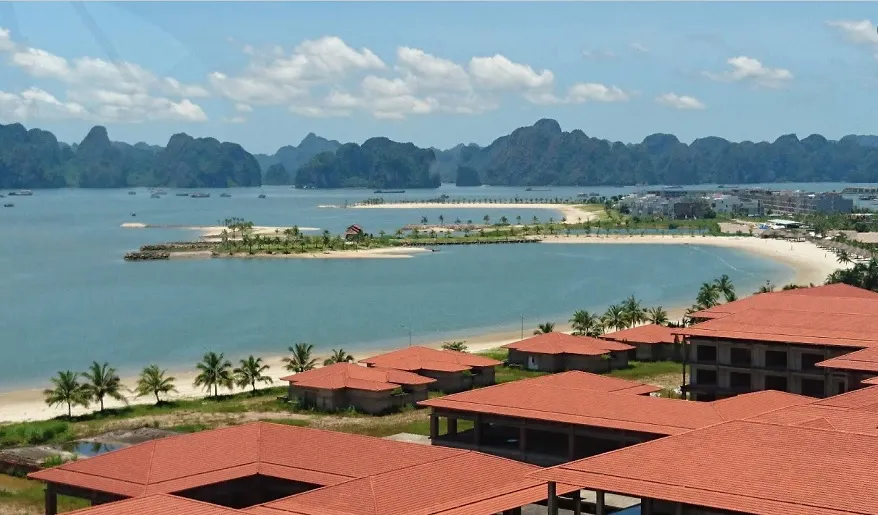
Tuan Chau Island is one of the most famous tourist destinations in Ha Long
|
Park
|
Ticket Price
|
Opening Hours
|
Note
|
|---|---|---|---|
|
Tuan Chau Park
|
280,000 VND/guest
|
t t t |
– Applies for 1 entry, valid for use on the same day.
– Free for children under 1m tall.
– Free for 1 tour guide carrying an ID card, if applicable.
– 20% discount for group tours with 10 or more tickets purchased, VAT is mandatory.
|
|
Kingkong Park
|
100,000 VND/guest
|
Weekdays: 8:00 AM – 10:00 PM
|
– Valid for one-time entry, valid for use on the same day.
– Free for children under 1m tall.
– Free for 1 tour guide with a valid ID card, if applicable.
|
|
Combo for both Parks (Park + Kingkong Park)
|
350,000 VND/guest
|
Weekdays: 8:00 AM – 10:00 PM
|
– Valid for one-time entry, valid for use on the same day.
– Free for children under 1m tall.
– Free for 1 tour guide with a valid ID card, if applicable.
|
3. Explore the City’s Unique Cultural Features and “Check-in” Spots
Mainland Ha Long also attracts visitors with its cultural spaces and impressive architecture. The Bai Chay area is not only home to a vibrant beach but also the Bai Chay Old Town (Little Vietnam), a uniquely designed neighborhood modeled after the ancient architecture of Hoi An and Hanoi, making it a must-visit “check-in” spot. Moving to the Hon Gai area, visitors will be impressed by the Quang Ninh Museum & Library complex on Tran Quoc Nghien Street. With its unique black glass exterior resembling a black pearl, this is a place that preserves and displays the historical, cultural, and natural values of the mining region. As night falls, the Ha Long Night Market (Bai Chay/Ha Long Marine Plaza Night Market) becomes a bustling destination where visitors can find countless souvenirs, specialties, and enjoy street food. For those who love creativity, the Funny Art 3D Museum offers exciting interactive experiences and endless “virtual living” photo opportunities. Additionally, Ha Long has many other iconic “check-in” spots such as the shimmering Bai Chay Bridge at night, the spacious 30/10 Square near the Quang Ninh Museum, the colorful Ha Long Flower Park, the modern Vincom Plaza Ha Long, Bai Tho Mountain, and more.
n
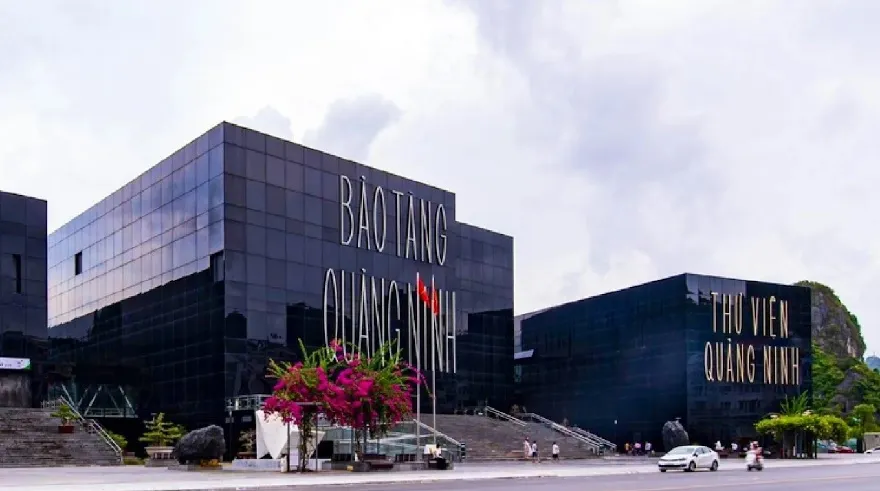
Quang Ninh Museum and Library is known as one of the most visited museums in Vietnam
V. The Pulse of the “Festival City” and New Tourism Trends
Moving beyond the image of a quiet heritage city, Ha Long is confidently donning the mantle of a modern festival capital—a leading regional hub for cultural, sports, and tourism events. This transformation not only enriches the visitor experience but also affirms a strategic vision where heritage values are honored and resonate with the trendiest tourism movements.
A. Positioning “Ha Long – The Festival City”
The strategy to turn Ha Long into a “Festival City” is considered a breakthrough move, reflecting its aspiration to reach international standards. Quang Ninh Province has set impressive goals for 2025, with plans to organize approximately 170 large-scale cultural, sports, and tourism programs and events across the region. The aim is to attract about 20 million visitors, including 4.5 million international tourists, and achieve revenue of up to 55 trillion VND from this “smokeless industry.” These figures not only reflect the scale of investment but also demonstrate a strong determination to refresh the city’s image, diversify its products, and enhance the competitiveness of Ha Long tourism.
At the heart of this strategy is the Initiative “Ha Long – City of Festivals,” scheduled to be strongly implemented starting in 2025, with the goal of building Ha Long into a national tourism center of international stature. The concept of a “City of Festivals” is not merely a fancy title but a comprehensive development orientation, clearly reflected through specific events ranging from revamped traditional festivals to world-class sports and music events. This is a crucial transitional step, showing that Ha Long no longer relies solely on its existing natural heritage beauty, but is actively creating new values, rich and unique experiences to attract travelers, draw new streams of visitors, and minimize tourism seasonality.
B. Must-Not-Miss Signature Festivals in Ha Long
2025 is truly an explosive year for events in Ha Long. Right from the first months of the year and extending through all seasons, the coastal city never ceases to buzz with diverse festivals, catering to every traveler’s preference.
One of the most anticipated flagship events, Ha Long Carnaval 2025, took place on the evening of May 1st at Sun Carnival Square (Bai Chay) with the meaningful theme “Connecting Heritage – Pioneering to Shine.” This event was not simply a grand street culture party with spectacular artistic performances, but also a message of harmonious development between heritage preservation and the aspiration for integration and innovation. Following this festive atmosphere is the Ha Long Summer Tourism Week 2025—a framework program featuring a series of diverse cultural, sports, and tourism activities highlighted by the Carnaval—which has officially kicked off a vibrant summer for the coastal city.
For music lovers, Ha Long in 2025 is an unmissable rendezvous. SUPERFEST 2025 – The Radiant Summer Concert, scheduled to light up Sun Carnival Square on the evening of July 19th, will gather about 20 renowned artists, delivering an “unprecedented upgraded version – where light, music, and emotions peak together.” Previously, Skywave Ha Long 2025, another major music festival also at Sun Carnival Square, delivered an impressive opening for Quang Ninh’s tourism season.
n
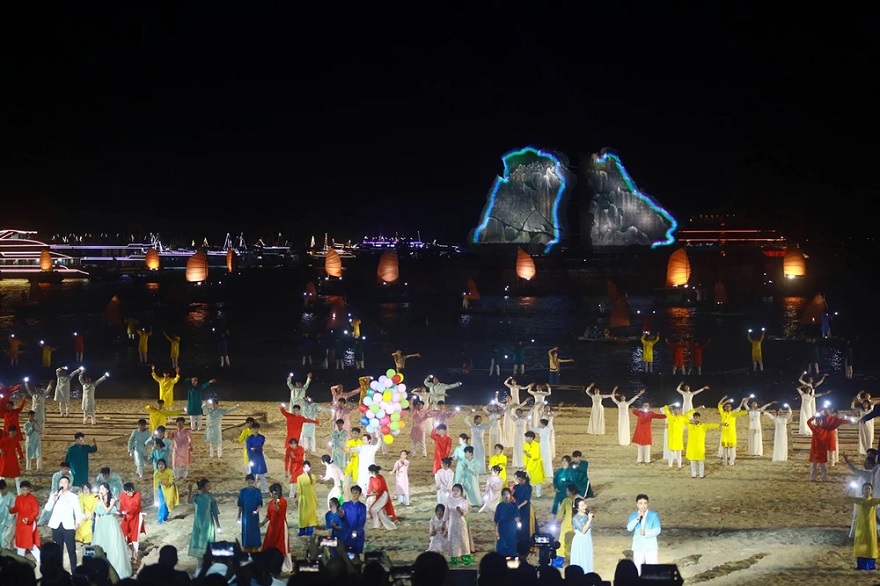
Ha Long Carnaval is one of the most attractive events of the year
Breathtaking performances and sports events are also special highlights of the year. The hot air balloon and paragliding flight exhibition over Ha Long Bay is taking place from April 15th through September 1st, offering a chance to admire the heritage from a completely novel perspective. Meanwhile, Aqua Warriors Halong Bay 2025, a sporting event combining aquathlon (swim-run) and triathlon with various attractive distances, took place successfully on April 12th and 13th, attracting a large number of athletes and sports enthusiasts.
Specialized festivals also contribute to enriching Ha Long’s event landscape. The Fun Wheels Festival Ha Long 2025, scheduled for June 28th and 29th at the 30/10 Square area and the Provincial Planning, Fair and Exhibition Palace, promises to be an appealing rendezvous for car and motorbike enthusiasts with activities such as Gymkhana racing, Test Drives, vehicle parades, and an accessories fair. Regarding cuisine, the Ha Long National Culinary Festival 2025, taking place around May and June, is an event honoring the richness of Vietnamese gastronomy and promoting local culinary tourism. Concurrently with the early summer festivals, the Red River Delta – Quang Ninh OCOP Fair 2025 took place successfully from April 29th to May 4th at the Provincial Planning, Fair and Exhibition Palace, introducing and promoting hundreds of high-quality OCOP products.
Notably, Ha Long in 2025 is at the center of global attention with the high-caliber international event “Art for Climate – Ha Long Bay 2025.” This event is expected to gather about 200 global billionaires along with tens of thousands of participants to honor art, raise awareness for heritage preservation, and respond to climate change through meaningful activities such as tree planting and panel discussions. Concurrently, on June 5th, aboard the Ambassador Cruise II, the UNESCO Program themed “Cultural Industry – A Driving Force for Cave Tourism Spaces” also took place, affirming Ha Long’s role in international cultural dialogue and sustainable development.
Alongside modern and large-scale events, traditional festivals such as the Yen Tu Festival (held from the first to the third lunar month in Uong Bi), Long Tien Pagoda Festival (24th day of the third lunar month), and Duc Ong Tran Quoc Nghien Temple Festival continue to play an important role in the spiritual cultural life of local people and serve as spiritual destinations for travelers.
VI. Ha Long Culinary Journey: The Essence of the Sea and Local Specialties
Ha Long cuisine is a wonderful blend of ocean flavors, an indispensable chapter in any sophisticated traveler’s guidebook. Visiting Ha Long in 2025, you will not only admire the natural wonder but also have the opportunity to immerse yourself in a rich culinary world—from fresh seafood just brought in from the bay to local specialties imbued with cultural imprints and traditional preparation techniques. Every dish tells a story, an invitation to explore the depth of this land.
1. Hand-Pounded Ha Long Squid Cakes: The “National Soul” of Mining Land Cuisine
When mentioning Ha Long, the first dish that comes to mind for many is Squid Cake (Chả Mực) – a specialty that has transcended local borders to become a source of pride for Vietnamese cuisine, recognized as one of the country’s record-breaking delicacies. What sets the renowned Ha Long Squid Cake apart is its elaborate preparation process, especially the traditional hand-pounding technique. Fresh cuttlefish, with their shimmering green skin, clear eyes, and thick bodies, are cleaned and then pounded entirely by hand by skilled artisans using stone mortars. This hand-pounding method, as opposed to machine grinding, allows the squid cakes to retain their natural chewiness, satisfying crunch, and the rich, sweet flavor of the sea, without becoming mushy or losing their texture.
On the market, Ha Long squid cakes come in various types with different price points, reflecting their quality and processing methods. Standard squid cakes, which may be partially machine-ground, usually cost around 300,000 VND/kg. However, to fully enjoy the essence, you should look for the special hand-pounded variety, priced between 360,000 and 500,000 VND/kg; premium versions can reach up to 550,000 VND/kg, offering delicious, golden, crispy, and chewy cakes that are never fishy. Ha Long squid cakes are best enjoyed hot. Locals often eat them with warm, sticky rice, sprinkled with a bit of meat floss or fried shallots – a simple yet hearty breakfast. Additionally, squid cakes are a perfect companion to steamed rice rolls (bánh cuốn), or simply fried until golden and dipped in spicy chili sauce. To purchase high-quality squid cakes, you can visit famous brands and reputable stalls at Ha Long Market 1 (Hon Gai area) or the Bai Chay area, with established names such as Cha muc Ba Kien, Cha muc Thoan, Cha muc Hoai Phuong, or Cha muc Hien Nhung.
2. Signature Fresh Seafood You Cannot Miss: Gifts from the Ocean
Beyond the “star” of squid cakes, Ha Long is a seafood paradise with countless fresh options inviting diners to explore. Sá sùng (peanut worm), also known as earth ginseng, is a rare and expensive seafood that resembles an earthworm but carries a distinct oceanic flavor. Fresh sá sùng can be stir-fried with fragrant garlic, grilled until crispy, cooked in a refreshing soup, or dried to become a premium seasoning that makes pho or noodle broth richer and naturally sweet. Cù kỳ (rock crab) is a type of crab-like seafood distinguished by its unusually large claws and meat that is firmer and sweeter than regular sea crab; it is often prepared as cù kỳ noodle soup, porridge, or stir-fried with tamarind or steamed with lemongrass. Mantis shrimp (bề bề), with its firm, sweet, and protein-rich meat, is the main ingredient for the famous mantis shrimp noodle soup or simply steamed, boiled, or grilled to preserve its fresh taste.
n
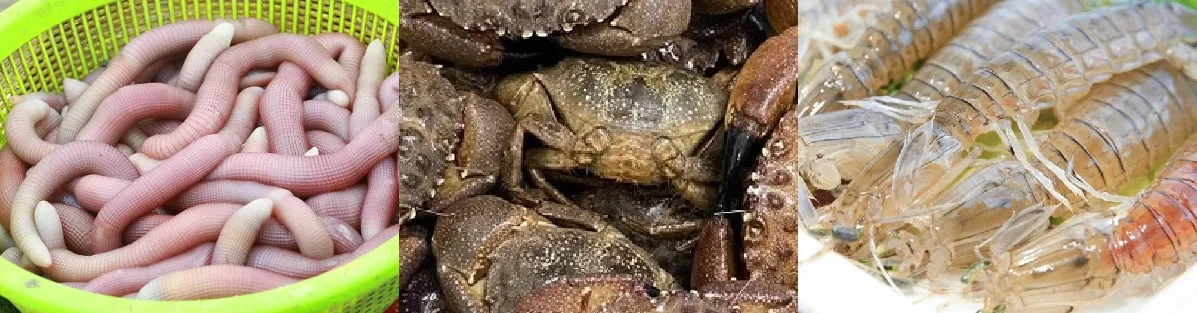
Ha Long is a coastal city famous for fresh seafood like Sa Sung, Cu Ky, and Be Be
One cannot forget Ha Long milk oysters, famous for being fresh, creamy, and firm. The most popular and beloved oyster dish is grilled oysters with scallion oil, served with crunchy roasted peanuts, or enjoyed raw with wasabi and fresh lime to fully appreciate the original sweetness of the sea. Horseshoe crab, a crustacean with a unique shape that often lives in pairs, is also a specialty worth trying, with delicious dishes like grilled horseshoe crab roe with scallion oil, refreshing horseshoe crab salad, or sweet and sour stir-fry. Ngán (a type of clam), a bivalve mollusk similar to a clam but larger and highly nutritious, is famous for its rich, creamy sweetness and can be used for porridge, steaming, grilling with scallion oil, or making a unique “ngán” wine found only in Quang Ninh. Additionally, there is the “ba gai” fish, with two types of meat—yellow (tastier) and white—often braised with galangal or green bananas; razor clams with firm, chewy, and crunchy meat, best in the rainy season (May-July) when steamed with lemongrass or stir-fried with tamarind; and geoduck (tu hài) with thick, cool, sweet meat similar to abalone, which is excellent in porridge, grilled with scallion oil, or baked with cheese. And of course, Ha Long dried squid, with its chewiness, pinkish-white body, and natural sweetness, is always a popular seafood gift.
3. Other Unique Local Specialties
Ha Long cuisine is not just about seafood. Typical dishes from the Quang Ninh region also contribute to the richness of the local culinary map. Tien Yen “Gat Gu” cake, a type of steamed rice roll made from finely ground rice flour, is spread thin and rolled up; it gets its name because when held, the cake is so soft that it “nods” (gật gù) to the rhythm of your hand. The cake is served with a special dipping sauce made from chicken fat fish sauce, fried shallots, chili, and sometimes braised fish intestines, “khâu nhục” (braised pork belly), or squid cakes. Tien Yen “Ca Say,” a hybrid poultry between a duck and a Muscovy duck, raised naturally in the Tien Yen hills, has firm meat, thin skin, is fragrant, and low in fat; it is usually boiled and enjoyed with a dipping sauce made from Tien Yen soy sauce and fresh ginger. Similarly, Tien Yen hill chicken is also a famous specialty known for its firm meat and golden skin.
A beverage that cannot be missed is Hoành Bồ Steamed Glutinous Rice Wine, a traditional wine naturally fermented from glutinous rice and characteristic forest leaves of the Hoành Bồ region (now merged into Hạ Long), offering a mildly tart flavor, gentle pungency, and a sweet aftertaste. A dessert or snack particularly loved by the youth is Hạ Long Pearl Yogurt. The special feature of this dish is that the yogurt has a thick, chewy, smooth texture like ice cream, served with chewy pearls, rich coconut milk, and other diverse toppings. In addition, rustic yet nutritious dishes such as refreshing, crunchy jellyfish salad, highly popular in summer, or stewed duck heart/kidney with mugwort leaves featuring the distinct pungent aroma of mugwort, are also flavors worth trying when visiting Hạ Long.
4. Suggested Delicious and Famous Dining Spots in Hạ Long
Hạ Long treats visitors to an endless array of dining options, from bustling fresh seafood markets and local eateries serving authentic regional flavors, to luxury restaurants with upscale ambiance and rich menus.
To experience culinary arts at fresh seafood markets, travelers should not miss Hạ Long Market 1 (Hòn Gai), which is not only famous for its reputable squid cake stalls but also boasts countless types of fresh seafood. Cái Dăm Market (Bãi Cháy) is a major seafood wholesale market where you can buy fresh seafood at great prices and even enjoy dishes prepared on the spot like mangrove horseshoe crab rice noodles. Bãi Cháy Seafood Market (Hoàng Quốc Việt Street) or Cao Xanh Fish Market (the new Hòn Gai fish market, operating from early morning) are also reliable spots.
Regarding seafood restaurants and local specialties,
-
t
- the Bãi Cháy area concentrates many large restaurants, serving a variety from high-end seafood to buffets, including Ngọc Phương Nam Restaurant with a beautiful bay view, Cua Vàng Bãi Cháy Restaurant, Bãi Cháy Seafood Warehouse, the Hồng Hạnh Restaurant chain, Sen Á Đông Buffet, or May Corner – Cafe & Bistro featuring Asian-European dishes.
- The Hòn Gai area is the ideal place to find long-standing local eateries and more affordable seafood restaurants, such as Hồng Hạnh Restaurant (facility 2 at 30 Hải Phượng), Hương Duyên Restaurant (66 Trần Hưng Đạo), Bằng Lăng Restaurant, or Talata Seafood Restaurant with a bay view. Sam Bà Tỵ Eatery (Alley 6 Cao Thắng) is a must-visit address for those wanting to enjoy horseshoe crab dishes.
- Tuần Châu Island, Cua Vàng Tuần Châu Restaurant, or YOLO Seafood Supermarket are also worthwhile options.
t
t
For street food and snack joints, the Giếng Đồn food court (Hòn Gai) is a popular destination. And don’t forget to enjoy Hạ Long Pearl Yogurt at familiar addresses such as Cô Nghi shop (10 Văn Lang, Hòn Gai), Facility 00 (Bãi Cháy Old Town), or Nhất Long (Minh Khai, Hà Lầm).
The clear distinction between the two areas of Bãi Cháy and Hòn Gai is also reflected in their culinary culture. Bãi Cháy tends to focus on large restaurants catering to tourists with more international choices and generally higher prices. Meanwhile, Hòn Gai is where visitors can find eateries imbued with local flavors, a cozy atmosphere, and more affordable prices.
To make your choices easier, the Table of Top Must-Try Hạ Long Delicacies and Recommended Eateries below will summarize detailed suggestions, from dish names, descriptions, to dining locations and reference price ranges, promising a complete and memorable culinary journey in this beautiful coastal city.
Top Must-Try Hạ Long Delicacies and Reputable Eateries
VII. Detailed Ha Long Travel Itinerary Suggestions for Every Need (2025)
Detailed planning is the key to a fulfilling Ha Long adventure, especially since the attractions and exciting activities are spread across a magnificent bay and a vibrant mainland city. Whether you have just one short day or plenty of time to explore deeper, the itinerary suggestions below will help you visualize an ideal journey while remaining flexible enough to adjust to your personal preferences and pace. Deciding between an overnight cruise to immerse yourself in the wonders of the bay or staying at a mainland hotel to enjoy the urban rhythm will be the main factor shaping the structure and focus of your trip.
A. 1-Day Ha Long Itinerary: Time Optimization for Short Trips
A day in Ha Long may be tight, but it is enough to touch upon the most characteristic features of the heritage site and the city. The key is to focus on core experiences.
Table: Option 1 – Full Ha Long Bay Experience in One Day
B. 2-Day 1-Night Ha Long Itinerary: A Balanced Experience of Exploration and Relaxation
Two days and one night is the ideal and most popular duration to deeply experience the beauty of Ha Long, allowing you to harmoniously combine bay exploration with land-based amenities or an overnight stay amidst the natural wonder.
Table: Option 1 – Magical Night on the Bay (Overnight Cruise)
Table: Option 2 – Vibrant Mainland, Breathtaking Sea (Combining Hotel Stay and Bay Tour)
C. 3-Day 2-Night Ha Long Itinerary: A Deeper and More Comprehensive Exploration
With three days and two nights, you will have plenty of time to explore Ha Long at a more leisurely pace, combining bay experiences, mainland entertainment activities, and a deeper dive into local culture.
Table: Option 1 – Comprehensive Exploration Balanced Itinerary
Table: Option 2 – Blue Bay Immersion and Mainland Relaxation