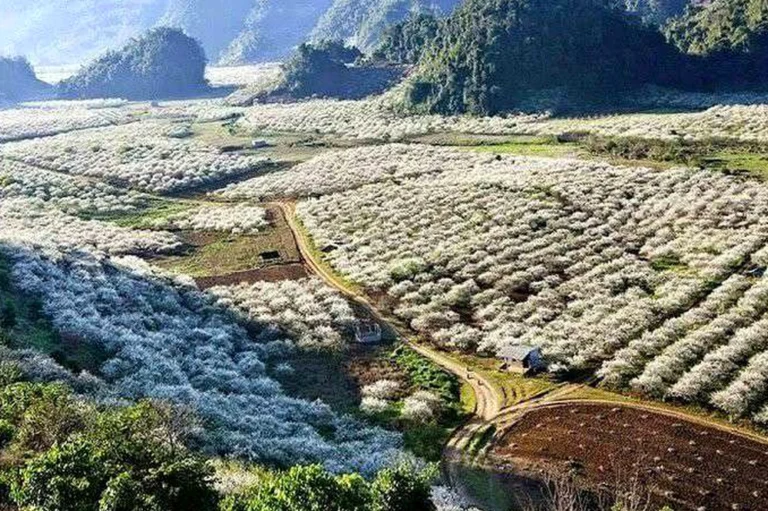
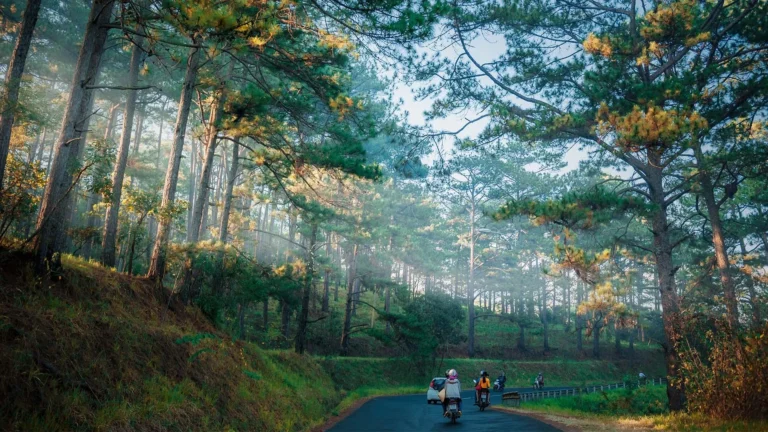
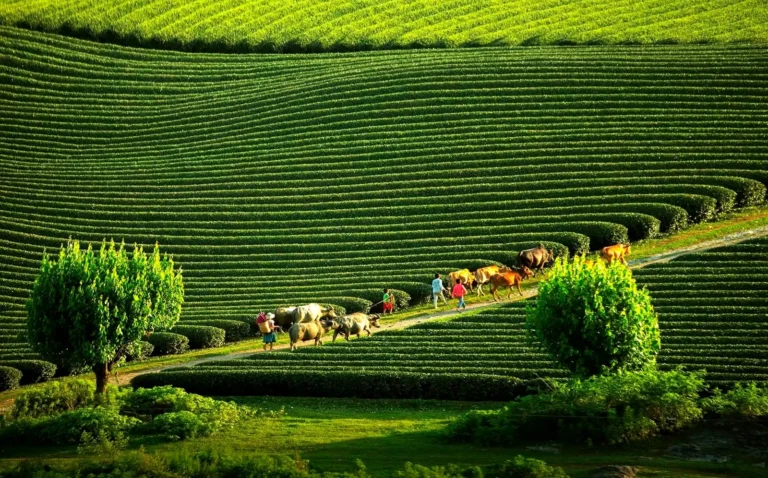
Located at coordinates 20°50’45″N 104°38’12″E, the Heart Tea Hill in Sub-zone 69, Moc Chau Farm Town, Son La Province, is not merely a sightseeing stop, but a proud contemporary agricultural cultural heritage entity. At an altitude of 1,050 meters above sea level, where the Moc Chau limestone plateau stretches like a lush green velvet carpet, this tea hill emerges as a symbol of the harmonious blend between human cultivation efforts and nature’s bounty. The terrain here possesses the classic “resting against mountains and facing water” layout—backed by the majestic mountain ranges of the Northwest region and facing a valley that catches cool breezes from the great forests, creating an auspicious energy-gathering landform where winding streams encircle the area, establishing an ideal microclimate for flavorful Shan Tuyet tea buds infused with morning dew.
The historical origin of the Heart Tea Hill is tied to the monumental milestone of April 8, 1958, when the Moc Chau State Farm was established. This is the result of a heroic chapter of history, where youth volunteers and demobilized soldiers left behind the smoke and fire of war to lay the first bricks for land reclamation, transforming wild, frost-covered lands into bountiful tea hills. While traditional ancient relics are typically identified by stone steles or royal decrees, the Heart Tea Hill is identified by the sweat and willpower of generations of pioneers. Its unique heart shape is not a random arrangement, but the culmination of masterful hedge-trimming techniques clearly shaped by agricultural artisans in the early 21st century to optimize harvesting areas while creating an iconic landscape highlight for the highland region.
The heritage value of this site also lies in the layers of cultural sediment overlapping the ancient land. Situated within the long-standing settlement area of the Thai and Mong ethnic minority communities—which once preserved precious archaeological artifacts such as stone tools and burial caves—the Heart Tea Hill represents the continuation of indigenous cultural roots in a new form. In the consciousness of local residents, the tea hill is not only “green gold” providing a livelihood, but also a space of romantic legends. The traditional courting songs (Khap) of the Thai people frequently recount young couples meeting amidst the drifting mist, where the fragrant aroma of tea mingles with sincere declarations of love. The heart shape has thus transcended its agricultural technique origins to become a contemporary folkloric symbol, where reclamation history and romantic love intertwine to create an enchanting indigenous landscape beauty recognized by cultural researchers and the press as a living heritage, testifying to the enduring vitality of Moc Chau across the eras.

If the Moc Chau plateau is considered a giant ink-wash painting, the Heart Tea Hill is its most delicate brushstroke, where human craftsmanship and nature’s favor blend into an architectural masterpiece of landscape. Lacking the solemn, contemplative gravity of ancient architectural monuments, the Heart Tea Hill possesses a vibrant beauty, a form of “green architecture” crafted from tens of thousands of ancient Shan Tuyet and cultivated tea roots. The tea rows are not merely agricultural produce; through the masterful trimming techniques of farmworkers, they have been shaped into smooth curves winding along the hillsides, forming a perfect heart shape when viewed from above. This stands as proof of aesthetic thinking in cultivation, where every tea trench is a stroke of the brush and every foliage canopy is a patch of lush green color, creating a magnificent geometric structure in the heart of the breezy highlands.
The terrain at Sub-zone 69 features the distinct characteristics of a limestone plateau topography, with rolling bowl-shaped hills that provide an ideal depth of field for anyone stepping foot here. As morning sunlight begins to weave through the characteristic mist of the high mountains, the entire tea hill appears blanketed in a layer of golden dust. Early morning dewdrops resting on tea leaves sparkle like diamonds, highlighting the heart-shaped structure that has become a symbol of love and connection. The magnificence of the landscape here lies not only in its shape, but also in the contrast between the lush green of the tea and the deep blue of the sky alongside distant hazy mountain ranges, creating a visually captivating space.
To capture “million-view” moments at this landmark, professional photographers generally prioritize two classic camera angles. The first angle looks down from the highest hilltop, where a wide-angle lens can fully capture the heart shape nestled neatly within the valley. The ideal time is at dawn, roughly between 6:00 AM and 7:00 AM, when sunlight remains gentle and casts alternating bands of light and shadow across the tea rows, accentuating the sculptural depth of the landscape. The second angle features close-ups along the paths between the tea rows, where photographers can capture curving lines stretching out toward the horizon. At sunset, as the sun dips behind the mountain range, the light shifts into warm amber-orange tones, crafting a romantic, mystical scene that turns every photo into an emotionally evocative work of art.

Experiencing the Heart Tea Hill goes beyond merely admiring the landscape architecture; it is about feeling the heartbeat of this land. Every check-in spot here carries its own story, where humans feel small before the vastness of nature yet energized by the fierce vitality of the tea hills. Whether you are a photographer hunting for unique angles or a traveler wishing to preserve memories, the Heart Tea Hill always satisfies with its pristine, authentic, and artistic beauty. This is sustainable “green architecture,” a contemporary symbol of Moc Chau where every line tells of diligence, creativity, and a deep love for this highland land.
Upon setting foot in Sub-zone 69, the first sensation that washes over any visitor is awe before an endless “green ocean.” The Heart Tea Hill is not merely a straightforward check-in coordinate, but a vibrant space where the breath of the Northwest sky and earth blends with the diligent pace of local farmers. To truly empathize with this land, visitors should begin their journey by following small pathways where meticulously trimmed tea rows resemble smooth green silk ribbons winding across the hillsides. Climbing to the highest points of the tea hill in the early morning, when mist still drifts halfway up the mountains, delivers an unforgettable visual experience. From here, the entire Moc Chau plateau unfolds like a watercolor painting, where the green of the tea merges with the white of the sky and clouds, creating a remarkably tranquil pause.
The experience here does not stop at sightseeing. Visitors can transform into true farmers, picking tender young tea buds by hand under the warm guidance of locals. This is when indigenous culture becomes most alive: stories of land reclamation and tea cultivation techniques are recounted in the rustic, sincere voices of Thai and Mong people. After moments of physical activity, savoring a cup of fresh tea right on the hill is an indispensable ritual. The light astringency on the tip of the tongue and the lingering sweet aftertaste spreading across the palate, combined with the pure aroma of the mountain forests, make all fatigue from a long journey seem to vanish. It is the crystallization of sunshine, wind, and the dedication of generations attached to this land.

Regarding culinary aspects, the surrounding area of the tea hill is a paradise of renowned specialties. Visitors should not miss the chance to taste sizzling hot fried veal, smoked buffalo meat rich with smoky flavor, or fragrant grilled stream fish seasoned with distinctive spices of the Northwest mountains such as wild pepper (mac khen) and doi seeds. Each dish offers not only sensory satisfaction but also a deep connection to the culinary culture of highland residents. For those seeking inner tranquility, visiting nearby villages to pay respects at small temples or simply sitting beside a babbling stream flowing around the hill will bring a sense of peace and stillness. The sound of running streams blending with wind blowing through the tea canopy creates an enchanting natural symphony.
The awe experienced before the Heart Tea Hill stems not only from the structural beauty of the landscape, but also from the historical depth and vibrant living indigenous culture present there. As dusk falls and dyes the entire space purple, standing amidst the tea hill allows visitors to feel a sacred connection between humans and the land. It is the sensation of touching the historical strata, where every tea leaf tells a story of love, perseverance, and human aspiration to rise in the Northwest highlands. The Heart Tea Hill is therefore not just a destination, but a journey to find balance, where every practical experience leaves deep echoes in the heart of the traveler.
To ensure your journey exploring the “Contemporary Agricultural Cultural Heritage” at the Heart Tea Hill is complete, visitors should grasp the following practical information and useful tips. The Heart Tea Hill is located in Sub-zone 69 of Moc Chau Farm Town. This is an open farming area without fixed ticket control gates like historical monuments, allowing visitors to freely tour and admire the landscape without paying an admission fee. However, to maintain the sustainability of highland “green gold,” guests are encouraged to support local services such as renting ethnic costumes or enjoying fresh tea at local resting huts.

Regarding visiting hours, the tea hill is open to visitors year-round, from dawn until dusk. The ideal time to visit is in the early morning, when dew lingers on the tea leaves and thin mist drapes over the valley, creating a magical atmosphere straight out of folklore. To avoid harsh highland midday sun, the hours from 7:00 AM to 9:00 AM or after 4:00 PM are optimal choices to capture the best photographs without harsh lighting.
Traveling to the tea hill is quite convenient. From the center of Moc Chau Farm Town, visitors can travel by motorcycle or private car toward Sub-zone 69. The route leading to the tea hill consists of asphalt roads mixed with small concrete paths winding across mountain slopes. For safety, visitors are advised to use a motorcycle if they want to weave deep into paths between tea rows, or a small car if traveling with a family group. Pay attention to local directional signs to avoid accidentally entering farming areas currently undergoing spraying or harvesting.
Regarding clothing, although this is a modern tourist destination, because it sits within the cultural space of the Thai and Mong people, visitors should choose modest, polite attire. Brightly colored outfits such as white, red, or yellow stand out wonderfully against the lush green background of the tea leaves. However, avoid overly short skirts or cumbersome outfits that make movement difficult across steep hillside and stony terrain. A pair of athletic shoes with good traction is essential for comfortably climbing hilltop viewpoints that offer panoramic vistas of the entire valley.
Finally, always remember the principle of “leave nothing behind but footprints.” The tea hill is not only a check-in spot but also the livelihood of local residents. Maintaining environmental sanitation, refraining from breaking branches, picking leaves, or trampling young tea rows is the most practical way to preserve the value of this agricultural cultural heritage. Enjoy the tranquil space, listen to the wind whispering through the tea plantations, and feel the breath of the Northwest highlands in every pulse of nature.
To enjoy a complete vacation and fully appreciate the beauty of the Moc Chau Heart Tea Hill without worrying about arranging transportation, booking tickets, or planning travel itineraries, visitors can choose premium all-inclusive Son La tour packages from VDS Travel. Each tour is optimized to time your check-ins when the scenery is most vibrant, accompanied by a team of guides deeply knowledgeable about local culture and top-tier hotel and dining standards.