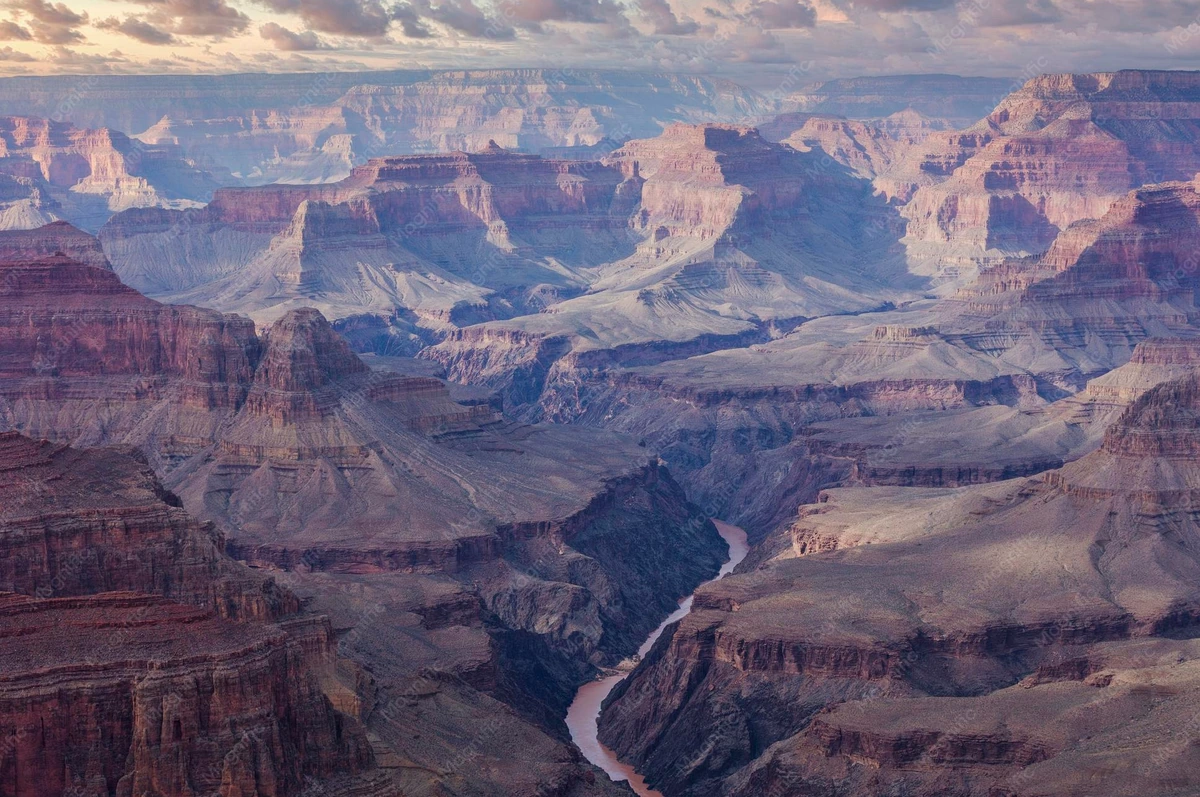
Rising across the Colorado Plateau in Arizona, the Grand Canyon reads like a vast chronicle carved patiently by nature over two billion years. Deep beneath the plunging gorge, the dark, ancient crystalline rock of the Vishnu Schist bears witness to Earth’s earliest crust—a landscape that once saw ancient mountain ranges rise before they were worn down and buried under layers of marine sediment. Churning with red silt over millions of years, the Colorado River steadily cut a colossal gash through sandstone, limestone, and shale, exposing a geological library of unmatched scale and deep time.
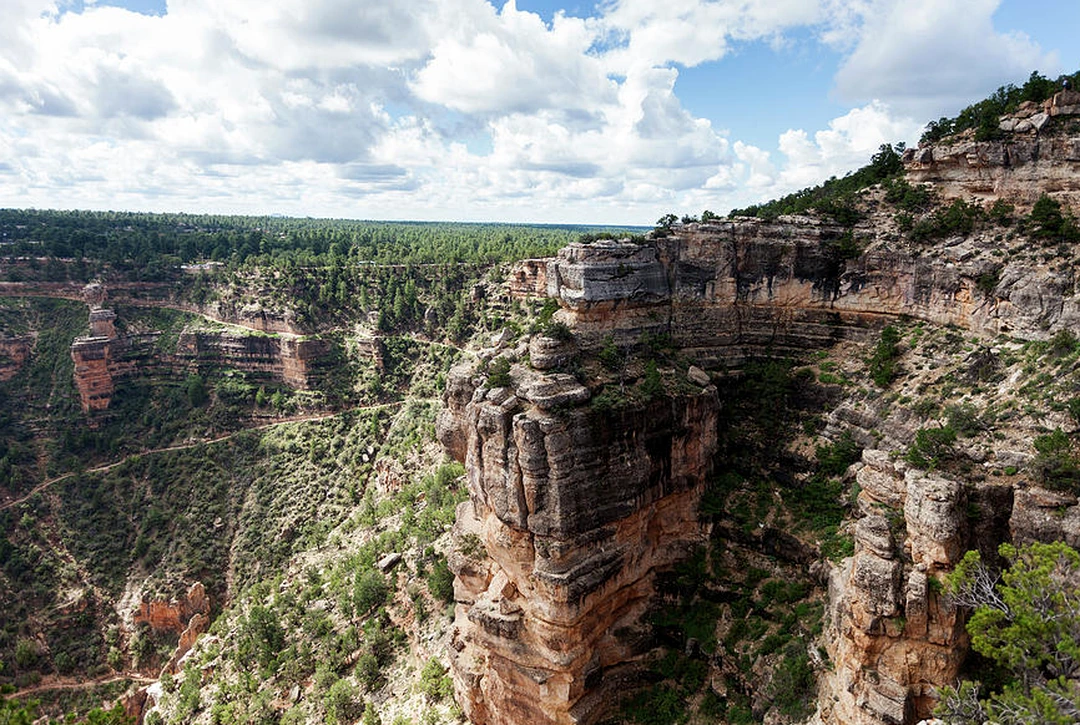
Long before Western explorers arrived in this rugged country, the Grand Canyon was a sacred cradle of survival for ancient Indigenous civilizations. Archaeological traces—from hunting tools to rock carvings—point to thousands of years of continuous human presence, notably among the Cohonina and the Ancestral Puebloans. These early inhabitants adapted remarkably to the arid desert environment, building sturdy dwellings tucked into sheer sandstone alcoves and tending terraced farms along desert springs and seeps. To them, the canyon was sacred ground where life began and where spirits journeyed after leaving this world.
Continuing this human story, the steep western reaches became the stronghold of the Hualapai tribe, a name proudly meaning “People of the Tall Pines.” For centuries, the Hualapai lived closely tied to the canyon cliffs and seasonal washes around the West Rim, honoring Mother Earth and preserving ancestral stories through oral songs and traditions. Rather than isolating them, the demanding terrain shaped a resilient culture rooted in harmony with the raw power and grandeur of the wild.
Direct contact between the Grand Canyon and the outside world began in the autumn of 1540, when Spanish nobleman and officer García López de Cárdenas led a party of horsemen from Francisco Vázquez de Coronado’s expedition to the canyon’s edge. Standing along the breezy South Rim, the European soldiers were stunned—and thwarted—by the sheer scale of the chasm; from high above, the roaring Colorado River looked like a narrow thread, defeating three days of efforts by the men to climb down to the river for water.
At the dawn of the twentieth century, the canyon’s future took a decisive turn through the conservation vision of President Theodore Roosevelt. During his historic visit in May 1903, moved by the canyon’s untamed majesty, he delivered his famous call urging Americans to leave this grand wonder of nature as it was—without buildings or alterations that would mar what only time and creation had shaped. That early commitment helped establish the Grand Canyon Game Preserve and paved the way for the 1919 Act of Congress designating it a National Park, safeguarding the landscape as a lasting heritage for humanity.
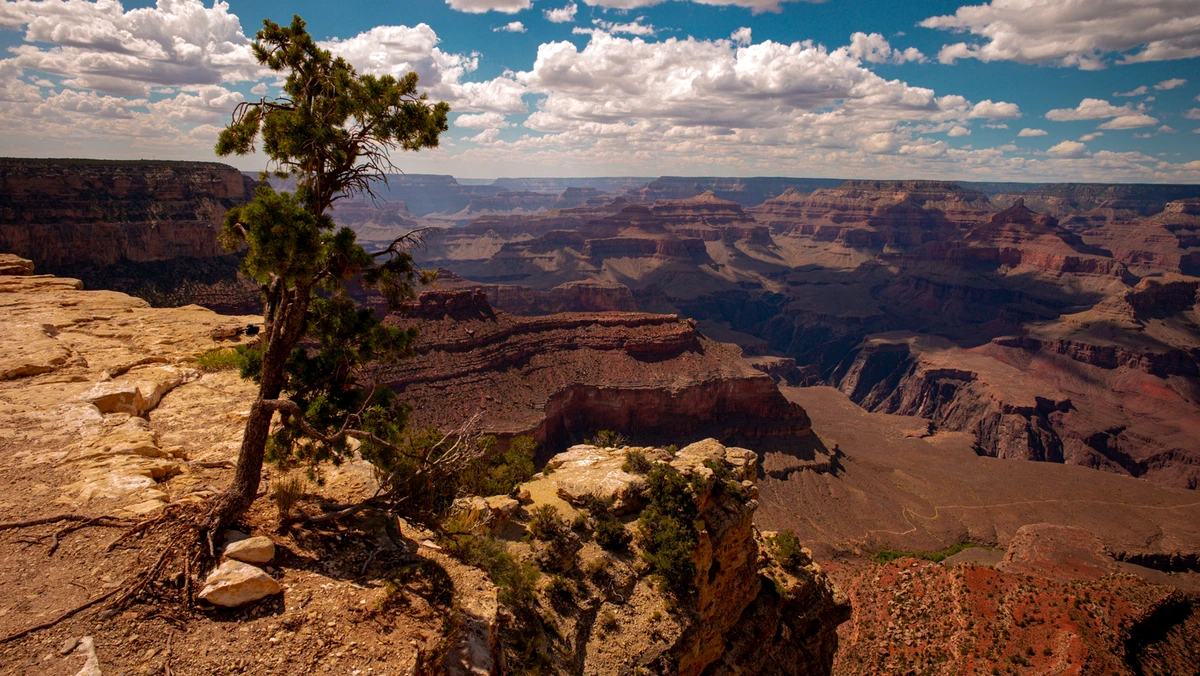
Seen through human geography and natural form, the Grand Canyon is a monumental scar etched into the Colorado Plateau, where the Colorado River has carved for millions of years like a lifeblood shaping land and water. More than a deep trench, it stands as a vast natural structure reaching a maximum depth of 1,857 meters. Layered bands of sandstone, limestone, and shale step down into massive terraces open to the sky—bringing together the steadfast ancient rock deep below and the ever-shifting winds sweeping across the rim.
The canyon’s layout is shaped in distinct ways by how its sections are managed and visited. The South Rim is overseen directly by the U.S. National Park Service (NPS) under strict preservation standards, keeping classic trails and rustic stone overlooks set quietly amid woodland intact. By contrast, the West Rim lies within the sovereign lands of the Hualapai Nation—the “People of the Tall Pines.” Under tribal governance, the West Rim blends respect for Mother Earth with bold visitor attractions designed for travelers arriving from afar.
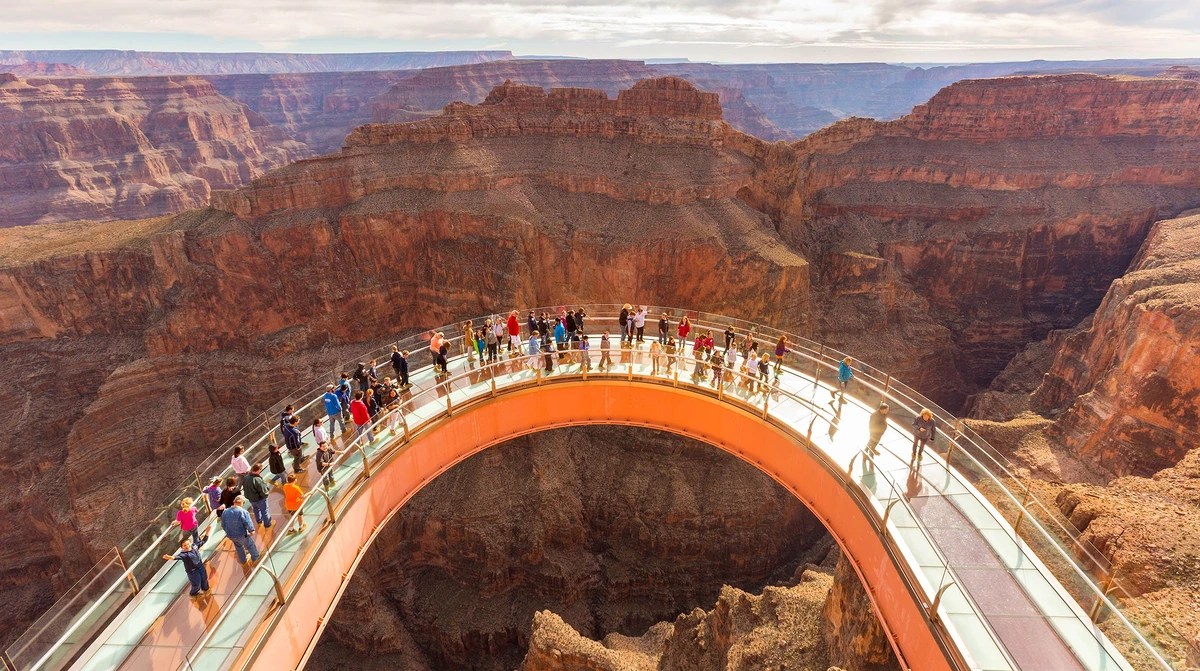
A prime example of modern engineering built into steep terrain is the glass Skywalk at Eagle Point on the West Rim. Anchored deep into ancient limestone with cantilevered steel beams reaching more than twenty meters into open space, this horseshoe-shaped structure is engineered to handle loads comparable to dozens of large commercial airliners and strong updrafts rising from the gorge. Modern construction works alongside the cliffside to create an unobstructed mid-air vantage point without altering the surrounding rock formation, turning the sheer drop into a dramatic stage for viewing the canyon.
Few places on Earth pack such dramatic shifts in scenery and microclimate into a single vertical span. With nearly two thousand meters of elevation change from the river below to the high rim above, the canyon spans five of the seven major life zones recognized in classic ecological classification. Down in the deep gorge lies the hot, arid Lower Sonoran semi-desert, where prickly cacti and desert willow endure intense heat. Climbing the steep walls, vegetation transitions through the Upper Sonoran with pinyon pines and juniper, moves through stands of tall Ponderosa pine in the transition zone, and reaches Boreal-like subalpine conditions on the highest ridges, where crisp mountain air blows and winter brings snow.
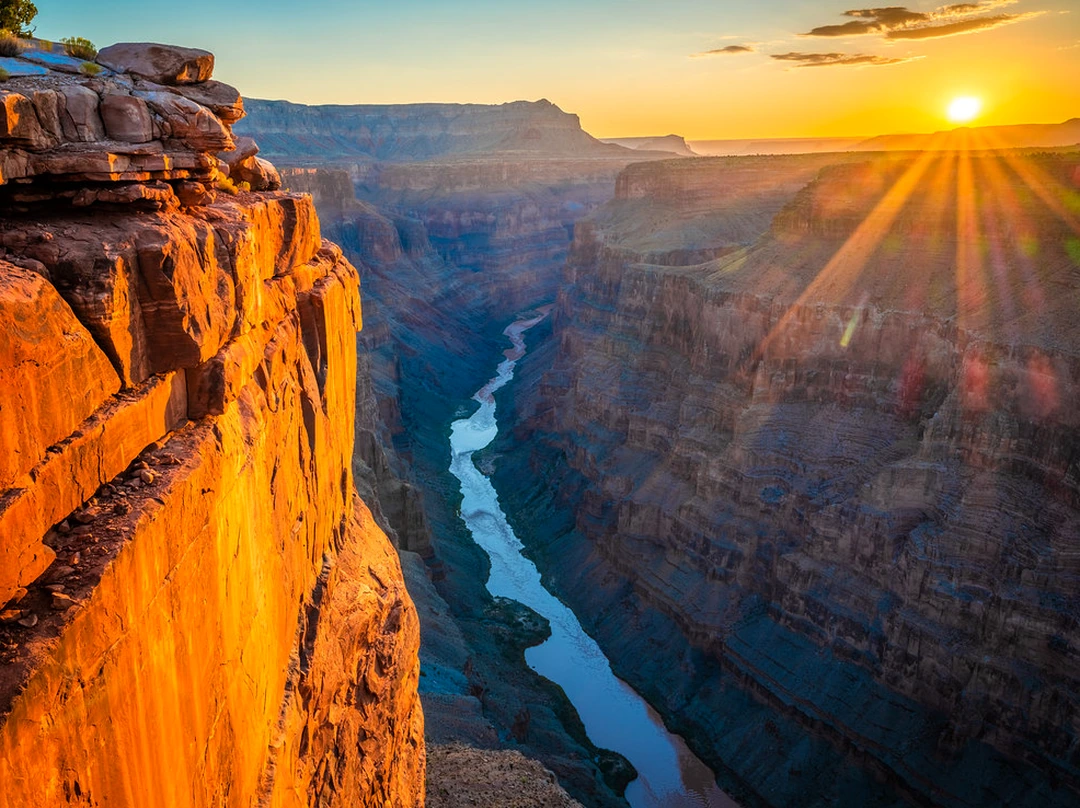
Across the wide expanses of Arizona, where rock strata are split by nature’s colossal fissure, human structures feel small against the landscape. Yet at Eagle Point on Hualapai land at the West Rim, a striking contemporary engineering feat tests visual boundaries: the glass Skywalk. Pushing past conventional building forms, the horseshoe cantilever extends 21 meters past the limestone cliff edge out over open air. From the outer curve of the arc, looking straight through the clear floor drops more than 1,200 meters down to the Colorado River winding like a turquoise ribbon between red sandstone walls—an unforgettable sense of height and space.
To make walking over open air possible while protecting the ancient cliff face, engineers solved complex structural and materials challenges on a $30 million project completed in 2007. Supported by more than 450 tons of high-strength structural steel and anchored deep into bedrock with post-tensioned tie-downs, the walkway deck is built from 4-inch-thick (over 10 cm) laminated tempered glass bonded with tough ionoplast interlayers. This design allows the Skywalk to withstand winds up to 100 mph (about 160 km/h) blowing up the gorge, resist local earthquakes up to magnitude 8.0, and support the weight of dozens of commercial aircraft at once. Stepping onto clear glass above the canyon turns a nerve-testing walk into a vivid moment where solid ground and vast open space seem to meet.
Where the West Rim Skywalk highlights modern steel and glass engineering, architecture along the South Rim leans into an organic, grounded presence shaped by famed designer Mary Colter. A standout landmark is the Desert View Watchtower, a stone structure inspired by ancient Ancestral Puebloan watchtowers. Rather than uniform, flat masonry, Colter selected weathered red sandstone blocks and rough-hewn Ponderosa timber to build a 21-meter tower rising from the rim as if grown from the Kaibab limestone itself. Inside, it serves as a living gallery featuring Hopi mythological murals painted by Indigenous artist Fred Kabotie, lit by windows aligned to frame views of the Colorado River valley. Alongside Hopi House and Bright Angel Lodge, this National Park Service Rustic style sets a quiet, respectful tone that contrasts cleanly with the modern glass walkway on the West Rim.
In spatial layout and sheer scale, human structures at the Grand Canyon—from the cantilevered glass bridge reaching over the void to stone towers along the rim—yield to the canyon’s vast proportions. Stretching nearly 450 kilometers long and up to 29 kilometers wide, the gorge dwarfs any attempt at architectural showmanship. Instead, these buildings act like quiet viewing frames, giving visitors a steady place to take in two billion years of Earth’s history, where the dark Vishnu Basement rock deep below speaks to enduring time.
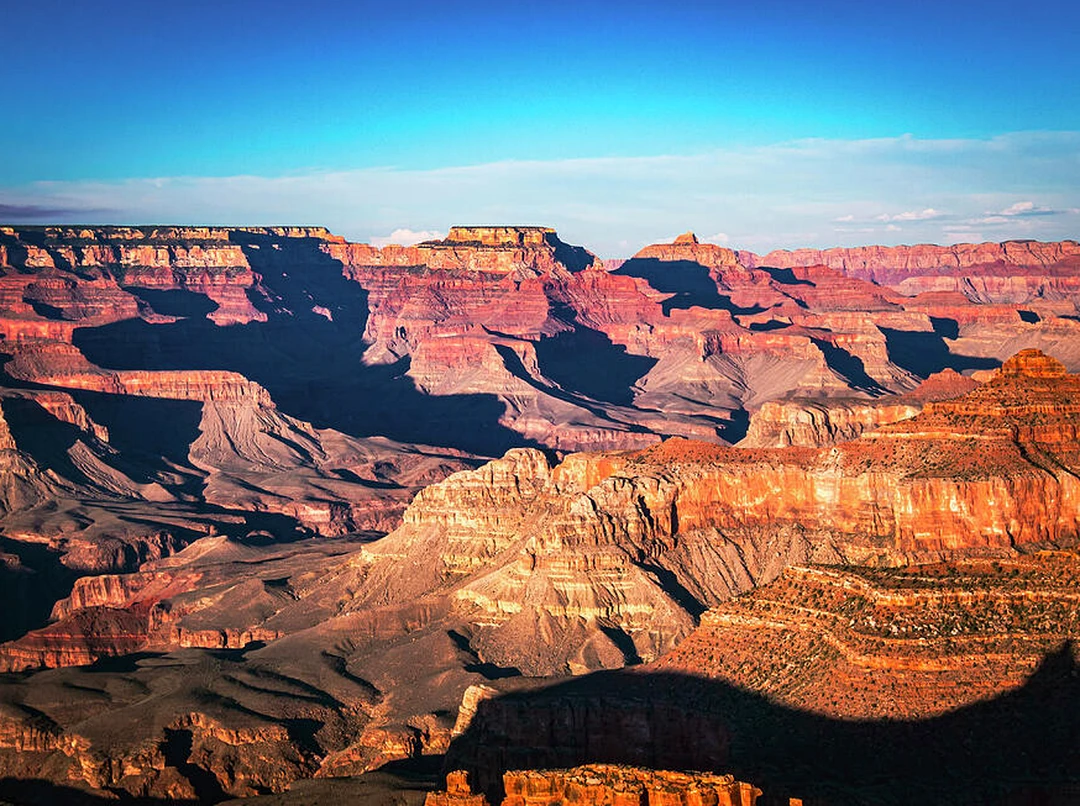
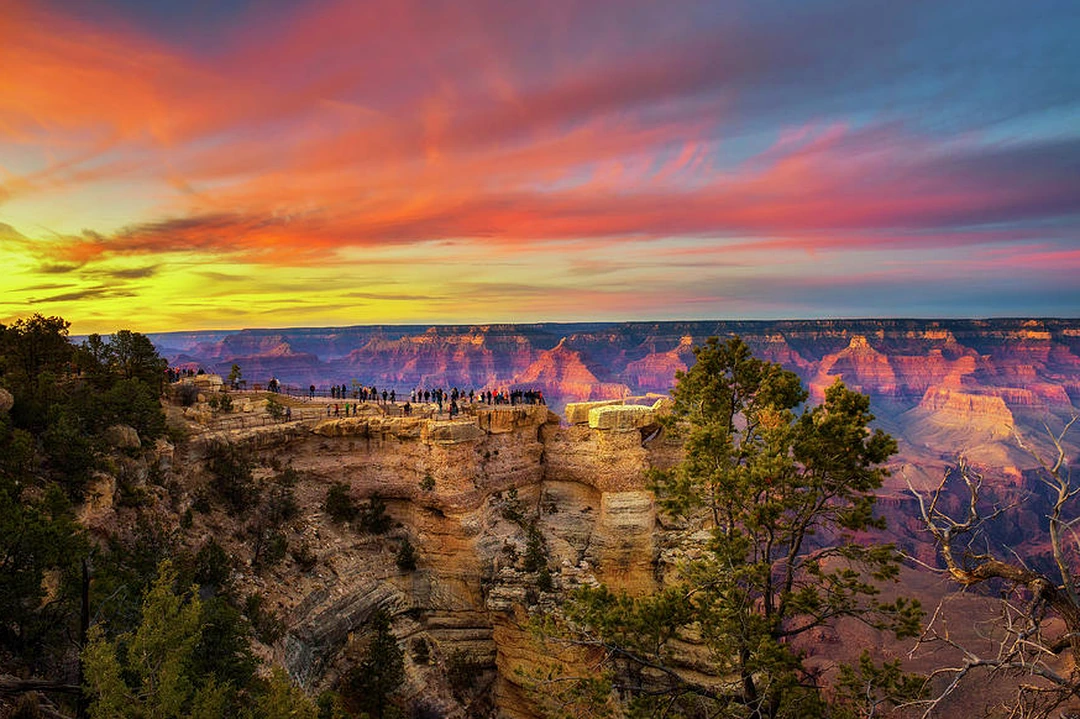
As sunset settles into the canyon, the day doesn’t simply end—it turns into one of nature’s grandest spectacles, driven not by stagecraft or mechanical effects, but by light and sky. The “show” here is the shifting play of late-day sunlight across exposed rock layers. From Mather Point at over 2,100 meters elevation on the South Rim, golden hour brings rapid changes in color as Kaibab sandstone and Toroweap limestone catch the low sun—glowing ochre, crimson, and burnt orange before fading into deep twilight purple across miles of canyon.
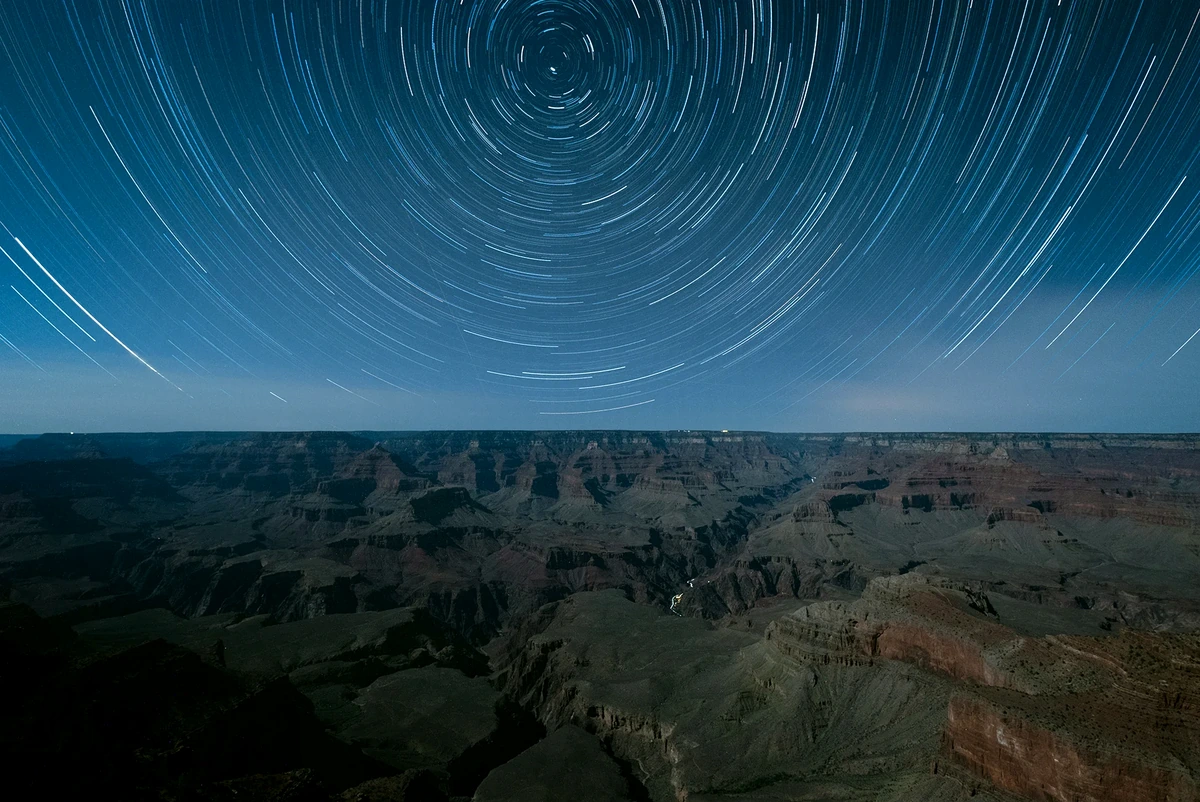
The transition from dusk to night at the Grand Canyon is protected as an International Dark Sky Park. To safeguard natural darkness for nocturnal wildlife and preserve clear stargazing conditions, South Rim Village follows strict Dark Sky lighting guidelines. Outdoor fixtures and lodging lights along the rim use shielded optics that direct light downward and keep color temperatures warm (under 3,000 Kelvin) to minimize light pollution. As a result, night at the Grand Canyon isn’t pitch-black gloom—it’s a clean, dark sky that lets your eyes adjust and sense the scale of space above.
Evenings on the South Rim take on a quiet, awe-inspiring rhythm through astronomy programs hosted with the National Park Service. Guided by NPS rangers and volunteer astronomers, visitors can look through large refracting and reflecting telescopes set up along rimside trails. In the dry, thin, clear air of the Colorado Plateau, the Milky Way stands out vividly overhead like a silver river arching across the sky, echoing the unseen river rushing far below in the gorge. Nebulae, ancient globular clusters, and the faint glow of the Andromeda Galaxy feel remarkably close, offering a quiet reminder of human scale beneath a vast universe.
Nighttime on the South Rim is also a distinct sensory experience once daytime mechanical noise fades away. Standing near the rim in the quiet dark, visitors hear wind moving through pinyon pines and junipers, punctuated occasionally by the deep call of a great horned owl echoing off ancient Vishnu rock. Instead of artificial light displays, moonlight silvers isolated rock formations, turning the night canyon into a peaceful setting to take in a landscape shaped over two billion years.
Food around the Grand Canyon is more than visitor dining—it reflects generations of life and adaptation in the American Southwest. From the West Rim’s red-rock cliffs to the South Rim’s quiet woodlands, local food traditions bring together longtime Indigenous knowledge and frontier hospitality. In an arid landscape framed by towering sandstone walls, traditional sustenance drew on hardy native plants tied to the history of the Hualapai and neighboring tribes.
For the Hualapai, who watch over the western edge of the canyon, traditional foods carry the flavors of the high plateau and Mojave desert. Over generations, they developed ways to prepare wild plants for steady nourishment. Summer-harvested mesquite pods were dried on flat stone and ground into a golden flour with a natural caramel-like sweetness, used for porridge or flatbreads. Pinyon pine nuts gathered from small pines rooted on limestone slopes provided rich fats for cold winters. Especially distinctive is pit-roasting agave hearts, where agave crowns are baked underground over hot stones for two to three days, turning sharp raw flavors into tender, honey-sweet flesh.
Around the West Rim, one of the best-known Indigenous foods is fry bread, a staple across the Southwest. Its history carries the poignant memory of nineteenth-century forced relocations and rations of white flour, lard, salt, and baking powder that people shaped into a resilient staple. Hand-stretched dough is fried in hot oil until puffed, golden, and crisp on the outside while staying soft and chewy inside. Topped with spiced beans, seasoned ground beef with bell peppers, shredded cheese, and fresh salsa, it becomes a hearty Navajo Taco—a lasting symbol of resourcefulness and cultural pride.

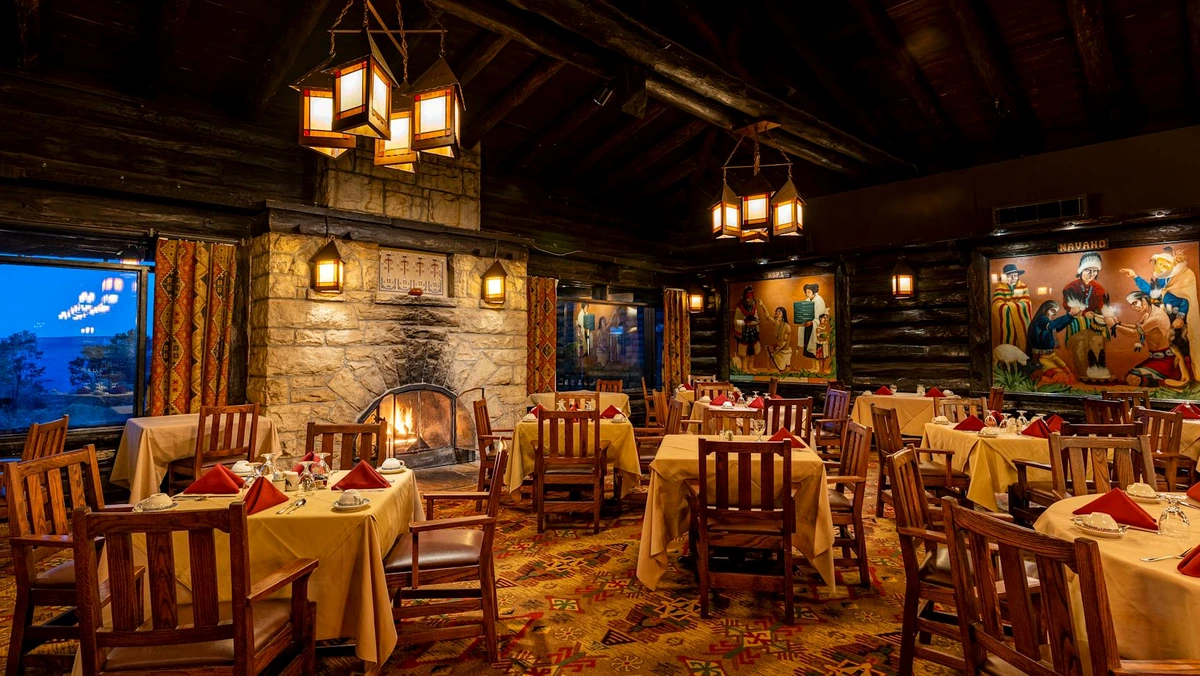
In contrast to the rustic West Rim, the South Rim evokes early-twentieth-century rail travel at the El Tovar Dining Room. Set inside the 1905 timber-and-sandstone lodge designed by Charles Whittlesey and operated under the Fred Harvey company, the dining room keeps its log walls, wrought-iron light fixtures, and wide views toward the canyon. It has long been known for classic frontier-inspired fare featuring hearty game meats from northern forests.
The El Tovar menu highlights Southwestern flavors with dishes like seared elk loin paired with a rich juniper berry and wild pepper reduction that balances lean, flavorful red meat. Charcoal-grilled bison steaks with herbs—naturally lean and savory—are served alongside buttered sweet corn and Southwestern-spiced mashed potatoes. Dining at El Tovar feels like a stop through travel history, pairing regional cooking with the sound of wind through two-billion-year-old rock above the Colorado River.
Planning a trip to the Grand Canyon depends on how the two main rims—the South Rim and the West Rim—are managed. Managed by the National Park Service, the South Rim is open 24 hours a day year-round, letting visitors experience night skies or sunrise on the rim. Camping reservations, vehicle passes, and park entry are best arranged ahead of time through Recreation.gov to keep entry smooth. On the other hand, the West Rim lies within the Hualapai Reservation and operates daily from 8:00 AM to 5:00 PM under Hualapai Tourism. Visiting the glass Skywalk and West Rim overlooks requires purchasing tickets or cultural experience packages separately from standard National Park passes.
Getting to the canyon offers several distinct routes depending on your itinerary. From Las Vegas in neighboring Nevada, a drive of about 2.5 hours crosses the Mojave Desert—with views near Hoover Dam—straight toward the West Rim. For a classic trip to the South Rim, riding the historic Grand Canyon Railway is a memorable option. Departing from Williams along historic Route 66, the train rolls through Ponderosa pine woods and open grasslands before arriving at the 1901 two-story log Grand Canyon Depot right by the rim.
Sitting above 2,100 meters on a semi-arid plateau, the Grand Canyon experiences wide day-to-night temperature swings and low humidity. Early morning at dawn is one of the best times to start a walk along the rim, when soft rose and orange light hits Toroweap limestone and Kaibab sandstone and temperatures are cooler than midday heat in the canyon. Along rim trails, stay behind safety railings and never step onto unstable ledges for photos. Keep a respectful, lawful distance from wildlife such as elk, bighorn sheep, and endangered California condors, and never feed animals so they retain natural foraging habits.
Visiting a two-billion-year-old landscape also means practicing Leave No Trace—packing out all trash, carrying plenty of water and electrolytes against dehydration, and wearing sturdy hiking footwear while respecting lands held sacred by Indigenous peoples. After taking in the canyon, travelers who want to connect major U.S. cities and natural landmarks without worrying about complex logistics can consider a complete East–West USA tour package for a smooth, well-paced trip.