Nestled beside the vast Gulf of Tonkin where mainland and sea meet along southern China’s coast, Wanwei Beach in Dongxing unfolds as a natural coastal gem layered with evocative cultural history. Located in Jiangping Town roughly twenty-seven kilometers east of central Dongxing, it appears in historical gazetteers as a wind-and-wave-sheltering coastal island. Viewed from afar, casuarina groves stretch across gentle coastal slopes opening onto the South China Sea, where white-capped surf rolls steadily onto long, flat sands. Quiet and unpretentious compared with bustling resort cities, Wanwei carries a raw coastal grace, the hush of breaking waves, and the briny character of a fishing community shaped over centuries of change.
More than a seaside getaway, Wanwei is closely tied to the migration story of the Kinh (*Jing*) ethnic community across the “Three Islands” (*San Dao*) in China. Tracing back to the early sixteenth century—around the Hong Thuan reign of Vietnam’s Early Le Dynasty, corresponding to the Ming Dynasty—roughly two hundred resilient fishermen setting out from storm-swept Do Son in Hai Phong sailed across open waters in pursuit of large schools of fish. Storms and currents carried these pioneers to three isolated offshore islands in the Gulf of Tonkin—Wanwei, Wutou, and Shantxin, known locally as the Kinh Three Islands. Finding sheltered waters, rich tidal flats, and abundant fishing grounds, they settled and built makeshift shelters and rafts, laying the foundations of a coastal frontier community spanning more than five hundred years.
Across shifting historical periods and border treaties between imperial courts and modern administrations, while administrative boundaries evolved, local ties to ancestral roots remained strong. That living memory is clearest at the historic Wanwei Communal Hall (*Dinh*), which honors twelve village guardian spirits descended from Do Son, Hai Phong pioneers. This spiritual bond finds a remarkable parallel in Tra Co Communal Hall at Vietnam’s northeastern border tip, reflecting deep shared roots across land and sea. During *Hoi Dinh* festivals, resonant *dan bau* monochord melodies mingle with traditional antiphonal singing as men in *ao the* and *khan xep* carry palanquins facing out toward the sea—sending prayers back across the water toward ancestral origins.
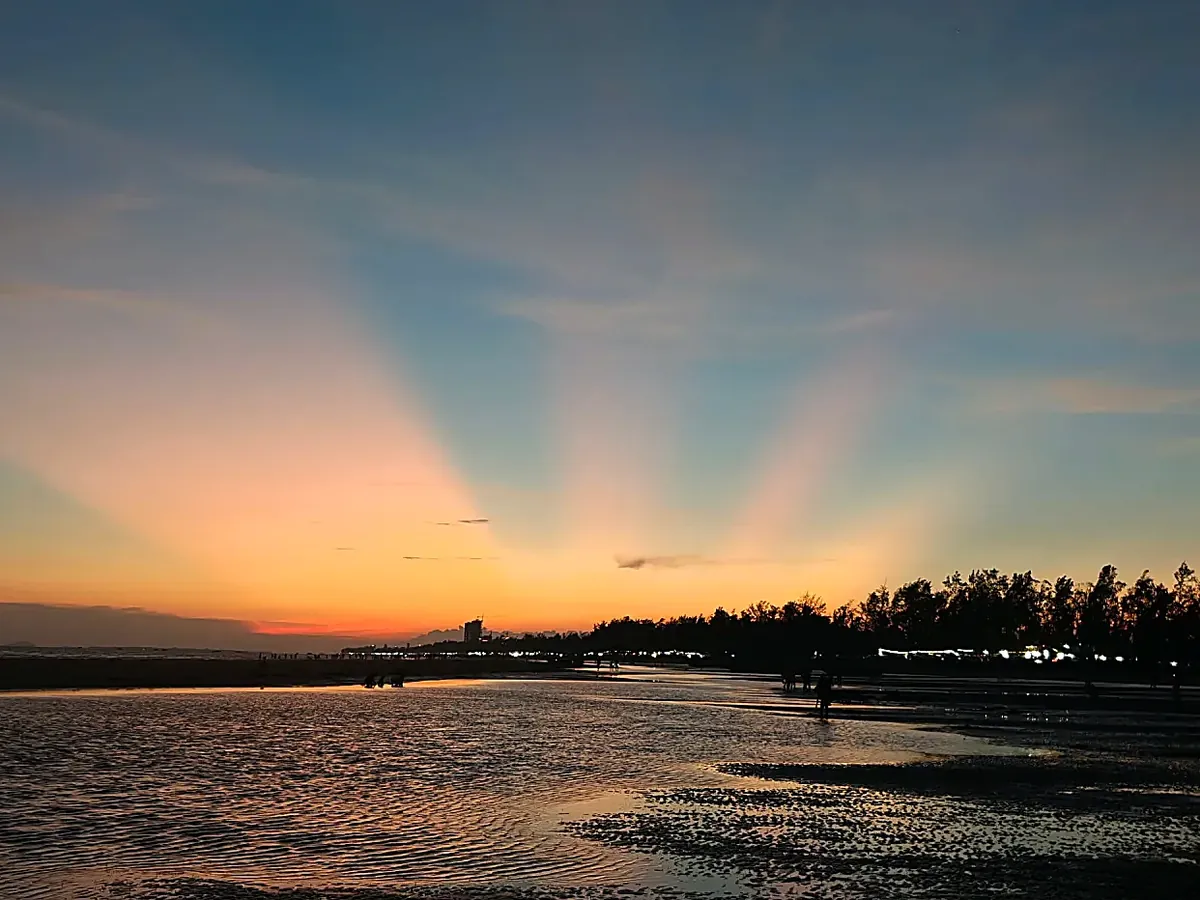
Wanwei Beach’s signature geographical feature is Jinshan Beach (“Golden Sand Beach”), cherished locally as a golden shore. Stretching over fifteen kilometers with an unusually gentle slope, its fine, silky sand is shaped by coastal currents and sediment. At low tide, a wide, level sand flat opens before you like a mirror reflecting blue skies and clouds, with gentle surf and shallow water extending far offshore—making swimming and seaside walks calm and welcoming for visitors of all ages.
At the heart of the Wanwei peninsula stands the Kinh Ethnic Museum, preserving the history and identity of the Kinh community in China. Inside, exhibits bring heritage to life through bamboo-ribbed sailing boat models, traditional fishing nets, flowing *ao dai* garments, and Sino-Vietnamese (*Han-Nom*) records of village rules and family genealogies. Notably, the *dan bau*—played from a single string over a resonant gourd—holds pride of place as a treasured intangible cultural heritage emblem reflecting Kinh identity within China’s diverse ethnic tapestry.
Trips to Wanwei Beach commonly begin from Mong Cai in Vietnam’s Quang Ninh Province, crossing the Friendship Bridge over the historic Beilun River into Dongxing before continuing along the coast. For a relaxed trip without navigating border paperwork alone, many travelers choose an all-inclusive Dongxing tour package pairing lively border-town exploration with the quiet coastal atmosphere of Wanwei.
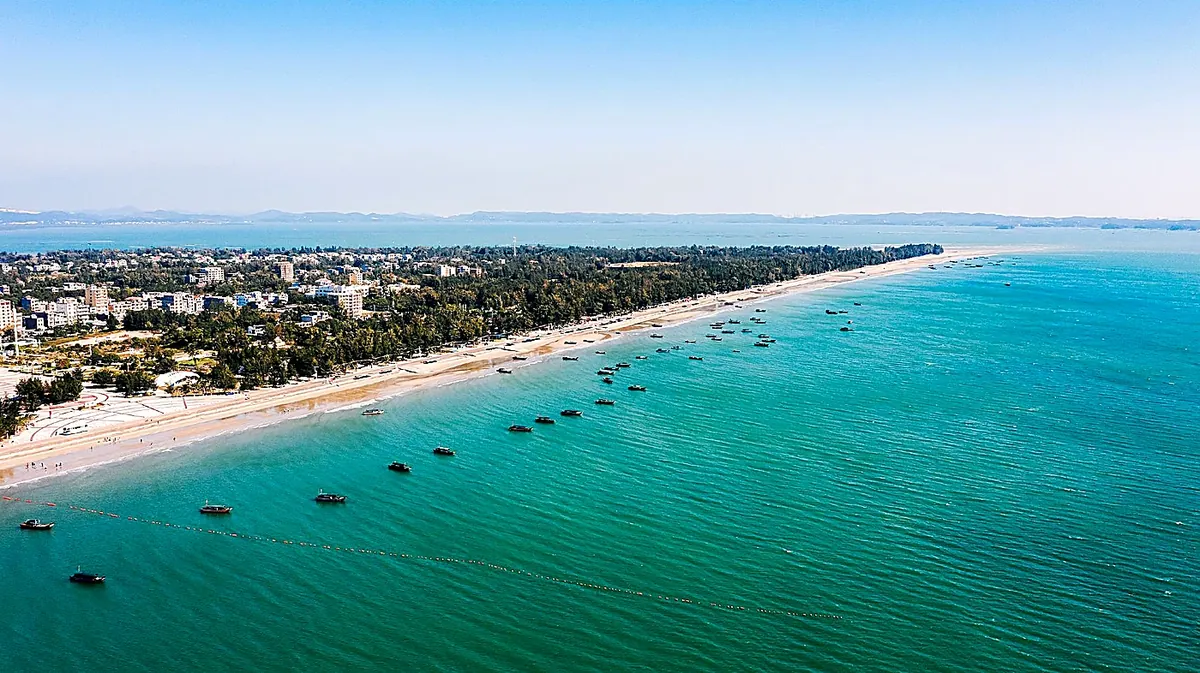
Getting from the Dongxing border area to Wanwei is straightforward along upgraded coastal roads. Heading toward the shore, urban high-rises give way to neat aquaculture ponds, shrimp farms, and wind-bent coconut palms, bringing travelers to the beach in under forty minutes by tour coach, local bus, or private car.
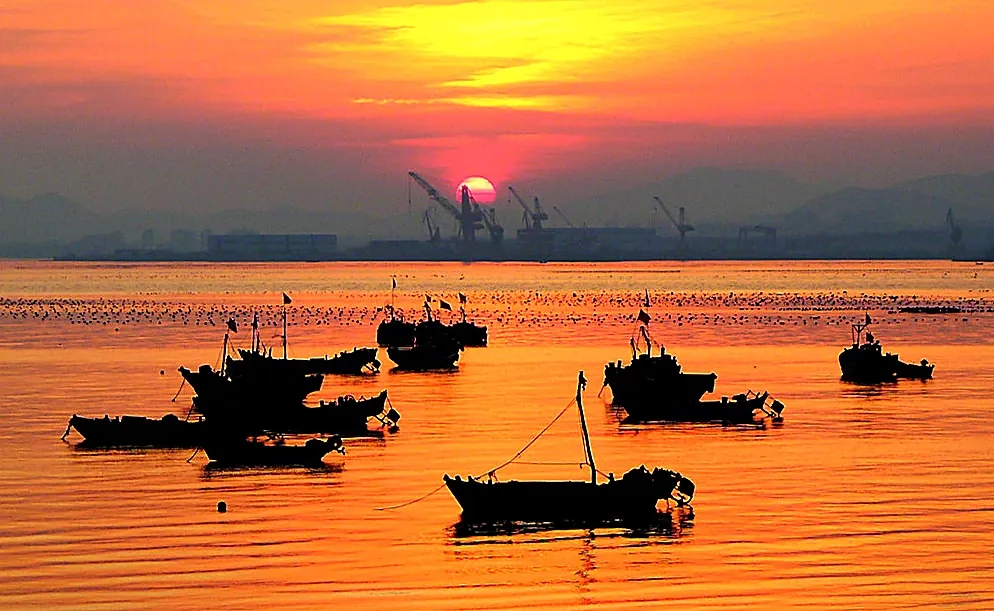
One of Wanwei Beach’s most distinctive living sights is traditional stilt fishing (*cau ca tren ca kheo*). Because Jinshan’s tidal flats feature shifting sandbars and channels, Kinh fishermen long used tall bamboo stilts strapped to their legs to wade farther out into moving currents. Balanced on stilts with a wide hand net, fishermen sweep through shifting water to catch small fish and shrimp—a striking silhouette against sunset skies that has long inspired photographers from afar.
Wanwei’s coastal kitchen blends fresh seafood with Cantonese and Guangxi seasonings. Visitors savor steamed blue swimming crabs fresh from local boats, grilled sweet snails topped with scallion oil, and crisp fried cuttlefish highlighting ocean sweetness. Kinh households also preserve traditional fish sauce fermented from fresh anchovies, pairing rich umami with sour bamboo-shoot fish soup and hand-pounded squid patties for comforting coastal meals.
To round out a coastal outing around Dongxing, pairing Wanwei Beach with nearby Zhushan Ancient Village adds a meaningful landmark stop. Located at the southwestern end of mainland China’s coastal highway where land meets sea, Zhushan features the coastal “Zero Kilometer” marker, border monuments looking toward Mong Cai, shaded banyan trees, and the historic Wanxiang Pagoda—highlighting centuries of cross-border geography and history.
The most pleasant time to enjoy Wanwei is during dry months when clear skies and warm sunlight fall across Jinshan sands cooled by Gulf of Tonkin breezes. Sunrise paints the water rose-gold as fishermen return with morning catches, while sunset casts violet and amber hues across the horizon for memorable seaside walks and photos.
For a smooth visit, ensure your border pass or travel documents are valid, follow border-zone rules carefully, keep mobile payment apps or local currency handy for small fishing-village stalls, and show quiet respect inside communal halls and museums. Joining an in-depth Dongxing tour with experienced guides helps bring out the stories behind every lane and landmark.
Leaving Wanwei Beach, visitors carry away more than golden sand and fresh seafood—they take with them the enduring spirit of a coastal Kinh community whose *dan bau* notes and communal traditions still echo beside the sea, making Wanwei a memorable bridge of memory and heritage along the Gulf of Tonkin.