Amidst the floating clouds of the Qinghai-Tibet Plateau—known as the “roof of the world”—Tibetan Esoteric Buddhism (also called Vajrayana – Diamond Vehicle) shines as one of the most mysterious and solemn jewels in the history of human thought. More than just a religion, Tibetan Esoteric Buddhism is a magnificent crystallization of profound Mahayana Buddhist philosophy, ancient Indian esoteric meditation practices, and the sacred indigenous Bon religion of the Tibetan people. Every turn of the bell, every revolution of the Prayer Wheel, or every fluttering Lungta prayer flag in the snowy wind holds profound spiritual layers of meaning, lifting humans beyond ignorance to touch ultimate enlightenment.
1. Historical Origins & The Formation of Vajrayana (Diamond Vehicle)
The historical current of Tibetan Buddhism originated in the 7th century CE, during the reign of the great king Songtsen Gampo—who united the tribes on the snowy plateau and established the powerful Tibetan Empire (Tubo). To expand his borders and absorb the light of civilization, the king married two devout Buddhist princesses: Princess Wencheng of the Tang Dynasty (China) and Princess Bhrikuti of Nepal. These two princesses brought exquisite statues of Gautama Buddha and a treasure trove of scriptures, sowing the first seeds of the righteous dharma upon this barren land.
By the 8th century, King Trisong Detsen invited the great master Shantaraksita and notably Guru Rinpoche / Padmasambhava—the renowned esoteric master from Nalanda University (India)—to propagate the teachings. With boundless supernatural power and wisdom, Guru Rinpoche subdued the indigenous divine forces of the Bon religion, turning them into protective deities (Dharmapala) guarding the dharma, while laying the foundation to build Samye Monastery—the first complete Buddhist monastery in Tibet. From then on, Vajrayana officially became the state religion, shaping the immortal spiritual identity of all snow mountain residents.
2. The Four Major Sects of Tibetan Esoteric Buddhism
Through thousands of years of development and reform, Tibetan Esoteric Buddhism has formed 4 major traditional sects, each possessing a uniquely distinct lineage and practice system:
Nyingma Sect (Ancient Translation / Red Hat Sect): The oldest lineage founded by Guru Rinpoche himself. This sect is famous for its Dzogchen (Great Perfection) teachings—a direct-pointing practice to the true mind, helping practitioners realize the pristine, pure nature of their own mind in an instant. Nyingma masters often preserve terma treasures hidden deep within earth, rock walls, or consciousness to transmit to future generations.
Kagyu Sect (White Robe Sect): Originating from the great Indian masters Tilopa and Naropa, and propagated into Tibet by the great translator Marpa and the saint-poet Milarepa. This sect places special emphasis on pure ascetic practice, alongside the Mahamudra (Great Seal) and the Six Yogas of Naropa.
Sakya Sect (Variegated Earth Sect): Founded by the Khon family in the 11th century with its core teaching being Lamdre (Path and Fruit). The Sakya sect once held supreme political and religious power across Tibet during the Yuan Dynasty of Kublai Khan.
Gelugpa Sect (Yellow Hat Sect): Founded by the great religious reformer Je Tsongkhapa in the early 15th century. Finding contemporary monastic discipline somewhat lax, he rigorously revived pure discipline, emphasizing thorough study of scriptures combined with esoteric meditation. This is the sect of the Dalai Lamas and Panchen Lamas, as well as the core practice system in famous grand monasteries such as Potala, Jokhang, Drepung, Sera, and Songzanlin Monastery (Shangri-La).
3. The Dalai Lama Institution & The Majesty of the Yellow Hat Sect
The title Dalai Lama is a miraculous combination of the Mongolian word “Dalai” (meaning Ocean / Vast Sea) and the Tibetan word “Lama” (meaning Noble Spiritual Master). Tibetan people revere the Dalai Lama as the flesh-and-blood reincarnation embodiment of Avalokiteshvara Bodhisattva (Chenrezig)—the Bodhisattva symbolizing boundless compassion directed toward all sentient beings.
One of the most mysterious and sacred features of Tibetan Buddhism is the Tulku (Reincarnation System). When a Dalai Lama passes away, senior elder monks rely on auspicious omens, cloud wind directions, sacred testamentary words, and water surface reflections at the sacred lake Lhamo La-tso to search for the newborn child who is the reincarnate embodiment. The child must pass extremely rigorous testing trials, such as accurately identifying personal relics (rosary beads, diamond bell, alms bowl) of their past life before being solemnly enthroned and crowned.
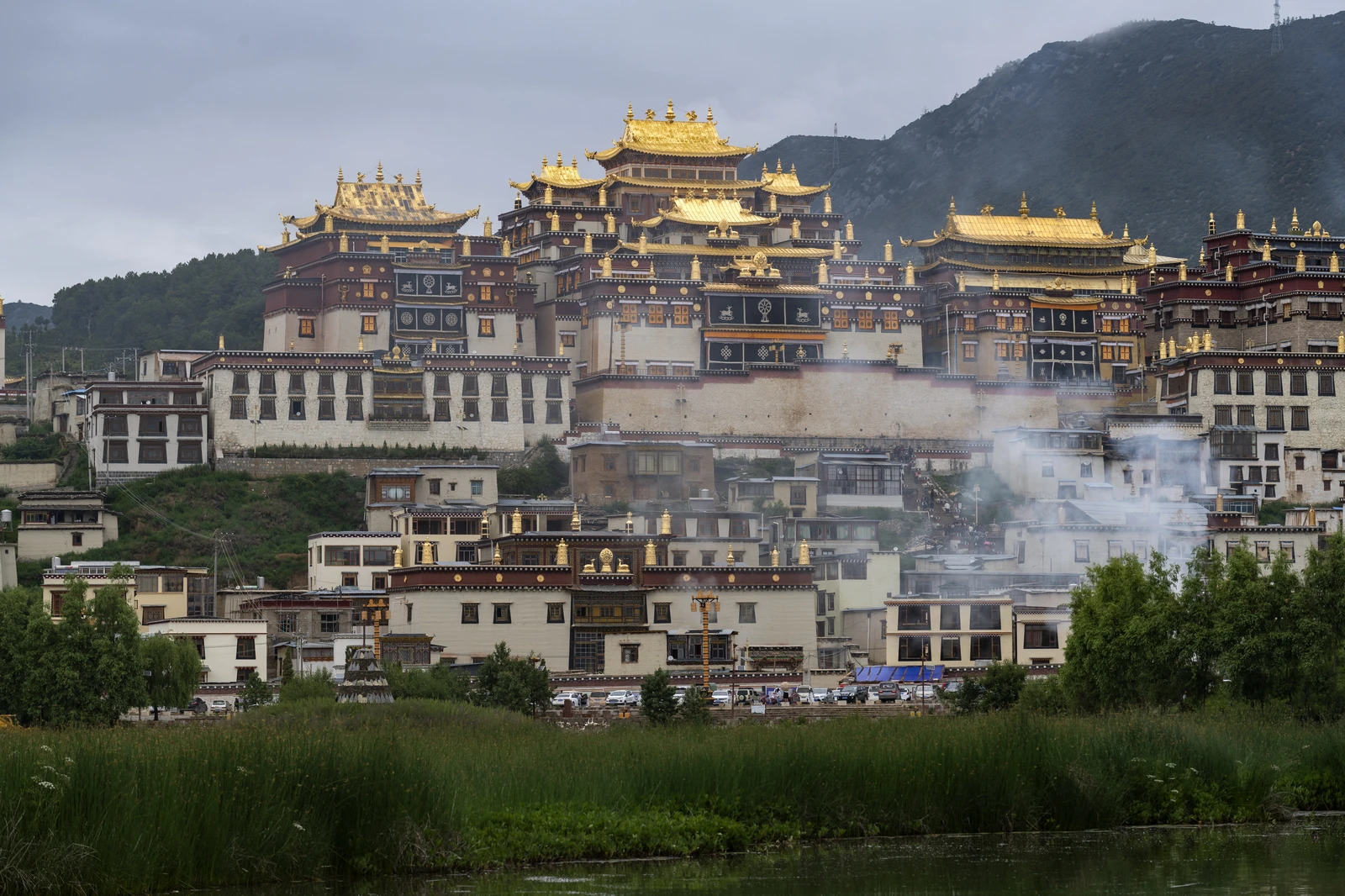
In the 17th century, the 5th Dalai Lama (Ngawang Lobsang Gyatso)—who built the majestic Potala Palace in Lhasa—ordered the construction of Songzanlin Monastery (Songtsen Ling) on the Zhongdian Plateau (now Shangri-La, Yunnan). He personally bestowed the sacred name Gandenh Sumtseling Gompa and enshrined gold-plated statues of Gautama Buddha, turning this place into the most massively scaled Yellow Hat Esoteric holy site in southwestern China.
4. The Mysterious Spiritual Symbols of Vajrayana
Stepping into the space of Esoteric Buddhism, visitors will be overwhelmed by a system of religious symbols carrying layers upon layers of profound philosophy:
4.1. Mani Wheels (Prayer Wheels) & The Six-Syllable Great Bright Mantra
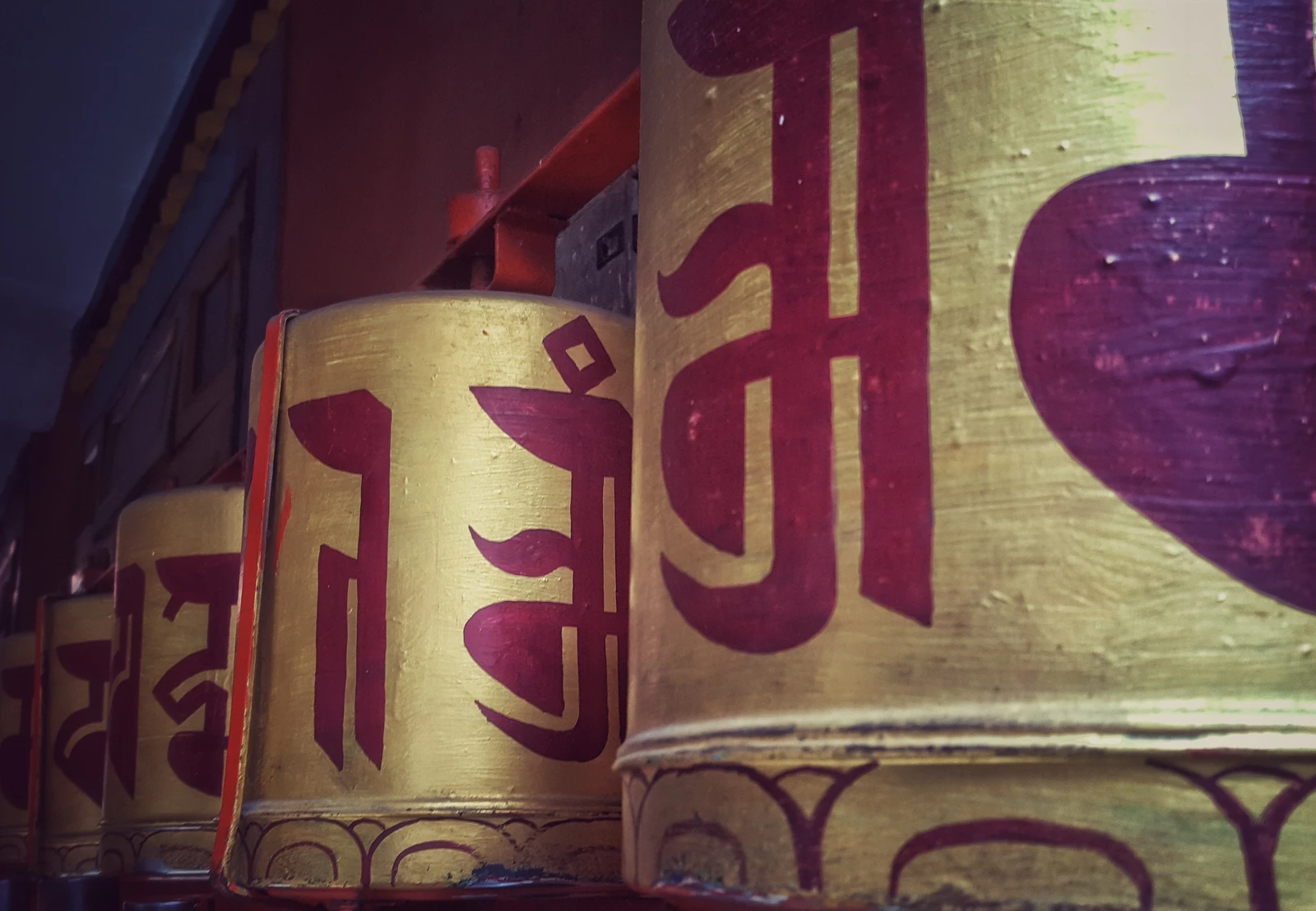
Walking along monastery corridors or in the hands of every Tibetan person, one constantly encounters copper or gold-plated prayer wheels spinning ceaselessly. These are Mani Wheels (Prayer Wheels). Inside the hollow cylinder of each Prayer Wheel are thousands and millions of thin paper rolls printed with the sacred six-syllable mantra: “Om Mani Padme Hum” (Om Ma Ni Padme Hum – the quintessential heritage residing in the lotus).
Tibetan people believe that every rotation of the Prayer Wheel clockwise is equivalent to chanting millions of prayer mantras, helping purify the evil karma of body, speech, and mind, banishing the darkness of ignorance, and radiating unconditional peaceful energy to all sentient beings in the six realms of samsara.
4.2. Thangka Scroll Paintings – The Pinnacle of Natural Mineral Pigment Art
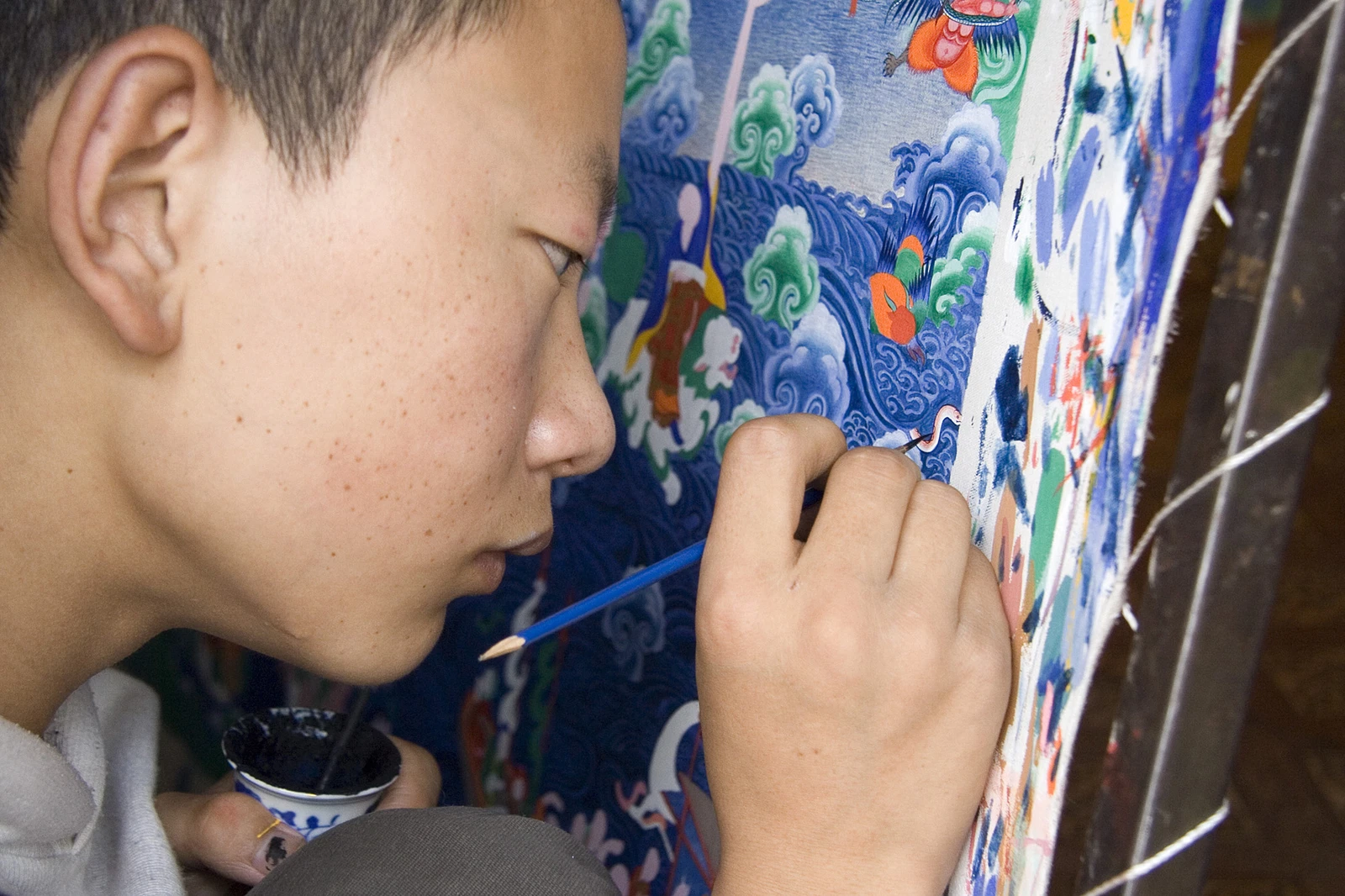
Thangka is a unique religious scroll painting of Tibetan culture, painted or embroidered on precious brocade silk. The special feature that makes Thangka paintings endure indestructibly across centuries is the material of the pigments: entirely made from finely crushed natural minerals such as pure gold, jade, lapis lazuli, malachite, and red coral combined with herbal tree resins.
Each Thangka is not merely an art masterpiece but also a visual diagram serving meditation contemplation, accurately depicting down to the millimeter the facial proportions of Buddhas, Bodhisattvas, cosmic Mandalas, and solemn Dharmapalas.
4.3. Lungta Wind Horse Prayer Flags – Prayers for Peace Fluttering in the Wind
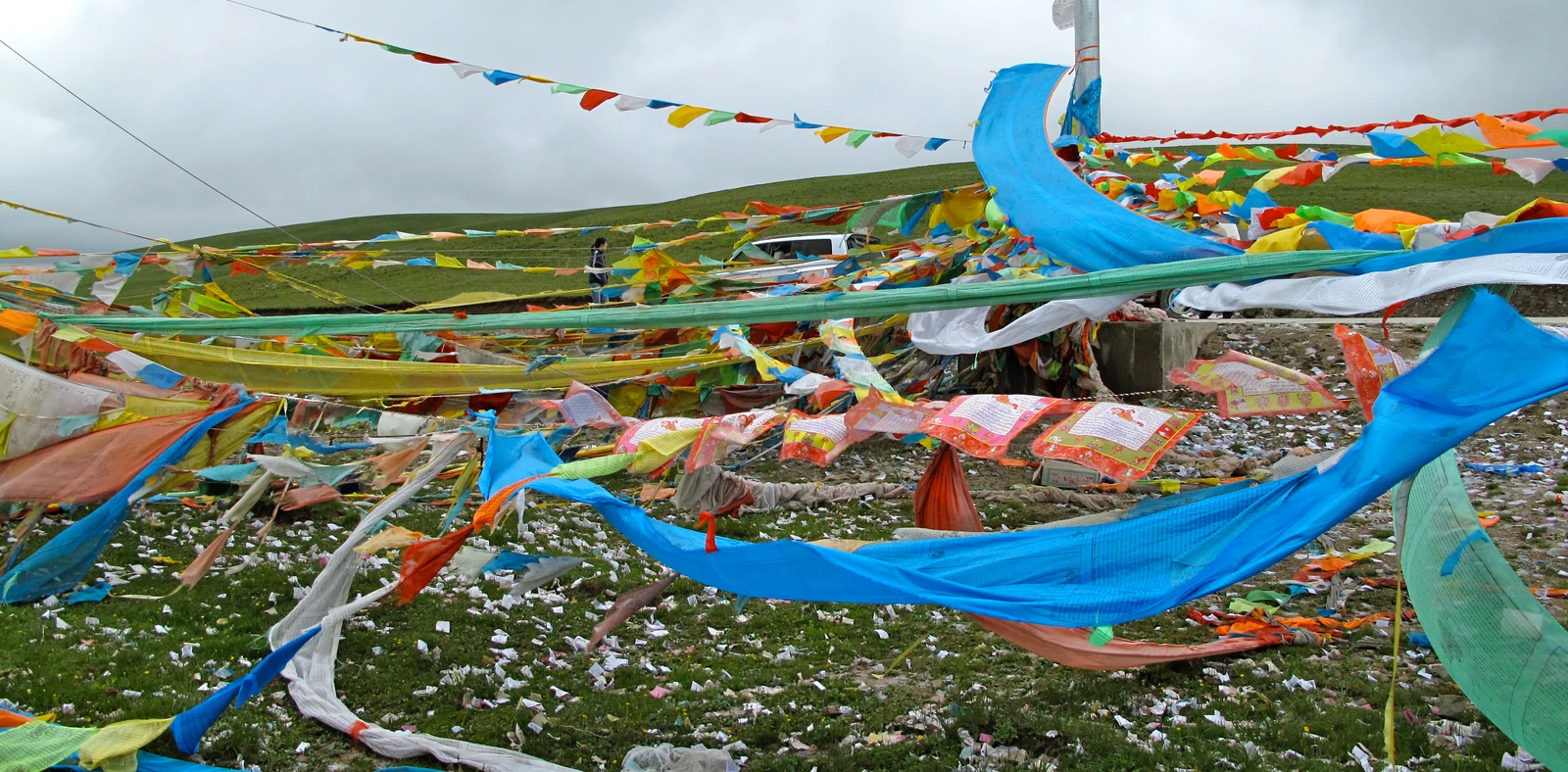
Across snow-covered mountain passes, suspension bridges over gorges, or on the rooftops of Tibetans, vibrant strings of five-colored cloth flags are strung continuously. These are Lungta Flags (meaning Wind Horse), symbolizing resilient vitality and good luck. The five colors of the flags represent the five elements and the five components constituting the universe:
Blue: Symbolizes the vast Sky and Space.
White: Symbolizes White Clouds and clean Wind.
Red: Symbolizes Fire and warm Light.
Green: Symbolizes Water and everlasting Life.
Yellow: Symbolizes Mother Earth sustaining all things.
Printed on the flag surface are images of a horse biting a wish-fulfilling jewel along with countless esoteric mantras. Whenever a plateau breeze blows, making the flag ripple, Tibetans believe the wind is reading millions of blessings on behalf of humanity, spreading peace and auspiciousness across the world.
4.4. Sand Mandala – A Profound Lesson on Impermanence
One of the Vajrayana rituals that leaves the entire Western world in awe is the ritual of constructing a Sand Mandala. Dozens of monks must use tiny metal funnels, meticulously sprinkling each grain of brilliantly mineral-dyed sand continuously for many weeks to create a breathtakingly symmetrical cosmic diagram.
Yet, immediately after the masterpiece is completed during the sacred festival, the presiding master uses a broom to sweep away the entire sand artwork in an instant, gathering it into a vase and pouring it into a flowing river heading out to the great sea. That action is the most heart-stirring reminder of Buddhism: All worldly phenomena are Impermanent (Anicca), no matter how beautiful or magnificent, one cannot cling to attachments.
5. The Ritual of “Three Steps, One Bow” – The Indomitable Power of Tibetan Faith
The most deeply moving image for any traveler setting foot in the land of Esoteric Buddhism is pilgrims performing the ritual of “Three Steps, One Bow – Prostration to the Earth” (Taking three steps, placing hands clasped above the head, then lying prostrate flat on the gravel road). Their hands wear protective wooden blocks, knees wrapped in calloused animal hide, and foreheads marked with bruised calluses from touching the ground millions of times across hundreds or even thousands of kilometers crossing cold snowy passes heading toward the holy site of Lhasa or the sacred Mt. Kailash.
They do not bow to pray for personal fame or wealth; the prayer in every rhythmic full-body prostration is always: “May all sentient beings be free from suffering, may the world be at peace, and may all creatures soon realize peace and joy.” That is the highest symbol of Bodhicitta in Esoteric Buddhism.
6. Connecting Tibetan Esoteric Buddhism in the Yunnan Tour (Shangri-La) Journey
In the journey exploring the golden route Dali – Shaxi – Shangri-La – Lijiang – Kunming with VDSTravel, visitors will have the golden opportunity to directly touch the living roots of Tibetan Esoteric culture:
Pay homage at Songzanlin Monastery – admire the magnificent 8-meter-tall gold-plated statue of Gautama Buddha, gaze at the shimmering gold-plated domes under the plateau sunshine, and listen to the resonant chanting echoing across the valley.
Explore Dukezong Moonlit Ancient City – home to the 21-meter-tall giant gold-plated Prayer Wheel weighing 60 tons; and join dozens of visitors in spinning the giant wheel of dharma to pray for family peace.
Savor unique Tibetan plateau cuisine featuring a steaming pot of Yak Beef Hotpot, sipping fragrant creamy Butter Tea (Po Cha) that helps warm the body and dispel fatigue amidst the thin highland air.
Tips When Visiting Tibetan Esoteric Holy Sites:
• Attire: Dress modestly and politely (long pants, sleeved shirts), strictly avoiding short skirts, sleeveless shirts, hats, or sunglasses when entering inside the monastery’s main hall.
• Direction of Movement: Always walk, tour, and spin Prayer Wheels in a clockwise direction (the direction of sunrise) to show respect for the dharma.
• Photography: Do not photograph or film monks while they are performing meditation rituals or take close-ups of secret Buddha statues inside the main hall without permission from the monastery management.